INTRODUCTION
There is a rising consensus among environmental scientists that one effective method of mitigating the increasing carbon load in the atmosphere is through the enhancement of soil carbon (or organic matter) accretion (Lal et al. Reference Lal, Kimble, Follet and Cole1998). Many studies provide evidence that the soil provides a safe store for carbon in the long term when annual additions of biomass are made to the soil and soil organic matter is properly managed. Apart from the goal of reducing atmospheric CO2, increased soil carbon is also beneficial to tropical agriculture because organic matter is a repository for nutrients such as N, P, K and S (Bandaranayake et al. Reference Bandaranayake, Qian, Parton, Ojima and Follet2003). Not only are these nutrients released during organic matter decomposition but also the decomposition products enhance the cation exchange capacity (Wright & Foss Reference Wright and Foss1972) and the structure (Skjemstad et al. Reference Skjemstad, Janik and Taylor1998), especially of soils in the tropics that usually have low permanent charges. Although the decomposition process is accompanied by CO2 release, it is conceivable that practices that enhance the accumulation of soil carbon will also ensure sustained maintenance of soil productivity. Thus, soil carbon sequestration is not only of global significance, but is also of great benefit to agriculture.
Taking this into consideration, tropical agricultural systems need to be re-evaluated given that most current practices, such as bush burning and deforestation, not only reduce residue contribution to increased soil carbon sequestration (Yang & Wander Reference Yang and Wander1999) but also lead to a decline in soil productivity. It is also worth noting that despite the large quantities of residue incorporated into the soil under conventional tillage (CT) practices, the soil organic carbon (SOC) of tropical soils continues to be low, suggesting a rapid loss and ineffectiveness of CT in enhancing the SOC. In contrast, some practices such as conservation agriculture, which entails minimal soil disturbance and permanent soil cover combined with rotations, has been proposed as a more sustainable cultivation system (Hobbs Reference Hobbs2007). Indeed, crop rotation with manure application (Covaleda et al. Reference Covaleda, Pajares, Gallardo and Etchevers2006), no-tillage (Chivenge et al. Reference Chivenge, Murwira, Giller, Mapfumo and Six2007) and agro-forestry (Nair Reference Nair1984) has been found to increase residue input and soil carbon. However, the contribution of these methods to sustaining crop yields and economic returns to farmers' investments of land and labour must be further investigated. Proposed practices must meet the dual goals of increased crop yields and enhanced soil carbon accretion. The adoption of agro-forestry technology has often been hampered by land tenure problems and the fairly long waiting periods for tree establishment. No-till methods that involve the use of chemicals to kill fallow plants have cost implications for farmers and are still at experimental testing stages in Ghana. In light of this, alternative residue production and management technologies that would meet the dual goals and are feasible within the operations of farmers must be developed. The hypothesis of the present paper is that in regions where the rainfall distribution favours two growing seasons in a year, the main season could be used to support crop production while the minor season could be used to support in situ residue production, avoiding the need to transport off-farm biomass to the farm. The combination of the short-cycle in situ residue production with crop rotation and simple residue management practices could be an effective alternative to the current practices of bush burning and CT and could meet the dual goals of soil carbon sequestration and increased crop yields in the tropics. To test this hypothesis, the present study evaluated the effects of seven maize–fallow rotation and residue management treatments on maize growth, yield and soil carbon changes within a savannah-forest farming zone of Ghana.
MATERIALS AND METHODS
Site description
The present study was carried out between 2003 and 2006 at the experimental site of the Ministry of Food and Agriculture in Kpeve, Volta Region (6°43·15′N, 000°20·45′E, 41 m asl), situated within the south-eastern savannah-forest transition ecological zone of Ghana. The annual rainfall of about 1200 mm is distributed between two seasons. The period from May to July (major season) receives about 0·66 of the rain, and the remaining 0·34 falls from September to November (minor season). Occasionally, rainfall occurs between December and March, in which case it is considered to be part of the minor season.
The selected field was previously fallowed for over 2 years and carried vegetation that was largely composed of elephant grass (Pennisetum purpureum). The soil, sandy clay loam, had abundant coarse fraction below the depth of 0·50 m and was classified as Haplic Lixisol. Soils were sampled in March 2003 and at the end of the trial in 2006 for determination of SOC as well as available P and exchangeable K. The SOC was determined following the Walkley & Black (Reference Walkley and Black1934) procedure and the available P was determined using the Bray 1 method (Bray & Kurz Reference Bray and Kurz1945). For the determination of exchangeable K, soil samples were extracted with 1 M NH4Cl solution and the K in the supernatant was measured using a flame emission photometer (FEP). A HOBO weather station was installed at the site in June 2003 in order to record the daily rainfall.
Establishment of maize–fallow rotations
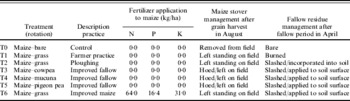
A field plot measuring 50×80 m was demarcated in April 2003 to accommodate seven maize–fallow rotations (Table 1). The rotations were planned such that maize was planted during the major seasons (April/May to July/August) and fallow plants for residue production grew in the minor season (September to March). Treatment T0 (control) comprised a maize–bare fallow rotation treatment with complete removal of the maize stover after grain harvest and keeping the plots bare during the fallow period. Treatment T1 represented the farmer's practice and comprised maize–grass rotation with burning of the grass residue at the end of the fallow period. Treatment T2 was similar to T1 except that the fallow grass residue was incorporated into the soil. Treatments T3–T5 were maize–legume rotations, with improvement of the fallows using cowpea (Vigna unguiculata; T3), mucuna (Mucuna pruriens (syn. Dolichos pruriens); T4) and pigeon pea (Cajanus cajan; T5). Additionally, for all of these treatments, the fallow residue was slashed and applied to the surface of the soil. Treatment T6 involved fertilizer application to the maize rotated with grass fallow. The fallow grass residue was slashed and applied to the soil surface.
Description of maize–fallow treatments

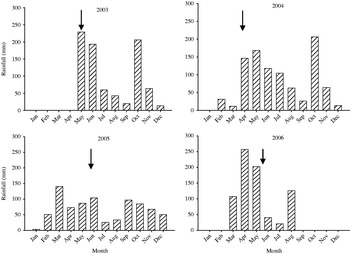
The experimental design was a randomized complete block with four replicates and a plot size of 10×10 m. The trials spanned a period of 4 years (2003–2006), within which time four maize sowings and three fallow cycles were realized. Maize (variety Obatanpa) was planted on 6 May 2003, 28 April 2004, 4 May 2005 and 23 May 2006. The within-row and between-row spacing was 0·4 and 0·8 m, respectively. Four seeds were sown per hill and later thinned to two at 14 days after planting (DAP). For the first maize sowing in 2003, treatments T0–T5 were the same relative to the prior fallow period and crop management, but T6 maize differed in that the maize received fertilizer application. In subsequent sowings, however, all treatments differed. Fertilizer was applied to treatment T6 maize at the rate of 37·5 kg N/ha, 16·4 kg P/ha and 31·0 kg K/ha using compound NPK (15–15–15) broadcast at 14 DAP, followed by a top dressing of 26·5 kg N/ha using (NH4)2SO4 at 42 DAP. Fertilizer applications followed the recommendations of the Ghana Grains Development Project (GGDP 1991). Due to a severe initial dry spell at the start of the third sowing in 2005 (Fig. 1), plant emergence was adversely affected, thus necessitating the replanting of up to 0·80 of the T0 maize on 13 May 2005 to avert complete crop failure. The first fertilizer application to T6 maize in 2005 was also delayed to 28 DAP instead of 14 DAP. The fourth maize crop was harvested at maturity in September 2006, and the trial was then terminated.
Rainfall during the 4-year study period. The arrows indicate approximate maize planting times. Trials were terminated after the major season in 2006.

Data were collected on the days of 0·50 tasselling, using five plants per treatment, which were tagged soon after emergence. A final maize harvest from an area of 4·0 m2 was carried out at 84 DAP for each treatment, and the total dry weight and grain weight of the plants were determined by drying at 65°C for 48 h. The grain yield was, therefore, reported on oven dry basis (zero moisture). The harvested plants were not returned to the field.
The elephant grass in treatments T1, T2 and T6, which began as weeds towards the end stages of the previous maize crop, was allowed to continue uninterrupted growth during the fallow period and was killed on 30 March of the following year. Biomass from 4·0 m2 areas was harvested and transported away for dry matter determination. This harvested material was not returned to the field. The remaining fallow grass residues were managed differently in April, i.e. burned (T1), incorporated (T2) or applied to the surface (T6) as indicated in Table 1. Treatment T0 plots were kept bare throughout the entire fallow period by hand weeding.
The remaining fallow treatments, T3, T4 and T5, which were all improved fallows, were planted on 9 September 2003, 16 September 2004 and 29 September 2005 for the first, second and third fallow cycles, respectively. Before planting, weeds and the stover from the previous maize crop were hoed and left on the field plots. Seeds of cowpea, mucuna and pigeon pea were sown using between-row and within-row spacing of 0·60×0·30, 1·0×1·0 and 0·90×0·50 m, respectively. These fallow legumes also grew without any further husbandry and were killed on 30 March of the following year, at which time biomass was harvested from a 4·0 m2 area of each plot for dry weight determination. The remaining fallow residues were slashed and applied to the surface of the plots.
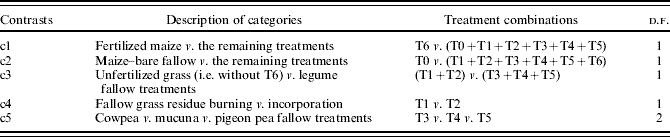
Orthogonal contrasts were used to compare the effects of different treatment categories (Table 2) on maize development, growth and yield. The first contrast, c1, was the comparison between the fertilized maize–bush fallow rotation (T6) and the remaining treatments (T0–T5). The second contrast, c2, was between the maize–bare fallow rotation (T0) and the remaining treatments, while the third contrast, c3, compared the grass (T1 and T2) with the legume (T3–T5) fallow treatments. The fourth contrast, c4, compared grass fallow residue burning (T1) with incorporation (T2) and the last contrast, c5, compared the legume fallow treatments. Since all the treatments in the first year (2003) except T6 were the same relative to their prior fallow treatment and crop management, only the first contrast c1 was tested in 2003. For the statistical analysis, the Generalized Linear Model (GLM) of MINITAB Release 14 (Minitab Inc., 2004) was used. The contrasts were considered significantly different when P<0·05.
Categories for orthogonal contrasts of maize–fallow rotations

d.f., degrees of freedom.
RESULTS
Rainfall patterns during the field trials
Rainfall varied from year to year, especially during 2005 and 2006 (Fig. 1). For the first two maize sowings (May–August in 2003 and 2004), the seasonal rainfall was 460 and 453 mm, respectively, and could be considered as fairly adequate given that the long-term average major season rainfall was 700 mm. The third maize sowing (2005) was driest and received only 203 mm, and the fourth maize season (2006) was the wettest with 700 mm. Rainfall amounts during the three fallow cycles were 327, 277 and 600 mm, respectively. Compared with the long-term minor seasonal rainfall of 500 mm, the first two cycles could be considered as fairly dry.
Maize development, growth and yield
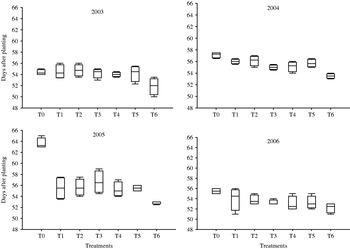
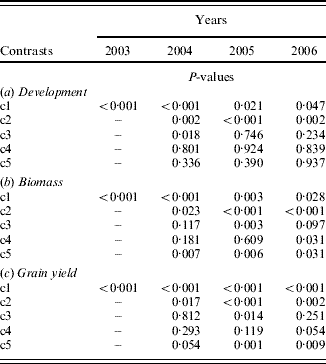
Maize development was affected by the rotations (Fig. 2). Over the 4-year period, the fertilized maize–grass rotation (T6) showed a significantly (P<0·047) faster development than all the other treatments (Table 3a, contrast c1), reaching 0·50 tasselling at about 52 DAP. Treatment T0 also led to a significant delay (P<0·002) in reaching 0·50 tasselling than the remaining treatments (Table 3, contrast c2). The other contrasts were generally not significant except for c3 in year 2004, when maize development under the legume fallow treatments (T3+T4+T5) was significantly faster than under the grass fallows (T1+T2). The year-to-year differences in maize development were significant for the maize–bare fallow, T0 (P<0·001), maize–cowpea, T3 (P<0·05) and maize–pigeon pea, T5 (P<0·05) rotations.
Boxplot showing the average and quartiles of the days to 50% tasselling in maize for the various treatments and years.

P-values for treatment contrasts for maize development, growth and yield

See Table 2 for explanation of contrasts.
A mulch effect on the establishment of maize was evident during the low rainfall maize season of 2005. Using maize height at 21 DAP as a surrogate for establishment, it was observed that the maize under mulched treatments (e.g. T4, T5 and T6) reached 0·4 m, which was significantly taller (P<0·05) than that under residue burning (T1) or incorporation (T2) treatments (0·3 m).
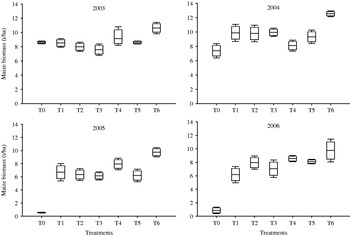
Maize biomass growth varied significantly with treatment (Fig. 3). The contrasts (Table 3b) showed that in all the years, the fertilized-maize–bush fallow rotation (T6) produced significantly (P<0·05) higher biomass than the remaining treatments (c1), whereas the biomass production by maize–bare fallow rotation (T0) was significantly lower (P<0·05) than the remaining treatments (c2). The comparison between the grass (T1+T2) and legume (T3+T4+T5) fallow effects on maize biomass indicated a superiority of the grass fallows in 2005 (c3). Further, the effect of grass residue incorporation on maize biomass was only significantly better (P<0·05) than burning in year 2006 (c4). Significant differences in maize biomass accumulation were observed in the years 2004–2006 for the legume fallows (c5), with cowpea (T3) fallow effect appearing to be better in 2004, whereas the mucuna fallow effect was better in 2005 and 2006 (Fig. 3). The analysis of the data showed that the year-to-year differences in maize biomass were significant (P<0·001) for all the treatments.
Boxplot showing the average and quartiles of maize biomass accumulation for the various treatments and years.

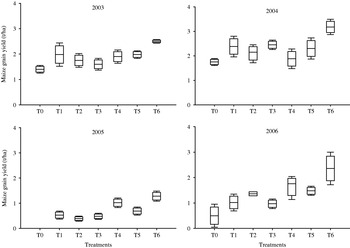
The patterns of maize yield generally followed those observed for biomass accumulation (Fig. 4). The contrast c1 (Table 3c) showed the significant superiority (P<0·001) of the fertilized maize–grass rotation (T6) over the remaining treatments in all the years. On the contrary, maize yield under the maize–bare fallow rotation (T0) was significantly lower than the remaining treatments (c2). The effect of the legume fallows on maize yield (T3+T4+T5) was only superior to that of grass fallow (T1+T2) in year 2005 (c3) and there was no significant difference between grass residue burning and incorporation (c4). The between-legume fallow differences were significant in the years 2005 and 2006, with the average maize yield in the order of mucuna fallow>pigeon pea>cowpea fallow. As observed for maize biomass, the year-to-year differences in maize yield were significant (P<0·001) for all the treatments.
Boxplot showing the average and quartiles of maize grain yield for the various treatments and years.

The harvest index (HI), calculated as the ratio of grain weight to the total dry weight, varied from year to year, ranging from 0·14 to 020 (not shown) for all the treatments during the first 2 years when rainfall was adequate. In 2005, when the maize seasonal rainfall was low, the HI also decreased, and ranged from 0·00 (T0) to 0·12 (T6). In 2006, when the maize season rainfall was adequate (700 mm), the HI for treatment T0 increased to only 0·05, whereas all other treatments had a HI greater than 0·14. Apparently, the soil productivity under treatment T0 had declined to such an extent that maize growth was impaired despite the good rainfall.
When averaged over the 4 years of study, maize in treatment T6 (fertilized maize–grass rotation) produced the highest biomass and yield of 11·0 and 3·0 t/ha/yr, respectively. The lowest biomass production and grain yield of 5·0 and 1·0 t/ha/yr, respectively, were observed for treatment T0. Maize in both T1 (fallow residue burning) and T2 (fallow residue incorporation) produced similar biomasses and grain yields of about 8·0 and 2·0 t/ha/yr, respectively, suggesting that with regard to maize performance, the practice of residue incorporation was not always better than residue burning. Despite the year-to-year differences in the effect of the legume fallows, maize biomass production (8·0 t/ha/yr) and yield (2·0 t/ha/yr) were similar when averaged over the 4 years for treatments T3, T4 and T5, but the variability was higher for the maize–cowpea rotation (T3).
Fallow plant growth and total residue returned to the soil
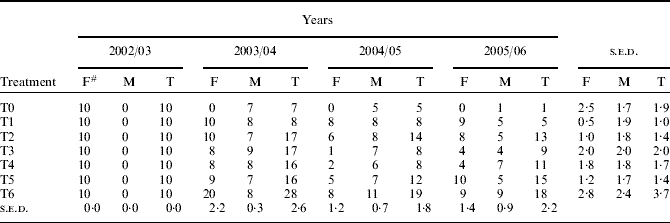
Fallow grass growth under treatments T1, T2 and T6 generally outweighed the growth of the fallow legumes (Table 4). This may be partly attributed to the head start of the fallow grass, starting as weeds during the previous maize growth and accumulating between 2·0 t/ha (T1, T2) and 4·0 t/ha (T6) at the time of fallow legume planting, as well as the more efficient photosynthetic capacity of the C4 grass than the C3 legume plants. Fallow biomass production varied from year to year, with the lowest production observed in 2004/05. However, even though rainfall during the third fallow cycle (September 2005–March 2006) increased to 600 mm, a substantial portion occurred in March 2006, which did not benefit cowpea and mucuna due to their short life cycles. However, pigeon pea (T5) showed re-growth in March 2006, accumulating biomass that was comparable to the fallow grass treatments. Over the 3-year fallow cycle, the fallow grass of treatments T1 and T2 produced an average residue biomass of 9·0 and 8·0 t/ha/yr, respectively, while the T6 grass produced an average of 12·0 t/ha/yr, presumably reflecting a residual benefit from the fertilizer applied to the T6 maize. Among the fallow legumes, pigeon pea (T5), which appeared to be hardier and also had a longer growing cycle, produced a higher average biomass of 8·0 t/ha/yr than mucuna (T4: 5·0 t/ha/yr) and cowpea (T3: 4·0 t/ha/yr).
Fallow biomass production, maize residue and total residue (maize stover+fallow residue) input (t/ha) by the various treatments

F, fallow biomass; M, maize residue; T, total residue input; #, fallow residue estimated for 2002/03.
The total aboveground (maize stover+fallow residue) residue returned to the soil (Table 4) also varied with treatment. The removal of all residues under T0 resulted in practically zero residue input except for the initial addition of an estimated 10 t of elephant grass/ha, which was ploughed in at the onset of the trial in 2003. When averaged over the 4 years, T0 returned about 3 t/ha/yr to the soil. In the case of treatment T1, only the stover of the preceding maize crop was returned to the soil as the fallow residue was burned, and the average residue input was 7 t/ha/yr. Treatment T2 (maize–grass rotation with residue incorporation) returned 14 t/ha/yr, while both the maize–cowpea (T3) and maize–mucuna (T4) rotations returned about 13 t/ha/yr. The average residue input by maize–pigeon pea rotation (T5) averaged 15 t/ha/yr and the highest input of 18 t/ha/yr was by the fertilized maize–grass rotation (T6).
Changes in soil carbon and other soil fertility parameters
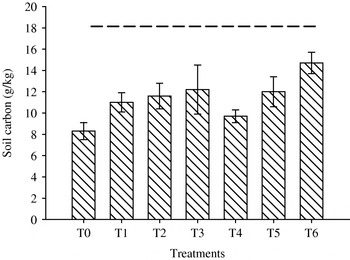
SOC (in the 0–0·2 m layer) at the end of the trial was lower for all treatments than the initial value of 18·1 g/kg (Fig. 5). The maize–bare fallow rotation (T0) lost almost 55% of SOC, while the maize–grass rotations with residue burning (T1) and residue incorporation (T2) maintained SOC near 12·0 g/kg, having lost about 34%. Among the maize–legume rotations, the maize–cowpea treatment (T3) had the highest SOC (12·2 g/kg), followed by the maize–pigeon pea rotation (T5). The fertilized maize–grass rotation (T6) had the highest SOC (14·7 g/kg), losing only 19% by the end of the trial. Using the bulk density value of 1490 kg/m3 determined for the top 0·2 m of the soil, treatments T0 and T6 lost a total of 29·2 and 10·1 t/ha of carbon, respectively, by the end of the trial. The other treatments lost between 18·1 and 26·6 t/ha.
Soil carbon observed for different maize–fallow rotation and residue management treatments at the end of the trial. The horizontal line shows the initial soil carbon.

The available P at the end of the trial decreased in all treatments (except T6). The maize–bare fallow rotation (T0) recorded a decline from an initial value of 11·7 to 5·1 mg/kg, and the maize–grass rotations T1 and T2 recorded final P values of 5·7 and 7·7 mg/kg, respectively. The maize–pigeon pea (T5) rotation recorded 9·0 mg/kg and only the fertilized maize–bush fallow rotation (T6) showed an increase in the final available P value (13·0 mg/kg). In all treatments except T6, the exchangeable K also decreased from an initial value of 0·51 cmol (+)/kg to 0·34 cmol (+)/kg. Only treatment T6 had exchangeable K value of 0·61 cmol (+)/kg at the end of the trial.
DISCUSSION
The observations from the present study indicated that crop rotation and residue management practices can affect maize performance significantly. When fertilizer was applied in T6, maize produced appreciable yield even during the low rainfall season (2005) and generally outyielded all other treatments. A modest fertilizer application is, therefore, necessary for sustained maize production on a long-term basis. However, when no fertilizer was applied to maize, the yield for the maize–legume rotation treatments was no better than that for the maize–grass fallows. Higher yields under maize–legume rotation would have been expected as legumes are known to fix nitrogen, thereby improving the soil nitrogen economy and enhancing the growth of subsequent crops (Cheruiyot et al. Reference Cheruiyot, Mumera, Nakhone and Mwonga2003).
The differences in maize response to the different rotations could also be attributed to the differences in biomass additions to the soil. Increased residue returned to the soil generally led to increased yields, whereas complete residue removal was very detrimental to maize growth and yield. However, the lack of significant difference between maize performance under grass residue burning (T1) and incorporation (T2) suggests that even though larger quantities of residue biomass were returned under T2 than T1, incorporating the residue was ineffective in improving maize yield. This underscores the importance of residue management, in that not only the quantity but also the application method should be considered in designing cropping systems for enhancing crop productivity. Surface-applied residues have a mulch effect that is known to enhance maize establishment under tropical conditions (Lal Reference Lal1974). Physically, mulch intercepted radiation early in the season when the crop leaf area index (LAI) was low and soil temperature reduced, which could result in increased soil moisture storage (Lascano & Baumhardt Reference Lascano and Baumhardt1996).
Another factor that could explain the differences in maize performance is the treatment-related effects on soil fertility parameters. Complete residue removal led to a rapid decline in SOC and maize performance. Detrimental effects of SOC loss on crop productivity have been reported. Lal (Reference Lal2006) indicated that maize yield could decline by 30–300 kg/ha for every 1·0 t/ha decrease in the SOC in the root zone. The rapid decline of SOC of tropical soils has been reported by Brams (Reference Brams1971), who observed a 50% decrease of organic matter within the top 0·2 m in a ferallitic soil of Sierra Leone after 5 years of land clearing and continuous cultivation. Riezebos & Loerts (Reference Riezebos and Loerts1998) observed a 35% reduction in the soil carbon from 24·2 to 15·8 g/kg within the top 0·1 m of a Brazilian soil after 6 years of CT. Assuming a bulk density of 1400 kg/m3, total loss of carbon within the top 0·2 m in the Brazilian soil would be 24 t/ha, which is comparable to the present data for the same soil depth. In general, the SOC loss rates of 2·4 and 0·8 t/ha/yr observed within the top 0·05 m soil depth under treatments T0 and T6, respectively, are comparable to those reported for sub-Saharan African soils (Vågen et al. Reference Vågen, Lal and Singh2005) and these far exceed those observed in temperate regions. Data reviewed by Liebig et al. (Reference Liebig, Morgan, Reeder, Ellert, Gollany and Schuman2005) showed that for many temperate soils, SOC loss rates ranged from 35% (in 15 years) to 52% (in 100 years). In effect, SOC decreases of 50%, which may occur in 100 years in temperate zones, were observed after only 4 years in the present study.
Assuming that the critical value of the available P for maize was between 10 and 16 mg/kg and that for exchangeable K was between 0·6 and 0·8 cmol (+)/kg (Adeoye & Agboola Reference Adeoye and Agboola1985), then the relative better maize performance under treatments such as the maize–pigeon pea (T5) and the fertilized maize–grass (T6) rotations could be attributed to their higher P and K maintenance. In some studies, increased soil P availability under pigeon pea was attributed to the efficient solubilization and uptake of P from bound sources (e.g. Fe–P) by root exudates (Ae et al. Reference Ae, Arihara, Okada, Yoshihara and Johansen1990; Ishikawa et al. Reference Ishikawa, Adu-Gyamfi, Nakamura, Yoshihara, Watanabe and Wagatsuma2002) but this aspect was not investigated in the present study.
In conclusion, it was inferred that in the region where the rainfall distribution favoured two growing seasons, the main season could support maize crop production while the minor season could support in situ residue production, avoiding the need to transport off-farm biomass to the farm. A modest application of fertilizer to maize and rotation with high biomass-producing grass sustained maize yields and maintained the SOC at appreciable levels. In the absence of fertilizer application, the rotation of maize with legumes, especially the woody pigeon pea, could be considered as an alternative cropping system that returned large quantities of residue to the soil, sustained maize growth and minimized soil carbon loss.
This study was made possible through the support provided by the office of Natural Resource Management and the Office of Agriculture in the Economic Growth, Agriculture and Trade Bureau of the U.S. Agency for International Development under the terms of Grant No. LAG-G-00-97-00002-00 and through a collaboration with the Department of Agricultural and Biological Engineering, University of Florida, USA. The authors are grateful for this support. Support by the staff and Management of the Ministry of Agriculture, Kpeve, Ghana, is also acknowledged.