Life insurance companies—mainly British, American, French and Italian—began their international expansion in search of new markets in the countries of the European periphery during the first era of globalization. Footnote 1 The historiography of the creation and expansion of multinationals has considered many factors that encouraged companies to cross borders. Footnote 2 Postulations include, among others, the saturation of the domestic market, the development of economic imperialism, or the entry into foreign markets in order to not lose market share vis-à-vis competitors. Footnote 3 This process benefited from new communication systems and the development of the agency system, which facilitated establishment in foreign markets. Footnote 4 Life insurance multinationals, in particular, expanded as a result of the growth in demand triggered by the increase in per capita income in industrialized countries, the scientific progress that enabled the development of statistical calculation, and the cultural changes that led to the decline of religious influence in society. Footnote 5 In general, when life insurance multinationals established themselves in backward economies, they enjoyed the advantages of offering products that were little known or nonexistent in these markets, such as the new tontines (deferred dividend policies) or reinsurance. This allowed them to rapidly assume leadership in the sector, which subsequently enabled them to expand their activities. Footnote 6 These factors, along with the attraction of a largely unregulated Footnote 7 market with a low tax burden, helped to overcome the obstacles arising from a limited number of clients as a result of continuing low per capita income and slow economic growth. Footnote 8 These advantages, however, do not fully explain why the life insurance multinationals continued doing business in certain countries. It is worth considering other elements to understand how these companies confronted problems such as demographic backwardness and the lack of mortality tables, which reflected the realities of the host country. It is in this field—in the development of actuarial techniques—that some of the keys to explaining the likelihood of foreign companies continuing to operate in certain countries can be found. This is not the only explanatory factor, of course, but the choice of mortality tables applied by companies in each market went beyond a simple technical decision and was part of a business strategy.
This article sets out to address the following questions: Did life insurance companies, especially the multinationals, use actuarial tools to maintain a lucrative business in backward markets at the expense of high premiums that, knowingly, were not based on actual mortality? And if so, was this done as simply one more way of maximizing the return on investments in markets with a limited demand? To achieve this objective, first, the role played by British life insurance companies in Spain from 1880 until the Spanish Civil War (1936–1939) provides a context, by analyzing the moment of their entry, their operations, and market share, and the individual reasons behind their withdrawal from, or permanence in, the market in the 1920s. Second, once the weight of these companies in the Spanish market has been determined, the tardy development of actuarial studies in Spain is examined. These keys to the life insurance industry were, from the outset, based on the use of mortality tables calculated for other countries and adapted to the Spanish situation by the companies concerned. Third, after considering the actuarial situation in the Spanish market, the application of these tables on the basis of estimated mortality is compared with actual mortality. This comparison is based on the information available from an English company, the Gresham Life Assurance Society. Gresham’s own data are contrasted with information from other companies that also operated in the Spanish market. Finally, the article is completed with a series of conclusions intended to contribute to knowledge of the growth strategies of the insurance multinationals.
Multinational Companies and the Life Insurance Market in Spain
Life insurance developed early in Great Britain, which was one of the few countries where this type of insurance policy was not prohibited in the modern period. Different experiments were tried before 1720, although the use of mortality statistics was quite secondary and the business developed around tontines and other policies that covered small disbursements, which were never more than what members had paid in. Footnote 9 In the early eighteenth century, there was a small life insurance market in which mutual societies and privileged companies (Royal Exchange Assurance and London Assurance) coexisted. These latter companies operated in the branch of life insurance as a complement to maritime and fire insurance. Technical and entrepreneurial limitations hindered the growth of the life insurance market during the first half of the century until the foundation of the Equitable Life Assurance Society in 1762, which was the pioneer in the selection, clarification, and scientific assessment of life insurance business. Footnote 10 This technical advantage ensured leadership in this type of insurance for thirty years. The clientele was limited to the nobility, large-scale merchants, and army and navy officers. New companies joined in during the last decade of the century and the first decade of the nineteenth century. The increase in the income of the emerging middle class and the diffusion of the culture of prudence and saving of the Victorian era, along with the continuation of this type of unregulated insurance and its tax deductibility, increased demand and encouraged the appearance of new companies. Footnote 11 Ordinary life insurance was supplemented with popular forms for workers, such as industrial insurance, developed thanks to the growth of real wages, the reduction of premiums, the expansion of public education (which began in 1870), and the actuarial and technical improvements and better advertising of life insurance products. Footnote 12 The maturity of the domestic market, notwithstanding the entry of U.S. companies from 1870 onward, motivated British life insurance companies to expand abroad. The weight of their foreign business, however, was less than that generated by fire and maritime insurance. Footnote 13 According to Pearson, only 10 percent of the premiums of the British life insurance companies came from abroad in 1914, compared with 67 percent of premiums in the fire branch. Footnote 14
During this international expansion, a group of British companies considered Spain to be an attractive market for life insurance operations. In the 1870s, Guardian, Commercial Union, and Northern decided to explore the Spanish market. From 1908, the year in which the first law regulating private insurance in Spain was passed, Gresham, Standard Life Assurance Company, Consolidated Assurance Company Limited, and Norwich Union Life, which chose Spain as part of their process of expansion into new markets, were all active in varying degrees.
The Spanish insurance market, in line with the country’s economy, clearly remained in a state of lethargy until 1869, as a result of the disappearance of the maritime insurance companies after the war of independence against the occupation of Napoleon’s troops (1808–1815) and the loss of the Spanish colonies on the American continent (leaving Cuba, Puerto Rico, and the Philippines as the only major Spanish colonies). The economic stagnation in the first half of the century was accompanied by legislation restricting the creation of stock companies, which gave rise to the development of other forms of partnership, such as mutuals in the fire branch and tontines and societies that imitated Lloyd’s in maritime insurance. Few companies offered scientific life insurance. The traditional tontine societies developed significantly in this branch and grew substantially between 1851 and 1863. Footnote 15 These societies, unlimited companies or mutuals, invested the capital gains from their policies in public debt and were prohibited from making any other kind of investment. Footnote 16 The channeling of these savings almost exclusively into this type of security meant that, when the dramatic fall in debt securities in the Spanish stock exchanges began in 1863, the tontine societies were unable to meet the payment of matured policies and many depositors were unable to recover invested capital.
This event had a great impact on Spanish society to the detriment of the nonscientific life insurance industry, which subsequently had to contend with public distrust. This scenario, along with new legislation on stock companies in 1869 and the country’s incipient economic recovery, facilitated the creation of national insurance companies and, particularly, beginning in 1870, the entry of multinationals that initiated the modernization of the industry. Footnote 17 These companies were thus able to overcome the distrust of the Spanish public caused by the tontine crisis through the diffusion of scientific life insurance. From this year until 1884, eighteen foreign companies (British, French, and American) were officially established in the country and only a dozen companies were created with Spanish capital. The majority of foreign companies that set up in Spain operated in the fire branch and only a few in life insurance. Specifically, three British life insurance companies established themselves in Spain in the 1870s: Guardian (Malaga, 1876), Commercial Union (Barcelona, 1877) and Northern (Malaga, 1877). These, together with the French company Le Monde, which had been authorized in 1864, were among the few companies that operated in life insurance. Competition, however, increased in the following decade when two American companies, New York Life and Equitable Life, installed themselves in Madrid in 1881. These were accompanied by the French companies L’Urbaine (1881) and Le Temps and La Foncière (1883). Footnote 18
The domination of the multinationals in this branch continued over time. In 1911, in the first official statistics for the sector, only seven of the nineteen companies operating in the life business were Spanish. Of the twelve foreign companies, three were from the United States, and there were two Austrian, one Brazilian, three French, and three British firms. There was only one large company among the Spanish insurers: the Banco Vitalicio de España, the result of the merger in 1897 of two Barcelona companies, La Previsión (founded in 1880) and the Banco Vitalicio de Cataluña (1881). Footnote 19 From 1912, the year in which the regulation implementing the insurance law of May 1908 was passed, the official statistics reflect the weight of foreign companies in the life branch, unlike other branches such as fire and accidents, which were initially in the hands of Spanish companies. In 1912, fifteen of the twenty-three companies authorized in the life branch were foreign and accounted for 65.18 percent of premiums. By nationality, the U.S. companies led the branch with 40.04 percent, followed by British firms with 12.5 percent, Austrian with 4.99 percent, French with 4.92 percent, and, finally, the rest of the premiums were distributed in small-scale participation by Brazilian and Italian companies, with 2.25 percent and 0.43 percent, respectively. Footnote 20 The multinationals were to dominate, accounting for more than 50 percent of life business until 1921, when they still collected 56.8 percent of premiums. A gradual reduction had begun, however, in 1919, after the end of World War I. As of that moment, the withdrawal of U.S. and British companies from the Spanish life insurance business started to take place. The market was subsequently occupied by Spanish and French companies and, to a lesser extent, by Brazilian, Italian, Swiss, and German ones. Footnote 21
British insurance companies actually established themselves in Spain early on, in the 1860s, but political instability led them to postpone the development of their activity until the following decade. One of their distinctive features was their location far from Madrid, specifically in Malaga (Andalusia), Barcelona (Catalonia), and Bilbao (the Basque country). Here, they offered their policies against fire to the incipient Malaga, Catalan, and Basque industries and to the British wine export trade, which, in the long term, did not facilitate the sale of life insurance, as the supply of this provision, and a large part of the demand, was concentrated in Madrid. Footnote 22 In fact, after the passage of the law on private insurance in Spain in 1908, new British companies specializing in life insurance started operating in this branch.
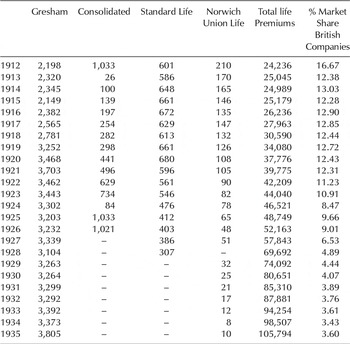
Four British companies sold life insurance policies between 1908 and 1935 (see Table 1). In 1912 they obtained 16 percent of the market share, behind the U.S. companies, which accounted for 40 percent, and the Spanish, with 34 percent. The most important British firm was Gresham, which in 1890 signed an agency contract with Francisco de Paula Fabra, of Barcelona, covering an area comprising Catalonia, Aragon, Navarre, Santander, Valencia, Murcia, and the Balearics. Footnote 23 The agency contract was canceled in March 1893, however, on the orders of the company’s board of directors. Meanwhile, in July 1890, the directors and the London manager of the company granted power of attorney to Guillermo Enrique Dunn and José Alguer as deputy directors of the company’s Malaga office. Some years later, these same agents were granted a new power of attorney, now as directors of the Spain and Portugal office that had been established in Madrid. Footnote 24 The potential market for the life branch and the incipient insurance regulatory bodies were to be found in the capital. The company was subsequently represented by D. and G. Smither during the period from 1912 to 1918, and from 1919 onward by Federico Scott. In September 1937, Gresham’s business in Spain accounted for 10 percent of the company’s entire turnover. Footnote 25 Apart from Gresham, Standard Life Assurance also started operating in Spain in 1908, with its general agency located in Barcelona, as did Consolidated Assurance Limited, based in Malaga, and Norwich Union Life, which first established itself in Barcelona, although its head office in the country moved to Madrid in 1929. Footnote 26 Of the four British companies authorized by the new law of 1908, only Gresham and Norwich continued operating in Spain until the Civil War.
Market share of British companies in the life insurance branch (1912 –1935), pesetas at current prices in thousands

Source: Boletín Oficial de Seguros (1913–1926); Boletín Oficial de la Inspección Mercantil y de Seguros (1927–1928); Revista de Previsión (1929–1934); and Boletín Oficial de Seguros y Ahorro (1934–1936).
A general tendency of the insurance multinationals to reduce their operations abroad and to abandon certain markets was initiated during World War I, and continued into the 1920s, especially due to monetary distortions. Footnote 27 The decision to abandon the Spanish market was taken on the basis of a variety of factors that were accumulating and putting pressure on the companies. One of the most influential factors was the increase in economic nationalism, which, in the case of Spain, led to an increase in the deposits and reserves to be obligatorily invested in Spanish securities and physically deposited in Spain, and the bureaucratic demands that established balances and reserves and required constant information regarding agencies’ operations in the Spanish market. Footnote 28 Along with these general factors, the U.S. companies also suffered the effects of the Armstrong investigation, which obliged them to reduce their activities abroad. Footnote 29 In these circumstances, the board of directors of the U.S. company Equitable Life decided to stop writing new policies in 1916 despite its leading position in the Spanish market, with second place in the rankings and 20 percent of the market share. This decision was followed shortly after by New York Life, which sold its client portfolio to the Spanish company La Equitativa Fundación Rosillo, recently created by the ex-agents of Equitable in 1922. The withdrawal of the U.S. life insurance multinationals from the Spanish market was followed, in the 1920s, by the departure of Consolidated Assurance Company Limited and Standard Life Assurance Company. The withdrawal of Consolidated from the Spanish market was part of a process in which the company abandoned certain markets, transferring its client portfolio to other companies or maintaining its agents merely to manage outstanding policies until their maturity. The decision to leave Spain was taken in 1920, when Consolidated’s agent in Barcelona, Ernest Noble, died. Footnote 30 Nevertheless, the company’s official withdrawal took place in 1926, when the client portfolio was sold to Phoenix of Vienna. Footnote 31 Standard Life Assurance Company, for its part, was established in Barcelona in 1904 and continued in Spain until 1929, the year in which it passed on its client portfolio to the Spanish company La Equitativa-Fundación Rosillo. Footnote 32
The weight of British companies in Spanish life insurance declined as a result of these withdrawals. Until 1923, they had captured more than 10 percent of the market share. However, after their withdrawal, this percentage fell to a mere 3.5 percent of the life insurance market in the 1930s, a figure that corresponded almost exclusively to Gresham’s business. Footnote 33 In an international context of repatriation of capital, the fact that Gresham remained leads us to inquire about what factors convinced its agents and board of directors to carry on doing business in Spain. In the next section we study the possibility that one of these factors was the use of mortality tables, which, over and above the actual criteria of actuarial techniques, would have enabled it to maintain a high level of profits while at the same time compensating the increase in bureaucratic requirements, control, and reserves and deposits.
Mortality Statistics and Actuarial Science: The Case of Spain
As in other peripheral countries, the development of the life insurance market in Spain took place in a context characterized by two elements that helped define company practices: a retarded demographic pattern with respect to its northern neighbors and the slow development of actuarial techniques. During the nineteenth century, the Spanish population underwent an evolution marked by the survival of traits inherited from the demographic cycle of the ancien régime and by the enormous contrasts between different regions. Footnote 34 The fall in the mortality rate occurred more slowly and at a later date than in other Western European countries, delaying the increase in life expectancy and curbing the rate of population growth until the second half of the nineteenth century. Footnote 35 Meanwhile, the culmination of the demographic transition—that is, the steady decline in birth rates—would not take place until the first decades of the twentieth century, almost a century later than in France. Footnote 36 Furthermore, this process coincided with a growth in internal migration flows that widened regional differences, increasing the demographic weight of coastal areas in comparison with inland areas.
In parallel with the dynamics of demographic change, the development of actuarial techniques in Spain, especially the construction of mortality tables, lagged well behind other countries such as Britain, France, or the United States. To find the first British mortality statistics prepared with a rigorous methodology, it is necessary to go back to the late eighteenth century, to the work of Richard Price. Footnote 37 In 1780 through 1783 he published his studies based on the parish registers of births and funerals in the districts of Northampton and Chester. Footnote 38 These were used by Equitable, which modified them on the basis of its business experience. In 1815, the Sun Life Insurance Office adopted the first table adjusted to the characteristics of the insurance market. Footnote 39 During the following decades, other British, French, American, and German life insurance companies followed Sun’s example, constructing their own mortality tables and applying corrections on the basis of their own insurance experience. Footnote 40 These data were used in in subsequent years to develop the different experience tables. Shared by various companies, these served as a technical basis of scientific life insurance in Great Britain, France, Germany, and the United States until well into the 1920s. Footnote 41
While these technical advances based on so-called scientific insurance were taking place in the main continental markets and the English-speaking countries, in the case of Spain there were no initiatives for analyzing population and mortality data until the second half of the century. Footnote 42 The first census of the century was conducted in 1857, and on the basis of this, in 1863, the Junta General de Estadística (General Statistics Board) published the first compendium of mortality data, covering the period 1858 to 1861. This work was subsequently extended until 1870 by the Geographical and Statistical Institute, and was the only compilation of mortality statistics made in Spain before 1900. Footnote 43 The mathematician Vázquez Queipo commented on this situation when, in 1865, he referred to the need to have reliable mortality tables that covered the entire national territory as a matter of the utmost importance for Spanish insurance, pointing out that “mortality tables have not been computed in Spain, and those that best please and benefit each life insurance society are adopted capriciously with serious detriment to the insured.” Footnote 44
With the data from the General Statistics Board, Miguel Merino prepared the first Spanish mortality tables in 1866. Footnote 45 However, the analytical errors of this study and its methodological orientation, which was not focused on actuarial practice, minimized its impact on Spanish life insurance. The scenario described by Vázquez Queipo continued during the following decades, when foreign companies were establishing themselves in the Spanish market. In the period 1880 to 1920, during which the Spanish population started to undergo profound changes in its demographic structure, the use of mortality tables from other countries and adapted to Spain, or based on outdated mortality data, was the norm for both national and foreign companies. Footnote 46 This was affirmed by the directors of the company La Previsión in 1880, who, in view of “the insurmountable difficulties which were inevitably encountered in order to construct an accurate mortality table for our country,” agreed from their first meetings to use the statistics of the French company Crédit Viager, “increasing the premiums by a certain percentage since it can be assumed that mortality is more rapid in our country.” Footnote 47
In 1912, the press took up the issue again with the publication of studies such as that of the Puyol Lalaguna brothers, where they complained that “the application of foreign mortality tables gives rise to the undue premium surcharge and lack of insurance, in some cases, and the evidently insufficient reserves in others.” Footnote 48 This problem was even acknowledged openly in political circles. In 1925, the Under-Secretary of Labor and future Minister of Labor Eduardo Aunós publicly commented on the problems of calculating life insurance and annuities while using “foreign mortality tables that are not adequately adapted to Spanish reality.” Footnote 49 As late as 1927, the statistician and actuary of the Instituto Nacional de Previsión (National Welfare Institute), Mariano Fuentes Martiáñez, gave a detailed description of this problem as one of the impediments of the Spanish insurance market. In view of the lack of mortality tables actually constructed on the basis of Spanish data, he indicated that “both foreign and national companies, even including the National Welfare Institute, use foreign mortality tables.” Footnote 50 This practice did not entail a mere extrapolation, as the census data applied in the tables frequently included the uninsured population—that is, the chronically ill and the lower classes—with the result that the expected death rates included in the tables used by the Spanish and French insurance companies exceeded those calculated by the author for all age groups, except for children under the age of 10 and those over the age of 68. Footnote 51 The tables used by the British and American companies showed similar discrepancies, as did those used by the Germans. Footnote 52 Consequently, Fuentes warned that “the foreign tables described are old, and in these countries mortality has fallen; however, it is noteworthy that, being currently in use in their countries and these being nations of a lower mortality than ours, they have tables whose coefficients are far higher than those we have found.” Footnote 53 Faced with this situation, the Spanish life insurance sector got by with statistics that were not adapted to the market, thus generating higher premiums and nullifying incentives for both competition in the Spanish market and the international expansion of the companies involved, as they had an artificially productive market.
This void with respect to mortality tables was closely linked to the scant progress in the professionalization of actuaries. During the nineteenth century, the actuarial profession in Spain did not have a regulated training scheme and was not sufficiently recognized. As a consequence, “whoever operated in this field did so as enthusiasts coming from other professions, whose common denominator was a basic grounding in mathematics,” and the Spanish actuaries frequently resorted to foreign experts when technical difficulties cropped up. Footnote 54 It was not until 1908, after the passage of the law on private insurance, that the provisional regulation implementing the law included the design of curricula geared toward the technical training of actuaries. Footnote 55 After this first step forward in the training sphere, the process of professionalization of actuaries continued with the institutionalization of a corporate structure. Legislation from 1910 onward followed this direction, giving the National Welfare Institute the responsibility for creating a Corporación de Actuarios Españoles (Corporation of Spanish Actuaries) that would have to accredit the suitability of applicants and would perform the functions of a professional association. Footnote 56 Subsequently, further legislation ended up granting actuaries exclusive functions both in private companies and in public inspection bodies, from signing the statements of mathematical reserves to undertaking work related to a public register of balance sheets. Footnote 57 In spite of this initial progress, it was not until 1915 that a consolidated training plan was introduced, modeled on the experience of the British, French, and Belgian institutes of actuaries. Footnote 58 This curriculum, organized in business schools and leading to certification as an Intendente Mercantil-Sección Actuarial (mercantile intendant actuarial section), included a broad representation of foreign actuaries among the teachers, a fact that led to various conflicts within the profession in the following years. Footnote 59 This situation, along with changes that took place in Spanish insurance during the 1920s, delayed the creation of the first professional association until 1927: the Asociación Actuarial y Matemática Española (Spanish Actuarial and Mathematical Association). In contrast to the Corporation of Actuaries, this served as a link between the professional and academic worlds regarding the field of insurance, while trying to increase the scope of actuarial science. An indication of the continuing shortage of qualified actuaries in Spain was the fact that the association was open to anyone interested in, or an enthusiast of, actuarial matters.
Gresham’s Actuarial Practices in Spain
Beginning in the first half of the nineteenth century, the introduction and spread of the use of mortality tables in England had transformed the methods of calculating life insurance premiums, both for whole life policies and subsequently for a wide range of products that, in most cases, included the participation of policyholders in company profits. Footnote 60 In this process, mortality statistics became the key element in establishing the rates of life insurance companies until well into the twentieth century. The company used the mortality table to estimate, in accordance with the law of large numbers, the average life expectancy for the age group of the person taking out the policy. By combining this probability of death with the sum insured and adjusting the projected time span of the policy in line with interest rate forecasts, the actuary of the company determined the theoretical price of the claim. Finally, by adding the surcharges for management and administration costs, the theoretical premium rate was obtained for each policy. This was used by the company’s management as the basis for setting market rates, combining expected profit with the theoretical rate to obtain the final price of the insurance. Consequently, mortality statistics and expected profit were the fundamental elements of a charging system focused on the supply side, paying little attention to demand. Footnote 61 Specifically in the case of Spain, competitive incentives such as participation in profits and the offer of bonuses, which were basic elements in other markets, hardly affected the final price; common practice consisted in adding a 10 percent surcharge to the standard rate in policies that incorporated the participation of policyholders in profit sharing. Footnote 62
The adoption of one mortality table or another was one of a company’s major strategic decisions, even more so in markets that, like the Spanish one, did not have their own actuarial statistics. In the case of Gresham, from the beginning of its operations in Spain it used the so-called HM Table of the Institute of Actuaries. Published in 1869, it was based on the mortality experience of some twenty insurance companies in the British market during the period 1863 to 1868. Footnote 63 It was introduced into the Spanish market in 1881 and the company continued using it uninterruptedly during the first third of the twentieth century. Indeed, despite the evident time-lag of the HM Table sixty years after its publication, it was only at the beginning of 1937 that its possible substitution with more modern statistics was considered, but the change was finally rejected in view of the negative results. Thus, by the start of the Civil War, the Gresham office was still applying a mortality table in Spain that, even with adjustments and corrections, was based on seventy-year-old English demographic data.
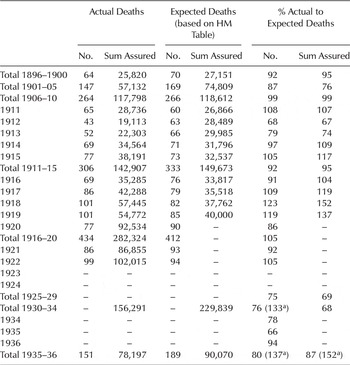
Gresham’s Spanish office used this table to set rates for more than fifty years, thereby generating a large quantity of documentation on its demographic calculations. Table 2 has been compiled on the basis of these data. The table includes data on actual and expected deaths and the percentage ratio between both, both by the number of policies and by the sum insured. In accordance with the charging system used by the company, higher mortality expectations corresponded to higher life insurance premiums. At the same time, more actual deaths corresponded to greater expenditure on the indemnification of claims. Consequently, on analyzing the ratios between actual deaths and expected deaths, values above 100 would entail unexpected losses for the company. Likewise, values below this threshold would be indicators of profit and the lower the value, the greater the profits, owing to having fewer indemnifications of claims to pay and with a rate based on higher expectations of mortality than actual deaths, which, therefore, pushed up the cost of premiums.
Actual and expected deaths of Gresham in Spain and ratios by number of policies and by sum assured, in pesetas at current prices (1896–1936)

a In parentheses, results from applying the A1924–29 Mortality Table based on the mortality experience in Britain during the second half of the 1920s.
Source: London Metropolitan Archive, MS 17917-1, Gresham Life.
Table 2 shows the performance of Gresham’s life insurance client portfolio during the period 1896 to 1936. No data whatsoever on deaths have been found for 1923 and 1924, however. For many of the years in question, only five-year data are available, which, in view of the paucity of elements allowing the distribution within each period to be analyzed, has led to their inclusion as aggregated entries. In terms of the number of active and matured policies, it can be seen how there are only six years out of a sample of forty in which actual deaths exceed expected deaths, entailing extraordinary losses in the portfolio, whereas with respect to the sum insured, this figure rises to seven, taking into account a total of ten years without data.
These indicators rose from the beginning of the twentieth century until they reached a high point in 1911, after which actual deaths dropped below forecasts, then resumed their upward trend in 1914. It was from this year, and at least until 1919, that the greatest deviation in mortality with respect to actuarial calculations took place. Specifically, 1917, 1918, and 1919 were the years of greatest discrepancy when, jointly, there was a deviation from the expected death rate of 12 percent in the number of policies, with a maximum deviation of 23 percent in 1918. With respect to the sum assured, the difference for this three-year period was 23 percent, with a maximum of 52 percent in 1918. These data coincide with the growth, peak, and decline of the epidemic of Spanish influenza that (although in Spain it did not reach the high levels of mortality of other European regions) was especially virulent in the urban population aged between 25 and 55, the main component of the potential demand for insurance. Footnote 64 Hence, and as Gresham’s actuary in Spain had warned earlier, the policies with the largest sums insured were the most affected by the increase in mortality. Footnote 65
As a result of these unexpected losses for the company, premiums for new life insurance contracts were increased immediately, while at the same time a plan to expand operations was implemented. Nevertheless, the total sum insured in Spain in the life branch rose by 12 percent in real terms between 1919 and 1921, whereas the life insurance premiums collected increased by 14 percent in the same period. From then on, the termination of old policies through nonrenewal and the extension of policies subject to the new rates maintained expected deaths above actual deaths, increasing the profitability of business in Spain. However, in view of the five-year data for the period 1925 to 1936, Gresham’s operations were always within the company’s forecasts: Neither the social conflict of the last years of the Primo de Rivera dictatorship and during the Republic, nor the violent episodes after the military uprising of 1936, reached the artificially pessimistic forecasts used by Gresham in Spain. Footnote 66
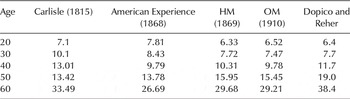
It follows that, especially after the high mortality rate of the three-year period 1917 through 1919, Gresham used excessively conservative forecasts in its life portfolio that were based on outdated statistics, applying rates that, in terms of demographic calculation, were well above the real costs of the product. Footnote 67 Nevertheless, for a company to be able to maintain this practice continuously over a period of time, convergence with the other companies present in the market would have been necessary. In this regard, the different mortality tables used by the leading insurance companies operating in the life branch in 1921 are presented in Table 3. As a means of reference, urban mortality indicators estimated by Dopico and Reher (Reference Dopico and Reher1998) have been introduced, corresponding to the two-year period 1930 to 1931, these being the closest available figures to 1921. Footnote 68
Mortality rate per 1,000 inhabitants according to the tables of life insurance companies operating in Spain and according to Dopico and Reher

Source: Campbell, “Mortality Tables,” p. 426; Dopico and Reher, El declive de la mortalidad, p. 71.
Table 3 indicates companies’ resistance to change despite the age of their statistics; in fact, as the OM table was used only by Standard Life, the rest of the life branch of the insurance sector operated with mortality tables that were more than fifty years old. On analyzing the mortality expectations set for the potentially insurable age groups of the population—that is, between the ages of twenty and sixty—it can be seen that, with respect to the reference of the Dopico and Reher study, the American Experience, HM, and OM tables maintain similar values, with the Carlisle Table showing the greatest discrepancies, probably because it was based on English demographic data that were more than a century old. Furthermore, the tables adopted by the insurance companies were constructed on the basis of insurance experience of earlier times, but took into consideration the distinction between total population and potentially insurable population. On the other hand, the data of Dopico and Reher include the entire population of the provincial capitals regardless of income or the capacity to have access to products such as life insurance. Consequently, the mortality data of the potentially insurable population in Spain must have been substantially lower than the data produced by Dopico and Reher and, thus, lower than the rates used by the life insurance companies. This confirms that the statistics used were deliberately pessimistic in spite of the adjustments made, as the mortality data considered apt for Spain were far higher than the actual death rate. To corroborate this point, Table 4 includes the ratios between actual deaths and expected deaths of a selection of life insurance companies operating in Spain.
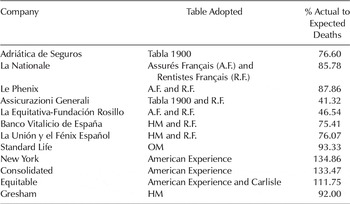
Ratios of actual death to expected death used by life insurance companies operating in Spain, and mortality table used, 1921

Source: London Metropolitan Archive, MS 17917-1; Gresham Life, The Gresham Spanish Branch, Mortality Statements 1916 to 1922.
Table 4 shows the performance of the life insurance portfolios of the leading companies operating in Spain in 1921. As can be seen, the companies that based their operations on the American Experience Table had an actual death rate higher than the expected death rate. This is linked to the lower mortality expectations stipulated by this table for those under the age of sixty at a time when the deaths resulting from the Spanish influenza pandemic continued to directly affect this segment of the population. Footnote 69 This situation, however, did not affect the other companies to the same extent. Especially in the case of those that used the Assurés Français and Rentistes Français tables, of French origin, even the effects of the persistence of the pandemic did not lead actual deaths to equal the expected deaths of these companies. This implies that, in normal conditions, the practice of overestimating mortality and the effects that this had on determining life insurance premiums were not exclusive to Gresham, but rather that they were a general trend in the Spanish market.
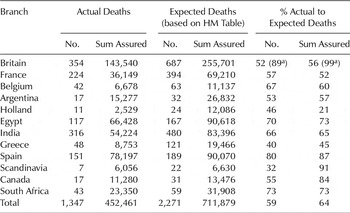
Finally, having seen the practices of national and foreign insurance companies in Spain, this raises the question of whether this was a specific characteristic of the Spanish market or whether, on the contrary, it was a routine feature of operations in peripheral and technically backward countries. Footnote 70 To study the case of Gresham, Table 5 has been compiled, which presents the ratios of actual deaths to expected deaths, in terms of both the number of policies and the sum insured, of the different territorial branches of the company around the world.
Actual and expected deaths of the Gresham in main branches by number of policies and by sum assured, in pesetas at current prices (1935–1936)

a Result according to the A1924–29 Table, adopted for the British branch.
Source: London Metropolitan Archive, MS 17917-1, Gresham Life, Gresham Mortality Experience 1935–1936, Schedule 1.
The first thing to take into account when analyzing Table 5 is that the mortality table used by all branches was the HM, except in the case of Great Britain, where the tables adopted from 1934 onward were the A1924–1929. These tables were much more modern, but as the company’s chief actuary explained, “these tables have no special application to foreign business […] and our foreign premiums allow for a considerably higher rate of Mortality.” Footnote 71 Hence, Gresham used a set of mortality statistics that “probably represents the mortality amongst assured lives about 1850” for all branches except Great Britain, thereby applying the same actuarial fundamentals to markets of completely different structures. Footnote 72 As a result, the relationship between the company’s forecasts and demographic behavior reveals an extremely favorable balance for the portfolio: except in the extreme case of Spain in 1936, the values of the ratio are always below 75 percent. This indicates the common practice of applying artificially high mortality estimates in Gresham branches in certain markets, thus increasing the cost of life insurance as a result of the paucity of actuarial information adjusted to the market. Apart from the preceding quotations, no explicit statements have been found in the company documentation on the intention of this practice. However, the frequency of this strategy is quite clear from contemporary public debates. Footnote 73
The use of the same mortality table in all the markets in which the company operated was also based on the need to reduce costs owing to the scale of its operations. If the company had needed to invest in conducting local actuarial studies to construct individualized tables in each market, its administrative and management costs would have risen. The use of the same tables, adapted, enabled the company to carry on acting as though in a global market, although coming under pressure with more and more obstacles arising from the economic nationalism explained earlier. This practice, however, does not appear to have been an isolated case, but rather was common practice among insurance companies. The explanation as to why they were able to maintain high premiums through the use of mortality tables that had not been updated in line with contemporary demographic behavior was linked to the structure of the life insurance market at this time. In the Spanish case, the industry was an oligopoly in the hands of very few companies. Unlike fire and transport insurance, the life branch was not officially cartelized. Footnote 74 Although companies in Great Britain or Sweden developed collusive institutions to establish entry barriers for competitors, other markets, such as the Australian or Spanish markets, did not need them. Footnote 75 In the Spanish case, the institutional requirements such as deposits as a guarantee of solvency and the restrictions on the investment of reserves acted as a barrier to the establishment of new companies. Hence, there were fewer companies operating in life insurance, which accounted for a much greater average of premiums per company than in the fire branch, for example. In 1912, there were 46 insurance companies registered in the fire branch, which earned an average of 0.7 million pesetas per company. In the life branch, however, there were only 23 authorized insurers, with an average of 1.8 million pesetas. These differences continued into the late 1930s, when there were 80 insurance companies operating in the fire branch, with average premiums of 1.2 million pesetas per company, compared to the 2.6 million pesetas collected on average by the 43 companies operating in the life branch. Footnote 76 The lower degree of competition enabled them to maintain high premiums, especially as there were barriers to entry that favored oligopoly.
Conclusion
Despite the fact that the British life insurance companies concentrated their activity in the domestic market, some of them achieved a significant presence abroad during the first era of globalization in the late nineteenth century. This was the case in the Spanish market, where four British insurers accounted for 16 percent of premiums in this branch in 1912. In a context of change, after World War I and with the emergence of economic nationalism in the sector, some of them abandoned the market, whereas others, such as Gresham, continued doing business thanks to the sustained profitability of their operations.
Noteworthy among the factors that enabled this strategy of continuity was the use of actuarial tools, over and above strictly technical criteria. From the Gresham documentation of mortality statistics in the life branch, it has been seen that the mortality tables used in Spanish life insurance were computed on the basis of outdated data from other countries. This practice was not exclusive to Gresham, but rather, as has been demonstrated, it was the common strategy of both Spanish and foreign companies operating in the Spanish market. Moreover, the data suggest that this strategy was not limited to the case of Spain, but rather that it was general procedure to apply this strategy in offices established in less-developed markets.
The use of these tables that had not been adapted to the demographic reality of the host market had a direct impact on setting the rates for life insurance and, therefore, on the final price. Thus, risks were overestimated and higher premiums were applied. By not having to prepare mortality statistics for each market, management and administration costs were saved and profits were maximized. This mode of operating provided higher mathematical reserves accompanied by a lower mortality ratio. This manner of using actuarial instruments for the purpose of maximizing profits helps explain the continuity of some companies in markets in which, with economic nationalism in full swing, both bureaucratic obstacles and financial and fiscal requirements were increasing.