Introduction
India is one of the 12 mega-biodiversity centres in the world. The country is divided into ten biogeographical regions, where the islands and coast are considered one region. The Andaman and Nicobar group of islands are situated about 1 200 km from mainland India in the Bay of Bengal. They form an arched string of about 572 islands, islets and rocks stretching from Burma in the north to Sumatra in the south between 6° and 14° North latitudes and 92° and 94° East longitudes. They are summits of a submarine range of mountains connecting Arrakkan Yoma of Burma in the north and Pegungan Barrisan of Sumatra in the south enclosing the deep Andaman Sea between this archipelago and Malayan peninsula (Figure 1). Geographically these islands are separated into two groups, i.e. the Andaman group and Nicobar group, separated by a channel at 10°N. The total land area of all these islands amounts to only about 8 249 km2, of which about 86 percent is covered by lush green tropical rain forests. These islands have a typical maritime climate and receive both southwest and northeast monsoons with an average rainfall of 3 100 mm distributed over 8 months (April–November). The natives of these islands represent primitive tribes, of which only the Nicobarese occur in large numbers (27 000) and other tribes include Onge, Jarawa, Sentinelese, Great Andamanese and Shompens. Other than tribes, the major population of the islands includes ex-convicts, settlers from various countries viz. Burma, Bangladesh, Sri Lanka and from various states of India viz. West Bengal, Tamil Nadu, Telangana, Seemandhra and Kerala (Ramakrishna, Ragunathan and Sivaperuman, Reference Ragunathan, Sivaperuman and Ragunathan2010).
Location of Andaman and Nicobar Island and neighbouring countries.

The geological isolation makes this group of islands unique and is endowed with rich floral and faunal biodiversity, which has not yet been fully studied. Efforts are currently underway to carry out inventories of the farm animal genetic resources of the islands. Deterioration of original breeds due to natural disasters, poor documentation and conservation measures, as well as non-systematic breeding has been a major threat to survival of indigenous domestic livestock breeds. Detailed information on their origin, distribution and breed characteristics warrant research.
Among the indigenous livestock germplasm, the pig occupies a major share among the tribes of Nicobar group of islands. Pigs are part of the community's traditions and culture, and these pigs constitute the chief source of protein (Tikader and Das, Reference Tikader and Das1985). Boden Kloss (Reference Boden Kloss1903) reported that his team observed the track of pigs in various parts of the Southern group of islands viz. Car Nicobar, Kondul, Great Nicobar and Trinket. Nicobari pigs are believed to have an origin from Sus scrofa/Sus cristatus (Eurasian wild boar) and Nicobaricus as a region-specific sub-species and in recent times, they have generally been called the “Nicobari pig”. These pigs have been present since time immemorial along with the primitive tribes of these islands, but have never been studied systematically. The lack of attention given to this pig is such that no-one has studied what types there are and what potential they might have, especially under typical tribal village conditions. Their valuable traits and performance viz. phenotypic characteristics, body conformation, ability to utilize waste, disease resistance and performance under a low-input production system remain largely unrecognized. This present paper presents preliminary report on phenotypic characterization and husbandry practices of Nicobari pig.
Materials and methods
Location, topography and climate of the study area
The islands are located between the 16° and 14° latitude, and 92° and 94° East longitudes.
These islands have a uniform tropical, warm and humid climate. The annual rainfall is 318 cm, but is irregular. It ranges from approximately 300 cm in the north to about 380 cm in the south. The major precipitation occurs during the southwest and northeast monsoons from April to November. These islands are subjected to cyclonic winds and gales, common with the change of monsoons and sudden depressions in the sea around. The maximum and the minimum temperatures are 30 and 23 °C, respectively. The mean relative humidity is about 78 percent, whereas mean wind speed is approximately 10.8 km/h. The Government of India declared the Nicobar Islands as an Aboriginal Tribal Reserve Area and these have become inaccessible to the common people. Those who wish to visit need a special tribal pass from the Andaman and Nicobar Administration to land on different islands.
Geographical distribution
The breeding tract of Nicobari pig is confined to Nicobar group of islands and it is reared by the Nicobari communities located in these islands and a small population of Nicobari pig are reared by Nicobari tribes on Little Andaman (Nicobari settlement area at Harminder Bay) Island (Jeyakumar and Sunder, Reference Jeyakumar and Sunder2009).
Communities of the breeding tract
The term “Nicobarese” refers to the community of indigenous tribal people from the Nicobar group of Islands, in general. Nicobari tribes belong to Mongloid origin, inhabitating large permanent villages mostly close to seashore and their population is around 27 000. The Nicobari tribes are spread over various islands of Nicobar group; however, they have territorial distinctions in terms of local dialect and socio cultural activities. Thus Nicobari tribes are fairly well divided into six groups viz. Car Nicobar, Chowra, Teressa with Bompooka, the Central group, the Southern group. The main occupation and source of income for their livelihood is coconut plantation-based horticulture and homestead farming. Fishing and pig rearing are major traditional farming activity to meet out their nutritional security.
Survey, collection of data and documentation of phenotypic characteristics
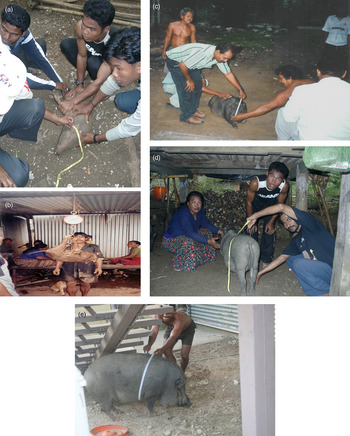
A total of 377 families were surveyed in randomly selected villages on Car Nicobar, Nancowrie, Teressa, Katchal and Chowra Islands. The necessary information on pig farming, population and characteristics was collected from tribal families as per the standard format developed for pigs by National Bureau of Animal Genetic Resources (NBAGR) through participatory conversation (interview). Permission from First Captain of a village is essential prior to survey in the tribal village. In general, most of the tribes were very reserved. Although the tribes spoke Hindi, it was difficult to understand what they were saying in Nicobari language and we used a Nicobari tribe as an interpreter to record information. Most of the time, the tribal people were in the forest or coconut plantations (from morning to evening) which were difficult to access. Frequently nobody could be found in the village and the principal investigator along with survey team went inside the forest to contact the tribes. Once the Sun begins to set, no outsiders were allowed to stay around the village. The Nicobari tribes did not know much information about the farming system and performance as the pigs were reared under free range system and they did not follow any systematic/scientific farming practices. In general, temperament (nervousness) of the male Nicobari pig was too much than the female pigs. At least ten people were needed to catch the pigs for slaughter. However, the female Nicobari pigs were very docile and could be controlled easily by the Nicobari tribal women. Therefore, the data were mostly based on the information provided by the tribes and as observed by the survey team. The phenotypic characteristics were recorded using measuring tape from the pigs available during the survey. General behaviour and appearance were recorded from a distance by direct observation and recorded using videos. Pigs squealed loudly when restrained and on hearing this other pigs scavenging nearby ran away. However, pigs which were roaming near the tribal household and confined under shelter were approached and caught with the help of tribes and phenotypic measurements were recorded (Figure 2) with photography. Phenotypic data viz. appearance (general appearance, coat, muzzle, eye lid and hoof colour, head, face, ear, eye, eye lid, snout, neck, shoulders, body, abdomen, legs, tail and activity) and body measurements (body height, length, chest girth, paunch girth, neck circumference, snout length, ear length, ear width, ear circumference, leg length and tail length) were recorded.
Phenotypic measurements of Nicobari pigs of various age groups.

Results and discussion
Population trend of Nicobari pig in the breeding tract
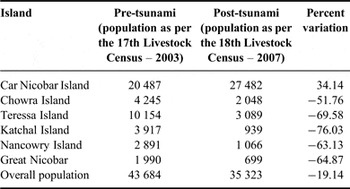
The recent census data by the Department of Animal Husbandry and Veterinary Services on the pig population revealed that the post-tsunami, i.e. after 2004, status of the number of the Nicobari pig was highest in Car Nicobar followed by Teressa, Chowra, Nancowry and Katchal (Table 1). However, the population as per the 18th Livestock Census-2007 was minus 19 percent of the original population prior to tsunami, as most of the pig population was washed away. In Car Nicobar Island, there was less damage to the pig population and, the Southern group of the islands, particularly Nancowry, Teressa, Chowra and Katchal, were worst affected with a loss estimated to be 51–76 percent of total population based on the provisional 18th Livestock Census Report-2007, Office of the Senior Veterinary Officer, Nicobar District, Department of Animal Husbandry and Veterinary Services, Andaman and Nicobar Islands. This could be due to islands topography, force of tsunami waves and water ingression in the seashore and the population of pig caught in tsunami waves. In addition to loss during the tsunami, indiscriminate slaughter by tribes to meet the nutritional demand of the families, escape of pigs into the dense forest and death due to disease (swine fever) lead to the post-tsunami loss and slow progress in population growth.
Pre- and post-tsunami Nicobari pig populations in Nicobar district (Source: Department of Animal Husbandry &Veterinary Service, Andaman and Nicobar Islands).
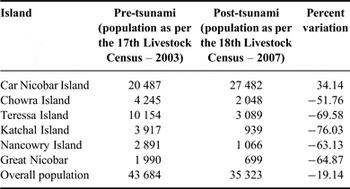
The herd size (in numbers) of Nicobari pig per individual tribal family in Car Nicobar, Nancowry and Teressa ranged between 10 and 15 and was higher than on other islands. The overall herd size of the Nicobari pig was 12.46 for the 377 tribal families surveyed. The herd composition revealed that the adult female population ranged between 9 and 20 percent. The adult breeding populations were important to further propagate the germplasm and there was an immediate need to increase breedable population of female pigs in Nicobar group of islands.
Husbandry practices
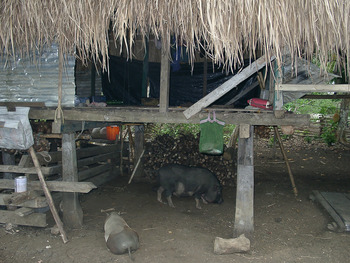
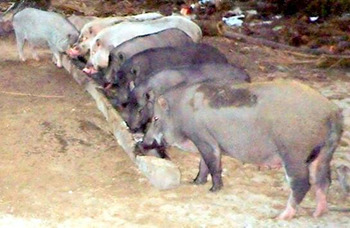
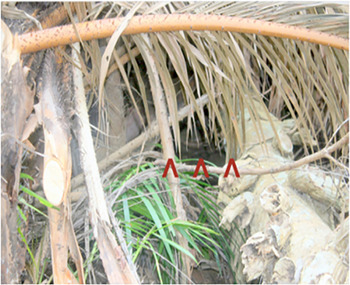
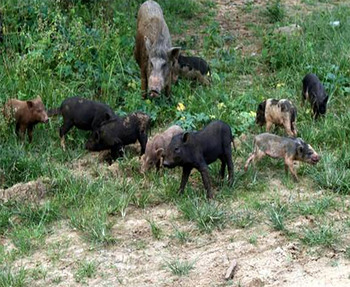
The pigs were reared under a free-range system, roamed freely and might come to the residential area or remain in the forest. They were very active in the very early morning and late evening, moved in bands of 4 to 20 and ate an omnivorous diet (Tikader and Das, Reference Tikader and Das1985). The pigs were mainly resting underneath the tribal's hut/shelter during day time (Figure 3). The Nicobari hut/shelters were in appropriate height above the ground level to protect the pigs from heavy rainfall. No separate pig sty or any housing pattern was constructed for the pigs. However, a separate enclosure/shelter for piglets were made using locally available material by all tribes. Sometimes pigs that had been caught in the forest, more ferocious pigs or pigs marked for slaughter were kept in a separate well-protected enclosure. The shelters were generally made of pieces of wooden planks, tree branches and the roofing was made using leaves/grasses. The shelters were made in different sizes depending on the population. These animals were largely vegetarian, although they were opportunists and mostly consumed a wide range of food of animal origin especially fish and fish waste. The tribes mainly fed the pigs in groups with coconut in the evening (Figure 4). Other than routine raw coconut feeding, the pigs are also fed with oil extracted coconut powder, Pandanus fruit (Pandanus lerum, locally called Kevri), Nicobari Alu (Dioscorea alata), tapioca (Manihot esculenta, locally called Malayal alu) and fish waste. In addition, the pigs are also given a small amount of kitchen waste by some tribes. Before feeding, each tribe summoned the pigs by raising peculiar sound either vocally or using an instrument or an object. The pigs, after hearing the sound, recognize their owners and go to their tribal hut/shelter. The Nicobari pig showed good rooting behaviour and fed on roots of wild palm. No feed (ration) was prepared separately for the pigs. The pigs were grown and fattened using locally available feed resources and without any concentrate ration. However, they may still lack a proper balanced nutrition (protein, energy and minerals, etc.). The feeding pattern for Nicobari pig was similar in all Nicobar groups of islands.
Nicobari hut with shelter/resting place for pig below the hut.

Group feeding of Nicobari pig with coconut at Car Nicobar Islands in a traditional wooden feeder called “naam”.

Physical characteristics
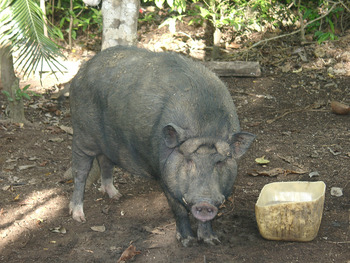
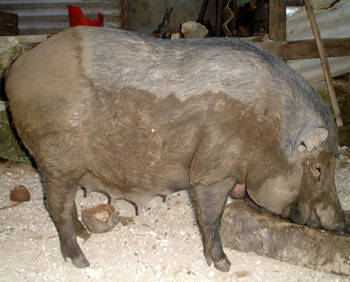
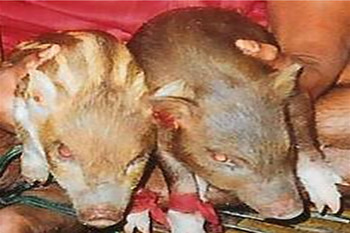
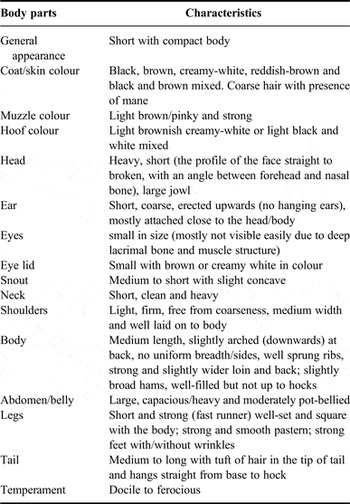
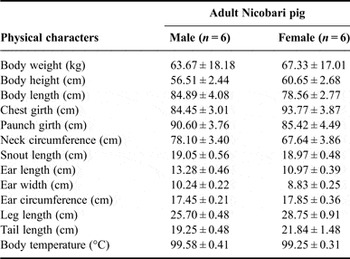
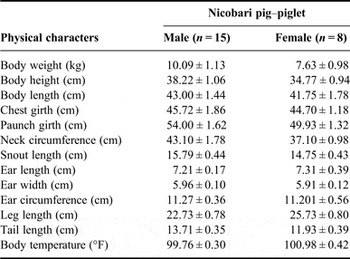
Phenotypic appearance of Nicobari pigs and physical measurements of adult and piglet are presented in Tables 2–4. The male (Figure 5) and female Nicobari pig (Figure 6) was short with a long body. The pigs were sturdy and healthy in appearance. The skin colour of adult pig included shades of red-brown (5 percent), blackish grey (80 percent), brown and blackish brown (5 percent) and also with a faint black with a faint brownish wash on dorsal side (10 percent) which is similar to that observed by Tikader and Das (Reference Tikader and Das1985) and similar to the observation that the range of adult colours among the Suidae included shades of red brown, yellow-brown, black, grey, brown, blackish brown and fawn (Porter and Tebbit, Reference Porter and Tebbit1993). In Car Nicobar, Teressa and Chowra Islands, piglets were occasionally born with stripes (dark reddish brown stripes/banding throughout the body) and the existence of striped pig (Figure 7) was indicative of primitive type or origin from wild pig group (Porter and Tebbit, Reference Porter and Tebbit1993). John Nesfield, writing in The Ark in 1980 to describe the village pigs of Hindu India, remarked that the most of the young were striped at birth (Porter and Tebbit, Reference Porter and Tebbit1993). Sometimes the undersides (belly) were cream or white and, in few pigs, the colouring extended over the whole body. The bristles were dense, coarse being black, brown or cream in colour. There was a marked bristle crest (mane) on the back of the pig extending from mid head/shoulder to base of the tail. There were no facial warts.
Male Nicobari pig.

Female Nicobari pig.

Banded Nicobari piglet (left side).

Phenotypic characteristics (appearance) of Nicobari pig.

Mean values (± SEM) of phenotypic parameters of adult male and female Nicobari pigs (>12 months of age).

Mean values (± SEM) of phenotypic parameters of male and female Nicobari piglets (2–3 months of age).
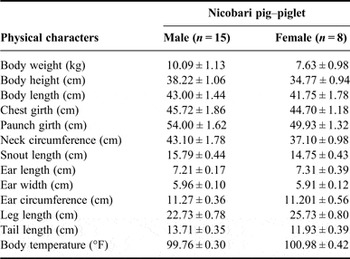
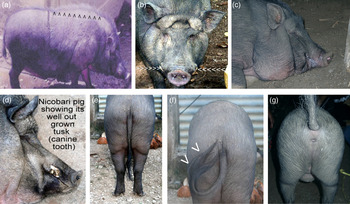
The snout of pigs varied from flat to concave. The uncastrated pigs were heavy with well grown tusks (upper and lower canine tooth), ferocious and tried to attack strange people which is similar to the observation of Tikader and Das (Reference Tikader and Das1985) that the Nicobari pigs were larger in size and its skull and teeth were distinctively larger than those of Andaman wild pig. These characters might indicate its wild origin. The muzzle, eyelid and hoof colours include fuscous (brownish-grey), brownish, creamy-white and the muzzle might also be pinkish/grey in colour. The most commonly observed feature was a slightly downward arch/curvature of the back (low back). The head was short with a strong slightly curved (downward) snout. Some of the pigs (10–20 percent) in the forest were observed with a long head and strong lengthy snout indicating wildness. Ears were short and erect. The neck was short with a very large jowl region. The leg was short and they were fast runners. The tail was generally medium to long and had no curl, extending beyond the hock (Figure 8). Porter and Tebbit (Reference Porter and Tebbit1993) stated in his book that, in India, it was claimed that all domesticated varieties, except Chinese, were the descendants of the Indian wild pig (Sus scrofa cristatus known as the jungle or Indian wild pig). The Nicobari pigs might be the descendants of the Eurasian wild Boar (Sus scrofa) since there was an extensive original range of pigs throughout Europe and Asia, and from which many regional sub species of S. scrofa evolved. In the context of domesticated pigs, the most interesting were also the most divergent of the sub-species: the European wild Boar (Sus scrofa scrofa) and South East Asia's Banded pig of Malaysia and Indonesia (Sus scrofa vitatus) and Indian Wild Boar or jungle pig (Sus scrofa cristatus). In this context, the Sus scrofa nicobaricus, which were available in Nicobar group of islands, the so called “Nicobari Pig” has been domesticated by the tribes over many centuries and up to present day. Considering the species S. scrofa as a whole, the natural habitat included dense forest, steppe lands, and a wide range of maritime climates to tropical rain forest (Porter and Tebbit, Reference Porter and Tebbit1993), which was similar to the present day Nicobri pig habitat. The process of domestication brings about morphological and behavioural changes in all species and it is possible to contemplate the evidence of origin from domestic animals. This was clearly evident from the morphological observation of Nicobari pig's appearance viz. varied coat colour, banded/striped coat, short to longer skull, shortening of face, mandible and lacrimal bone, shorter leg, the profile of the face was from straight to “broken” with an angle between muzzle and forehead, coarse bristle and a marked crest along the back, straight tail and pricked ears. These were important phenotypic characteristics suggestive of wild pig origin from which the Nicobari pig could be recognized as S. scrofa nicobaricus.
Photographs showing various phenotypic features viz. (a) crest of bristles, (b) head and face, (c) jowl, (d) tusk, (e) long tail, (f) tuft of hair in tail and (g) back portion of Nicobari pig.

This is further confirmed by earlier reports of British/sea travellers who observed the existence of pigs as early as in the year 1846 along with tribal community when they passed through Car Nicobar, Teressa, Chowra and Nancowrie and Katchal Islands. In a paper on the “Nicobar Islands”, in “The Geographical Magazine” in February, 1875 by F.A. de Roepstorff, it was written that the “Pig occupied the main stream among the tribes of Nicobar group of islands” (de Roepstorff, Reference de Roepstorff1875). It was stated by many senior/aged tribesmen that the Nicobari pigs might exist on these islands for over thousands of years. Furthermore, he observed that the tribes were celebrating a feast in remembrance of a dead person and they slaughtered 24 large pigs. In the huts, they observed the slaughtered pigs, and the women were busy cutting them up. The faces and hands of all the people were smeared with pig's blood (http://andaman.org/NICOBAR/Book/Shompen/Shompen.htm). This century old observation clearly showed that the Nicobari pigs occupied the sociocultural system of the tribes and as a major source of animal protein in their diet. Based on the geographical location of Nicobar group of islands, historical reports, phenotypic appearance and behaviour, the Nicobari pig may have genetic relatedness to pigs of South East Asian countries which could be further confirmed by molecular characterization.
Performance and breed utility
Pigs of both sexes roamed freely in the forest and breeding occurred inside the forest area through natural service and breeding data could not be obtained in detail. It was reported by the tribes that the sow in the last stage of gestation goes into the forest for farrowing. During survey, a farrowing nest (Figure 9) made by Nicobari pig was observed in the forest area and this shows the Nicobari pig's inherent behaviour for fashioning or building their nest. After a month, the sow, along with her 8–10 piglets (Figure 10), comes to the tribal shelter and, therefore, litter size at birth and mortality were not known. However, based on interviews and observation, it was revealed that the mean ± SEM age at first farrowing (months), litter size (no.) farrowing interval (months) was 10.91 ± 0.85, 6.48 ± 0.31 and 8.06 ± 0.33, respectively. Teats were equally placed in sows and the number of teats ranged from five to six pairs indicating high mothering ability. The number of teats was an important trait for the mothering ability of sows (Pumfrey et al., Reference Pumfrey, Johson, Cunningham and Zimmerman1980) and, in particular, teat number played a significant role when there are more piglets than number of teats (Hirooka et al., Reference Hirooka, de Koning, Harlizius, van Arendonk, Rattink, Groenen, Brascamp and Bovenhuis2001). Kim et al. (Reference Kim, Jin, Lee, Son, Lee, Yi and Park2005) concluded that 14 or more teat number compared to 11–13 teat numbers in gilts increased litter size at birth and at 21 day weaning. It was presumed that the Nicobari pig gave birth to more piglets, which needs to be confirmed by thorough monitoring under confined rearing. No specific weaning practices were followed and there was no information available about the pre or post-weaning mortality in pigs. This could be due to lack of postpartum care and attention on number of piglet delivered by a sow by the Nicobari tribe. Nicobari tribes practiced castration of their male pigs at 3–4 months of age with a belief that castrated pigs attain higher body weight and become docile. It was stated by the tribesmen that the piglets that show good health, body weight and active behaviour were not castrated and allowed go into the forest to give them the opportunity to become breeding males, which was similar to the practice followed by tribal people of Papua (former Dutch New Guinea) (http://www.papuaerfgoed.org).
Recently farrowed pig in the farrowing nest.

Nicobari pig with its nine piglets.

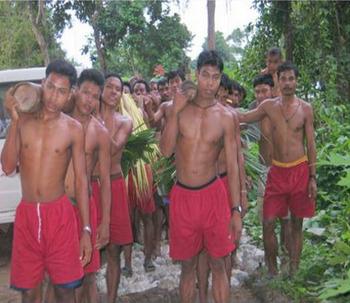
Pigs are considered a family asset and reared mainly for pork consumption among the Nicobari tribes. During the pig festival (Canahaun in Nicobari language), which is celebrated after Christmas in January to Februry, Nicobari families select an adult swine from their stock, slaughter and distribute the carcass among their Tuhet which conists of 20–25 families. Pigs are also gifted (carried in a well-decorated manner) during the marriage ceremony (Figure 11) and slaughtered during various occasions such as the marriage ceremony, “Fatya” a function observed in fond remembrance of ancestors or recently dead person and during inter village Mela (local festival) on the island. No commercial system of pig rearing or sale of pork prevails among the Nicobari tribe. However, they exchange pigs between different islands during festivals and this significantly contributes to avoidance of inbreeding. This could be due to the fact that the tribes did not kill pigs regularly for meat consumption.
Tribal youths carrying decorated Nicobari pig for marriage ceremony (Photo courtesy N. Ravishankar, CARI).

Pig slaughter
Pigs were slaughtered by direct cardiac puncture using a sharp-ended stick, which was passed through a small slit made just in front of the xiphoid of the sternum. Sometimes the tribesmen go for hunting pigs in the forest. Then, the entire pig was roasted on a fire for scalding (removing hair from a pig using scrapers) and cut off parts for consumption. The slaughter and processing procedure was done properly as per the standard procedure followed in the modern pig slaughter. Furthermore, it was reported that in Teressa Island, after consumption of the pork, the pig blood was smeared over the abdomen of the people present during slaughter believing that this practice improved their digestion. In Chowra Island, the pig blood is smeared all over the body for medicinal purposes. Since all parts of the pig were edible, it was presumed that dressing percentage could be approximately 70–80 percent which is similar to the report of Srivastava et al. (Reference Srivastava, Ahlawat, Chatterjee, Roy, Choudhuri and Saha2002). Mostly, male/boars were preferred for slaughter. The average age (months) and live weight (kg) at slaughter was 12.76 ± 1.07 and 112.82 ± 14.26, respectively. It was stated by the tribesmen that the pig fat was smeared over the meat for long-term storage and consumption.
Conservation of indigenous Nicobari pig germplasm in its breeding tract
This unique indigenous pig germplasm is considered a sign of prosperity of Nicobari tribes on this island territory. The Nicobari pigs have adapted well to the island ecosystem over the centuries and perform well under the integrated resource-driven (plantation based) production system. The Nicobari pigs are under constant threat due to natural calamities (earthquake, tsunami), outbreak of disease (swine fever), predators (Reticulated pythons) and lack of scientific breeding and farming practices. As a part of conservation measure, the tribal people and school children were given awareness training on the importance of indigenous Nicobari pig germplasm and their conservation by the corresponding author and survey team in collaboration with staff of Department of Animal Husbandry and Veterinary services located at Car Nicobar Island. There is an urgent need to monitor the growth rate, molecular characterization studies for breed origin, identity, formulation of conservation strategies for the genetic improvement and conservation of this precious indigenous germplasm of India.
Conclusion
The phenotypic characters and farming system of Nicobari pig was documented for the first time and this study showed that the Nicobari pigs are indigenous to these islands and their existence was noted for many centuries. The Nicobari pigs were short in stature, with a long body and live with tribes under a free range system. Pigs were considered as a family asset by the Nicobari tribes. No commercial farms or sale of meat was practiced. The lack of interest in the indigenous pigs is such that there are only a few studies which have focused on characterization and performance under typical village conditions. Wild pigs could have an effect upon local domesticants and such species are of interest as they contribute significantly to sociocultural and livelihood of the tribes and the less privileged section of the society in many parts of the world. As in the case of the present day Nicobari pig, which could be descendants of S. scrofus nicobaricus (wild pig), the potentially valuable traits still remain largely unrecognized, such as adaptability, conformation, performance, the ability to utilize waste and their disease resistance under a tropical island ecosystem. Therefore, it is concluded that the Nicobari pigs could be a recognized indigenous pig breed/germplasm belonging to the Nicobar group of islands in India and this would attract academics, researchers and conservationists to pay special attention to it in future. This could lead to studies on conservation, as well as a detailed study on performance under existing tribal production system or under scientific management at an institutional level.
Acknowledgements
The authors are grateful to the INDIAN COUNCIL OF AGRICULTURAL RESEARCH Govt. of India, for providing necessary funding and facilities under the AP Cess project on “Conservation and characterization of Nicobari pig”. The first author thank specially Dr. R.B. Rai and R.N. Chatterjee for their initiatives, guidance and support. Thanks are also due to the Director, Central Agricultural Research Institute, Port Blair, Veterinary Officers and Para-veterinary staff of the Department of Animal Husbandry and Veterinary Services, Nicobari Tribes and Tribal Councils, A&N islands, and the project staff Dr T.P. Swapna, S.K. Jana, Dr T. Geetha, M. Gayathridevi and all the enumerators associated with the project.