Introduction
The timely provision of analgesia is an important aspect of emergency care and one of the key quality indicators of emergency care. International research has identified that between 50%–80% of patients in an emergency department (ED) present with a complaint of pain (Holdcroft and Power, Reference Holdcroft and Power2003; Tcherny-Lessenot et al., Reference Tcherny-Lessenot2003). While older people are disproportionately high users of ED services and often present with pain, the assessment and effective management of their pain is often compromised in the ED environment.
Multiple studies have demonstrated inadequate dosing and timeliness of pain relief for older people in ED, with advancing age shown to be a risk factor for delay to analgesia (Arendts and Fry, Reference Arendts and Fry2006; Fry et al., Reference Fry, Bennetts and Huckson2011). Though many factors contribute to this inadequate response, the difficulty is sometimes due to the older person's inability to inform others that they are in pain because of impaired language or communication ability (Davies et al., Reference Davies2004).
Cognitive impairment is an umbrella term that refers to a variety of disorders which affect a person's ability to think, concentrate, formulate ideas, and remember (Folstein et al., Reference Folstein, Folstein and Mchugh1975). Cognitive impairment in older people is strongly associated with dementia. Chenoweth and others (Reference Chenoweth2009) and Hancock et al. (Reference Hancock, Chang, Chenoweth, Clarke, Carroll and Jeon2003) have reported that the presence of dementia increases comorbidity and dependency levels in hospital patients who are more likely to experience increased length of stay, suboptimal care, and poor outcomes. Ensuring timely and appropriate pain assessment and intervention for older people with cognitive impairment presenting to the ED is therefore important, but is also very challenging for clinicians. Difficulties in assessing pain levels and severity is one of the main issues. For example, ED visual or verbal analog scales (VAS) are the tools most commonly used to assess pain (Holdgate et al., Reference Holdgate, Asha, Craig and Thompson2003). However, for the cognitively impaired older person, the utility of VAS may not be useful (Hjermstad et al., Reference Hjermstad2011; Lukas et al., Reference Lukas, Barber, Johnson and Gibson2013). The use of pain assessment scales that are not suitable for use with a cognitive impairment may decrease recognition of pain by clinicians and subsequently lead to analgesic delay. Few previous studies have examined this issue in the older ED population who are admitted with an acute injury and are therefore, likely to require treatment of pain.
This study compares the time to analgesia for cognitively impaired and cognitively intact older people diagnosed with a common painful musculoskeletal injury (a long bone fracture). Specifically, the hypothesis of the study was to determine whether the time to analgesia for cognitively impaired patients with long bone fractures and pain was different when compared to cognitively intact patients. Therefore, the aim of the study was to determine if cognitive impairment is associated with an inadequate analgesic response.
Materials and methods
A retrospective analysis of randomly sampled older patients presenting to ED between January and December 2012 with a long bone fracture was conducted across four metropolitan sites. Ethical approval was obtained from the local Human Research Ethics Committee (NSLHD HREC 1212–430 M) to access and analyze ED patient records.
Electronic hospital patient data were extracted from FirstNet™ (ED computer software program) to identify patients aged 65 years and over with long bone fractures. Data retrieved included: patient demographics (age, gender); clinical information (time of arrival to the ED, triage code, doctor seen by time, treating doctor, discharge, diagnostic code, and disposition). The remaining data were collected by manually examining the patient's medical and e-health records. Cognitive impairment was determined by geriatrician diagnosis of impairment and/or with a Folstein mini mental assessment score of <24 or Six-Item Screener (SIS) of <4 measured in the ED (Folstein et al., Reference Folstein, Folstein and Mchugh1975; Wilber et al., Reference Wilber, Carpenter and Hustey2008).
The primary outcome was the proportion of patients receiving analgesia in 60 minutes or less. Time to analgesia was measured from time of triage to drug administration as documented on the medication chart. The secondary outcome of interest was time to analgesia.
In calculating adequacy of sample size, prior audit data in the study's jurisdiction (unpublished) suggested that 50% of cognitively intact older patients (controls) would receive analgesia for long bone fractures within 60 minutes of arrival, and that the ratio of intact to impaired patients with long bone fracture was 5:1. If the probability of type I error is 0.05, to have 85% power to show a 25% absolute difference in the outcome (proportion of patients with analgesia within 60 minutes), for the cognitively impaired group we would require 40 patients and 200 controls (240 records). As we anticipated that 10% of records would have incomplete information, 264 of the target group's records were extracted for review.
Data were stored electronically in a security password-protected Excel database and analyzed using IBM SPSS v. 21. Descriptive statistics were calculated, followed by comparisons of cognitively intact and impaired patient groups using the Mann–Whitney U test and Pearson's χ 2 test. A multivariate logistic regression model was used to adjust for possible confounders in the association between cognitive impairment and the proportion of people waiting more than 60 minutes for analgesia.
Results
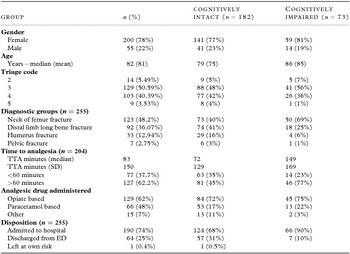
ED presentations across four ED sites in 2012 numbered 168,021, with 44,778 (26.6%) patients aged 65 years and over. Of the patients aged 65 years and over, 7,501 had a musculoskeletal condition injury diagnosed, including 1,343 with a long bone fracture. Medical records of 264 older patients with long bone fractures were randomly sampled and reviewed, with 255 having sufficient data to be analyzed (Table 1).
Characteristics of older patients with a long bone fracture (n = 255)

The majority of these patients were cognitively intact while 73 (28.6%) had a diagnosis consistent with cognitive impairment (unspecified dementia (n = 53; 72.6%); unspecified cognitive impairment (n = 7; 9.5%); Alzheimer's (n = 6; 8.2%); Parkinson's syndrome (n = 6; 8.2%); and delirium (n = 1; 0.5%). Only three of these patients were newly diagnosed with cognitive impairment on testing in the ED.
Women (n = 200; 78.4%) were more frequently represented. The average age of the study population was 81 years (SD +/−8.4 years; median: 82 years) with cognitively impaired patients significantly older (median: 86 years vs. 79 years, Mann–Whitney U test: p < 0.001; Table 1). The majority (n = 230; 94.5%) of patients spoke English as a first language and arrived by ambulance (n = 186; 72.7%).
The triage code distribution is shown in Table 1, with no significant difference in triage code allocation between cognitively intact and impaired patients (Pearson's χ 2 test: 2.00, p = 0.16). The mean time taken to be entered into the triage system was 5 minutes (median: 6 minutes; SD: 5 minutes). The mean time to be seen by a medical officer was 37 minutes (median: 44 minutes; SD: 28 minutes). The majority (n = 123; 48.2%) of patients had a diagnosis of femur fracture, followed by distal long bone limb fracture (n = 92; 36.1%; tibia, fibula, radius, ulna; Table 1).
Of the 255 patients, 204 (80%) received analgesia in the ED. The overall median time to analgesia was 83 minutes (IQR = 38–180 minutes). The median time to analgesia for the cognitively intact group was 72 minutes compared with 149 minutes for the cognitively impaired group, with the difference statistically significant (Mann–Whitney U test: p < 0.001; Table 1).
The majority (n = 127; 62.2%) of older patients waited longer than 60 minutes for analgesia in the ED (Table 1). There was a significant difference between the cognitively impaired (77%) versus cognitively intact (56%) patients waiting more than 60 minutes for analgesia (Pearson's χ 2 test: 7.51, p = 0.006). After adjusting for age, triage code, gender, ambulance analgesia, and whether a pain score was documented for the patient in a binary logistic model, patients with cognitive impairment were more likely to suffer a delay to analgesia beyond 60 minutes (p = 0.045, OR = 2.14, 95% CI = 1.01–4.50).
The majority of these patients received an oral analgesic in the ED (n = 107; 52.4%; Table 1), but 51 (20%) patients received no analgesia. Cognitively impaired patients (n = 13) were no more likely to receive no analgesia (Pearson's χ 2 test: 0.31, p = 0.58) compared with cognitively intact patients (n = 38). Of the 51 patients who did not receive an ED analgesic, 10 out of 12 who declined analgesia were cognitively intact.
Only 136 (68.3%) of the 255 patient records had a pain score documented. Of those that did, the median score was 5 for cognitively intact and 3 for cognitively impaired patients. There were 64 (25.09%) patients that had a pain descriptor documented (mild, moderate, severe). The majority (n = 189; 74.1%) of patients were admitted (Table 1).
Of the patients with long bone fractures, 51 (20%) patients received no analgesia while in the ED. Of these patients, eight (16%) received pre-hospital analgesia by ambulance officers.
Discussion
The study identified that the majority of older patients waited greater than 60 minutes for analgesia. However, those with cognitive impairment waited twice as long to receive analgesia compared with cognitively intact patients. The majority of older patients in this study received inadequate pain assessment and management, according to international standard pain management recommendations (American Nurses Association, 1991; American College of Emergency Physicians, 2005; Australian and New Zealand College of Anesthetists, 2008). Differences in analgesic response times for this vulnerable patient group remain a challenge for emergency clinicians despite a relatively short doctor seen by time.
It is well established that older people in general suffer delay to analgesia in ED. Hwang et al. (Reference Hwang, Richardson, Harris and Morrison2010) highlighted a disparity between age and opioid analgesia, finding that older patients (65–84 years) were less likely than younger patients (18–64 years) to receive opioid analgesia for moderate-to-severe pain. Platts-Mills et al. (Reference Platts-Mills2011) also identified that ED patients 75 years and older were less likely to receive pain medication.
Our research findings show that, amongst older people, cognitive impairment is a further risk factor for delayed and inappropriate analgesic management. These findings are congruent with other work. For example, Andunsky et al. (Reference Adunsky, Levy, Mizrahi and Arad2002) found that older people with cognitive impairment and a diagnosed hip fracture received up to 53% less opioid analgesia compared to cognitively intact older patients with similar comorbidities.
Throughout Australasian EDs, nurses commonly initiate pain management, although older cognitively impaired patient groups have traditionally been excluded from nurse-initiated pain management initiatives. Despite many nurse-initiated pain management initiatives (Fry and Holdgate, Reference Fry and Holdgate2002; Fry et al., Reference Fry, Ryan and Alexander2004) older patients appear vulnerable and receive care well below acceptable practice guidelines. If we are to improve the time to analgesia for this vulnerable ED patient group, nurse-initiated pain management policies and guidelines need to be revised to enable nurses to initiate and provide appropriate analgesics. We must improve pain management given that multiple studies (Fry et al., Reference Fry, Ryan and Alexander2004; Arendts and Fry, Reference Arendts and Fry2006; Fry et al., Reference Fry, Bennetts and Huckson2011; Reference Fry, Hearn and Mclaughlin2012), including this study, continue to identify an issue with the timely delivery of analgesia for older people, particularly for those with a cognitive impairment.
The study found that pain assessment was routinely conducted using a standard VAS. There was no evidence that ED clinicians used pain assessment tools specifically developed for older adults with cognitive impairment. This may be a factor of not having access to a universally accepted pain assessment screening tool for people with a cognitive impairment within EDs. Unless a validated pain assessment tool is available to ED clinicians, they will most likely continue to underestimate the cognitively impaired patient's pain intensity (Duignan and Dunn, Reference Duignan and Dunn2008).
Clinicians face ongoing challenges to improve the care and outcomes for cognitively impaired older people, such as identifying signs of pain and making a timely analgesic response to suspected pain, without having access to validated pain assessment tools and guidance in their use. Several screening tools have been developed to assess pain in cognitively impaired patients, with some requiring minimal time to complete (DeWaters et al., Reference Dewaters, Popovich and Faut-Callahan2003; Herr et al., Reference Herr2006; Zwakhalen et al., Reference Zwakhalen, Hamers, Abu-Saad and Berger2006; DeWaters et al., Reference Dewaters2008; Ersek et al., Reference Ersek2010; Jannings et al., Reference Jannings, Underwood, Almer and Luxfor2010–2011). However, given our study findings it appears there is an urgent need to identify a valid and reliable pain assessment tool for use with older people having a cognitive impairment who present to the ED (Gerson et al., Reference Gerson, Counsell, Fortanarosa and Smucker1994; Jannings et al., Reference Jannings, Underwood, Almer and Luxfor2010–2011). Further research comparing available observation pain assessment tools is required to identify the most appropriate tool(s) for the emergency context.
While this study has identified an important area for ED practice improvement for a sample of metropolitan hospitals, the study was limited by having to rely on retrospective ED data. These findings need to be confirmed by identifying current ED pain management practices in a larger hospital sample, such as through a multicenter prospective study. As well, the retrospective ED data were reliant on clinicians’ completion of all required documentation fields. The missing data from these records may have been a factor of clinician workload and thus, may not accurately reflect their pain assessment and care practices for older patients.
Other factors which were not identified in this study may also contribute to analgesic delay. Consequently, future research needs to explore the potential impact of factors such as time to radiological procedure and reporting, communication issues, and delay to diagnosis.
Similarly, there is an issue with having to rely on retrospective patient cognition scores allocated by hospital geriatricians and other clinicians. Since it is likely that not all older people attending the ED were assessed for cognitive level, and especially if the person's cognitive status changed during the course of an ED stay, these data might be incomplete. Consequently, the ED records relied on for this study might have underestimated the number of older patients being assessed and receiving analgesics for pain, including those with a cognitive impairment. The data on wait time for analgesia might, therefore, also be unreliable.
Conclusion
Research suggests that older adults with long bone fractures are at greater risk of analgesic delay and inadequate assessment of pain by ED clinicians, especially if cognitive impairment is present. This study supports those findings. In order to improve the ED care and outcomes for older people with a cognitive impairment it is vital that ED clinicians improve pain assessment and management practices. This can be better achieved by using valid and reliable pain assessment tools that are sensitive to the signs and expressions of pain occurring in people who are unable to articulate the presence and severity of pain because of impaired language and other cognitive abilities. A more accurate assessment of the presence and severity of pain in these people is the first step in developing an awareness and a timely response to analgesia.
Conflict of interest
None.
Description of author's roles
M. Fry formulated the research question, designed the study, carried out the study, analyzed the data, and wrote the paper. G. Arendts, L. Chenoweth, and C. MacGregor designed the study, analyzed the data, and wrote the paper.
Acknowledgments
This study was supported by a grant by the Emergency Care Institute, New South Wales, Australia.