Child maltreatment represents a pathogenic relational environment that strikes at the core of children's stage-salient developmental issues and confers major risk for maladaptation across both biological and psychological domains of development. (Cicchetti & Lynch, Reference Cicchetti, Lynch, Cicchetti and Cohen1995; Cicchetti & Toth, Reference Cicchetti and Toth1995, in press). The deleterious sequelae of child maltreatment not only result in adverse outcomes during childhood but also often initiate a negative developmental cascade that continues throughout the lifespan (Cicchetti & Tucker, Reference Cicchetti and Tucker1994; Masten & Cicchetti, Reference Masten and Cicchetti2010).
Among the consequences of child maltreatment are diverse forms of psychopathology, including depression and internalizing problems (Cicchetti & Toth, in press; Cicchetti & Valentino, Reference Cicchetti, Valentino, Cicchetti and Cohen2006; Toth, Manly, & Cicchetti, Reference Toth, Manly and Cicchetti1992; Widom, Dumont, & Czaja, Reference Widom, DuMont and Czaja2007). Consistent with the developmental psychopathology principle of multifinality (Cicchetti & Rogosch, Reference Cicchetti and Rogosch1996), all maltreated children do not develop depression and internalizing problems. Thus, it is essential to discover and comprehend the processes and mechanisms that contribute to the development of depression and internalizing psychopathology in maltreated children.
In order to comprehend the pathways from child maltreatment to depression and internalizing psychopathology in their full complexity, it is important to examine systems operating at multiple levels of analysis (Cicchetti, Reference Cicchetti, Cicchetti and Cohen2006; Cicchetti & Dawson, Reference Cicchetti and Dawson2002; Cicchetti & Toth, Reference Cicchetti and Toth2009). For over a decade, the molecular genetic level of analysis has been increasingly incorporated into studies examining the effects of stress and childhood adversity on the development of depression and internalizing psychopathology.
Gene variants may contribute to risk for depression in a number of ways. For example, such effects may be independent from maltreatment's effects on depression and constitute a genetic risk factor. In addition, because maltreated children often develop depression and internalizing psychopathology, there may be additive main effects of genes and of maltreatment on depression and internalizing psychopathology. Genes also may modify the developmental response to maltreatment experiences. Furthermore, maltreatment may intensify a main effect of genetic risk (i.e., maltreatment moderates genetic risk as in diathesis–stress theory; Gottesman & Shields, Reference Gottesman and Shields1972). Alternatively, genetic variation may modify the main effect of the environmental pathogen (i.e., gene as moderator that is reflective of a protective effect of genetic variation). Finally, genetic variation may have opposite effects on outcome depending on the nature of the environmental pathogen, that is, cross-over interactions as exemplified in differential susceptibility theory (Belsky & Pluess, Reference Belsky and Pluess2009; Ellis, Boyce, Belsky, Bakermans-Kranenburg, & van IJzendoorn, Reference Ellis, Boyce, Belsky, Bakermans-Kranenburg and van IJzendoorn2011).
Research in molecular genetics suggests that maltreated children's risk for psychopathology, including depression and internalizing problems, is not inevitable. Gene × Environment (G × E) interaction occurs when the effect of exposure to an environmental pathogen on a behavioral, health, or biological phenotype is conditional upon a person's genotype or when the genotype's effect is moderated by the environment (Moffitt, Caspi, & Rutter, Reference Moffitt, Caspi and Rutter2005). Reciprocal coactions between the environment and the individual result in differential expression of genetic material. Environmental conditions may interact with an individual's genetic constitution to alter processes such as the timing of the initiation of transcription and translation for a specific gene, the direction for which it does so, or whether the gene will ultimately be expressed (Grigorenko & Cicchetti, Reference Grigorenko and Cicchetti2012; Meaney, Reference Meaney2010; Szyf & Bick, Reference Szyf and Bick2013).
Caspi et al. (Reference Caspi, Sugden, Moffitt, Taylor, Craig and Harrington2003) examined the prospective link between maltreatment and depression. In an ancestrally homogenous Caucasian sample, these investigators found that genetic variation in a functional polymorphism, the serotonin transporter linked polymorphic region (5-HTTLPR), in the promoter region of the 5-HTT gene plays a moderating role. Adults carrying the short allele (short–short [S/S] or short–long [S/L]) exhibited more depressive symptoms, diagnosable depression, and suicidality in response to stressful life events than did individuals homozygous for the long–long (L/L) allele. In addition, an examination of early life stress showed that a history of child maltreatment predicted depression in adulthood, but only among short allele carriers.
We next selectively review G × E research on maltreated children, adolescents, and adults. We focus on studies that examined the most commonly studied candidate genes in G × E research on child maltreatment and depressive symptomatology, namely, 5-HTTLPR and corticotropin releasing hormone receptor 1 (CRHR1) genes.
In an ancestrally heterogeneous sample, Kaufman et al. (Reference Kaufman, Yang, Douglas-Palumberi, Houshyar, Lipschitz and Krystal2004) found that maltreated children with the S/S genotype of 5-HTTLPR evinced depression scores that were almost twice as high as the depression scores of maltreated children with the S/L or L/L genotypes. In a subsequent multigenic investigation, Kaufman et al. (Reference Kaufman, Yang, Douglas-Palumberi, Grasso, Lipschitz and Houshyar2006) replicated the findings of their earlier study. Kaufman et al. (Reference Kaufman, Yang, Douglas-Palumberi, Grasso, Lipschitz and Houshyar2006) also found a significant three-way G × G × E interaction. Specifically, the interaction among the brain-derived neurotrophic factor (BDNF), 5-HTTLPR, and maltreatment predicted heightened levels of depression scores. In another instance of G × G × E, Cicchetti, Rogosch, and Sturge-Apple (Reference Cicchetti, Rogosch and Sturge-Apple2007) examined an ancestrally heterogeneous sample and found that adolescents with a history of sexual abuse who carried the S/S genotype and the monoamine oxidase A low-activity genotype exhibited higher levels of depressive symptomology than did sexually abused adolescents with alternative combinations of the variants of the 5-HTTLPR and monoamine oxidase A genes.
Banny, Cicchetti, Rogosch, Crick, and Oshri (Reference Banny, Cicchetti, Rogosch, Crick and Oshri2013) examined child maltreatment, peer victimization, and 5-HTTLPR as predictors of depressive symptomatology. Path analyses revealed that both relational and overt victimization mediated the association between child maltreatment and depressive symptoms. Bootstrapping procedures used to test moderated mediation demonstrated that genotype moderated the indirect effects of relational and physical victimization on child depressive symptoms, such that victimized children with the L/L genotypic variant of 5-HTTLPR were at increased risk for depressive symptoms compared to victimized children carrying a short allele.
A number of investigations have demonstrated that individuals who had been maltreated possessed a significantly greater risk of experiencing suicidal behavior (i.e., suicidal ideation, suicide attempts, and completed suicide) than comparable samples of nonmaltreated persons from the same socioeconomic status. These studies have demonstrated that the experience of sexual and physical abuse are risk factors for suicidal behaviors in adolescents and adults (Brodsky & Stanley, Reference Brodsky and Stanley2008). Cicchetti, Rogosch, Sturge-Apple, and Toth (Reference Cicchetti, Rogosch, Sturge-Apple and Toth2010) investigated whether genotypic variation of 5-HTTLPR moderated the effect of maltreatment on suicidal ideation in an ancestrally heterogeneous sample of low-income maltreated and nonmaltreated school-age children. Higher suicidal ideation was found among maltreated school-age children. Higher suicidal ideation was found among maltreated than nonmaltreated children. Children with one to two maltreatment subtypes and S/S or S/L genotypes had higher suicidal ideation than did those with the L/L genotype; suicidal ideation did not differ in nonmaltreated children or in children with three to four maltreatment subtypes based on 5-HTTLPR variation. The results were applicable to emotionally maltreated/neglected and to physically abused/sexually abused children. The more extensively maltreated children (i.e., those with three to four subtypes) expressed higher levels of suicidal ideation, regardless of genetic variation. Thus, the pathogenic relational environment of children who experienced extensive maltreatment appears to have predominated over genotype variation in the risk for, or protection against, suicidal ideation.
In a final illustration of 5-HTTLPR as a moderator of depression in maltreated children, Uher et al. (Reference Uher, Mors, Rietschel, Rajewska-Rager, Petrovic and Zobel2011) conducted a prospective longitudinal investigation of G × E interaction in two large ancestrally homogeneous samples: one in New Zealand and one in England. The former sample was followed until age 32 and the latter until age 40. The prospective nature of this study is unique in that the majority of studies of 5-HTTLPR × Maltreatment on depression have been cross-sectional (for some exceptions, see Caspi et al., Reference Caspi, Sugden, Moffitt, Taylor, Craig and Harrington2003; Cutuli, Raby, Cicchetti, Englund, & Egeland, Reference Cutuli, Raby, Cicchetti, Englund and Egeland2013). Uher et al. (Reference Uher, Mors, Rietschel, Rajewska-Rager, Petrovic and Zobel2011) found that, in both longitudinal cohorts, statistical analyses of G × E interactions revealed positive results for depression that runs a persistent course in adulthood, but not for single-episode depression. Individuals with the S/S 5-HTTLPR genotype and child maltreatment history had elevated risk of persistent but not single-episode depression.
Bradley et al. (Reference Bradley, Binder, Epstein, Tang, Nair and Liu2008) conducted an ancestrally homogeneous study of a predominately (97.4%) African American sample to test the hypothesis that genetic polymorphisms that alter the functionality of CRHR1 may moderate the effects of child maltreatment on adult depression. These investigators found that G × E interaction was important for the expression of depressive symptoms, or lack thereof, in adults who possess CRHR1 risk or protective alleles in conjunction with a history of child maltreatment. Specific CRHR1 polymorphisms appeared to moderate the effect of child abuse on the risk for adult depressive symptoms. These protective effects were substantiated with similar results in a second independent sample of Caucasians.
The findings of Bradley et al. (Reference Bradley, Binder, Epstein, Tang, Nair and Liu2008) underscore the importance of taking environmental experiences into account in genetic association and linkage studies that otherwise might miss many important genetic variants that are involved in the etiology of complex diseases. An extension and partial replication of the Bradley et al. (Reference Bradley, Binder, Epstein, Tang, Nair and Liu2008) study was conducted by Polanczyk et al. (Reference Polanczyk, Caspi, Williams, Price, Danese and Sugden2009). As in the investigation of Bradley et al. (Reference Bradley, Binder, Epstein, Tang, Nair and Liu2008), a CRHR1 haplotype was shown to exert a protective effect against depression in adults who were maltreated in their childhood; however, the replication only occurred when a retrospective, but not a prospective, measure of child maltreatment was used. The authors speculated that the protective effect of the CRHR1 haplotype was likely related to its function in consolidating memories of emotionally arousing experiences.
DeYoung, Cicchetti, and Rogosch (Reference DeYoung, Cicchetti and Rogosch2011) examined the influence of CRHR1 variation on neuroticism, in interaction with child maltreatment, in a large ancestrally heterogeneous sample of maltreated children and a well-matched nonmaltreated comparison group. Neuroticism, one of the Big Five personality characteristics, is a risk factor for mood and anxiety disorders. The biological systems involved in neuroticism are thus of great import in the etiology of internalizing disorders. Genes that are involved in the systems that are stress responsive, such as CRHR1, are thus important candidates for studies of the genetic moderation of the effects of major stressors like maltreatment.
DeYoung et al. (Reference DeYoung, Cicchetti and Rogosch2011) found that the CRHR1 TAT haplotype significantly moderated the association of child maltreatment with neuroticism. Having two copies of the TAT haplotype of CRHR1 was associated with higher levels of neuroticism among maltreated children relative to nonmaltreated children, with the exception of sexually abused children and children who had experienced three or four types of maltreatment. The findings of this study are also important because they contribute to a growing body of evidence that variation in the CRHR1 gene moderates the effects of child maltreatment on affective functioning.
Research reviewed above shows that G × E interactions mediating depressive symptomatology have been identified in both stress-sensitive serotonergic (5-HTTLPR) and CRHR1 systems. In an investigation of an ancestrally homogenous sample of African Americans from low socioeconomic stress backgrounds, Ressler et al. (Reference Ressler, Bradley, Mercer, Deveau, Smith and Gillespie2010) sought to determine whether the effects of child maltreatment are moderated by G × G × E interactions between CRHR1 and 5-HTTLPR polymorphisms. Ressler et al. (Reference Ressler, Bradley, Mercer, Deveau, Smith and Gillespie2010) first replicated the interaction of child maltreatment and 5-HTTLPR on lifetime major depressive disorder. They next replicated earlier work in their laboratory by Bradley et al. (Reference Bradley, Binder, Epstein, Tang, Nair and Liu2008) and Polanczyk et al. (Reference Polanczyk, Caspi, Williams, Price, Danese and Sugden2009), again finding that an interaction between a CRHR1 haplotype and child maltreatment predicted greater depressive symptoms. In addition, Ressler et al. (Reference Ressler, Bradley, Mercer, Deveau, Smith and Gillespie2010) discovered that a G (5-HTTLPR, short allele) × G (CRHR1 haplotype) interaction with child maltreatment predicted heightened current depressive symptoms.
In the present multigenic investigation, we examined G × E and G × G × E to test whether variation in these genes moderates the influence of child maltreatment on depressive symptomology and internalizing problems. We chose to include four candidate genes that have been shown to be of interest to research on depressive symptomatology and/or internalizing problems: 5-HTTLPR, CRHR1, BDNF, and norepinephrine transporter (NET). Below we discuss why each of these genes is worthwhile for investigation.
-
1. 5-HTTLPR: The neurotransmitter serotonin has been shown to be involved in the development of diverse forms of psychopathology, including anxiety problems and depression (Cicchetti & Toth, Reference Cicchetti and Toth1995; McGrath, Weill, Robinson, MacRae, & Smoller, Reference McGrath, Weill, Robinson, Macrae and Smoller2012). Differences in the promoter region of the 5-HTT gene (5-HTTLPR) have been conceptualized as a marker for a stress-vulnerable phenotype through the contribution of 5-HTTLPR on serotonin functioning (Cutuli et al., Reference Cutuli, Raby, Cicchetti, Englund and Egeland2013). The serotonin transporter has received a significant amount of attention because it is involved in the reuptake of serotonin at brain synapses (Caspi et al., Reference Caspi, Sugden, Moffitt, Taylor, Craig and Harrington2003). There are two forms of a functional insertion/deletion polymorphism that have been studied with respect to psychopathological outcomes: a 16-unit repeat long form and a 14-unit repeat short form (biallelic 5-HTTLPR). The short variant has been linked to decreased transcriptional efficiency and reduced levels of serotonin (Caspi, Hariri, Homes, Uher, & Moffitt, Reference Caspi, Hariri, Holmes, Uher and Moffitt2010). There also is an A/G single nucleotide polymorphism (SNP) in the long form (rs25531; triallelic 5-HTTLPR). The more common LA allele is associated with the reported higher basal activity, whereas the less common LG allele has transcriptional activity no greater than the short. Thus, LG carriers are considered effectively to be short carriers with functioning similar to the short form (Hu et al., Reference Hu, Oroszi, Chun, Smith, Goldman and Schuckit2005). Given the links with the serotonin system, and links between reduced serotonin functioning and depression, 5-HTTLPR polymorphisms are a good candidate gene for etiological models of depressive symptomatology and internalizing problems.
-
2. BDNF: This gene is expressed in the brain. It is active in the hippocampus, cerebral cortex, and the basal forebrain. In addition, BDNF is found in diverse tissue and cell types. Despite the fact that the majority of neurons in the human brain are formed prenatally, areas of the adult brain retain the ability to grow new neurons through the process of neurogenesis. BDNF is one of the most active neurotrophins that stimulate and control neurogenesis. Most research of the role of the BDNF genotype in moderating early adversity has focused on risk for depression (Aguilera et al., Reference Aguilera, Arias, Wichers, Barrantes-Vidal, Moya and Villa2009; Gunnar et al., Reference Gunnar, Wenner, Thomas, Glatt, McKenna and Clark2012; Kaufman et al., Reference Kaufman, Yang, Douglas-Palumberi, Grasso, Lipschitz and Houshyar2006) or on depression endophenotypes.
-
3. CRHR1: This gene has been shown to be a viable candidate gene that influences vulnerability to depression. CRHR1 is the key activator of the hypothalamic–pituitary–adrenal (HPA) axis, binding to receptors that initiate the stress response, culminating with release of cortisol from the adrenal cortex. Overactivity of the HPA axis has been shown to be partially caused by hyperactivity of CRH neurons. In addition, CRH activity at the CRH type 1 receptor (CRHR1) in extrahypothalamic regions also are thought to bring about internalizing disorders, such as depression and anxiety (Bradley et al., Reference Bradley, Binder, Epstein, Tang, Nair and Liu2008). Published investigations to date suggest that atypical activity of the HPA axis may be a function of early life stress (Cicchetti, Rogosch, Gunnar & Toth, Reference Cicchetti, Rogosch, Gunnar and Toth2010; Heim, Newport, Mletzko, Miller, & Nemeroff, Reference Heim, Newport, Mletzko, Miller and Nemeroff2008).
-
4. NET (SLC6A2): This SNP is located on the gene that encodes for the norepinephrine transporter. These transporters are located along the cell bodies, axons, and dendrites of the noradrenergic neurons. Animal models have shown that NET is related to fear and anxiety. Human studies reveal that females who have attention-deficit/hyperactivity disorder (ADHD) often exhibit more comorbid anxiety disorders than males.
We chose to conduct this investigation with an ancestrally homogenous population of African American children from low socioeconomic backgrounds. There are challenges inherent to conducting molecular genetic research with low-income maltreated populations. There is great racial diversity and high minority representation. The vast majority of molecular genetic research has been conducted with Caucasian samples (Odgerel et al., Reference Odgerel, Talati, Hamilton, Levinson and Weissman2013). The results of this molecular genetic research may not generalize to African Americans, given known variation in allelic distributions in different ancestral groups. Molecular genetic research conducted with African Americans by Brody and Beach (Bradley et al., Reference Bradley, Binder, Epstein, Tang, Nair and Liu2008, Reference Bradley, Westen, Mercer, Binder, Jovanovic, Crain and Heim2011; Brody et al., Reference Brody, Yu, Chen, Evans, Beach and Windle2013, Reference Brody, Yu, Beach, Windle and Kogan2014) and Ressler et al. (Reference Ressler, Bradley, Mercer, Deveau, Smith and Gillespie2010) are important exceptions to the paucity of genetic research with African Americans. In order to understand the contributions that genetic variation may make to depressive symptomatology and internalizing problems in African American children, it is essential that research of this nature be conducted.
-
Hypothesis 1: We expect genetic variation in 5-HTTLPR, CRHR1, BDNF, and NET to moderate the effects of child maltreatment on depressive symptomatology and internalizing problems in African American children.
-
Hypothesis 2: We expect to obtain interactions among multiple genes and the environmental pathogen of child maltreatment (G × G × E) to further heighten and explain the effects of child maltreatment on depressive symptomatology and internalizing problems.
Method
The participants in this investigation included 1,096 African American children aged 7 to 12 (M age = 10.24, SD = 1.38) who attended a summer camp research program designed for school-aged low-income children. The sample comprised both maltreated children (n = 545) and nonmaltreated children (n = 551). The subsample of African American children was drawn from a larger racially and ethnically diverse sample of camp participants that included Caucasian, Latino, and other groups. African American children were selected in order to have a uniform ancestral group for genetic analysis purposes and because of limited genetic research on African American samples during the school-age years. The maltreated and nonmaltreated children did not differ significantly in age, t (1,094) = 1.04, ns. Among the participants, 49.5% were girls. The gender distribution evidenced a difference between the maltreated and nonmaltreated groups, χ2 (1, N = 1,096) = 5.01, p = .03, with 52.8% girls in the maltreated group and 46.1% girls in the nonmaltreated group. Gender was controlled in subsequent analyses. The families of the children were low income, with over 97% of the families in both the maltreated and nonmaltreated groups having a history of receiving public assistance benefits. Marital status in the families of the two groups was not significantly different, χ2 (6, N = 1,026) = 10.69, p = .10. Nonmarried mothers headed 83.5% of the families.
Recruitment and classification procedures
Parents of all maltreated and nonmaltreated children provided informed consent for their child's participation, as well as consent for examination of any Department of Human Services (DHS) records pertaining to the family. The research was approved by the Research Subjects Review Board of the University of Rochester. Children in the maltreated group had been identified by the county DHS as having experienced child abuse and/or neglect, and the sample was representative of the children in families receiving services from the DHS. A recruitment liaison from the DHS contacted eligible maltreating families, explained the study, and if parents were interested, then their names were released to the project team for recruitment. Families were free to choose whether or not to participate. Comprehensive searches of DHS records were completed, and maltreatment information was coded utilizing operational criteria from maltreatment nosology specified in the Maltreatment Classification System (MCS; Barnett, Manly, & Cicchetti, Reference Barnett, Manly, Cicchetti, Cicchetti and Toth1993), as discussed below.
Consistent with national demographic characteristics of maltreating families (National Incidence Study (Sedlak et al., Reference Sedlak, Mettenburg, Basena, Petta, McPherson and Greene2010), the maltreated children were predominantly from low socioeconomic status families. Consequently, demographically comparable nonmaltreated children were recruited from families receiving Temporary Assistance for Needy Families. A DHS recruitment liaison contacted eligible nonmaltreating families, described the project, and if interested, parents signed a release for their names to be given to the project team for recruitment. DHS record searches were completed for these families to verify the absence of any record of child maltreatment. Trained research assistants also interviewed mothers of children recruited for the nonmaltreatment group to confirm a lack of DHS involvement and prior maltreatment experiences. Subsequently, record searches were conducted in the year following camp attendance to verify that all available information had been accessed. Only children from families without any history of documented abuse or neglect were retained in the nonmaltreatment group. In addition, families who had received preventive services through the DHS due to concerns over risk for maltreatment were excluded from the sample to reduce the potential for unidentified maltreatment existing within this group.
The MCS is a reliable and valid method for classifying maltreatment (Bolger & Patterson, Reference Bolger and Patterson2001; Bolger, Patterson, & Kupersmidt, Reference Bolger, Patterson and Kupersmidt1998; English et al., Reference English, Upadhyaya, Litrownik, Marshall, Runyan and Graham2005; Manly, Reference Manly2005) that utilizes DHS records, detailing investigations and findings involving maltreatment in identified families over time. Rather than relying on official designations and case dispositions, the MCS codes all available information from DHS records, making independent determinations of maltreatment experiences. Based on operational criteria, the MCS designates all of the subtypes of maltreatment children have experienced (i.e., neglect, emotional maltreatment, physical abuse, and sexual abuse). Coding of the DHS records was conducted by trained research assistants, doctoral students, and clinical psychologists. Coders were required to meet acceptable reliability with criterion standards before coding actual records for the study; weighted κs with the criterion ranged from 0.86 to 0.98. The reliabilities (κs) for the presence versus absence of maltreatment subtypes ranged from 0.90 to 1.00.
In terms of the subtypes of maltreatment, neglect involves failure to provide for the child's basic physical needs for adequate food, clothing, shelter, and medical treatment. In addition to inadequate attention to physical needs, forms of this subtype include lack of supervision, moral–legal neglect, and education neglect. Emotional maltreatment involves extreme thwarting of children's basic emotional needs for psychological safety and security, acceptance and self-esteem, and age-appropriate autonomy. Examples of emotional maltreatment of increasing severity include belittling and ridiculing the child, extreme negativity and hostility, exposure to severe marital violence, abandoning the child, and suicidal or homicidal threats. Physical abuse involves the nonaccidental infliction of physical injury on the child (e.g., bruises, welts, burns, choking, or broken bones). Injuries range from minor and temporary to permanently disfiguring. Finally, sexual abuse involves attempted or actual sexual contact between the child and caregiver for purposes of the caregiver's sexual satisfaction or financial benefit. Events range from exposure to pornography or adult sexual activity, to sexual touching and fondling, to forced intercourse with the child.
Children in the maltreatment group all had documented histories of abuse and/or neglect. Among the maltreated children, 82.2% had experienced neglect, 56.5% had experienced emotional maltreatment, 30.3% had experienced physical abuse, and 8.1% had experienced sexual abuse. As is typical in maltreated populations (Bolger et al., Reference Bolger, Patterson and Kupersmidt1998; Manly, Cicchetti, & Barnett, Reference Manly, Cicchetti and Barnett1994; Manly, Kim, Rogosch, & Cicchetti, Reference Manly, Kim, Rogosch and Cicchetti2001), the majority of children had experienced multiple subtypes of maltreatment. Specifically, 58.4% of the maltreated children had experienced two or more maltreatment subtypes. Among maltreated children, we derived a variable to characterize maltreatment subtype experiences. Given the overlap among subtypes and the relatively lower rates of physical and sexual abuse as compared to neglect and emotional maltreatment, we identified children who had experience neglect and/or emotional maltreatment (PNEM; 64.6%) without physical or sexual abuse versus children who had experience physical and/or sexual abuse (PASA; 35.4%). The PASA group also may have experienced neglect or emotional maltreatment.
The MCS also determines when in the course of development maltreatment events occurred, providing indices of developmental timing. Events were coded as occurring during five developmental periods, including infancy (0–18 months), toddlerhood (19–36 months), preschool (36–59 months), early school age (age 5–7), and later school age (age 8–12). The timing information allows for the determination of whether maltreatment occurred within each of the developmental periods. The developmental periods of onset of maltreatment and the recency of maltreatment were determined. In the current investigation, we classified maltreated children in terms of early onset (infancy through preschool, 76.3%) versus later onset (early and later school age, 23.7%), and in terms of recency during school age (49.9%) versus recency prior to school age (51.1%). The onset and recency of maltreatment variables were combined to generate onset-recency classifications, including early onset only (onset and recency in the infancy through preschool periods, 51.3%), early and recent (onset in the infancy through preschool periods and recency in the school age years, 25.0%), and late onset (onset and recency in the school age periods, 23.7%). These groups were compared to nonmaltreated children.
Procedure
Children attended a weeklong day camp program and participated in research assessments. At the camp, children were assigned to groups of 8 to 10 same-age and same-sex peers; half of the children assigned to each group were maltreated. Each group was conducted by three trained camp counselors, who were unaware of the maltreatment status of children and the hypotheses of the study. Camp lasted 7 hr/day for 5 days, providing 35 hr of interaction between children and counselors. In addition to the recreational activities, after providing assent, children participated in various research assessments (see Cicchetti & Manly, Reference Cicchetti, Manly, Brody and Sigel1990, for detailed descriptions of camp procedures). Trained research assistants, who also were unaware of research hypotheses and maltreatment status, conducted individual research sessions with children, in which questionnaires and other research measures were administered. Clinical consultation and intervention occurred if any concerns over danger to self or others emerged during research sessions. At the end of the week, the counselors, who had been trained extensively for 2 weeks prior to the camp, also completed assessment measures on individual children, based on their observations and interactions with children in their respective groups. DNA samples also were obtained from the camp participants, as described below.
Measures
The measures described below constitute a subset of assessments conducted during the research camp. The camp context and associated measurement battery provide a multi-informant, multiperspective view of child adaptive functioning. In the current analyses, self-report and adult counselor-report measures of child depressive/internalizing symptomatology were used.
Children's Depression Inventory (CDI)
The CDI (Kovacs, Reference Kovacs1982, Reference Kovacs1992) is a widely used self-report questionnaire to assess depressive symptomatology in school-age children. For each item, children chose from among three option statements, depicting increasing levels of depressive symptoms, in order characterize their experiences in the past 2 weeks. Kovacs (Reference Kovacs1992) reports that internal consistency for the total scale has ranged from 0.71 to 0.89, and validity has been well established.
Teacher Report Form (TRF)
Behavioral symptomatology was evaluated at the end of each week by counselors' completion of the TRF (Achenbach, Reference Achenbach1991). The TRF is a widely used and validated instrument to assess behavioral disturbance from the perspective of teachers, and the measure was used in the present study because camp counselors are able to observe similar behaviors to that of teachers. The TRF, containing 118 items rated for frequency, assesses two broadband dimensions of child symptomatology, externalizing and internalizing, as well as total behavior problems. In the current analyses, we focus on the anxiety/depression subscale. In the present study, interrater reliability for the internalizing scale based on average intraclass correlations among pairs of raters was 0.70. The counselors' scores for each child were averaged to obtain individual child scores.
DNA collection, extraction, and genotyping
Trained research assistants obtained DNA samples from participants by collecting buccal cells using the Epicentre Catch-All Collection Swabs or by collecting saliva using the Oragene DNA Self-Collection kits. For buccal cells, DNA was extracted and prepared for polymerase chain reaction (PCR) amplification using the Epicentre BuccalAmp DNA Extraction Kit (Epicentre, Catalog BQ090155C). For saliva samples, DNA was purified from 0.5 ml of Oragene-DNA solution using the DNAgenotek protocol for manual sample purification using prepIT-L2P. Sample concentrations were determined using the Quant-iT PicoGreen dsDNA Assay Kit (P7589, Invitrogen). Genotyping was then performed using established protocols. SNP genotyping was conducted using Applied Biosystems Custom Taqman SNP Genotyping Assays. The products of these analyses were then analyzed using endpoint allelic discrimination. Genotypes were identified and sequenced with the Beckman-Coulter CEQ8000 semiautomated fluorescent sequencing system, which utilizes Fragment Analysis Application and associated software. All samples were genotyped twice for quality control. Human DNA from cell lines were purchased from Coriell Cell Repositories for each genotype and used as control samples using dye terminator cycle sequencing chemistry on an ABI 3130xl. These cell lines and a no-template control were run with study samples representing 9% of the total data output. Samples that were not able to be genotyped to a 95% or greater confidence level were repeated under the same procedures up to four times.
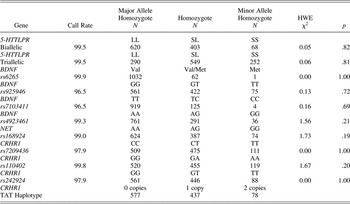
Call rates for individual SNP determinations ranged from 96.5% to 100%. Genotype distributions for all SNPs included in the analyses are presented in Table 1. All genetic polymorphisms were in Hardy–Weinberg equilibrium.
Call rate, genotype frequencies, and Hardy–Weinberg equilibrium for selected genes and associated SNPs

5-HTTLPR: Biallelic and triallelic
The 5-HTT gene has a polymorphism in the linked polymorphic region (5-HTTLPR) in the 5′ regulatory region due to a 44 base pair deletion that eventuates in either the short or long allele (Lesch et al., Reference Lesch, Bengel, Heils, Sabol, Greenberg and Petri1996). 5-HTTLPR samples were genotyped for fragment length polymorphisms of 5-HTTLPR with Hot Star Taq PCR Mix (Qiagen, Catalog 203205) and previously described primers (Gelernter, Kranzler, & Cubells, Reference Gelernter, Kranzler and Cubells1997), followed by fragment analysis using a CEQ 8000 (Beckman-Coulter, Inc.).
SNP genotyping for 5-HTTLPR (rs25531)
The SNP located within the 5-HTTLPR L/S region, rs25531 (NC_000017.11:g.30237328T>C), was genotyped using previously reported TaqMan probes (Lesch et al., Reference Lesch, Bengel, Heils, Sabol, Greenberg and Petri1996). Individual allele determinations were made using TaqMan Genotyping Master Mix (Life Technologies, Catalog 4371357) with amplification on a GeneAmp 9700 (Applied Biosystems) and analyzing the endpoint fluorescence using a Tecan M200 and data analyzed with JMP 10.0 (SAS, Inc.). Human DNA from cell lines was purchased from Coriell Cell Repositories for all representative genotypes in duplicate and genotypes confirmed by sequencing using dye terminator cycle sequencing on an ABI 3130xl. These and no-template controls were run alongside study samples representing 9% of the total data output. Any samples that were not able to be genotyped to a 95% or greater confidence were repeated under the same conditions (Hu et al., Reference Hu, Oroszi, Chun, Smith, Goldman and Schuckit2005).
Fragment length polymorphism genotyping for 5-HTTLPR
Human genomic DNA was collected using the Buccal Amp Kit (Epicentre, Cat. No. BQ0901SSC) and amplified using the Repli-g kit (Qiagen, Catalog 150043) per the kit instructions. Amplified samples were then diluted to a working concentration and PCR amplified with HotStar Taq PCR Mix (Qiagen, Catalog 203205) and previous described primers (Gelernter et al., Reference Gelernter, Kranzler and Cubells1997), followed by fragment analysis using a CEQ8000 (Beckman-Coulter, Inc.; Gelernter et al., Reference Gelernter, Kranzler and Cubells1997).
BDNF
SNP genotyping for BDNF (rs6265, rs4923461)
Amplified samples were then diluted to a working concentration and genotyped for two SNPs in the BDNF gene rs6265 (C_000011.10:g.27658369C>T) and rs4923461 (NC_000011.10:g.27635363A>G) using TaqMan SNP genotyping assays C_11592758_10 and C_50562_10 (Applied Biosystems), respectively. Individual allele determinations were made using TaqMan Genotyping Master Mix (Life Technologies, Catalog 4371357) with amplification on a GeneAmp 9700 (Applied Biosystems) and analyzing the endpoint fluorescence using a Tecan M200 and JMP 10.0 (SAS, Inc.). Human DNA from cell lines was purchased from Coriell Cell Repositories for all representative genotypes in duplicate using previously reported genotyped from the National Center for Biotechnology Information. These and no-template controls were run alongside study samples representing 9% of the total data output. Any samples that could not be genotyped to a 95% or greater confidence were repeated under the same conditions.
SNP genotyping for BDNF (rs925946, rs7103411)
Repli-g amplified samples were then diluted to a working concentration and genotyped for two SNPs in the BDNF gene rs925946 (NC_000011.10:g.27645655T>G) and rs7103411 (NC_000011.10:g.27678578C>T). DNA from study subjects was submitted to the BioMedical Genomics Center at the University of Minnesota for quantity and quality testing then subsequent SNP genotyping. Sample quantity was measured using a nonallelic real-time PCR reaction and a standard TaqMan probe and DNA quantity measured using the Quant-iT PicoGreen dsDNA Assay Kit (P11496, Life Technologies). Once samples were determined to be of sufficient quantity and quality, they were subjected to single base primer extension with fluorophore labeled nucleotides from primers designed for SNPs of interest. Genotyping was then carried out on the iPLEX platform from Sequenom Bioscience, Inc., using the Sequenom MassArray for matrix-assisted laser desorption ionization time of flight mass spectrometry. Duplicate samples were used to ensure reproducibly and no-template controls were run alongside study samples representing 2% of the total data output.
The frequencies of the minor homozygote genotype for BDNF SNPs rs7103411 and rs4923461 were rare (see Table 1). Accordingly, genotype groups combining the minor homozygote with the heterozygote genotype were used in analyses (rs7103411: TT vs. TC or CC; rs4923461: AA vs. AG or GG).
CRHR1
CRHR1 was genotyped using assays for SNPs rs110402, rs242924, and rs7209436 purchased from Applied Biosystems as C2544843 10, C2257689 10, and C1570087 10, respectively. Individual allele discriminations were made using Taq Man Genotyping Master Mix (Applied Biosystems, Catalog 4371357) with amplification in an ABI 9700 thermal cycler and analyzing the endpoint fluorescence using a Tecan M200
Arlequin v3.5.1.3 was used to form haplotypes using a pseudo-Bayesian approach to estimate phase (Escoffier & Lischer, Reference Escoffier and Lischer2011). All samples were haplotyped with greater than 98% confidence, with the exception of four samples, which were subsequently excluded from analyses. Over 92% of the sample was represented by either the TAT or the CGG haplotype. The distribution of copies for the TAT haplotype, as shown in Table 1, was 0 copies (52.8%), 1 copy (40.0%), and 2 copies (7.2%).
NET
SNP genotyping for SLC6A2 (rs168924; i.e., NET-1014A/G)
Amplified samples were then diluted to a working concentration and genotyped for rs168924, a SNP in the SLC6A2 gene, which has also been identified in literature as the NET-1014A/G polymorphism. This SNP is located at NC_000016.10:g.55655632A>G and was genotyped using C_581568_10 (Life Technologies, Inc.). Individual allele determinators were made using TaqMan Genotyping Master Mix (Life Technologies, Catalog 4371357) with amplification on a GeneAmp 9700 (Applied Biosystems) and analyzing the endpoint fluorescence using a Tecan M200 and JMP 10.0 (SAS, Inc.). Human DNA from cell lines was purchased from Coriell Cell Repositories for all representative genotypes in duplicate using previously reported genotypes from the National Center for Biotechnology Information. These as no-template controls were run alongside study samples representing 9% of the total data output. Any samples that were not able to be genotyped to a 95% or greater confidence were repeated under the same conditions.
Because of the low frequency of the GG genotype (n = 74), it was combined with the AG heterozygote, and compared to the AA group in statistical analyses.
Ancestral proportion determinations
DNA from the study participants was submitted to the BioMedical Genomics Center at the University of Minnesota for quantity and quality testing and subsequent SNP genotyping. Acceptable samples (99.0%, 10 cases were excluded) were subjected to SNP genotyping of the Burchard et al. panel of 106 SNPs (Lai et al., Reference Lai, Tucker, Choudhry, Parnell, Mattei and Garcia-Bailo2009; Yaeger et al., Reference Yaeger, Alvial-Bront, Abdul, Nolan, Grann and Birchette2008), known to be informative for ancestry from Africa, Europe, and Native America. The SNPs were genotyped using the iPLEX platform from Sequenom Bioscience, Inc., which uses the Sequenom MassArray. The SNP genotyping results were then recoded and uploaded into STRUCTURE v2.3.4, which uses algorithms developed by Pritchard et al. (Falush, Stephens, & Pritchard, Reference Falush, Stephens and Pritchard2003, Reference Falush, Stephens and Pritchard2007; Hubisz, Falush, Stephens, & Pritchard, Reference Hubisz, Falush, Stephens and Pritchard2009). Three SNP tests were excluded based on high allele call rates of the non-DNA containing wells. The data from the remaining 103 loci were uploaded into the software and set to analyze with an Admixture model of ancestry and initialization of the simulation on the GALA cohort. The simulation was set to run with a burn-in of 10,000, MCMC reps of 1,000, and assuming three populations within the group. The results of the simulations were subsequently identified as percent association to each ancestry group, African, Native American, and European, based on the known ancestry of the GALA cohort.
Logistic regression procedures were used to classify individuals into distinct ancestral groups, utilizing the continuous proportion scores of the ancestrally important markers to predict parent-reported child race in the larger sample of camp participants. The resulting classification for the African American group used in this study (n = 1,096) was highly homogeneous for the African ancestral markers (M = 0.92, SD = 0.10).
Results
Plan of analysis
We examined a series of models to investigate the coactions of genetic variants and maltreatment status and associated maltreatment parameters in relation to child self-report of depressive symptoms (CDI total scores) and adult-report of child anxiety/depression symptoms (TRF anxiety/depression subscale). Allelic variants of SNPs linked to the 5-HTT, BDNF, NET, and CRCH1 genes were evaluated. Analyses for each genetic variant involved analyses of covariance (ANCOVAs), with gender and child age included as covariates. Gender was controlled because of the significant difference in gender composition between the maltreated and nonmaltreated samples (p = .03, as indicated above). Gender correlated (r = .07, p = .02) with CDI scores, indicating higher scores among boys relative to girls. Gender was not associated with anxiety/depression TRF symptoms (r = –.01, ns). Age was correlated with CDI (r = –.09, p = .002) and TRF anxiety/depression (r = –.07, p = .02), with younger children self-reporting and being rated as exhibiting higher symptomatology. In the ANCOVA models, the genetic variant and maltreatment status were included as main effects, along with their interaction. Additional analyses involving maltreatment parameters were considered when cell sizes were sufficient to undertake such analyses. Bonferroni-corrected contrasts were used in follow-up analyses to identify significant group differences and the pattern of G × E interaction effects. In addition, analyses involving two gene systems were evaluated for G × G × E interaction effects.
Following the recommendations of Keller (Reference Keller2014), rather than control for gender as a covariate, we initially evaluated models that included gender main effects and interactions with maltreatment status and with genotypes. Except for one analysis, all of these gender interaction effects were nonsignificant, and results involving other main effects and interaction effects were consistent with those without the gender interaction. Accordingly, for parsimony and because of a lack of hypotheses about gender interactions, we maintained gender as a covariate in all models. However, in the analysis of BDNF, triallelic 5-HTTLPR, and maltreatment status, which did have a significant gender interaction, we maintained all gender interactions in the model, as presented below.
Initial analyses indicated that biallelic 5-HTTLPR in models of CDI and TRF anxiety/depression symptoms did not result in significant G or G × E effects. However, important findings were found when triallelic 5-HTTLPR was examined, and results with triallelic 5-HTTLPR are reported.
Evidence for gene–environment correlation effects
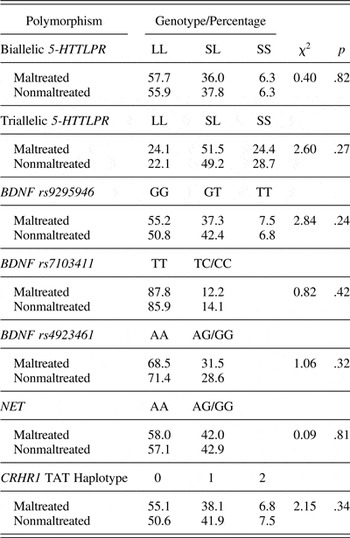
For each of the genotypes determined for each of the targeted genes, biallelic 5-HTTLPR, triallelic 5-HTTLPR, BDNF SNPs, NET, and CRHR1 TAT haplotype comparisons were conducted between the distribution of genotype groups in the maltreated and nonmaltreated samples with χ2 tests. These comparisons are shown in Table 2. All maltreatment group differences were nonsignificant, indicating that maltreatment status was not associated with genetic variation in any of the respective genes.
Comparison of maltreated and nonmaltreated children on genotype group distributions

Models for CDI outcomes
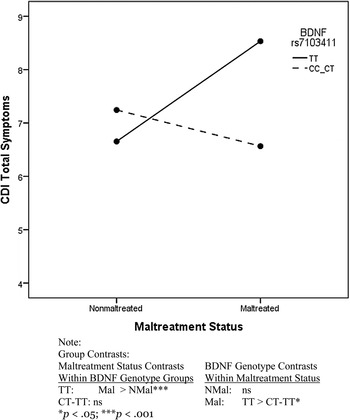
BDNF SNP rs7103411 was examined in an ANCOVA model for CDI symptoms. After controlling for covariates, although the main effects for the BDNF, F (1, 1,037) = 1.31 p = .25, and for maltreatment status, F (1, 1,037) = 0.99, p = .32, were nonsignificant, the G × E interaction was significant, F (1, 1,037) = 4.48, p = .03. As shown in Figure 1, for children with the TT genotype, maltreated children had significantly higher depressive symptoms than nonmaltreated children, whereas the difference between maltreated and nonmaltreated children was not significant in the TC-CC group. Among nonmaltreated children, no differences in depressive symptoms were found for the two BDNF genotype groups. In contrast, among maltreated children, those with the TT BDNF genotype had significantly higher symptoms than those with the TC-CC genotype.
BDNF rs7103411 × Maltreatment Status interaction for Child Depression Inventory depressive symptoms. *p < .05, ***p < .001.

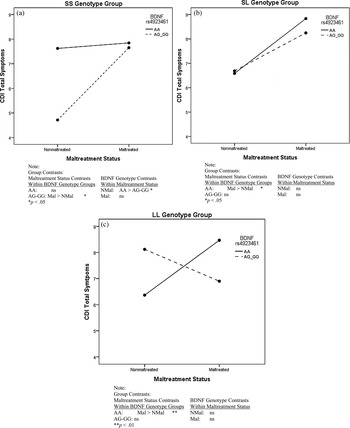
A similar analysis was conducted with the rs49233461 BDNF SNP. Neither G nor G × E effects were significant. However, we further examined this BDNF SNP in G × G × E analyses with triallelic 5-HTTLPR, given the precedence in the literature for G × G × E effects of 5-HTTLPR, BDNF, and maltreatment history (cf., Kaufman et al., Reference Kaufman, Yang, Douglas-Palumberi, Grasso, Lipschitz and Houshyar2006). This was the one analysis in which gender interactions were observed. In this ANCOVA analysis, after controlling for age and including gender main effects and interactions, with CDI scores as the dependent variable, a significant main effect for maltreatment status was observed, F (1, 1,043) = 8,92, p = .003, with maltreated children having higher scores than nonmaltreated children. Other significant main effects and two-way interactions were nonsignificant. However, a significant three-way interaction of maltreatment, gender, and 5-HTTLPR was observed, F (2, 1,043) = 3.27, p = .01. More important, the G × G × E three-way interaction was significant, F (2, 1,043) = 3.00, p = .05. An analysis of this three-way interaction shows the pattern of the interaction effects of maltreatment status and the BDNF SNP separately for the three triallelic 5-HTTLPR genotypes. For children with the triallelic 5-HTTLPR S/S genotype (Figure 2a), within BDNF genotype groups, among children with AG or GG genotypes, maltreated children had significantly higher CDI scores than did nonmaltreated children. Among children with AA genotypes, maltreatment group differences were nonsignificant. Further, among maltreatment status groups, for nonmaltreated children, those with the AA BDNF genotype had significantly higher CDI scores than those in the AG-GG genotype group.
(a) BDNF rs4923461 × Maltreatment Status within the triallelic 5-HTTLPR S/S genotype group: Child Depression Inventory (CDI) depressive symptoms. (b) BDNF rs4923461 × Maltreatment Status within the triallelic 5-HTTLPR S/L genotype group: CDI depressive symptoms. *p < .05. (c) BDNF rs4923461 × Maltreatment Status within the triallelic 5-HTTLPR L/L genotype group: CDI depressive symptoms. **p < .01.

A different pattern emerged for children with the triallelic 5HTTLPR S/L genotype (Figure 2b). For children with AA genotypes, maltreated children had significantly higher CDI symptoms than nonmaltreated did children; differences were not significant for maltreatment groups for those with AG-GG genotypes. In addition, differences among nonmaltreated and maltreated children were not significantly different depending on whether they had AA or AG-GG BDNF genotypes.
Finally, for children with the triallelic 5-HTTLPR L/L genotype (Figure 2c), the only significant group contrast was for children with the AA BDNF genotype, with maltreated children having higher CDI scores than nonmaltreated children.
Thus, significant differences between maltreated and nonmaltreated children in CDI scores were observed for children with S/L or L/L genotypes of triallelic 5-HTTLPR and BDNF AA genotypes (major alleles are prominent), whereas for children with S/S genotypes, maltreated children had higher CDI symptoms than nonmaltreated children among those with AG-GG BDNF genotypes (minor alleles are predominant).
Additional analyses examining the CRHR1 TAT haplotype and NET in relation to CDI symptoms did not result in G or G × E effects. However, these genetic variants were found to operate in models for TRF anxiety/depression.
Models for TRF anxiety–depression outcomes
Triallelic 5-HTTLPR
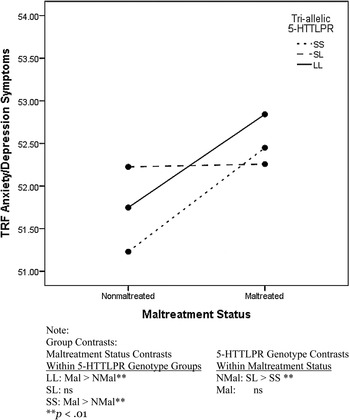
In the first analysis, we examined triallelic 5-HTTLPR and maltreatment status with TRF anxiety/depression symptoms as the dependent variable. In this ANCOVA model, the effect of maltreatment status was significant, F (1, 1,087) = 11.78, p = .001, whereas the effect of genotype was not, F (1, 1,087) = 1.38, p = .25. However, the G × E interaction effect was significant, F (1, 1,087) = 3.43, p = .03. This interaction is depicted in Figure 3. Follow up Bonferroni contrasts indicated that maltreated children had significantly higher anxiety/depression symptoms in both the L/L genotype group and in the S/S genotype group, whereas there was no difference among maltreated and nonmaltreated children for those with the S/L genotype. Furthermore, among the nonmaltreated children, those with the S/L genotype had significantly higher symptoms than those with the S/S genotype. Other contrasts were not significant. Among nonmaltreated children, none of the contrasts among genotype groups was significant.
Triallelic 5-HTTLR × Maltreatment Status interaction for Teacher Report Form anxiety/depression symptoms. **p < .01.

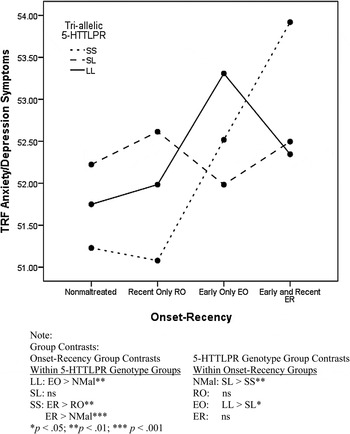
Consideration of variation in developmental timing of maltreatment experiences further elaborated the triallelic 5-HTTLPR × Maltreatment interaction effect. In terms of onset-recency groups, after controlling for covariates, the ANCOVA resulted in a significant effect for maltreatment onset/recency group, F (3, 1,072) = 5.64, p = .001, a nonsignificant genotype effect, F (2, 107) = 0.13, p = .88, and a significant G × E interaction, F (6, 1,072) = 3.51, p = .002. See Figure 4. Follow-up Bonferroni contrasts indicated that among children with the S/S genotype, children with early and recent maltreatment experiences had significantly higher symptoms than did nonmaltreated children and children with only recent maltreatment. In contrast, for the L/L genotype group, early only maltreatment children had significantly higher symptoms than nonmaltreated children; no other contrasts were significant. As in the prior analysis with maltreatment status, among children with the S/L genotype, no significant differences across onset-recency groups were observed.
Triallelic 5-HTTLR × Maltreatment Onset-Recency Group interaction for Teacher Report Form anxiety/depression symptoms. *p < .05, **p < .01, ***p < .001.

When genotype differences were examined within onset-recency groups, as before, among nonmaltreated children those with S/L genotypes had significantly higher symptoms on the TRF than did nonmaltreated children with S/S genotypes. Among children with early only maltreatment, those with L/L genotypes had significantly higher symptoms than those with S/L genotypes. Significant symptom differences among genotype groups were not found for children in the early and recent group and the recent only group.
NET
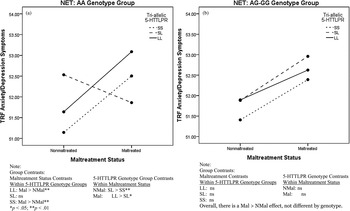
Variation in the NET gene was examined in relation to maltreatment status for TRF anxiety/depression scores. The initial model examining NET and maltreatment status did not indicate significant G or G × E effects. However, relations were observed when NET was added to a model including triallelic 5-HTTLPR. In this ANCOVA model after controlling for covariates, the main effect of maltreatment was significant, F (1, 1,063) = 12.47, p < .001. In addition, a three-way interaction of NET × 5-HTTLPR × Maltreatment Status was observed, F (2, 1,063) = 3.48, p = .03. See Figure 5 for illustrations of this interaction effect. The interaction effects were examined with Bonferroni contrasts. In Figure 5a, children with the AA genotype of NET are shown. The interactive effects of triallelic 5-HTTLPR and maltreatment status are presented. Maltreated children had higher symptom scores than did nonmaltreated children when they had L/L and the S/S 5-HTTLPR genotypes. For children with S/L genotypes, the maltreated and nonmaltreated children did not significantly differ.
(a) Triallelic 5-HTTLPR × Maltreatment Status interaction within the NET AA genotype group: Teacher Report Form anxiety/depression symptoms. *p < .05, **p < .01. (b) Triallelic 5-HTTLPR × Maltreatment Subtype Group interaction within the NET AG-GG genotype group: Teacher Report Form anxiety/depression symptoms. Overall, there is a Mal > NMal effect, not different by genotype.

Within maltreatment status groups, among nonmaltreated children, those with the S/L genotype had significantly higher symptoms than those with the S/S genotype; for maltreated children, those with the L/L genotype had significantly higher symptom scores than those children with the S/L genotype.
In contrast, relations were different for children with a minor allele of NET, AG or GG genotypes, as shown in Figure 5b. For these children there were no main effects of 5-HTTLPR or interaction effects of 5-HTTLPR and maltreatment status. The main effect of maltreatment status on symptoms for the AG-GG subgroup was significant, with maltreated children having higher symptoms than nonmaltreated children, regardless of genetic variation.
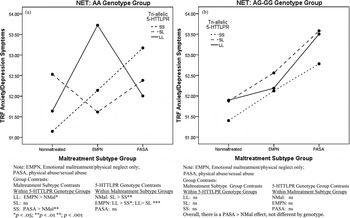
The findings for the NET × 5-HTTLPR × Maltreatment Status interaction were further elaborated through consideration of maltreatment subtype effects. The ANCOVA utilizing subtype group, with NET and 5-HTTLPR genotypes, resulted in a significant effect for maltreatment subtype group, F (2, 1,057) = 7.38, p = .001, as well as significant three-way interaction of NET, 5-HTTLPR, and subtype group, F (4, 1,057) = 2.72, p = .03. Figure 6 presents this three-way interaction effect. In comparison to the analysis above with maltreatment status (Figure 5a), Figure 6a shows the interaction effect among children with the NET AA genotype and illustrates variation between the PNEM and PASA subgroups. Bonferroni contrasts indicated that among children with the S/S 5-HTTLPR genotype, children in the PASA group had higher TRF anxiety/depression scores than did nonmaltreated children. Among children with the L/L 5-HTTLPR genotype, the PNEM group had significantly higher anxiety/depression scores than did nonmaltreated children. For children with the S/L 5-HTTLPR genotype, maltreatment status group differences were not significant.
(a) Triallelic 5-HTTLPR × Maltreatment Subtype Group interaction within the NET AA genotype group: Teacher Report Form anxiety/depression symptoms. *p < .05, **p < .01, **p < .001. (b) Triallelic 5-HTTLPR × Maltreatment Subtype Group interaction within the NET AG-GG genotype group: Teacher Report Form anxiety/depression symptoms. Overall, there is a PASA > NMal effect, not different by genotype.

As in prior analyses, among the nonmaltreated children, those with the S/L genotype had significantly higher scores than those with the S/S genotype. In contrast, among children in the PNEM group, those with the L/L 5-HTTLPR genotype had significantly higher symptom scores than those with the S/L genotype and those with the S/S genotype. For children in the PASA group, difference among children in the different 5-HTTLPR genotype groups did not differ significantly.
Figure 6b shows the different effects for children with the NET AG or GG genotypes. As in the analysis with maltreatment status, contrasts indicated a significant effect overall for subtype group, with children in the PASA group having significantly higher symptoms than nonmaltreated children. However, no subtype group contrasts were significant within 5-HTTLPR genotype groups, and no genotype group effects were significant within maltreatment subtype groups. Thus, genetic effects were not present in the subgroup of children with NET AG or GG genotypes.
BDNF
Analyses were conducted with BDNF SNPs rs7103411 and rs4923461 in modeling individual differences in TRF anxiety/depression scores. G, G × E, and G × G × E effects were found for these two SNPs.
Although significant G and G × E effects were not obtained for BDNF rs71043, ANCOVA analyses with BDNF SNP rs49233461 were informative. For TRF anxiety/depression symptoms, the ANCOVA indicated a main effect for maltreatment status, F (1, 1,078) = 4.24, p = .04, and a marginally significant gene main effect, F (1, 1,078) = 3.23, p = .07, with children having the major allele homozygote, AA, tending to have higher symptomatology than those with a minor allele, AG or GG. The G × E interaction was not significant, F (1, 1,078) = 0.86, p = .35.
We followed up these gene main effects in ANCOVAs examining maltreatment parameters. In these analyses, significant gene main effects were observed for analyses with maltreatment subtype, p = .01, number of subtypes, p = .01, and onset-recency, p = .03. In each of these ANCOVAs, the gene main effect was significant, with children with the AA major allele genotype having higher scores on TRF anxiety/depression symptoms than those with a G allele.
CRHR1 TAT haplotype
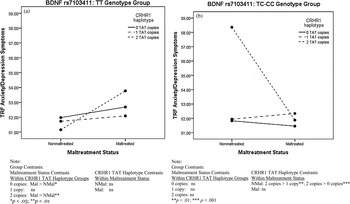
The CRHR1 TAT haplotype did contribute G or G × E effects to the model for TRF anxiety/depression symptoms. However, given the G × E interaction effect for maltreatment status and BDNF rs7103411 presented above, we further considered whether CRHR1 would contribute to the model in conjunction with BDNF. In the ANCOVA model for TRF anxiety/depression symptoms, after controlling for covariates, a significant main effect was found for CRHR1 haplotype, F (2, 1,036) = 3.79, p = .02, as well as two significant two-way interactions: BDNF × Maltreatment Status, F (1, 1,036) = 12.49, p < .001, and BDNF × CRHR1 Haplotype, F (2, 1,050) = 3.52, p = .03. However, these effects were clarified by a significant three-way, G × G × E, interaction, F (2, 1,036) = 5.61, p = .004. This interaction effect is shown in Figure 7. In Figure 5a, the interaction of CRHR1 TAT haplotype and maltreatment status is depicted for children with the BDNF TT genotype. Among children with two copies of the TAT haplotype, maltreated children had significantly higher anxiety/depression symptoms than did nonmaltreated children. This maltreatment status effect was also significant for children with zero copies of the TAT haplotype, but not for those with one copy. Within maltreatment status groups, there were no significant differences between haplotype groups for maltreated or for nonmaltreated children.
(a) CRHR1 TAT Haplotype × Maltreatment Status interaction within the BDNF rs7103411 TT genotype group: Teacher Report Form anxiety/depression symptoms. *p < .05, **p < .01. (b) CRHR1 TAT Haplotype × Maltreatment Status interaction within the BDNF rs7103411 TC-CC genotype group: Teacher Report Form anxiety/depression symptoms. **p < .01, ***p < .001.

When children with the BDNF TC or CT genotypes were examined (Figure 5b), a very different pattern emerged. Nonmaltreated children with two copies of the TAT haplotype were significantly higher in anxiety/depression symptoms than nonmaltreated children with zero copies or one copy (p = .002). Thus, the role of CRHR1 and maltreatment is very different among children with the BDNF TT genotype versus those with the CT or CC genotypes.
Discussion
Evidence for the experience of child maltreatment being associated with polymorphic variation in any of the genes included in this investigation was not found. Thus, the potential for gene–environment correlation effects to influence the probability of children experiencing abuse and neglect was not supported. Child maltreatment had a significant independent main effect in predicting CDI depressive symptomatology and TRF anxiety/depression problems. Among the genes examined, 5-HTTLPR, BDNF (4 SNPs), CRHR1 TAT haplotype, and NET, only one SNP of BDNF (rs49233461) evidenced a main effect on TRF anxiety/depression in the context of maltreatment parameters. This was an additive effect, in that maltreatment parameters had a direct effect on symptoms; BDNF added to that effect, but it did not diminish the effects of maltreatment. The remaining genes, while not significantly directly related to outcomes, were found to be variously involved in moderating the main effects of child maltreatment on depression and internalizing symptoms.
We found support for a G × E interaction, with the triallelic 5-HTTLPR moderating the effect of maltreatment on TRF anxiety/depression. However, the pattern of the genotype differences was not typically reported in the literature. Specifically, both S/S and L/L genotypes of 5-HTTLPR were associated with greater anxiety/depression symptoms for maltreated children. For children with the S/L genotype, maltreated and nonmaltreated children did not differ in symptom level. Moreover, within the group of nonmaltreated children, those with S/L genotypes had significantly higher anxiety/depression symptoms than those nonmaltreated children who possessed the S/S genotype.
These findings demonstrate that researchers should not presume that a particular genotype is uniquely associated with plasticity. Plasticity may vary based on a number of factors, including culture, racial composition, and variation in the parameters of the risk construct (e.g., developmental timing, subtype differences, and individual differences in experiencing, or exposure to, the environmental pathogen). Furthermore, the findings of this investigation illustrate the importance of analyzing S/S and S/L genotypes independently. Combining them, as often is the case in studies with small sample sizes, would have missed important differences in this African American sample.
The triallelic 5-HHTLPR × Maltreatment G × E picture became expanded when maltreatment parameters were considered. We examined G × E findings for onset-recency in maltreatment groups. The effects of the various triallelic 5-HTTLPR genotypes further varied based on children's developmental experiences of maltreatment. Specifically, the highest TRF anxiety/depression symptoms were found for children in the S/S genotype group who had experienced both early onset and recent maltreatment. The highest anxiety/depression symptoms were found in the L/L genotype group for children who had experienced only early onset maltreatment. Finally, children who experienced only recent onset maltreatment were similar to, but not significantly different from, the nonmaltreated children, who had their highest symptoms with S/L genotypes. These results reveal that variation in the developmental timing of child maltreatment is associated with differential genetic vulnerability to anxiety/depression symptomatology. All three 5-HTTLPR genotypes were associated with greater risk for symptomatology, depending on variation in the pattern of maltreatment exposure across development.
The interaction of BDNF SNP rs7103411 and child maltreatment produced a statistically significant G × E such that maltreated children who had the TT genotype had higher depressive symptomatology on the CDI than nonmaltreated children with the TT genotype (cf. Kaufman et al., Reference Kaufman, Yang, Douglas-Palumberi, Houshyar, Lipschitz and Krystal2004). Whereas nonmaltreated children did not differ in symptom level dependent on genotype variation, maltreated children with the TT genotype had significantly higher CDI depressive symptoms than did maltreated children in the TC-CC genotype group. Thus, maltreated children who were minor allele carriers appeared protected from depressive symptoms.
In addition, we conducted a G × G × E analysis with a three-way interaction among the triallelic 5-HTTLPR, BDNF rs4923461, and child maltreatment in relation to depressive symptomatology on the CDI. Maltreated children with the S/S genotype of the triallelic 5-HTTLPR and either the AG or GG genotypes of BDNF had significantly higher CDI depression scores than did nonmaltreated children. Another pattern was found for maltreated children who possessed the triallelic 5-HTTLPR S/L genotype and the AA genotype of BDNF. These maltreated children had higher depressive symptoms on the CDI than the nonmaltreated children with the same genotypes. A similar pattern was found for maltreated children with the L/L 5-HTTLPR genotype and AA genotype of BDNF. These findings further underscore the importance of examining each of the triallelic 5-HTTLPR genotypes, and illustrate variation in outcomes with consideration of multigenic influences.
The triallelic 5-HTTLPR × BDNF × Maltreatment results bear striking similarity to those obtained by Kaufman et al. (Reference Kaufman, Yang, Douglas-Palumberi, Grasso, Lipschitz and Houshyar2006), who reported a G × G × E interaction among the biallelic 5-HTTLPR, BDNF VAL66MET, and child maltreatment on child-reported depressive symptoms. Kaufman et al.'s (Reference Kaufman, Yang, Douglas-Palumberi, Grasso, Lipschitz and Houshyar2006) sample comprised 196 children. Slightly over 100 were residing in foster care for recent (within the past 6 months) child maltreatment. The remainder of the participants were from comparable low socioeconomic backgrounds, living in their natural homes, and had not experienced maltreatment. Although the sample was ancestrally heterogeneous, Kaufman et al. utilized ancestral informative markers to covary for racial differences. The environmental pathogen of child maltreatment utilized was carefully defined.
The current study comprised an ancestrally homogenous sample of 1,096 African American 7- to 12-year-old children. The sample enrolled was over five times larger than that of Kaufman et al. (Reference Kaufman, Yang, Douglas-Palumberi, Grasso, Lipschitz and Houshyar2006). The triallelic 5-HTTLPR was utilized and a different BDNF SNP was used than in the Kaufman et al. (Reference Kaufman, Yang, Douglas-Palumberi, Grasso, Lipschitz and Houshyar2006) study because of the very low rate of biallelic 5-HTTLPR S/S genotypes (6.3%) and of valine/methionine or methionine/methionine BDNF genotypes (5.8%) in our African American sample. Maltreatment and nonmaltreatment status were documented using objective, reliable, and valid criteria. All children lived at home and were from low socioeconomic status families. Similar to the Kaufman et al. (Reference Kaufman, Yang, Douglas-Palumberi, Grasso, Lipschitz and Houshyar2006) study, which controlled for ancestral markers, in the present study ancestral markers were used to identify a homogeneous African American group. Despite the differences in sample size, racial composition, and contextual characteristics, our results provide confirmatory evidence for Kaufman et al.'s BDNF × (biallelic) 5-HTTLPR × Child Maltreatment three-way interaction finding on depression symptoms. The present study was not designed as a literal replication of Kaufman et al (Reference Kaufman, Yang, Douglas-Palumberi, Grasso, Lipschitz and Houshyar2006), nor was our sole focus on confirming or disconfirming Kaufman et al.'s (Reference Kaufman, Yang, Douglas-Palumberi, Grasso, Lipschitz and Houshyar2006) findings. Nonetheless, the similarity between the results of the present study to their G × G × E results is striking and important.
The NET and CRHR1 genes did not evince G × E effects with either TRF or CDI; however, each of these genes was found to be important in G × G × E interactions. For example, the G × G × E effect for the triallelic 5-HTTLPR, NET genotypes, and maltreatment suggests that NET moderates the G × E effects of 5-HTTLPR and child maltreatment on anxiety/depression scores. Specifically, for children with the NET AA genotype, the pattern of G × E effects were very similar to the pattern for 5-HTTLPR for the entire sample. In contrast, for children with NET AG-GG genotypes, the interactive effects of 5-HTTLPR and maltreatment were no longer observed. Thus, variation in NET influenced where 5-HTTLPR had a moderating influence on the effects of child maltreatment on anxiety/depression symptoms.
These results were further elucidated through examination of variation in children's maltreatment experiences by evaluating the effects of different subtypes of maltreatment. Again, the moderating effects of 5-HTTLPR were observed only among children with NET AA genotypes. Striking here was that the highest anxiety/depression symptoms were found among children in the emotional maltreatment/physical neglect group with L/L genotypes, whereas among children with the S/S 5-HTTLPR genotype, those children who had experienced physical/sexual abuse were the most symptomatic. These differential 5-HTTLPR/maltreatment subtype effects were not present among children in the NET AG-GG genotype group; only subtype appeared to influence symptom outcomes for these children.
Another pattern of G × G × E interaction was observed when the influences of CRHR1 and BDNF rs7103411 were examined together to predict TRF anxiety/depression symptoms. In isolation, neither gene was found to interact with maltreatment to influence symptom outcomes. However, when they were considered together, a significant G × G × E interaction was observed. Specifically, among children who had two copies of the CRHR1 haplotype and the TT genotype of BDNF, maltreated children had more symptoms than nonmaltreated children. Maltreated children with zero copies of the TAT haplotype also had a significantly greater number of anxiety/depression symptoms than did nonmaltreated children. In contrast, for children with the BDNF TC or CC genotypes and two copies of the TAT haplotype of CRHR1, it was the nonmaltreated children who had higher anxiety and depression scores than nonmaltreated children with zero or one copy; no CRHR1 haplotype differences were observed among maltreated children with BDNF TC or CC genotypes. Thus, it appears that the co-action of both genes together was important in revealing genetic moderation of the effects of child maltreatment on symptoms and would have not been detected had the genes only been considered separately.
This multigenic study of the genetic moderation of the effects of child maltreatment on depression and internalizing symptomatology in school-aged African American children is an important addition to the molecular genetic literature. Multilevel research such as conducted with this sample of African American children contributes to reducing the gap in molecular genetic studies with African American children. The ancestrally homogeneous sample comprised a large number of children, many of whom were in transition from preadolescence to adolescence. This is a developmental period characterized by marked changes in neurobiological, hormonal, psychological, and social systems and great risk for depression and internalizing psychopathology.
Another positive aspect of this investigation is that it was conceived to address issues raised by Duncan (Duncan & Keller, Reference Duncan and Keller2011; Duncan, Pollastri, & Smoller, Reference Duncan, Pollastri and Smoller2014) and Keller (Reference Keller2014) regarding the current state of Gene × Environment research. The replication and extension of Kaufman et al. (Reference Kaufman, Yang, Douglas-Palumberi, Grasso, Lipschitz and Houshyar2006) with a substantially larger sample size is important. The low-income population from which the majority of maltreated children come (Sedlak et al, Reference Sedlak, Mettenburg, Basena, Petta, McPherson and Greene2010) is very racially and ethnically diverse. Keller (Reference Keller2014) has cautioned the need not only to covary race in G × E analyses but also to evaluate interaction effects of race with genetic variation and race with environmental risk factors. In the present study of African Americans with ancestral marker homogeneity, we have eliminated the effect of race interactions influencing results. Keller (Reference Keller2014) also suggests gender interactions should similarly be evaluated. We evaluated all such gender interactions in our analyses and found only one such effect. Thus, this analysis retained these more thorough gender interaction controls. These features of our approach all serve to decrease the probability that the present findings are false positives.
The experience of child maltreatment is a major risk factor for the development of depression and internalizing problems, even in the absence of genetic moderation. Delineation of how genetic variation influences symptomatology adds to the understanding of how psychopathology emerges in African American children exposed to child abuse and neglect. The targeted genes we investigated influence neurotransmitter systems, stress regulation, and synaptic plasticity, thus implicating multiple components that may contribute to differential pathways to depression and internalizing outcomes. Several different patterns of G × E and G × G × E interactions emerged between maltreated and nonmaltreated African American children. Moreover, variation in developmental timing and subtypes of maltreatment also are important considerations in understanding developmental pathways. Future multilevel research that examines gene–brain–HPA axis dysregulation in relation to depression will enable the construction of relatively homogeneous subgroups of African American children that may show greater improvement with different types of intervention.
Differential pathways may suggest implications for preventing depression in African American children and for intervening with individuals where depression has occurred. Depression among African American adolescents is an important public health concern (Byck, Bolland, Dick, Asbeck, & Mustanski, Reference Byck, Bolland, Dick, Ashbeck and Mustanski2013), and distressed African American youth are less likely than other racial/ethnic groups to receive treatment (Carson, Cook, & Alegria, Reference Carson, Cook and Alegria2010; Kodjo & Audinger, Reference Kodjo and Audinger2004). Moreover, racial discrimination contributes to the development of depressive symptoms (English, Lambert, & Ialongo, Reference English, Lambert and Ialongo2014). Thus, cultural considerations will be important in any intervention initiatives. Multiple prevention and intervention strategies are likely necessary. The design and implementation of effective intervention approaches will be advanced by attention to the diversity of multilevel processes involved in differential pathways to depressive outcomes among African American children and adolescents.