At the premiere of Peter Grimes (1945), a critic much later recalled, audiences wondered about an earlier opera, composed in America, about which next to nothing seemed to be known. Britten insisted the score for Paul Bunyan – the ‘choral operetta’ he had written with W.H. Auden in 1939–41 – was gone, ‘carelessly left behind in a chest of drawers in Montreal’.Footnote 1 The remembered wording of this phrase is telling, suggesting haplessness rather than wilful erasure, and a transient life rather than a specifically American one. We are left with the impression that even this period of transience had no lasting effects; like the score, it had simply been left behind. In fact, Britten had the score all along, but he waited until the last year of his life to revive the work. It is easy to see why Paul Bunyan was so erased, for it complicates our sense of Britten’s operatic assumptions and ideals, particularly as they are established in Peter Grimes.
If Grimes seems committed to communication and tradition, appearing in the post-war context as a self-assured, almost comfortable act of operatic entrenchment, Paul Bunyan is a tricksy work, suggesting a prevailing operatic scepticism at which Grimes barely hints. Its hybrid genre avoids familiar categories. More striking, though, is its apparent discomfort with singing as a communicative act, and its entirely different approach to operatic populism: through popular styles, hybrid forms, amateur accessibility and a small scale, avoiding anything smacking of the grand even while maintaining a somewhat inaccessible complexity and uncertainty of meaning. The shift from Bunyan to Grimes is routinely imagined in terms of Britten’s personal development: as part of an English homecoming after a brief period of rootlessness and of artistic self-realisation away from the dominating influence of Auden. But in many ways, Grimes seems less of a homecoming than a further experiment in indigenous populist opera, imagined along very different lines from Paul Bunyan but nonetheless shaped by American operatic trends and by Britten’s experience with the failed operetta.
Paul Bunyan has often been seen as out of touch with its American context, dismissed as the confused project of two foreigners, but a closer look suggests a deeper engagement with American musical life and with the problem of American opera, one that left its mark on Britten’s later operas, not least Grimes itself – commissioned for students in the newly founded opera workshop at Serge Koussevitzky’s Berkshire Music Center, much as Paul Bunyan had been commissioned for university and high school students.Footnote 2 At the same time, Paul Bunyan proves a revealing entry-point into the development of American opera at a formative and unstable moment: it suggests operatic institutions and genres in a state of flux, and the definitions of both populism and Americanness as uncertain. The discourse around opera in wartime America, much as in Britain, was concerned not only with developing an indigenous style, but also with the need for democratisation.Footnote 3 One might even argue that populism and democratisation were more fundamental operatic goals than the development of national style – that the latter was incidental to the former – on both sides of the Atlantic. Indeed, Paul Bunyan highlights the transatlantic nature of the American opera project itself. As Lydia Goehr suggests, ‘American’ opera became the site of European attempts to escape the opera crisis of the 1920s, offering an imagined new world of operatic possibilities both to immigrant composers and to those conjuring it from afar.Footnote 4 For Kurt Weill, for instance, in his 1937 article ‘The Future of Opera in America’, American opera promised to continue the developments towards a more populist musical theatre – one closer to theatrical life, and embracing radio, school operas and film – that had been cut off in Germany.Footnote 5 In New York, Britten both picked up from Weill and effectively reversed the transatlantic movement, bringing some of the lessons of American operatic populism back with him when he returned to Britain in late 1942.
Auden’s America
Paul Bunyan was a critical failure in 1941, and it is not hard to understand why. Its genre is mixed, its narrative loose to non-existent, its meaning unclear. It is filled with extraneous episodes and odd, unstageable touches. Paul, the mythic giant lumberjack, is never seen, and is instead represented by a disembodied speaking voice, becoming at times a godlike presence. There are choruses of trees, singing animals and speaking parts for the moon and the wind. Britten’s music ranges widely in style, from the narrator’s set of banjo-accompanied ballad interludes to jazz and blues, Broadway choruses, liturgical chant, sentimental songs and operatic parodies.
In this profusion, it can be hard to tell precisely what Paul Bunyan is about. There is a kind of story, however unoperatic: a large-scale narrative of progress from a state of nature to modernity, and from communal to individual life.Footnote 6 The operetta moves from the innocence and wildness of an unpopulated landscape (as seen in the opening chorus of trees) to the arrival of Paul, who tames the landscape and gathers a motley group of men in his lumber camp, forming a portrait of improvised communal life – in many ways echoing the bohemian Brooklyn household in which Britten, Peter Pears and Auden all lived – that takes up much of the opera.Footnote 7 Tensions emerge, thanks in part to the force of modernisation (a shift to farming, for instance) and individual aspiration, as one of the lumberjacks seeks power over the camp. Eventually everyone is reunited at a festive Christmas celebration, only for them to realise that the time for the camp – and the communal life that went with it – has ended: the wilderness has been cleared and civilisation has arrived. The members of the group go their separate ways, to pursue uncertain destinies in the modern world of Hollywood (entertainment), Washington (government) and New York (tourism). They are sent off with a mock litany, voicing prayers to ‘save animals and men’ from the mixed perils of this new world, from empty political rhetoric and bland entertainment to ‘children brought up to believe in self-expression’.Footnote 8
As this broad narrative unfolds, a few interpolated dreamlike episodes offer further commentary on this process of modernisation. ‘The Blues: Quartet of the Defeated’ – one of the most praised numbers in the work – acts as ‘a dream of warning’ for ‘those who pause on the frontiers of an untravelled empire’.Footnote 9 The ‘Lullaby of Dream Shadows, Film Stars and Models’, which was cut some time during the first run of performances, offers a more elaborate critique of the mind-numbing ‘nullities’ of the entertainment industry, to which Paul Bunyan itself is presumably opposed.Footnote 10
For Auden, the myth of Paul Bunyan was about the end of a state of nature and the moment at which, as Paul says in his parting words, ‘the life of choice begins’.Footnote 11 In an introduction to the piece in the New York Times, he described its central problem:
External physical nature has been mastered, and for this very reason can no longer dictate to men what they should do. Now their task is one of their human relations with each other and, for this, a collective mythical figure is no use, because the requirements of each relation are unique.Footnote 12
It was a myth of modernity more than Americanness, through which Auden – in a world pressed in by totalitarianism – dwelt on the challenges of individual moral choice and the isolation of living free from the bonds of tradition and community. At the same time, these concerns resonated deeply with Auden’s experience of American life.
Auden wrote Paul Bunyan in 1939, soon after he arrived in New York, and its themes of choice and individualism emerge in much of his writing from these years: in his long poem New Year Letter (1940), his introduction to Henry James’s The American Scene and even a proposed film called The Life of an American.Footnote 13 In a 1940 commencement speech at Smith College, he stated: ‘I think I have learned here what I could have learned nowhere else: what the special demands and dangers of an open society are.’Footnote 14 If the demands included those of ‘human relations’, as mentioned in his description of Paul Bunyan, the dangers included loneliness and isolation, concerns that are perhaps even more at issue in the operetta, as seen particularly in one of its central characters, the writer Inkslinger.Footnote 15 ‘America is one of the loneliest places on this planet’, Auden wrote from Ann Arbor in 1941, dwelling in particular on an image of isolated ‘small-town queens’ scattered across the Midwest.Footnote 16 For Auden, then, this sense of America was heavily inflected by his experience as both an immigrant and a gay man.
This preoccupation with America as ‘defined by … the inescapability of choice’ in the absence of ‘entrenched, communal, and inherited moral or cultural narratives’ is also closely connected with Auden’s changing sense of poetry’s function.Footnote 17 Known as a public and political voice in 1930s England, he self-consciously left this role behind at the start of the Second World War. His poems began to show a new interest in drawing boundaries between art and political life. In New Year Letter, for instance, he wrote, ‘Art is not life and cannot be/A midwife to society’.Footnote 18 In some ways, Paul Bunyan carried on the practices of Auden’s more political years, as seen in the plays he wrote with Christopher Isherwood and Britten for London’s Group Theatre in the 1930s, but it also seemed part of an uneasy transition away from this earlier political engagement. The Ascent of F6 (1937) and On the Frontier (1938) had an obvious topicality, even if they were also so elaborate and hybrid as to obscure their political goals. The topicality of Paul Bunyan was less clear, and although it was marked as leftist theatre – critics regularly noted resemblances to Marc Blitzstein’s The Cradle Will Rock (1938) or No for an Answer (1941), and its featured singer, Mordecai Bauman, was strongly associated with Blitzstein and the Popular Front – its concerns were frustratingly difficult to pin down.Footnote 19 The Group Theatre’s collective ideals still seem at work in Paul Bunyan’s designation as a ‘choral operetta’ and its related focus on ‘many small parts rather than a few star roles’.Footnote 20 But even this collective impulse is counteracted by the work’s thematic preoccupations with the end of communal life. And in a multitude of ways – its expanded role for music, its magical elements, its preoccupations with literary and musical style – Paul Bunyan insisted on its own separateness from social and political reality.
Nonetheless, Auden’s apparent withdrawal might also be read as part of a new political programme, one that figured poetry as a training ground for the life of individualism and ethical choice on which Paul Bunyan dwelled. Adrian Wasley suggests that Auden embraced a style that was ‘didactic yet rigorously un-dogmatic’ in his American poetry, confronting readers with ‘the same kind of dizzying interpretive demands … found in the world outside the poem’ as a form of political education, while treating the acts of reading and writing as lessons in human connection, however precarious.Footnote 21 Paul Bunyan exhibits some of this approach, not least in its passing criticism of the emptiness and escapism of entertainment, situating itself as a more ethical alternative. Its surface simplicity belies a complicated and confusing jumble of ideas and messages, in ways that suggest an attempt (if perhaps failed) at undogmatic didacticism.
Its positioning as opera (and yet not quite opera) is also part of this political and aesthetic shift from the works of the 1930s. On the one hand, Paul Bunyan represents only an incremental change, as the role of music in Auden and Britten’s plays had been steadily expanding.Footnote 22 On the other hand, for both men it marked the beginning of a turn to opera proper: Auden would go on to write The Rake’s Progress (1949–51), The Bassarids (1966) and translations of The Magic Flute (1956) and Don Giovanni (1961, all with Chester Kallman), to name a few examples. In turning to the hybrid musical theatre of Paul Bunyan soon after their arrival in New York, Britten and Auden engaged with a larger turn to the question of American opera on the part of the League of Composers and figures such as Weill, Copland and Blitzstein. If Paul Bunyan was a scattered work, it spoke both to Auden’s changing artistic ideals and to a larger lack of consensus about what American opera should be, even on the left. Although there was a widespread sense that American ‘lyric theatre’ (to use a term favoured by the League of Composers) should leave behind a tradition of European ‘grand’ opera, the alternatives to the opera house, and to the generic conventions it had long incubated, were far from obvious. Paul Bunyan is very much a document of this uncertainty, and it may be worth lingering on its early institutional history, which reveals a moment when some of the divisions later entrenched in New York’s new music scene – between ‘academic’ and ‘populist’, ‘uptown’ and ‘downtown’ – were more permeable, and when the influx of European composers both energised and confused attempts to build an ‘American’ musical tradition.
Building American Opera
Paul Bunyan engaged with a dizzying array of institutions and projects for the development of American opera, many of them in their first, formative stages. It was in conversation with the American arm of Boosey & Hawkes that the idea of an ‘operetta for children’ first emerged; the publisher believed that the ‘opportunities’ for such a project were ‘immense’, and Britten perhaps imagined something along the lines of Aaron Copland’s school opera The Second Hurricane, which the American composer had played for him in Snape in 1938.Footnote 23 Paul Bunyan took shape as an operetta for university students, and its first performance was by the Columbia Theatre Associates, sponsored by the new Alice M. Ditson Fund.Footnote 24 Established in 1940 ‘for the purpose of aiding musicians’ and administered by Columbia University, the Ditson Fund soon shifted its focus to encouraging the composition and performance of new American music. Its grant in support of Paul Bunyan was one of only two in its first year (the other, perhaps more in line with the fund’s stated aims, was to Béla Bartók, allowing him to emigrate to New York).Footnote 25 It would go on to fund a number of important American operas in cooperation with the Theatre Associates, commissioning Gian Carlo Menotti’s The Medium (1946), for instance, and enabling the premiere of Virgil Thomson’s The Mother of Us All (1947).
Paul Bunyan’s first production was also supported by the League of Composers. As was prominently announced in the programme for the preview performance, Britten’s operetta initiated a project ‘to encourage the composition and the performance of new American operas in American universities’ and was to be ‘only the first of a long series of new operas and operettas given throughout the country under the auspices of the League’.Footnote 26 The Columbia Theatre Associates was an ideal forum for such an experiment. While the group mainly focused on spoken theatre, by 1940 it was presenting musical plays and ballad operas. At first it performed older works, both British and American, but as the 1940s progressed it turned increasingly to new operas by composers based in the United States (including many recent immigrants such as Britten).Footnote 27 In 1937, for instance, it presented Samuel Woodworth’s American ‘pastoral opera’ The Forest Rose (1825), and in 1940 the British ballad opera Mr. Pepys (1923). In early 1941, it collaborated with the Juilliard Institute Opera Players to present Vittorio Giannini’s Blennerhassett (written for CBS radio in 1939) in a double bill with a British opera, Arthur Benjamin’s The Devil Take Her (first performed at the Royal College of Music in 1931, when Britten was a student there). Paul Bunyan, staged a bit later in 1941, was claimed as ‘the first formal collaboration’ between the Theatre Associates and Columbia’s department of music, anticipating the founding of its opera workshop in 1943.Footnote 28 With help from the Ditson Fund, the Theatre Associates went on to present Paul Horgan and Ernst Bacon’s A Tree on the Plains in 1943, Bernard Wagenaar’s Pieces of Eight (1944), The Medium (1946) and The Mother of Us All (1947) as mentioned above, Otto Luening’s Evangeline (1948), The Barrier (1950) by Langston Hughes and Jan Meyerowitz, and Douglas Moore’s Pulitzer Prize-winning Giants in the Earth (1951).Footnote 29 By 1951, Herbert Graf – the Viennese head of the Metropolitan Opera who also helped found Columbia’s opera workshop – could claim that the collaboration between the Theatre Associates and the new opera programme was ‘a decisive influence in furthering modern opera in America’.Footnote 30 Paul Bunyan, then, participated at an early stage in this important strand of American opera, with its emphasis on intimacy, technical accessibility and closeness to the spoken theatre. Indeed, this educational model was also crucial to the development of Peter Grimes, in that it was commissioned for the Berkshire Music Center, founded in 1940 as part of this same movement for student opera workshops.Footnote 31
Despite its dependence on a college theatre model, though, Paul Bunyan was also intended for Broadway, another promising avenue for new American opera in the 1940s. Britten wrote in 1939: ‘Auden and I are now set to write a school operetta for Max Winkler. This has the extra stimulus of a possible professional Broadway performance by the well-known Ballet Caravan in January.’Footnote 32 This Broadway connection – as well as the presence of spoken dialogue – has led later critics to associate the operetta anachronistically with the genre of the Broadway musical, Paul Kildea, for instance, suggesting that Annie Get Your Gun (1946) ‘was no doubt the type of show, and success, to which Auden and Britten aspired’.Footnote 33 Such claims are based in part on the operetta’s 1976 revival, when the press described Paul Bunyan as an antecedent of frontier-themed musicals such as Oklahoma! (1943), evidently prompted by the revival’s director Colin Graham.Footnote 34 (A few critics saw past this labelling of Paul Bunyan, identifying it more accurately as a ‘musical pageant’ or relating it to ‘Weill’s and Hindemith’s ethico-social pieces’.Footnote 35 ) When work on Paul Bunyan began in 1939, though, Broadway was the site of intense battles about the future of American ‘lyric theatre’: it had already seen productions of Blitzstein’s The Cradle Will Rock, Thomson’s Four Saints in Three Acts (in 1934), and Gershwin’s Porgy and Bess (1935), and it was increasingly imagined as a forum for a new type of hybrid, populist musical theatre somewhere between grand opera and the commercial musical, at a moment when the Metropolitan Opera seemed especially ossified, and before the founding of New York City Opera in 1943.Footnote 36 Blitzstein, for instance, wrote about the need for a ‘new form’ of ‘musical theatre’, observing that in America, ‘opera means only the Met’ and ‘musical comedy is on its last lap’; for him, Broadway was the site for this kind of experimentation.Footnote 37
Britten and Auden’s proposed route to Broadway, Lincoln Kirstein’s short-lived Ballet Caravan, was at the centre of these battles over the shape of lyric theatre.Footnote 38 Kirstein’s company was established only in 1936, as a touring wing of his American Ballet. In 1939, Ballet Caravan arrived on Broadway, participating in the first season of another new institution sponsored by the League of Composers, the American Lyric Theatre, whose stated mission was ‘to discover a medium of entertainment between commercial musical comedies and straight grand opera’.Footnote 39 In that first Broadway season, Ballet Caravan performed Copland’s Billy the Kid (1938) and another commissioned dance work, Virgil Thomson’s Filling Station. The American Lyric Theatre, meanwhile, presented Douglas Moore’s new one-act ‘folk opera’ The Devil and Daniel Webster and a ballad opera based on tunes by Stephen Foster. These productions exemplified Ballet Caravan’s concerns with an American vernacular.Footnote 40 Its basic project was a leftist one: it was associated with the WPA, its first performance was featured in the central arts publication of the Popular Front, and like the Group Theatre it was imagined – at least ostensibly – along cooperative lines.Footnote 41 At the same time, it arose as much out of practical necessities as populist ideals, as Kirstein experimented with a small-scale touring company and minimal sets to find a form of ballet that was economically viable in the United States.Footnote 42 Attempting to create an alternative to both commercial and elite culture, Kirstein also aimed to engage a slightly different audience from that of the opera house and Broadway popular entertainment – a mixed intelligentsia, possibly new to the theatre, rather than a social elite.Footnote 43 In the end, both Ballet Caravan and the American Lyric Theatre quickly failed, but Kirstein’s project continued in the Ballet Society (a precursor to the New York City Ballet, which he founded with George Balanchine in 1946), which continued to support American opera and to provide a forum for it on Broadway, giving the first professional performances of Menotti’s The Medium (after its premiere at Columbia) and The Telephone. After the success of Menotti, even Stravinsky could contemplate a Broadway premiere for a major opera, as he and Auden did for The Rake’s Progress.Footnote 44
Despite Paul Bunyan’s premiere at Columbia, it remained closely connected to these developments on Broadway: through the Ditson Fund and Columbia Theatre Associates, and through Douglas Moore, whose opera premiered in the Lyric Theatre’s first Broadway season, and who was closely associated with the League of Composers. Moore led the Columbia music department, administered the Ditson Fund and spearheaded Paul Bunyan’s first performance. Paul Bunyan, then, emerged in this important area of overlap between universities and Broadway in the American quest for an indigenous populist opera that could straddle high culture and entertainment.Footnote 45
Resisting national style
Britten and Auden clearly engaged with the populist ideals emerging in these new institutions. Paul Bunyan’s mixed genre was especially symptomatic of the larger resistance to grand opera markers, seen in a contemporary profusion of hybrid generic designations: ballad opera, folk opera, musical play and so on. Olin Downes welcomed the piece as a sign of the arrival of this type of ‘intimate and modern’ opera, even if it was not a particularly successful example:
What is done by Mr. Britten shows more clearly than ever that opera written for a small stage, with relatively modest forces for the presentation, in the English language, and in ways pleasantly free from the stiff tradition of either grand or light opera of the past, is not only a possibility but a development nearly upon us.Footnote 46
What Downes described was a particular model of American opera, one that closed the gap between theatre and modern American life, avoiding archaic Europeanisms. But in other ways, Britten and Auden often ran afoul of the definitions of Americanness at work on the operatic scene, while also revealing the ways in which those definitions could shift.
Downes himself, for instance, seemed unhappy with the fact that the League of Composers chose an opera by two recent immigrants to kick off its new American opera project. In an article on the League’s new scheme, published in anticipation of the Paul Bunyan premiere, Downes wrote, ‘it is to be hoped that this movement will emphasize particularly the efforts of American artists, and not take the form of a warmed-over edition of models that European composers have produced in this genre’.Footnote 47 The League of Composers understood this as a veiled criticism of the authors’ origins and responded in kind, distancing itself from Paul Bunyan and clarifying:
The league’s idea is to foster a lyric theatre in America, chiefly by promoting American works by American composers and authors … We naturally intend to secure commissions chiefly for American composers and authors, and although this is the main purpose of our endeavor, we shall include in our list of recommendations to universities a few good and suitable works by European composers living in America whenever there is an adequate text for productions in English.Footnote 48
The difficulty of distinguishing so clearly between ‘American composers’ and ‘European composers living in America’, however, is highlighted by another article on the same page of the New York Times, by the Viennese composer of Das Maschinist Hopkins (1929), Max Brand. Responding to a performance by the Columbia Theatre Associates – most likely Paul Bunyan – Brand echoed the calls for a new American opera fostered by the educational system, from an explicitly European perspective but also as a participant.Footnote 49 Brand, who had arrived in New York in 1940, spoke from experience of the central European ‘opera crisis’ and its concerns with the remove between a stultified operatic tradition and contemporary life, in terms very similar to Weill’s in ‘The Future of Opera in America’, but he also saw America as granting ‘a refuge to the lyric stage’ in the face of Europe’s self-destruction, particularly through its educational system. Brand – along with the many other immigrant composers and musicians already mentioned – illustrates the entanglement of European and American investment in American opera in the early 1940s.
Neither Britten nor Auden made much claim for acceptance as Americans. Rather, Paul Bunyan uncomfortably straddled the tradition of American-themed operas by Europeans and a new indigenous American opera, coming closest in spirit to some of Weill’s American works, perhaps especially his unfinished ‘musical play’ Davy Crockett. (Britten had spent some time with Weill in 1940, after encountering him by chance in Maine, and Donald Mitchell has identified Davy Crockett as a possible model for Paul Bunyan’s use of ballad interludes, one of its more distinctive features.Footnote 50 ) Even its failure seems symptomatic of its particular strand of outsider American operas, including Davy Crockett, or perhaps Adorno’s unfinished Singspiel from the early 1930s, based on The Adventures of Tom Sawyer.Footnote 51
Just as Auden cast the myth of Paul Bunyan as one about modernity, to which anyone could lay claim, so Britten and Auden’s take on American style was distinctly cosmopolitan. After all, their interest in American literary and musical genres began well before they arrived in New York. They had used jazz and blues forms for years in London: in the plays and in the closely related Cabaret Songs (1935–9), which were in any case influenced more directly by German cabaret than American music. As Genevieve Abravanel points out, Auden tended to approach his poetic blues forms from a self-consciously British perspective, before and after emigration, transposing ‘the rhythms of the blues into an undeniably British idiom’ by using identifiably British details and images.Footnote 52 In using the blues to speak for the experience of German Jewish immigrants in his 1939 poem ‘Refugee Blues’, Abravanel adds, he drew on a common association between jazz and Jewishness, but also suggested the ‘transnational fluidity of the form’, using it to ‘denounce the rise of fascist nationalisms’.Footnote 53 Paul Bunyan did much the same, claiming American culture as fundamentally transatlantic and transnational, and turning the very idea of a ‘national’ style against the sense of security and belonging it courted.
Britten borrowed liberally from blues (‘The Blues: Quartet of Defeated’), folk music (especially in the ballad interludes), jazz and Broadway. But these indigenous styles mingle freely with European traditions both high and low: with nineteenth-century choral traditions, Gilbert and Sullivan, operatic parodies and, at the end of the work, Anglican chant, while the jazz is often by way of cabaret or the type of big bands one could find as easily in England as in the United States. Moreover, these styles often shift almost imperceptibly into each other.
The result, for many critics, was no model of American style. (An ‘anemic operetta put on by two British expatriates’ is how it was described in Time.Footnote 54 ) But it was consistent with Britten’s resistance to ‘national’ content. In the New York Times in 1940, for instance, he warned against the danger for the composer of ‘trying to create what he imagines to be a national style’. He wrote, echoing Auden, ‘There is no more malignant disease than nationalism. Why not make the best of both worlds?’Footnote 55 Paul Bunyan was informed by that ambition, but in the end produced a jumble of different styles – American and European, high and low – that appeared simply confused.
Emotional illegibility
For many critics, the problem with Paul Bunyan came down to this sense of confusion. One critic observed ‘a rather befuddled public’ at the premiere, another a ‘frankly puzzled’ one; Time called it ‘bewildering and irritating’.Footnote 56 Critics were responding in part to the muddled narrative and the elaborate representation of Bunyan himself, as somehow both frontier lumberjack and godlike father figure. But they also reacted to the chaotic mix of styles and modes. Olin Downes wrote, ‘In the plot, as in the score, is a little of everything, a little of symbolism and uplift, a bit of socialism and modern satire, and gags and jokes of a Hollywood sort, or of rather cheap musical comedy.’Footnote 57 Another critic was less indignant and more simply puzzled by its shifts of mode:
A sort of psychological satire and fairy-tale combined, it jumps from straight opera to musical comedy, from mystic drama to sheer farce. High-flown allegory gives way to flatfooted realism with disconcerting suddenness, diatonic writing to chromatic, large chunks of Gilbert and Sullivan being thrown in for good measure while folksy ballads jostle operatic arias … Lightning changes of mood and tempo made it difficult to adjust oneself.Footnote 58
These observations point to one of the real difficulties in Paul Bunyan, a pervasive instability of tone. Critics have often proved uncomfortable with this aspect of Britten’s music. Much later, for instance, Peter Evans would make a related criticism of Paul Bunyan, in similar terms of disorientation and confusion. The work, he wrote, ‘seems disconcertingly to require of us vacillating attitudes, without creating between them the ironic tensions that characterise Weill at his most powerful’.Footnote 59 Indeed, the imputation of irony has been one way of resolving this emotional and stylistic unrootedness in Britten, in the reception of Albert Herring for example.Footnote 60 More often than directly confronting the problem, though, critics tend to set aside hints of disingenuousness, preferring to hear Britten as more direct. Paul Bunyan presents an extreme case, in which the instability is so prevalent as to require confrontation if the work is not to be ignored altogether.
Of course, one could also blame Auden. He habitually mixed modes in his plays, delving frequently into burlesque and parody, in ways that made their relative seriousness hard to read.Footnote 61 This effect is even more pervasive in Paul Bunyan, with its melancholy playfulness. But far from resolving the problem, Britten’s music compounds the instability of Auden’s text: through parody and satire, and through disorientating stylistic juxtapositions, but also by underlining Auden’s frequent mismatches between style and content. An example of the latter is the operetta’s ending, where Auden imposes an unlikely sort of Anglican litany on the frontier Christmas celebrations, in which two cats and a dog intone the repeated prayers for the forest’s inhabitants as they leave for the wider world. Despite the unorthodox intercessors, Britten sets these prayers as relatively straightforward Anglican chant. For Evans, again, this litany was typical of an uneasiness that tended to ‘mar’ the operetta: ‘the conceit of setting a catalogue of abominations of modern life as a litany intoned by the three animals invites titters that are difficult to reconcile with the somber mood of valediction’.Footnote 62 Indeed, the difficulty is perhaps greater than this, as Auden’s ‘abominations’ are for the most part petty and everyday evils, in the clearly distinguished realms of politics, entertainment and domestic life that are referred to so frequently in the work. If the litany’s delivery by the animals is comic, the content is mixed and the style is serious. Britten’s music, aligning itself with the serious style of Auden’s language, effectively prevents it from resolving into the purely comic.
Similarly, Britten’s ‘Mock Funeral March’ underlines rather than resolves the basic doubleness of the episode it sets. Mourning the ‘death’ of Hel Helson – who is defeated in a fight with Paul Bunyan after attempting to take over the camp – the chorus sings an aggressive, quasi-revolutionary march befitting a fallen hero. But of course Helson is not dead, and the unison outcries of the chorus are interrupted by jauntier sections dominated by saxophone, deflating their hyperbole.
This vein of the false – or slightly disingenuous – lament appears often in Britten and Auden’s collaborations, and it is one aspect of their work together that Britten continued to explore afterwards: in the threnody of Albert Herring (which, like the ‘Mock Funeral March’, mourns a hero who is not actually dead) or the odd lament of the sailors in the first act of Billy Budd, with its oversized proportions and its saxophone accompaniment, surprisingly recalling saxophone laments in the more sardonic musical worlds of Mont Juic (1937), Sinfonia da Requiem (1940) and Our Hunting Fathers (1936), as well as Paul Bunyan.Footnote 63
In the 1930s, Auden and Britten regularly used the lament to explore the overlaps between sincerity and disingenuousness, in both popular and high-cultural styles. In Our Hunting Fathers, for which Auden selected the poems, ‘Messalina’ appears to plumb the depths of mourning.Footnote 64 But as a lament for a pet monkey, the song is tinged with irony, and casting the poem in the voice of Messalina – a notoriously ruthless and decadent Roman empress – suggests even more clearly that it is perhaps not entirely to be believed.Footnote 65 A long closing statement in which the saxophone takes over Messalina’s mournful cries further undermines their seriousness, and ties the lament sonically to the ‘Mock Funeral March’ in Paul Bunyan.Footnote 66 ‘Funeral Blues’, from the Cabaret Songs, is even more closely related to Paul Bunyan in its references to American popular culture and its equivocal tone. Its language of devastation comes by way of the casual, the domestic and the everyday, as can be seen in its opening lines: ‘Stop all the clocks, cut off the telephone/Prevent the dog from barking with a juicy bone/Silence the pianos and with muffled drum/Bring out the coffin/let the mourners come.’ Particularly in the poem’s original theatrical context in The Ascent of F6, it seems markedly double-edged, as does Britten’s rather nonchalant setting of it, labelled simply ‘Blues’. The effect, as Donald Mitchell observed, is an odd blend of dirge-like seriousness and cabaret-style triviality.Footnote 67 In one version of the play, ‘Stop all the clocks’ is sung by two highly compromised figures of authority, who are themselves partly responsible for the death of the mountaineer they mourn, and who profit from the moment of national mourning they now orchestrate.Footnote 68 With its swing rhythms, syncopations and jazzy flourishes in the percussion and piano, Britten’s setting is strikingly dispassionate.Footnote 69 His solo version in the Cabaret Songs is a bit different – the text is changed too, tending towards a more intimate address – but still nonchalant, especially in his own performance with Pears (which was recorded but never distributed).Footnote 70 Even as the performance becomes more intense and emotionally heated, it retains its odd jauntiness and indulges ever more in vocal and pianistic flourishes, giving itself over to show.
Singing and the opacity of expression
If Pears’s performance of the ‘Funeral Blues’ plays with the overlaps between directness and intimacy on one hand, and the performative and artificial on the other, Paul Bunyan is similarly concerned with a combination of artificiality and direct expression located in the act of singing. Persistently in Paul Bunyan, singing marked as expressive – whether operatic or popular in style – is distanced or undermined. Operatic styles come in for some clearly parodic treatment: in the cooks’ bel canto ode to beans and soup, for instance, and in the ‘Animal Trio’, with its tribute to the ‘Cat Duet’ long attributed to Rossini. These sorts of parodies are revisited in later Britten operas, especially Albert Herring (1947) and A Midsummer Night’s Dream (1960), and their target is safely delimited to early nineteenth-century Italian styles and the stuff of amateur operatic performance.
Perhaps, though, the more fleeting, less comic shifts to operatic, expressive styles are more telling than the obvious parodies. The artist figure Inkslinger, for instance, occasionally slips into a heroic tenor mode in ‘Inkslinger’s Song’. Critics have heard this aria-like number as a redeeming passage of the operetta, a rare moment of ‘complexity of feeling’ when Britten’s ‘true voice’ emerges.Footnote 71 But its most ‘expressive’ passages are framed as self-indulgent and clichéd – even the loyal dog Fido, Inkslinger’s confidant here, is a little bored – and they carry hints of parody. The first verse, for instance, reaches Wagnerian heights – telegraphing the ‘Ride of the Valkyries’ with its rising arpeggios – in a fantasy of artistic triumph marked ‘esultante’:
The end of the second verse also turns to chromatic complexity – another nod to Wagnerian expressivity – in a list of restless fantasies of accomplishment and travel. And when Inkslinger sings of his isolation in the beginning of the third verse, it is to the conventional accompaniment of a solitary oboe melody, marked ‘espressivo’. Each verse ends with a simple and muted modal line – ‘But I guess that a guy gotta eat’ – using colloquialism to foreclose the fantasies in the more ‘expressive’ and ‘operatic’ passages preceding it.
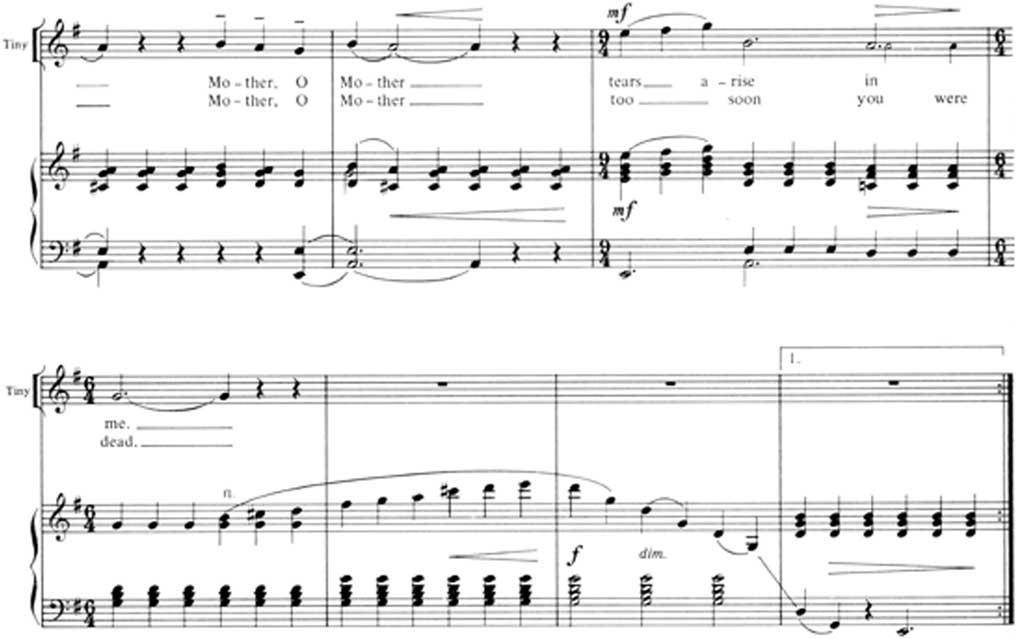
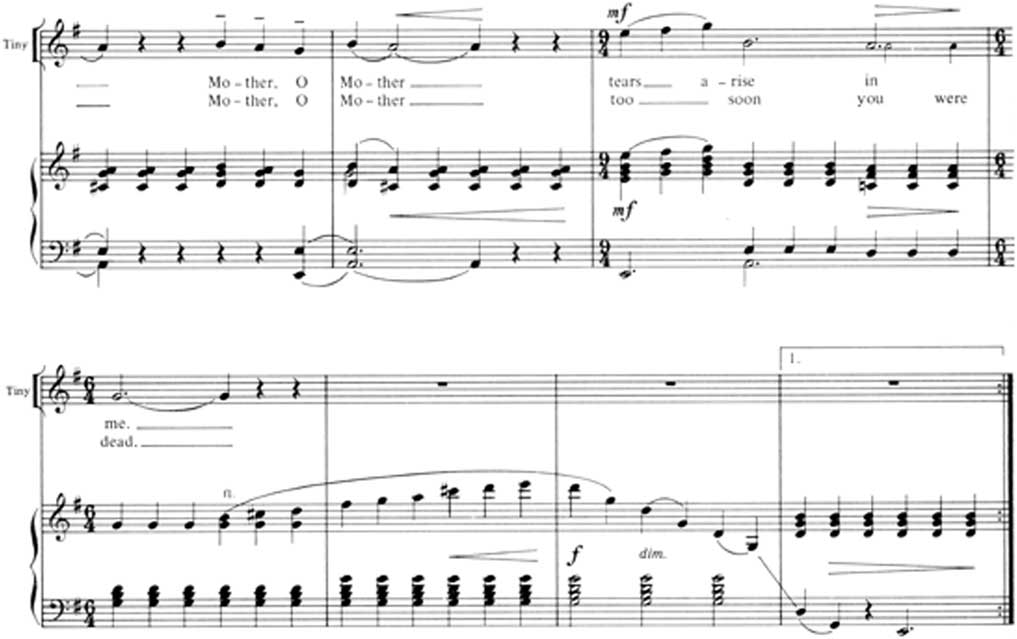
A similar aria-like moment – this one in more of a popular than an operatic mode – is Tiny’s elegy to her mother, which acts as a kind of feminine counterweight to Inkslinger’s Song. (Tiny, Paul’s daughter, is the only female character in the opera, excepting the cats.) But this too is framed as an indulgence rather than an effective act of communication by Inkslinger’s introduction when, after a wordless sigh from Tiny, he tells the oversolicitous lumbermen to ‘leave her alone’, adding ‘Have you forgotten her mother’s just died?’ The song also proves to be yet another slightly comic lament, as Tiny’s simple lyricism in the first two stanzas is offset by Britten’s off-kilter treatment of rhythms and phrase lengths. Auden’s text, toying with abstraction and cliché, occasionally disrupts the sentiment with flat-footed awkwardness, as when Tiny ends the second verse with the line ‘Mother, O Mother, too soon you were dead.’ Britten sets these words with comically abrupt finality, as a straightforward V7–I cadence (Ex. 1). Although Tiny is allowed a bit more musical complexity in her final stanzas, she is brought down to earth by the closing line ‘till the day I die’, echoing the abrupt end of the second verse. Any seriousness, finally, is undone by her repeated closing cries of ‘Alas’, and her quick recovery upon meeting a new love interest at the song’s end.
Act I, scene 2, 15a ‘Tiny’s Song’ (from Paul Bunyan, Op. 17). Music by Benjamin Britten, text by Wystan Hugh Auden © 1978 by Faber Music Ltd, London WC1B 3DA. Reproduced by permission of the publishers. All Rights Reserved.
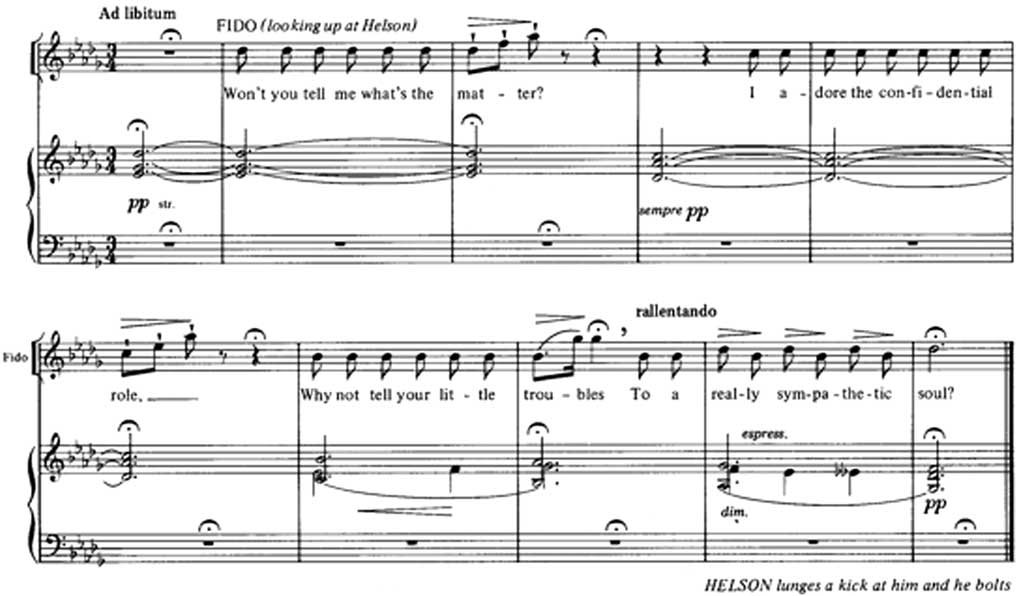
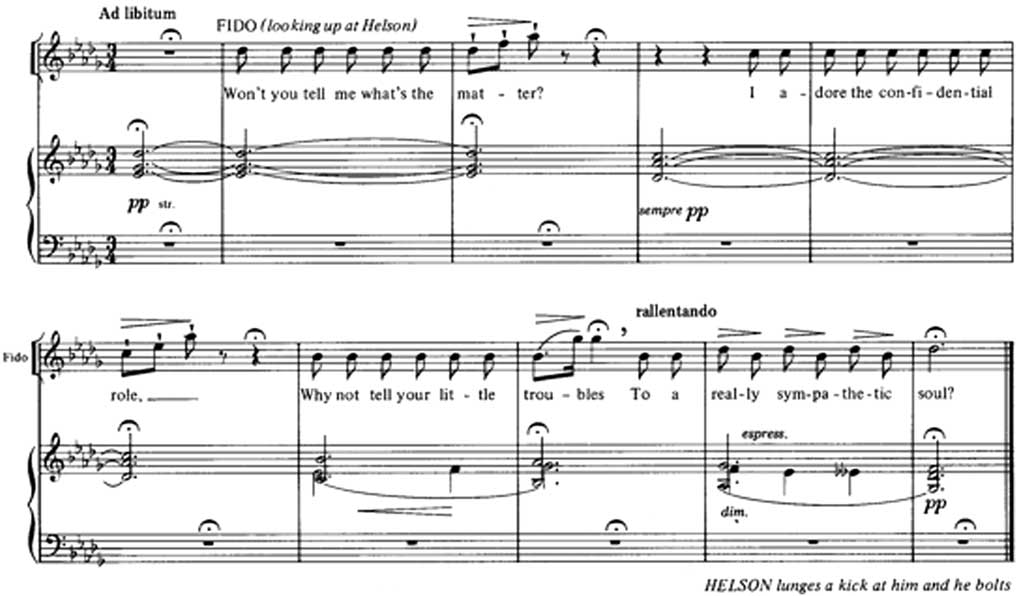
Elsewhere, singing as a mode of connection is more explicitly complicated by its artificiality. Throughout Paul Bunyan, the power of sympathetic connection is largely displaced to a dog, Fido, not coincidentally a coloratura soprano. Indeed, the slightly suspect notion of sympathy Fido represents is closely connected with the singing voice. In the short number ‘Fido’s Sympathy’, Auden plays with the origins of the name to suggest a hackneyed performance of fellow-feeling, ultimately rejected by its object, the gruff Hel Helson, who kicks Fido away. Fido shifts from light coloratura arpeggios at the opening of the number to a sound more influenced by torch song or blues at the end, marked ‘espressivo’, where he describes himself as ‘a really sympathetic soul’ to a chromatically descending accompaniment (Ex. 2). The shift into blues here suggests less a descent into degraded feeling, perhaps, than an equivalence between opera and popular song in their superficial vocal effects.
Act II, scene 2, 21 ‘Fido’s Sympathy’ (from Paul Bunyan, Op. 17). Music by Benjamin Britten, text by Wystan Hugh Auden © 1978 by Faber Music Ltd, London WC1B 3DA. Reproduced by permission of the publishers. All Rights Reserved.
The artificiality of song, though, is more playfully treated in Inkslinger’s ‘Love Song’, which renders the love song as a game of language and style. As Inkslinger instructs the Chorus on how to woo the newly arrived Tiny, the entire number is bracketed as a lesson in writing love songs, and degenerates into a nonsensical rhyming game.Footnote 72 To some extent it is a formal game as well, with each stanza split into two halves, the second of which repeatedly expands by one line. Britten’s music underlines the song’s playfulness, with lyrical writing for the first half of each stanza followed by patter-like text setting and tight repetitions of melodic and rhythmic patterns in the second section. Within this comic frame, though, the song also makes appeals to sincerity, warning against satire, sarcasm and irony, and claiming ‘a natural naïveté’ and truth. These appeals are matched musically by forays into a more chromatic, ‘expressive’ language, especially in the lyrical first half of each stanza. In the opening of the fourth stanza, for instance, Inkslinger moves through a rising chromatic line from the song’s prevailing E flat major to an expectant E major chord as he sings, ‘Some force mysteriously/But most imperiously/Warms my heart through’, suggesting something deeper than the glittering surfaces of the song.Footnote 73 These forays are clearly framed as part of an expressive game, though, even as they suggest that perhaps the game is in earnest.
Auden would go on to explore the idea of operatic singing as a powerful declaration of freedom and feeling, if still fundamentally a self-indulgent one. Opera, he wrote in 1951, ‘is rooted in the fact that we not only have feelings but insist upon having them at whatever cost to ourselves. The moment a person starts to sing, he becomes a monomaniac.’Footnote 74 He also further developed his ideas about the odd combination of directness and artificiality embodied in the act of singing, shifting further, perhaps, towards an embrace of artificiality. ‘[F]or a singer’, he wrote, ‘there is no question of simulation, of singing the composer’s notes “naturally”; his behaviour is unabashedly and triumphantly art from beginning to end’.Footnote 75 In his next opera, The Rake’s Progress, perhaps finding a more sympathetic collaborator in Igor Stravinsky, Auden explored the playful aspects of singing and performance more jubilantly, especially in the character of Baba the Turk.Footnote 76 If The Rake’s Progress revels in artificiality, Paul Bunyan – with its much simpler vocal style – plays with the limitations of singing as an act of communication and connection, and in the process seems more fixated on those limitations.
Undoing choral idealism
Paul Bunyan, it seems fair to say, is ambivalent about sincerity, unwilling to locate it in poetry, popular music or the operatic past. The sincerity of choral music, too, is called into question, as the voice of mass public expression and of political idealism. We have already seen this ambivalence at work in the heroic chorus of the ‘Mock Funeral March’. After Helson and Bunyan’s reconciliation, similarly, the chorus sings a mock-Elgarian ‘Hymn’, ‘O great day of discovery’, whose sweeping nobilmente quality is slightly undermined – revealed as rote and mechanical – by the melody’s reduction to one short repeated fragment, even as the hymn expands in length and grandiosity out of all proportion to the situation.
This ambivalence about music as a site of sincerity and idealism is at its most pointed, complex and, perhaps, most political in the opera’s prologue. The opera begins with a chorus of ‘old trees’, celebrating the impossibility of change: ‘Revolution/turns to rain/Whence more solid/Sensible Creatures gain/In falling they serve life’. Four young trees express frustration with this state of affairs, and things get more complicated when three wild geese – travellers by nature – arrive to announce the coming of a hero who will ‘bring you to another life’. But the tension between the eternal present of nature and the promise of revolutionary transformation soon becomes much stranger. An elaborate choral finale begins with the geese unexpectedly praising the status quo:
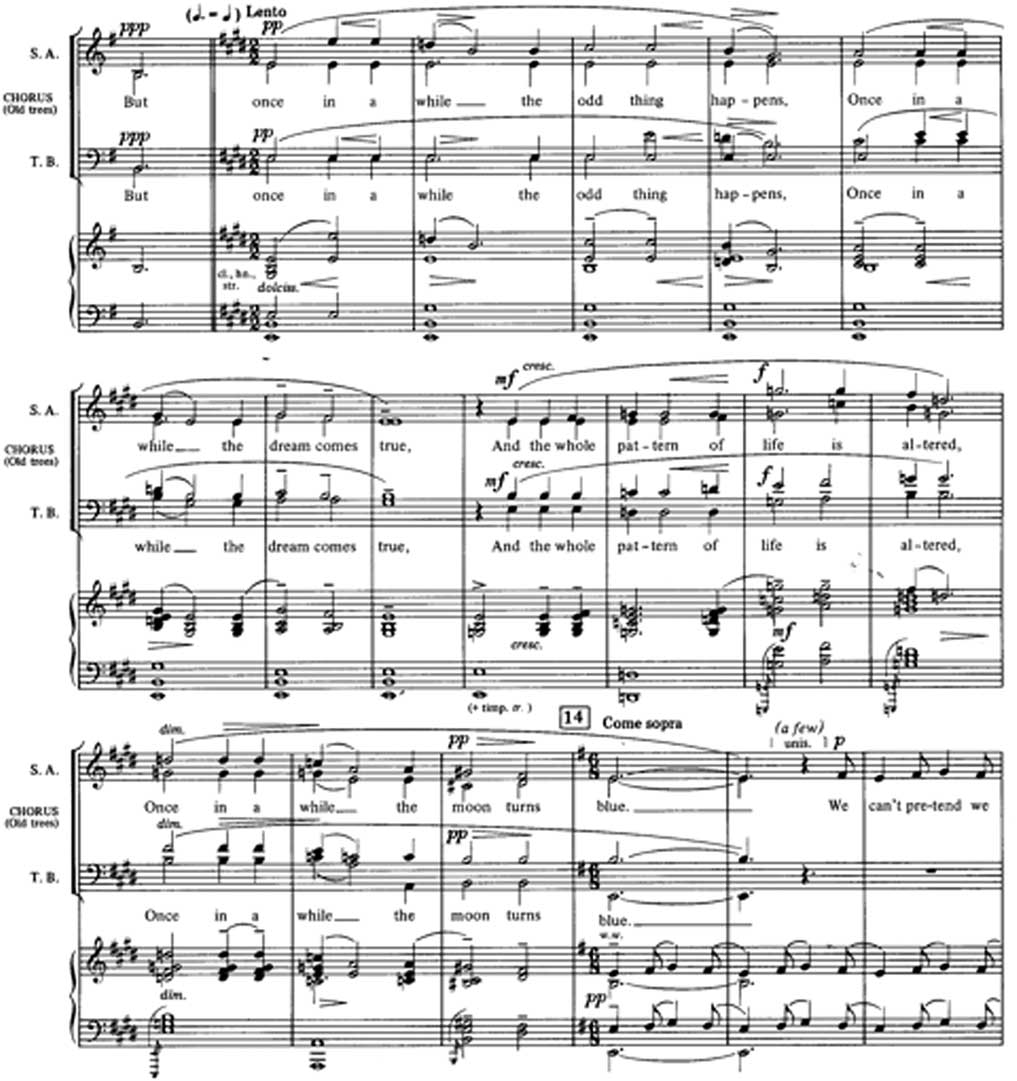
These lines are set in a swinging, repetitive style that recalls Weimar-period Weill in its cynicism. The old trees counter this – again, in a reversal of roles – with an appeal to miracles, couched in oddly casual language:
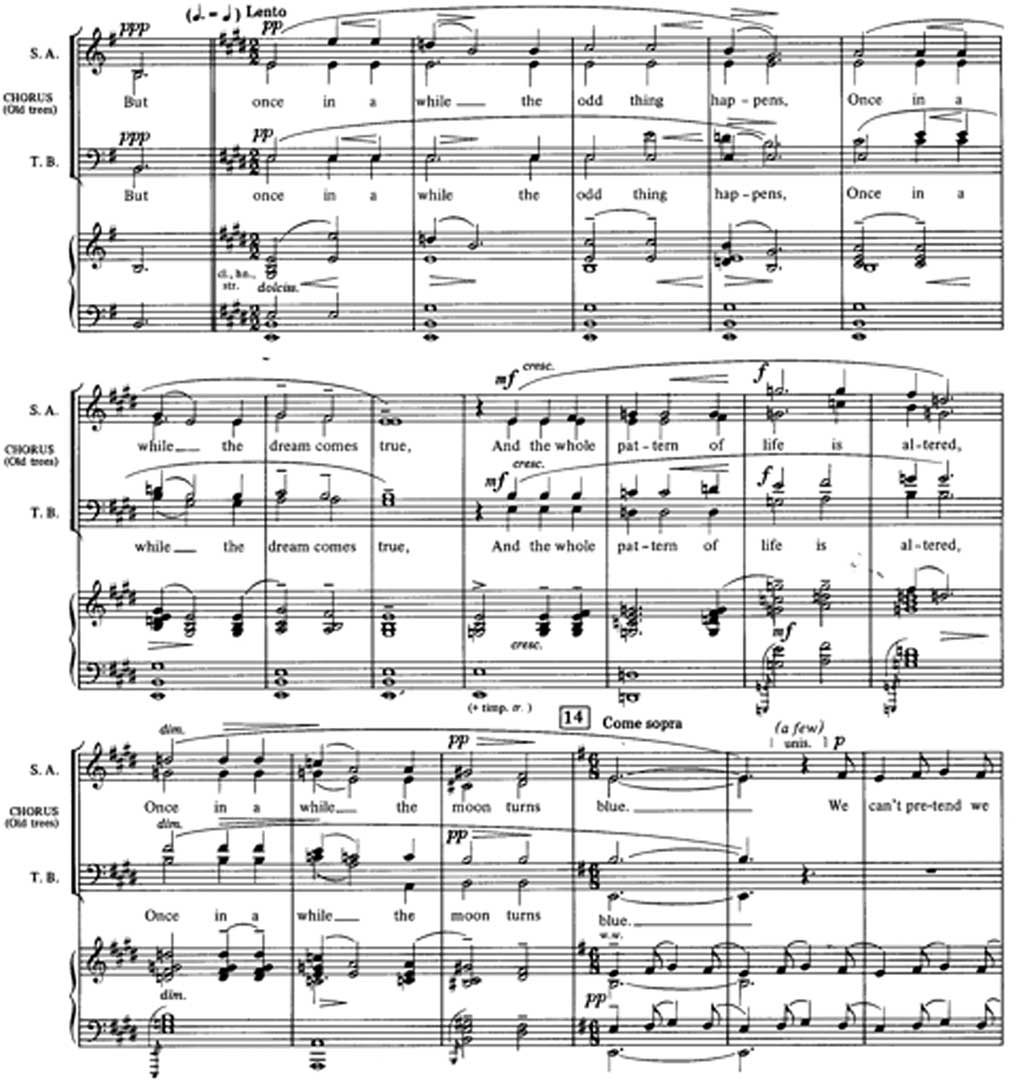
This music is extraordinarily dignified, and its melodic contours seem modelled on the finale to Beethoven’s Ninth Symphony (Ex. 3). More specifically, the passage recalls a similar moment of magical transformation:
Prologue, R.13 (from Paul Bunyan, Op. 17). Music by Benjamin Britten, text by Wystan Hugh Auden © 1978 by Faber Music Ltd, London WC1B 3DA. Reproduced by permission of the publishers. All Rights Reserved.
Yet given the earlier association of the trees with tradition at its most self-satisfied, we are perhaps meant to be wary of revolutionary sentiments clothed in the sounds of the past (however radical they may once have been). It seems significant, furthermore, that the restless young trees respond to this by imagining a transformation that is uniquely compromised: ‘I’ve always longed for edges, and I’d love to be a square./How swell to be a dado and how swell to be a chair.’ Revolutionary idealism finds its goal in the mundane, the conventional and the everyday. Of all Britten and Auden’s light swipes at the untrustworthiness of singing, this reversal of choral music’s mass expression of connection and optimism is in some ways the most troubling, in the context of an aspiring operatic populism.
Demanding sincerity
Britten’s works of the 1930s were often attacked for their reflexivity and apparent lack of feeling. Both American and British critics called them inconsistent in style, facile, clever and artificial.Footnote 77 Occasionally, critics directly confronted the problem of satire in these works: a review of the Piano Concerto (1938), for instance, took issue with the idea of mockery or satire that emerged repeatedly in Britten’s programme note.Footnote 78 (The piano ‘mocks’ the second subject ‘in brilliant fashion’, and elsewhere, ‘rather impertinently makes fun of’ the winds.Footnote 79 ) Another praised the Piano Concerto’s ‘moments of seriousness and genuine romantic feeling’, but was similarly concerned with the danger of satire, particularly in the third movement, labelled ‘Recitative and Aria’ (perhaps suggesting specifically operatic problems of expression), which Britten later replaced:Footnote 80
But satire kept breaking in, and, unlike cheerfulness, satire is a dangerous element in music. For one thing it sets the hearer on his guard against taking anything at its face value. For instance, is the end of the third movement, which is rather commonplace in its romanticism, meant seriously, or is the composer’s tongue still in his cheek, as it is during the first part of the movement?Footnote 81
More often, critics alighted on a broader sense of superficiality – of too-easy technique, of technical stunts and, most damningly, a suspicion of tricks being played. One of the reviews cited above adds that Britten’s ‘writing is extremely facile and, if anything, too brilliant’, suggesting that he should turn ‘to matter rather than to manner’.Footnote 82 On the Violin Concerto (1938–9), a critic writes, ‘It is a brilliant work. The only doubt it leaves in one’s mind is whether it is not really too clever.’ In the work’s favour, he adds, ‘there are moments of genuine tone-poetry’.Footnote 83 When critics praised his music, as these reviews suggest, it was often for rare moments of perceived directness.Footnote 84 But Olin Downes found no such thing in Paul Bunyan. Britten faltered, he said, ‘when he has exhausted devices and is faced with the necessity of saying something genuine’.Footnote 85
This demand for sincerity was not restricted to Britten. In 1947, Thomson praised Menotti’s The Medium and The Telephone, declaring that it was ‘infused with a straightforward humanity that is a welcome note of sincerity in contemporary operatic composition’.Footnote 86 As Beth Levy recounts, Copland, like Britten, faced criticisms ‘as a skilled craftsman still searching for his own personal voice’, and his stylistic diversity led critics to worry over which elements ‘could be considered “sincere”’.Footnote 87 For Levy, this demand for sincerity and directness is mainly a sign of the persistence of nineteenth-century values, as critics and composers clung to ‘romantic notions of originality, creative consistency and an easily recognisable individual “voice”’.Footnote 88 But this concern with sincerity, however vague, also seems part of a new ideal of populism, closely related to the concepts of simplicity and directness Copland invoked when he declared that the newly ‘broadened … democratic bases of music’ demand ‘a music that is fresh, direct, simple and profound’.Footnote 89 If Paul Bunyan failed in this regard, it was just this kind of music that Britten seemed self-consciously to cultivate in his next opera, Peter Grimes.
Embracing sincerity in Peter Grimes
In Peter Grimes, even taking into account differences of genre and mode, the playful vacillations of Paul Bunyan are palpably erased. The enormous success of Grimes, by contrast, was often located in a dramatic directness and straightforwardness, despite complaints about the lack of a love duet or full-blown arias.Footnote 90 Indeed, this quality of simplicity, even roughness, may be what drew Britten to George Crabbe’s poem in the first place. As Britten mentions in his introduction to Grimes, he came across its subject in the wake of Paul Bunyan’s failure. ‘Despite the criticisms’, he wrote, ‘I wanted to write more works for the stage’, and Crabbe must have offered an altogether different direction.Footnote 91 E.M. Forster’s 1941 article on Crabbe, which was Britten’s introduction to the poet, offers some intriguing clues to his attractions beyond the East Anglian connection that Britten generally cited. Here was a poet almost diametrically opposed to Auden, in Forster’s account. ‘He is not brilliant or cultivated, witty or townifed’, Forster writes. ‘He is provincial, and I am using provincial as a word of high praise.’ Crabbe, Forster concludes, ‘is not one of our great poets. But he is unusual, he is sincere, and he is entirely of this country’.Footnote 92 Crabbe, then, seemed to represent just the kind of sincerity and genuineness critics were calling for. The alternative to Paul Bunyan’s games of style and expression could hardly be clearer.
Unusual, sincere, entirely of this country: those qualities touched the opera Britten based on Crabbe. Most important, perhaps, was sincerity, or a new kind of directness. The speech-like opening scene of Grimes, for instance, with its simplicity and legibility, seems designed to gain the listener’s trust. For the American critic Edmund Wilson, responding to Grimes at Sadler’s Wells in 1945, the spectator was ‘almost completely unaware of anything artificial, anything “operatic”. The composer here seems quite free from the self-consciousness of contemporary musicians.’Footnote 93 Wilson spoke of a ‘drastic simplification of opera to something essential and naked’, which seemed to enable a new emotional directness. ‘We find ourselves touched and stirred’, he wrote, ‘at listening to an eloquence of voices that does not merely charm or impress us as the performance of well-trained singers but that seems sometimes to reach us directly with the emotions of real people’.Footnote 94 In 1950, Edward Dent, a prominent supporter of British operatic populism, similarly praised Grimes for ‘its sincerity and integrity as a whole’, although Dent, a more sophisticated listener than Wilson, ‘was annoyed by certain tricks of effect’.Footnote 95
Grimes was hailed as a triumph of English opera, and Britten himself hoped it might help correct the ‘scarcity of modern British operas’.Footnote 96 Like Crabbe, in Forster’s account, it could lay claim to a distinct Englishness, rooted as it was in local life and landscapes. In many ways, though, it was also shaped by the American discourses of operatic populism in which Paul Bunyan participated, and by the lessons Britten had learned from the earlier operetta’s failures. This is hardly surprising when Britten expected an American premiere as late as 1944, and continued to expect the opera would be performed there after the Sadler’s Wells premiere was settled. Indeed, if Britten’s approach to operatic populism had changed since Paul Bunyan, so too had that of many American composers, in similar ways. In its basic turn to realism and emotional directness, away from the playful artificiality of Paul Bunyan, Grimes anticipated a growing trend in American opera – particularly opera on Broadway – towards melodrama, greater realism and a more expressive style that Elise Kirk has termed ‘new American verismo’. Menotti’s first full-length opera The Consul (1950) represents one kind of operatic realism on the American stage, but Blitzstein and Weill are perhaps the more relevant examples. After his politicised musical plays of the 1930s, Blitzstein turned to a more realist and emotional style in his ‘Broadway opera’ Regina (based on Lillian Hellman’s 1939 play The Little Foxes), commissioned by Koussevitzky in 1946, as did Weill in Street Scene, his ‘American opera’ for Broadway from 1947.Footnote 97 Moore’s Giants of the Earth (1951) represents a realist turn from The Devil and Daniel Webster’s concerns with myth and the supernatural in 1939. Even Thomson’s The Mother of Us All seems touched by realism (in the sense of representing a recognisable historical episode) compared to the earlier Four Saints. Already in 1951, Graf observed an emerging 1940s consensus about realism as the favoured approach to operatic populism on Broadway, but American opera houses were also moving in this direction as they came a little nearer to the populist ideals developed in wartime.Footnote 98
In many ways, George Gershwin’s Porgy and Bess (1935) was foundational to this emerging definition of American operatic populism. One thing Porgy and Bess offered was the idea that populism might be located as much in direct emotional appeal as in popular style. Gershwin included healthy doses of both, but it was a difficult balance to maintain, particularly when the popular style at issue was indebted to jazz. (Indeed, wartime leftist ideals of a new American ‘lyric theatre’ have been seen to founder on this very problem of the integration of operatic styles and jazz, not least in the Blitzstein and Weill ‘Broadway’ operas mentioned above.Footnote 99 ) In Grimes, Paul Bunyan’s nods to popular style were largely rejected, but in their place was a new emphasis on realism and emotional directness, emphasising a different side of the Porgy and Bess model.
A few critics have even suggested a link between Grimes and Porgy and Bess, which Britten apparently heard during its 1942 Broadway revival.Footnote 100 In 1949, Joseph Kerman drew a similar connection, while also situating Grimes as more comfortably operatic and high-cultural, when he suggested that its local colour and emphasis on the seamy side of village life ‘would seem more appropriate to Catfish Row’. (Presumably he was thinking in part of the village dance in Act 3, one section of Grimes that does engage with commercial popular style.) And tellingly, Kerman described the libretto in terms reminiscent of the larger American verismo turn, as ‘positively slick’, reading ‘like a text-book of the tried devices of verismo melodrama’.Footnote 101 Grimes’s apparent directness (if located here primarily in Montagu Slater’s libretto) appears as a stylistic choice, and thus as related to the same ‘cleverness’ Britten turned to other purposes in earlier works. Indeed, in many ways Grimes reads as an experiment in sincerity, colloquialism, directness and dramatic coherence; in other words, in conjuring what the critics of Paul Bunyan so clearly demanded. And despite its success, its methods were not altogether embraced in Britten’s later works.
Britten never fully abandoned the territory he staked out in Paul Bunyan. For one thing, the institutional apparatus that he explored in the years of American opera’s emergence informed how he imagined a sustainable opera tradition in Britain. This can be seen not only in his participatory children’s operas but also in his commitment to touring chamber operas and his establishment of the English Opera Group, which owes much to the model of American university opera workshops. As for Paul Bunyan’s distinctive approach to operatic expression, a similar toying with disingenuousness would emerge more discreetly in later works: in comic operas like Albert Herring (which also revisits its concerns with pastiche and popular music) and Midsummer Night’s Dream, but also passingly elsewhere. For the most part, though, Paul Bunyan’s expressive instability was replaced – in Grimes, Billy Budd, The Turn of the Screw (1954) and Death in Venice (1973) – by an almost obsessive attention to the more obviously unsaid and the unsayable, the misread and the misunderstood. In place of a playful, slightly melancholic approach to operatic expression, these operas created clearer oppositions between opacity and legibility to reinforce the possibility – if rarely the achievement – of singing as transparent communication.