Before the 1990s the Italian political system was regarded as ‘anomalous’ in relation to other western democracies, largely (but not only) on the grounds that it failed to secure genuine alternation in government over a 50-year period.Footnote 2 The (apparent) goal of many, therefore, was a ‘normalization’ of Italian democracy through electoral and institutional reform as well as change in the party system, orienting the political system in a ‘majoritarian’ direction. In the early 1990s, the conditions for achieving such a change came together, and Italy witnessed the effective meltdown of its existing parties under the weight of corruption investigations, and their replacement with new parties and coalitions operating in a bipolar format under a different electoral system. Moreover, the past 15 years or so have seen a concerted (but ultimately fruitless) effort to secure major institutional reform. The scale of what has occurred combined with the ambitions for further change has been such that Italy has been popularly viewed as in ‘transition’ between a First Republic and a Second, the latter to be characterized (at some point in the future) by a new set of constitutional arrangements.
Yet, if ‘transition’ implies that a polity is in between one regime and another, then the idea that this is true of Italy has been increasingly hard to sustain as time has gone on, simply because of the unequivocal failure of all attempts to complete it. This is not to suggest that no change has occurred in the past 15 years. On the contrary, one should distinguish between the formal constitutional order on the one hand and the broader political system on the other; and, while the former may not have undergone any comprehensive revision, the latter has experienced significant change in some sectors, as well as little change in others. Because of this, there is difficulty in capturing Italy's political change tout court.
The purpose of this article is less to engage directly with the transition debate than to emphasize an important aspect which is too often overlooked and which, today, we would argue, makes Italian politics distinctive in relation to many other advanced democracies: the manner in which the everyday struggle for political power is enmeshed with a more profound debate over the very rules of the game. This is not to suggest that this entanglement makes Italian democracy totally unique. On the contrary, to make such a claim would require a comparative empirical study of several other European democracies where institutional reform has figured on the political agenda. Yet, if we assume (as we think it safe to do) that the democratic ‘norm’ is a general acceptance of both the ‘rules of the game’ and the means by which those rules might be changed (or proposed to be changed), then it is clear that Italian politics are a long way from that norm – and that therefore an Italian ‘anomaly’ of sorts remains.
The Italian political debate has long been characterized on the one hand by a general consensus that fundamental institutional reform is needed, and, on the other, by a lack of agreement over what needs to be changed. Furthermore, since the end of the 1990s, there has been deep-seated disagreement over the best (or ‘legitimate’) method by which such a reform might be achieved – beyond acceptance of the formal procedures for reform laid down by the Constitution. As a consequence of these three factors, the debate over institutional reform has become an intimate part of the substantive struggle for political power. Of course, one might argue that this in itself implies that Italy is ‘in transition’. Our point is that paradoxically, the enmeshing of ‘institutional’ and ‘political’ struggle makes successful completion of any transition process less, rather than more likely. We can see why this is so by illustrating what we claim to be the distinctiveness of Italian politics through an analysis of two recent electoral consultations: the national election of April 2006 and the referendum on constitutional reform of June 2006. The former was significantly overshadowed by the electoral reform carried through just four months previously and clearly driven by the search for partisan advantage; the latter showed how the constitutional reform debate too had been entirely reduced to a matter of partisan political contest.
THE 2006 NATIONAL ELECTIONS: TAMPERING WITH THE ELECTORAL SYSTEM
The national elections took place at the end of a legislature relatively unusual for having lasted its entire five-year term, Silvio Berlusconi having had exclusive tenure of the office of prime minister at the head of a single coalition of the centre right.Footnote 3 Since the beginning of the 1970s only two previous legislatures had gone for their full terms, as the declining hegemony of the Christian Democrats (DC), first, and the party system upheavals of the 1990s, subsequently, had made it more difficult than before for presidents of the Republic to fulfil, without recourse to dissolution, their supreme function of regulating and mediating the processes of political contestation. The break with this pattern in 2006 was due to a variety of political changes that, though not part of a comprehensive design, had ‘had important effects upon the working of governments and for the relations between cabinet and parliament’.Footnote 4 These included the transformation of the party system (into one characterized by ‘fragmented bipolarity’ based on unwieldy coalitions of centre left and centre right, each competing for overall shares of parliamentary seats); the selection of government leaders before elections (rather than through post-election interparty negotiation); as a consequence, these leaders’ holding a more commanding role in cabinet; and with the result that governments acquired greater durability and more power in parliament.
Yet, Berlusconi's tenure of office had by no means been a straightforward, tranquil or uncomplicated experience. Moreover, the polls had been indicating, for many months in advance, an almost certain victory for the centre left in the elections. It was this situation that led the centre right to change the electoral system: doing so would resolve a key problem for the coalition and reduce the chances of electoral victory for the centre left – or at least reduce the size of its majority.
In essence, if Berlusconi's party, Forza Italia (FI), was the fulcrum around which the centre-right coalition revolved, then FI owed this success for the most part to the marketing of an image that was almost completely dominated by Berlusconi and his supposedly extraordinary personal qualities. While this was a very potent weapon at the election in 2001 (when FI could claim to be led by a self-made entrepreneur who would do for Italy what he had done for himself), in subsequent years it lost a great deal of its force. Not only was a message based on Berlusconi's charisma much less convincing when the evidence of a not outstanding government performance was before the electorate, but it left FI particularly exposed in two ways. First, by denying space, in its communications, to a clear ideological and programmatic profile, the massive emphasis on Berlusconi left the party with few other means of retaining voter loyalty when economic difficulties began tarnishing the leader's image. Second, therefore, it rendered the party – and, given the nature of the 1993 electoral law, the coalition as a whole – especially vulnerable to a loss of votes when the leader's own popularity fell.Footnote 5 As a consequence, while Berlusconi and FI were in an extraordinarily powerful position within the coalition before and immediately after the 2001 election (for which they could claim most of the credit), their capacity to impose discipline declined thereafter, and especially after the 2004 European elections. These elections revealed that, if a government in difficulties was going to have to pay an electoral price, then – in the context of the proportional law used for those elections – it would be paid by FI rather than its allies, and they rather than the opposition parties would be the principal beneficiaries.Footnote 6 The new electoral law, passed at the end of 2005 was thus driven by the centre right's need to find a solution to the main source of its internal instability, namely Berlusconi's leadership.Footnote 7 This can be seen more clearly in the law's main features.
For elections to the Chamber of Deputies, parties present lists of candidates in each of 26 multi-member constituencies and voters are required to make a single choice among the lists with which they are presented. Parties can either field lists independently or as part of a coalition with other parties. Seats are distributed between the parties proportionally except that, to be eligible to participate in such distribution, parties must obtain at least 4 per cent of the national total of valid votes cast if they are running independently or as part of a coalition whose combined total turns out to be less than 10 per cent. If they are part of a coalition whose combined total is 10 per cent or more, then they must obtain at least 2 per cent of the national valid vote total or be the largest party just below this total. If an initial proportional distribution of seats results in the largest party or coalition receiving less than 340 seats, then it is assigned as many seats as are necessary to bring it up to that figure. This so-called premio di maggioranza (or majority premium) thus ensuring, for the party or coalition concerned, an overall majority in the 630-seat Chamber of Deputies. The remaining seats are distributed proportionally among the other parties and coalitions.
Arrangements for the Senate are essentially the same, but with the important differences that: (1) seats are assigned to regions (in accordance with their populations) rather than to constituencies; (2) seat distribution (including assignment of the premio di maggioranza) takes place region by region (that is, seat assignment depends on parties’ and coalitions’ regional, not their national totals); (3) the premio in each region consists of the number of seats awarded to the largest coalition or party that is necessary to bring it up to 55 per cent of the seats assigned to the region; (4) in order to be eligible to participate in the distribution of seats, parties have to have attracted – if running independently or as part of a coalition whose combined regional vote total turns out to be less than 20 per cent – at least 8 per cent of the valid votes cast in the region concerned. If it is running as part of a coalition whose combined vote is above 20 per cent, then it must have attracted at least 3 per cent of the region's valid vote total.
Given the fragmentation of the Italian party system, the effect of the law is, on the one hand, to encourage parties to field their lists as coalitions rather than independently while removing the pressure (that had been created by the 1993 law with its single-member constituencies) to unite behind candidates representing the coalition as a whole; and on the other hand, to combine for the voters the choice of party and coalition into a single choice, while allowing them to support a coalition without having to cast a vote for a candidate drawn from a party other than their most preferred party. In this way, the new law considerably reduced the significance of Berlusconi's personal popularity for the prospects of his allies and those of the coalition as a whole and hence removed his leadership as a source of coalition instability; for it removed the dilemma otherwise faced in plurality contexts by voters dissatisfied with Berlusconi, namely, that they had no means of giving expression to their dissatisfaction other than by action (abstention or voting for the centre left) that was also damaging to the entrepreneur's allies.
This was an especially important consideration in the run-up to the 2006 elections. Reflecting cross-national trends, election campaigning in Italy has been markedly more ‘candidate-centred’ since the end of the ‘First Republic’ than it was before then.Footnote 8 That is, the focus in parties’ campaigns has been much more on their candidates and their qualities – and especially, given the nature of national-level contests, on coalitions’ leaders – than on their programmes and ideologies. If this makes it seem likely that there has been a corresponding increase in the significance, in voters’ electoral choices, of their assessments of such leaders, then obliging the centre-right parties to line up behind a single prime ministerial candidate whose popularity was in decline did not augur well for them. However, the new electoral law enabled each party to present its own prime ministerial candidate and to claim, in the run-up to the election, that the coalition as a whole was offering voters a range of prime ministerial candidates whose fortunes, in terms of whether they actually assumed the premiership or not, would depend on the distribution of votes between their respective parties.
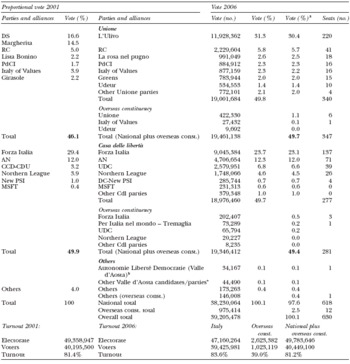
In short, the centre right ‘was less a coalition than an aggregate of parties, its electorate less willing [than the electorate of the centre left] compactly to support its own common candidates’.Footnote 9 This had been clearly revealed by the results of the three previous general elections when the centre right's ability to compete with the centre left had shown itself much greater in the proportional than in the plurality arena – while the two previous elections suggested that in the proportional arena its constituent parties had a collective reach that extended beyond the pool of voters prepared to support their candidates in the plurality arena.Footnote 10 If this made it clear that an additional driving force behind the law (besides the Berlusconi leadership issue) was the intimately connected one of attenuating, or avoiding, the centre left's expected victory, then the outcome revealed that the plan was almost successful (see Table 1).
Chamber of Deputies Election Results 2001 and 2006

Sources: Ministero dell'Interno, http://politiche.interno.it; turnout: Istituto Cattaneo, 2006 (2001 figures), http://www.repubblica.it/speciale/2006/elezioni/camera/index.html (2006 figures).
a The percentages in this column are based on the overall total of votes cast, i.e. including the overseas constituency.
b Autonomie Liberté Democratie was associated with the Unione. Votes cast in the single-member Valle d'Aosta constituency are not included in the totals used to determine allocation of the majority premium.
The number of votes separating the centre right from the centre left in the Chamber of Deputies election was wafer thin at 24,755. In the Senate election the centre left's majority was a mere two seats and in terms of votes it actually emerged behind the centre right. There are several ways in which this outcome may be interpreted, but one is in terms of the electoral law, which affected the outcome both ‘directly’, in terms of the way in which it translated the distribution of votes into the distribution of parliamentary seats, and ‘indirectly’– through its impact on parties’ and voters’ perceptions of its likely effects, and thus its impact on parties’ decisions about the line-ups to offer and about how to campaign, and on voters’ decisions about the choice to make between such line ups.
As far as the direct effects are concerned, in the Senate election, unlike in the election for the Chamber, there was no guarantee that the coalition with the largest number of votes nationally would win the largest number of seats, because the majority premium is distributed on a regional rather than a national basis – meaning that, because of the varying size of regions, the outcome in terms of seats is significantly determined not only by the overall numbers of votes, but also by where those votes are cast. In fact, the centre right had a 269,998-vote advantage and a one-seat advantage across the 20 Italian regions. What ‘saved’ the centre left was the so-called ‘foreign constituency’– the voting arena with its six seats reserved for Italians resident abroad – which had been set up by Law 459 in 2001. Championed by the centre right, convinced that this too would work to its advantage, the constituency in fact favoured the centre left, which not only had a 93,544-vote advantage there, but won four seats to the centre-right's one also because it was able to exploit more effectively the peculiar features of the electoral system there. As Chiaramonte has pointed out,Footnote 11 though formally proportional, the system is in fact majoritarian because the seats within the constituency are allotted to four geographically based ‘colleges’, half getting two seats and the other half one each. And the centre left, unlike the centre right, was able to avoid wastage of its votes by presenting single, coalition-wide lists rather than separate lists for its parties. Had the votes cast for centre-right lists all gone to single, coalition, lists, the centre right would have obtained an extra two seats and a narrow Senate majority. As it was, though ahead by 176,454 votes in the domestic and foreign arenas combined, the centre right ended up with 156 seats to the centre left's 158.
As far as the indirect effects of the electoral law are concerned, these were three-fold. First, the fact that assignment of the majority premium was decided by the votes of every single party belonging to the two coalitions, not just by the votes of parties succeeding in surmounting the threshold, meant that the two coalitions were extremely broad and inclusive: the centre right consisted of 20 parties, the centre left of 18. This meant, second, that third forces unaligned with either of the two coalitions were very few and far between and almost entirely ignored by the media.Footnote 12 If this meant, third, that voters could be expected, as in fact happened, to confine their attention and choices to the coalitions, almost completely turning their backs on the non-aligned, then it also provided the context to enable Berlusconi to attempt a comeback from his apparent disadvantage by focusing media attention on himself – something that he did by fighting the campaign as if he were an opposition leader, rather than by defending his government's record; by ably exploiting the weaknesses of the centre left on tax, and by a series of outbursts designed to dramatize the campaign and mobilize disillusioned supporters who might otherwise have been inclined to abstain.Footnote 13
The upshot was that, the centre left having won by such an apparently small margin following initial expectations of a larger win, its victory appeared to many to be a partial defeat, and, far from being weakened by the outcome, Berlusconi's position as leader of his coalition was in fact reinforced.
In sum, the campaign, vote and outcome of the 2006 national elections were influenced by an institutional reform (of the electoral system) that was carried through by the incumbent government with just such a purpose in mind. The ‘rules of the game’ were explicitly changed in order to condition the everyday struggle for political power. Yet this was not the only example of the instrumental use of institutional reforms; on the contrary, electoral reform, while significant, was, in fact, only one (separate) element in a much broader and more comprehensive package of institutional reforms that Berlusconi and the centre right were bent on achieving and which became entangled in the political battle between the two coalitions.Footnote 14
CONSTITUTIONAL REFORM AND THE 2006 REFERENDUM
There were several reasons why Berlusconi and his allies were interested in achieving constitutional reform during their period in office.Footnote 15 First, the centre-right coalition was influenced by what had already occurred insofar as institutional reform was part of a long tradition stretching back 30 years to the launch of the idea of the grande riforma by former Socialist Party leader, Bettino Craxi.Footnote 16 The grande riforma, or root-and-branch overhaul of the Constitution, was predicated on the assumption that an improvement in Italy's democratic functioning would follow from comprehensive institutional reform. In the 1990s the assumption was reinforced by dramatic political changes – notably, the 1993 reform of the electoral system from pure proportional representation (PR) to a mixed proportional/majoritarian system, and a transformation of the party system – that underpinned the argument that institutional arrangements needed to be updated to reflect and consolidate these new political trends. Yet, three successive attemptsFootnote 17 before then had all failed,Footnote 18 largely because they were predicated on the important assumption that no reform of such a fundamental nature could be passed without a large majority straddling the government/opposition divide. This meant that no reform could get past the veto players within each coalition. In 1999 the centre-left government broke with the assumption in securing, on the strength of its own majority, a reform to a specific aspect of the Constitution – Title V relating to the regions – driven by the desire to undercut support for the Northern League (Lega) in the subsequent elections. This set a precedent that the Berlusconi government was happy not only to follow, but to expand upon, by passing a much broader reform of the Constitution using the strength of its majority.
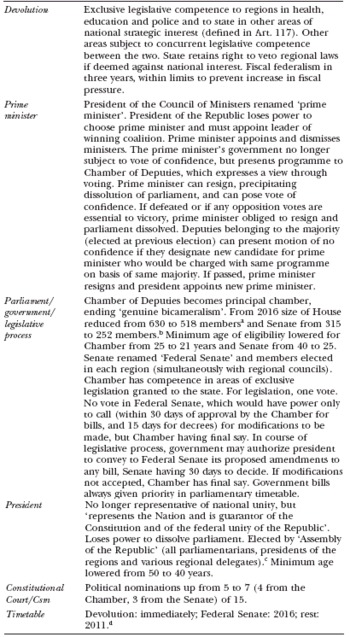
Second, although the substance of the conceived reform was wide ranging, its origin lay in one aspect and one party: devolution and the Lega. The Lega, for its own credibility, had little choice but to declare the centre-left reform as not having gone far enough and committed itself to achieving more extensive regional devolution. Indeed, the party made its participation in government and the survival of the centre-right coalition that took office in 2001 conditional upon devolution being achieved during the legislature. However, while Berlusconi recognized the importance of passing a devolution bill, he was also aware that it would not be particularly palatable to the right-wing National Alliance (AN) and former Christian Democrats in the Union of Christian Democrats and Centre Democrats (UDC), whose support base was mainly in the south where considerable concern was consistently registered about the impact of devolution measures on national welfare provision. The scope of the reform was therefore expanded to meet the interests of the other party leaders, including those of Berlusconi himself. This was a process that Sartori described as a ‘cattle market’ in which each leader went home with one ‘cow’: devolution to Bossi, a stronger premiership to Berlusconi, a national interest veto on regional acts to Fini (AN leader) as well as the possibility of becoming prime minister for his loyalty, and a promise of return to proportionality in the electoral law for Follini (UDC).Footnote 19 The overall effect on the Constitution was quite dramatic: with 50 articles being revised and a further three added, it effectively amounted to a rewriting of Part II (see Table 2 for a summary of the principal changes proposed).
The Principal Elements of the Proposed Constitutional Reform (rejected by referendum)

Source: M. Bull, ‘The Constitutional Referendum of June 2006: End of the “Grande Riforma” but not of Reform Itself’, in Jean-Louis Briquet and Alfio Mastropaolo (eds), Italian Politics. The Center-Left's Poisoned Victory, London, Berghahn, 2007.
a Eighteen of whom would be elected in overseas constituencies; to this number should be added life deputies (nominated by the president, maximum three at any one time) and former presidents of the Republic.
b Including 42 delegates from the regions (who would participate in the work of the Federal Senate but without voting rights).
c A two-thirds majority would be required. If this were not to be achieved after three votes, three-fifths would be sufficient, and after five votes, a simple majority only would be required.
d In fact, the latter two dates were dependent on whether the referendum were to be held before or after the national elections in 2006. If the referendum had been held before, the reform would have entered into effect with the new legislature, the Federal Senate then being implemented in 2016.
Third, if this suggested the reform was the product of a political compromise providing direct benefits for each party, there was also a more indirect political gain to be had from the reform passing, which related to ‘ownership’ of the Constitution. The existing Constitution, forged between 1946 and 1948, was widely recognized to be based on an anti-Fascist pact of national unity between the main political forces (including the communists) of the immediate post-war period. Significantly, three of the four main parties of the centre-right coalition (FI, AN, Lega) had played no role in that pact (although several leading members of FI had come from parties that had signed the Constitution); indeed, one (the forebears of AN, the Italian Social Movement) was the explicit target of exclusion by that pact, and another (the Lega) had been founded to break up national unity. The arrival of these parties in government in the 1990s had placed a strain on that pact, with the parties of the centre left continuing to link the Constitution with national unity, while the centre right played this down. For example, in the heat of the referendum campaign, on 25 April, Italy celebrated the sixty-first anniversary of the Liberation. Prodi was quick to use it to link the Resistance and the fight for liberation in 1945 to the birth of the Constitution and national unity, and therefore the importance of safeguarding it from the current assault of the centre right. Berlusconi, in keeping with his own tradition of recent years, refused to celebrate the day, and accused the centre left of exploiting the date for political purposes.Footnote 20 What the constitutional reform offered, therefore, in its radicalism, was to break the document's link with anti-Fascism and the Resistance, and to allow the centre right to claim ‘ownership’. Berlusconi in particular seemed to be aware of the importance of leaving a de Gaulle-style institutional legacy. Significantly, the 1990s had witnessed a growth in the revisionist debate over the Constitution (which went back many years and essentially challenged the role of anti-Fascism and the Resistance in providing the political inspiration for the Constitution), and the constitutional reform, it could be argued, offered the prospect of turning the revisionist position into a material gain.
If these were the motivating factors behind the reform, the method used to achieve it was Article 138 of the Constitution, which stipulates that, ‘Laws revising the Constitution and other constitutional laws must be approved by each House in two successive sittings marked by an interval of not less than three months, and, in the second sittings, must be approved by an absolute majority of the memberships.’ Use of this article in order to carry through a sweeping change of various parts of the Constitution (i.e. a package of measures) on a single vote was controversial and even regarded by some as a misuse of this article. In addition, the centre right, exploiting the centre left's break with precedent in 1999, did not seek to achieve a wide consensus on its proposed reform, but passed it on the basis of the strength of its majority.
The controversy surrounding the method used, combined with the radical nature of the reform, ensured that, once given definitive approval by parliament in November 2005, the centre left took the necessary measures to make it subject to a referendum. ‘Confermative’ (as opposed to ‘abrogative’) referenda are provided for by the second part of Article 138, which states that, ‘The laws themselves may be subjected to a popular referendum when, within three months of their publication, it is requested by either a fifth of the members of one of the Houses or 500,000 voters or five regional councils.’ The opposition to the reform secured all three methods (even though only one was strictly necessary) and presented them to the Court of Cassation on 10 February 2006. Although the government did not decide on the exact date of the referendum (25–6 June) until late April, the campaign to ‘save’ or change the Constitution effectively began as soon as the referendum was authorized by the Court of Cassation.
If, as suggested, there were strong political origins to the referendum, then its timing reinforced that political context. The referendum campaign ran alongside the election campaign and was also influenced by the electoral result. In terms of party positions, the ‘yes’/‘no’ divide on the referendum reflected almost perfectly government/opposition alignment of parties in the election. In addition, following his narrow defeat in the national elections, Berlusconi sought to enact ‘political revenge’ on Prodi, emphasizing that the referendum would act as a form of vote of confidence in the government, with the implication that he should resign in the event of defeat. In short, while referenda are (ideally) meant to be about divisions over evaluations of the substance of proposed reforms, this one reflected more the general political balance of power, the referendum being used as a further vehicle through which the parties could engage in substantive partisan conflict.
The battle over the substance of the proposals also had partisan political connotations. Those opposed to approval highlighted three principal weaknesses. First, the attribution of exclusive legislative power to regional governments in the key areas of health, education and policing raised the spectre of 20 different systems for each, depending on different regions’ resources, and therefore a growing inequality in provision for citizens of these services and a consequent exacerbation of the north–south divide. The strain on national unity would be further inflamed through the attempt to operate two potentially contradictory principles: exclusive legislative regional power and a ‘national interest’ veto. There would probably be a rise in overall expenditure, in addition to the cost of introducing the new system.Footnote 21
Second, the ‘strengthening’ of the premiership amounted to the creation of a single office that could effectively dominate the rest of the system. The apparent quest to reduce the instability of governments through institutional tinkering had produced in this reform a shift in the balance between government/prime minister and parliament too far the other way, to the point of straining the very principle of parliamentary democracy. This was because the usual remedies or checks against a government that was incapacitated, failing to deliver its programme or just corrupt disappeared under the new measures – as could be seen in the removal of the president's power to dissolve parliament, the introduction of the ‘constructive vote of no confidence’ reserved to the majority's deputies, and the ability of the government to intervene directly in the legislative process. Sartori argued that this amounted to a ‘prime ministerial dictatorship’.Footnote 22
Third, the new bicameralism was more fictitious than real, since the Chamber of Deputies dominated the Senate, but through a complicated system that increased the number of legislative procedures from one to five, one of which also involved (effectively in an improper role) the president of the Republic. Moreover, the Chamber of Deputies itself was largely under the control of the prime minister and his/her government. Finally, the Senate could hardly be defined as ‘federal’ insofar as the regional and local representatives did not have voting rights, thus removing the essential characteristic of a federal body: that it acts as a representative of territory.Footnote 23
Overall, the proposals smacked of being either ill thought through or too much determined by the need to satisfy different interests. Whether, as some claimed, they (unwittingly) posed an actual danger to Italian democracy itself is another matter. But even if not, they were, as Diamanti argued, undoubtedly cumbersome, lacking in coherence, potentially contradictory and likely to generate conflicts between institutions at the centre as well as between centre and periphery, which could in the future provoke a form of institutional paralysis.Footnote 24 Constitutional experts for the most part opposed the reform. For example, in a volume containing their views, 60 out of 63 were damning of the centre right's proposals.Footnote 25
The centre right insisted that its reform was about modernizing the Constitution, and berated the centre left for being ‘conservatives’ and against any type of reform. While this was true with regard to some of those in the ‘no’ camp, there were, at the same time, many on the centre left who were in support of constitutional reform, but not this specific reform. Fearing that the centre right's accusation might stick in the public's minds, Prodi and government ministers became more insistent on this point, going so far as to commit themselves to opening a dialogue on future constitutional reform immediately following the referendum, and appealing to those voters who were for constitutional reform to vote ‘no’. At the same time, the centre right, under a barrage of criticism for the inadequacy of the reform, confessed that its proposals were not perfect, but argued that there would be time after their approval to make suitable adjustments, and that it was more important to make a start with constitutional reform than not at all. They appealed therefore to voters who were interested in future constitutional reform to vote ‘yes’. In short, both camps managed to complicate the choice facing voters by appealing to the electorate to vote for their respective positions on precisely the same grounds: if the voters wanted constitutional reform in the future.
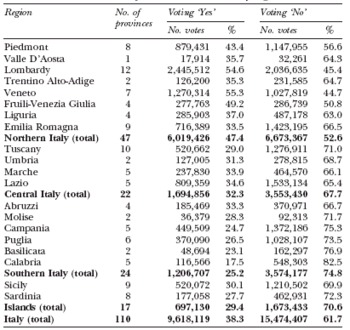
The outcome was decisive, with 61.7 per cent voting against and 38.3 per cent in favour. The size of the rejection increased the further south one went: northern Italy (52.6 per cent against), central Italy (67.7 per cent), the south (74.8 per cent) and the islands (70.6 per cent). This trend is confirmed in the regional breakdown of the vote (see Table 3) – which suggests that devolution, the origin and core of the reform, was crucial to the outcome, influencing people to vote for the package of reforms in those regions where the Lega has strong support, and against it in the south and the islands.
Constitutional Referendum 2006: The Vote by Region

Source: Bull, ‘The Constitutional Referendum of June 2006: End of the “Grande Riforma” but not of Reform Itself’, pp. 109–12, and ‘Documentary Appendix’, table B15, p. 309.
POLITICAL PARTIES, THE STRUGGLE FOR POWER AND INSTITUTIONAL REFORMS
The above analysis shows how, in Italy, it is impossible to separate the day-to-day political struggle between the parties from the more fundamental debate over institutional reform. The 2006 elections and referendum and the events leading up to them, were part of a feature that has characterized Italian politics for many years. Whether this means that Italy should be defined as being ‘in transition’ is presumably a question to which only an unambiguous regime change could ever provide a definitive answer. And in any case it is perhaps a question that is less important than capturing in substance this distinctive feature – a feature that the outcomes of the election and referendum have ensured will continue to constitute the filo rosso of Italian political debate.
Regarding the election, the arrival in office of a government whose existence was precarious from the start ensured that the electoral law would continue to be debated as much as was institutional reform more generally. The reason was that the highly fragmented nature of the governing coalition, one to whose survival in office every single component was indispensable, clearly did not bode well for stable governance; it was apparent too that fragmentation, in turn, was significantly encouraged by the new law. On the one hand, the fact that the vote of every member-party counted when it came to awarding the all-important majority premium encouraged the formation of the broadest coalitions possible. On the other hand, the fact that every single vote is in this way useful, no matter which of the given coalition's parties it is cast for, undermines whatever incentives there may have been in the previous electoral law to aggregation. This undermining leaves the larger parties vulnerable to defection when they alienate this or that group of voters and encourages smaller parties – which know that in any case they will be courted in the coalition-building process – to seek to retain their own followings by emphasizing their visibility and distinctiveness from other parties. In short, the law significantly lowers the political costs associated with defection and party-splitting.
For this reason, given that the centre left has traditionally been the more unstable and litigious of the two coalitions, introduction of the law could be seen as having been driven, besides the factors we have adduced above, by the kinds of motives that drive retreating armies to blow bridges and poison wells. As Antonio Floridia has pointed out, the early period of the Prodi government ‘showed how the main effects the authors expected from this law have actually been obtained’,Footnote 26 with crises in August 2006 (over measures to resolve prison overcrowding) and February 2007 (over foreign policy), both of which revealed the precariousness of the government in its dependence on the smaller allies in the coalition. Worries initially focused especially on Communist Refoundation (RC), both because of 1998 – when a minority of RC deputies provoked the collapse of the first Prodi government – and because, while the party apparently risked losing support if it put the survival of the government at risk, it seemed in serious danger of losing the support of its more radical supporters if it took too accommodating a position on many highly charged issues (such as pensions, immigration, the labour market and civil partnerships).Footnote 27 In the event, RC turned out to be a loyal party, sacrificing some of its core interests on labour and welfare issues to the stability of the government. The latter's collapse, when it came in January 2008, was due to a withdrawal of support by the small centre-positioned, Democratic Union for Europe (UDEUR). Nevertheless, it remained the case that the government suffered from an image of permanent argumentativeness, as parties sought to distinguish themselves, only to fall into line at the last minute.
As a consequence, electoral reform remains high on the agenda of Italian politics and the period after the February 2007 crisis of the Prodi government witnessed the emergence of a committee, ‘CO.R.EL 2008’, sponsored by a cross-party grouping of intellectuals and persons in public life, seeking to gather the required number of signatures to make possible the holding of a referendum on three proposals to abolish parts of the electoral law. Of the three, the two most important proposals would remove the current option available to parties to field lists as part of a coalition with other parties, and would strike down those clauses allowing attribution of the majority premium to the largest coalition. The result would thus be to reserve the premium to the largest single list, and automatically to raise the vote thresholds for all lists to 4 per cent in the Chamber and 8 per cent in the Senate.Footnote 28 The promoters’ expectations are that the reform would drive party actors to pursue the formation of single large groupings, bringing disappearance of the current distinction between coalitions and their constituent parties, in effect reducing fragmentation by considerably raising the political costs of defection for both parties and voters.
Clearly driven by the intention of putting pressure on the parties in Parliament to introduce a reform possibly less drastic than the one implied by the referendum proposals but nevertheless one that is incisive, the initiative appeared to create, for the larger parties of the centre left, something of a dilemma. On the one hand, they could not officially support the referendum campaigners (even though they were the most obvious likely gainers from the initiative) without risking the stability of the government, and indeed the same imperative put them under pressure officially to oppose the initiative. On the other hand, as the whole purpose of the referendum appeared to be to ‘place a loaded gun on the table’ (that is, the initiative would only be called off in the event of incisive reform), the parties could only effectively counter it by sponsoring reform that would also threaten government stability. Either way, then, it was clear that the smaller parties wielded a blackmail power from which it was impossible to escape.
This impossibility was revealed with the above-mentioned withdrawal from government of the UDEUR, which took place a few days after the Constitutional Court's verdict that the referendum's questions were constitutionally permissible, and which appeared driven by a determination to resist the implications of the Court's decision. In the event of a dissolution of parliament any referenda in train are automatically suspended until at least a year after the resulting elections. In fact, following a brief attempt on the part of Senate president, Franco Marini, to form an alternative government, fresh elections (strongly campaigned for by Berlusconi, who enjoyed a strong poll lead) were called for 13–14 April 2008, and saw the return to power of a centre-right coalition headed by Berlusconi. Since any referenda in train do not take place at all if rendered redundant by changes in the law on which citizens would otherwise be called to vote, the referendum now scheduled for spring 2009 hangs essentially on the government and parliament and whether they act.
The dilemma concerning electoral reform is reflected at the broader level of the institutional reform debate. It could be argued that rejection of the centre right's proposals for constitutional revision brings to an end two approaches to reforming the Constitution that have long dominated the Italian political debate. First, it brings to an end the notion of a grande riforma or a root-and-branch overhaul of the Constitution. Second, it brings to an end the idea of revising the Constitution on the strength of the government's majority (rather than seeking the widest possible consensus), something that has characterized the debate since the centre left's reform of Title V of the Constitution in 1999. It might also have brought to an end certain types of reform insofar as the re-presentation of similar proposals, although legally permissible, is politically unlikely in the future, unless there is an evident widespread political and public consensus behind them.
Yet, if this outcome precludes certain options in the institutional reform debate, it has not had the effect of extinguishing the debate itself. On the contrary, both coalitions, during the referendum campaign, committed themselves to pursuing constitutional reform after the result, and the centre-left election victory was based on a platform that included a commitment to constitutional reform. The attempt by the centre right to brand the centre-left parties as ‘conservatives’ for being opposed to their reforms reveals the extent to which achievement of constitutional reform is still regarded as a core mission of the self-styled ‘modernizing’ forces in Italian politics. Polling evidence suggests that this is also reflected at the level of public opinion. An Itanes poll conducted shortly after the 2006 elections found that voters were not, at a general level, oriented unfavourably towards constitutional reform, either through devolution and/or a reinforcement of the executive.Footnote 29 The rejection of the centre right's proposals in 2006 appears to have been largely a rejection of a specific type of devolution, one that would have granted exclusive legislative powers to the regions. In short, the 2006 referendum does not appear to have affected two of the principal enduring assumptions in the institutional reform debate in Italy: first, that a change in political behaviour can be achieved through institutional engineering; second, that constitutional reform remains essential to complete the so-called Italian ‘transition’. At the same time, of course, the 2006 referendum outcome, in precluding for the future certain types and methods of institutional reform, will make institutional engineering all the harder to secure. In this way, the referendum of 2006 marks an important milestone in the Italian political debate by making more acute the long-term dilemma of institutional reform confronting the political system.
CONCLUSION: STILL THE ANOMALOUS DEMOCRACY?
Debate about the ‘rules of the game’ is not necessarily unusual in western democracies; neither is it unusual for parties to view institutional reforms from a partisan perspective. Yet, these debates are either concentrated into short intense periods in a democracy's history (e.g. in a transition from one regime to another) or, if stretched over a longer period of time, are such that they do not impinge directly on the daily political struggle. The Italian case is rather different. Fifteen years after the dramatic changes of the early 1990s, which most observers expected would lead to a ‘normalization’ of Italian democracy – in the sense of an improvement in its democratic quality – the debate over the rules of the game shows no sign of ending. As Bull and Pasquino have noted, ‘A lack of agreement on the fundamental rules, mechanisms and institutions shaping Italian democracy has pervaded the system for so long it seems to have become a predominant element in the country's political culture.’Footnote 30 This article has argued that it is, in fact, the manner in which this aspect of its political culture affects everyday politics that characterizes Italian democracy as (still) anomalous. The article has shown, through an analysis of the intertwining of a key aspect of the daily political struggle (the national elections of 2006) with an attempt to revise fundamentally the Italian Constitution (the referendum of 2006), how this can operate in practice. The entanglement of these two aspects witnessed the political parties cynically seeking political advantage through electoral and institutional reform, and the clouding over of a debate about the ‘rules of the game’ with partisan politics. The outcome, moreover, has reinforced the Gordian knot tying together the debate over the rules of the game to the everyday political struggle, without any perceivable way of cutting through it. The Italian ‘anomaly’ therefore continues.