The most commonly reported healthcare-associated infection in the United States is surgical site infection (SSI).Reference Anderson, Pyatt, Weber and Rutala1 Despite improvements in infection control practices, SSIs remain a significant cause of morbidity and mortality and result in increased hospital stay and excess healthcare costs.Reference Anderson, Pyatt, Weber and Rutala1, Reference Shepard, Ward and Milstone2 The Centers for Disease Control and Prevention National Healthcare Safety Network (NHSN) is the largest healthcare-associated infection reporting system in the United States.3 NHSN has a list of operative procedures for SSI surveillance based on International Classification of Diseases, Ninth Revision, Clinical Modification (ICD-9-CM) and Current Procedural Terminology, fourth edition (CPT-4) procedure codes.4
Although NHSN puts laparoscopic and open surgical approaches for incisional/ventral, umbilical, and inguinal/femoral hernia sites together, the literature suggests that there are differences in SSI rates by site and approach. Studies examining a single anatomic surgical site have reported higher SSI rates for open versus laparoscopic surgery.Reference McGreevy, Goodney, Birkmeyer, Finlayson, Laycock and Birkmeyer5–Reference Liang, Berger, Li, Davila, Hicks and Kao10 There is wide variation in SSI incidence depending on the anatomic location of the surgical incision,Reference McGreevy, Goodney, Birkmeyer, Finlayson, Laycock and Birkmeyer5–Reference Farrow, Awad and Berger12 but it is difficult to directly compare SSI incidence by hernia site in the literature because most results are reported from only single anatomic sites and there are differences in the population studied, length of follow up, and surveillance methods. Another potentially important operative risk factor for hernia SSI is the presence of bowel obstruction or necrosis, because these operations are more likely to be performed emergently and are considered “contaminated” rather than “clean” surgeries. Increased risk of SSI has also been reported for incarcerated/strangulated versus reducible ventral/incisional hernia repair.Reference Kaoutzanis, Leichtle, Mouawad, Welch, Lampman and Cleary13 The goal of our study was to determine the risk of SSI after hernia repair by anatomic site, surgical approach, and presence of bowel obstruction and necrosis in a large, geographically diverse population.
Methods
Data Source
We conducted a retrospective cohort study using data from 13 WellPoint-affiliated plans in the HealthCore Integrated Research Database. WellPoint is an independent licensee of the Blue Cross and Blue Shield Association. Data in the HealthCore Integrated Research Database include all fully adjudicated claims submitted for reimbursement from providers, facilities, and outpatient pharmacies linked to health plan enrollment information. Our cohort included all fully insured members with enrollment in a fee-for-service health plan that included medical coverage of hospital and physician services. Members with an ICD-9-CM diagnosis code or prescription claim that indicated human immunodeficiency virus–positive status were excluded for privacy concerns. Medical claims were restricted to paid claims.
We used the American Hospital Association Annual Survey of Hospitals (Health Forum) and the Outpatient Surgery Center Profiling Solution data (IMS Health) to determine whether the hernia repair was performed at a hospital or freestanding ambulatory surgery center. The facility information from these 2 data sources was matched to the operative facility using National Provider Identifier codes, where available; otherwise matching was performed using facility name and address fields.
Hernia Repair Patient Population
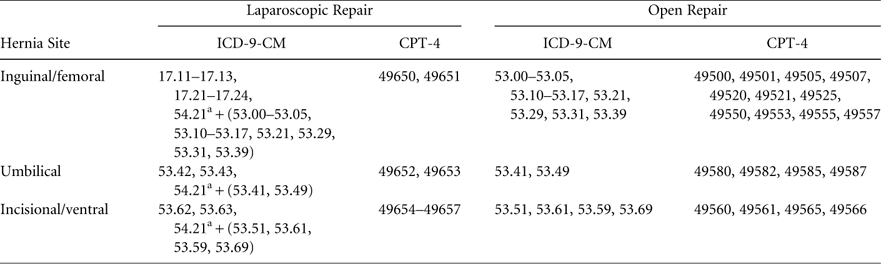
We identified hernia operations in members aged 6 months to 64 years from January 1, 2004, through December 31, 2010, using ICD-9-CM and CPT-4 procedure codes from inpatient and outpatient facilities and providers (Table 1). The hernia repair population was further refined by excluding operations likely to have erroneous claims for hernia repair, operations in members whose enrollment ended on the day of surgery, complicated procedures (ie, procedures performed together with another operation or after another NHSN operation during the same hospitalization or hernia repairs performed >1 day after hospital admission) and operations in medically complicated patients (ie, current cancer or sepsis; end-stage renal disease; operations coded for motor vehicle accident, abdominal compartment syndrome, or gunshot wounds), and procedures in which the surgery date and/or classification of the hernia site could not be determined from the claims, as described previously.Reference Nickel, Wallace, Warren, Mines and Olsen14 We limited our final population to procedures coded by both a facility and provider for the same hernia site and surgical approach to improve reliability.
Procedure Codes Used to Identify Hernia Repair

Note. ICD-9-CM, International Classification of Diseases, Ninth Revision, Clinical Modification; CPT-4, Current Procedural Terminology, fourth edition.
a Required that 54.21 be on the same claim as the open hernia repair ICD-9-CM procedure code.
Identification of SSI
SSIs first recorded 2 to 90 days after hernia procedures were identified using ICD-9-CM diagnosis codes from inpatient and outpatient facilities and provider claims. We excluded claims with locations that were not consistent with a provider diagnosis (eg, patient home) and claims with CPT-4 codes for laboratory services (88104-88399), since the coding may have indicated “rule-out” diagnoses.
The diagnosis codes used to identify SSI included postoperative wound infection (998.5, 998.51, 998.59, 996.69), peritonitis (567.2-567.29, 567.9), and retroperitoneal infection (567.3-567.39). To be consistent with the NHSN SSI definition,4 diagnosis of cellulitis of the trunk (682.2) or unspecified site (682.9) on the same claim as a CPT-4 code for incision and drainage was considered evidence of SSI. The diagnosis code 682.9 was used as an indicator of SSI only if it was on the same claim line as an abdomen-specific CPT-4 code (11005, 11008, 49020, 49021, 49040, 49041, 49060, 49061) or if it was coded on the same claim as incision and drainage (CPT-4 code 10060, 10061, 10180) by the provider who performed the hernia repair.
The date of onset of SSI was defined according to the timing and location of diagnosis. For SSI newly coded by an inpatient facility during the original operative admission, we assigned the date of SSI to the discharge date if the difference between the admission and discharge date was 2 days or greater. For SSI diagnosed during an inpatient readmission, the date of SSI onset was assumed to be the date of hospital readmission. For SSI diagnosed initially in an outpatient setting, the onset date was defined as the first service date with an ICD-9-CM code for SSI. Procedures with ICD-9-CM diagnosis codes for SSI, peritonitis, retroperitoneal infection, or sepsis from 30 days before to 1 day after surgery were excluded owing to preexisting infection.
The observation period for development of SSI was through 90 days after surgery, with earlier censoring for end of insurance enrollment, subsequent hernia repair, or another abdominal surgery. When censoring for subsequent surgeries, we censored 1 day after the subsequent surgery since SSI coded the day of or the day after a surgical procedure likely represents preexisting infection attributable to a previous surgery. Infections coded with non–abdomen-specific ICD-9-CM diagnosis codes (eg, 998.59) were not classified as SSI if they were first coded after a subsequent nonabdominal NHSN surgery.
Identification of Hernia Repair with Bowel Obstruction or Necrosis
We used ICD-9-CM diagnosis codes on the claims coded for the hernia procedure to identify bowel obstruction (550.1-550.13, 552-552.29, 552.8, 552.9) and necrosis (550.0-550.03, 551-551.29, 551.8, 551.9). We identified emergency room utilization associated with bowel obstruction or necrosis by using place of service codes and Uniform Billing-04 revenue codes 0450-0459 and 0981 during the surgical admission or within 7 days of the operation.
Statistical Analysis
Comparisons were performed using the χ2 or Fisher exact test for categorical variables, as appropriate, and the Kruskal-Wallis for continuous data. All data management and statistical analyses were performed using SAS, version 9.3 (SAS Institute). This study was approved by the Washington University Human Research Protection Office.
Results
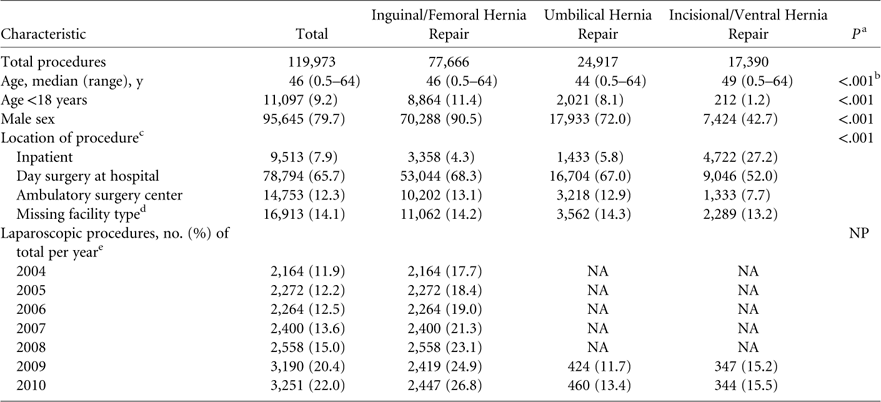
The final hernia repair population for analysis included 119,973 single-site operations in 116,572 patients with matching hernia site and surgical approach coded by both provider and facility. Overall, 80% of the operations were performed in males; males accounted for 91% of inguinal/femoral procedures, 72% of umbilical procedures, and 43% of incisional/ventral procedures. The median age of patients was 46 years (interquartile range, 35–55 years). Nine percent of all procedures were performed in children 6 months to 17 years of age with a range from 1.2% for incisional/ventral to 11.4% for inguinal/femoral hernia repairs. Most procedures were performed as same-day surgery at a hospital (66%). The percentage of laparoscopic hernia repairs increased each year; this was primarily influenced by inguinal/femoral hernia repair (Table 2).
Characteristics of Hernia Repair Procedures in 116,572 Patients
Note. Data are number (percentage) of patients unless otherwise specified. NA, not available; NP, not performed.
a χ2 test comparison across anatomic sites.
b Kruskal-Wallis test.
c Inpatient and day surgery matched to a facility in the American Hospital Association Annual Survey of Hospitals; inpatient was based on an inpatient designation in the HealthCore claims data. Ambulatory surgery center matched to a facility in the IMS Health Outpatient Surgery Center Profiling Solution data.
d Missing facility type due to no match to a facility in the American Hospital Association Annual Survey of Hospitals or the IMS Health Outpatient Surgery Center Profiling Solution data (n=16,826), or a match to multiple facilities (n=87).
e Specific International Classification of Diseases, Ninth Revision, Clinical Modification procedure codes for laparoscopic umbilical and incisional/ventral hernia repair were not introduced until 2009.
Of the 119,973 operations, 64.7% were inguinal/femoral, 20.8% were umbilical, and 14.5% were incisional/ventral hernia repairs. Among children, 8,864 (79.9%) procedures were inguinal/femoral, 2,021 (18.2%) were umbilical, and 212 (1.9%) were incisional/ventral hernia repairs. Among adults, 68,802 (63.2%) procedures were inguinal/femoral, 22,896 (21.0%) were umbilical, and 17,178 (15.8%) were incisional/ventral hernia repairs. Overall, 15.1% of hernia procedures were performed laparoscopically, including 21.3% of inguinal/femoral, 3.6% of umbilical, and 4.0% of incisional/ventral hernia repairs (Table 3). Ninety-seven percent of procedures among children were open hernia repairs, compared with 84% of procedures among adults.
Comparison of Surgical Site Infection (SSI) Rates after Hernia Repair by Site (n=119,973)
a χ2 test comparing SSI rates across anatomic sites within surgical approach.
b Fisher exact test.
Bowel obstruction was present at the time of 16.4% of procedures (n=19,633), while necrosis was present in 0.8% of procedures (n=900). Among hernia repairs with bowel obstruction or necrosis, the majority were open (92.6%) rather than laparoscopic (7.4%) operations. Bowel obstruction was present in 7.5% of inguinal/femoral, 33.4% of umbilical, and 31.7% of incisional/ventral hernia repairs, while necrosis was present in 0.8% of inguinal/femoral, 0.5% of umbilical, and 0.9% of incisional/ventral hernia repairs. Twelve percent of patients with hernia repairs with bowel obstruction or necrosis were admitted to the hospital through the emergency department compared with 3% of those with hernia repairs without obstruction or necrosis.
SSIs were identified after 1,355 procedures (1.13%). The rate of SSI was significantly higher among adults compared with children (1.21% vs 0.30%; P<.001) and significantly higher among females than males (2.47% vs 0.79%; P<.001). SSI was first identified from 2 to 30 days after operation in 71.5% of those with infection, while 20.7% of SSIs were identified from 31 to 60 days, and 7.8% were identified from 61 to 90 days following the hernia repair.
The incidence of SSI differed significantly by anatomic site, with rates of 0.45% for inguinal/femoral, 1.16% for umbilical, and 4.11% after incisional/ventral hernia repair (p<.001; Table 3). Compared with inguinal/femoral hernia repairs, the relative risk of SSI was 2.55 (95% CI, 2.18–2.98) for umbilical hernia repairs and 9.07 (95% CI, 7.99–10.30) for incisional/ventral hernia repairs. This trend remained after stratifying by open versus laparoscopic approach (Table 3).
Overall, the incidence of SSI was 3-fold higher after open procedures (1.26% [1,280/101,874]) versus laparoscopic procedures (0.41% [75/18,099]; relative risk, 3.03 [95% CI, 2.40–3.83]). The incidence of SSI was significantly higher for open versus laparoscopic inguinal/femoral (0.48% vs 0.34%, P=.020) and incisional/ventral hernia repair (4.20% vs 2.03%, P=.005). The incidence of SSI after umbilical hernia repair was not significantly different on the basis of surgical approach (1.18% after open vs 0.45% after laparoscopic repair, P=.052).
The rate of SSI was significantly higher among hernia repairs with bowel obstruction or necrosis than those without bowel obstruction or necrosis for open inguinal/femoral repair (0.89% vs 0.44%; P<.001) and umbilical hernia repair (1.57% vs 0.95%; P<.001) (Table 4).
Comparison of Surgical Site Infection (SSI) Rates after Hernia Repair by Bowel Obstruction/Necrosis
a χ2 test comparing SSI rates by presence of bowel obstruction/necrosis within anatomic site.
b Fisher exact test.
Discussion
To our knowledge, this is the first study to show variation in the incidence of hernia repair SSI by site, surgical approach, and bowel obstruction/necrosis in a large, multicenter, geographically diverse population. Our findings suggest that surveillance for hernia repair SSI rates should be stratified or weighted by operative factors in order to more accurately compare SSI rates among facilities with different patient populations and surgical case mix.
We confirmed previous reports of higher rates of SSI after open versus laparoscopic hernia repair.Reference McGreevy, Goodney, Birkmeyer, Finlayson, Laycock and Birkmeyer5–Reference Liang, Berger, Li, Davila, Hicks and Kao10 We demonstrated that incisional/ventral and umbilical hernia repair had significantly higher SSI incidence compared with inguinal/femoral hernia repair. We also found higher rates of SSI among open inguinal/femoral and umbilical procedures with bowel obstruction or necrosis, but not with open incisional/ventral hernia repairs. It is possible that open incisional/ventral procedures have inherently higher risk of infection owing to the proximity or potential involvement with the umbilicus so that incarceration or necrosis may not confer additional risk. Kaoutzanis et alReference Kaoutzanis, Leichtle, Mouawad, Welch, Lampman and Cleary13 reported overall SSI rates of 5.1% after incarcerated/strangulated ventral/incisional hernia and 4.2% after reducible ventral/incisional hernia repair using the American College of Surgeons National Surgical Quality Improvement Program data. Other studies have reported infection rates over 10% following incarcerated and/or strangulated inguinal/femoral,Reference Alvarez, Baldonedo, Bear, Solis, Alvarez and Jorge15 umbilical,Reference Nieuwenhuizen, van Ramshorst and ten Brinke16 incisional,Reference Nieuwenhuizen, van Ramshorst and ten Brinke16, Reference Zafar, Zaidi, Qadir and Memon17 and ventralReference Bessa and Abdel-Razek18 hernia repairs; however, all studies included only acute/emergency procedures and rates of infection in nonincarcerated/nonstrangulated operations were not available for comparison.
Recently new procedure-specific risk indices were incorporated into NHSN surveillance, as described by Mu et alReference Mu, Edwards, Horan, Berrios-Torres and Fridkin19 in 2011. The herniorrhaphy risk index includes age, American Society of Anesthesiologists score, duration of procedure, sex, and outpatient versus inpatient surgery. The NHSN hernia risk index does not include the operative factors we found to be associated with SSI, namely, anatomic site of hernia, approach, or presence of bowel obstruction/necrosis. We were unable to compare the impact of adding these operative factors to the NSHN index since we could not capture American Society of Anesthesiologists score or duration of surgery with claims data. It is likely that anatomic location of hernia is highly correlated with duration of surgery, since incisional or ventral hernia repair is usually performed at the site of previous surgery and involves a larger incision. In addition, mesh is often used for incisional hernia repair, which would be expected to increase the SSI rate owing to the presence of a foreign body.Reference Mangram, Horan, Pearson, Silver and Jarvis20 This suggests that incisional/ventral hernia location may be used as a proxy for a more complex operation. Bowel obstruction or necrosis would also be expected to be a proxy for a more complex operation, particularly in inguinal/femoral and umbilical hernia repair, and expected to be associated with higher wound class (clean-contaminated or contaminated).
The inclusion of surgical approach in a risk adjustment index is problematic, since unlike anatomic location, surgical complexity, or obstruction/necrosis, the choice of open versus laparoscopic approach is under the control of the surgeon. Likewise, in some respects duration of procedure is also under the control of the surgeon, since it represents a combination of time spent due to operative complexity and skill of the surgeon. Similarly, the choice to perform surgery in an outpatient facility versus during an inpatient hospitalization is also under the control of the surgeon. Although factors under the control of the surgeon (ie, processes of care) should not be included in risk indices,Reference Iezzoni21 duration of surgery and operating facility (outpatient vs inpatient) are included in the NHSN risk index for hernia repair. If the intent is to risk adjust for fixed patient- and operative-factors, operative approach should not be included in a risk adjustment index. Incisional/ventral hernia location and bowel obstruction/necrosis would be preferable to duration of surgery to adjust for operative complexity, since they are patient-level operative variables that are independent of surgeon skill.
Although the National Surgical Quality Improvement Program and NHSN mandated surveillance for 30 days during the period of our study,4, 22 we found that almost 30% of SSIs were first identified more than 30 days after the hernia repair procedure. This suggests that extending the period of surveillance improves detection of SSIs. Beginning in 2013, NHSN expanded the time frame for surveillance after hernia repair to 90 days for deep incisional and organ/space but not superficial incisional SSIs.
By definition, use of claims data for SSI surveillance involves secondary analysis of data collected for billing purposes. Our comparison of SSI rates in open versus laparoscopic umbilical and incisional/ventral operations was hampered by lack of specific codes to identify laparoscopic procedures prior to 2009. Although we excluded complex patients from analysis, underlying differences in patients likely remain that may account for some of the differences in infection rates by site and approach. There is also the potential for misclassification of SSIs, particularly minor infections treated only with antibiotics in an outpatient setting during the 90-day global surgical reimbursement period for providers.23 Thus our calculations for the incidence of SSI are likely underestimates of the true infection rate after these procedures. Our findings may not be generalizable to all hernia procedures since we limited our population to less complex procedures.
Strengths of this study include the very large number of procedures from a diverse group of providers and facilities and the rigorous method we used to categorize site and surgical approach by requiring concordant coding from both facility and provider. In contrast to most studies in the literature that reported SSI rates after only single anatomic site proceduresReference McGreevy, Goodney, Birkmeyer, Finlayson, Laycock and Birkmeyer5, Reference Neumayer, Giobbie-Hurder and Jonasson6, Reference Sauerland, Walgenbach, Habermalz, Seiler and Miserez8–Reference Kaoutzanis, Leichtle, Mouawad, Welch, Lampman and Cleary13 or after procedures that included a mixture of anatomic sites,Reference Mason, Moazzez, Sohn, Berne and Katkhouda7 we applied a uniform method to identify SSIs after categorizing the site and surgical approach in order to compare infection rates across different anatomical sites and surgical approaches. In addition, the use of claims data allowed identification of SSIs after discharge across the spectrum of healthcare providers. This is particularly important for procedures performed in ambulatory settings, since patients may be diagnosed and treated for SSI at a facility other than where the surgery was performed.
We found higher rates of SSI following open compared with laparoscopic hernia repair, incisional/ventral repair, and umbilical repair compared with inguinal/femoral procedures, and higher rates after open inguinal/femoral and umbilical hernia repairs with bowel obstruction/necrosis. Additional studies to determine the impact of adding the anatomic hernia location and bowel obstruction/necrosis to the NHSN risk adjustment index are needed to determine whether adding operative factors will allow for more accurate comparison of SSI rates across facilities. Risk adjustment indices that incorporate operative characteristics will help surgeons better communicate postoperative infection risk to patients undergoing hernia repair.
Acknowledgments
We thank Cherie Hill for database and computer management support.
Financial support. Agency for Healthcare Research and Quality (grant 5R01HS019713 to M.A.O.) Centers for Disease Control and Prevention Epicenters Program (grant U54CK000162 to V.J.F.). The findings and conclusions in this document are those of the authors, who are responsible for its content, and do not necessarily represent the official view of the Agency for Healthcare Research and Quality or the Centers for Disease Control and Prevention.
Potential conflicts of interest. D.K.W. reports consultant work with Centene, Sagentia, and Novaerus for work outside the submitted manuscript. V.J.F. reports personal fees from Battelle outside the submitted manuscript; her spouse is employed by Express Scripts. M.A.O. reports consultant work with Pfizer, Merck, and Sanofi Pasteur and grant funding through Cubist Pharmaceuticals and Sanofi Pasteur for work outside the submitted manuscript. All other authors report no conflicts of interest relevant to this article.