Introduction
Although transport is an issue of great importance to older people it has attracted a relatively modest body of research in the gerontological literature. This is a pity as it is a truly fascinating aspect of ageing, covering virtually every aspect of gerontology – social, psychological and clinical as well as ageism and policy – but also which provides one of the most comprehensive and pragmatic illustrations of the positive attributes of ageing, that of an exemplary safety record for older drivers despite high levels of multi-morbidity. Reference Cicchino and McCartt1 This potent and practical example of the longevity dividend Reference O’Neill2 is enhanced by the finding that the safety benefit is also conferred to other generations: children in crashes where the grandparents are driving are at one-half the risk of injuries as those in crashes where parents are driving. Reference Henretig, Durbin, Kallan and Winston3
Transport is the invisible glue that holds our lives together, an under-recognized and tacit contributor to economic, social and personal well-being. Reference Mindell, Cohen, Shelton, Sutaria, Hayward and Watkins5 Unfortunately, in public health terms, the medical profession has allowed itself to focus almost exclusively on the downsides of transport. The chapter on transport in one of the key texts of public health, Marmot and Wilkinson's otherwise excellent Social Determinants of Health Reference Marmot, Marmot and Wilkinson6 makes for grim reading – accidents, pollution and the impact of cars on exercise, and no mention on how lack of access to transport is associated with impaired health and social inclusion, an emerging research issue. Reference Hjorthol7 Equally, transport is a neglected area in virtually all existing longitudinal studies on ageing, Reference Bartley and O’Neill8 often with a disproportionate emphasis on public transport.
Search methods
This review is based on a search strategy using MedLine with MeSH terms (‘automobile driving’ OR ‘Transportation’) AND ‘Aging’, and with the terms ‘aging’ AND (driving OR transport OR transportation) on the Transport Research International Documentation database (TRID). This is an integrated database that combines the records from US Transportation Research Board's Transportation Research Information Services Database and the OECD's (Organization for Economic Co-operation and Development) Joint Transport Research Centre's International Transport Research Documentation Database: TRID provides access to more than one million records of transportation research worldwide. The search period was from 2000 (the last review of ageing and transport in this journal Reference O’Neill4 ) to February 2015 and was confined to papers, reports and other documents in English only.
A key element of social inclusion and well-being
The most major change in the literature of transport and health in the last decade has been the recognition that any focus on medical fitness to drive must maintain a due equilibrium between mobility and safety. 9 This may seem so obvious as to be banal, but the literature for the first 100 years of medicine and driving has been almost obsessively concerned with safety. Reference Oxley and Whelan10
It is increasingly clear that the private car and walking are the predominant forms of transport for not only the general public but also older people in the developed world: even if usage of public transport is increasing among older US citizens, it is from a very low baseline and still below 3% of trips. Reference Lynott and Figueiredo11 Driving cessation is associated with a range of negative health outcomes, including depression, Reference Marottoli, Mendes de Leon, Glass, Williams, Cooney and Berkman12 nursing home placement Reference Freeman, Gange, Munoz and West13 and death. Reference Edwards, Lunsman, Perkins, Rebok and Roth14 Negative social outcomes and impaired quality of life, even if less well quantified, Reference Banister and Bowling15 are increasingly a cause of concern, particularly when related to cessation of driving Reference Davey16 and also affect spouses and partners, Reference Curl, Proulx, Stowe and Cooney17 as well as reducing spending in the wider economy. Reference Kim and Richardson18
Theoretical basis of mobility
The theoretical framework for aligning transport with health and well-being has been marked by conceptual advances in recent years. One of the most useful concepts has been that of the life-space, concentric areas of expanding distance within and outside the home with increasing requirements for independent mobility. Reference May, Nayak and Isaacs19 A widely used instrument to measure this is the Life Space Assessment (LSA); Reference Peel, Sawyer Baker, Roth, Brown, Brodner and Allman20 and higher scores on the LSA are correlated with increased quality of life in older people, Reference Rantakokko, Portegijs, Viljanen, Iwarsson and Rantanen21 and lower scores are correlated with impaired physical performance and a lower sense of autonomy. Reference Portegijs, Rantakokko, Mikkola, Viljanen and Rantanen22
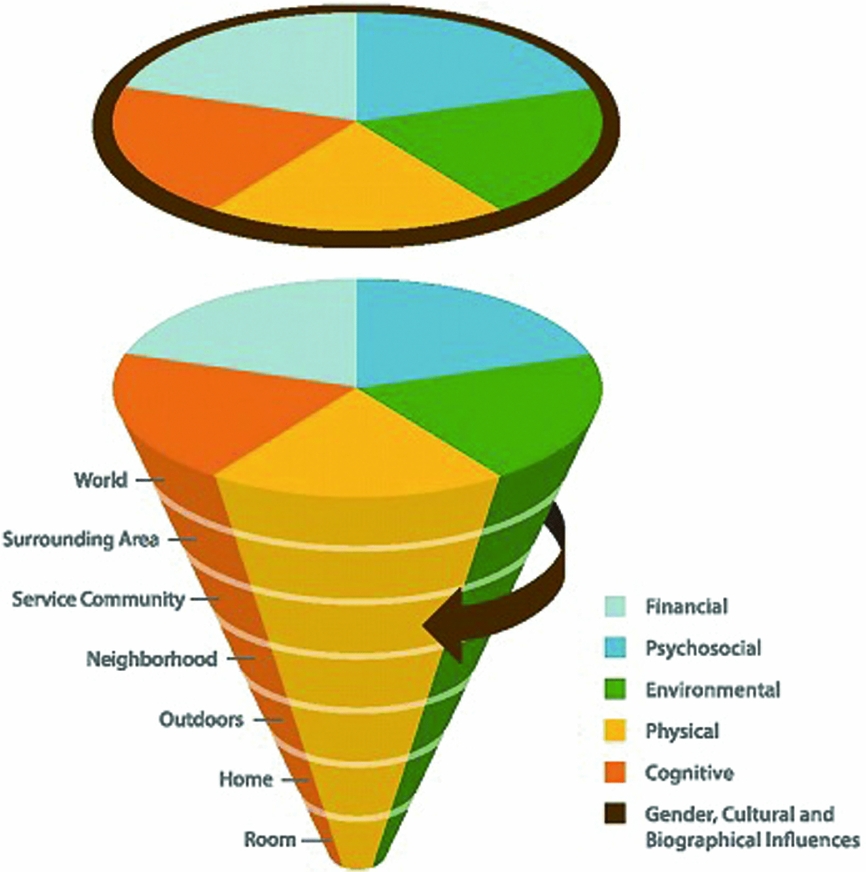
A comprehensive model of the factors involved in mobility in the life-space has been proposed through five fundamental categories of determinants (cognitive, psychosocial, physical, environmental and financial), with gender, culture and biography (personal life history) conceptualized as critical cross- cutting influences (Fig. 1). Reference Webber, Porter and Menec23 This model is useful because it expands on previous discourse which was relatively compartmentalized and usually concentrated on physical aspects related to the person and/or the environment, whereas a much broader range of social, Reference Yeom, Fleury and Keller24 environmental Reference Rantanen, Portegijs, Viljanen, Eronen, Saajanaho and Tsai25 and even genetic Reference Viljanen, Mikkola, Rantakokko, Kauppinen, Kaprio and Rantanen26 determinants to mobility in later life are increasingly recognized. A broader and holistic vision is needed to progress research into the determinants not only of mobility but also transport-related quality of life.
Conical model of the theoretical framework for mobility in older adults illustrating seven life-space locations (ascending in order of increasing distance from the room where one sleeps), each of which is composed of mobility determinants related to cognitive, psychosocial, physical, environmental and financial factors. A ring representing gender, culture and biographical influences surrounds the entire cone exerting influence on all of the mobility determinants. A cross-section of the cone is illustrated above. Reproduced with permission from Sandra C. Webber et al. The Gerontologist 2010. Published by Oxford University Press on behalf of The Gerontological Society of America.

Complementing this over-arching theoretical structure is a useful hierarchy of transport needs, akin to Maslow's hierarchy of needs, based on qualitative research with older people. Reference Musselwhite and Haddad27 It supplements the often utilitarian view of transport needs by generating three levels of need: utilitarian (primary) needs; affective (secondary) needs, such as control and independence; and aesthetic (tertiary) needs, such enjoying the journey itself, mastery and achievement. When older people give up driving, their self-reported quality of life is reduced and this seems significantly related to a reduction in affective and aesthetic qualities of mobility that a car affords, which walking and using public transport lack.
An ageist policy matrix
Despite the relatively clear emerging message of the importance of transport, and in particular driving, to older people, it is clear that negative attitudes persist towards older drivers in the media, public policy, and even among gerontologists. At the heart of this problem is a tenacious and fixed false belief that older drivers are somehow more dangerous. Reference O’Neill28 This is best characterized by the persistence of the ‘more-crashes-per-distance-travelled’ concept nearly a decade after this was shown to be an artefact of low mileage, Reference Hakamies-Blomqvist, Ukkonen, O’Neill, Raitanen and O’Neill29 and subsequently confirmed in further studies. Reference Langford, Methorst and Hakamies-Blomqvist30 Although these findings have been disputed on the basis of discrepancy between self-reported and odometer-based driving distances, Reference Staplin, Gish and Joyce31 subsequent research confirms the low-mileage bias with both forms of measurement. Reference Langford, Koppel, McCarthy and Srinivasan32 In addition, increasing fragility is recognized as the explanation for the fact that older people have less crashes but more fatalities. Reference Li, Braver and Chen33
However, in the popular media, older drivers are repeatedly portrayed as hazardous Reference Martin, Balding and O’Neill34 and many jurisdictions continue to implement medical screening of older drivers, Reference White and O’Neill35 despite the fact that it has repeatedly been shown to have a negative impact on traffic safety. Reference Siren and Haustein36
Of more concern, advocacy organizations and some gerontologists have also engaged in ageist stances, perhaps a manifestation of reverting to the failure model of ageing. Reference Kalish37 The AARP (American Association of Retired Persons), the largest advocacy organization in the USA, provides training courses for older drivers (http://www.aarp.org/home-garden/transportation/driver_safety/), despite the fact that (a) there is no indication of need for such training, and (b) not only is there no evidence of any efficacy for such courses Reference Korner-Bitensky, Kua, von Zweck and Van Benthem38 but there is also a suggestion of increased crash risk among attendees. Reference Nasvadi and Vavrik39 From a gerontological perspective, many researchers working with older drivers still preface their papers with reference to the increased hazard older drivers present, Reference Zur and Vrkljan40 an approach that should no longer be acceptable. Reference O’Neill41
It is not that there are not hugely important research issues for the safety of older people in the traffic system – the safety of older pedestrians and cyclists, Reference Martin, Hand, Trace and O’Neill42 non-collision bus injuries among older people, Reference Palacio, Tamburro, O’Neill and Simms43 the failure of in-car safety measures to be adapted to populations with more physical frailty Reference Palacio, Tamburro, O’Neill and Simms43 – but the scope for significant gains in safety through research among whole population approaches to older drivers remains marginal at best, and should not be at the expense of a misrepresentation of their safety record.
Driving cessation
Driving cessation has become a key focal point of practice, research and debate. It is a cause of concern that older people will spend a significant proportion of their later years as non-drivers. A 2002 study calculated that women drivers aged 70–74 years will depend on others for transportation for 10 of their remaining years, and the corresponding figure for men is 7 years. Reference Foley, Heimovitz, Guralnik and Brock44
In line with complexity of factors inherent in maintaining mobility through life, older people report a variety of factors that inform their decision to stop driving. Reference Choi, Mezuk and Rebok45 Poor health remains strongly correlated with cessation, including vision and cognition, Reference Keay, Munoz, Turano, Hassan, Munro and Duncan46 neurological disease, Reference Lafont, Laumon, Helmer, Dartigues and Fabrigoule47 and cardiovascular disease and reduced functional status. Reference MacLeod, Satariano and Ragland48 In addition, licensing policies have an important impact: accelerated renewal, mental testing, peripheral vision testing, renewal in person at age 70+ (as opposed to renewal by mail or online) and restricted licensing have a significant effect on an older driver's decision to reduce or cease driving. Reference Kullkov and Kulikov49 For families, this transition can prove particularly difficult: Reference Connell, Harmon, Janevic and Kostyniuk50 adult children worry about assuming responsibility for their parents’ transportation needs and their parents’ reactions to restricted mobility. Driving cessation for people with dementia has been described as a process with three stages and associated challenges and needs. Reference Liddle, Bennett, Allen, Lie, Standen and Pachana51 The early stage involved worried waiting, balancing safety with impending losses, and the challenge of knowing when to stop. The crisis stage involved risky driving or difficult transportation, acute adjustment to cessation and life without driving, and relationship conflict. The post-cessation stage was described as a long journey with ongoing battles and adjustments as well as decreased life space, and was affected by the disease progression and the exhaustion of caregiver.
Certain factors seem to ameliorate the transition to not driving, such as pre-planning, Reference Musselwhite and Shergold52 and transportation access is better for those who have access to lifts from friends and neighbours compared with those who rely on family or public transport. Reference Choi, Adams and Kahana53 Notwithstanding, multiple studies point to negative consequences associated with driving cessation.
Approaches to managing the consequences include review of licensing procedures, counselling Reference Edwards, Bart, O’Connor and Cissell54 and provision of alternative transportation. Whatever combination of factors led to driving cessation almost invariably rule out the use of public transport: 9 social economy models and information management technology can help to create community mobility that is consumer-oriented, age friendly and environmentally and financially sustainable, as in the mould-breaking ITNAmerica (http://www.itnamerica.org/). In this new approach to community transportation, people are finding innovative ways to achieve efficiency by travelling together in private vehicles. Reference Freund and Vine55
Clinical aspects of driving and ageing
Given that medical factors have a relatively small role to play in accident causation, Reference Marshall56 that older drivers strategically adapt to their age-related disability, Reference De Raedt and Ponjaert-Kristoffersen57 and that transport is so important in optimal ageing, physicians need to reformulate their approach to driving, transport and ageing by moving from the traditional position of arbiter of who should not drive to that of enabler of safe transport.
There is now an impressive range of evidence for interventions that improve comfort and safety for older drivers (Table 1). In addition, license restriction is associated with lower crash risks, Reference Caragata Nasvadi, Wister, Nasvadi and Wister58 holding out promise that graduated driving reduction may be a viable option to driving cessation. So, while patients require advice for many medical conditions to protect them and other road users from harm, Reference Redelmeier, Yarnell and Tibshirani59 they also need access to these enabling and rehabilitative strategies which will facilitate continued and more comfortable driving.
Sample diseases and conditions for which appropriate assessment and remediation may be of benefit

The philosophy and practice of geriatric medicine, with its emphases on assessment of function, enabling and supportive paradigms, multi-disciplinary assessment, advocacy and adherence to the biopsychosocial model, are a good basis for the development of assessment of medical fitness to drive in older people. In practice, the same skills are seen in the integration of clinical assessment and input from the multidisciplinary team in the calculation of risk in other areas of clinical practice such as deciding on discharge to home. Elements of the decision-making process include careful multidisciplinary evaluation, discussion with carers and perhaps a trial visit home. The elements of this process are very similar to the assessment of fitness to drive. Not only may relatives place security before independence but also a psychometric model is not likely to be helpful. This often surprises clinicians: while psychometric support is important in backing up our diagnostic abilities, it is rarely of help when making decisions about function. For example, the decision that the patient is no longer fit to remain at home and requires placement in a nursing home is much more likely to be taken on the basis of measures of function and behaviour than on psychometric measures.
The premise that the expertise of those who specialize in the healthcare of older people contains some of the elements necessary for mobility assessments is not a charter for dilettantism. Rather, it is a challenge to us to develop the extra resources required to ensure that we have adequate support when making decisions about enhancing the safe mobility of older people. This has many parallels with the task of assessing safety at home or capacity to manage financial affairs: in these cases, it is good practice to liaise with an occupational therapist or a neuropsychologist. Further support can be gained from a range of guidelines on medical fitness to drive, Reference Rapoport, Weegar, Kadulina, Bédard, Carr and Charlton60 as well as a helpful clinical guide from the American Medical Association. Reference Carr, Schwartzberg, Manning and Sempek61
Elements of the driving assessment
Physicians assessing older people for transport/driving capability need to know:
-
(1) How does the older adult meet their transportation needs?
-
(2) What intrinsic factors contribute to driving ability and how can we assess them?
-
(3) What interventions should clinicians pursue?
-
(4) What is the physician's responsibility with regard to driver licensing and insurance authorities?
Taking a driving/transportation history
Although it may seem obvious that transportation should figure in a comprehensive assessment, this is not necessarily the case: for example, many patients do not obtain formal advice or assessment about driving after stroke Reference McNamara, McCluskey, White and George62 or syncope. Reference MacMahon, O’Neill and Kenny63 The patient's own assessment of driving should be assessed, and a promising approach in this regard is the Adelaide Self-Efficacy Scale. Reference George, Clark and Crotty64 A collateral (witness) history of driving abilities is important if the patient has cognitive impairment, cognizant of a potential conflict of interest of a spouse who does not drive: Reference Adler, Rottunda, Rasmussen and Kuskowski65 a proxy rating of self-efficacy may be helpful Reference Stapleton, Connolly and O’Neill66 and a new proxy instrument, the Fitness-to-Drive Screening Measure, shows promise. Reference Winter, Classen and Shanahan67
For patients with cognitive impairment, physicians should enquire about new unsafe driving behaviors. These behaviors can be apparent in mild dementia and would raise concerns about continuing driving privileges. It is important to recognize behaviours that represent a change from baseline. They include becoming lost in familiar areas, driving too fast, reacting too slowly, consistently making poor judgements, failure to notice street signs, having more accidents, receiving indecent gestures from other drivers, miscalculating speed and distances, new dents on the car, knocking off rear view mirrors, showing poor judgement when making turns, or impaired ability to recognize or understand road or traffic signs.
What factors are important in driving assessment?
There are three main categories of medical conditions relevant to driving. The most important are those conditions which affect self-regulation: at younger ages this mostly relates to immaturity, risky personality, alcohol dependence and psychiatric illness, but for older drivers is predominantly related to dementia. The second category is that of physical impairments relevant to driving, including those of vision, strength and co-ordination. Finally, a number of conditions can suddenly disable a driver, most commonly syncope, seizure and hypoglycaemia.
An older person can present at clinic with a combination of all three – for example Parkinson's disease with associated Lewy Body disease and a tendency to fall asleep, further complicated by fluctuations – but in general it is the ability to self-regulate and behave in a prudent manner relative to the current clinical condition which is the key determinant of fitness to drive. This is in keeping with the concept of risk homeostasis, the concept which best explains the complex and hierarchical processes of driving. Reference Fuller68
Traditional neuropsychological test batteries do not reflect this model: unsurprisingly, psychometric approaches to assessing self-regulation have been disappointing: Reference Ranney69 despite a huge and ultimately Quixotic range of publications on psychometric assessment and driving, all such batteries should be seen as an aid to an overall assessment of the functional status of the patient rather than as an indicator of whether or not the patient is fit to drive. Reference Molnar, Patel, Marshall, Man-Son-Hing and Wilson70
The most simple clinical approach to the risk homeostasis model is the hierarchy of Michon, which uses strategic, tactical and operational factors. Reference Michon, Evans and Schwing71 The strategic level is the choice of whether or not to travel, the tactical decision is whether or not to overtake and the operational level is what to do when overtaking and faced with an oncoming car. The strategic and tactical levels are probably more important in terms of driving safety than the operational level, and experienced clinicians will be alert to this. This concept has been operationalized for brain damage, Reference Galski, Ehle and Williams72 in an older driver screening battery Reference De Raedt and Ponjaert-Kristoffersen57 and resonates with the Adelaide Self-Efficacy Scale. Reference George, Clark and Crotty64
The most common model for driver assessment involves a combination of physician, occupational therapist, neuropsychologist, specialist driving assessor and/or social worker. Not all disciplines will be needed by all patients, as a trichotomy is usually the result of preliminary assessments: Reference Molnar, Patel, Marshall, Man-Son-Hing and Wilson70 should not drive (i.e. severe dementia), with referral to the social worker to plan alternative transportation is appropriate; no problem with driving (i.e. mild cognitive impairment); and those who require further evaluation, off- and/or on-road. The overall interdisciplinary assessment should attempt to provide solutions to both maintaining activities and exploring transport needs. However, even in a skilled rehabilitation setting, the predictive value of team assessments may be low for diseases such as stroke Reference Akinwuntan, Feys, DeWeerdt, Pauwels, Baten and Strypstein73 and it is increasingly clear that early recourse to an on-road test is the optimal approach for those with cognitive impairment who need further assessment. Reference Breen, Breen, Moore, Breen and O’Neill74
At the moment simulators of sufficient sophistication are not widely available but may represent opportunities for both driver rehabilitation Reference Akinwuntan, De Weerdt, Feys, Pauwels, Baten and Arno75 (analogous to training aeroplane pilots) and assessment, albeit limited by increased simulator sickness with advancing age. Reference Brooks, Goodenough, Crisler, Klein, Alley and Koon76
On-road driver testing is the gold standard and should be offered to all patients who are not clearly dangerous when driving. The assessor will require a full clinical report, and may choose to use one of the recently developed scoring systems for on-road testing of patients with dementia. A number of formalized tests have been described for both dementia and general usage, the key elements of which have been usefully summarized. Reference Kowalski, Tuokko and Tallman77 The tests should ideally involve some degree of cognitive loading, which will tend to bring out the degree and extent to which the older driver can manage complex situations safely. Reference Uc, Rizzo, Anderson, Shi and Dawson78
There are certain limitations with road tests. Occasionally a patient may perform well on a test but the proxy history and clinical examination may suggest a background pattern of driving and capabilities which seem unduly hazardous: in such cases, the clinical decision should outweigh the on-road test. Expenses for driving evaluations may vary from $200 to $500 and health insurance or government health providers may not cover the cost. However, it is also argued that such a cost is not unreasonable in view of the other maintenance costs associated with the upkeep of a car.
What interventions can we make?
Depending on the illnesses present, there is potentially a wide range of interventions that we can undertake (Table 1). Adaptation of the car, following advice from the occupational therapist, physiotherapist or specialist driving assessor can improve driving comfort and safety: a particularly interesting development in occupational therapy is the CarFit programme. Reference Stav79 Follow-up review should be organized for those with progressive illness such as dementia and Parkinsonism. A review period of 6–12 months would seem to be reasonable with a progressive neurodegenerative dementia. Reference Duchek, Carr, Hunt, Roe, Xiong and Shah80 However, patients and carers should be asked to seek an earlier review if they perceive a significant decline in the status of the dementia or in driving abilities. The American Academy of Neurology guidelines, proposing that no-one with a Clinical Dementia Rating (CDR) scale of 1 should drive, have been superseded by research which judged 41% of those with a CDR of 1 as safe (19% were considered to be marginal, and 41% to be unsafe). Reference Duchek, Carr, Hunt, Roe, Xiong and Shah80 This reinforces the need for a full assessment and appropriate follow-up.
For the progressive neurological conditions, the physician needs to help the patient and their family prepare for eventual withdrawal from driving. Early and appropriate diagnosis disclosure is likely to be important here Reference Bahro, Silber, Box and Sunderland81 in conjunction with modified Ulysses contract outlining that driving cessation needs to planned for. Reference Howe82 This is named after the hero who made his crew tie him to the mast on the condition that they did not heed his entreaties to be released when seduced by the song of the sirens. It forms the basis of a useful patient and carer brochure from the Hartford Foundation which is also available online. Reference Hartford83
The very act of highlighting the potential of compromised driving ability may have a therapeutic benefit, promoting an increased vigilance on the part of the patient and carers that their social contract for driving privileges is not the same as that of the general public. Support is given to this concept by the success of restricted licensing for people with medical illnesses. Reference Langford and Koppel84 While the effect might arise from the restrictions (avoidance of motorways, night-time driving) it is also possible that the very act of labelling these drivers may heighten self-awareness.
A clear recommendation should be made to the patient and recorded in the medical record: this should include advice to inform their insurance company of relevant illnesses, as well as any statutory requirement to inform their driver licensing authority.
When driving is no longer possible, alternative options should be discussed with the patient, and it is helpful to discuss options with friends and family, as well as for the drawing on locally available resources. State or local sponsored services may provide door-to-door transport for older adults in large vans, many of which are lift-equipped. Local communities, societies, retirement centres, or local church groups may use funds or volunteers to provide services to physician offices, grocery stores and meetings. The place of mobility scooters in meeting this need is controversial: while not suitable for those with moderate to severe dementia, their role for those with physical disabilities is unclear; Reference Auger, Demers, Gélinas, Jutai, Fuhrer and DeRuyter85 but they are increasingly popular Reference May, Garrett and Ballantyne86 and neither road nor pavements are currently configured for their safe use.
What is the physician's responsibility with regard to driver licensing and insurance authorities?
In general, the welfare role of the physician extends to reminding the patient that most insurance companies require disclosure by the driver of ‘illnesses relevant to driving’ when they arise, which includes virtually all neurodegenerative illnesses, and conditions that affect function. In addition, many driver licensing authorities require the driver to report a range of conditions to them, and controversially some jurisdictions require mandatory reporting of certain illnesses. This is widely regarded as unhelpful, as not only does it interfere with the doctor–patient relationship and potentially deter older drivers from seeking treatment but also benefits can be demonstrated for mandatory reporting. Reference McLachlan, Starreveld and Lee87 The issue needs to be taken up by clinicians through their professional groupings, as has occurred already with a call for its removal by epilepsy specialists in Canada. Reference Remillard, Zifkin and Andermann88
What can be done when patients continue to drive despite advice to cease?
We may have laid too much emphasis in the previous literature on medical fitness to drive guidelines on the role and responsibility of the doctor, and not enough on the responsibilities of drivers and other citizens, and have thereby perhaps over-medicalized the response. At the point where concerns arise over continued driving by a driver with dementia and it is clear that the patient's driving habits are dangerous, it is a misguided kindness to approach dangerous driving as an issue that should be approached in terms of diagnosis and treatment of the underlying cause. As dangerous driving not only represents a hazard to the driver and other road users, and is a statutory offence, it should be reported to the police in the first instance.
This approach can lift a weight off doctor's shoulders, as not uncommonly a relative will ask the doctor to do something about dangerous driving the relative has witnessed in a driver with dementia. This is second-hand information, and the doctor should remind the relative that they have a citizen's duty to report the dangerous driving to the police: the medical aspects can be dealt with subsequently.
In addition, it is also inappropriate and unfair to expect doctors to be the sole conduit for reporting driving that poses a hazard to the general public, so this responsibility, in the absence of a family member or carer who can assist, should lie with the healthcare professional witnessing the behaviour.
The actual process of a physician breaking confidentiality in the event of evidence of hazard to other members of the public is almost universally supported by most codes of medical practice. In general it is expected that the clinician will have tried persuading the patient and the family in the first instance, and that breaking confidentiality should only occur if both of these approaches have failed and the patient is deemed to represent a significant risk to other road users.
A grey area is the determination of what represents a significant risk to other road users. It is likely that a relatively low threshold is indicated for a progressive neurodegenerative illness where insight is often impaired: if a patient refuses assessment, is reported by a third party to be driving erratically or in an unsafe manner, then it is probably appropriate to consider breaking patient confidentiality.
To whom this should be reported poses a practical ethical challenge. The traditional route of reporting to driver licensing authorities may have relatively little benefit: removal of a driving licence is likely to have little impact on a driver whose insight into deteriorating driving skills is poor. It is important that this disclosure has some likelihood of impact and results in the least traumatic removal of the compromised older driver from the road. In such instances, the family may be able to intervene in terms of disabling the car and providing alternative modes of transport. In my own experience, I rarely have had to invoke official intervention, but find that a personal communication with a senior police officer in the patient's locality may result in a sensitive visit to the patient and cessation of driving.
Mandatory reporting represents a different ethical challenge. It is unlikely that it is of significant benefit and unless significant benefit can be shown in future studies, the profession should resist the introduction of such schemes. For individual practitioners in jurisdictions where such regulations exist, a twin-track approach is probably necessary – professional advocacy with law-makers, and a considered approach as to whether disclosure is in the patient's best interests on a case-by-case basis. If the physician is confident that the state or province has a mechanism for fair assessment and an enlightened approach to maintaining mobility, compliance is not difficult. If the assessment is cursory and aimed at unduly restricting mobility, physicians may be faced with a problem recognized with other laws, which may put a patient's welfare at risk and where professional obligations may require non-compliance with an unfair law.
Conclusion
Transportation and driving represents an important if relatively neglected aspect of optimal ageing, and gerontologists need to provide due attention to incorporating outdoors mobility into research and practice. Assessment of driving has become an integral part of the clinical assessment of older people. Gerontologists and geriatricians, appropriately supported by their interdisciplinary team and specialist on-road assessment, can help to support safe mobility and social inclusion in later life.
Conflicts of interest
The author has no conflicts of interest to declare.