Background
Catheter-associated urinary tract infections (CAUTIs) are externally reported by hospitals based on national surveillance criteria. 1 These criteria are broad and often capture patients with asymptomatic bacteriuria rather than true infection. Among various CAUTI prevention measures, diagnostic stewardship of urine cultures is recognized as an important element; it serves to reduce the detection of asymptomatic bacteriuria that may lead to overdiagnosis of CAUTI and unnecessary antibiotic use. Reference Trautner, Grigoryan and Petersen2 While this benefit has been demonstrated in a number of clinical studies, Reference Coffey, Claeys and Morgan3 there is a paucity of diagnostic algorithms shown to be effective for reducing CAUTI. As part of quality improvement efforts at our institution, we developed and implemented a novel diagnostic algorithm for CAUTI.
Methods
This was a pre-post implementation study of a diagnostic algorithm for CAUTI at Lahey Hospital and Medical Center, a 334-bed tertiary academic medical center in Burlington, MA. The diagnostic algorithm (Figure 1) was created in 2020 through a review of current evidence and consultation with Infectious Disease, Infection Prevention, Urology, and Nursing services. The algorithm was introduced to all intensive care units in last quarter of calendar year 2020, and all medical-surgical units in the first quarter of 2021. One author (D.A.C) recorded a lecture to explain the algorithm to provider divisions and inpatient nurses. A best-practice advisory (BPA) was released in April 2021 within the electronic medical record (Epic Systems Corporation, Verona, WI) for every urine culture or urinalysis with reflex to culture ordered for an inpatient with an active indwelling urethral catheter, and cued the ordering provider to refer to the algorithm and order a catheter exchange, if appropriate (supplemental material).
Urine culture algorithm for patients with an indwelling urethral catheter.

Episodes of indwelling urethral catheterization for ≥2 consecutive calendar during calendar years 2020 – 2022 were included; nephrostomy or suprapubic catheterizations were excluded. The preimplementation period was the calendar year of 2020, and the postimplementation periods were the calendar years of 2021 and 2022, analyzed separately. The primary outcome was the rate of CAUTI per 1,000 catheter-days. CAUTI was defined by NHSN (National Healthcare Safety Network) criteria. 1 Secondary outcomes were the rate of catheterized urine specimens (defined as urine culture or urinalysis with reflex to culture obtained from an indwelling urethral catheter) obtained per 100 catheter-days and the percentage of catheterized urine specimens obtained after a catheter exchange. A reflex threshold of >10 white blood cells per high-power field or moderate to large leukocyte esterase was used to reflex to culture.
Data was collected from our electronic medical record, including the number of catheterized urine specimens and whether a catheter was exchanged prior to each specimen. Patient-days, catheter-days, and CAUTI events were collected from NHSN. A student’s T-test or Wilcoxon signed-rank test were used to compare annual rates with a two-sided P value and alpha < .05. A two-sided exact test was used to compare the incidence rates with matching confidence intervals. A Bonferroni correction was used for multiple tests. Surveillance for adverse events related to the algorithm (eg, catheter trauma or delayed diagnosis of urinary infection) was performed through the hospital’s event reporting system. This study was exempted from review by the Lahey Clinic Institutional Review Board.
Results
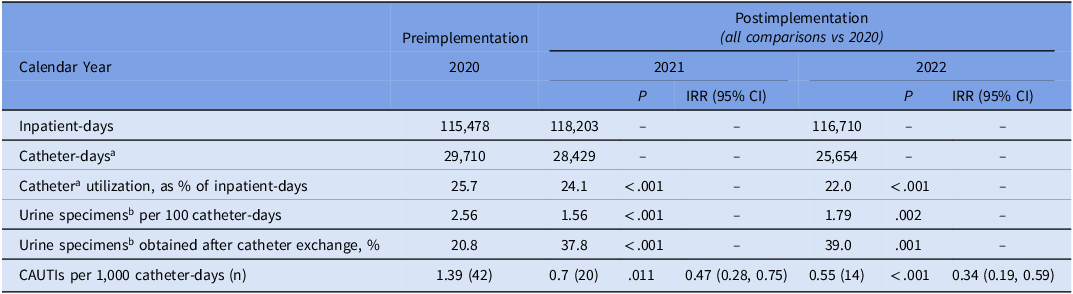
The rate of indwelling urinary catheter utilization per inpatient-day was 25.6%, 23.9%, and 21.84% in 2020, 2021, and 2022, respectively (Table 1). Catheterized urine specimens per 100 catheter-days decreased significantly from 2020 to 2021 (2.56–1.56, P < .001) and remained decreased through 2022 (1.79, P = .002 compared to 2020). The percentage of catheterized urine specimens obtained after a catheter exchange increased significantly from 2020 to 2021 (20.8% vs 37.8%, P < .001) and remained increased through 2022 (39.0%, P = .001 compared to 2020). There were 42, 20, and 14 episodes of CAUTI in 2020, 2021, and 2022; the CAUTI rate per 1,000 catheter-days decreased from 2020 to 2021 (1.39–0.7, incidence rate ratio [IRR] 0.47, 95% confidence interval (CI) 0.28 – 0.75) and remained decreased in 2022 (0.55, IRR 0.34, 95% CI 0.19 – 0.59 compared to 2020).
Results from pre- and postimplementation periods

IRR, incidence rate ratio; CI, confidence interval; CAUTI, catheter-associated urinary tract infection.
a Indwelling urethral catheters only.
b Catheterized urine cultures and urinalyses with reflex to culture.
No safety reports related to catheter exchange or CAUTI diagnosis were received during the study period.
Discussion
CAUTI prevention is a universal need for both acute and long-term care facilities. The diagnostic stewardship of urine specimens has become an increasingly recognized element of CAUTI prevention, Reference Coffey, Claeys and Morgan3 yet there are few published examples of clinical decision support tools. Trautner and colleagues Reference Trautner, Grigoryan and Petersen2 described a diagnostic algorithm that reduced urine specimen use but did not address catheter exchange before obtaining a specimen. Reference Raz, Schiller and Nicolle4 Mullin and colleagues Reference Mullin, Kovacs and Fatica5 showed that limiting catheterized urine specimens to specific populations reduced urine culture use and CAUTI, but similarly did not address catheter exchange and was limited to fever workup of critically ill patients only.
In this study, we report a significant and durable improvement in CAUTI and a corresponding improvement in the key process measures targeted by the algorithm - urine specimen use and exchange of indwelling urethral catheters prior to obtaining urine specimens. The improvement in these process measures suggests that the improvement in CAUTI did not occur by chance but more likely as a result of true changes in practice brought on by the algorithm.
Indwelling urethral catheter utilization decreased during the study period despite no changes being made to policies around catheter utilization. This could be a result of increased scrutiny of catheters in general due to our intervention. While reducing catheter utilization is a well-recognized CAUTI prevention strategy, the effect on CAUTI rates can be unpredictable and conversely may increase rates by decreasing the denominator.
The ideal time point after which an indwelling urethral catheter ought to be exchanged prior to obtaining a urine culture is unclear. We used a threshold of 48 hours to place a high priority on avoiding contaminated specimens at the cost of performing more exchanges. Others have studied 7 days Reference Yarrington, Reynolds and Dunkerson6 or 14 days Reference Hooton, Bradley and Cardenas7 as thresholds for catheter exchange but a timeframe as short as 24 hours has shown benefit. Reference Frontera, Wang and Phillips8 We achieved 39% compliance with catheter exchange; the remaining 61% may have been missed due to provider judgment, patient preference, or other clinical contraindications. Our approach to catheter exchange did not result in any reported harms and was sustainable for nursing staff.
The limitations of this study include its quasi-experimental nature and the potential influence of other unmeasured factors affecting CAUTI. Our preimplementation period coincided with the onset of the COVID-19 pandemic which has been associated with increased healthcare-associated infection rates, however internal data shows that CAUTI rates at our institution did not meaningfully change after onset of the COVID-19 pandemic (1.35 vs 1.39 CAUTIs per 1,000 catheter-days in calendar years 2019 and 2020, respectively). We did not collect data on patient-level demographics, comorbidities, or trends in antibiotic prescribing. We did not use a “wash-out” period after implementation, but this omission would have only biased our results toward the null. Finally our study was performed at an academic medical center and may not be generalizable to other settings.
Conclusion
The implementation of a diagnostic algorithm for CAUTI led to significant, durable improvement in both urine culture practices and CAUTI rate. More research is needed to clarify best practices for diagnostic stewardship of urine cultures.
Supplementary material
The supplementary material for this article can be found at https://doi.org/10.1017/ice.2025.10236
Financial support
None reported.
Competing interests
All authors report no conflicts of interest relevant to this article.