Peircean semiotics has retained a place in the study of music for more than 40 years. Early examples are found in the work of Wilson Coker and David Osmond-Smith, and aspects of Jean-Jacques Nattiez's work draw on Peircean thought.Footnote 1 Raymond Monelle's 1991 article ‘Music and the Peircean Trichotomies’ exhibits a particularly rigorous engagement with Peirce in relation to musical signification,Footnote 2 but the most important and influential studies to date that deploy Peirce's semiotics are Robert Hatten's Musical Meaning in Beethoven of 1994 and Naomi Cumming's The Sonic Self of 2000.Footnote 3
This scholarship provides some insightful and at times brilliant uses of Peirce's semiotics. In the hands of Hatten, in particular, Peircean thought has proved both flexible and theoretically astute. Despite this significant interest in Peirce, however, few studies have focused upon what are arguably the most important aspects of his thought: his contribution to logic and his development of a pragmatic approach to epistemology. These two areas are intimately linked; indeed, it has been argued that Peirce's entire project is thoroughly unified, despite certain shifts in his thinking around 1886.Footnote 4 This article develops a theory of Peircean semiotics in music that is rigorously derived from key insights at the heart of this unified project. It focuses, therefore, upon Peirce's theory of the proposition, which is central to his conception of the human ability to make progress in understanding. In so doing, the article posits an approach to music analysis that is sensitive to the importance of music's internal structure while looking to understand more fully the role of cultural contexts and social forces in the development of musical meanings. To this end, it avoids any tendency to conflate structure and meaning, looking instead to recognize their categorical separation so as to theorize their interaction. The article begins with an introduction to Peircean semiotics before developing a theory of musical valency, which is then applied to the Allegro of Mozart's ‘Prague’ Symphony. It concludes by theorizing the role of cultural and ideological forces in articulating and saturating music's valency.
Peircean semiotics and music studies
In approaching Peircean thought, music scholars have tended to be less concerned with Peirce's broader philosophical project than with a set of theoretical tools extracted from it. These tools are, of course, intimately bound up with Peirce's wider system, but the process of extraction has tended to produce a piecemeal engagement with Peircean thought that has not harnessed the full potential of his insights. This section will briefly consider popular Peircean theoretical tools and their application in earlier studies of music before outlining how the most important of these tools, the trichotomy icon–index–symbol, might be better approached by taking fuller account of Peirce's philosophical project.
There are two theoretical tools that have proved particularly popular with music scholars looking to deploy Peircean thought. The first is the trichotomy of the sign complex: sign–object–interpretant; the second might be described as the trichotomy of sign functions: icon–index–symbol. I will deal with each of these in turn.
The first theoretical tool, the trichotomy of the sign complex, occurs early in Peirce's published works but under different guises. Examples include ground–correlate–interpretant (1868), quality–relation–representation (1868), sign–object–mind (1885) and sign–object–interpretant (1903).Footnote 5 In music studies the trichotomy of the sign complex, addressed using this latest terminology, has been picked up as a means of moving beyond a simpler bipartite picture of musical meaning. Hatten, for example, emphasizes the advantages of the dynamic conception of musical meaning that Peirce's trichotomy of the sign affords. Key here is Peirce's claim that any given sign will relate to an object such that an interpretant develops. This interpretant (a more developed sign) acts as a sign to that same object and will, in turn, be developed by a further interpretant. We have, then, a dynamic series of signs/interpretants that constitute a growth in our understanding of an actual object. Hatten draws attention to the way in which, amongst other things, Peirce's sign complex ‘avoids the more simplistic or mechanical mapping of a rudimentary code’.Footnote 6 Nattiez, too, places special emphasis upon Peirce's dynamic conception of the sign complex, but any application of it to music is limited by Nattiez's adoption of an essentially Saussurean framework.Footnote 7
The second widely adopted theoretical tool is the trichotomy of sign functions, and this holds a similarly foundational place in Peirce's semiotics. Note also that there is extensive interconnection in his thinking around the sign-complex trichotomy and the sign-function trichotomy.Footnote 8 In the case of the trichotomy of sign functions we encounter likeness–index–symbol (1868), icon–index–token (1885) and icon–index–symbol (1895).Footnote 9
The trichotomy of sign functions has had a clear appeal to music scholars with an interest in musical meaning because it appears to offer a means of exhaustively categorizing the different processes through which music can generate meaning or be meaningful. Thus, in Music and Meaning, Coker devotes separate sections of his book to icons, indices and symbols in music. Other theorists have tended to focus upon one of these sign functions as particularly characteristic or important in musical meaning; thus Osmond-Smith, in ‘The Iconic Process in Musical Communication’, focuses upon the icon in music, while Vladimir Karbusicky emphasizes the indexical.Footnote 10 Monelle also tends to emphasize musical meaning as indexical while demonstrating a willingness to consider aspects of Peirce's later systems in which sign functions are proliferated.Footnote 11
Perhaps the most compelling application to music of the icon–index–symbol trichotomy is found in the work of Hatten. Hatten uses the trichotomy as a means of exploring the details of musical meaning within a framework derived from markedness theory. In Musical Meaning in Beethoven, Hatten connects musical structure and expressive meaning with an appeal to the notion of correlated markedness values. Thus the structural opposition between minor (marked) and major (unmarked) correlates with the expressive opposition between tragic (marked) and non-tragic (unmarked).
Peirce's trichotomy of sign functions is subsequently invoked to explain and fill out this framework. Hatten conceives the correlations as dependent upon ‘structural iconism’; that is to say, it is the qualitative (rather than the actual or conventional) connection between these markedness values that makes correlation possible. Similarly, Hatten examines this process further by conceiving musical meanings as motivated by either iconism or indexicality. The symbolic is also given a role as it explains the process by which meanings are retained through cultural habit, that is, through symbolic sign functions, even when iconic motivations have broken away.
But while Hatten's work is compelling, it tends to draw on Peirce's system with limited reference to his wider philosophical project.Footnote 12 It is really markedness theory rather than Peircean pragmatism that provides the framework for Hatten's Musical Meaning in Beethoven. As a result, the potential for Peircean thought to open up new insights into the tradition of music theory and analysis as a whole is not fully explored. By affording Peircean thought a more central position this article will explore its potential to elucidate questions of musical meaning more thoroughly.
Key to this approach is a focus upon the trichotomy icon–index–symbol that continues to underpin Peirce's thought even in the more elaborate sign systems of his later unpublished writings.Footnote 13 The tendency throughout this article is to generalize these sign functions as indicative of Peirce's universal categories (firstness, secondness and thirdness). While I acknowledge the importance of the trichotomy of the sign complex (sign–object–interpretant) in theorizing the details of sign operations, the concern in this article is to move from sign function to more generalized categories. As a result, direct discussion of the trichotomy of the sign complex is limited.
The broader aim of this article is to develop a holistic recognition of Peirce's categories in the process of musical meaning. My primary concern is to consider how all three categories will operate more or less simultaneously in the experience of musical meaning and to gain insight thereby into the relationship between music's form and its sociopolitical work. To begin, however, it is necessary to consider how Peirce's semiotics can be situated within his wider philosophical system.
Situating Peircean semiotics
There is no better illustration of Peirce's importance as a philosopher than the fact that he developed many of the central ideas of quantificational logic at around the same time as, and independently of, Gottlob Frege. Fregean logic now forms a staple for analytical philosophical training much as Schenkerian thought does for music analysis, and it is instructive to consider that while Frege is the more widely recognized architect of quantificational logic, Peirce is also a significant figure in this development – a development often characterized as the only fundamental shift to have occurred in the field of logic since Aristotle.
Peirce's work on quantificational logic is bound up with his discovery of a logic of relations, a point that warrants some explanation. Quantificational logic allows us to deal more successfully with sentences concerning notions such as ‘all’ and ‘some’ (especially where these notions occur more than once in a sentence); that is, with notions pertaining to quantity. The flexibility of the systems that Frege and Peirce developed to this end also make possible a means of going beyond the simple logic of monadic predicates (as in ‘John is male’) to more complex relational constructions (as in ‘John loves Mary’ or, more complex still, in ‘John gives the ring to Mary’).
While Peirce's contribution to the development of logic is extremely important, to understand his achievements more fully (so that they can be applied more carefully to music) we need to recognize the extraordinary scope of his philosophical project, which retains a rigour comparable to his work in logic. Furthermore, his work in logic should not be isolated from the broad sweep of his wider system – a point usefully underlined by Peirce's reconception of logic as semiotics (or Semeiotic) and the concomitant breadth with which he defined semiotics as a field of study.Footnote 14
To understand the connection between Peirce's work in logic (in the narrower sense) and his wider system we might start with another of his most prominent contributions to philosophy – the positing of the pragmatic maxim in ‘How to Make our Ideas Clear’ in 1878: ‘Consider what effects, which might conceivably have practical bearings, we conceive the object of our conception to have. Then, our conception of these effects is the whole of our conception of the object.’Footnote 15 In this oft-cited claim Peirce lays out the intimate connection between the world as idea or conception and the world as it actually is – the world in practice. For Peirce, our ideas about the world are not in any sense sealed off from an external reality. Our ideas derive from inferences that develop from our practical engagement with the world as actuality and can be understood in terms of the practical consequences our ideas will be expected to have in the future. Furthermore, given the proper approach to enquiry, a community of enquirers will acquire an ever more accurate understanding of the objects they study.
The languages of logic are not divorced from the enquiry process; quite the contrary, they are essential to it, and it is here that we see how the so commonly deployed (but usually too narrowly understood) terms icon, index and symbol play a vital role in drawing together Peirce's work in logic and his pragmatism.Footnote 16 In Peirce's logic of relations there are only three types of relation: those with a valency of 1, those with a valency of 2 and those with a valency of 3. These can be exemplified thus:
All relations can be reduced to one or more propositions with a valency no higher than three,Footnote 17 and each of these constructions can be conceived as a diagram that maps out the relationship between entities. The pattern ‘(__) loves (__)’ is analogous to the relationship that holds between two people in the actual world. For this reason we consider ‘(__) loves (__)’ to be an icon. Its meaning derives, at one important level, from that quality (the quality of connecting two entities) it shares with the relation it represents.
Each of the icons above contains between one and three bracketed underscores. In each case a bracketed underscore can be understood as an unsaturated bond that is filled by a sign that represents an object in the world. This sign, which serves to saturate the bond, connects with an actuality. The connection in question may well involve a combination of iconicity (formal similarity), indexicality (actual connection, such as the pointing finger) and symbolism (habitual connection that appears arbitrary). But while all three sign types may operate, the only necessary sign operation will be the index; for it is only via the index that a connection between actuality and sign can be achieved. These signs, then, pick out actualities and are considered, first and foremost, indices. Their meaning derives from their ability to connect with the actual world.Footnote 18
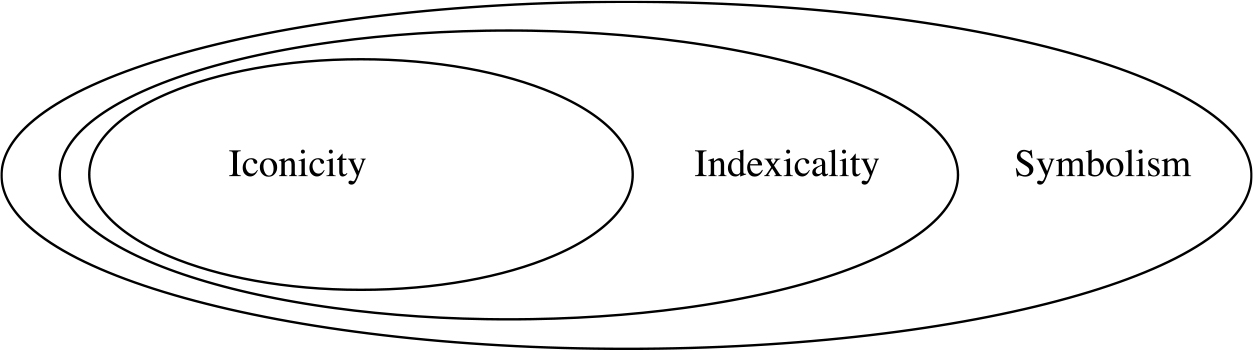
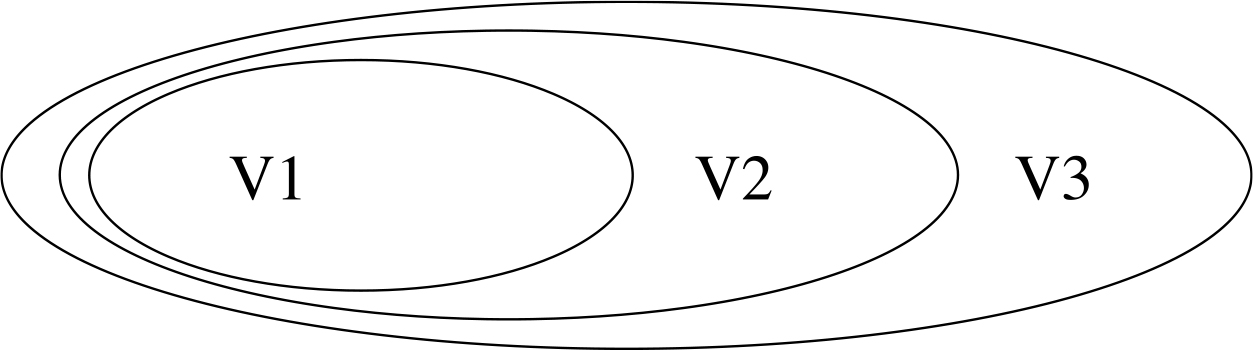
In the production of meaning, icons and indices are always working together. But their relationship is not one of simple opposition, because the qualitative aspect that identifies the icon as an icon is also a constituent of the entity picked out by the index. Indices, in this sense, are icons with the added aspect of actuality – indices refer to instantiated qualities. In this way we need to think of icons as degenerate forms of indices, that is as indices with actuality removed to leave only a qualitative potentiality. This brings us to Peirce's third central sign type, the symbol, because just as icons are degenerate forms of indices, indices are degenerate forms of symbols – that is, symbols with thought removed such that the object prior to conception remains (see Figure 1).
The relationship between iconicity, indexicality and symbolism.

The role of the symbolic cannot be overemphasized because just as quality (icons) cannot be rendered meaningful without instantiation (indices) – that is, without being actualized – so actualities (represented by indices) cannot be made meaningful without drawing in the dimension of rule or habit, or, to use a term that is more fashionable but less commonly used by Peirce, convention. It is this aspect that identifies the symbolic. In the examples explored thus far this is particularly easy to recognize because both iconic constructions (such as ‘(__) loves (__)’) and the indexical terms that might saturate the bonds of the icons, such as John and Mary, rely upon linguistic conventions to be meaningful. More generally, we can note that in using signs we are always inferring from past experience such that we act and think in accordance with rules and habits – rules and habits that are derived from the past but are orientated towards the future (consider again the pragmatic maxim, which conceives reasoned thought in terms of future practical consequences).Footnote 19 Meaning in this sense is never simple and innocent; it is always subject to inferences that produce habits. Symbols, then, are the sine qua non of meaning.
Analysing musical valency
In applying Peircean semiotics to music let us begin with that stalwart example of musical meaning, the cuckoo (or imitation of a cuckoo) in Beethoven's Sixth Symphony (henceforth Beethoven's cuckoo). Earlier work on music semiotics would tend to explain this example quite simply as an iconic relationship between music and a bird call.Footnote 20 While such an analysis is accurate up to a point, we will find that by applying the more sophisticated account of Peircean models outlined above we leave ourselves better equipped to address more complex examples of musical meaning. The analysis may at first seem a little laboured, but it is hoped that the adjustments in thinking outlined at this point will pay dividends in grasping the theories that follow.
The two-note clarinet melody that constitutes Beethoven's cuckoo can be conceived as an icon because it maps the relationship between two entities in time and pitch space. The two pitches form an icon that, like the icon ‘(__) loves (__)’, has two unsaturated bonds to be filled by two signs that refer to actual experienced entities. If (and this is an important if) Beethoven's cuckoo does bring to mind the call of the cuckoo, these bonds have been saturated by memories of the notes of an actual cuckoo call. In this way the connection between musical sound and cuckoo call is understood not simply as straightforward resemblance but as the result of two simultaneous semiotic functions: an icon, which concerns the form of the music, and indices, which concern actualities, remembered by the listening subject, that now saturate the bonds of the more abstract form of the music. The symbolic is also important here as it plays a vital role in determining the actualities used to saturate bonds (Beethoven's annotation of the score is obviously relevant here) and also in allowing the timbre of a clarinet to be transformed in such a way that it is understood as equivalent to the timbre of a cuckoo call.Footnote 21
Beethoven's cuckoo is a useful introductory example because it deals with a small-scale, relatively simple case of valency articulating meaning. The central point to grasp in this example is the process by which musical meaning is made possible through the simultaneous operation of icons (at the level of form) and indices (at the level of past actualities brought to the listening situation by the listening subject) underpinned by the symbolic (conventions or rules that guide the process as a whole and at various levels). It is useful to keep these broad functions in mind as we approach more subtle examples such as the tendency for the rhythmic structure of music (in the broad sense)Footnote 22 to be systematically correlated with higher and lower levels of activity, a point convincingly demonstrated by Patrik Juslin and Renee Timmers.Footnote 23
At the level of the icon (pure form),Footnote 24 music's rhythmic structure concerns the mapping of discrete entities through time. Simply to claim that each entity will form an unsaturated bond is misleading, because in practice each rhythmic entity will tend to form part of a group. It is this group, more often than not, that will form an unsaturated bond to which an actuality/index will be brought to bear. As a result, more clearly distinguishable meanings tend to derive from the conception of grouped rhythmic entities as unsaturated bonds, but we can still theorize the correlation of faster and slower tempos with higher and lower levels of activity using the theory of valency pursued here. Such correlations can be theorized as a connection between the basic rhythmic entities needed to articulate a tempo, which form icons, and the experience of activities, which form indices that saturate the icons. Thus a faster tempo may be saturated by one's experience of faster heartbeats, faster footsteps or faster repeated gestures. Again, then, the form of music serves to allow actualities (actual experiences) to be configured (or reconfigured) in such a way that musical meaning is generated.Footnote 25
The first period of Mozart's Piano Sonata in F major, K.332
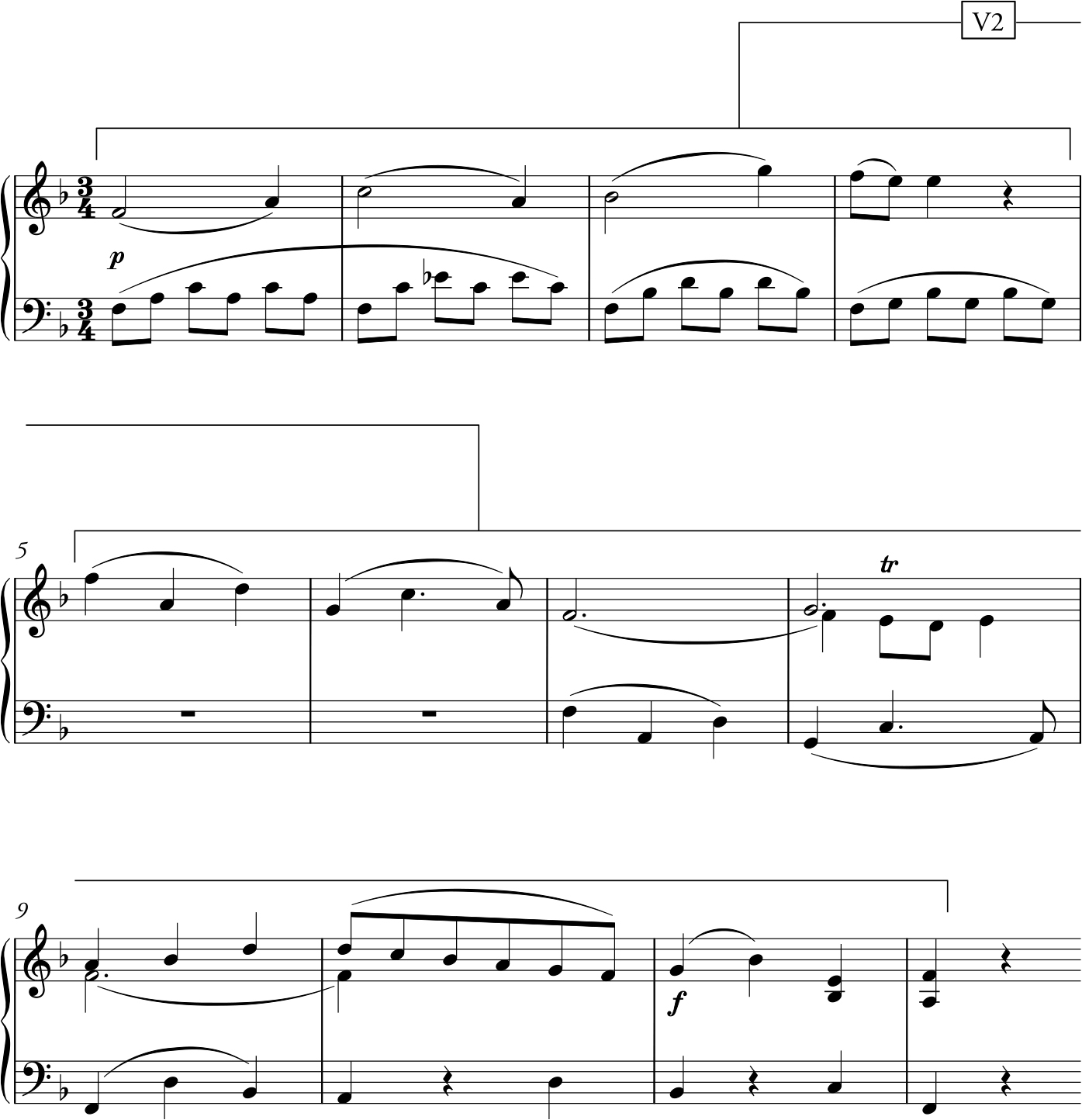
When musical entities (pitched or unpitched) are grouped to form larger gestaltsFootnote 26 they can be conceived as unsaturated bonds that mirror more closely the kinds of sign functions outlined by Peirce's theory of propositions like ‘John loves Mary’. A useful musical example here is the opening period of Mozart's Piano Sonata in F major, K.332 (see Example 1). It is likely that any listening subject will, at some level, hear this period as just that: a period, that is, two units – antecedent and consequent – with the second cadencing more strongly than the first.Footnote 27 Such a conception parallels that of a proposition with a valency of 2, such as ‘John loves Mary’. In the same way that the linguistic proposition maps out a relationship between two entities, the musical period maps out a connection between two musical gestalts through temporal juxtaposition. There may appear to be something of a conceptual leap here in moving from the linguistically secured relation of ‘(__) loves (__)’ to the temporal juxtaposition of music that lacks such linguistic moorings. However, we need to remain mindful of Peirce's conception of ‘(__) loves (__)’ as an icon. The iconic function of ‘loves’ here derives not from linguistic conventions, but from its role in mapping out two unsaturated bonds. It is the form of ‘(__) loves (__)’ that is iconic, not the further conceptual apparatus invoked by the term ‘loves’. There is, then, a sense in which temporal juxtaposition in music more thoroughly exemplifies the iconic dimension of the proposition, for it is a purer mapping more easily divorced from conceptual habits.
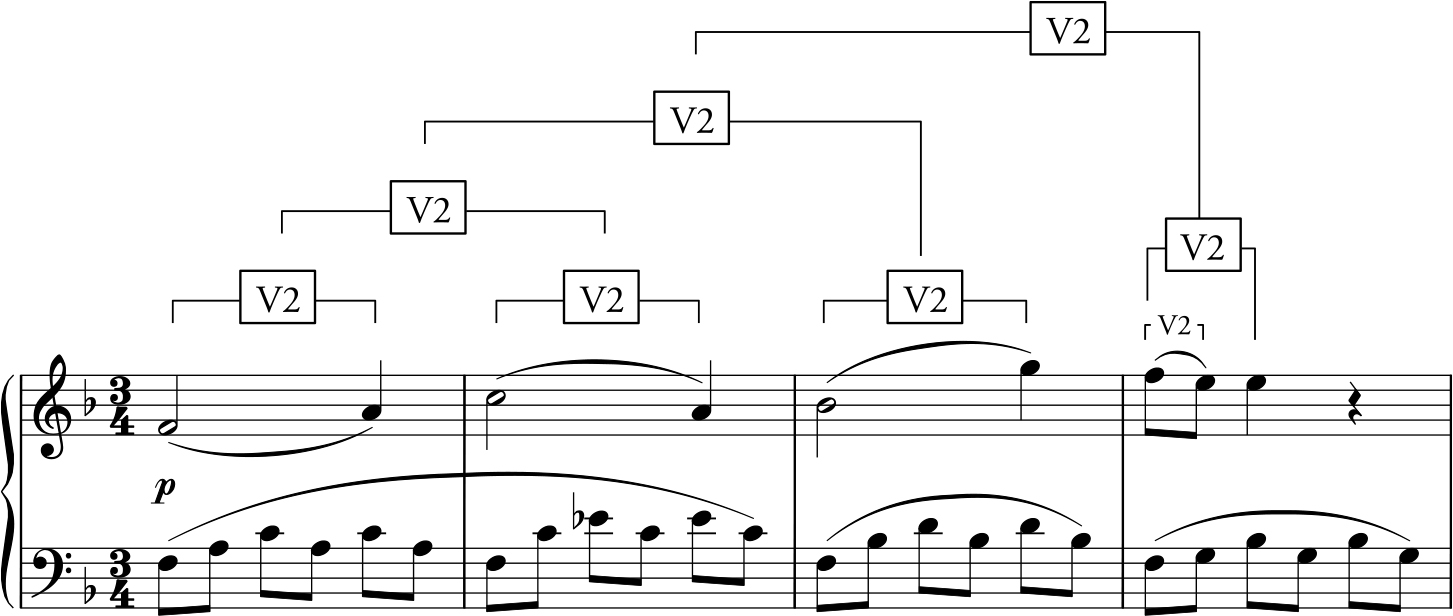
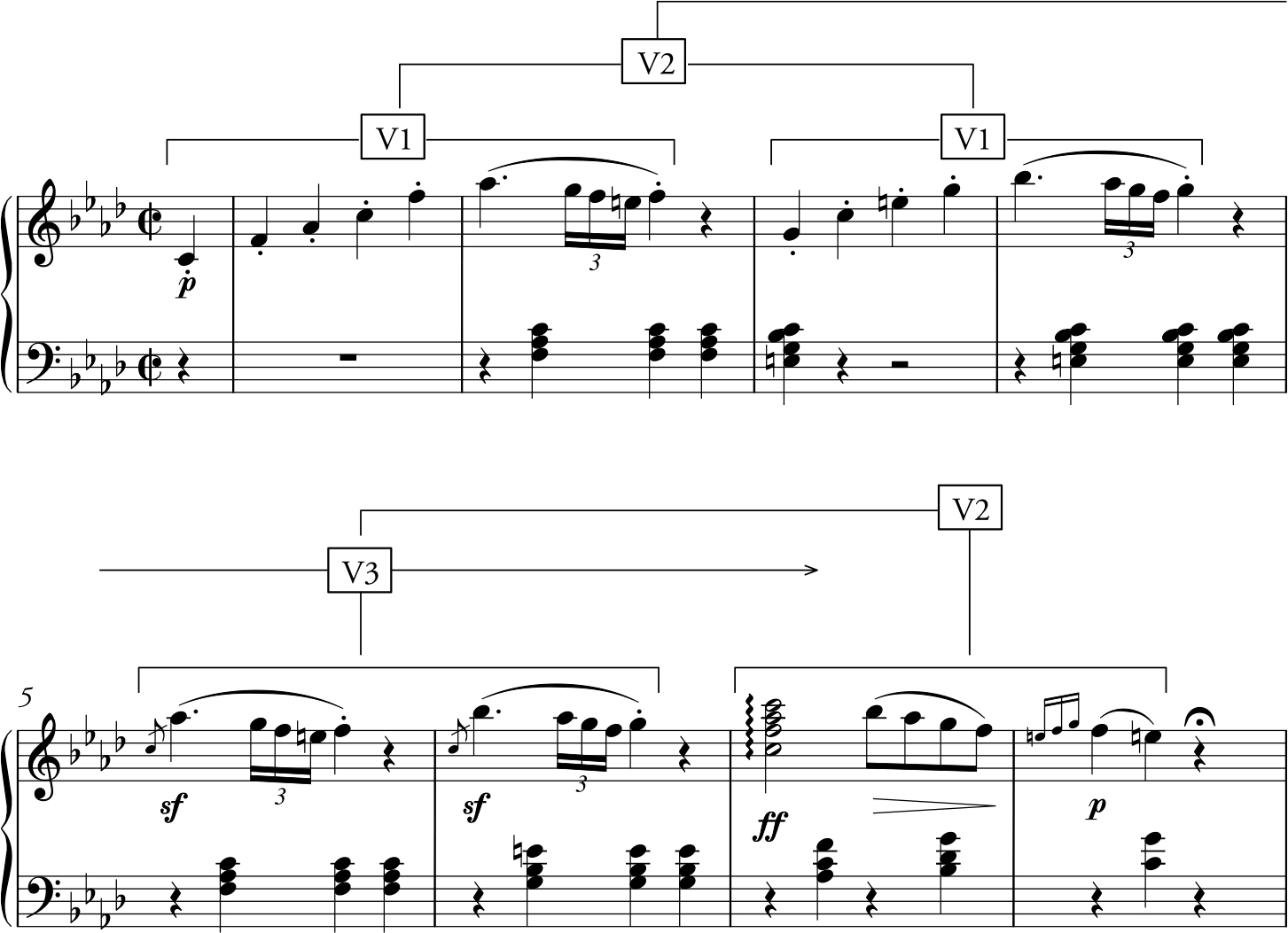
Mozart, Piano Sonata in F, K.332, first movement, bars 1–12, with basic valency analytical notation. A line connecting the bracketed antecedent and consequent phrases is labelled V2.

The relationship between the antecedent and consequent of a musical period can be demonstrated in spatial terms by annotating a score, as in Example 1, with the label ‘V2’ to indicate that the icon involved has a valency of 2.Footnote 28 The saturation of the two bonds of the icon is the function of the index and it is at this point that we can begin to note a vital discrepancy between the semiotics of language and the semiotics of music. In language, indices quickly become consolidated through symbolic convention. Thus the name ‘Ben’ has been clearly connected with my body as an actuality, and in certain contexts, therefore, there will be little ambiguity as to what the index (or what Hookway would term a symbol functioning as an index)Footnote 29 ‘Ben’ refers. It is easy to conceive of the indices ‘John’ and ‘Mary’ having the same unambiguous power of reference in certain contexts, rendering the proposition ‘John loves Mary’ capable of signifying an actual state of affairs.
Music's indexicality in Western culture is rarely, if ever, consolidated through symbolic convention in the way that it is in language.Footnote 30 Music's indexicality tends to be contested in Western cultures, particularly those cultures pertaining to the tradition of classical music, making the kinds of clear indices associated with language rare and imaginable only in unusual contexts.Footnote 31 The tendency to contest the musical index or, more accurately, to contest the conventionalization of music's indexical functions can be related to a tendency for iconicity to play a more prominent role in music. Thus, as we saw with the example of faster tempos correlating with ideas of higher activity, music will often be engaged in such a way that those actualities that share qualities (that is to say, are overtly similar) will come to saturate the musical icon – the music as pure form.Footnote 32
While the iconicity of musical signs may go some way towards compensating for the contestation of their indexicality, musical signs remain far less stable than linguistic signs in terms of their ability to connect with actualities. This has certain consequences that may be construed as positive or ideologically questionable, a point tied to the idea of music's transcendence (see further below). But the relative instability of musical signification has not prevented a considerable degree of conventionality to develop in relation to certain musical ideas, gestures and patterns. It is here that we encounter that most ubiquitous of music-semiotic concepts, the musical topic.Footnote 33
The notion of meaningful topics has developed primarily in relation to late eighteenth-century music. In such music, it seems, we can recognize a relatively high degree of conventionalized musical meaning, making the saturation of the musical index a more generalizable (albeit still controversial) process. In the case of Mozart's K.332 the two unsaturated bonds of the opening period are likely to be guided by what Ratner has termed the singing style, in the case of the first unit, and the learned style, in the case of the second.
It is important to recognize that topics are not actualities. The singing style does not exist as such. Singers, however, do, and acts of singing have and will continue to take place. Clearly it is not any singer and song that is evoked by the singing style (the representative song chosen by Ratner is ‘Ach wohin ohne Euridyke’ from Gluck's Orfeo), but the notion of a singing style connects with a broad range of possible experiences a listener may have had, which will all be tied to actuality. It is not necessarily the case that one particular memory of a song will be brought to bear on the process of saturating the bond articulated by the antecedent of the period in Example 1, but rather that a range of ideas, thoughts and feelings might be brought to bear, all of which will derive from actual experience, and that those actual experiences are likely to be of song.
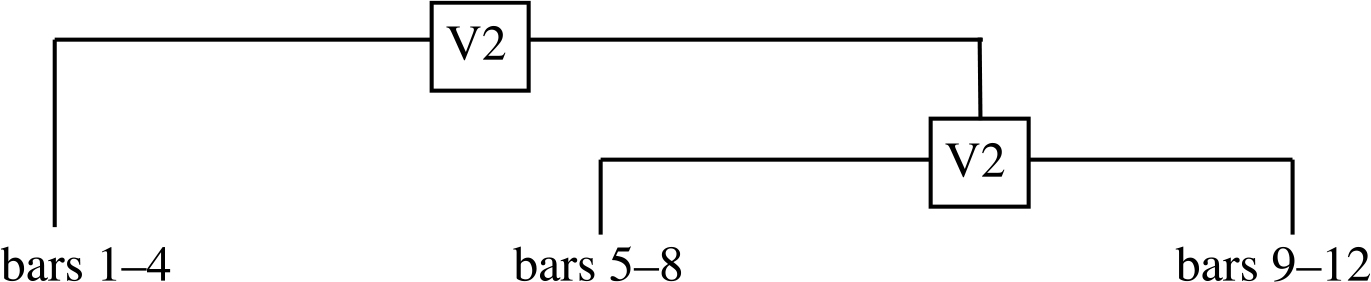
The consequent is arguably more complex in topical terms because the learned style that dominates its first four bars dissolves in the next four, leading Allanbrook to label bars 9–12 as ‘galant minuet style’.Footnote 34 If we hear bars 5–12 as two units, the music they contain can be analysed as a V2 on a lower hierarchical level than that indicated in Figure 2. In the case of both the valency analysis in Example 1 and that outlined in Figure 2, the iconic structures perceived will be rendered meaningful only if the bonds they exhibit are saturated by an index. These indices will always derive from past experience of the actual world, for if musical meaning is to be understood as more than simply the music itself, then, from a Peircean perspective, it is only facts or actualities (which are always in the past) that can engender meaning, even if that meaning is ostensibly internal.Footnote 35 This is a point outlined in the first of Peirce's four anti-Cartesian conclusions: ‘We have no power of Introspection, but all knowledge of the internal world is derived by hypothetical reasoning from our knowledge of external facts.’Footnote 36
Valency analysis of Mozart's Piano Sonata in F, K.332, first movement, bars 1–12.

The indices I have given as likely occurrences, owing to topical conventions, are brought into a new relationship through the iconic (that is, the formal) structure of this passage. In simple terms, we might look at the sign situation as one in which we connect singing-style ideas with learned-style ideas, with the latter relating to more straightforward minuet ideas (straightforward in that there is no other obvious topical reference in bars 9–12), to form an intricate network of signs. This network of signs will be symbolic, as no thought is possible without the symbol. But these symbols will be bound to actualities (indices) and formal qualities (icons).
Temporality, harmony and formal function
One way in which this model of semiotic analysis, as it has been explained so far, might seem lacking is with respect to temporality. This issue, I would argue, is partly unavoidable with my analysis of the semiotic processes involved in hearing K.332 because I have relied on the generalizing force of the topic, which, by its nature, will posit conceptual gestalts that deliberately overlook certain internal contrasts developing through time. Peircean thought, however, is not insensitive to the importance of temporality to any sign situation. In fact, time is a central consideration in conceiving the categories of iconicity, indexicality and symbolism, for as Karl-Otto Apel notes these categories can be ‘rigidly coordinated with the dimensions of time’.Footnote 37
For Peirce, thought occurs as a series through time, with one thought developing from another. In the present we experience sensations and perceptions which are connected through past thought to actuality, a process that entails the production of habits and rule that are made manifest by future conduct. Time, then, is construed as a continuum, but one that can be segmented in accordance with the dimensions of time. Robert Corrington provides a useful summary:
[Peirce] argues that the three modes of past, present and future all function differently and that they have different modal properties. This reconstruction of the three modes of time makes it possible for Peirce to show how there are qualitative breaks within the flow of time (even though time is a continuum; that is, modal differences do not break the more basic ontological continuity of the modes of time).Footnote 38
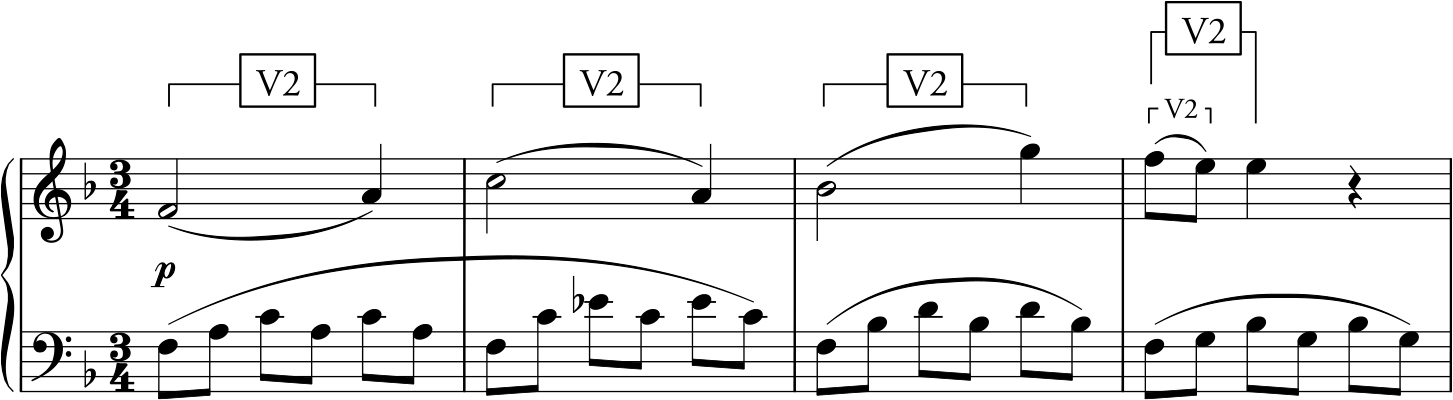
This recognition of time as both a continuum and as segmentable allows us to develop further the analytical methods already outlined. First, the analysis in Figure 2 can be understood as drawing out only one (or perhaps two) levels of iconic structure. A more thorough analysis might be guided by Mozart's articulation marks and take each trochaic figure in each of the first four bars of the right hand as a lower-level V2 (see Example 2). It is now widely recognized that analysis always entails interpretation, and that there will be as many ways of analysing the valency structure of these units as there are ways of hearing them. The most obvious approach might be to pair bar 2 with bar 1 and bar 4 with bar 3.Footnote 39 However, I prefer a different analysis, which points to the sense of cumulative meaning. This stems from the way in which each trochaic unit might be heard as deriving its meaning from all of the music that precedes it. That is to say, each low-level V2, when recognized as a gestalt in the relative present, can be drawn into a relationship with the music heard previously within the same work (see Example 3).
Mozart, Sonata in F, K.332, first movement, bars 1–4, with valency analysis of lower level.

Mozart, Sonata in F, K.332, first movement, bars 1–4, with valency analysis of multiple levels.

The approach taken to analysis in Example 3 is partly justified on harmonic grounds. In bar 1 we hear chord I, which in bar 2 is supplemented by an E♭ to form a secondary dominant – V7 of IV. Bars 1 and 2, then, I hear as an (F major) unit that becomes more tense as the melody rises, until it is partly resolved, on a higher hierarchical level, at bar 3 with the sounding of chord IV. The chord vii over a tonic pedal in bar 4, by drawing a partial closure, seems to comment on all that preceded it, at a yet higher hierarchical level. In this way, valency analysis can reflect harmonic structure and avoids the heavy reliance upon melodic structure that characterizes paradigmatic semiotic analysis (to which it remains indebted to some degree).
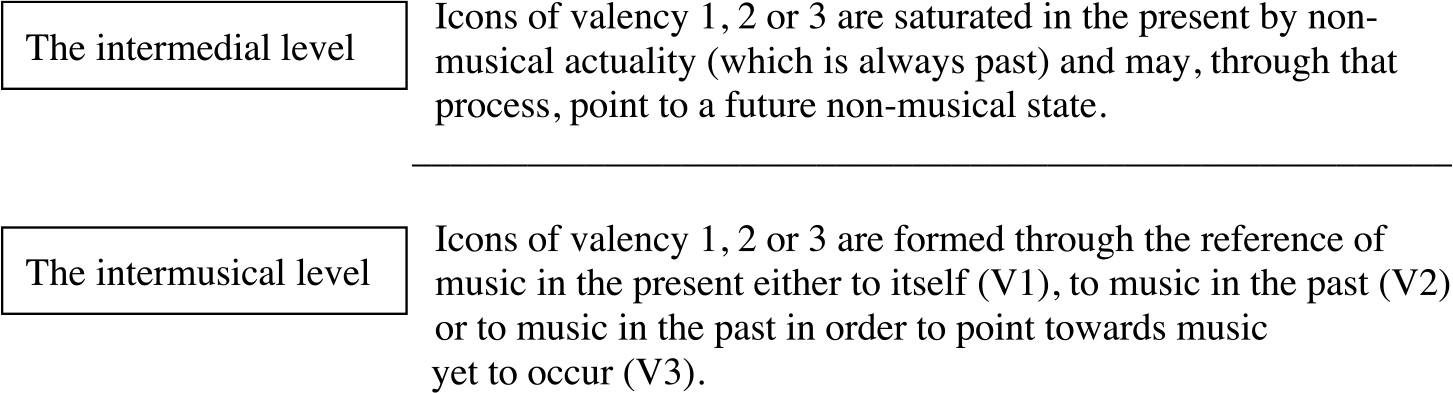
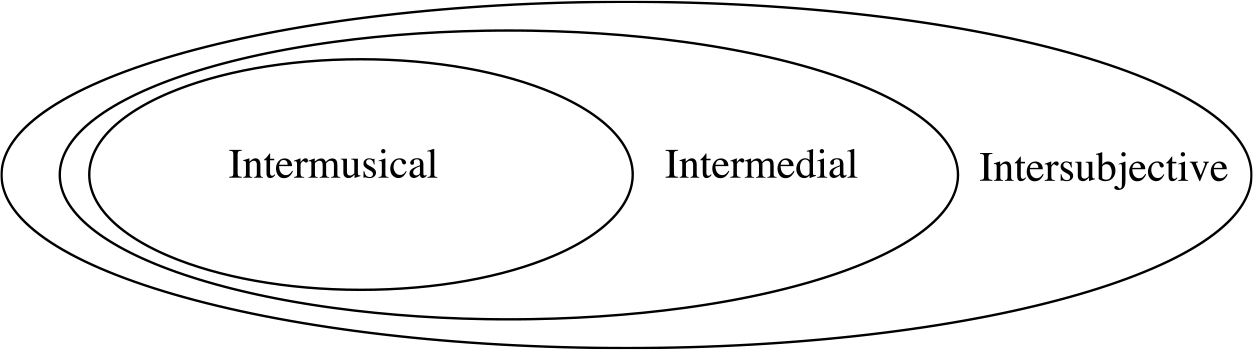
The top-level V2 in Example 3, which highlights the relationship between the cadential figure and the phrase it closes, begins to demonstrate the intersection between valency analysis and William E. Caplin's theory of formal functions.Footnote 40 To understand this point, it is first useful to conceive temporality as working on at least two levels in valency analysis. These are at the intermusical level and the intermedial level (see Figure 3).Footnote 41 The intersection of valency analysis with the formal functions of Caplin, then, occurs at the intermusical level of valency analysis. In simple terms, the V1, V2 and V3 of valency analysis can be mapped respectively onto Caplin's initiating, ending and medial functions.Footnote 42
Two levels at which temporality defines musical reference.

In order to explain this point we can return again to the simple analysis in Example 1 (see p. 411). The V2 in this analysis indicates a listening response in which a listening subject draws a connection between the antecedent and the (extended) consequent of a period. This relationship obviously cannot be established during the antecedent. It is only on hearing the consequent that the V2 can develop with reference to past musical experience (i.e. the experience of hearing the antecedent). The paradigm case of the V2 is a musical unit that articulates a sense of arrival and, in so doing, draws a particularly stark relation between itself and that which preceded it (its musical past) – such a unit is the cadence. Thus Caplin's end function corresponds to the V2 of valency analysis. The sense of finality is pertinent here because a V2 exhibits indexicality (compare Figures 1 (p. 407) and 4). Thus although the indexicality and V2 appear in the middle of most schematizations of the categories, they concern actuality, and it is, for Peirce, the actual from which, and towards which, all thought develops.Footnote 43
The interconnection of valencies in line with the interconnection of Peirce's categories.

Prior to the development of the V2 in question, we are still able to consider the valency of the antecedent on this same hierarchical level. This valency can be considered simply as an expression of character or quality and, like the icon ‘(__) is red’, it will have a valency of 1. This V1, then, develops from conceiving any lower-level valencies (such as those in Example 3) as gestalts, which might then be saturated by a concept pertaining to actual experience such as ‘singing style’. In this way valencies develop in relation to one another, with the establishment of a V1 a necessary condition for the subsequent establishment of a V2 (although the development of a V2 is likely to inflect the conception of the V1s it entails). The V1 indicates a character in itself,Footnote 44 and in that sense does not refer to the past but simply serves to establish its own character as a present entity. This is comparable to Caplin's initiating function, usually identifiable by a more static harmonic structure, which serves to prolong a single harmony (usually the tonic).
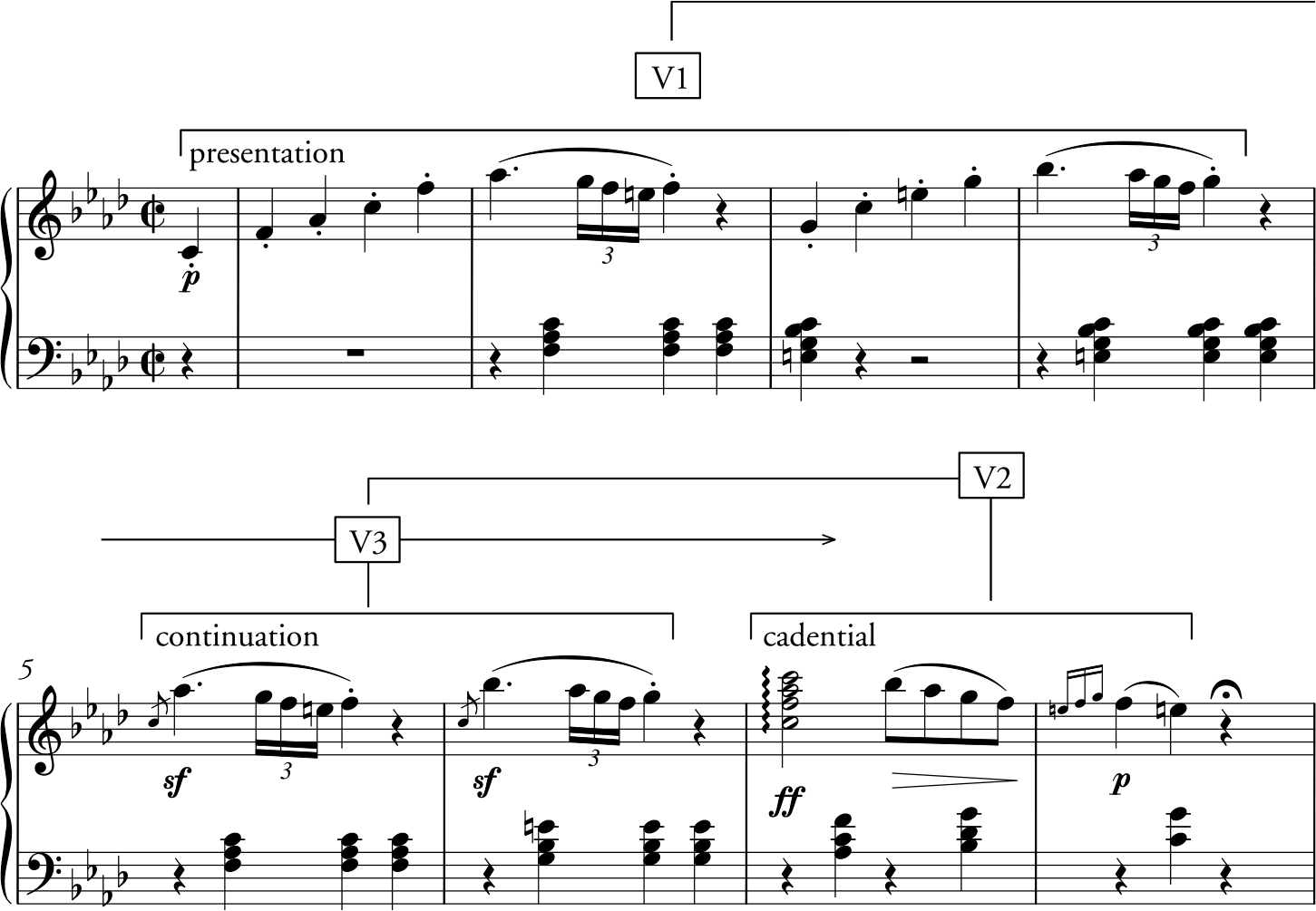
The V3 does not necessarily develop from a cadence – what I have described as the quintessential V2 unit. But the V3 will develop from a V2 in that a sense of looking to the musical past will be necessary. The V3 will extend the process of a V2, however, by now placing a special emphasis upon the future of the music. That is, patterns recognizable with reference to the past will be anticipated by the listener, and in this sense a V3 places greater emphasis upon what will happen to the music – its habit or rule. This corresponds closely to Caplin's medial function, identifiable by its use of patterns such as the model-sequence, which point the music forward, often to a subordinate harmonic region. Example 4 demonstrates how the differing functions of a sentence correspond to valencies of 1, 2 or 3. The presentation sets up a character that prolongs tonic harmony such that it could be looped (an approach more common in Mozart); this can be labelled ‘V1’.Footnote 45 The continuation refers to the presentation in the use of a melodic fragment, and this fragment articulates a model-sequence pattern that points forward emphatically, generating a V3. The cadence puts the brakes on this forward motion and in closing the sentence invites the listener to refer back to that which preceded it, thereby forming a V2.Footnote 46
Beethoven, Piano Sonata in F minor, op. 2/1, first movement, bars 1–8, with annotations showing the intersection of Caplin's formal functions and the differing icons of valency analysis.

Although there are times when Caplin suggests a continuum operating in relation to formal functions, such as in his discussion of the positioning of his hybrid themes ‘within a spectrum of formal possibilities, where the sentence and period occupy the two extreme positions’,Footnote 47 the functions themselves seem reasonably self-contained. A theory of musical valency points to a somewhat different state of affairs. Like the categories (outlined in Figure 1 on p. 407), valencies have a strict interconnection (see again Figure 4).
In the same way that the symbolic (thought and habit) must relate to the indexical (an actual object) that must in turn instantiate the iconic (qualities), so musical valencies at the intermusical level must be formed such that any given musical process must point forward (V3) by referring to past music (V2), which in turn assumes the possibility of a music of the present moment (V1). Similarly, at the intermedial level thoughts develop (the symbolic) in the process of musical listening such that our past (the indexical) must be invoked and this, in turn, must assume the possibility of a present moment of musical meaning (the iconic).
In considering the intersection of formal functions and valencies, it is also important to be clear that musical valencies are not defined by formal functions. Valencies at the intermusical level (see Figure 3) are defined by the extent to which a listening subject will be invited to consider the experience of the music at any given moment in relation to past and future musical experience. As with the Peircean categories, all three valencies will be operating at any given point. Strictly speaking (and moving in the opposite direction through the categories), then, our experience of music, like thought, will always be in the present, refer to what is in the past and thereby point to the future by way of rules (such as the rules of a model-sequence pattern). But music can be configured (again like thought) in such a way that there is a greater apparent emphasis on the present, the past or the future. Valency theory might, in this way, allow us to develop our conception of formal functions as handed down by Schoenberg, Ratz and, of course, Caplin, in order to address concerns such as those raised by James Hepokoski and James Webster, especially those points regarding the excessive self-evidence of the beginning, middle and end functions (Hepokoski) and the insensitivity to context these functions might signal (Webster).Footnote 48
Valency theory, by positing three ever-functioning, interconnected iconic structures (that can be mapped with some qualification onto Caplin's formal functions), provides a flexible analytical approach that indicates a certain hierarchy of functions and a recognition that subtle formal differences might engender a higher degree of one valency in relation to another, while positing a systematic interconnection between functions. Furthermore, valencies act both within music and in connecting it to non-musical aspects of the world – that is, to musical meanings.
Towards a Peircean framework for musical meaning
The Peircean categories operate at every level of musical meaning. At the level of form (the intermusical or iconic level), the categories apply in the segmentation and connection of musical gestalts of differing valency across a range of scales. At the level of the actual (the intermedial or indexical level), the categories apply in the saturation of valencies with experience that can be traced to the actual. The third level, as one might expect, is the level of the symbolic. This is a governing level, and is characterized by habit or rule. It concerns the interaction of human subjects (rather than musical gestalts or actual objects in experience) and can therefore be termed the intersubjective level. It is constituted by the social. At this level of rule or habit (intersubjective or symbolic), the categories apply in determining the rules according to which valencies are saturated. The intermusical, the intermedial and the intersubjective are again strictly interconnected in the process of musical meaning (see Figure 5).
The interconnection of levels in musical meaning in line with the interconnection of Peirce's categories.

The intersubjective or social level, then, will govern the ways in which form is rendered meaningful through saturation by the actual. We saw in the case of K.332 that the notion of musical topic gives a particularly clear example of how intersubjective habit, within a certain social formation, will engender relatively stable meanings. In the case of the singing style, such meanings were more conventionalized, but can still be traced to the actual (the act of singers), which in turn can be taken to instantiate certain qualities (of legato phrasing, for instance). In the case of faster tempos indicating, say, a faster heartbeat, convention and quality are clearly in operation, but it is the actual that seems most overtly operable (especially if dancing is involved). And in the case of Beethoven's cuckoo, the conventional and the actual again operate, but the qualitative connection between clarinet part and bird call seems more pertinent.
One might be tempted, then, to regard key questions in musical meaning to be thoroughly addressed by Peircean semiotics, but there is a fundamental complication that needs further consideration. The contesting of the musical index undermines the operation of musical signs at all levels, but particularly at the intermedial level. Indexicality in Peircean thought (our connection with the actual) is the key stabilizing component of semiotic processes. The actual determines thought and provides the basis for the assertion of a qualitative potentiality. By contesting a connection with the actual, musical meanings, within certain Western listening communities, are brought into doubt.
One way to understand the implications of the contested index concerns two interrelated points. First, as a result of this contestation, listening subjects appear freer to divine their ‘own’ meanings; indeed, the contesting of the index might appear, in part, to take place with the express purpose of freeing the individual in this manner. Secondly, the process of claiming a special, personal (and thereby potentially transcendent) meaning for music is itself an aspect of the intersubjective or social dimension of musical meaning. In certain listening communities we have a somewhat paradoxical situation, then, in which social habits appear determined to efface themselves. The rules that constitute the intersubjective level of musical meaning do not derive primarily from the actual (as is the case in meanings within proper scientific enquiry), and the rules themselves are thereby radically undermined in the contesting of any place for the actual in musical meaning.
The contesting of the musical index complicates musical meaning processes, but it does not render them completely inaccessible to analysis. Within the framework I have outlined, we are still able to explore the intermusical level in considerable detail, and this will be pursued at considerable length in relation to the Allegro of Mozart's ‘Prague’ Symphony. The process by which the intersubjective level will determine the saturation of valencies at the intermedial level in the context of a radically contested index can also be explored further. We saw in the case of K.332 that the notion of topics can provide some insight into the saturation of valencies to generate meanings, but my concern in analysing the Allegro of the ‘Prague’ will be less with topical reference and more with the ways in which the contesting of the musical index (because of the ways in which subjectivity is thereby brought to the fore) can render certain interpretative patterns apt. These interpretative patterns embrace the paradox of musical meaning and subject formation in certain Western communities, and it is this particularly complex area that will be considered at some length in the final sections of this article.
Approaches to the Allegro of Mozart's ‘Prague’ Symphony, K.504
As has already been suggested in relation to Example 3 (see p. 416), an exhaustive analysis of the valencies that might develop on hearing a work (particularly a large-scale work) would entail considering an enormous number of permutations. Such an analysis would be unwieldy and would fail to recognize the performative role of analysis, that is, the role of offering a well-informed means of hearing a musical work anew.
The analysis offered below of the Allegro of Mozart's ‘Prague’ Symphony focuses on certain aspects of the movement in an attempt to provide such a performative gesture. It also provides further insight into the methods of valency analysis and how this approach might work in relation to a canonized work that has received considerable scholarly attention.Footnote 49 Having presented this analysis, I will go on to consider the process by which the bonds identified by musical valencies are saturated, and how the recognition of contested indexicality plays out in exploring musical meaning in the Allegro of the ‘Prague’. However, before entering into my own analysis, I will consider a number of other scholarly approaches to the movement.
Analysing the large-scale structural components of the Allegro of Mozart's ‘Prague’ Symphony is not a straightforward task owing to the occurrence of the opening theme in the dominant at bar 71 – 26 bars before a lyrical second subject at bar 97. This point is underlined by the fact that Sisman gives the starting point for the transition or bridge as bar 71, whereas Hepokoski and Darcy identify bars 59–71 as ‘TR modules’, that is, as transitional.Footnote 50 While Sisman's analysis is arguably the neatest, in that it posits similarly portioned sections, all with distinct cadential and thematic demarcation, Hepokoski and Darcy's approach derives from the special significance they place upon the ‘medial caesura’. In the Allegro of the ‘Prague’ there are two medial caesuras, one at bar 70 and the other at bars 96–7, forming what Hepokoski and Darcy term a trimodular block in that the ‘S zone’ or second-subject area comprises three blocks: a secondary theme (in this case the primary theme transposed up a fifth with a slight alteration), a transition-like section and another secondary theme (which in this case has a character more typical of secondary themes). While the Allegro of the ‘Prague’ fits the theory of the trimodular block quite comfortably, aspects of it appear to stray from the outlines Hepokoski and Darcy provide, especially with regard to the reuse of the opening theme after the first medial caesura – a ‘deformation’ that is not discussed. Furthermore, while the medial caesura at bar 70 seems indisputable (a half-cadence in the tonic or I:HC with a ‘dominant lock’ and caesura fill), Hepokoski and Darcy's only discussion of medial caesuras in relation to the ‘Prague’ concerns the second medial caesura at bars 96–7 (a medial caesura ‘blocked’ by vi and subsequently ‘dovetailing’ a perfect authentic cadence (PAC) in V with ‘S material’).Footnote 51 Hepokoski and Darcy do not recognize the second medial caesura of a trimodular block as structural and refer to it instead as a ‘post-medial caesura’,Footnote 52 but this is not highlighted in their discussion of bars 96–7. More noticeably, Hepokoski and Darcy label the last block of the trimodular block (i.e. the lyrical second subject) ‘S’, and not ‘TMB3’, as one would expect if this ‘S zone’ were to be understood as an example of a trimodular block. There remains some uncertainty, then, it seems to me, as to how Hepokoski and Darcy conceive the structural components of the Allegro of the ‘Prague’, perhaps because the very integrity of P (primary) and S (secondary) zones is brought into question by the play of key identity that characterizes much of the movement.
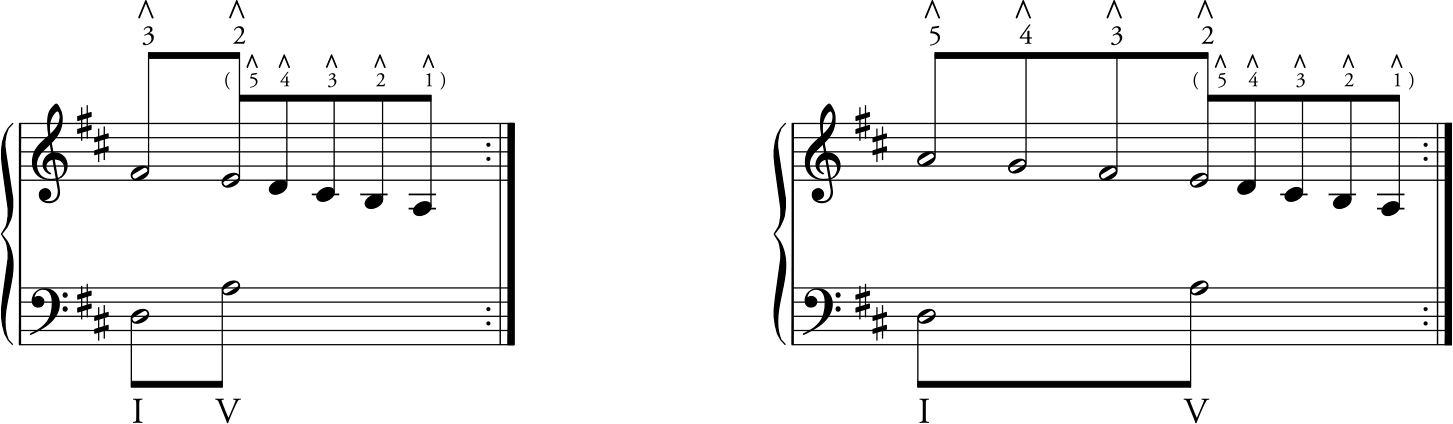
The double medial caesura and reuse of the opening theme up a fifth also poses problems for Schenkerian analysis. Second-subject areas of a major-key sonata form are usually conceived in Schenkerian analysis as prolonging the Urlinie component  , with a descent from
 in the dominant articulated during the later parts of the exposition (see Example 5). When the opening theme of the ‘Prague’ reappears at bar 71, one would expect it to be analysed so as to exhibit the same background pattern as the opening theme itself (but transposed up a fifth). If, however, the opening theme has been conceived as prolonging
 or an ascent to
 (as is the case in Lauri Suurpää's analysis of this exposition),Footnote 53 then the most likely outcome is that the transposed version of the theme at bar 71 will be reduced to
 (
 in the dominant), as
 in the dominant would clearly be premature. Consequently, an analysis such as Suurpää's comes to the awkward conclusion that the first occurrence of the theme articulates an ascent to
 , whereas the same theme sounded in the dominant simply prolongs
 . Nor can this inconsistency be resolved if we conceive the first theme as a prolongation of
 (A in the tonic), because
 in the dominant (E) is altered at bar 72 to E♯ (hence the parenthesized E in Example 6), which would surely undermine its ability to instantiate such a strong structural function. This is the case not least because it is now heard (more overtly) as a chromatic neighbour to the F♯ of the D major chord to which it moves in bar 73.
Common Schenkerian patterns for an exposition in D major.

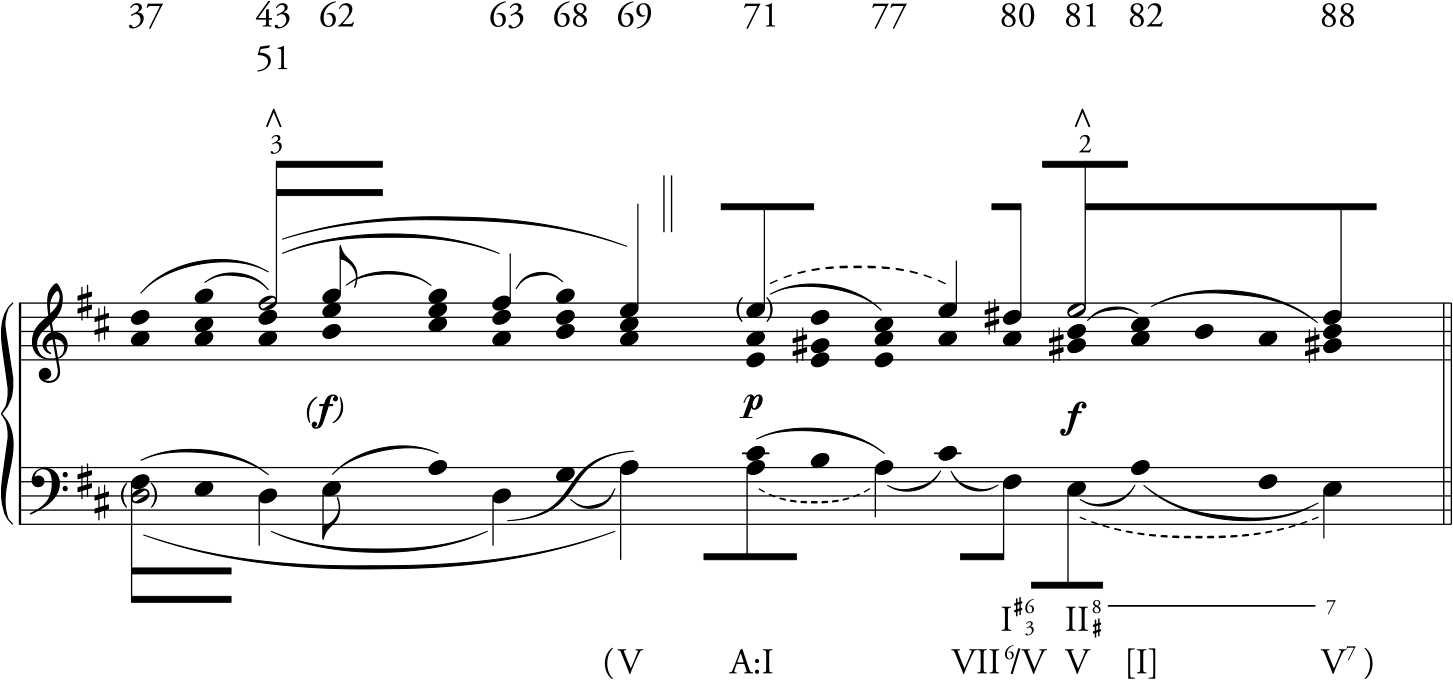
Lauri Suurpää's Schenker graph for the first 52 bars of the Allegro of Mozart's ‘Prague’ Symphony.

The second medial caesura at bars 96–7 also causes problems for a Schenkerian analysis of the Allegro. The difficulty here is that the PAC in the dominant that dovetails with the lyrical second subject clearly articulates a descent to  (in the dominant). More importantly, the lyrical second subject follows a clear middle-ground pattern of A (
 ) ascending through B to C♯ before reaching further up the scale only to fall back to B, with a half-cadence leading back to the A that begins the consequent of this 16-bar period. Although A is clearly a more structurally significant note in this passage, this point cannot be easily accepted in a Schenkerian context. This is because completing the Urlinie when the second subject proper has just started suggests that the last 46 bars of the exposition (which include this second subject) are little more than cadential or post-cadential material. Suurpää offers the intriguing solution that the A, which appears to have such a clear structural role in the lyrical second subject, is actually an inner voice, and the C♯ is thereby afforded Urlinie status. This is clearly an inventive solution, and a Schenkerian might assert that although the A appears more structurally significant when the lyrical second subject is heard in isolation, in the context of the work as a whole the C♯ will (or should) be heard as the structural voice. Such an argument is clearly performative and makes an interesting case for a way of hearing the exposition of the ‘Prague’. Whether one accepts such arguments or not, there is surely little doubt that the ‘Prague’ does not sit easily within the confines of the Ursatz, and that Suurpää's Schenkerian approach to the movement appears to have encountered a degree of tension between local musical events and the need to posit a normative structural underpinning.
A valency analysis of the ‘Prague’
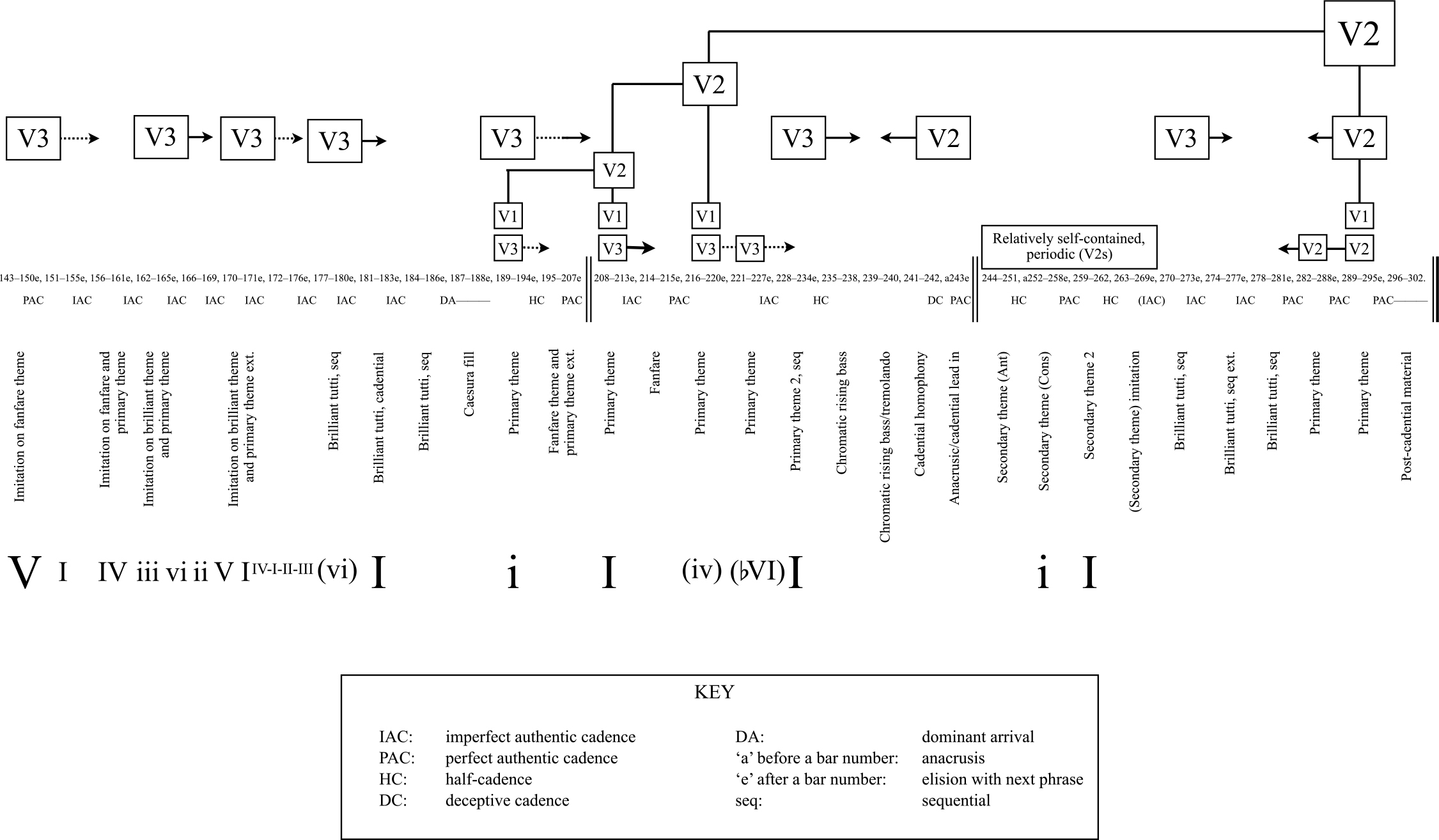
The analysis offered here of the Allegro of Mozart's ‘Prague’ Symphony focuses on certain aspects of the movement in an attempt to provide one possible conception of its form in the process of meaning generation. It looks to provide further insight into the methods of valency analysis and to demonstrate how this approach might be developed in relation to a canonized work that, as we have seen, has received considerable scholarly attention. Whilst the analysis that follows posits certain ways of hearing Mozart's Allegro, the flexibility of valency theory needs to be borne in mind, because it is this flexibility that allows us to avoid the issues and tensions encountered by the more prescriptive approaches already discussed. This flexible approach also allows valency to draw heavily upon the work of other scholars, particularly that of Caplin, in the use of formal functions to identify threefold valencies at medium and large scales, and that of Leonard B. Meyer, in that his implication-realization model has clear points of contact with the V3 with dotted and unbroken arrows designating ambiguity and clarity of pattern continuation respectively.Footnote 54 My analysis is followed by a detailed consideration of the process by which the bonds that constitute musical valencies are saturated.
A valency analysis of the Allegro of the ‘Prague’ might fruitfully begin with Charles Rosen's point that ‘at each playing of the main theme, there is an alteration – sometimes slight – which elucidates its new significance’.Footnote 55 As well as providing a useful starting point, analysis of the main theme of the ‘Prague’ in its various guises will provide a means of demonstrating the potential of valency theory to elucidate aspects of the Allegro under-theorized by the scholarly approaches to it discussed above.
When Caplin analyses the opening theme of the Allegro he conceives the entire theme as exhibiting a continuation function with a one-bar introduction. This is explained by the point that the ‘harmonic instability, fragmentation, and increased surface rhythm project a strong continuational quality, which is maintained up to the imperfect cadence at measure 43’.Footnote 56 Even the cadential figure in bar 42, therefore, is not labelled as a cadence because of the unusual structure of Mozart's theme.Footnote 57 The point that a continuational passage might still contain a cadence is consistent with Caplin's theory that the continuation phrase (the second phrase of a sentence) ‘combines the formal functions of continuation and cadential’.Footnote 58 However, the possible ambiguities here perhaps point to the need for an approach to analysis that will allow for a more fine-grained differentiation of functions. That is to stay, Caplin's analysis, in relation to this theme, may highlight important relations at one structural level and hint at others, but valency theory might fill out this account by considering these levels in more detail, and theorizing the connection between them.
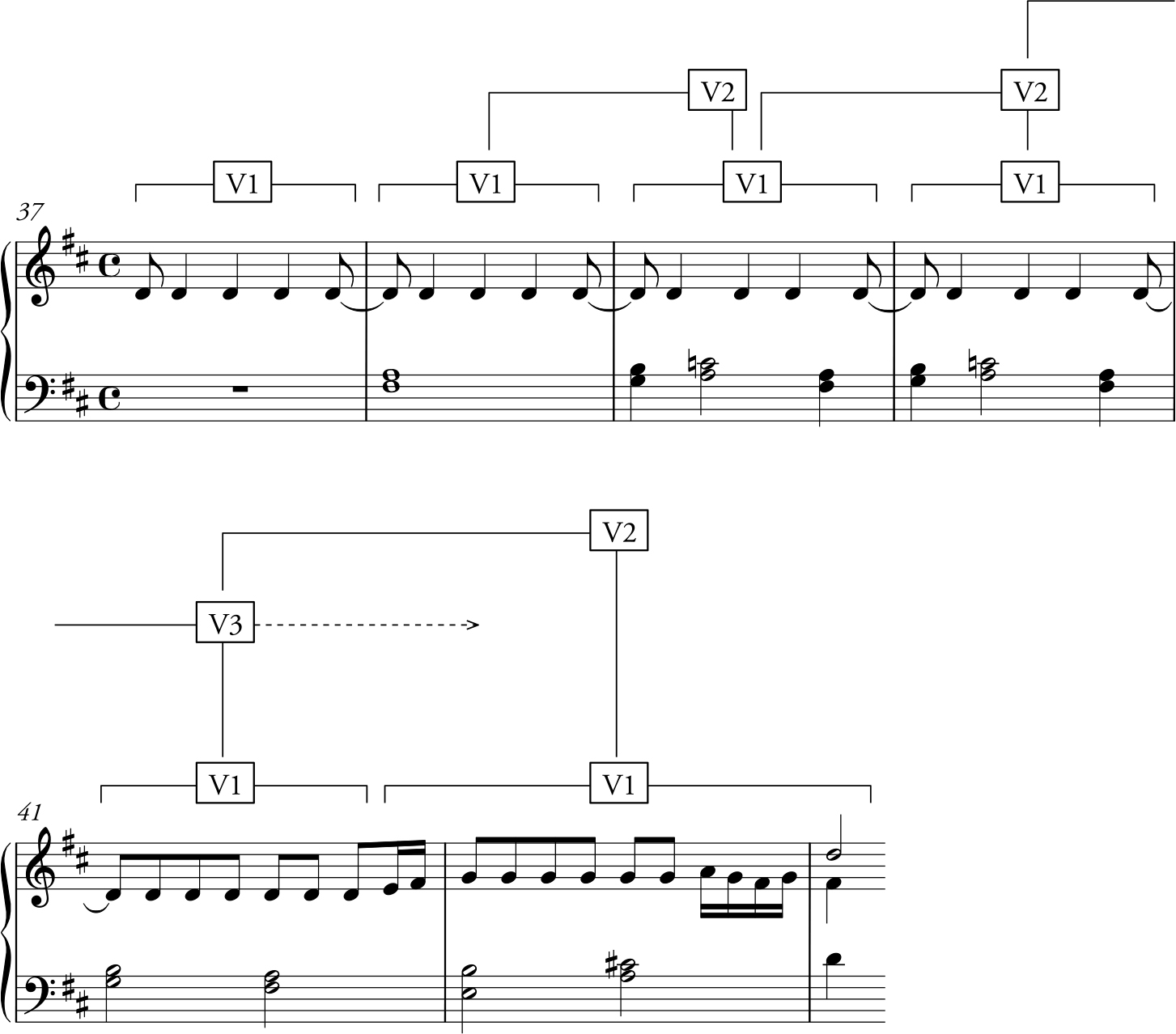
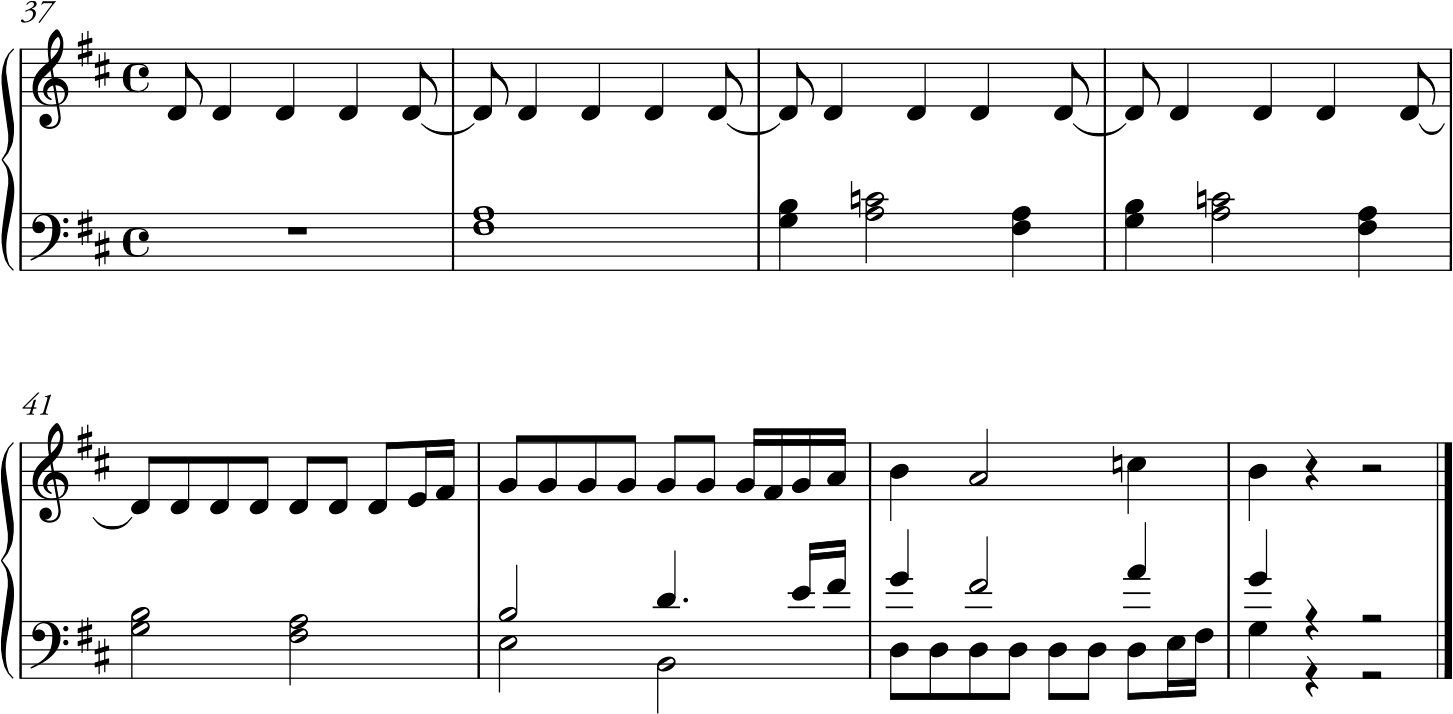
Consider, then, the valency analysis of the opening theme of the Allegro in Example 7. I follow Caplin in suggesting that the opening bar (bar 37) stands alone to some extent in simply introducing material. This syncopated figure does, of course, repeat, but the sense of a separable gestalt is so limited that there is little sense of reference between syncopated figures. It is for this reason that no V2 is posited between bar 37 and subsequent bars. With the entry of the lower strings at bar 38 the sense of distinct gestalts becomes stronger, and I have generally followed Mozart's phrasing in positing a series of one-bar units, each of which forms a V1. The V2 between bars 38 and 39 might also have been omitted, since it has a weaker sense of reference than that suggested between bars 39 and 40 (a limitation of the annotations). So it is worth underlining the point that the V2 between bars 39 and 40 forms our most significant V2 relation thus far, and it is from this point that cumulative valency relations begin to form (this cumulative approach to valency analysis was introduced in relation to Example 3 on p. 416). The ‘loopability’ of the figure in the lower strings in bars 39 and 40 brings a sense of stasis comparable to that which characterizes presentations. Hepokoski and Darcy conceive the phenomenon of the Mozartean loop as a two- to six-bar module that is ‘either elided or flush-juxtaposed with a repetition of itself before moving forward into differing material’.Footnote 59 They relate this phenomenon to the larger-scale process of P (main theme or first subject) moving to TR (or transition),Footnote 60 but we might also relate it to the smaller-scale process we find in Example 7. The relatively static music in bars 39 and 40 is succeeded by an idea (bar 41) that exhibits ‘energy gain’ and a greater sense of harmonic momentum achieved through the change to a steady harmonic rhythm. This leads to a cadential figure in bars 42–3 which, despite its continuation-like qualities (hence Caplin's analysis), I have still analysed as a V2, because the sense of close it articulates still draws our attention to that which preceded it. Here again, then, we can observe how valency analysis allows us to uncover more detailed relations (which are comparable to what Caplin terms functions). Furthermore, the interconnections schematized in Figure 4 (see p. 418) demonstrate the way in which the establishment of one relation does not exclude the development of another. Thus the V2 at the highest hierarchical level (above bar 42) in Example 7 could be converted to a V3 if the listener senses the forward-looking quality of the cadential figure more strongly.
Valency analysis of Mozart's ‘Prague’ Symphony, K.504, first movement, bars 37–43.

Taken as a whole, the valency analysis in Example 7 also highlights the way in which Mozart's theme, while unconventional, still exhibits a similar pattern of valencies to that of the sentence. This becomes all the more apparent when we note that a V2 will generally occur during the presentation of a sentence, when a version of the basic idea is repeated (see Example 8), even though the overriding sense will be of a stable singularity – a V1.
Beethoven, Piano Sonata in F minor, op. 2/1, first movement, bars 1–8, with annotations showing a varied valency analysis from that given in Example 4.

Like the archetypal sentence, then, the opening theme of Mozart's Allegro begins with an idea that, despite containing repetition that could form a V2, is likely to be heard as a single gestalt with a particular character. This leads to a section with greater energy and a stronger sense of harmonic motion that will refer back in order to point forwards. This, in turn, leads to a cadence that serves to draw our attention to that which has passed.
The analysis in Example 7 also contains a somewhat different approach to schematizing the V3 in that the line pointing forwards is dotted. This dotted line highlights what is perhaps most remarkable about the theme, its harmonic ambiguity. Thus the dotted arrow is employed to show that although we are being pointed forwards, it is not entirely clear where we are going in harmonic terms. We could be moving to G major or D major. This point can be highlighted by a recomposition of the theme so that it cadences with an Imperfect Authentic Cadence (IAC) in G instead of D (see Example 9).Footnote 61
Recomposition of the opening of the Allegro of Mozart's ‘Prague’ Symphony, K.504, so that it cadences in G.

It is arguably this process of pointing forwards with a sense of ambiguity – indicated by the dotted arrow of the V3 – that characterizes so much of the Allegro of the ‘Prague’. The idea of needing to retain a sense of ambiguity until what Hepokoski and Darcy term the essential expositional close (EEC), and to reinstate it only for it to be resolved even more emphatically at the essential sonata close (ESC), provides a means of understanding both the larger- and the smaller-scale design of the Allegro. Valency analysis provides a means to draw out and examine these processes.
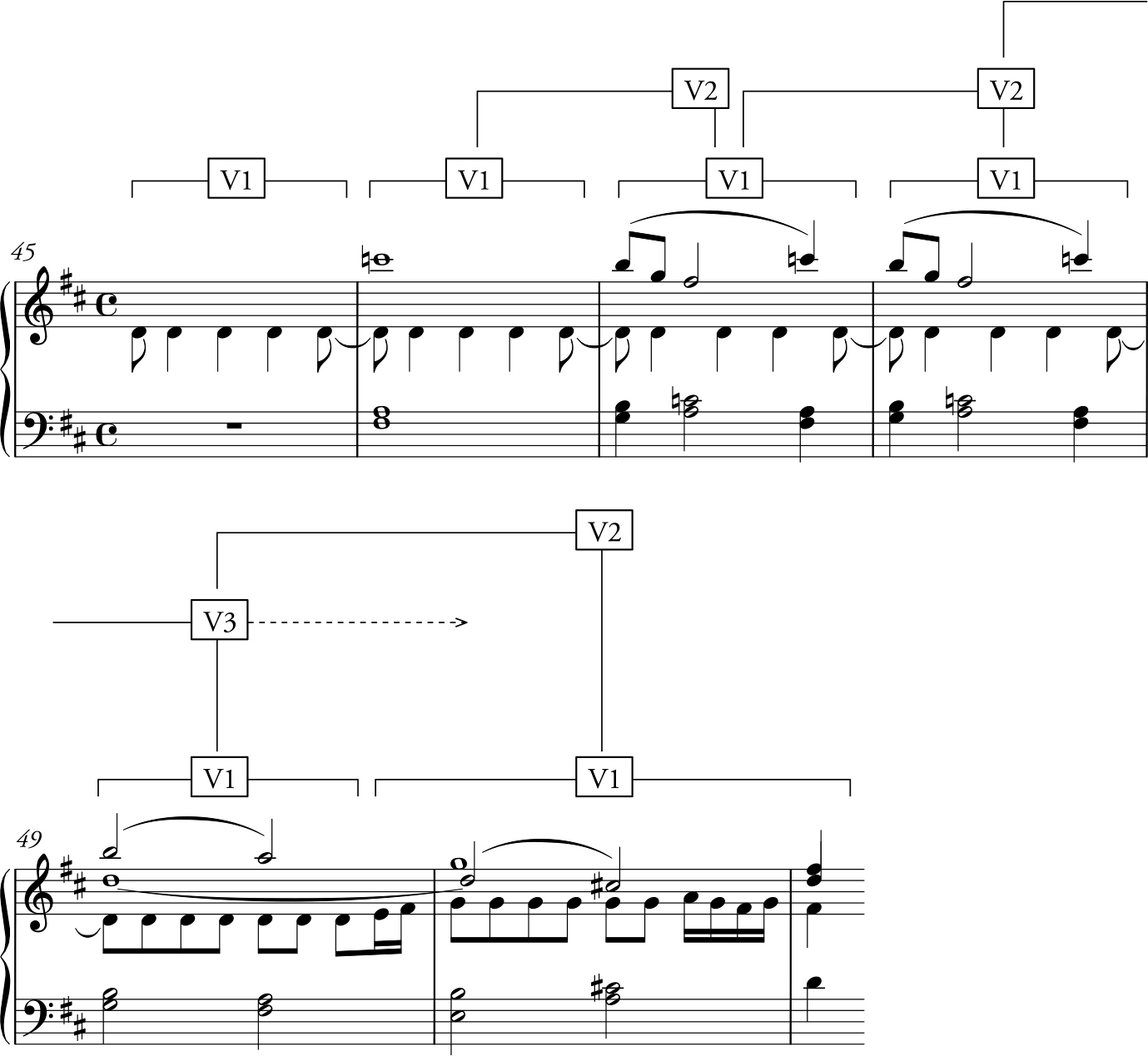
In pursuing this line of enquiry let us consider a restatement of the opening theme with a countermelody in the oboe (see Example 10) after a short fanfare section at bars 43–4. Rosen points out that the C in the oboe ‘underlines the harmonic instability of the theme’.Footnote 62 This is an important point for valency analysis, for if the valency pattern in Example 7 is to be applicable again at bars 46–50, something is needed to reinvigorate the directional ambiguity indicated by the V3 with dotted arrow. The emphasis on the C♮ in the oboe's countermelody fulfils this role. If the countermelody were not sounded, there would be little reason to expect anything other than a cadence in D, but a countermelody emphasizing C♮ underlines its harmonic instability in such a way that we are invited to doubt its direction. For this reason, then, the dotted arrow is retained in analysing this theme (see again Example 10).Footnote 63
Valency analysis of Mozart's ‘Prague’ Symphony, K.504, first movement, bars 45–51.

The next occurrence of the opening theme is at bar 71, now transposed up a fifth and with the E (the fifth of what has previously turned out to be the tonic chord in this thematic context) becoming E♯. One of Rosen's explanations for this sharpened note is that it ‘pushes the theme towards the dominant’.Footnote 64 I would suggest, however, that the E♯ points us not sharpwards towards A major but flatwards, back towards D. This is because the E♯ functions as a chromatic auxiliary to the F♯ and suggests a dominant function for the resulting augmented chord on A, a reasonably common device in late eighteenth-century music.Footnote 65 Again, then, any uncertainty as to how this theme will resolve is reinvigorated by a suggestion that the opening note (A in this case, D in bars 37 and 45) is actually the dominant rather than the tonic. An E♮ at bar 72 would result in little ambiguity, for we have heard this same pattern before and could predict its future with some security, but the E♯ (like the prominent C♮ in bar 46) again suggests that a move flatwards could occur – a possibility that is again thwarted by a cadence that reasserts the first chord of the theme (in this case A) as tonicized. As a result, this occurrence of the theme could again be annotated with a V3 with dotted arrow.
The opening theme is not heard again until the end of the exposition, directly after the EEC at bar 129. At this point the ambiguity has been completely overcome. Clearly this is partly a result of the tutti perfect authentic cadence at the EEC, but the new sense of tonal affirmation is reinforced by a tonic pedal that now appears in the bass and the removal of the syncopation (we now hear straight quavers) that seemed to underline the theme's earlier instability. The tutti scoring with the highest notes sounded thus far in the first violins adds to the overpowering sense of confidence in tonal grounding while assimilating the V7 of IV to IV progression that has up to this point been articulated less confidently and with a greater sense of directional (that is, tonal) ambiguity. This newfound confidence could be indicated by simply replacing the dotted line of the V3 arrow with a solid line.
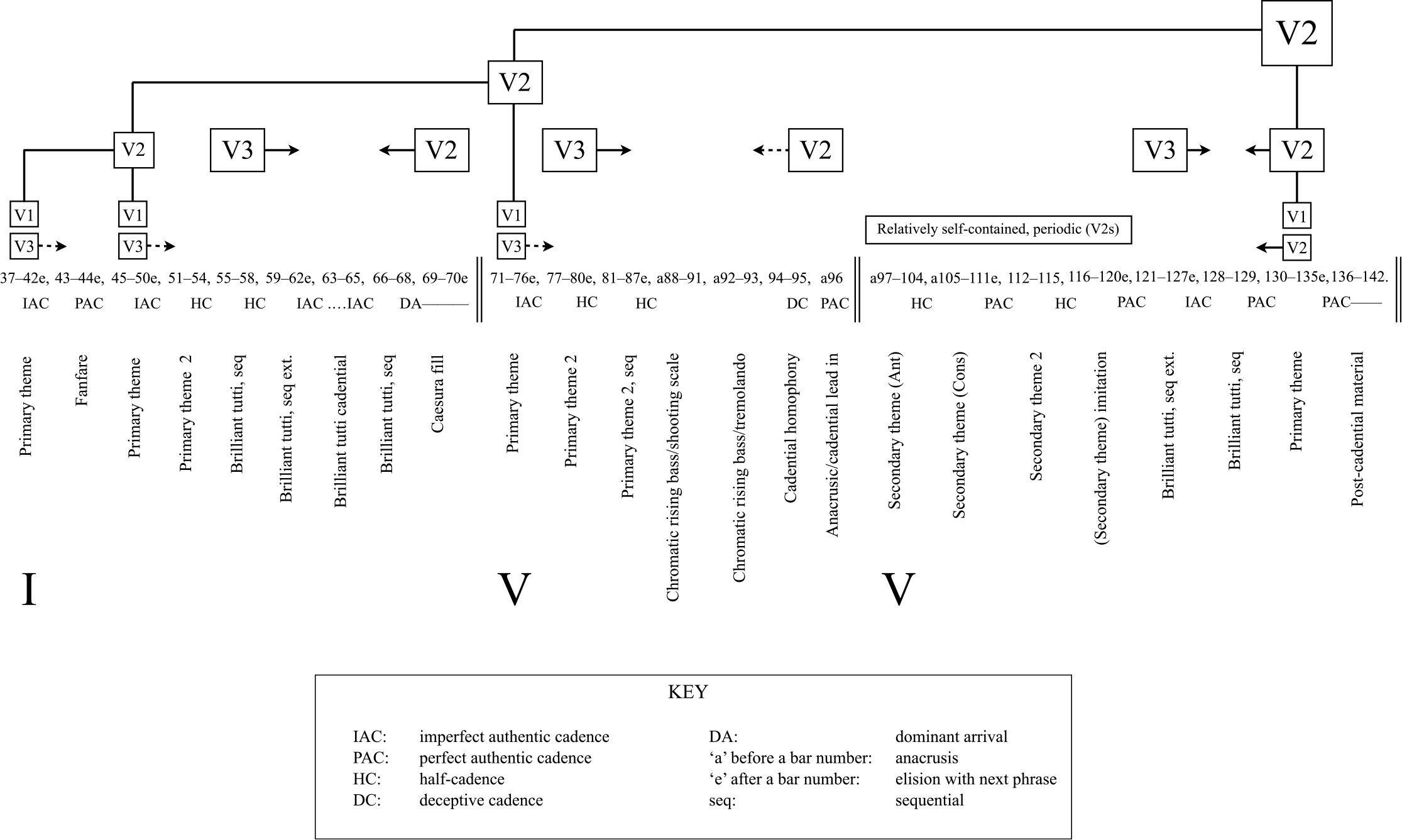
The large-scale operation of the opening theme during the exposition of the ‘Prague’ can also be examined through valency analysis. Figure 6 outlines important valencies in the exposition and places particular emphasis upon the role of, and relationships between, occurrences of the primary theme. The analysis identifies a number of distinct levels of valency. The lowest level highlights the V3s with dotted arrows that, I have argued, aptly describe the primary theme. The occurrence of the primary theme at bar 130, however, is identified as a V2 in order to indicate its confident cadential character.
Valency analysis of the exposition of Mozart's ‘Prague’ Symphony, K.504, with particular attention drawn to the role of and relationships between occurrences of the primary theme.

At a slightly higher level, these V3s and this V2 can be considered gestalts that are perceived as singularities (V1s). At a higher level again, the first two V1s form a V2. The hierarchical level of this V2 is comparable with that of the sentence-like move from V3 to V2, and this characterizes the medium-scale structure of all three sections. These V3s are indicated at bars 55, 77 and 121, and in each case lead to a substantial cadence or dominant arrival (sections beginning at bars 69, 96/97 and 130).
When the primary theme occurs at bars 71–7 we have a clear reference between two of the three large-scale sections that comprise the exposition. This is defined as a V2 and placed at a higher hierarchical level. However, the V2 that occurs at bar 130 can be situated at a higher level again because it represents a relational thread that runs throughout the exposition. The power of this V2 is indicated in the valency analysis in a number of ways. First, the accumulative V2 relations are given particular prominence by connecting lines in the manner already outlined in Example 3, with the V2 at bar 130 standing at the head of these connections. The growing scope of each of these V2s is indicated by the size and position of the boxes. Secondly, the V3s with dotted arrows at the lowest hierarchical level lead to a V2 at bar 130 to make clear the importance of local-level detail in articulating the power of the primary theme at bar 130. Lastly, at bar 130 the valency analysis draws attention to the process by which V2s at three levels are coordinated so as to perform a powerful resolution of the syntactical relations developing through the exposition. The increasing size of boxes as we move up through hierarchical levels indicates the temporal scope of the relation represented, but this scope should not be taken to outweigh that of the lower-level valencies. These local details are equally important in the forming of valencies and the generation of meaning, a point that is sometimes overlooked in Schenkerian analyses.
A valency analysis of the development and recapitulation of the ‘Prague’ highlights the similarities in process between the music before and after the double barline (both sections are repeated). Like Figure 6, Figure 7 is concerned with the middle-level operation of valencies in the ‘Prague’ and with highlighting the role and relationships between occurrences of the main theme.Footnote 66 Comparison of Figures 6 and 7 demonstrates how the substantial reduction in length of the recapitulation, when compared with the exposition, does not alter the accumulative V2 pattern articulated by the main theme. Thus although Mozart has effectively gone from three sections (exposition) to two (recapitulation), the potent vehicles for the development of meaning formed by the V2s connecting occurrences of the main theme have a similar structure, which allows, in turn, a large-scale V2 to be more plausibly drawn between the overall structure of the two sections (as dictated by the repeats) of the Allegro. This point may also help us to explain why Mozart, in Hepokoski and Darcy's terms, converts a Type 2 sonata form (where the recapitulation starts not with the main theme but with material that first occurred later in the exposition) to a Type 3 sonata form (where the recapitulation begins text-book-like with the opening material of the exposition and a return to the tonic – the double return).Footnote 67
Valency analysis of the development and recapitulation of Mozart's ‘Prague’ Symphony, K.504, with particular attention drawn to the role of and relationships between occurrences of the primary theme.

In the process of effecting a Type 2 to Type 3 conversion and concentrating the exposition material into fewer bars while enacting a comparable accumulative V2 patterning in the second half of the Allegro, Mozart again exploits the ambiguity and uncertainty of direction that characterizes the main theme. In the second half of the Allegro, the theme first occurs at bar 189, before the double return proper. The theme begins exactly as it was heard in bar 71 on A, and we might reasonably expect an IAC in A major to follow. However, Mozart now introduces F♮s and a B♭ in such a way that the key outlined is unquestionably D minor. This subtle change re-enlivens the ambiguity of the theme. As it closes with a half-cadence (German sixth to V in D minor), it appears to be fulfilling its potential to be resolved in a subdominant direction. But such a resolution is only suggested; the tonal trajectory of the theme remains unpredictable, so again the V3 with dotted arrow is appropriate in the analysis. However, at bar 195 the sounding of a dominant pedal instigates a growing expectation of a double return (a Type 3 sonata), and this process by which uncertainty becomes replaced by growing certainty warrants a further adaptation of the analytical annotations – the dotted arrow of the V3 at bar 189 transforms into a solid arrow as the function of the dominant pedal becomes increasingly recognizable.
When the recapitulation proper (what is ostensibly a double return) begins at bar 208, a move flatwards is suggested again by a V♯5 chord, but the more likely reassertion of the tonic follows. In the subsequent music, a particularly sophisticated listener may well expect to hear the subdominant tendency of the main theme exploited so as to accomplish the retransition; that is, by landing back in the tonic via a brief shift into the subdominant. Few would expect, however, the move to F major (tending towards B♭) that follows, which is again achieved by exploiting the ambiguous directional tendency of the main theme. This move flatwards is the most extreme yet, but it is thwarted by a quick move through D minor to D major via another German augmented sixth in the second half of bar 227.
The V3 with dotted arrow allows us repeatedly to highlight the ambiguous directionality of the main theme. Through various means we are kept guessing as to its future. It clearly points forward, but its security is continually in question. In aligning the main theme with both the EEC and the ESC, however, Mozart invites us to reconsider radically the meaning of this theme. In both instances its newly acquired valency (V2 rather than V3) invites us to look back with confidence on past structures that were once uncertain, and this transformative process is further underlined by the sentence-like move from V3 to V2 at the medium-scale structure of all the sections I have designated by double lines in Figures 6 and 7.
The valency of 3 (V3) encountered in the first subject in its different guises forms a complex of slots. Each V3 can be conceived as an icon, which the listener will saturate with indices (constituted by past memories). In theorizing the saturation of these valencies I will pay particular attention to Susan McClary's essay on the ‘Prague’ Symphony (see above, note 49). I consider McClary's focus upon subjectivity insightful and useful to valency analysis because the process of saturating icons with indices can be understood as a process of subject formation. In saturating icons we draw upon memories rendered significant in the forming of our subjectivity and in doing so conform to the dominant habits of classical-music listening. On experiencing the V3s above, the tendency is to pick out and bring to bear those memories key to our conception of self. This is consistent with Peirce's tendency to conceive woman/man as a sign.Footnote 68 For Peirce, we have no powers of introspection, but we reason the self through a dialogue comparable with that of a sign-using community of enquirers: the human subject consists of a sign or a series of interpretants inferred from past occurrence. In the present moment, Peirce insists, ‘there is no time for any inference at all’ and as a consequence ‘the present object must be an external object’.Footnote 69 Thus, when conceived as a series of present moments, music can be seen to provide a particularly successful means of enacting the process of identity formation. But noticing the success of music in fulfilling this role is not the same as suggesting that such a role for music is necessary or inevitable. It seems more reasonable to conceive the act of reading the self into the music, and certainly the act of reading the music in terms of autonomous selfhood, as a habit that could be and is otherwise within different musical cultures.
Saturating valency and contesting meaning
The flexibility of valency analysis, I would suggest, has the potential to provide new insights into the internal relations of musical works. The approach has been developed primarily through engaging Peirce's theory of the proposition, but the similarity to Caplin's notion of form functionality provides an important guide when attempting to apply and refine the theory in relation to specific works.Footnote 70 The primary purpose of valency analysis, however, is not to provide a better means of analysing internal structure. Its flexibility is clearly a virtue on some levels, but arguably leads to a lack of rigour in certain respects when compared with the outcomes of Schenkerian, form-functional or sonata-theoretical approaches. Whatever the drawbacks of valency analysis, I would suggest that the flexibility it provides forms a necessary step in developing a model of analysis that genuinely has the potential to capture the manifold interpretations which are liable to develop when multiple listeners experience the ‘Prague’. The flexibility of valency theory lays plain the enormous scope for interpretation provided by Mozart's work because it allows us to identify, in abstract terms, an enormous number of internal structural relations, which can all serve as icons – that is, as slots to be saturated by indices in the process of meaning generation.
In considering the first period of Mozart's Sonata in F, K.332, I asserted that in the West, and in the Western classical tradition in particular, music's indexicality is contested. This is a particularly important concept in my application of Peircean semiotics to music. It is a claim that is intimately bound to the now commonplace recognition that classical music since the end of the eighteenth century has become characterized by a discourse of transcendence, a point that can, in turn, be related to the rise and dominance of the bourgeoisie in the years following the French Revolution. The growing emphasis upon an individual autonomous subject has been accompanied by a tendency to consider musical meaning a private affair that transcends the material world. This private affair, nevertheless, albeit paradoxically, makes possible the attainment of some kind of universal truth through the experience of the artwork. These threads are succinctly drawn together by Terry Eagleton in The Ideology of the Aesthetic when he writes:
From the depths of a benighted late feudal autocracy, a vision could be projected of a universal order of free, equal, autonomous human subjects, obeying no laws but those which they gave to themselves. This bourgeois public sphere breaks decisively with the privilege and particularism of the ancien régime, installing the middle class, in image if not in reality, as a truly universal subject, and compensating with the grandeur of this dream for its political supine status. What is at stake here is nothing less than the production of an entirely new kind of human subject – one which, like the work of art itself, discovers the law in the depths of its own free identity, rather than in some oppressive external power.Footnote 71
In semiotic terms, this manoeuvre is achieved through the contention that meaning, in the case of music, is not limited by reference to the material world, whence, in Peirce's pragmatic terms, all semiosis (that is, meaning) must derive. The fundamental role of indexicality in any meaningful experience, then, is contested. But if we accept Peirce's pragmatism that there cannot be meaning without indexicality, the external world must play some role in the formation of any thought. What happens as a result is that meaning is generated with reference to those experiences that the listening subject regards as particularly profound – those experiences that have the semblance of being somehow removed from the material world such as emotional states and, perhaps more importantly for my argument, conceptions of self.
These experiences are indexical in temporal terms. They are remembered experiences which have tended to acquire a certain profundity in retrospect and which are now brought into new relations in the present in accordance with the valency structure of the music experienced. The iconic (valency) and the indexical (past experience) work together in this sense to create musical meaning, but they do so within the operation of the symbolic. The symbolic, here, can be understood as a listening habit that predisposes the listening subject to engage semiotic functions in a particular way. Music does not have to be conceived in terms of private emotion and self-realization, but that is the tendency that has developed in the West – not by necessity but through habit. And such habits are, of course, developed in response to historical and social forces. They cannot be exhaustively explained by the intentions of an enlightened artist or the apparent structural necessities of a particular artistic medium or work within that medium.
Drawing on the work of Eagleton cited above, McClary conceives the ‘Prague’ in terms of bourgeois subjectivity, bringing quite specific meanings to bear upon specific structural relations and more generally upon tonality and sonata procedure. In this analysis, as in others, McClary is liable to oversimplify the processes involved. In his recent and otherwise sympathetic account of McClary's work on Mozart, Rumph notes, with reference to both Joseph Kerman's and Harold Powers's criticism of her work,Footnote 72 ‘an undeniable weakness in her approach – the absence of a semantic theory mediating musical and social meanings’.Footnote 73 In discussing the ‘Prague’, McClary perhaps goes too far in mapping the journey of the bourgeois subject onto the thematic successions and developments of the Allegro without sufficient qualification. But a theory of valency may go some way towards providing the theory of mediation that Rumph identifies as lacking.
This theory, however, is not straightforward; it does not plug a theoretical gap in the manner that might be expected. The theory of listening habits is key to grasping this complexity. Listening habits, in the case of the Western classical tradition, as I have explained, do not simply govern the process by which a musical structure gets mapped onto a particular thought or meaning. Listening habits in this context are peculiar, even contradictory, phenomena whereby relationships between musical form and the reality that underpins our thought are contested. There is no habitual process whereby Mozart's music is understood to signify the social world of the late eighteenth century. And if ever such an explanatory process begins to develop, it tends to be undermined by claims for Mozart's transcendence of social forces and resistance to social critique. In this sense it is not so much the musical text that articulates the habits of bourgeois subjectivity, but the listening habits that surround it. However, to conceive of listening habits as straightforwardly detached from the texts they are employed to engage is to miss the way in which habit or the symbolic contains indexicality and iconicity. Listening habits surround a work, but they also penetrate it. To put this in another way, any listening habit must surely inform the decisions of an artist. McClary does much to draw on this core assumption in addressing sonata form in relation to the ‘Prague’:
Sonata is never merely a form imposed from the outside. Because it captures so well the dilemmas surrounding identity and dynamic change in the bourgeois era, sonata becomes the central arena in music where such issues are explored, fought through, and negotiated. Whatever the solution in any given movement, the tensions between energy and stasis inherent in the procedure remain – just as they remain unreconciled in the social sphere.Footnote 74
McClary's argument is powerful in the abstract. It becomes less convincing when we look to apply it to specific texts or common procedures. The theory seems to slip in transition from the general to the particular – from the symbolic to the indexical. But this can be explained in precisely the terms I have outlined. In moving to the particular work and specific meanings, we come up against that manoeuvre that allows the habit of bourgeois listening to cover its own tracks. Claims to universality and transcendence problematize the process by which such claims themselves can be recognized in form. The contesting of the index is, in this sense, an ingenious means of simultaneously developing an artistic experience that appears divorced from the social world and undermining the possibility of critiquing its meaning. To put this argument in stark terms (perhaps too stark – a point to which I will return), listeners/analysts, in adhering to this listening habit, are guaranteed musical experiences that nourish the self and affirm a sense of separation from the realities of a stratified and palpably unjust social world.
For these reasons there is no straightforward means of identifying those ideas that are brought to bear upon the valencies of the ‘Prague’. The contested index makes possible an enormous number of interpretations. However, we can identify a tendency in the West to saturate valencies with ideas pertinent to the formation of the listening subject's identity. The contested index in one sense empties music of its meaning, but in another affords the listening subject a freedom to explore those ideas and memories that seem most pertinent to their own, ostensibly private, subject formation.Footnote 75 The ‘Prague’ seems particularly apt to exemplify this process not only because it has been habitually understood as an autonomous work of art, but also because the potential valency structure constructed through the manipulation of the main theme seems to invite its saturation with ideas of subject formation. In positing such arguments we are able further to support and develop McClary's claims concerning the Allegro. The recurrent use of the main theme to articulate V3s (complex subjects that look back in order to look forwards, but do so with some uncertainty) that eventually transform into V2s (versions of the subject that look back with this ambiguity dramatically reduced) appears to invite the listening subject to conceive themselves in similarly transformative terms. Identifying the habit of conceiving classical music as informing our conception of ourselves, coupled with the quite reasonable step, posited by McClary, of focusing this conception on the main theme, renders her reading of the symphony compelling and astute. What valency analysis can do, by means of support, is to offer a systematic method of mapping out the internal relations that are integral to this interpretation. Furthermore, the theory of musical valency and its contested saturation provides a means of understanding the complex and, at times, seemingly contradictory processes that mediate structure and meaning – sign and interpretation. Peirce's rigorous but flexible triple thinking proves invaluable in this.
Conclusion: Peirce and subjectivity
One of the central claims of this article is that the experience of music in the West is closely bound to processes of a listener's subject formation. I have suggested that Peircean semiotics can elucidate this process when we recognize that musical form, experienced in the present, functions as an icon that can be saturated by memories of past experience, which thereby function as indices. This entire process is governed by habit or the symbolic. The contention that semiosis (in this case in music, but the same applies to other symbolic interaction) governs the process of subject formation is consistent, I would suggest, with Peirce's thinking on the relationship between the world and the thinking subject. In the important early essay ‘Some Consequences of Four Incapacities’ (see above, note 68), Peirce marks out how his pragmatic thinking leads us to conclude that the mind (the human subject) is inferred not through powers of introspection, but from experiencing the world.
The content of consciousness, the entire phenomenal manifestation of mind, is a sign resulting from inference. Upon our principle, therefore, that the absolutely incognizable does not exist, so that the phenomenal manifestation of a substance is the substance, we must conclude that the mind is a sign developing according to the laws of inference.Footnote 76
In the next paragraph Peirce makes the identity of the human subject and signhood explicit when he states that ‘the fact that every thought is a sign, taken in conjunction with the fact that life is a train of thought, proves that man is a sign’.Footnote 77
In this essay Peirce appears to consider words as the primary means through which the notion of a human subject becomes manifest. ‘Men and words’, he tells us, ‘reciprocally educate each other.’Footnote 78 But music has a similar role in the development of thought, and perhaps an even more important role in the development of subjectivity or the conception of self. Western classical music is habitually deployed as a means of renegotiating a conception of self. As we experience music in the present, we draw on our past and thereby develop a notion of ourselves that stretches into the future. I have underlined the ideological implications of this process in quite stark, negative terms, but we should surely recognize that music's role in subject formation cannot be understood as entirely negative. In The Ideology of the Aesthetic, Eagleton highlights a dual function of the aesthetic:
It is not only, as radical thought has familiarly insisted, that art is […] conveniently sequestered from all other social practices, to become an isolated enclave within which the dominant social order can find an idealized refuge from its own actual values of competitiveness, exploitation and material possessiveness. It is also, rather more subtly, that the idea of autonomy – of a mode of being which is entirely self-regulating and self-determining – provides the middle class with just the ideological model of subjectivity it requires for its material operations. Yet this concept of autonomy is radically double-edged: if on the one hand it provides a central constituent of bourgeois ideology, it also marks an emphasis on the self-determining nature of human powers and capacities which becomes, in the work of Karl Marx and others, the anthropological foundation of a revolutionary opposition to bourgeois utility.Footnote 79
The contesting of the index in music renders the art form a particularly potent force in engaging and articulating the discourse of autonomy. Music has with relative ease, it would seem, been ‘sequestered from all other social practices’, and yet its ability to soak up the subjective has repeatedly allowed it to be used positively in empowering the disempowered and, through its role in subject formation, in easing personal suffering. The theory of musical valency developed here is a means of theorizing the connection between such processes and musical form. It is for this reason that this theory does not seek out correct interpretations within a historically reconstructed field (as in sonata theory), although it does acknowledge the interest and possible benefits of such an approach. Nor does the theory of musical valency seek out essentialized, normative underpinnings (as in Schenkerian theory), although it does recognize the possible influence of such models upon listeners and their interaction with other structural habits. The theory of valency looks instead to conceive musical form as a potentiality that may through its actualization and comprehension engender a wide variety of relations and interrelations. These relations need to be conceived flexibly, because music's role in social practices relies upon this flexibility. This, in turn, relates to the contesting of the index, because the recognition of particular valency patterns (icons) will occur in dialogue with the ideas, inferred from experience, that saturate the bonds of these patterns (indices). Thus the flexibility with which we theorize musical form is a necessary step if we are to understand how musical form performs its role in listening processes that are underpinned by cultural habit.
It is hoped that the method of identifying and relating valencies developed in this article could be deployed in exploring possible listening strategies and formal complexity that may enrich further listening, but its primary purpose is to demonstrate that a theory of musical form that pays attention to the social and ideological role of music can and should be developed. The rigorous logic of Peirce's categories, as it is deployed here, provides a fruitful means of engaging with this process.