Since the nineteenth century, foxhunting has established itself as one of the most iconic cultural practices associated with the English rural landscape and a ritual that is “arguably the most complex performative event in the English countryside.”1
Marvin, “A Passionate Pursuit,” 49.
Carr, English Fox Hunting, 195–214; Newall, “The Unspeakable.”

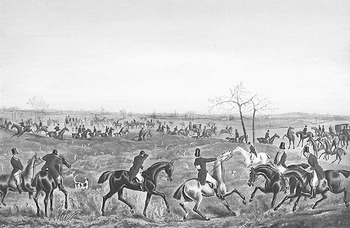
“A Fox Chase” by E. Gill c. 1819. This print shows the preferred topography for hunting, with rolling hills providing a clear view, fenced and hedged fields with a predominance of pasture to allow a quick gallop.
When the U.K. government established the Committee of Inquiry Into Hunting with Dogs in November 1999, in what became the first stage of the process leading to a ban, the committee's terms of reference were explicitly limited to the “practical aspects” of different types of hunting.3
Committee of Inquiry Into Hunting with Dogs in England and Wales, Final Report, 1.
Neither side in the debate, however, placed much emphasis on the relationship between hunting and the landscape, because it was not prioritized within the remit of the inquiry. The landscape was engaged with in two general contexts: the first was as the location of agricultural business and the second was as a habitat for wildlife. Crucially, there was no recognition that the practice of hunting might contribute to a sense of identity or place specifically through its relationship to the rural landscape. The landscape was not considered to be culturally significant, nor was it recognized as an historical medium imbued with meaning or heritage value. Such a position is at odds with recent statements by government agencies about the need to find ways of sustaining the historic environment and recognizing significance within the landscape as well as the importance of landscape within definitions of heritage. English Heritage and the Council of Europe now recognize the landscape as making a significant contribution to definitions of place and in prompting personal and regional definitions of heritage.
The separation of practice from place within the inquiry's terms of reference is therefore important for two reasons. Firstly, recent initiatives within the historic environment recognize that maintaining the link between practice and place is essential if distinctive and historic landscape character is to be sustained. The European Landscape Convention, which is dedicated to promoting the protection, management, and planning of all European landscapes, states that landscape “contributes to the formation of local cultures and … is a basic component of the European natural and cultural heritage, contributing to human well-being and consolidation of European identity.”4
Déjeant-Pons, “The European Landscape Convention,” 13.
Déjeant-Pons, “The European Landscape Convention,” 13.
Cox and Winter, “The Beleaguered ‘Other,’” 84.
The second important implication of separating practice and place is that those who study hunting across societies and time recognize the relationships created between the landscape, the hunters, and the hunted as fundamental to the material and cultural significance of those constitutive elements. The encounters between the hunter and the hunted structure the social memories of those involved and are given meaning through references to the “places and spaces of encounter” within which they were enacted or performed.7
Matless, Merchant, and Watkins, “Animal Landscapes.”
Marvin, “A Passionate Pursuit,” 51.
This article, therefore, explores the relationship between foxhunting and the English landscape, focusing on an area known as the shires in hunting parlance. It demonstrates how hunting affected and altered the landscape character of Leicestershire, Rutland, and Northamptonshire during the late eighteenth and nineteenth centuries (Figure 2). However, it also demonstrates that those responsible for interpreting and managing historic landscape character have overlooked foxhunting. Hunting landscapes therefore provide a useful critique of current initiatives that seek to characterize the historic landscape and claim to prioritize regional distinctiveness and significance within the working landscape. It is argued that by championing long-term processes of change, these initiatives depoliticize the landscape to accommodate a common, but illusionary, cultural landscape heritage.

Location map showing the three counties of Leicestershire, Northamptonshire and Rutland. The “shires” region formed a central strip from north Leicestershire into central-south Northamptonshire, taking in the western boundary of Rutland.
PREMODERN HUNTING LANDSCAPES
The historical development of foxhunting in the United Kingdom is still far from clear. It has recently been accused of being both “a pursuit rooted in the moral climate of the fourteenth century” and an “invented tradition” of the late eighteenth century.9
Middleton, “The Origins of English Fox Hunting,” 13; Landry, The Invention of the Countryside; Itzkowitz, Peculiar Privilege; Newall, “The Unspeakable.”
Trollope, “On Hunting,” 72–74.
Medieval or premodern hunting in England focused on deer and most was carried out within private parks. Protected by a substantial ditch and bank, surmounted by a cleft oak pale, the deer were removed from the wider landscape and carefully managed within the park, which in turn provided a specialized arena for the ritualistic performance of the hunt. Some deer were also hunted within unbounded areas of chase or forest, areas legally protected for aristocratic or royal hunting; but increasing pressure on land for cultivation and the declining population of wild deer, led to most being deregulated or disafforested by the sixteenth century. By the eighteenth century, captive or carted stags were often used within forest settings, such as Epping Forest (Essex), which only served to highlight the artificiality of what had become a self-consciously archaic aristocratic sport. Deer maintained their status as the most prestigious quarry into the eighteenth century, when there was a revival of deer hunting within the larger designed landscapes that were being laid out around the substantial new country houses of the nobility, such as Badminton (Gloucestershire) and Chatsworth (Derbyshire), which often incorporated the relict landscapes of earlier, medieval deer parks.
In contrast, other forms of hunting in the sixteenth and seventeenth centuries were informal pursuits enjoyed by country squires as well as lesser landowners and were pluralistic in terms of the quarry. The hare was preferred, in terms of the sport it showed; but foxes were hunted when they were found or when they posed a particular problem to local farmers. Contemporary comments suggest that hunting the hare was a slow-paced affair with plenty of time to observe the landscape and indulge in related interests such as botany or sketching.11
Landry, The Invention of the Countryside.
Most historical narratives of hunting focus on the necessary shift from hunting the noble hart or deer to the less distinguished fox, as a response to the declining population of deer. However, perhaps the most important distinction was that the deer was hunted within landscapes that were protected or managed specifically to facilitate hunting, whereas the alternatives, principally the hare and the fox, were hunted within, or on the periphery of, the cultivated landscape. As a consequence of this shift, the varied nature of regional agricultural landscapes had an important effect on the form and frequency of hunting during the sixteenth and seventeenth centuries. Foxhunting was becoming increasingly popular in regions that contained large tracts of heath, commons, or rough grazing—typically found in the areas of lighter soils in southwest and northeast England. Celia Fiennes, for example, writing at the end of the seventeenth century, described the landscape around Newton Toney in Wiltshire as “all on the downs a fine Champion Country pleasant for all sports–Rideing, Hunting, Courseing, Setting and Shooteing.”12
Morris, The Illustrated Journeys of Celia Fiennes, 36.
North Yorkshire County Record Office MIC 1504 ZF9/1 Manor of Hackness, map c.1709.

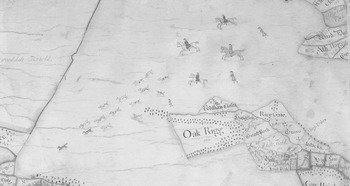
Detail from a map of Hackness, North Yorkshire, c. 1709, showing an early foxhunt heading away from the cultivated areas of farm land and across the common grazing land or moors (NYCRO MIC 1504 ZF9/1, copyright reserved).
The Midland shires were also dominated by medieval open-field systems, in which the arable land was farmed as several large fields divided into strips and farmed communally by the village. The system was characterized by open, ploughed landscapes, devoid of hedges and woodland. But significantly, unlike in Wiltshire or Yorkshire, in the Midlands the arable fields often extended to the parish boundary; and grazing was limited to the fields that were left fallow each year.14
Williamson, The Transformation of Rural England, 31.
Hoskins and McKinley, Victoria History of the County of Leicester, 269.
MODERN HUNTING LANDSCAPES
Both foxhunting and the Midlands landscape underwent radical transformations during the period 1750 to 1850, and it was during this period that the two came to be so closely linked. The transformation of the landscape was occasioned by the process of enclosure—the creation of discrete, hedged, or fenced fields held in severalty—which in turn facilitated a shift from arable to pasture. The process had begun in the fifteenth century when the earliest enclosures took place on the heaviest and most intractable clays of High Leicestershire and Northamptonshire.16
Williamson, The Transformation of Rural England, 42.
Tate, A Domesday of English Enclosure, 20.
As mentioned earlier, the enclosure of the Midlands facilitated converting the heavy clay soils that were deemed unsuitable for modern arable cultivation into more profitable pasture. Documentary records of cropping rotations before enclosure suggest that between 75% and 80% of the acreage was arable in the open-field districts of Leicestershire prior to enclosure, whereas the 1801 Crop Returns show that after the first wave of enclosure acts only about one-sixth was still in arable cultivation.19
Beresford, “Glebe Terriers”; Hoskins, “Leicestershire Crop Returns”; Turner, “Arable in England and Wales.”
The transformation of foxhunting into a fashionable sport is often attributed to Hugo Meynell, Master of the Quorn Hunt in Leicestershire between 1753 and 1804. It became characterized by an extended chase, with specially bred hounds that followed the scent and kept up with the fast-running fox; a large mounted field observed by following the hounds at a gallop, jumping or negotiating obstacles. Meynell's most significant contribution may only have been to draw together a number of disparate practices and to popularize the sport amongst a new, wealthy, and fashionable clientele; but the “Meynellian system” as it became known, was adopted right across England in the early nineteenth century. From the outset, however, this ideal of modern hunting was—and indeed remains—particularly associated with the distinctive landscape of the Midland shires: Leicestershire, Northamptonshire, and Rutland.20
Carr, English Fox Hunting, 33.
The new pastoral landscape supported the faster pace of the modern sport. The combination of continuous permanent pasture with thorn hedges and fences around relatively large fields, over gently undulating terrain, created an ideal hunting landscape. Furthermore, the quality of the pasture improved over the nineteenth century as it became established and as the considerable efforts to drain the clay soils took effect.21
Finch, “Grass, Grass, Grass,” 45.
Surtees, Town and Country Papers, 90.
Beach Thomas, Hunting England, 89.
Carr, English Fox Hunting, 68.
It would be wrong, however, to simply view the landscape changes of the late-eighteenth century as creating the appropriate arena within which hunting could flourish. Meynell moved to Leicestershire and became the first master of the Quorn Hunt in 1753 at the moment the transformation was beginning, not once its manifestation was apparent. The parish of Quorndon, where Meynell established himself, was not subject to an Act of Enclosure until 1763, some 10 years after he became Master of Foxhounds, whereas the adjacent parishes were subject to even later acts, the last not being enclosed until 1799.25
Tate, A Domesday of English Enclosure, 153–59.
Rather than seeing enclosure as a necessary prerequisite for hunting, it is important to recognize it was a contemporary cultural manifestation of the same forces that effected the physical changes within the landscape. By the early nineteenth century, the landscape could sustain fast, extended gallops, interspersed with challenging jumps; and the participating tenant farmers were prosperous gentlemen working new consolidated holdings, keen to demonstrate and enjoy their status. Foxhunting, therefore, was a conspicuous cultural practice that was embedded within the new landscape and became an iconic representation of both the social and agricultural changes associated with the transformation.
CREATING HUNTING LANDSCAPES
The reason behind the change to hunting the fox in the eighteenth century is usually explained simply in terms of the declining availability of deer as quarry.27
For example, Carr, English Fox Hunting.
Finch, “Grass, Grass, Grass,” 47.
Of foxes we have some, but no great store … [foxes and badgers] are rather preserved by gentlemen to hunt … For such is the scantity of them here in England in comparison of the plenty that is to be seen in other countries, and so earnestly are the inhabitants bent to root them out that, except it had been to bear thus with the recreations of their superiors … they should have been utterly destroyed many years agone.29
Harrison, The Description of England, 325–26.
If the gentry's lack of persecution allowed the fox to survive into the eighteenth century, the growing popularity of foxhunting required more active conservation measures to promote and sustain the fox population. The adoption of a hunting season that respected the breeding cycle of the fox was one measure, because they were previously hunted in the spring when livestock was vulnerable during lambing and when the pelt was at its best for furriers but when the fox was raising its cubs. Once the fox became the preferred quarry of the hunt, however, the hunting season ended around March to establish a high and regularly dispersed population of foxes.
A key aspect of this new concern for fox preservation was the availability of suitable habitat. The open-field landscape in the Midlands had lacked suitable habitat for foxes in the form of hedges, scrub, or woodland, a factor that must also have contributed to keeping their numbers low. Enclosure brought hedges and permanent grassland, but there was still precious little tree or scrub cover so essential to encourage breeding. The drive for agricultural improvement and the high value of postenclosure land meant that few areas were allowed to remain uncultivated within this new productive landscape. However, the landscape of the Midland shires soon acquired a distinct character that set them apart from other regions enclosed at the same time, suggesting that there were different priorities behind postenclosure landscape development within the region (Figure 4). One of the most apparent differences is the presence of small, regularly spaced patches of woodland within the enclosed fieldscape. Hunts and hunting landowners put aside parcels of land as designated fox coverts throughout the shires to help establish and maintain a sizeable fox population. Corners of fields, areas of particularly steep slopes or scarps, prominent knolls, and even small closes were planted with gorse and blackthorn and carefully managed to provide areas where foxes could breed and raise cubs. Some coverts were even furnished with artificial earths, built of brick and tile, with a central den and several entrance tunnels, to encourage cub rearing (Figure 5).30
MacMahon, “An Early Artificial Fox Earth”; Frederick, “Fox Coverts and Their Care.”

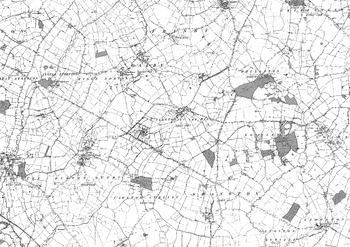
Map showing known coverts in an area east of Melton Mowbray. The map shows the distinctive landscape character created by the regularly dispersed but small pockets of woodland which were managed to encourage the fox population.

“Drawing Cover” by Henry Alken, early nineteenth century. An ill-disciplined field circles a covert, with the tails (or “sterns”) of hounds visible above the low-growing gorse. These patches of low scrub rapidly regenerated into woodland without annual management.
The exact chronology over which coverts were established is difficult to establish, but hunt accounts include regular payments for managing or renting coverts from the late eighteenth century. Cartographic analysis confirms that coverts were established within the enclosed landscape, once communal rights had been removed and as landowners established their new holdings. They become a more significant element of hunt expenses during the nineteenth century as the sport became more popular and the demand for finding foxes increased. The names of coverts sometimes provide clues about when they were established, such as the Quorn Hunt's Botany Bay covert from the 1790s and the Pytchley Hunt's Waterloo Gorse of around 1817.31
deBelin, “The Landscape of Foxhunting,” 31.
deBelin, “The Landscape of Foxhunting”; Harris, “To Find a Fox,” 11; Patten, “Fox Coverts for the Squirearchy,” 736.
The size and distribution of coverts was critical to the maintenance of the optimum fox population as well as to provide regular and reliable sport. Large areas of woodland allowed foxes to go to ground too easily, whereas smaller, regularly spaced coverts encouraged the fox to break and provide a chase across the fields.33
Harris, “To Find a Fox.”
Nimrod, The Chase, The Turf and the Road, 16.
Finch, “Grass, Grass, Grass,” 48.
Bosky was a term favored in the seventeenth century for a landscape that was well-stocked with brush, underwood, shrubs, and hedges but not necessarily dominated by wood or forest. It was also used in comparison to the barren arable open-field systems and heaths as in Shakespeare's Tempest (1610): “My boskie acres, and my vnshrubd downe,” iv, I, 81.
It seems clear that the emergence of modern foxhunting alongside the newly enclosed landscape of the shires was symbiotic; but subsequently, foxhunting had a significant effect on the development of landscape character. Unlike the early hunts that took place on the periphery of the cultivated landscape, away from areas of arable cultivation, coverts located the fox firmly within the pastoral landscape and therefore made that landscape integral to the performance of the hunt. The scrub and hedgerow cover matured over the following 200 years into a landscape that is dramatically different not only from the earlier preenclosure landscape character of the region but also from other regions that also experienced enclosure in the late eighteenth and nineteenth centuries, but were not so closely associated with the hunting phenomena.
The new landscape was celebrated in the popular songs published in increasing numbers during the nineteenth century to commemorate famous runs enjoyed by the various hunts. Perhaps the most famous of these was Billesdon Coplow, A Poem Descriptive of a Remarkable Day's Sport in Leicestershire on Monday, February 24th, 1800 by the Reverend Robert Lowth. It celebrates a run that lasted for more than two hours and covered approximately 28 miles between two coverts in the Quorn country, Billesdon Coplow and Enderby Gorse, where the (second) fox finally eluded the hunt.37
Lowth, Billesdon Coplow.
Eardley-Wilmot, Reminiscences of the Late Thomas Assheton Smith, Esq.
What more were the pastures of Leicester to me?
In the haunts of my childhood my spirit would be;
For we think when to wider famed countries we roam
No fox has the pluck of the foxes at home.39
York Minster Archives Y-BED/LN9 DOD The Bedale Hunt.
The songs articulate a popular local geography of hunting landscapes, linking place with moment through the recollection of exceptional runs across hunting countries. Although largely forgotten today, there is a wealth of hunting songs from right across England, including William Bromley-Davenport's The Dream of an Old Meltonian (1901), which recounts an imaginary run starting from Ranksborough Gorse in the Cottesmore country of Rutland. The culture of hunting was pervasive in all cultural aspects of the shires, something that is still apparent today. The fox appears as the symbol for Leicestershire County Council and Charnborough District Council, for example; and a fox mask features on the badge of Leicester City Football Club, who are still known colloquially as “The Foxes.” Despite the decline of hunting's economic and social importance within the region since 1945, it remains central to the region's cultural heritage and identity.
HUNTING AND HISTORIC LANDSCAPE CHARACTERIZATION
In the mid 1930s, Beach Thomas suggested that although the face of England had “marvellously changed” over the previous two and half centuries, each change (with the exception of barbed wire) “might have been especially designed to improve the art and craft of fox-hunting.”40
Beach Thomas, Hunting England, 8.
Duckworth, Firbank and Yamamoto, “Changes in Land Cover.”
Ewald, et al., “Foxhunting in England and Wales.”
Established and managed woodlands are widely recognized and highly prized as playing a major role in sustaining biodiversity, but fox coverts are rarely considered in the same category.43
Peterken, Woodland Conservation and Management; Rackham, Trees and Woodland in the British Landscape; Woodruffe-Peacock, “A Fox-Covert Study.”
Ewald, et al., “Foxhunting in England and Wales.”
Duckworth, Firbank, and Yamamoto, “Changes in Land Cover.”
Having made such an important contribution to the regional landscape character, it might be expected that foxhunting would feature in the initiative charged with facilitating the management of the historic landscape at a county level. Historic Landscape Characterisation (HLC) has been coordinated by English Heritage since 1994 and involves identifying and mapping the historic dimension of today's landscape, on a county-by-county basis, to create a tool with which to “protect and manage dynamic rural landscapes.”46
Clark, Darlington, and Fairclough, Using Historic Landscape Characterisation, 2.
Trow, “Why Our Rural Landscapes Matter,” 3.
Northamptonshire County Council has completed its HLC, and it now forms part of the Environmental Character Strategy, alongside characterization of the natural landscape elements. The HLC document is divided into two halves, the first outlines a chronology of landscape development from the Paleolithic to the present; and the second describes and maps 12 landscape character types, including “19th century Parliamentary enclosure” and “Large Modern Fields.” Despite Northamptonshire's place as one of the three main hunting shires, and home to prestigious hunts including the Pytchley Hunt, there is not a single reference to foxhunting within the HLC document. There is, however, a reference to the fact that in the Thornby-Watford Hills area, in the west of the county, coverts provide what little woodland there is in the absence of ancient woodland.48
However, no explanation or definition is given as to the original role or function of these coverts, but they are noted as being eighteenth or nineteenth century in date. The absence of foxhunting as a contributory factor to landscape character stands in marked contrast to medieval and early modern deer parks, which are mentioned no less than 56 times. Most of the references refer to the partial survival of earthwork boundaries associated with the park pale, such as the survival at Fotheringhay.49 The remains of a park keeper's lodge at Drayton Park are also noted as a “moated site,” and the presence of ancient woodland within the bounds of medieval deer parks is also recorded, as is the significance of deer parks as an early form of enclosure.50Northamptonshire Historic Landscape Character Assessment, 17, 26, 54, 73.
The situation in Leicestershire and Rutland is slightly different. The HLC assessment is not yet completed, but there is a Landscape and Woodland Strategy for the region, which characterizes the physical and natural landscape in the manner that was subsequently developed as the model for HLC. The landscape is discussed in terms of its geology, soils, and climate as well as a brief consideration of the region's landscape development since prehistoric times. These variables are then used to divide the region into 17 character areas, which are deemed to share “a unity of character and a distinctive sense of place” resulting from “particular combinations of natural and historical factors which make one place different from another.”52
Leicestershire County Council, Leicester, Leicestershire and Rutland Landscape, 1.
Leicestershire County Council, Leicester, Leicestershire and Rutland Landscape, 16, 18, 66.
Leicestershire County Council, Leicester, Leicestershire and Rutland Landscape, 11.
The other group of references to foxhunting relate to the possible affect of a ban since the document was prepared in 2001. It is acknowledged that a ban would have “particular implications for the Leicestershire and Rutland countryside in terms of small woodland and hedgerow management,” although “High Leicestershire” is the only character area for which a ban is identified as a specific management issue.55
Leicestershire County Council, Leicester, Leicestershire and Rutland Landscape, 22.
Leicestershire County Council, Leicester, Leicestershire and Rutland Landscape, 17.
Two key issues emerge from this analysis of landscape characterization in the shires and the fact that the contribution made by foxhunting is ignored. Firstly, despite professing a move away from site-based designations, the substantial earthwork remains of deer parks are accorded greater priority than foxhunting in the HLC assessment for Northamptonshire. Deer parks have been an established element of medieval archaeology since Cantor's works in the 1960s and 1970s; and as an easily recognizable feature, they have continued to be cataloged and studied.57
For example, Cantor, “The Medieval Parks of Leicestershire”; Dennison, Within the Pale.
The second point is that the involvement of archaeologists has been championed on the grounds that the discipline is most suited to take HLC forward because “archaeologists bring to cultural landscape an understanding of time-depth and long term processes.”58
Fairclough, “Cultural Landscape,” 31.
Fairclough, “Archaeologists and the European Landscape Convention,” 28.
Blake, “On Defining Cultural Heritage,” 84.
Clark, Darlington, and Fairclough, Using Historic Landscape Characterisation, 1.
However, as previously argued, the celebrated character of the landscape in the shires has been produced over the last 200 years and is radically different from its antecedent landscapes highlighted by the longer-term view. It is also a landscape that has survived relatively intact, because the cultural practice that created it has continued, at least until the ban in 2005. It was also a landscape and practice that became ingrained within the regional cultural heritage, moving beyond the community who followed hunting to impact on other forms of popular culture. The failure of HLC to identify the landscape contribution of foxhunting as a cultural practice in the shires, despite the sheer volume of evidence available, suggests that the methodology and long-term perspective must be refined.
One solution might be to engage more actively in another of the aims within the ELC: the democratization of the landscape. Champions of characterization have extolled its virtues on the grounds that it “is a tool for participation: it provides a meeting place in which to draw together public and personal opinions as well as specialist values.”62
Grenville and Fairclough, “Characterisation: Introduction,” 3.
Fairclough, “Archaeologists and the European Landscape Convention,” 35.
Fairclough, “Archaeologists and the European Landscape Convention,” 29.
In describing such lifestyles, the word traditional is often used as a short cut to a series of powerful but unhelpful myths that lie at the heart of the sentimental view of the cultural landscape: harmony with nature, the noble savage (or at least the dignified peasant), even Edens … These myths romanticise non-modern, usually rural lifestyles that are too often now almost entirely unsustainable; in doing this, they prevent real engagement with the cultural landscape as the historic dimension of the real world.65
Fairclough, “Cultural Landscape,” 31.
One can only conclude from these apparently contradictory statements that different priorities, definitions, and political agendas have yet to be fully worked into a methodology for protecting and sustaining the historic environment. Foxhunting has not, thus far, registered within a methodology for characterization that has prioritized an archaeological perspective of the landscape. Being a relatively modern development that has developed an integrated relationship with landscape character, foxhunting has neither the antiquity nor the material remains associated with medieval hunting practices. Nevertheless, foxhunting has undoubtedly had a major role in creating the regional landscape character of the present landscape in the shires and can demonstrate a significant and continuous heritage in the region. If the agencies involved in protecting the cultural landscape are serious about their pledges to recognize the many different views of landscape, and if they are committed to supporting sustainable management practices, they must acknowledge the role of the hunts in creating and sustaining the landscape of the shires. In doing so they must address how communities are constituted within the modern landscape and that some might claim a more active and significant contribution to the sustainable management of the historic landscape than others. They must also recognize that popular perceptions of landscape character may not extend beyond the last few hundred years; and although the archaeological perspective is important in understanding how those recent landscapes came into being, those views should not necessarily have precedence over others. To make judgments about the future of the cultural landscape, the first step is to ensure that all aspects of its history are presented without bias.