INTRODUCTION
The definition of giftedness is still a matter of debate. Many forms of giftedness have been described and theorized. Among them is intellectual giftedness (IG), which is related to theories of intelligence, and historically based on the psychometric approach (Mandelman et al., Reference Mandelman, Tan, Aljughaiman and Grigorenko2010; Sternberg, Reference Sternberg1981). IG refers to a high ability level, which was defined almost a century ago by Spearman (Reference Spearman1904) as the g factor. Standardized measures of general cognitive ability are widely used to identify IG children (Cao et al., Reference Cao, Jung and Lee2017), based on the intelligence quotient (IQ; McCoach et al., Reference McCoach, Kehle, Bray and Siegle2001). Children are therefore considered to be IG when their full scale intelligence quotient (FSIQ) reaches a particular threshold (Geake, Reference Geake and Shavinina2009), generally equal to or above 130 on a test such as the Wechsler Intelligence Scale for Children (WISC; Caroff, Reference Caroff2004; Grégoire, Reference Grégoire2012; Terriot, Reference Terriot2018). If this rigorous criterion is applied, gifted children represent 2.2% of a given age group.
Over the past decades, the increased availability of data on brain and cognitive functions in IG children has allowed neuropsychologists to gain a better understanding of how these children function. Many studies point to a unique neurodevelopmental trajectory in IG children. Intelligence is known to be supported by an extensive neuronal network in which frontal and parietal areas play a major role (Jung & Haier, Reference Jung and Haier2007). The resolution of complex tasks, usually underpinned mainly by frontal areas (Jin et al., Reference Jin, Kwon, Jeong, Kwon and Shin2006; Lee et al., Reference Lee, Choi, Gray, Cho, Chae, Lee and Kim2006), elicits a different pattern of activation in highly intelligent individuals, involving more posterior areas. In general, the functioning of IG children’s brain networks is characterized by less segregation, less modularization, and more global integration (Luders et al., Reference Luders, Narr, Bilder, Thompson, Szeszko, Hamilton and Toga2007; Solé-Casals et al., Reference Solé-Casals, Serra-Grabulosa, Romero-Garcia, Vilaseca, Adan, Vilaró, Bargalló and Bullmore2019; Westerhausen et al., Reference Westerhausen, Friesen, Rohani, Krogsrud, Tamnes, Skranes, Håberg, Fjell and Walhovd2018).
At the cognitive level, it has been suggested that IG children do not necessarily excel across the whole spectrum of performance measures. Their performances may be on a par with, or only slightly ahead of, their peers in a number of areas (Schofield & Ashman, Reference Schofield and Ashman1987). They may also have weaknesses in their cognitive functioning, with learning difficulties and/or disabilities (Brody & Mills, Reference Brody and Mills1997). Some authors have postulated that IG children undergo asynchronous development, with some cognitive and social aspects lagging behind their general ability (Silverman, Reference Silverman1997; Terrassier, Reference Terrassier2009). Meanwhile, other studies have suggested that some cognitive functions, such as attention or executive functions (EFs), play a key role in the development of intelligence. We would therefore expect IG children to perform better on these functions than TD children. So far, however, studies have failed to confirm this suggestion (Montoya-Arenas, Aguirre-Acevedo, Díaz Soto, & Pineda Salazar, Reference Montoya-Arenas, Aguirre-Acevedo, Díaz Soto and Pineda Salazar2018; Viana-Sáenz, Sastre-Riba, Urraca-Martínez, & Botella, Reference Viana-Sáenz, Sastre-Riba, Urraca-Martínez and Botella2020).
Intelligence scales (e.g., Wechsler scales) were initially developed to obtain a single measure (FSIQ) of an ability (g), calculated from a range of cognitive subscores. Since then, however, researchers have identified several segmented domains of intelligence, evidenced by factor analyses and supported by neuropsychological theories (Wechsler, Reference Wechsler2016). To measure these domains, subtests probing particular sets of cognitive functions, some sharing a common variance, are clustered into indices. For example, the Wechsler Intelligence Scale for Children–5th edition (WISC-V) includes seven primary subtests used to calculate the FSIQ, and these, together with a further three primary subtests, are used to produce the following five indices: Similarities and Vocabulary (Verbal Comprehension Index, VCI), Block Design and Visual Puzzles (Visual Spatial Index, VSI), Matrix Reasoning and Figure Weights (Fluid Reasoning Index, FRI), Digit Span and Picture Span (Working Memory Index, WMI), and Coding and Symbol Search (Processing Speed Index, PSI). These indices necessarily correlate with IQ, but their loadings differ, ranging from .81 (VCI), .87 (VSI), 1.00 (FRI), and 87 (WMI) to .57 (PSI). This explains the large discrepancies and increased variability in indices and subtest scores among persons with high ability (Binder, Iverson, & Brooks, Reference Binder, Iverson and Brooks2009).
As indicated by the interpretation manual, this scale can be used to test assumptions about neuropsychological deficits. However, in the context of IG, the interpretation of subtest scores and indices may lead to a circular analysis (Makin & Orban de Xivry, Reference Makin and Orban de Xivry2019), as the variable of interest (index or subscore) is characterized by retrospective data (FSIQ). For example, Vocabulary has a loading of .76 on VCI and VCI and a loading of .81 on FSIQ. Consequently, IG children generally score higher on VCI subtests than on subtests of other indices, such as PSI, which has a loading of .55 on FSIQ. Neuropsychological tests offer a means of overcoming this issue, as they allow researchers to move away from intelligence by focusing on specific neuropsychological domains. Even so, there may be an overlap between some of these measures (Tremont, Hoffman, Scott, & Adams, Reference Tremont, Hoffman, Scott and Adams1998).
To our knowledge, there has yet to be a study comparing IG children and TD children on overall cognitive performances, measured with neuropsychological tests. This is paradoxical, given that a cognitive characterization would enhance the clinical description of this population. It is important to identify IG children’s cognitive strengths and weaknesses, in order to provide suitable care and support at school for those who need it. Greater knowledge about their neuropsychological functioning would allow assessment guidelines to be developed for professionals. However, there are numerous methodological issues that need to be resolved if research is to move forward. At a theoretical level, gathering data on neuropsychological functioning in giftedness may help to refine the definition of this population.
We undertook a systematic review of the literature pertaining to a range of cognitive domains in IG. Research findings were grouped according to the classes of cognitive functions identified by Lezak, Howieson, Loring, and Fischer (Reference Lezak, Howieson, Loring and Fischer2004): receptive (sensory reception and perception) and expressive functions (linguistic and motor skills/praxis), memory, attention and EFs, and social/emotional cognition. Academic skills (reading, writing, mathematics) were also taken into consideration. The neuropsychological tests measuring these domains were selected according to their interpretation manuals, and in accordance with reviews in child neuropsychology (Cassidy et al., Reference Cassidy, Ilardi, Bowen, Hampton, Heinrich, Loman, Sanz and Wolfe2018; Grealish, Price, & Stein, Reference Grealish, Price and Stein2020; Lehtonen, Howie, Trump, & Huson, Reference Lehtonen, Howie, Trump and Huson2013). The present systematic review summarized the contributions and limitations of each included study and opened up avenues for future research.
METHOD
Search Strategy
We followed the PRISMA guide (Moher, Liberati, Tetzlaff, Altman, & PRISMA Group, Reference Moher, Liberati, Tetzlaff and Altman2009) and PRISMA protocol (PRISMA-P) (Moher et al., Reference Moher, Shamseer, Clarke, Ghersi, Liberati, Petticrew, Shekelle and Stewart2015) for this systematic review. An initial search was conducted by the primary author in PROSPERO and Cochrane, to avoid duplication of similar reviews being undertaken. Two researchers independently conducted searches in Scopus, PubMed, PsycArticles (PsycInfo), and Psychology & Behavioral Sciences Collection (PBSCO) between June 2018 and June 2020. No restrictions were applied to publication dates. Searches were performed using combinations of the following terms: “gifted” OR “giftedness” OR “talented” OR “superior intelligence” OR “high abilities” OR “high intelligence” OR “high-IQ” AND “neuropsychology” OR “cognition” OR “attention” OR “executive functions” OR “social cognition” OR “working memory” OR “memory” OR “speech” OR “reading” OR “spelling” OR “visuospatial” OR “perceptual” OR “perceptive” OR “motor” OR “gesture” OR “praxis” OR “coordination” OR “graphomotor” OR “arithmetic” OR “mathematics” OR “learning disabilities” AND “preschooler” OR “children” OR “child” OR “adolescent”. Example of a search string used in the review: “gifted” OR “giftedness” OR “talented” OR “superior intelligence” OR “high ability” OR “high intelligence” OR “High-IQ” AND “attention” AND “preschooler” OR “children” OR “child” OR “adolescent”. A manual search was conducted in the reference lists of retrieved papers to identify further relevant studies.
Article Screening
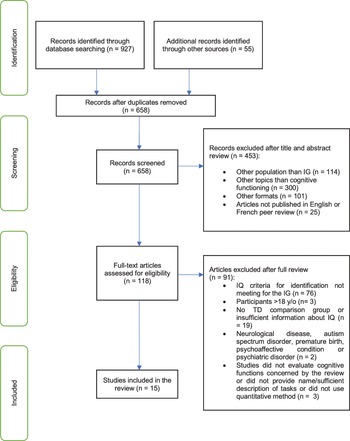
All studies were collected using a matrix on a spreadsheet in order to help locate duplicate articles, classify them according to inclusion criteria, and register excluded studies. After removing duplicates, the two reviewers independently screened titles, abstracts, and full texts of the remaining 658 articles for eligibility. To be eligible for the current review of neuropsychological findings in gifted children, studies had to fulfill five criteria: (1) only case–control and cross-sectional studies including IG children and a comparison group; (2) scores at least two standard deviations (SDs) above the mean on one intellectual measure (e.g., FSIQ) for IG children (see Table 1 for criteria used in each study); (3) for studies focusing on specific subgroups of IG children with attention-deficit hyperactivity disorder (ADHD) or learning disability (LD), cutoff lowered to FSIQ ≥ 120, in line with recommendations (see further explanation in section below; criteria for these studies set out in Table 2); (4) use of a valid and reliable cognitive assessment to determine groups’ performances in each cognitive domain considered; and (5) published in English or French in a peer-reviewed journal.
Sample characteristics of studies comparing IG children with a TD control group (or norms)

a The above average group was not taken into consideration in this review
b The adult sample was not taken into consideration
c Only IG and TD samples nonexcelling in math were taken into consideration
d Only Study 1 was taken into consideration
M: mean
Samples: IG: intellectually gifted; TD: typically developing children of average intelligence; Measures: CAT: Cognitive Abilities Test; CPM: Raven’s Colored Progressive Matrices; IQ: intelligence quotient; OLSAT: Otis-Lennon School Ability Test; RAPM: Raven’s (Advanced) Progressive Matrices; WISC: Wechsler Intelligence Scale for Children.
Sample characteristics of studies featuring IG children subgroups (attention-deficit hyperactivity disorder, learning disabilities)

a Criteria for dyslexia: discrepancy between IQ and reading or spelling ability of at least two SDs, demonstrated: (a) at most average scores on both reading and spelling (standard score ≤ 12), (b) below average scores on reading or spelling (lowest 10–15%), and (c) below average performance on at least one of the three cognitive factors thought to underlie dyslexia: phonological awareness, rapid automatized naming, verbal short-term memory.
b Criteria for dyslexic group: (a) significant discrepancy between IQ and reading or spelling performance of at least 2 SDs and (b) below average scores on reading or spelling (lowest 10–15% or a standard score ≤ 6)
M: mean; uk: unknown.
Samples: ADHD: attention-deficit hyperactivity disorder; IG: intellectually gifted; IGADHD: intellectually gifted with attention deficit hyperactivity disorder, IGLD: Intellectually gifted with learning disability; LD: children with learning disability (with average intelligence); TD: typically developing children (with average intelligence).
Measures: CBCL: Child Behavior Checklist, CTMM: California Test of Mental Maturity; IQ: intelligence quotient; TOVA: Test of Variables of Attention; WISC: Wechsler Intelligence Scale for Children.
Exclusion criteria were:
-
Studies on populations other than IG children (e.g., with autism spectrum disorder) or studies including IG children with neurological disease or neurodevelopmental conditions other than ADHD or LD, such as autism spectrum disorder or premature birth.
-
Papers covering other issues, to the exclusion of cognitive functioning (education, neuroimaging).
-
Case studies, retrospective studies on IG youth (as these generally focus on predictors of later intellectual level), book chapters, conference proceedings and reviews.
-
Studies that did not provide intelligence criteria for the IG group (e.g., only indicating mean IQ) or else used a nonconsensual IQ measure (e.g., IQ based on two subtests of an intelligence scale with no information about prorating method, or inclusion is based on a single quotient such as Verbal IQ or Performance IQ at ≥130).
-
TD group including children with an intelligence score at least two SDs above the mean.
-
Participants aged above 18 years.
-
Studies that did not sufficiently describe the cognitive tasks, did not use quantitative methods, or did not test the statistical significance of the results.
After applying these criteria, we excluded 643 studies and included 15 (see Figure 1).
Flow diagram of selected studies.

Data Extraction
Data were extracted from each study by the first author, using a predefined data extraction form. Information was (1) first author and year of publication, (2) country where study took place, (3) demographic characteristics of each group (IG, TD, and others), (4) intellectual and other inclusion criteria for each group, (5) recruitment method, (6) tool used for cognitive assessment, (7) results of group comparisons for each measure, and (8) main conclusion and study limitations.
As only a few studies were selected for each cognitive domain, and assessment tools were too heterogeneous (for both neuropsychological assessment and IQ measure), a meta-analysis was not appropriate. We therefore undertook a narrative summary of the results and produced a final statement about the main findings for each domain.
RESULTS
Study Characteristics
The 15 articles included in the review provided a combined sample size of 507 IG children (mean age = 11.5 years) and 598 TD children (mean age = 11.6 years). Sample characteristics are summarized in Table 1. Four of these studies included subgroups of IG children and children of average intelligence displaying either ADHD (IG-ADHD: 44; ADHD: 297) or LD (IG-LD: 47; LD: 73).
Most of the participants were recruited from special schools for gifted children (10/15), but some were selected by school professionals (doctor, psychologist) or teachers (3/15) or were recruited through advertisements or selected from a large sample (2/15). Studies were mostly conducted in North America (7), East Asia (3), Latin America (2), Europe (2), and the Middle East (1).
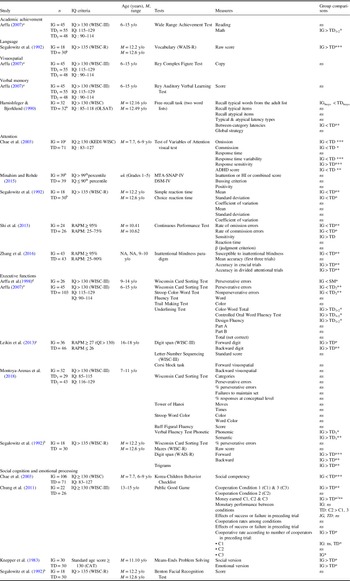
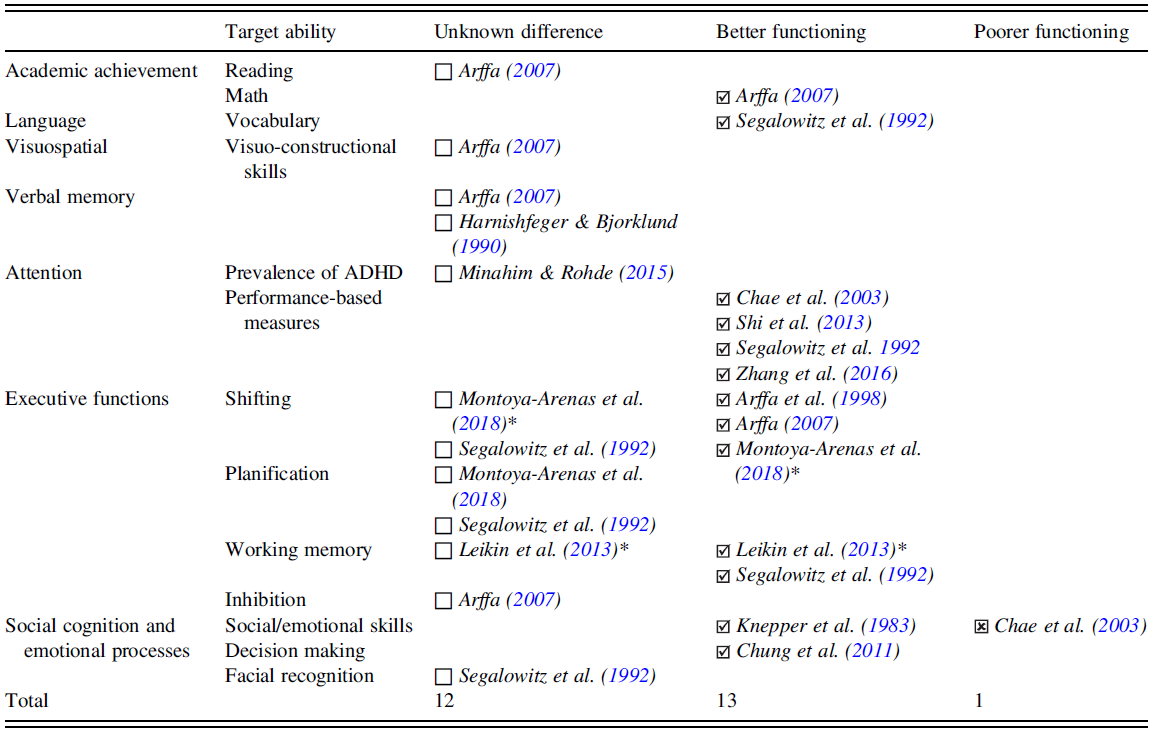
Table 3 summarizes results of comparisons between IG children and TD children on neuropsychological scores. Where available, the statistical significance is reported for each variable. For studies with many statistics, the results of group comparisons are given first. Results concerning specific subgroups of children with ADHD or LD are provided in a separate table and discussed in a specific subsection (Table 4). A final statement is provided in Table 5, classifying the studies according to their results.
Main results of studies comparing IG children with TD children on neuropsychological measures

a Only comparisons between IG and TD1 or TD2 were taken into consideration
b The adult sample was not taken into consideration in this review
c Results of IG children with ADHD are documented separately in Table 3
d TD were not taken into consideration, as they did not serve as a control group
e Only IG and TD samples nonexcelling in math were taken into consideration
M: mean; ns: not significant; uk: unknown.
Samples: IG: intellectually gifted; SM: statistical manual (comparison with adult mean); TD: typically developing children of average intelligence;
Measures: CAT: Cognitive Abilities Test; CPM: Raven’s Colored Progressive Matrices; DSM(-IV): Diagnostic and Statistical Manual of Mental Disorders (4th edition); IQ: intelligence quotient; MTA-SNAP-IV: NIMH Collaborative Multisite Multimodal Treatment Study of Children with Attention-Deficit Hyperactivity Disorder; OLSAT: Otis-Lennon School Ability Test; RAPM: Raven’s (Advanced) Progressive Matrices; WAIS: Wechsler Adult Intelligence Scale; WISC(-R, -III): Wechsler Intelligence Scale for Children.
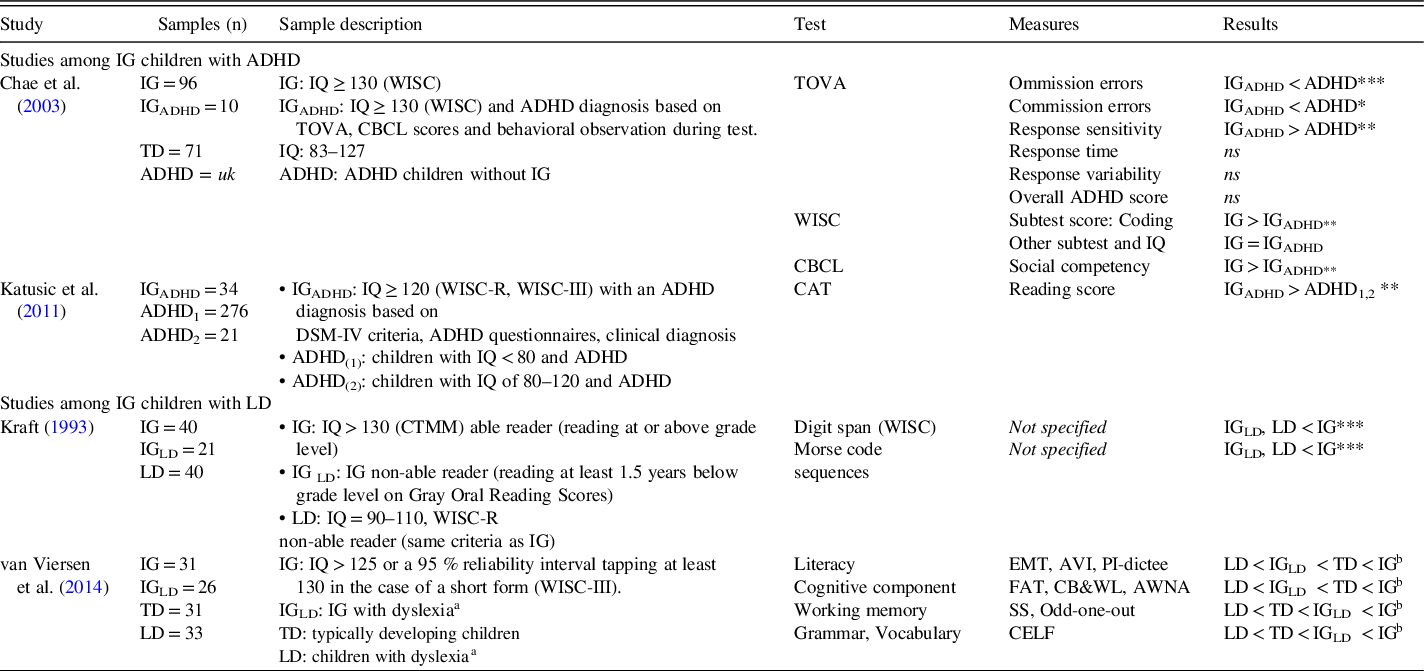
Main results of studies among IG children subgroups (learning disabilities, ADHD) on neuropsychological measures

a Criterion for dyslexia: discrepancy between IQ and reading or spelling ability of at least two SDs, demonstrated (a) at most average scores on both reading and spelling (standard score ≤ 12), (b) below average scores on reading or spelling (lowest 10–15%), and (c) below average performance on at least one of the three cognitive factors thought to underlie dyslexia: phonological awareness, rapid automatized naming, and verbal short-term memory
b Results based on Bayesian statistics
uk: unknown, ns: not significant.
Samples: ADHD: attention deficit hyperactivity disorder; IG: intellectually gifted; IGADHD: intellectually gifted with attention deficit hyperactivity disorder; IGLD: intellectually gifted with learning disability; LD: children with learning disability (without IG); TD: typically developing children (average intelligence)
Measures: AVI: text reading time; AWNA: Automated Working Memory Assessment; CAT: California Achievement Test; CBCL: Child Behavior Checklist; CB&WL: Continu Benoemen & Woorden Lezen; CELF-4: Clinical Evaluation of Language Fundamentals; CVLT-C: California Verbal Learning Test-Children’s version; EMT: Eén-minuut-test; FAT: Fonemische Analyse Test; SS: spatial span; TOVA: Test of Variables of Attention; WISC: Wechsler Intelligence Scale for Children.
Final statement about findings in IG children compared with TD children

* Studies supporting mixed results.
Findings in Neuropsychological Domains
Language
Language ability covers many functions and processes (e.g., comprehension, expression, phonology, lexicon, syntax, pragmatic), and no study has systematically explored all these aspects. Only one of the 15 studies selected for this review dealt with language ability, among other cognitive and electrophysiological measures (Segalowitz, Unsal, & Dywan, Reference Segalowitz, Unsal and Dywan1992). IG children outperformed TD children on the Vocabulary subtest (Wechsler Adult Intelligence Scale-Revised, WAIS-R), indicating better lexical ability in IG children.
Academic skills
Only one of the 15 studies we selected examined the academic performance of IG children (Arffa, Reference Arffa2007). This study addressed the contributions several executive and nonexecutive measures in samples of children with average, above average, or superior intelligence. The author expected to observe significant relationships for all or most of the EF measures. An achievement test (Wide Range Achievement Test Reading and Math) was used as a nonexecutive measure. Regression results indicated that intelligence accounted the most for the achievement measure, with proportions ranging from 14% of the variance for the math score to 28% for the reading score. After controlling for age, significant associations were only found for the math score, as the superior intelligence group scored significantly higher than the other two groups. The author concluded that achievement is more strongly related to IQ than to either executive or nonexecutive measures.
Motor and visuospatial abilities
These abilities have seldom been explored in IG children. The only included study to explore them was the one described in the previous section (Arffa, Reference Arffa2007). Another nonexecutive measure was obtained with the Rey-Osterrieth Complex Figure, assessing visuospatial skills. Regression analysis revealed a significant effect of IQ (WISC-III, perceptual organization composite score) on the copy score. However, after controlling for age, only the above average group scored above average. The authors did not find any differences between the IG group and the average and above average groups. They suggested that a ceiling effect might help explain why differences were not clearly evident. This study did not identify whether IG children had scores above or below those of the average sample.
Verbal memory
Only two of the 15 studies we included explored this domain, and neither of them reported a difference between IG and TD children on the Rey Auditory-Verbal Learning Test. Intellectual level and verbal learning performance seemed to be relatively independent (Arffa, Reference Arffa2007). Intelligence did not account for the variance on the learning test. Post hoc analyses only showed that the above average group performed better than the average group. The IG children did not differ significantly from either of these two groups. The other study found that IG and TD children did not differ significantly on free recall of category-related or not category-related words, whether they were adult-generated or self-generated (Harnishfeger & Bjorklund, Reference Harnishfeger and Bjorklund1990). This study did not report all the statistical and significant comparisons between groups and tended to over-emphasize some nonsignificant scores (p ≥ .05). However, sufficient evidence was collected to conclude that IG children failed to recall more words than TD children and were no more strategic.
Attention
Of all the cognitive domains considered in this review, attentional skills accounted for the greatest number of studies (5/15). Attention is a fundamental process that interacts with every other cognitive function and through it, information processing, orientation, decisional processes, and behavior are controlled (Zimmermann & Leclercq, Reference Zimmermann, Leclercq, Leclercq and Zimmermann2002).
Attention in IG children was assessed with various tools, ranging from reaction times to target detection and the inattentional blindness paradigm. Taken together, studies focusing on performance-based measures (4/5) supported the idea of better attentional functioning in IG children. Only reaction times led to conflicting results. One of three studies reported faster reaction times for IG children in a simple reaction time task (Segalowitz et al., Reference Segalowitz, Unsal and Dywan1992), but the other two studies did not, based on the Test Of Variables of Attention (TOVA)-Visual Test and continuous performance test (Chae, Kim, & Noh, Reference Chae, Kim and Noh2003; Shi et al., Reference Shi, Tao, Chen, Cheng, Wang and Zhang2013). These inconsistent results may be explained by the varying nature of the tasks. Nevertheless, variability in response times was lower in IG children than in TD children, in the two studies that measured it (Chae et al., Reference Chae, Kim and Noh2003; Segalowitz et al., Reference Segalowitz, Unsal and Dywan1992), suggesting that IG children display fewer fluctuations in attentional skills. Moreover, all the studies that recorded accuracy data (e.g., omission, commission, or accuracy scores) reported better scores for IG children (Chae et al., Reference Chae, Kim and Noh2003; Shi et al., Reference Shi, Tao, Chen, Cheng, Wang and Zhang2013; Zhang, Zhang, He, & Shi, Reference Zhang, Zhang, He and Shi2016). This superiority was also demonstrated using an inattentional blindness paradigm. IG children performed better on this task and were more liable to detect unexpected stimuli (Zhang et al., Reference Zhang, Zhang, He and Shi2016). These results were interpreted as an additional spare capacity of attention.
One study that assessed the frequency of ADHD symptoms, based on teacher ratings and reports (Minahim & Rohde, Reference Minahim and Rohde2015), found no evidence of a difference in the number of ADHD cases between IG children and their TD peers, suggesting that ADHD is neither more nor less frequent in IG children.
Executive functions
EFs are a set of general-purpose control processes that regulate thoughts and behaviors (Miyake & Friedman, Reference Miyake and Friedman2012). They “make possible mentally playing with ideas; taking the time to think before acting; meeting novel, unanticipated challenges; resisting temptations; and staying focused” (Diamond, Reference Diamond2013, p. 135). Different EFs can be distinguished, such as working memory (WM), inhibition, cognitive shifting, planning, and problem solving.
Executive functioning received just as much interest as attentional skills as five of the 15 studies we included provided EF measures. Mixed results were reported for WM, depending on the nature of the task and the processes involved. IG children performed better than TD children in both the forward and backward conditions of the digit span task, but not on letter-number sequencing and spatial WM tasks (Leikin, Paz-Baruch, & Leikin, Reference Leikin, Paz-Baruch and Leikin2013; Segalowitz et al., Reference Segalowitz, Unsal and Dywan1992).
All four studies of the included studies that assessed shifting did so using the Wisconsin Card Sorting Test (WCST). However, they reported contrasting results. When the percentage of perseverative errors was taken into account, half the studies failed to find a difference between IG and TD children (Montoya-Arenas et al., Reference Montoya-Arenas, Aguirre-Acevedo, Díaz Soto and Pineda Salazar2018; Segalowitz et al., Reference Segalowitz, Unsal and Dywan1992), while the other half reported lower scores in favor of IG children (Arffa, Reference Arffa2007; Arffa et al., Reference Arffa, Lovell, Podell and Goldberg1998). Performances on other WCST measures differed according to the study. One reported fewer nonperseverative errors for IG children (Arffa, Reference Arffa2007), whereas no difference was found between the groups on the number of categories completed or failures to maintain sets (Montoya-Arenas et al., Reference Montoya-Arenas, Aguirre-Acevedo, Díaz Soto and Pineda Salazar2018). In the fluency task, IG children scored higher in the verbal modality (Arffa, Reference Arffa2007; Montoya-Arenas et al., Reference Montoya-Arenas, Aguirre-Acevedo, Díaz Soto and Pineda Salazar2018), while conflicting results were reported in the nonverbal modality, with scores either equal to (Montoya-Arenas et al., Reference Montoya-Arenas, Aguirre-Acevedo, Díaz Soto and Pineda Salazar2018) or above (Arffa, Reference Arffa2007) those of TD children.
Of the three studies that examined inhibitory ability, only one used a valid measure of inhibition. In this study (Arffa, Reference Arffa2007), IG and TD children did not differ significantly on an underlining test. Montoya-Arenas et al. (Reference Montoya-Arenas, Aguirre-Acevedo, Díaz Soto and Pineda Salazar2018) also used the Stroop test to assess inhibition. However, the measure required (interference score) to distinguish EF(s) from other cognitive components was not provided. The same problem arose with the Trail Making Test used to assess shifting, as the alternating switch-cost measure was not provided.
Concerning planning skills, no difference was recorded between IG and TD children on either Mazes (Segalowitz et al., Reference Segalowitz, Unsal and Dywan1992) or the Tower of Hanoi (Montoya-Arenas et al., Reference Montoya-Arenas, Aguirre-Acevedo, Díaz Soto and Pineda Salazar2018).
Social and emotional processes
Social cognition refers to how people process information within a social context, including perception, causal attributions concerning self and others, social judgments, and decision making.
These abilities were assessed in four of the 15 studies. Only one of them (Chae et al., Reference Chae, Kim and Noh2003) highlighted poor social abilities in IG children, based on parents and teachers’ responses to the Child Behavior Checklist (CBCL). However, a study conducted with means-ends problem solving (Knepper et al., Reference Knepper, Obrzut and Copeland1983) showed that IG children outperformed the TD sample on social and emotional problem solving. These results were supported by another study of social decision making in IG adolescents (Chung et al., Reference Chung, Yun, Kim, Jang and Jeong2011). These authors showed that IG adolescents were more cooperative and strategic than the others’ and demonstrated weak loss sensitivity, but notable greed in a public goods game.
Research on IG Subgroups: Learning Disabilities and Attention-Deficit Hyperactivity Disorder
IG-LD children have received increasing attention over the past few decades. These students are defined as simultaneously having a high general ability and a cognitive deficit (Reis et al., Reference Reis, Baum and Burke2014). This results in low achievement in one or more areas, such as reading or writing skills (Maddocks, Reference Maddocks2020).
We initially identified two studies that focused on IG subgroups, formed on the basis of an intelligence score two standard deviations above the mean. However, the use of this cut-off is debated. Researchers have suggested that cognitive weaknesses in IG children with LD impact the PSI and WMI, leading to a depressed FSIQ (Maddocks, Reference Maddocks2020). Authors therefore recommend either lowering the IQ cut-off or using an alternative measure, such as the General Aptitude Index (Foley Nicpon, Allmon, Sieck, & Stinson, Reference Foley Nicpon, Allmon, Sieck and Stinson2011). This led us to consider research on IG-LD children that we had initially excluded, owing to an intellectual level less than two standard deviations above the mean. By setting the IQ cut-off at 120 (Lovett & Sparks, Reference Lovett and Sparks2013), we were able to include two additional studies in our review (Katusic et al., Reference Katusic, Voigt, Colligan, Weaver, Homan and Barbaresi2011; van Viersen et al., Reference van Viersen, Kroesbergen, Slot and de Bree2014), bringing the total number of studies on IG subgroups to four (4/15).
Two studies found that children in the IG-ADHD subgroup outperformed peers with ADHD of average IQ on the TOVA (Chae et al., Reference Chae, Kim and Noh2003). They made fewer commission and omission errors and had better response sensitivity. They did not differ on either response time, response variability, or overall ADHD score. Compared with their IG peers without ADHD, they scored lower on the Coding subtest of the WISC, but no differences were observed on either the other subtests or the IQ scores. Their social competence, assessed via parental reports (CBCL), was poorer than that of the IG children. IG-ADHD children had better reading performances than children with ADHD of average IQ (Katusic et al., Reference Katusic, Voigt, Colligan, Weaver, Homan and Barbaresi2011).
The two remaining studies attempted to characterize some of the cognitive functioning of dyslexic IG children, by investigating their WM (Kraft, Reference Kraft1993) and language skills (literacy, grammar, vocabulary, phonology; van Viersen et al., Reference van Viersen, Kroesbergen, Slot and de Bree2014). Although weaknesses were evidenced in some language skills (e.g., phonology), the dyslexic IG children always outperformed their dyslexic peers of average IQ. However, both dyslexic IG children and dyslexic children of average IQ scored lower than IG children on verbal WM tasks (Kraft, Reference Kraft1993). IG children with LD outperformed dyslexic children and TD children on WM and two language skills (grammar and vocabulary), suggesting strengths in their cognitive profile (van Viersen et al., Reference van Viersen, Kroesbergen, Slot and de Bree2014).
DISCUSSION
The twofold aim of this systematic review was to draw up an inventory of studies of the neuropsychological functioning of IG children and to summarize these children’s possible cognitive strengths and weaknesses. It was the first to provide a comprehensive understanding of IG children’s overall cognitive functioning.
Our study supports the conclusion that IG children generally exhibit average or above average skills, depending on the cognitive area. Only one study found weaker skills in a specific area of functioning (i.e., social competence proxy-reported by parents and teachers).
This review provides evidence that IG children differ from their IQ average peers, with better functioning in some cognitive areas, such as attentional skills, mathematics achievement, some EFs, and social cognition. Their attentional skills are the ones that have been most documented (along with EFs) up to now, and results converge. IG children make fewer errors on attentional tasks and display greater accuracy. Contrary to what has been suggested for many years (by drawing a parallel with ADHD symptomatology), these children seem to be no more concerned by ADHD diagnoses or signs than TD children. These findings are in line with a recent systematic review (Rommelse et al., Reference Rommelse, van der Kruijs, Damhuis, Hoek, Smeets, Antshel, Hoogeveen and Faraone2016) suggesting that higher intelligence is actually negatively linked to ADHD and related symptoms.
The executive functioning of IG children has received just as much interest as attention. However, findings in this area are noticeably more heterogeneous. This can be explained by the diverse (nonunitary) nature of EFs, which may lead to patterns of dissociation (Friedman & Miyake, Reference Friedman and Miyake2017). A recent meta-analysis of EFs in children with high intelligence (criteria not supplied) concluded that they outperform TD children on verbal and visuospatial WM, but not on other EFs (Viana-Sáenz et al., Reference Viana-Sáenz, Sastre-Riba, Urraca-Martínez and Botella2020). Our results are partially consistent with this study. IG children appeared to perform better on the verbal component of WM, as well as on shifting, when assessed with a verbal fluency task, probably thanks to their larger vocabulary. Contradictory results were reported by studies using the WCST. Performances of IG and TD children do not differ on the remaining EFs (planning, inhibition, and visual WM).
Studies did not find any evidence of differences between IG children and TD children on reading, long-term memory, or visuospatial skills. Only one study reported poorer functioning in IG children, and this was for social cognition. Results on this domain were also heterogeneous. It is important to distinguish between different aspects. In low-level social cognition, such as facial recognition, IG children did not differ significantly from their average IQ peers. However, in social/emotional problem solving and social decision making, they demonstrated better skills in performance-based measures. This contrasted with teachers’ and parents’ ratings, which indicated poorer social abilities in IG children. This is not surprising, as performance-based and rating measures are known to generally yield different types of information (Toplak, West, & Stanovich, Reference Toplak, West and Stanovich2013).
Our review also indicates that despite a growing interest in IG children with LD or ADHD, few empirical studies have attempted to empirically describe their cognitive profile. Nevertheless, their findings are along the same lines, showing better attentional and reading abilities in IG-ADHD children than in children with ADHD of average IQ. Despite this relative advantage, IG-ADHD children may also encounter difficulties at school (Rommelse et al., Reference Rommelse, Antshel, Smeets, Greven, Hoogeveen, Faraone and Hartman2017) and worrisome psychosocial outcomes requiring diagnosis and treatment, just like any other children (Katusic et al., Reference Katusic, Voigt, Colligan, Weaver, Homan and Barbaresi2011). Both IG-dyslexic children and average IQ-dyslexic children exhibit poorer WM skills than IG children who are able readers. However, IG-dyslexic children display better WM and language skills (grammar, vocabulary) than average IQ-dyslexic children and even TD children. These better skills may be sources of compensation, but also obstacles to the diagnosis of dyslexia in IG children.
Interestingly, the present systematic review did not provide any support for the assumption that IG children have better overall cognitive functioning, as measured by neuropsychological assessment. For example, although EFs are considered by some to be the fundamental components of intelligence (Ardila, Pineda, & Rosselli,, Reference Ardila, Pineda and Rosselli2000; Ardila, Reference Ardila2018), our study demonstrated that a higher intellectual level does not necessarily correspond to better executive functioning. Finally, as IG children seem not to outperform TD children in many cognitive domains, we can surmise that intelligence develops in a relatively independent manner from other cognitive functions. Some authors interpret discrepancies between intelligence level and other areas as being clinically specific to IG children and consider them to constitute a vulnerability factor (Terrassier, Reference Terrassier2009). However, according to other researchers, discrepancies can be explained by Spearman’s law of diminishing returns, which states that there is greater variability across scores and greater dispersion in a higher ability population (Binder et al., Reference Binder, Iverson and Brooks2009; Blum & Holling, Reference Blum and Holling2017; Labouret & Grégoire, Reference Labouret and Grégoire2018), thus refuting any clinical explanation. As neuropsychological measures are generally loosely correlated with IQ, we would not expect all these scores to be at the high level, owing to the regression-to-the-mean effect (Larrabee, Reference Larabee2000). The probability of obtaining an abnormal score is inversely related to intelligence (Binder et al., Reference Binder, Iverson and Brooks2009; McGee, Delis, & Holdnack, Reference McGee, Delis and Holdnack2009). Still others suggest that the lack of difference between samples of IG and TD children on cognitive measures is due to ceiling effects. Moreover, it should be noted that neuropsychological tests are designed with deficits in mind. Their utility for determining above-average abilities is tenuous and controversial.
Although our review offered a new perspective on IG children, by considering their overall cognitive functioning, it had several limitations. First of all, there was a dearth of studies in some domains (e.g., motor or mathematical components). Math abilities are mainly studied in other types of giftedness, notably mathematical giftedness (O’Boyle et al., Reference O’Boyle, Cunnington, Silk, Vaughan, Jackson, Syngeniotis and Egan2005), with criteria for math achievement rather than a general ability score. This explains why no such data were including in our study. The small number of studies included in this review was the result of a methodological choice to include a well-defined population. Many inclusion and exclusion criteria were applied for this review, in order to avoid limitations encountered in other studies among IG children, including confused definitions and a lack of stringent criteria (Viana-Sáenz et al., Reference Viana-Sáenz, Sastre-Riba, Urraca-Martínez and Botella2020). For some domains (e.g., academic achievement, language, and visuospatial ability), the conclusions of this review were based on a single study. Further studies are therefore necessary to generate additional data and make these conclusions more robust. Moreover, more systematic studies are needed to explore all aspects of the domain being considered.
This review also faced methodological issues arising from the studies we selected. The latter generally included children from gifted programs, who are overrepresented in the literature, thus raising the prospect of sampling bias. Moreover, as previously mentioned (Segalowitz et al., Reference Segalowitz, Unsal and Dywan1992), recruitment for these studies was based on the inclusion criteria for the relevant program. It is not clear whether the researchers checked these. Additionally, few studies identified their exclusion criteria, in particular, the presence of medical conditions (e.g., neurological or psychiatric disease). These are important aspects, as they are likely to have an impact on cognitive performance. It should also be noted that descriptions of the TD groups were evasive, and their IQ scores were not systematically provided. Few studies statistically tested the difference in IQ between the two groups, even though the size of this difference and its location in the distribution could have resulted in different effects (Schofield & Ashman, Reference Schofield and Ashman1987). Researchers should pay attention to these aspects in future studies. Furthermore, our review did not establish exactly how much higher each neuropsychological score was in the IG group, and nor did it ascertain the nature of the nonsignificant results (absence of sufficient evidence or equivalence between groups; Makin & Orban de Xivry, Reference Makin and Orban de Xivry2019). To answer these questions, effect sizes (or the data required to calculate them) are needed (Ferguson, Reference Ferguson2009; Sullivan & Feinn, Reference Sullivan and Feinn2012), but very few of the studies included in this review provided them. Further studies in IG would benefit from reporting effect sizes, in addition to statistical significance, to accurately interpret the results. Lastly, the studies included in this review tended to be old. Current studies tend to focus more on educational issues, even though our knowledge of these children paradoxically remains very limited. Researchers in the neuropsychology field will have an important role to play in enhancing our understanding of these children in years to come.
CONCLUSION AND FUTURES DIRECTIONS
This systematic review provided insight into the cognitive functioning of IG children with skills equal or superior to those of TD children. Strengths were identified in language (vocabulary), math achievement, attention, some EFs (verbal WM, spontaneous verbal shifting), and social/emotional cognition (decision making, emotional/social problem solving). However, the studies included in this review found no evidence of differences between IG children and their TD peers on either reading achievement, visuospatial skills, verbal memory, or other EFs (planning, inhibition, and visual WM). Parents’ and teachers’ reports identified impaired social competence, but IG children still performed well on performance-based measures in this domain. Further research is needed to explain the gap between what these children are actually able to achieve and adults’ perceptions of their skills. At the same time, our review highlighted the need to further investigate the cognitive functioning of IG children in a more systematic way, based on well-defined criteria for the study of IG. Researchers need to pay attention to the tools they use to assess IG children because of potential ceiling effects. It is important to raise the question of these tests’ sensitivity to IG people, as they are often constructed for large populations in clinical settings, and not really for individuals of exceptional ability. Further studies are necessary to move forward on this issue.
This review confirmed discrepancies in cognitive measures of IG and put forward several explanatory assumptions. It is an issue of crucial importance that deserves thorough study, in order to improve the characterization of the IG profile and inform the controversial debate about how to identify IG children with learning disabilities (Lyman et al., Reference Lyman, Sanders, Abbott and Berninger2017). Just like their peers, these children may also be concerned by LD, despite cognitive strengths and possible compensatory mechanisms.
FINANCIAL SUPPORT
This work was supported by DANA, a foundation based in Brest that helps children in difficulty living in Brittany (France), under the aegis of Fondation de France.
CONFLICTS OF INTEREST
The authors have nothing to disclose.