In 1938, the British colonial government enacted Section 377A of the Straits Settlements Penal Code. Derived from the Labouchere Amendment in Britain, the provision criminalized “acts of gross indecency” between men.Footnote 1 Although the law was neither the first nor the only attempt to regulate same-sex activity in Singapore, it represented a stark intensification of sexual policing.Footnote 2 Yet, the reasons for the introduction of Section 377A remain elusive. Given that the House of Commons passed the Labouchere Amendment with minimum debate, the origins of Section 377A's antecedents are themselves hazy.Footnote 3 A further 53 years separated the enactment of the Labouchere Amendment in 1885 and the enactment of Section 377A in the Straits Settlements in 1938. By contrast, Gibraltar introduced gross indecency legislation in 1888, and it was introduced in Hong Kong in 1901, in the Transvaal in 1907, and in Zambia in 1933. Still other colonies, such as India, maintained proscriptions on sodomy, but never enacted gross indecency laws.Footnote 4 Why, then, did the British introduce the specific instrument of Section 377A in the Straits Settlements? What further explains the timing of this colonial intervention?
New sources, including recently declassified documents, reveal that Section 377A intersected with the colonial state's wider project of social control. In the early 1930s, intensified policing of female prostitution inadvertently magnified the visibility of male prostitution in Singapore, just as homosexuality emerged as a distinct conceptual category. Meanwhile, scandals about sexual liaisons between male European officials and Asian men threatened British legitimacy. Collectively, these factors led the British to introduce Section 377A.
As British troops arrived in Singapore in the late 1930s in response to Japanese expansionism in the Far East, concerns about blackmail, military discipline, and the colonial color line governed the enforcement of Section 377A. Between 1938, when the law was introduced, and 1941, when Singapore fell to the Japanese, the British disproportionately used Section 377A to punish Asian male prostitutes whom they thought had seduced European men. Secondarily, the British used the provision to deter European soldiers, sailors, and non-officials from exposing themselves to the possibility of extortion. Seen in this light, Section 377A served as a response to changing configurations of race, class, and sexuality in colonial Singapore.
Three contexts—global, imperial, and legal—animated the introduction of Section 377A. Globally, the late 1930s coincided with a sharp escalation in anti-gay surveillance in locations as varied as New York, London, Russia, and Germany.Footnote 5 Within Southeast Asia, the Netherlands East Indies embarked on a purge of 225 men from December 1938 to May 1939.Footnote 6 The transnational dimensions of these purges were not lost on those who lived through them. Anthropologist Margaret Mead, who was conducting fieldwork in Bali at that time, described the Indonesian clampdown as part of a larger “witch hunt against homosexuals…in the Pacific which echoed from Los Angeles to Singapore.”Footnote 7 Although local conditions influenced each episode, the threat of war and the rise of nationalism and anti-colonialism provided a common backdrop of rupture to these attempts at strengthening the moral and sexual orthodoxy.
Across the British Empire, social policy became increasingly prescriptive in the late 1920s and early 1930s. In 1924, the first Imperial Social Hygiene Congress declared that Britain had underemphasized the “social life, health, and moral conduct” of the colonies, heralding a new era of biopolitical regulation in British Asia.Footnote 8 For most of the late nineteenth and early twentieth, the British tolerated female prostitution as a necessary evil in the colonies. By 1932, however, the British had criminalized the procuring, soliciting, and trafficking of prostitutes in India, Hong Kong, and Singapore. During the same period, the colonial government also introduced aggressive interventions in Malaya to address issues as far-reaching as public health, sanitation, motherhood, and venereal disease.Footnote 9 The timing of Section 377A's enactment dovetailed with broader preoccupations with colonial pathology and imperial hygiene.
Legally, Section 377A was not the first or only attempt to suppress same-sex activity in Singapore. In Britain, the Labouchere Amendment was one of many disciplinary technologies in the state's toolkit.Footnote 10 The same was true with Section 377A. Under Section 377 of the 1862 Indian Penal Code, which was transplanted into the Straits Settlements in 1872, “carnal intercourse against the order of nature” constituted a criminal offense. By virtue of its status as an East India Company possession and later a Crown Colony, the common law offenses of sodomy and indecent assault also applied in Singapore. In the early twentieth century, the colonial government further deployed military law, colonial service regulations, vagrancy laws, and public nuisance laws against men who allegedly had sex with other men. Section 377A redressed the limitations of these measures, but also fit into a variegated system of sexual regulation differentiated by race and occupation.
By situating Section 377A within the wider context of colonial regulation, this article integrates three strands of scholarship that have emerged around empire and homosexuality. Pioneered by scholars such as Ronald Hyam and Robert Aldrich, the first strand has depicted overseas empires as sites of sexual license.Footnote 11 A second, more recent strand has focused on sexual regulation as an expression of racial power, often through the discipline of colonial subjects.Footnote 12 A final strand has highlighted the cover-up of sex scandals involving colonial officers to preserve an ethos of white masculinity.Footnote 13 All three dynamics were in play in colonial Singapore, producing a uniquely potent moment of sexual regulation. In adapting the title and structure of C. Van Woodward's book, The Strange Career of Jim Crow, this article suggests that Section 377A was not the inevitable product of colonial sexual mores, but the result of social and political conditions in the Far East.
Forgotten Alternatives
The introduction of Section 377A did not mark the starting point of the regulation of same-sex activity in Singapore. Nonetheless, it represented a turning point in both the nature and extent of sexual regulation. For most of the nineteenth and early twentieth centuries, the colonial government in Singapore acknowledged the prevalence of same-sex activity, but adopted strategies of containment to manage the issue. The British posture of resigned tolerance arose from contemporary understandings of race and sex, as well as from the nature of colonial rule.
To the British, Singapore represented the archetypal “colonial city.” Racial and religious pluralism characterized its population, which comprised the indigenous Malay community, the burgeoning migrant Chinese and Indian communities, and the European colonial elite. Ethnic stratification and segregation sustained the racial ideology of the colonial state.Footnote 14 Insofar as Singapore served the goals of economic extraction and exploitation, the colonial government accommodated the customs of the colonized, including in family and marriage law.Footnote 15 Driven by the entrepôt trade, Chinese labor migration peaked in the late nineteenth century. By 1901, the Chinese comprised more than 70% of the population.Footnote 16 Much of this this population was transient, migratory, and disproportionately male. At the turn of the century, men outnumbered women by three to one.Footnote 17
Prevalence of Same-Sex Activity
Against this backdrop, the British acknowledged the existence of same-sex activity among Chinese migrants, attributing the phenomenon to demographic imbalance and cultural difference. In 1877, for example, colonial officials wrote that boys were “kept in a few of the brothels for an unnatural purpose.” Five years later the Chinese Protectorate noted in its annual report that “the proportion of respectable females…who leave home for the Straits is extremely small.” Consequently, “many [Chinese migrants] are conversant with an extraordinary state of immorality which cannot well be named in European Christian society,” in addition to engaging in what the report called “natural vice,” or female prostitution.Footnote 18 In this view, same-sex activity inevitably arose from gendered labor migration and varying cultural mores, reflecting both the reality of tolerance toward same-sex activity in late imperial China and Orientalist beliefs about sexual deviance in the “East.”Footnote 19
These beliefs grew stronger as Chinese immigration rose in the late nineteenth century. In 1887, doctors at the Chinese Pauper Hospital in Singapore noted the high incidence of anal and rectal syphilis.Footnote 20 At the turn of the century, Singapore boasted about six male brothels with twelve male prostitutes, half of which were set aside for Chinese clients.Footnote 21 The British saw Hainanese men as particularly prone to sodomy, given what one historian describes as their reputation for “fair skin and good looks.”Footnote 22 In an 1896 dispatch from the Straits Settlements Association in London to the Secretary of State for the Colonies, the Association observed that the “unnatural proportion” of Hainanese men in Singapore produced the “common practice of unnatural vice.”Footnote 23 Elite Chinese men were not exempt. According to a colonial medical officer, “intelligent Chinamen” preferred sodomy to female prostitution, which was widely associated with venereal disease by the late nineteenth century.Footnote 24
Although the colonial establishment depicted sodomy as an Asiatic vice, colonial officials also acquired a reputation for same-sex activity. By one account, two thirds of European men in Malaya engaged in same-sex activity with Asian men.Footnote 25 The British resident in Selangor in the 1930s was a “lifelong bachelor,” described by his contemporaries as “very courteous to ladies in company but seldom willingly seeking this.”Footnote 26 In the 1970s, an informant from the University of Malaya was more explicit, characterizing the resident as a closet homosexual who “might well have had hair down his waist and long finger-nails” had he been born in a different era.”Footnote 27 Similarly, the district officer in Perak from 1891 to 1925 was rumored to have had “tastes” in men.Footnote 28
In her recent work, historian Claire Lowrie suggests that European men in Singapore built on the homosocial intimacy of the master–servant relationship to seek sexual gratification from their servants, who were overwhelmingly Hainanese.Footnote 29 The Soul of Malaya, a French novel translated into English in 1931, embodied that possibility. Written by Henri Fauconnier, a rubber planter in Malaya, the European narrator develops an intimate relationship with his Malay servant. Citing Theocritus, the Greek writer of homoerotic poetry, the narrator declares that he does not “see any difference between loving a dog, a mother, a friend, or a mistress,” and that he does not “live quite like everybody else.”Footnote 30 Described as “half-memoir, half-novel” by its publisher, reviewers in Singapore praised the book as “one of the finest interpretations of the East that have appeared in any language,” particularly because of its “very living descriptions of the Tamils, Chinese and Malays.”Footnote 31 It is impossible to pinpoint how prevalent same-sex activity might have been, but the evidence indicates that it was both common and widely acknowledged in colonial Singapore.
Strategies of Containment
Confronted with the reality of same-sex activity, the British focused on controlling its prevalence through a strategy of containment, rather than on adjudicating guilt or innocence in individual cases through legal prosecution. Insofar as female prostitution remained legal in Singapore until 1930, the British believed that it kept male same-sex activity in check, echoing the prevailing view in British India.Footnote 32 Under William Pickering, the Chinese protector in Singapore from 1877 to 1889, the colonial government tolerated female prostitution precisely because it would mitigate the incidence of sodomy among Chinese laborers.Footnote 33 This attitude persisted during the early twentieth century. At a 1923 hearing of the Venereal Diseases Committee, David Galloway, the former president of the Straits Medical Association, argued for the repatriation of female brothel “inmates.” The committee's chairman immediately retorted: “Don't you think that with the resulting increased disparity between the sexes there will be an increase in unnatural vice?”Footnote 34 For supporters of regulated prostitution, the sexual labor of “fallen women” protected the moral purity of men.
This regulationist view fell out of favor by the 1920s.Footnote 35 However, abolitionists such as Gallowy regarded female prostitution as a more important issue than sodomy, redirecting the regulatory gaze away from male same-sex activity toward female prostitution. Many saw female prostitution as the greater evil because it forced girls and women into conditions akin to slavery. At a hearing of the Straits Committee on the Prevention of Venereal Diseases in the late 1890s, Singapore-based Methodist missionary William Shellabear was asked if the abolition of prostitution would lead to a rise in sodomy, as evidenced by the experience on Javanese plantations. “It seems to me more horrible for wicked men to ruin innocent young girls,” he replied, “than that wicked men should ruin each other.”Footnote 36
Because abolitionists viewed female prostitution as a precursor to sodomy, they argued that the authorities should devote their attention to female prostitution, which they saw as the root cause of degeneracy. In a draft of its 1924 report, the Singapore Venereal Diseases Committee noted that “men rarely proceed…from chastity to sodomy but from prostitution to sodomy.”Footnote 37 In the committee's estimation, sodomy was not an “alternative” to prostitution but a “sequel” to it.Footnote 38 By challenging the view that “men of the British Navy need frequent and safe access to prostitutes in order to prevent the danger of the men falling into the practice of unnatural vice,” the committee called on the British government to shut down brothels, which had ostensibly morphed into “hot-beds of perversion”—or male prostitution—in Eastern cities such as Rangoon and Colombo.Footnote 39 To the extent that social hygiene movements saw sodomy as an incident to female prostitution, they focused on shutting down licensed brothels rather than on clamping down on sodomy.
When the colonial government directly targeted sodomy among Asian men, it mobilized a wide range of administrative levers at its disposal. In 1910, a commission on conditions of indentured labor found that Chinese headmen “frequently practiced unnatural offences against their coolies.”Footnote 40 Consequently, the colonial government transitioned from a system of credit-ticket emigration, which allowed headmen to retain control over workers’ services until they had repaid their debt in full, to the Kanagi system, which ostensibly offered workers more autonomy. In this way, the immigration apparatus functioned as an instrument of sexual regulation.Footnote 41
Spatial control of the streets constituted another site for sexual regulation in Singapore as in other colonial cities.Footnote 42 In response to a 1921 questionnaire, the National Council for Combatting Venereal Diseases revealed that “men who persistently solicit men for immoral purposes are liable to be dealt with as rogues and vagabonds,” particularly in the case of “solicitation to unnatural offences between males.”Footnote 43 Under the Vagrancy Ordinance of 1906, the colonial government possesses broad administrative powers to confine vagabonds in a House of Detention that was neither “a prison nor a workhouse.”Footnote 44 Instead, vagabonds were detained indefinitely until work could be found for them, or until they were deported from the colony.Footnote 45 By casting male prostitutes as wandering and desirable characters antithetical to public order, the British used the ambiguously defined laws of vagrancy to target suspected sodomites outside the ordinary processes of criminal law.
Within the criminal justice system, the colonial government used three mechanisms to prosecute men who engaged in same-sex acts. In theory, the authorities could prosecute same-sex activity under English common law. Between the eighteenth and nineteenth centuries, gross indecency and indecent assault emerged as common law offenses in Britain, leading historians to argue that their codification into statutory offenses had minimal impact on the metropole.Footnote 46 In Singapore, however, the authorities did not vigorously pursue the possibility of common law prosecutions. The handful of prosecutions that did take place occurred in the late 1890s, after the Cleveland Street Scandal and Oscar Wilde trials catapulted same-sex activity into the late Victorian imagination. In 1896, a European was charged with attempting to commit an indecent assault on a male rickshaw driver.Footnote 47 In 1897, a “Chinaman” was jailed for 7 days for committing gross indecency on the Esplanade, a recreational district for the European elite.Footnote 48
These cases appeared to be the exception rather than the rule. The “rule of colonial difference” might explain a reluctance to prosecute same-sex activity under English common law.Footnote 49 Beginning with the introduction of the Indian Penal Code in 1861, colonial authorities used perceived cultural difference to justify an increasingly sophisticated array of legal codes, reducing their reliance on unwritten norms, which they presumed their subjects did not share.Footnote 50 In the case of gross indecency, stereotypes of Asian sexual degeneracy might have created an unwillingness to deploy English common law.
Apart from common law, the British also used the 1906 Minor Offences Ordinance to criminalize male prostitution. The gender-neutral ordinance banned “indecent behavior” in public and “persistently soliciting or importuning for immoral purposes,” alongside nuisances such as public intoxication. However, the punishment under the provision was light. A first offense carried a maximum punishment of a $20.00 fine or just 14 days’ imprisonment, whereas a subsequent conviction carried a fine of $50.00 or 3 months’ imprisonment.
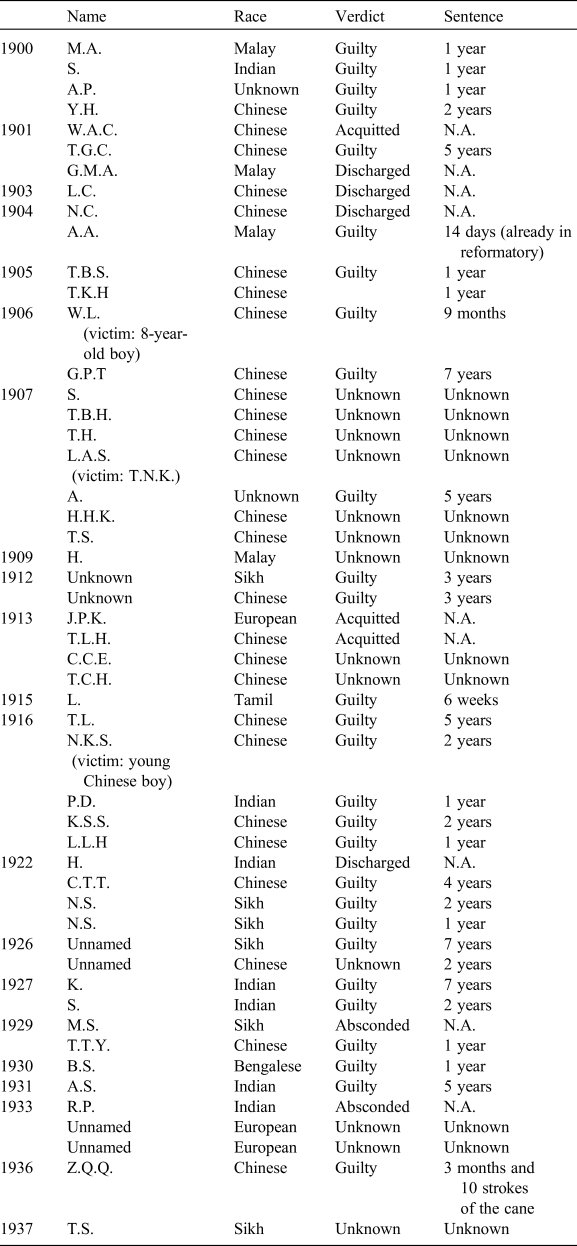
Finally, the colonial government prosecuted men who had sex with men under Section 377, the 1872 Penal Code provision that proscribed a broad range of nonprocreative sexual activity. Between 1900 and 1938, newspapers in Singapore reported on fifty-one defendants who had been charged in the Singapore Assizes with unnatural offences. Of these fifty-one, at least twenty-two had allegedly committed same-sex acts, as opposed to bestiality or opposite-sex sodomy. All but three of these men were Asian, indicating that the vast majority of men had engaged in intraracial sexual relations. The racial composition of the defendants suggests that Asian men were subject to a far more intense regulatory gaze than European men, as other historians have noted.Footnote 51
However, the British also viewed the Chinese as morally inferior to Europeans, and allowed for leeway in the application of inherited sodomy laws. Although Section 377 carried a maximum penalty of life imprisonment, judges often exercised leniency. For example, a British judge in Johor convicted a Chinese defendant of sodomy in 1927, but handed down a relatively light sentence of 18 months’ imprisonment. In rebuffing the prosecution's call for a heavier punishment, the judge noted that “it was common knowledge that this sort of thing did go on amongst Chinese and other races, and particularly in out-of-the-way mining areas [in Malaya].”Footnote 52 In 1936, another Chinese man received 3 months’ imprisonment and ten strokes of the cane for “interfering with” a 14-year-old boy at a quiet spot on Anson Road. In passing the sentence, the judge noted that the defendant's youth and ignorance had led him to momentarily give in to his bestial instincts.Footnote 53 Accommodation for cultural difference, real or imagined, created flexibility in the application of European moral standards.
Senior colonial judges would have been familiar with the question of the “unnatural vice” among the Chinese. From 1914 to 1920, John A.S. Bucknill served as chief justice of the Straits Settlements. A decade earlier, Bucknill had risen to prominence by chairing a commission of inquiry into allegations of sodomy among Chinese mineworkers in the Transvaal.Footnote 54 During the inquiry, he expressed ambivalence toward the suppression of same-sex activity among the migrants. In his final report to the secretary of state for the Colonies, Bucknill wrote that “a certain proportion [of Chinese migrants] … would indulge in this vice under favourable circumstances,” expounding a model of situational homosexuality. Although Bucknill recommended the repatriation of the “worst type” of male prostitutes, he conceded that “the places of some of those who may have been removed may be filled by others,” tacitly acknowledging the futility of a large-scale clampdown on sodomy.Footnote 55 In exercising restraint toward Chinese men accused of sodomy, officials drew on a transnational body of colonial knowledge about Chinese sexuality.
Tacit tolerance of non-normative sexualities extended to everyday life. Betty Seow, the daughter of a prominent Singaporean banker, recalled that a “big group” of kedi—literally translated as hermaphrodite, but understood to mean homosexual by their contemporaries—existed within the creolized Peranakan community in the 1940s. “[They were] quite open, quite well-known,” she said. “They [were] very friendly, very gentle.” To signal their sexual subjectivity, the kedi adopted the styles and mannerisms of femine affectation, wearing buttoned-up Nonya coats and walking “lenggang lenggang” (swinging from side to side).Footnote 56 This level of visibility indicates that the legal proscription of same-sex activity did not reflect Asian cultural mores.
Seen in this context, the introduction of Section 377A in 1938 represented a sharp deviation from long-standing colonial practice in Singapore. To the extent that the British sought to suppress same-sex activity before Section 377A, it had relied on an apparatus of sexual containment rather than outright prosecution. Even when the British prosecuted men under existing laws, officials and judges dispensed leniency on the basis of colonial assumptions about native and migrant sexualities. Why, then, did Singapore experience an intensification of anti-gay policing in the late 1930s?
Man on the Cliff
Three interconnected factors contributed to the enactment of Section 377A in 1938. First, a clampdown on female prostitution during the late 1920s and 1930s magnified the visibility of male prostitution, exposing the inadequacy of existing measures. Second, changing sexological ideas permeated public discourse and rendered homosexuality a distinct regulatory category. Finally, sex scandals involving male European officials and Asian men heightened anxieties about inter-racial same-sex relations, which threatened the moral claims of empire. Collectively, these factors forced the colonial government to deal with the issue of same-sex activity head-on, creating an imperative for state intervention.
Social Hygiene and the Abolition of Prostitution
The most immediate reason for the introduction of Section 377A lay in the government's clampdown on female prostitution during the late 1920s and 1930s, which inadvertently brought to light the extent of male prostitution. Multiple constituencies had agitated at different scales for a ban on brothels, which came into effect in Singapore in 1930. These included anti-trafficking activity by the League of Nations, as well as activism by social hygiene movements in the metropole.Footnote 57 In the run-up to World War II, an influx of British troops and the completion of the Singapore naval base also renewed fears of venereal disease within the military, prompting new efforts to eradicate prostitution.Footnote 58
These measures did little to stamp out female prostitution and did not explicitly target male prostitution. However, intensified policing forced law enforcement authorities to deal with the male prostitutes they encountered. This campaign also shifted the center of enforcement from brothels to the streets, where male hustlers were more likely to operate.Footnote 59 Whereas the police once focused on “known” and “sly” (or unregistered) brothels, they now patrolled in cafes, coffee shops, and amusement bazars.Footnote 60 In 1933, the inspector-general of the police noted in his report—for the first time— that three males had been convicted for publicly importuning for immoral purposes.Footnote 61 The following year, another three men were prosecuted for the same offense.Footnote 62 In 1936, the inspector-general wrote that “male prostitution was…kept in check, as and when encountered.”Footnote 63 The “as and when” coda suggests that the uncovering of male prostitution was incidental to the wider crackdown on female prostitution. By 1937, the inspector-general wrote that “widespread existence of male prostitution was discovered and reported to the government,” paving the way for the enactment of Section 377A in the next legislative session.Footnote 64 The language of discovery indicates that the colonial government was responding to new encounters with sexual subjects, rather than imposing a pre-existing schema of sexual morality.
Proceedings of the Executive Council—the colony's highest governing body—reinforced this point. At a Council meeting in May 1938, where the introduction of Section 377A was discussed, the Council noted that “in the circumstances … no warning to persons who are at present suspected is necessary even if it were practicable.” The attorney-general further cautioned the Council that the law would not have retrospective effect, and “therefore no person can be prosecuted for such practices until the amending Bill is passed.”Footnote 65 These caveats suggest that the Council was responding to specific conditions on the streets in introducing Section 377A.
The growing awareness of male prostitution extended to the wider public sphere. In a lecture to the Singapore Rotary Club, Dr. K. Ando, a Japanese venereal disease doctor based in Singapore, declared that dictionary definitions of prostitution were flawed because they did not account for the pervasiveness of homosexuality.Footnote 66 Male and female prostitution indeed intersected in the prewar sexual economy. According to a 1970 Straits Times feature, a male “catamite” named D. Sng had become the king of one of two “vice empires” by 1938 and managed female prostitutes in brothels across Changi, Bencoolen Street, Waterloo Street, and Tiong Bahru.Footnote 67 Although this story was probably apocryphal, the fact that Sng's mythology survived for over two decades suggests how prominent he must have been, illustrating the complex association between male “catamites” and female prostitutes.
Confronted with the heightened visibility of male prostitution in Singapore, the colonial government introduced Section 377A to address the limitations of existing laws. Although sodomy was illegal under Section 377, convictions were difficult to secure because the prosecution needed to prove beyond a reasonable doubt that penetration had occurred. Under English common law, meeting this burden required either medical evidence or third-party eyewitness testimony, which were challenging to obtain in cases of consensual and transactional liaisons.Footnote 68 From 1927 to 1938, only about one in five reports of unnatural acts in Singapore led to conviction at trial. Moreover, conviction rates remained stagnant even when reports and arrests increased (Figure 1).
Reports, arrests, and convictions for unnatural offenses in Singapore, 1927–38. Source: Annual Report on the Organization and Administration of the Straits Settlements Police and on the State of Crime, 1927–1938, Straits Settlements Sessional Papers, CO275, TNA.

By contrast, the expansive language of Section 377A criminalized a wide range of same-sex acts, regardless of whether the acts were committed in “public or private,” and independent of whether the defendant “commits, or abets the commission of, or procures or attempts to procure” said acts. Consequently, the attorney-general argued in the Legislative Council that Section 377A was necessary to “make punishable … acts which do not amount to an unnatural offence.”Footnote 69 Despite press speculation that insertive sexual partners would be prosecuted under Section 377 and receptive sexual partners prosecuted under Section 377A—or, alternately, that Section 377A would be used to punish attempted sodomy—Section 377 fell into relative disuse after 1938, given the comparable ease of proving an offense under Section 377A.Footnote 70
Similarly, the colonial government deemed the penalties set out under the 1906 Minor Offences ordinance to be an insufficient deterrent to male hustlers. During a Legislative Council debate, the attorney-general lamented that same-sex acts could only be dealt with under the 1906 provision “if committed in public,” and “if at all.” Even then, he noted that “punishment under the ordinance is inadequate and the chances of detection are small.”Footnote 71 The evidentiary burden for conviction was also high, given the challenge of proving that solicitation was both persistent and directed toward “immoral” ends. As S. E. Nicoll-Jones, the colonial government's external expert on prostitution, noted, “The culprit is going to say, ‘Yes, I did stop six men—I knew one and asked him for a match—another, if he knew my husband—another if he knew when so and so would be coming to Singapore.’”Footnote 72 By contrast, Section 377A allowed a harsher penalty of up to 2 years imprisonment, and was comparatively easier to prove.
Sexology and the Conceptual Visibility of Homosexuality
At the same time that same-sex activity became more visible on the streets, homosexuality emerged as a distinct category in the Malayan public sphere. Whereas sodomy was once a point in the continuum of undesirable vice, “inversion,” and “homosexuality” represented discrete phenomena in need of regulation and response. Although pioneering scholars, most notably Michel Foucault, located the shift from sexual acts to sexual identities at the end of the nineteenth century, historians have complicated this periodization by pointing to variations along the lines of race, class, and locale.Footnote 73 In Singapore's case, the 1920s and 1930s saw a rise in discourse around homosexuality, as developments in Euro-American sexology trickled into the English-language and vernacular public spheres.
During these decades, the English-language press in Singapore devoted significant coverage to the emerging concepts of sexual inversion and homosexuality. In 1922, the leading Singaporean English-language broadsheet, the Straits Times, republished a lecture at Oxford by Julian S. Huxley on his third-sex theory, which argued “those who departed from the normal are not morally perverted, but simply in the grip of blind hereditary forces.”Footnote 74 Six years later, an unsigned editorial denounced the ban on the novel, The Well of Loneliness, on the grounds that the publishers were trying to test the “sociological value” of a book on “sexual perversion.”Footnote 75 In 1933, the paper adopted a more hostile attitude in an editorial on Magnificent, which dealt with “male perversion,” but noted that sexual inversion was “a cult which every adult knows to exist, but hypocrites decline to discuss.”Footnote 76
To be sure, attitudes toward homosexuality were variegated. In 1932, the Malaya Tribune published an unsigned review of The Shadow World, which discussed the “homosexual affliction.” In his review, the writer observed that these “hapless people need sympathy and assistance rather than disgusted condemnation and legal prosecution.”Footnote 77 Just 2 years before the enactment of Section 377A, in 1936, the paper printed a column from the Police Chronicle and Constabulary World, which argued that “inversion and homo-sexuality … are shown to be often innate, rather than acquired traits,” and therefore deserving of “sympathy.”Footnote 78 New developments in sexology during this period enabled colonial audiences to view same-sex activity as a medical or psychological condition that afflicted a specific group, rather than a religious sin, moral vice, or criminal act to which all men were susceptible.
The Chinese-language press similarly featured vibrant discussions of homosexuality. Diasporic newspapers echoed debates in mainland Chinese journals and urban tabloids, where male same-sex relations became an issue in both highbrow debate and lowbrow gossip in the 1920s and early 1930s.Footnote 79 In the late 1930s, the Nanyang Siang Pau, the leading Chinese newspaper in Southeast Asia, ran several gossip columns. Stories included one about two men trying to get married in Southern China, and another about a prominent female author's butch–femme relationship with an older woman.Footnote 80 A 1936 op-ed even lamented that most Chinese saw homosexuality as a laughing matter rather than a serious problem.Footnote 81 In a 1938 editorial, the paper recommended that homosexual readers cure themselves of their mental illness by socializing more and reading sentimental literature.Footnote 82 To an even greater extent than the English-language press, open and vibrant discussion about same-sex activity featured prominently in the Sinophone public sphere.
Much of popular discourse was ambivalent toward the issue of homosexuality, making the enactment of Section 377A in 1938 all the more surprising. However, the rise of this new vocabulary also created a new target of regulation. In the May of 1938, the police prepared a memo on “sexual perversion” for the Executive Council, which in turn introduced Section 377A in the Legislative Council.Footnote 83 Prior to this point, colonial officials had discussed either sodomy or male prostitution. “Sexual perversion” provided a new rubric for interpreting male same-sex activity. In keeping with this rubric, Section 377A would proscribe a wide range of male same-sex acts that fell short of penetrative sex, while excluding other nonprocreative acts that had fallen under the ambit of Section 377.
Colonial Sex Scandals
While the growing visibility of homosexuality created an impetus for action, sex scandals within the Malayan civil service gave the issue urgency and salience. In the 1930s, several colonial civil servants were caught having sex with Asian male prostitutes, generating anxiety about inter-racial same-sex relations. These scandals threatened the legitimacy and authority of the British colonial administration.
According to the memoirs of Victor Purcell, a colonial civil servant, the diary of a Chinese “catamite” landed in the hands of the police in the 1930s, resulting in “an official inquiry, the disgrace of several prominent [European] persons, and the suicide of two of those who were implicated in the matter.”Footnote 84 By one account, the scandal provoked “scabrous jokes”: in Ipoh, the “Volunteers were not prepared to fall in in the front rank,” while the ship on which European homosexuals were deported “entered Penang harbour stern first.”Footnote 85 In his 1937 report, the inspector-general noted that sodomy gave rise to the “danger of blackmail” and produced a “demoralizing effect on disciplined forces and on a mixed community which looks to the Government for wholesome governing.”Footnote 86 In this account, Asian male prostitution constituted a concern because it embarrassed the colonial government and threatened the moral claims of an empire premised on masculine vitality.Footnote 87
Other historians have noted the existence of these scandals, but three key documents declassified from 2014 to 2016 provide unprecedented insight into their scope and extent.Footnote 88 The remainder of this section sets out these discoveries. According to a colonial office memo titled “The Malayan ‘Sexual Perversion’ Cases,” “reports were received from Malaya that a number of cases of this nature had come to light.” In March 1938, Shenton Thomas, the governor of the Straits Settlements, forwarded reports on “Mr. [R.],” a Malayan civil servant, to the secretary of state in London. Although the colony's Executive Council was “unable to find any charges proved,” it had “a strong suspicion that Mr. [R.] had been associating with catamites.” Shortly afterward, the governor referred several further cases to the secretary of state.Footnote 89 These included the cases of H. M., the European warder of Changi Prison, who “was arrested at a Japanese hotel [in Singapore] while in bed with two known catamites,” and H. G., an assistant commissioner of police who “was reputed to be addicted to acts of sexual perversion.”Footnote 90
Remarkably, the men involved in these cases cited the prevalence of same-sex activity among European officials to defend themselves. When D. W. Macintosh, the assistant superintendent of the police, arrested H. M. in his hotel room, H. M. defiantly told Macintosh that “if [he] had to go round hotels looking for persons committing offences … [he] should start with Police Inspectors.” H. M. further stated “he was another Government servant finished.”Footnote 91 By contrast, H. G. expressed contrition but petitioned Thomas for leniency, arguing that the climate of Malaya and “the unnatural life led by the European community” caused “this vice [to be] peculiarly prevalent amongst both Europeans and Asiatics.” According to H. G., “The European freely and unashamedly discusses it and the difficulty of any proof of guilt being established in open conversation throughout the country,” whereas the “Asiatic … regards this vice as no less natural than womanizing.” Consequently, he argued, a person “may become a victim of this vice” in the “peculiar atmosphere of this country.”Footnote 92
H. G. further presented himself as a young, unwitting prey of cunning Asian male prostitutes. By his own account, his “curiosity was aroused” and he “was tempted to experiment” when another European man—a “homosexual of long standing”—brought a Javanese man to his home in August 1937. The Javanese man returned twice to his house. Three months later, a Malay “attracted [his] attention” and H. G. brought him to his house, causing his “car number [to] become known to the whole of this community” of “hardened habitues.” In H. G.’s account, he went on to unwittingly hire two Malay “catamites” as servants, who “tried a kind of blackmail on [him] by gross profiteering on [his] household accounts.”Footnote 93 Based on these facts, G. urged Thomas to view his acts “as a transitory indiscretion rather than a permeant vice,” caused by “environment and the bad example of men much older in years.”Footnote 94
The governor appeared to accept G.’s account; he allowed G. to transfer to the colonial service in Palestine. Whereas colonial officials could be dealt with administratively, the colonial government needed a mechanism to clamp down on Asian male prostitutes, who putatively presented a corrupting influence on young European men. In a handwritten note on a draft of the 1938 Penal Code (Amendment) Ordinance that would give effect to Section 377A, a colonial official wrote that the provision “has been referred to in other (? secret) papers on the current … purge in Malaya.”Footnote 95 Although it is impossible to say with certainty what secret papers he was referring to, the reference to the “purge” indicates a nexus between the colonial sex scandals and the enactment of Section 377A.
The Capitulation to Racism
If the colonial color line motivated the enactment of Section 377A, race and occupation differentiated its enforcement from 1938 to 1941.Footnote 96 Despite its broad ambit and facial neutrality, prosecutions under Section 377A overwhelmingly targeted Asian “catamites” who might imperil the sexual purity and self-control of European men.Footnote 97 Secondarily, the colonial authorities used the charge of gross indecency to deter Europeans—particularly soldiers and sailors—from putting themselves at risk of blackmail by having sex with Asian men.
Race
Press reports show that inter-racial sexual liaisons constituted the dominant target of gross indecency prosecutions. Of the thirty-four men who appeared in court for gross indecency between 1938 and 1941, at least twenty were caught in a configuration involving a European man and an Asian man (Table 1). By contrast, the fifty-one sodomy prosecutions between 1900 and 1938 almost exclusively targeted Asian men (Table 2).Footnote 98
List of Defendants Reportedly Prosecuted for Gross Indecency, 1938–41

Sources: The Straits Times, The Singapore Free Press and Mercantile Advertiser, Nanyang Siang Pau, Morning Tribune
List of defendants reportedly prosecuted for unnatural offences, 1900–1938

Sources: The Straits Times, The Singapore Free Press and Mercantile Advertiser, Eastern Daily Mail and Straits Morning Advertiser, Nanyang Siang Pau, Morning Tribune
Although the post-1938 crackdown implicated both European and Asian men, Asian men were significantly more likely to be convicted at trial. The image of white masculinity conferred on European defendants the benefit of the doubt. In 1941, for example, a court sentenced K. A., a Malay youth, to 9 months’ rigorous imprisonment, after he confessed to an act of gross indecency with W. D. L. According to the prosecution, a Chinese police informant had summoned K. A. to Stamford Road, introduced him to W. D. L., and then sent them by taxi to W. D. L.’s house in Bukit Timah, where the alleged crime occurred. Nonetheless, the court acquitted W. D. L., accepting his defense that he had been trying to hire a “pretty Malay girl” through K. A. The prosecution cast aspersions on W. D. L.’s masculine credentials, producing evidence from three London doctors who certified that W. D. L.’s wife in Britain was a virgin. The prosecution also noted that W. D. L.’s wife had initiated divorce proceedings with W. D. L. Despite these insinuations, however, Conrad Oldham, the presiding judge, acquitted W. D. L. without calling the defense.Footnote 99
In a similar case later that year, a court convicted S. D., a “known catamite,” of committing gross indecency with D. M., the most senior military police officer in Singapore. Even so, Oldham acquitted D. M. In the prosecution's theory of the case, D. M. had been driving along Stamford Road when he invited S. D. into his car, drove to his house at Tanglin Hill, and committed an act of indecency with S.D. The prosecution relied on two pieces of evidence to incriminate D. M.: the discovery of S. D.’s shirt in D. M.’s room, implying that S. D. had been undressed, and a positive eyewitness identification at Stamford Road by T. A. L., a hustler turned police informant. Despite this, Oldham declared he had “no doubt” of D. M.’s innocence. According to Oldham, D. M. was a “man of education” and had “given evidence extremely well,” and had satisfied Oldham that Oldham could “rely on him.” In contrast, Oldham described S. D. as a “man of very poor character and a liar,” condemning him as “considerably undeveloped mentally with a species of cunning rather than brains.” In discussing the credibility of D. M. and S. D., Oldham echoed colonial discourses of native degeneracy and white male dependability. The defense similarly appealed to the logic of cultural and linguistic difference to suggest the impossibility of sexual relations, pointing out that S. D. only understood Malay, whereas D. M. spoke Hindustan and English. Although the high court ordered a retrial because of a technicality, the prosecution eventually dropped all charges against D. M.Footnote 100
Even when courts convicted European defendants, they almost always handed down lighter sentences on European men than on their Asian counterparts. In 1939, for example, a district court judge sentenced A. H. R., a 24-year-old soldier of the British Loyal Regiment, to 18 weeks’ rigorous imprisonment, after finding that A. H. R. had committed gross indecency with L. A. F., an 18-year-old Chinese youth, in a field near Waterloo Street.Footnote 101 By contrast, L. A. F. received a sentence of 6 months’ rigorous imprisonment. The excuse of inebriation allowed A. H. R. to maintain a degree of plausible deniability, while consigning L. A. F. to the role of the racialized sexual other who had seduced the young and impressionable A. H. R.
A few months later, Oldham released L. P., an American merchant seaman accused of procuring male prostitutes, on a bond of $100.00, even though his Malay and Indian codefendants received sentences of 5 months’ rigorous imprisonment. Oldham noted that L. P. had a clean record and that a prison term would adversely affect his future. The Detective Branch even requested an expedited hearing so that L. P. could leave on his ship the next day. By Oldham's own account, L. P. had been “dealt with in an exceptionally lenient manner.”Footnote 102
Across the British Empire and for a wide range of crimes, colonial courts generally treated white subjects more favorably than nonwhite subjects.Footnote 103 With gross indecency, however, the specific fear of predatory Asian “catamites” blackmailing unwitting European men amplified the racial discrepancy. In acquitting D. M., Oldham noted that “the Singapore catamite is the blackmailer of the cleverest kind.” As a result, he concluded that it was not “safe to assume that the boy [S. D.] was ignorant of any of the arts of blackmail or of the other vileness of which catamites may be capable of.” Oldham further implied S. D. might have been “a tool in the hands of the cleverer man,” T. A. L., who ostensibly possessed “considerable mental powers and shrewdness.”Footnote 104 By relying on the trope of the cunning Oriental, Oldham insinuated that T. A. L. and S. D. had conspired to extort money from D. M.
The high-profile case of “Mr. X” amplified the specter of racial blackmail in the popular colonial imagination. From July 1940 to June 1941, eleven men of Chinese, Indian, Malay, and Eurasian descent stood trial for extorting more than $20,000 from “Mr. X,” a 42-year-old single European businessman, who arrived in Singapore in 1922 and had been “addicted to homosexual practices” since 1928.Footnote 105 For more than a year, press reports offered tantalizing details about the plight of “Mr. X.” In 1928, “Mr. X” had asked A. G. L., a Malay man, to “makan angin” (get a breath of fresh air) along West Coast Road in his motorcar. The duo then engaged in a decade-long sexual relationship.Footnote 106 “Mr. X” also had numerous other liaisons, including with two of his other blackmailers. In 1938, “Mr. X” allegedly asked N. Ramiah, a clerk at a local law firm, to procure Tamil Hindu boys for him, in order to “convert these boys to Christianity.”Footnote 107
As a result of his reputation, “Mr. X” became the target of a sophisticated blackmail operation. At the end of 1938, Tan Ah Lek, a serial housebreaker who had just been released from prison, went to the office of the European and threatened to expose his same-sex liaisons to the police. For 2 years, “Mr. X” paid out thousands of dollars to Tan, even when he was on leave in Britain.Footnote 108 Around the same time, Rex Alexander Bell, an unemployed Eurasian, learned of “Mr. X's” homosexuality from Lim John Chye, a fellow blackmailer, and left phone messages for “Mr. X” claiming to be a police officer.Footnote 109 Lim himself would also extort money from “Mr. X,” in one instance demanding $7,000 to start a cabaret.Footnote 110 In December 1940, George Minjoot, a Eurasian man, left threatening notes at “Mr. X's” desk, indicating he had gotten hold of intimate letters to other men by “Mr. X.”Footnote 111 The European's sexual partners would join in the act: In Janruary 1940, A. G. L. appeared at his workplace and demanded money.Footnote 112 Five months later, R. B. K, with whom “Mr. X” had had a 5-year sexual relationship, did the same.Footnote 113 “Mr. X” eventually went broke and had no choice but to go to the police.
Tellingly, prosecutors and judges considered blackmail to be a more pressing issue than gross indecency. At a sentencing hearing, E. N. Griffith-Jones, the deputy public prosecutor declared: “I hold no brief for the victim, but the blackmailer is the worst of all social pests.”Footnote 114 He added that blackmail was hard to prosecute because victims seldom came forward. At a separate hearing, local judge L. C. Goh declared that “blackmail is a very serious and despicable offence,” noting sympathetically that the “European was being bled white because of those unfortunate practices of his.”Footnote 115 Whereas same-sex activity was “unfortunate,” sexual blackmail was “despicable.”
The disposition of these cases aligned with this rhetoric; the harshest sentences for gross indecency paled in comparison to the penalties for blackmail. The courts sentenced almost all the convicted blackmailers to at least eight strokes of the cane; Bell received twenty-one strokes.Footnote 116 Prison terms generally lasted between 1 and 2 years, and judges ordered that multiple sentences run consecutively instead of concurrently. When the judge spared Tan a caning, the judge found it necessary to justify his decision. He disparaged Tan as “not capable” of violent crimes, for which the dubious honor of the cane was reserved. Instead, Tan received a sentence of 5 years’ imprisonment.Footnote 117 Although “Mr. X” feared that he would be prosecuted, the colonial government never charged “Mr. X” with a crime.Footnote 118
Every newspaper headline about “Mr. X” referred to the races of both the blackmailers and their victim, suggesting that the press understood sexual blackmail in racialized terms. To the present-day historian, the precise relationship among race, blackmail, and intimacy is challenging to parse. In his defense, K. claimed that the money he had received from the European was payment for “services rendered,” implying that their long-term liaison had been transactional in nature. However, K.’s lawyer also argued that “Mr. X” had destroyed Krishna's letters to him because “far from being threatening, they were couched in endearing terms.”Footnote 119 Regardless of whether “Mr. X's” Asian liaisons were affectionate or transactional, the case brought home the perils of inter-racial same-sex relations for European men.Footnote 120
Occupation
Although race defined the enforcement of Section 377A, class and occupation also governed its application. The British saw enlisted soldiers and merchant seamen as particularly vulnerable to sexual temptation and used the law to deter them from sexual liaisons with Asian men. Of the nine Europeans reportedly prosecuted under Section 377A, five were British soldiers and one was an American sailor. At L. P.'s 1939 trial, the judge specifically declared that “this must be a warning to men who come here from ships not to get involved in this kind of offence.”Footnote 121 In a large port city with a transitory population and an imbalanced sex ratio, young working-class men aroused concerns of social and sexual disorder.
Consequently, the British military establishment gave significant attention to the subject of male prostitution. During D. M.’s trial, Brian Cantor, the deputy provost marshal of the Malaya Command, testified that military circles regarded “a certain type of vice among the troops” as a “problem.” To manage the issue, the army forbade soldiers from appearing in public with “Asiatics,” and particularly from riding in rickshaws with male “Asiatics.”Footnote 122 Cantor also discussed the problem with the superintendent and assistant superintendent of the civilian Anti-Vice Branch.Footnote 123 When D. M. assumed his position 2 months before his arrest, Cantor had even given him a tour of hot spots of male prostitution in Lavender Street, the Padang, and Stamford Road.Footnote 124 In fact, D. M. defended himself by explaining that he was interviewing S. D. to understand the issue of male prostitution. “At the back of my mind was some idea of getting at the root of the homosexual type of vice,” D. M. said. “I thought … that it would be a good idea to question a catamite and to try and find out to what extent soldiers in different regiments were involved.”Footnote 125 That this defense seemed believable indicates that the British military devoted considerable resources to policing civil-military same-sex liaisons.
Sexual blackmail had become a security threat in eyes of the British military authorities. The global rise of nationalist organizations in the 1930s led the British to fret about the loyalties of its subjects. As the Japanese military adopted an increasingly expansionist posture in the Far East in 1940 and 1941, rumors spread of fifth column activity in Malaya. The case of E. A., an artillery gunner, illustrates the link between sex and security. In May 1941, the police raided a house in Anguilla Road and arrested E. A. with T. A. Y., a Chinese man. E. A. claimed he had asked T. A. Y. to hire a female prostitute, but the court convicted them both of gross indecency. In seeking a harsh sentence for E. A., F. J. C. Wilson, the assistant superintendent of the police, told the court that “what makes this particular offence more serious is that when members of Her Majesty's Forces lower themselves to an animal degree like this, they are not only giving very poor impressions of themselves, but they also lay themselves open to blackmail which may not be paid in money … I am hinting, sir, at the possibility of espionage.”Footnote 126 To the colonial authorities, the seriousness of E. A.’s crime lay in its indiscretion rather than its immorality. In their view, soldiers who had sex with Asian men posed a security risk.Footnote 127
Conversely, the British sought the harshest penalties under Section 377A for Asian male prostitutes whom they thought were seducing soldiers. In April 1941, a soldier arrested M. Y. near Gillman Barracks at Alexander Road because he thought that M. Y. was making “indecent suggestions and gestures” to him.Footnote 128 In pressing for a heavy sentence, the prosecutor claimed that this case “proved that several attempts were being made in Singapore to pervert the members of His Majesty's forces stationed in Singapore.”Footnote 129 Just two weeks earlier, F. C. J. Wilson had warned the court of the “recrudescence” of gross indecency during the sentencing hearings of S. D. and T. A. Y. who had been caught with D. M. and E. A. respectively.Footnote 130 To send a strong message to “animals of the same ilk” in a “low-down quarter of Singapore,” Wilson urged the court to dish out harsh punishments, noting it took “a great deal of very hard and concentrated work” to clamp down on male prostitution. Wilson further called for S. D. to be whipped, even though whipping was not a prescribed punishment for gross indecency. While the judge rejected this suggestion, he sentenced S. D. and T. A. Y. to 18 and 15 months’ rigorous imprisonment respectively.Footnote 131
Wilson's reference to “hard and concentrated work” reflected the reality of intensified surveillance and foot policing. On the streets, inter-racial encounters gave rise to the suspicion of sexual liaison. In May 1941, a constable was patrolling Prinsep Street when he saw a Malay youth and a British soldier walk into a hotel owned by a Japanese man. On this evidence alone, the constable led a team of colleagues to the hotel. When the police returned, they arrested the duo—who were by then walking toward Bras Basah Road—and elicited a confession from the Malay youth.Footnote 132 In prosecuting these cases, the police deployed its full range of investigative capabilities, including identification parades, police informants, and forensic evidence.Footnote 133
In contrast to cases of inter-racial liaison, the British dealt with servicemen who had sex with other servicemen under military law, strengthening the explanation that Section 377A targeted sexual relationships between civilians and soldiers. Section 18 (5) of the King's Regulations already prohibited “disgraceful conduct of a cruel, indecent, or unnatural kind.”Footnote 134 In November 1939, a general court martial sentenced Privates T. C. and G. K. of the Loyal Regiment in Singapore to 18 and 9 months’ hard labor respectively, after finding them guilty of indecency.Footnote 135 In April 1940, a district court martial sentenced Privates R. B. and D. S. B. of the same regiment to 60 and 30 days’ detention, respectively.Footnote 136 Other instances of same-sex activity within the forces undoubtedly went unpunished. According to Dudley Cave, who served in the Royal Ordnance Army Corp in Singapore, the commanding officer of his unit knew that male soldiers were having sex with each other in the mangrove swarms but turned a blind eye, regarding it as a harmless outlet for pent-up sexual frustration.Footnote 137
Like the military, the colonial government subjected colonial civil servants to administrative discipline rather than criminal prosecution. Between 1938 and 1940, Thomas, the governor, corresponded extensively with Malcolm MacDonald, the secretary of state in London, about whether colonial officials should even face the possibility of criminal charges for same-sex acts.Footnote 138 Thomas was determined to avoid public embarrassment to the government. Citing the case of two missionaries, he argued that “prosecution may be undesirable and not in the public interest.” Instead, he pressed for the power to “order deportation [of European “unofficials”] in lieu of prosecution.” For colonial civil servants, Thomas pushed for closed-door enquiries under the colonial regulations in lieu of prosecution. Quoting the case of the son of a bishop, Thomas noted that he would “not like to subject this man's family to the publicity of criminal proceedings.”Footnote 139
These considerations led Thomas to exercise leniency toward colonial officers accused of having sex with Asian men. Despite the incriminating evidence against H. M., the Changi Prison warder, Thomas allowed him to resign from the civil service and leave the country as an alternative to standing trial.Footnote 140 To avoid “publicity being given to an unpleasant business,” Thomas also allowed one Mr. N., an engineer in the Public Works Department, to resign and leave Malaya, even though he had already been arraigned in court.Footnote 141 Thomas also granted H. G.’s request to be transferred to a different colony. Remarkably, the colonial government in Malaya said nothing to H. G.’s new superiors in Palestine about the circumstances in which H. G. had left. Even after Alan Saunders, the inspector-general of the police in Palestine, heard rumors about H. G.’s inglorious transfer, the Malayan government resolved to “stick to our ground and refuse to tell anybody anything.” “This will not allay suspicions,” a Malayan official wrote, “but it may deter Saunders from pressing the matter further.”Footnote 142
The difficulty of proving specific offenses in part explained the draw of administrative penalties. “Had I insisted on specific charges being framed against me,” H. G. told Thomas, “Government would, in all probability, have failed to prove its case and would have been compelled, as has happened in other cases, to retain my services.”Footnote 143 Even as H. G. confessed to his involvement with “catamites,” he used his admission to negotiate with Thomas for a transfer rather than a dismissal, a request to which Thomas acquiesced.
Despite the advantages of administrative action, the Colonial Office disagreed with Thomas's ad hoc approach. Although MacDonald authorized Thomas to give Europeans the option of resigning their position and leaving Malaya as long as criminal proceedings had not begun, he wanted colonial officers who declined this option to be prosecuted in criminal court, rather than disciplined internally under the colonial regulations.Footnote 144 MacDonald worried about perceptions that administrative action compromised due process. After Thomas dismissed Mr. Rz. of the Malayan Customs Service for alleged “sexual perversion” in 1938, Rz. hired Lewis and Lewis, a prominent law firm in London, to argue that “it is contrary to all justice to brand a man as a criminal by secret tribunal.” This episode led the colonial office to conclude that deportation “would be indefensible if the person concerned chose to raise the matter publicly on his return to [Britain].”Footnote 145
Moreover, the Colonial Office in London asserted that administrative discipline created a “definite risk that finality might not be reached” and placed the secretary of state “in the very difficult position of having to act as a court of appeal.” In 1938, Thomas had recommended R.’s removal from the civil service, but the secretary of state found himself “unable to approve this recommendation.” For one, the actual charges had not been proven. Neither could the colonial office remove R. for “inefficiency,” because it could not be “established beyond all doubt that Mr. [R.] had rendered himself incapable of performing his duties adequately owing to his association with catamites.” Consequently, R. remained in government employment, despite the “strong suspicion” that he was guilty.Footnote 146
By 1940, the colonial authorities in Singapore and the colonial office in London had reached an impasse, but the schism highlighted the fundamentally racialized character of Section 377A. Both sides accepted the prosecution of Asian “catamites” under gross indecency legislation, but regarded the prosecution of Europeans with ambivalence. Although criminal proceedings were not a foregone possibility for Europeans, they were certainly a last resort. At best, the threat of prosecution deterred European men from having sex with Asian men, and induced them to accept administrative sanctions when they were caught.Footnote 147
Resistance
Outside the corridors of government, Section 377A faced considerable opposition in the public square. Indeed, the inspector-general noted that “a certain amount of criticism … has been expressed against a policy the object of which is to stamp out this evil [of male prostitution].”Footnote 148 Some critics condemned the government for focusing on sodomy rather than female prostitution. One writer to the Singapore Free Press opined that Section 377A was an “absolute disgrace,” arguing that “this disgusting crime always follows unrestricted prostitution” and is “never caused by a lack of female prostitutes.”Footnote 149 Others assimilated ideas from contemporary sexology to criticize Section 377A. “Why is this ‘homo’ business regarded as so much worse than prostitution?” the secretary of the Association of Moral and Social Hygiene asked rhetorically in a 1940 letter to S. E. Nicoll Jones. “It is no greater an evil and it is a thing which a certain percentage of young men and even young women go through and yet grow out of fortunately when they become really mature.”Footnote 150 Whereas earlier accounts of same-sex activity emphasized the concept of vice, the adoption of a Freudian psychoanalytic model made it possible to view homosexuality as a harmless, transient stage of sexual development. In response, Nicoll Jones acknowledged that homosexuality was just “taken as a matter of course” in the Straits Settlements, echoing popular attitudes toward the issue in both European and Asian communities.Footnote 151 Far from embodying a social consensus about sexual morality, the enactment of Section 377A was fraught with controversy.
Occasionally, individuals took matters into their own hands. In April 1941, immigration official Ronald Ivan McHarg stood trial for harboring a European wanted for offenses under Section 377A. The unnamed European was freed on bail but had failed to turn up in court, leading to the issuance of an arrest warrant. Although McHarg was aware of this warrant, he allowed the European to elope from the country while he was on duty at the Singapore Harbour Board, telling a friend that he “let the poor devil through” because “he seemed quite a decent fellow.”Footnote 152
Resistance sometimes turned physical. In March 1941, a Malay man “seized” a Chinese man for committing an act of gross indecency on the 5-foot-way at Rochore Road. The Chinese man “put up a fight” and “bit the Malay on one of his legs.”Footnote 153 In another instance, the police surveilled a house where they suspected that same-sex activity was taking place. On seeing “the light from the torch,” one man “attempted to leave the room,” while another “tried to hide himself by creeping underneath a bed” before being “dragged out.”Footnote 154
The British also deployed Section 377A to prosecute what present-day historians would characterize as sexual assault. Nonetheless, these efforts were generally limited. In April 1941, a judge convicted a Eurasian man of committing an act of gross indecency on a 12-year-old boy behind the Cathay theater, but let him off with a $200 fine.Footnote 155 More perniciously, the introduction of gross indecency laws actually hurt such prosecutions. In September 1940, a Malay defendant successful appealed against his conviction “for acts of gross indecency against two boys,” on the grounds that the two young boys were accomplices rather than victims.Footnote 156
Conclusion: The Career Becomes Stranger
By 1941, Section 377A undoubtedly had a salutary effect on both Asian male prostitutes and their European clients. However, this exposure also risked embarrassing the British colonial establishment in Singapore. Following the high-profile trial of D.M., the British amended the Criminal Procedure Code in November 1941 to allow gross indecency proceedings to be held in camera.Footnote 157 Given the centrality of open trials to English common law, the move was highly unusual.Footnote 158 This small but significant change highlighted a wider truth about Section 377A. More than an attempt to legislate sexual morality, the provision protected the image, standing, and authority of Singapore's colonial rulers.
Over eight decades after its enactment, the history of Section 377A has assumed a life of its own. In a 2014 constitutional challenge to Section 377A, Singapore activists argued that the law was intended to target male prostitutes, suggesting that the provision was “over-inclusive and, hence, unconstitutional” when applied to gay men who fell outside that narrow category.Footnote 159 By contrast, government lawyers argued that the British introduced Section 377A to preserve public morality.Footnote 160 Although historical scholarship cannot settle the future of Section 377A, which remains on the statute books in Singapore, it can enrich both legal and social debates, as United States historians demonstrated with their amicus brief in Lawrence v. Texas, the 2003 United States Supreme Court case that overturned the nation's remaining sodomy laws.Footnote 161
In the absence of academic research about the origins of Section 377A, activists and community historians have speculated that the law served a variety of purposes in colonial Singapore: to target transvestite prostitutes, or to curb the rise of nationalism by strengthening colonial mores.Footnote 162 Although these suggestions are highly evocative, none have provided a comprehensive explanation for the origins of the law.
Defying monocausal explanations, the enactment of Section 377A cumulated from varying, multi-scalar contexts, including social hygiene movements, sexological writings, and colonial sex scandals. The enforcement of the law in turn reflected wider concerns about blackmail, espionage, and military discipline. In both its origins and operation, Section 377A illuminates the intersections of race, sexuality, and colonial law, revealing the historically contingent character of sexual regulation in the British Empire.