The reconstruction of social and political elites is one of the most demanding tasks a historian will face. It requires the collection of a mass of data—such as dates of birth and death, place of origin, parentage, marriage and issue, wealth, career, social networks, intellectual life—and its analysis. Even then the findings are predetermined because they follow from the criteria applied; rather than absolute certainty, these findings commonly yield no more than probabilities.Footnote 1 Only rarely will the sources obviate these difficulties by identifying the actors for us, as if ready-made. Happily those of the Tirol from 1567 do precisely that.
The occasion was the entry of the new count, Archduke Ferdinand II, into the Tirol. He had, since his accession in July 1564, been held up in the East, governing from Prague and campaigning in Hungary. At last in November 1566, he announced his imminent arrival, adding precise instructions as to how he should be received. Contrary to tradition, the archduke preferred to be met not by the Landschaft (estates), nor even the noble estate, but rather by up to twenty of the most honorable nobles, and he tasked the Tirolean Council (Regierung) to make it happen.Footnote 2 In short order, they compiled a guest list comprising the lord lieutenant (Landeshauptmann), government lords, and the twenty-three “most respectable and pre-eminent families of the land” (ansechelichen unnd furnemen Geschlechtern diß Lanndts) and chose one representative or “commissary” from each, in the following order:
a count from the Arcos and a count from the Lodrons (whomever they chose); Nicolò Baron of Madruzzo; Christoph Moritz Baron of Völs; George Baron of Firmian; Balthasar Trautson; Christoph Baron of Welsperg; Bernhard Künigl; Degen Fuchs, knight; Jacob of Boimont-Pairsberg, knight; Hans Khuen, knight; Ferdinand of Cles; Hans Botsch; Hans of Wolkenstein; Hillebrand of Spaur; Veit of Annenberg; Oswald Trapp, Anthony Jacob of Thun; Balthasar of Lichtenstein; Franz of Trautmannsdorf; Hans Heinrich of Brandis; Hans Jacob Römer of Maretsch; Franz Hendl of Goldrain.Footnote 3
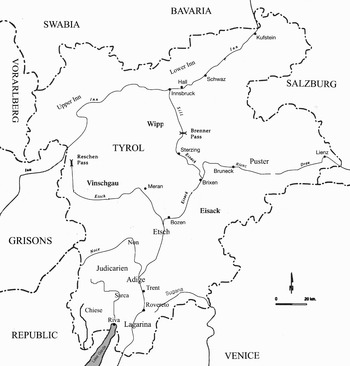
Hence, on 14 January 1567, these august personages—or their proxies—assembled at the Bavarian border outside Kufstein and in a solemn ceremony greeted the count and his Bohemian retinue. From there they accompanied the court on its progress up the Lower Inn valley; on 15 January they entered Rattenberg; on 16 January, Schwaz; on 17 January, Hall and, in an ordered procession, Innsbruck; finally, on 18 January, the commissaries took the hereditary oath of allegiance at the Innsbruck diet.
This group bears many of the trappings of the aristocracies now widely regarded to have appeared generally across Western Europe in the mid sixteenth century: a smallish core of nobles distinguished by quality of birth, subscription to an appropriate code of conduct, and Herrschaftsnähe (proximity to power).Footnote 4 That the word “aristocracy” is nonetheless absent from the Tirolean documents of the time should not necessarily be taken as counterevidence, for in early modern Europe, it still carried the Greek, purely political meaning of “rule of the best.” Only in the eighteenth century did “aristocracy” acquire the primarily social connotation of a noble elite.Footnote 5 Modern history writing of the early modern Tirol, in contrast, began in the mid nineteenth century, long after our sense of aristocracy gained currency; yet it employs the term scarcely any more. In digressions on foreign nobilities, it occasionally speaks about aristocrats or magnates but, in describing the Tirolean nobility, continues to adopt the generic designation “nobility” with its late medieval overtones of a single order marked by relatively porous social barriers. The impression to be gained is clear: The Tirol lacked a ruling class of its own.Footnote 6
The purpose of this paper is to show that in 1567 the Tirol did indeed have an aristocracy, and it comprised—more or less—the twenty-three dynasties called to join the count on his progress. A central piece of evidence, and the germ of this study, must be the record of Ferdinand's entry into the Tirol. By itself, however, that record is incomplete. Though high honor was to be sure the essence, it was neither an absolute nor a sufficient condition of being aristocratic. Aristocracy was a relative value, gauged by fine and mutable distinctions of title, long ancestry, office, seigneurial rights, blood ties, favor of the bishop of Trent, and, increasingly, lifestyle and education. And high honor notwithstanding, no magnate achieved or retained his status without commensurate wealth and influence. On closer inspection, the Tirolean aristocracy formed a complex structure, whose membership depended on a subtle calculus of multiple variables. To prove its existence justly calls for more than adducing a contemporary register of distinguished names; it requires explaining the reasons they were chosen (and others were not), even if the answer cannot be taken as definitive. The basis for this endeavor is the individual case studies of each family appended to this essay. The aim here is not to compose rounded family portraits, rather to draw out significant features with a view to defining the group.
Wealth and Influence
The foundation of aristocratic wealth and influence was laid in the so-called imperial age of the Tirol (1490–1564). For the first time in history, counts who were at the same time imperial rulers—Maximilian I (count 1490–1519, Roman king 1487–1493, Roman emperor 1493–1519), Charles V (count 1519–1522, Roman emperor 1519–1556), and Ferdinand I (count 1522–1564, Roman vicar 1521–1531, Roman king 1531–1556, and Roman emperor 1556–1564)—acceded to the throne, and they ruled first as emperors and second as counts. The priority of the largely absentee monarchs was the advancement of their far-flung dynastic projects. To this end they effectively relinquished control over major spheres of Tirolean government authority to a few cooperative noble families and otherwise used them as privy councillors (Hofräte), diplomats, soldiers, creditors, or any number of household officers.
Let us briefly scan the broad sweep of aristocratic activity in this time, starting with the highest levels of authority. In Maximilian's Privy Council based in Innsbruck, Tiroleans formed the leading regional bloc of councillors, led by Michael Wolkenstein and Paul Lichtenstein.Footnote 7 Following their maxim “what is good for the land is good for the emperor,” they gave Habsburg foreign policy a noticeable Tirolean stamp, expanding the total area of the land one-third in size. Ferdinand early moved the Privy Council to Vienna where Tirolean influence gradually waned; yet that influence nevertheless remained strong. Aristocrats held not only councillorships, but also the leading positions of chancellor and high steward virtually unbroken—from Bernardo Cles to Leonhard Völs to Hans Trautson—through which they again worked to shape Habsburg policy in their interests, such as in the installment of the Tirolean governor (Statthalter). When the incumbent died in 1556, Sigmund Thun wrote to Hans Trautson in Vienna. Thun deplored Ferdinand's partiality to foreign, especially partly Lutheran, governors and urged Trautson to seek the position himself.Footnote 8 The emperor turned down Trautson's application, but Trautson did negotiate the appointment of the Swabian Count Georg Helfenstein, whom he assured Thun would serve the land well.Footnote 9
At the same time, aristocrats served the Habsburgs as diplomats in Germany and Italy. They frequently held representative functions at imperial diets. Under Maximilian, Bernardo Cles served as governor of Verona; under Charles, Cristoforo Madruzzo as ambassador to the papacy and governor of the duchy of Milan; under Ferdinand, Sigmund Thun and Prospero Arco as imperial orators, the first at the Council of Trent, the second at three papal courts. And as bishops of Trent and hosts of the reform council, Thun and Arco also gained entry into the other universal court of Christendom. Three obtained the cardinalate—Bernardo Cles, Cristoforo Madruzzo, and Ludovico Madruzzo. Ferdinand's objections notwithstanding, Cristoforo eventually moved permanently to Rome, where as a favorite of Pius IV, he obtained a small papal principality, a host of papal offices, and the marriage of his nephew Fortunato to the pope's niece.
Such civilian persuasions did not, however, detract from the traditional militarism of the aristocracy. Indeed, the imperial age was the heyday of the feared Tirolean Landsknechte. Armed with halberds and arquebuses, and drilled to hold their formation in combat, these mercenary foot soldiers showed up on all the Habsburg battlefields—from Italy, Germany, France, Savoy, Hungary, the Netherlands, and the Mediterranean, to the Tirol itself—led by nobles from families like Arco, Lodron, Völs, Lichtenstein, Trautmannsdorf, Annenberg, Hendl, Spaur, and Brandis. The most famous of the bunch was Georg Frundsberg. Military entrepreneur and general, Frundsberg led his armies to defeat the Swiss at Bicocca in 1522 and Pavia in 1525 and to sack Rome in 1527.
Yet, for all their distant reach, the aristocracy with few exceptions remained rooted in the Tirol, which they dominated politically and economically. Analyzing this question is, however, complicated by the Habsburgs' largely absentee rulership and the land's peculiar tripartite territorial configuration. It is best approached by examining in turn each of the land's main component parts. Innsbruck was the traditional seat of the comital court, where, by 1567, aristocrats monopolized the hereditary court offices (Erblandämter). Furnished with fiefs and normally conferred on the house senior, the Trautsons held the office of marshal (Marschall) and Spaur that of cupbearer (Mundschenck) since 1450, Trapp that of steward (Hofmeister) since 1469, Cles that of chamberlain (Kämmerer) since 1525, and Botsch that of seneschal (Truchseß) since 1529. Largely honorific, these offices seem to have fallen into abeyance in the imperial ageFootnote 10 but were revitalized by Archduke Ferdinand, who created two new offices in 1568, the master of the stable and carver (Stallmeister und Vorschneider) and master of the baron and kitchen (Stabel- und Küchenmeister), with which he invested the Wolkensteins and Welspergs, respectively.Footnote 11
Though the imperial rulers spent little time in the Tirol, they often placed their families under the care of local nobles. Nicolaus Firmian was court steward (and his Veronese wife, stewardess) to the Milanese empress, Bianca Maria. Gaudenzio Madruzzo was high steward of Ferdinand's boys Maximilian, Ferdinand, and Charles. Jakob Khuen and Simon Botsch were high stewards (and Simon's wife, high stewardess) of Ferdinand's daughters in the early 1560s. Aristocratic daughters belonged to their court (Frauenzimmer) as well, such as Barbara Spaur, Juliana Lodron, and daughters of Franz Trautmannsdorf and Paul Welsberg.Footnote 12 Ferdinand selected Sigmund Thun as the high steward of his widowed daughter, Katherina of Mantua, because, among other qualifications, Thun was fluent in German and Italian. Aristocrats also followed the mature archdukes to Vienna, Prague, or Graz as courtiers.
Along with the Habsburg courts, Innsbruck was home to the Upper Austrian—or Tirolean, for short—Council. Subordinate to the Privy Council, it formed the central governing body of the county and, to a certain extent, that of the land. Even if foreigners frequently filled the governorship and chancellorship, Tiroleans dominated the majoritarian body, as attested by the chancellor. Since, as he explained to the emperor, Tirolean nobles by custom hold two-thirds of the seats in the council, they “can at any time outvote us [non-Tiroleans].”Footnote 13 In 1564 there were six Germans—governor, chancellor, and four jurists—and nine Tirolean—including Christoph Wolkenstein, Kaspar Wolkenstein, Hans Botsch, and Jakob Brandis.Footnote 14 Still, specifying only the Regenten (regular councillors), these sources understate the true aristocratic quality of the council, for Räte (ad hoc councillors)—like Sigmund Thun, Johann Jakob Khuen, Karl Welsberg, Wilhelm Wolkenstein, Cristoforo Madruzzo, Jakob Trapp, and Simon Botsch—on occasion attended.Footnote 15
Turning to the prince-bishoprics, they became aristocratic preserves in the imperial age. The case of Brixen is exemplary. From 1500 to 1519, the aristocracy supplied three of the thirty-seven new canons (8 percent); but during the Reformation, the trickle turned into a flood. From 1520 and 1567, twenty-five out of fifty-eight (43 percent) canonries were filled by eleven Tirolean aristocratic families: Khuen (4), Liechtenstein (4), Thun (4), Madruzzo (3), Cles (2), Spaur (2), Trautmannsdorf (2), Botsch, Fuchs, Trapp, and Wolkenstein.Footnote 16 At the time of the archducal entry, the nineteen canonries were held by fourteen Tiroleans, nine of whom were aristocrats.Footnote 17 Not surprisingly, they elected their own. From 1539 to 1567, three successive aristocrats—Cles, Fuchs, Madruzzo—held the throne of Brixen; from 1486 to 1567, four—Liechtenstein, Neideck,Footnote 18 Cles, Madruzzo—that of Trent. Hence, from 1539 to 1567, one aristocrat—Cristoforo Madruzzo—held princely authority over two-fifths of the land.Footnote 19
Aristocratic interest in the religious orders, in contrast, varied. They strongly patronized the Benedictine nunnery at Sonnenburg, where their daughters commonly rose to the abbacy. But their sons rarely entered the male orders, with one large exception. The southern Tirol in effect formed a province of the Teutonic Order, the Deutschordensballei an der Etsch und im Gebirge, with its five houses—Bozen, Schlanders, Lengmoos, Sterzing, and Trent. Against the protestations of the Grand Master, Ferdinand I deemed it immediate to the count (landsässig) with a seat and voice in the Tirolean diet. Though modestly endowed, which the ravages of the Peasants' War only aggravated, the Order nevertheless enjoyed the strong support of both the Habsburgs and aristocracy. In the early modern period, aristocrats formed a large majority of provincial and local commanders, as well as simple knights (but no priests).Footnote 20 Perhaps nothing more distinguished the Tirolean aristocracy from their counterparts in the rest of the monarchy than their deep entrenchment in the church, and it goes a long way to explaining their prompt support of the Counter Reformation.
Another vital institution was the diet.Footnote 21 In the imperial age, it was subverted by the aristocracy with Habsburg condonation. The problem lay in its anomalous late medieval workings. Comprising the Landschaft (prelates, nobles, towns, and countryside), who were subject to the count, and the prince-bishops of Trent and Brixen, who were subject to the emperor, the diet proved unworkable in the face of massive comital tax increases and the Reformation. Neither issue could be debated in the plenum diet without risking political breakdown. Members divided along fairly clear class lines. On the one hand, the bishops, prelates, and nobles insisted that the bishop of Trent was largely exempt from comital taxation and that the Reformation was wrong. On the other hand, the lower estates (towns and countryside) insisted that the bishop of Trent was as fiscally liable as anyone and that the Reformation was right. Therefore, in order to circumvent lower estates' opposition in the plenum diet, business was increasingly diverted into two new, reduced, more manageable assemblies: the small executive diet and the tax assessment commission. In fact, these assemblies were even held “in secret,” that is, exclusive of and unbeknownst to the lower estates. Their acute political importance is adduced by the composition of the noble estates. Not only wholly aristocratic, they were also virtually identical: In 1564, for example, the nobles of the executive diet comprised Simon Botsch, Jakob Boimont-Pairsberg, Jakob Brandis, Hans Khuen, Sigmund Thun, Jakob Trapp, Christoph Welsberg, Christoph Wolkenstein, and Wilhelm Wolkenstein, and those of the tax commission Simon Botsch, Jakob Boimont-Pairsberg, Jakob Brandis, Blasi Khuen, Sigmund Thun, Jakob Trapp, Christoph Wolkenstein, Wilhelm Wolkenstein.
Defense of the land, in contrast, fostered greater agreement among Tiroleans and, similar to so much else, consisted in a congeries of multilayered authorities. At the level of the land, the count appointed the commander in chief and district commanders to run the militia. At the level of the territories, the princes appointed commanders to maintain and garrison their various castles, with the exception of the commander of Trent—stationed in the bishop's Buonconsiglio castle, he was appointed by the count but attended the bishop's court as a councillor. These disparate organizations derived their coherence ultimately from the aristocracy, who dominated the senior officer ranks of both such that service was often hereditary.Footnote 22
The fundament of aristocratic power, however, remained lordship. The lord typically obtained the right to live in the local castle and farm its demesne, to administer the law for all but the gravest crimes, to manage regalia, to charge legal and administrative fees, to retain the rents and dues of subject peasants, and perhaps to fish and hunt. Though accurate data on the income derived from these activities are lost, the evidence does show the heightened concentration of lordships in the hands of a few families over the course of the imperial age. On the eve of Maximilian's rule, the nobility held seventy-four lordships: fifty-seven from the count, nine from the bishop of Trent, four as allod, and four from the bishop of Brixen. Three had four or more lordships, totalling a quarter of noble lordships (27 percent): Thun (10); Wolkenstein (7); Spaur (4). By the end of Maximilian's rule, the nobility held 107 lordships: eighty-six from the count; eleven from Trent; six as allod; and four from Brixen. Eight families now held four or more lordships, totalling one-half of noble lordships (53 percent): Wolkenstein (12); Thun (11); Liechtenstein (8.5); Trapp (7); Spaur (5); Völs (5); Welsberg (4); Fuchs (4). And by the end of Ferdinand's rule, the nobility held a total of 112 lordships: ninety-one from the count, thirteen from the bishop of Trent, four as allod, and four from the bishop of Brixen. Ten families held four or more districts, approaching two-thirds of noble lordships (61 percent): Wolkenstein (12); Thun (9); Trautson (9); Liechtenstein (6.5); Völs (6); Trapp (6); Madruzzo (6); Spaur (5); Welsberg (5); Khuen (4).Footnote 23
Yet lordship was not merely a matter of seigneurial exploitation; it also gave nobles substantial leverage over the princes themselves.Footnote 24 The office was assigned in the form of a contractual lien in return for sizable loans, which ranged from around 5,000 to 25,000 Gulden. Of course, liens contained a clause of redemption upon reimbursement of the principal, but the cash-strapped princes were hard-pressed to invoke it, a possibility nobles insured themselves against by increasing princely indebtedness where they could. The Wolkensteins, for example, paid 22,000 Gulden for four lordships—Lienz, Lienzer Klause, Kals, and Virgen—in 1501, a sum that they voluntarily topped up to 34,000 Gulden six years later.Footnote 25 And any ideas the Habsburgs might have had of diverting tax contributions toward the redemption of lordships were expressively forbidden by the estates.Footnote 26 For all intents and purposes, lordships were hereditary, a fact adduced by their marked stability of ownership, remaining in the same line of descent often for centuries.
The effective inheritability of lordships points to the final and perhaps crucial explanation for aristocratic preponderance. The natural depletion of their ranks notwithstanding, tight connubial ties ensured the retention of lordships in the group. To take the random sample of the bachelor Sigmund Thun (1487–1569): his mother was Genovesa, daughter of Oswald Wolkenstein and Barbara Trautson; his uncles were Frederico Madruzzo, Leonhard Völs, Georg Firmian, Jakob Fuchs, and Michael Wolkenstein; Elisabeth Fuchs was an aunt; Ulrich Spaur and Heinrich Khuen were brothers-in-law; and Margaretha Spaur, Dorothea Firmian, Margaretha Fuchs, Helena Cles, and Anna Fuchs were sisters-in-law.Footnote 27 More than a ruling order, the aristocracy was an extended family.
Social Status
If the imperial age brought the unprecedented concentration of power into the hands of a small elite, it also elicited the unprecedented eruption from below. Under Maximilian I, first rumblings of discontent were felt; Luther's message unleashed the storm. Ferdinand I's reign, virtually coeval with the age of Reformation, brought the seismic, cataclysmic dislocation of the land tantamount to a class war, in which the common man staged repeated, concerted attempts at social revolution and to which the aristocracy responded with even bloodier vengeance—from the Peasants' War, the communitarian Michael Gaismair, and the Anabaptist explosion, to the foiled “Dosser” affair (a large popular plot to “kill the nobles and clergy” and turn the land into a Swiss-like Reformed republic). Clearly the old noble ideology had lost its traction. Apart from a new religion, the aristocracy needed to delimit themselves sharply from every other subject and reinvent their values and culture.
To varying degrees all aristocrats enjoyed “long noble ancestry.” As far as verification allows, most families date back to the high Middle Ages, a handful to the thirteenth and early fourteenth centuries, the latest to the mid fourteenth century. Tirolean roots were not at issue here, since four descended from immigrants—the Trautmannsdorfs and Trapps came from Styria, the Römers from Rome, and the Botschs from Florence. But more than great age, they boasted blue blood. Many families were highborn as long as the records go back. Many again first come to light as Ministeriales. Only two were positively of common stock—Botsch and Hendl, perhaps Römer. In any case, all by the end of the Middle Ages had attained noble status—that is, untitled, including of course those members of the knighthood.
A century later, these families included the only ones distinguished by formal hereditary entitlement. Initiated by the Luxembourg emperors and extended by the Habsburgs—whether as emperors, counts, or both—the privilege created a clear gradation of precedence: untitled, baron, count, latterly prince. Sigismund elevated one family to the rank of count (Arco); Frederick III, one to count (Lodron); Sigmund, one to baron (Wolkenstein); Maximilian I, one to baron (Lichtenstein); Charles V or Ferdinand I, seven to baron (Völs, Madruzzo, Firmian, Spaur, Welsperg, Trautson, and Künigl) and one to count (Lichtenstein). In the last third of the sixteenth century, seven more would rise to baron (Boimont-Pairsberg, Römer, Trapp, Khuen, Brandis, Trautmannsdorf, Cles). Though Archduke Ferdinand raised no Tirolean to his rank of count, nearly every family not extinct later made count (Trautson, Thun, Wolkenstein, Spaur, Fuchs, Khuen, Brandis, Annenberg, Trapp, Trautmannsdorf, Künigl, Hendl, Welsperg, Firmian) or even prince (Trautson).
This system of rank was the touchstone of the aristocratic pecking order at the archducal entry. The counts lead, followed in turn by clusters of barons, knights, and untitled nobles. Within the two groups of titled nobles, the primary benchmark of precedence appears to be titular vintage. This is certainly the case of the counts: Arco (1433) precedes Lodron (1452). The arrangement of the barons, in contrast, eludes easy clarification. There plainly were different grades of baronage—imperial or Austrian, “conferred” or “confirmed”—but since the literature does not always specify the terms of individual entitlements, we lack a meaningful standard to compare them. Nor, as the case of the Künigls shows, did conferment alone bring official recognition.Footnote 28 Emperor Ferdinand I raised them to the baronage, but the Tirolean Council still deemed them untitled, though they are positioned at the head of the untitled next to the barons, suggesting the distinction counted for something. That said, the dates of entitlement we do have—whatever their terms—follow a definite, if imperfect, chronological order: Madruzzo (1525), Völs (around 1522), Firmian (1526), Trautson (1541), Welsperg (1539), Künigl (1563). It needs emphasis that individuals, not whole families, were ranked, and their titles were not always interchangeable. Personal title was sometimes limited to the direct, normally male, line; territorial titles were limited to the ownership of a family seat.Footnote 29 Hence, Wolkensteins, Spaurs, and Lichtensteins do not appear among the barons, though some did carry the title, because their commissaries were untitled. At the same time, in addition to hereditary titles, titles of office seemed to have weighed in the scales of honor. The Madruzzos were not the oldest barons, but they stood at the top of the heap, presumably owing to the force of their two prince-bishoprics and cardinalates. Similarly, the Trautson commissary, Balthasar, was untitled yet still is slotted in the middle of the pack, probably reflecting the prominence of his father Hans, baron and high steward of Emperors Ferdinand I and Maximilian II.
More generally, the hierarchy shows a strong correlation between ancestry and rank. Where the upper half consists entirely of high medieval families, the lower half is a hodgepodge of high and late medieval families. Also unmistakable is the crucial importance of Herrschaftsnähe. The Trapps, for example, are ranked seventeenth among nobles in 1567 but third in the noble estate's matriculation roll from 1474. Not coincidentally, Jakob Trapp (d. 1475) was appointed court steward by Duke Sigmund; a century later, the Trapps held no regular governmental office in Innsbruck or Vienna, focusing instead on managing their lands in Trent and the Vintschgau. The Trautsons, conversely, are ranked sixth in 1567 but thirtieth in 1474. Not coincidentally, Hans Trautson was a favorite of Emperor Ferdinand I; a century before, no Trautson was a member of Duke Sigmund's court.Footnote 30 Perhaps the most interesting rung on the ladder is the last. Having been ennobled only in the 1470s, the Hendls were the youngest of the nobles, hence confirming the old rule of thumb stipulating the passage of three generations of honorable descent to be considered noble.
The Fiegers are a case in point. Like the other local lowborn entrepreneurs—Stöckl, Tänzl, Jöchl—to make good in the great Tirolean mining bonanza of the fifteenth century, their social climb followed a set script. The accumulation of immense wealth translates, as Habsburg financiers, into Herrschaftsnähe and landed residence, which is capped by ennoblement in 1498. Except, where their fellow arrivistes soon faded again into obscurity, the Fiegers gave their new status a permanent footing. They gained the trust and confidence of not only the Habsburgs—producing five Tirolean councillors in the mid sixteenth century—but also of the leading nobles, to whom they extended loans, with whom they forged marital alliances—Spaur, Brandis, Welsperg, Botsch—and whom they educated. At Taufers castle, they ran a school for noble youngsters, including in the mid-1560s Fuchs, Lichtensteins, Welsbergs, Wolkensteins, Völs, Madruzzos, and Botschs. Deliberately assimilated into the aristocracy, yet not fully accepted by them, the Fiegers merely had to wait their turn, which came a century later with a baronage in 1655 and a countship in 1699.Footnote 31
No less honorable were the Niedertors. Old nobles, they first appear in the thirteenth-century town records of Bozen. A century later, they are marrying Völs and Botschs and creditors of the count. A century again, they hold substantial lordships around Bozen and Meran, and with these lordships follow high office: the Erbschenkenamt (hereditary office of butler) of Brixen, a councillorship of Emperor Frederick III, another of Emperor Maximilian I. By the early sixteenth century, Veit is a cathedral canon in Trent, Brixen, and Augsburg; and Georg takes a Fuchs as wife. Suffice it to say, the Niedertors belonged to the highest noble echelon. So why were they passed over? The point is easily forgotten, but the Tirolean nobility was patrilineal. As such, since the sole heir of the family was Georg's daughter, Margreth, his death in 1558 effectively extinguished the family. With her marriage in 1571, she acquired a new legal identity—as wife of Hans Khuen.Footnote 32
Of all prominent families, the omission of the Castelbarcos from the honor roll is perhaps most conspicuous. They were Italian, of pristine noble pedigree, and once overmighty magnates, holding almost the entire Lagarina valley in fief from Trent. They did lose a good part of their most southerly properties—the so-called Four Vicariates—to the Venetians in 1410, but their reputation scarcely suffered. They still had the fief Gresta, they still married Arcos and Lodrons, and likewise they claimed immediacy to the emperor (Reichsunmittelbarkeit)—in fact, of the sixty-three Tirolean nobles designated to receive Queen Mary of Bohemia in 1551, the Castelbarcos were privileged third in order and entitled to eight horses, after the Arcos and Lodrons, each entitled to eleven horses, and before the Madruzzos, entitled to eight.Footnote 33
What appears to have demoted the Castelbarcos from the top ranks was locking horns with the aristocratic primus inter pares, the bishop of Trent. Their quarrel is a complicated one, but it turned on the subtenancy of the Four Vicariates after they were reconquered in 1509 and restored to the bishop in 1532 by the Habsburgs. Because the Castelbarcos had never relinquished title to the fiefs, they demanded their restitution, appealing finally to the emperor. Charles V agreed and wrote to his brother Ferdinand to order the bishop to award the fiefs to their rightful owner. But Bernardo Cles invested his brother; after him, Cristoforo Madruzzo invested his brother. The Castelbarcos would eventually see justice, but they had to wait until the last Madruzzo bishop and heir died in 1658. Four years later, they were raised to the rank of count; two years later, the Privy Council ruled in their favor, bringing them the fiefs in the same year.Footnote 34
Next to title, the other mark of gentility was a new cultural sophistication. The imperial age coincided with the advent of the Renaissance in the Tirol, whose lodestar was the prince-bishopric of Trent. Its real initiator was the brilliant Bishop Bernardo Cles. Doctor of law in both kinds, bibliophile, internationally renowned humanist, and art connoisseur of the first order, Cles conceived and directed the radical physiognomic makeover of his entire principality in painting, sculpture, and architecture, from the medieval German to the modern Italian style. The focal point was the bishop's own seat of government and residence, Buonconsiglio castle. In complex biblical and mythological allegory, its murals depict the moral sanction for his rule as imperial authority is passed down the hierarchical chain—from God to Charlemagne to Maximilian I to Charles V to Ferdinand I and, finally, to the prince-bishop himself. Cristoforo Madruzzo's court, though less erudite, exuded a similar urbanity and delight in ostentatious display. In the celebration of Charles V's victory at Mühlberg in 1547, for instance, they held a festival with a public procession. The poet Leonardo Colombino relates that the sisters and nieces of the bishop led, followed by the womenfolk of the other great local families—such as Cles, Thun, Spaur, Botsch (probably), Trapp, Firmian, and Welsperg. All were arranged by age, wives, widows, and maidens in turn, dressed in German and Italian ornaments and skirts, and adorned in gold and the most precious gems of the Levant and other parts of the world.Footnote 35
The impact of these ideas and tastes on the southern Tirolean aristocracy was profound and reverberated northwards. The most palpable evidence is the mid-sixteenth-century building spree. In Trent it took the form of urban palazzos, such as those of Madruzzo, Lodron, Trapp, Arco, Firmian, Thun, and Wolkenstein. Up in the Noce valley, the erstwhile Captain of Trent, Pangratz Khuen, had frescoes added to the family residence at Belasi in the style he knew from Buonconsiglio castle. In the German Tirol, in contrast, the setting was largely rural. Houses were rebuilt or renovated with a conscious aesthetic intent. The new fashion called for symmetry and comfort aiming to please the senses with decorative features like atriums, fountains, enlarged and multiple windows, and symbolic and genealogical paintings—the Künigls at Ehrenburg, Hendls at Goldrain, Römers at Maretsch, Trapps at Churburg, Völs at Haselburg. The turn to humanist concerns is also discernable. Cristoforo Madruzzo kept a Wunderkammer, including various antiquities and natural curiosities, such as specimens of rocks, marble of every color, and minerals found in his territory. Hans Jakob Römer displayed ancient Roman sculpture and artifacts. Oswald Trapp collected medieval suits of armor and weaponry. Christoph Wolkenstein enjoyed a library of almost 3,000 volumes.
At the same time, a nascent noble bent for professional training is detectable. For the sons destined for a cathedral chapter, this was nothing new. The canons Bernardo Cles, Sigmund Thun, Cristoforo Madruzzo, Nikolaus Trautmannsdorf, Johann Thomas Spaur, and Johann Jakob Khuen, for example, all studied at university, typically law in both kinds. Now, however, we see the first signs of their lay peers seeking higher education, and the impetus seems to have come from Innsbruck. For example, the councillor Jakob Brandis obtained Habsburg scholarships for his sons to study and learn foreign languages in Italy and France before they joined the government. Jakob Pairsberg, after attending school in Brixen, continued his education in Feldkirch and Verona before entering the council in 1565. Perhaps the clearest sign of the changing noble world, the Jesuits—at the behest of Ferdinand I—opened their first Tirolean college in Innsbruck in 1562.
*
Two reasons explain why Archduke Ferdinand gave these twenty-three families pride of place at his entry. The first was his utter dependence on them. They effectively ran the land politically, religiously, financially, and militarily through their entrenchment in every major institution of the land—the Tirolean Council, the cathedral chapters and bishoprics, the Landschaft, and local government. In a sense, they were the land, for by nothing more did the three territories cohere. Without their continued support, Ferdinand could not rule successfully. From this dependence follows the second reason. Because Habsburg governance was only as secure as the aristocracy, Ferdinand sought to uphold their social position and defend their honor by deed and word. He not only vouchsafed them an exclusive and unexampled precedence in the opening pageant of his reign, but he also publicized the distinction in a royal livret, copies of which would circulate both at home and abroad.
Figure 1:The Tirol. Adapted with permission by Universitätsverlag Wagner.





 You have Access
The reconstruction of social and political elites is one of the most demanding tasks a historian will face. It requires the collection of a mass of data—such as dates of birth and death, place of origin, parentage, marriage and issue, wealth, career, social networks, intellectual life—and its analysis. Even then the findings are predetermined because they follow from the criteria applied; rather than absolute certainty, these findings commonly yield no more than probabilities.Footnote 1 Only rarely will the sources obviate these difficulties by identifying the actors for us, as if ready-made. Happily those of the Tirol from 1567 do precisely that.
The occasion was the entry of the new count, Archduke Ferdinand II, into the Tirol. He had, since his accession in July 1564, been held up in the East, governing from Prague and campaigning in Hungary. At last in November 1566, he announced his imminent arrival, adding precise instructions as to how he should be received. Contrary to tradition, the archduke preferred to be met not by the Landschaft (estates), nor even the noble estate, but rather by up to twenty of the most honorable nobles, and he tasked the Tirolean Council (Regierung) to make it happen.Footnote 2 In short order, they compiled a guest list comprising the lord lieutenant (Landeshauptmann), government lords, and the twenty-three “most respectable and pre-eminent families of the land” (ansechelichen unnd furnemen Geschlechtern diß Lanndts) and chose one representative or “commissary” from each, in the following order:
a count from the Arcos and a count from the Lodrons (whomever they chose); Nicolò Baron of Madruzzo; Christoph Moritz Baron of Völs; George Baron of Firmian; Balthasar Trautson; Christoph Baron of Welsperg; Bernhard Künigl; Degen Fuchs, knight; Jacob of Boimont-Pairsberg, knight; Hans Khuen, knight; Ferdinand of Cles; Hans Botsch; Hans of Wolkenstein; Hillebrand of Spaur; Veit of Annenberg; Oswald Trapp, Anthony Jacob of Thun; Balthasar of Lichtenstein; Franz of Trautmannsdorf; Hans Heinrich of Brandis; Hans Jacob Römer of Maretsch; Franz Hendl of Goldrain.Footnote 3
Hence, on 14 January 1567, these august personages—or their proxies—assembled at the Bavarian border outside Kufstein and in a solemn ceremony greeted the count and his Bohemian retinue. From there they accompanied the court on its progress up the Lower Inn valley; on 15 January they entered Rattenberg; on 16 January, Schwaz; on 17 January, Hall and, in an ordered procession, Innsbruck; finally, on 18 January, the commissaries took the hereditary oath of allegiance at the Innsbruck diet.
This group bears many of the trappings of the aristocracies now widely regarded to have appeared generally across Western Europe in the mid sixteenth century: a smallish core of nobles distinguished by quality of birth, subscription to an appropriate code of conduct, and Herrschaftsnähe (proximity to power).Footnote 4 That the word “aristocracy” is nonetheless absent from the Tirolean documents of the time should not necessarily be taken as counterevidence, for in early modern Europe, it still carried the Greek, purely political meaning of “rule of the best.” Only in the eighteenth century did “aristocracy” acquire the primarily social connotation of a noble elite.Footnote 5 Modern history writing of the early modern Tirol, in contrast, began in the mid nineteenth century, long after our sense of aristocracy gained currency; yet it employs the term scarcely any more. In digressions on foreign nobilities, it occasionally speaks about aristocrats or magnates but, in describing the Tirolean nobility, continues to adopt the generic designation “nobility” with its late medieval overtones of a single order marked by relatively porous social barriers. The impression to be gained is clear: The Tirol lacked a ruling class of its own.Footnote 6
The purpose of this paper is to show that in 1567 the Tirol did indeed have an aristocracy, and it comprised—more or less—the twenty-three dynasties called to join the count on his progress. A central piece of evidence, and the germ of this study, must be the record of Ferdinand's entry into the Tirol. By itself, however, that record is incomplete. Though high honor was to be sure the essence, it was neither an absolute nor a sufficient condition of being aristocratic. Aristocracy was a relative value, gauged by fine and mutable distinctions of title, long ancestry, office, seigneurial rights, blood ties, favor of the bishop of Trent, and, increasingly, lifestyle and education. And high honor notwithstanding, no magnate achieved or retained his status without commensurate wealth and influence. On closer inspection, the Tirolean aristocracy formed a complex structure, whose membership depended on a subtle calculus of multiple variables. To prove its existence justly calls for more than adducing a contemporary register of distinguished names; it requires explaining the reasons they were chosen (and others were not), even if the answer cannot be taken as definitive. The basis for this endeavor is the individual case studies of each family appended to this essay. The aim here is not to compose rounded family portraits, rather to draw out significant features with a view to defining the group.
Wealth and Influence
The foundation of aristocratic wealth and influence was laid in the so-called imperial age of the Tirol (1490–1564). For the first time in history, counts who were at the same time imperial rulers—Maximilian I (count 1490–1519, Roman king 1487–1493, Roman emperor 1493–1519), Charles V (count 1519–1522, Roman emperor 1519–1556), and Ferdinand I (count 1522–1564, Roman vicar 1521–1531, Roman king 1531–1556, and Roman emperor 1556–1564)—acceded to the throne, and they ruled first as emperors and second as counts. The priority of the largely absentee monarchs was the advancement of their far-flung dynastic projects. To this end they effectively relinquished control over major spheres of Tirolean government authority to a few cooperative noble families and otherwise used them as privy councillors (Hofräte), diplomats, soldiers, creditors, or any number of household officers.
Let us briefly scan the broad sweep of aristocratic activity in this time, starting with the highest levels of authority. In Maximilian's Privy Council based in Innsbruck, Tiroleans formed the leading regional bloc of councillors, led by Michael Wolkenstein and Paul Lichtenstein.Footnote 7 Following their maxim “what is good for the land is good for the emperor,” they gave Habsburg foreign policy a noticeable Tirolean stamp, expanding the total area of the land one-third in size. Ferdinand early moved the Privy Council to Vienna where Tirolean influence gradually waned; yet that influence nevertheless remained strong. Aristocrats held not only councillorships, but also the leading positions of chancellor and high steward virtually unbroken—from Bernardo Cles to Leonhard Völs to Hans Trautson—through which they again worked to shape Habsburg policy in their interests, such as in the installment of the Tirolean governor (Statthalter). When the incumbent died in 1556, Sigmund Thun wrote to Hans Trautson in Vienna. Thun deplored Ferdinand's partiality to foreign, especially partly Lutheran, governors and urged Trautson to seek the position himself.Footnote 8 The emperor turned down Trautson's application, but Trautson did negotiate the appointment of the Swabian Count Georg Helfenstein, whom he assured Thun would serve the land well.Footnote 9
At the same time, aristocrats served the Habsburgs as diplomats in Germany and Italy. They frequently held representative functions at imperial diets. Under Maximilian, Bernardo Cles served as governor of Verona; under Charles, Cristoforo Madruzzo as ambassador to the papacy and governor of the duchy of Milan; under Ferdinand, Sigmund Thun and Prospero Arco as imperial orators, the first at the Council of Trent, the second at three papal courts. And as bishops of Trent and hosts of the reform council, Thun and Arco also gained entry into the other universal court of Christendom. Three obtained the cardinalate—Bernardo Cles, Cristoforo Madruzzo, and Ludovico Madruzzo. Ferdinand's objections notwithstanding, Cristoforo eventually moved permanently to Rome, where as a favorite of Pius IV, he obtained a small papal principality, a host of papal offices, and the marriage of his nephew Fortunato to the pope's niece.
Such civilian persuasions did not, however, detract from the traditional militarism of the aristocracy. Indeed, the imperial age was the heyday of the feared Tirolean Landsknechte. Armed with halberds and arquebuses, and drilled to hold their formation in combat, these mercenary foot soldiers showed up on all the Habsburg battlefields—from Italy, Germany, France, Savoy, Hungary, the Netherlands, and the Mediterranean, to the Tirol itself—led by nobles from families like Arco, Lodron, Völs, Lichtenstein, Trautmannsdorf, Annenberg, Hendl, Spaur, and Brandis. The most famous of the bunch was Georg Frundsberg. Military entrepreneur and general, Frundsberg led his armies to defeat the Swiss at Bicocca in 1522 and Pavia in 1525 and to sack Rome in 1527.
Yet, for all their distant reach, the aristocracy with few exceptions remained rooted in the Tirol, which they dominated politically and economically. Analyzing this question is, however, complicated by the Habsburgs' largely absentee rulership and the land's peculiar tripartite territorial configuration. It is best approached by examining in turn each of the land's main component parts. Innsbruck was the traditional seat of the comital court, where, by 1567, aristocrats monopolized the hereditary court offices (Erblandämter). Furnished with fiefs and normally conferred on the house senior, the Trautsons held the office of marshal (Marschall) and Spaur that of cupbearer (Mundschenck) since 1450, Trapp that of steward (Hofmeister) since 1469, Cles that of chamberlain (Kämmerer) since 1525, and Botsch that of seneschal (Truchseß) since 1529. Largely honorific, these offices seem to have fallen into abeyance in the imperial ageFootnote 10 but were revitalized by Archduke Ferdinand, who created two new offices in 1568, the master of the stable and carver (Stallmeister und Vorschneider) and master of the baron and kitchen (Stabel- und Küchenmeister), with which he invested the Wolkensteins and Welspergs, respectively.Footnote 11
Though the imperial rulers spent little time in the Tirol, they often placed their families under the care of local nobles. Nicolaus Firmian was court steward (and his Veronese wife, stewardess) to the Milanese empress, Bianca Maria. Gaudenzio Madruzzo was high steward of Ferdinand's boys Maximilian, Ferdinand, and Charles. Jakob Khuen and Simon Botsch were high stewards (and Simon's wife, high stewardess) of Ferdinand's daughters in the early 1560s. Aristocratic daughters belonged to their court (Frauenzimmer) as well, such as Barbara Spaur, Juliana Lodron, and daughters of Franz Trautmannsdorf and Paul Welsberg.Footnote 12 Ferdinand selected Sigmund Thun as the high steward of his widowed daughter, Katherina of Mantua, because, among other qualifications, Thun was fluent in German and Italian. Aristocrats also followed the mature archdukes to Vienna, Prague, or Graz as courtiers.
Along with the Habsburg courts, Innsbruck was home to the Upper Austrian—or Tirolean, for short—Council. Subordinate to the Privy Council, it formed the central governing body of the county and, to a certain extent, that of the land. Even if foreigners frequently filled the governorship and chancellorship, Tiroleans dominated the majoritarian body, as attested by the chancellor. Since, as he explained to the emperor, Tirolean nobles by custom hold two-thirds of the seats in the council, they “can at any time outvote us [non-Tiroleans].”Footnote 13 In 1564 there were six Germans—governor, chancellor, and four jurists—and nine Tirolean—including Christoph Wolkenstein, Kaspar Wolkenstein, Hans Botsch, and Jakob Brandis.Footnote 14 Still, specifying only the Regenten (regular councillors), these sources understate the true aristocratic quality of the council, for Räte (ad hoc councillors)—like Sigmund Thun, Johann Jakob Khuen, Karl Welsberg, Wilhelm Wolkenstein, Cristoforo Madruzzo, Jakob Trapp, and Simon Botsch—on occasion attended.Footnote 15
Turning to the prince-bishoprics, they became aristocratic preserves in the imperial age. The case of Brixen is exemplary. From 1500 to 1519, the aristocracy supplied three of the thirty-seven new canons (8 percent); but during the Reformation, the trickle turned into a flood. From 1520 and 1567, twenty-five out of fifty-eight (43 percent) canonries were filled by eleven Tirolean aristocratic families: Khuen (4), Liechtenstein (4), Thun (4), Madruzzo (3), Cles (2), Spaur (2), Trautmannsdorf (2), Botsch, Fuchs, Trapp, and Wolkenstein.Footnote 16 At the time of the archducal entry, the nineteen canonries were held by fourteen Tiroleans, nine of whom were aristocrats.Footnote 17 Not surprisingly, they elected their own. From 1539 to 1567, three successive aristocrats—Cles, Fuchs, Madruzzo—held the throne of Brixen; from 1486 to 1567, four—Liechtenstein, Neideck,Footnote 18 Cles, Madruzzo—that of Trent. Hence, from 1539 to 1567, one aristocrat—Cristoforo Madruzzo—held princely authority over two-fifths of the land.Footnote 19
Aristocratic interest in the religious orders, in contrast, varied. They strongly patronized the Benedictine nunnery at Sonnenburg, where their daughters commonly rose to the abbacy. But their sons rarely entered the male orders, with one large exception. The southern Tirol in effect formed a province of the Teutonic Order, the Deutschordensballei an der Etsch und im Gebirge, with its five houses—Bozen, Schlanders, Lengmoos, Sterzing, and Trent. Against the protestations of the Grand Master, Ferdinand I deemed it immediate to the count (landsässig) with a seat and voice in the Tirolean diet. Though modestly endowed, which the ravages of the Peasants' War only aggravated, the Order nevertheless enjoyed the strong support of both the Habsburgs and aristocracy. In the early modern period, aristocrats formed a large majority of provincial and local commanders, as well as simple knights (but no priests).Footnote 20 Perhaps nothing more distinguished the Tirolean aristocracy from their counterparts in the rest of the monarchy than their deep entrenchment in the church, and it goes a long way to explaining their prompt support of the Counter Reformation.
Another vital institution was the diet.Footnote 21 In the imperial age, it was subverted by the aristocracy with Habsburg condonation. The problem lay in its anomalous late medieval workings. Comprising the Landschaft (prelates, nobles, towns, and countryside), who were subject to the count, and the prince-bishops of Trent and Brixen, who were subject to the emperor, the diet proved unworkable in the face of massive comital tax increases and the Reformation. Neither issue could be debated in the plenum diet without risking political breakdown. Members divided along fairly clear class lines. On the one hand, the bishops, prelates, and nobles insisted that the bishop of Trent was largely exempt from comital taxation and that the Reformation was wrong. On the other hand, the lower estates (towns and countryside) insisted that the bishop of Trent was as fiscally liable as anyone and that the Reformation was right. Therefore, in order to circumvent lower estates' opposition in the plenum diet, business was increasingly diverted into two new, reduced, more manageable assemblies: the small executive diet and the tax assessment commission. In fact, these assemblies were even held “in secret,” that is, exclusive of and unbeknownst to the lower estates. Their acute political importance is adduced by the composition of the noble estates. Not only wholly aristocratic, they were also virtually identical: In 1564, for example, the nobles of the executive diet comprised Simon Botsch, Jakob Boimont-Pairsberg, Jakob Brandis, Hans Khuen, Sigmund Thun, Jakob Trapp, Christoph Welsberg, Christoph Wolkenstein, and Wilhelm Wolkenstein, and those of the tax commission Simon Botsch, Jakob Boimont-Pairsberg, Jakob Brandis, Blasi Khuen, Sigmund Thun, Jakob Trapp, Christoph Wolkenstein, Wilhelm Wolkenstein.
Defense of the land, in contrast, fostered greater agreement among Tiroleans and, similar to so much else, consisted in a congeries of multilayered authorities. At the level of the land, the count appointed the commander in chief and district commanders to run the militia. At the level of the territories, the princes appointed commanders to maintain and garrison their various castles, with the exception of the commander of Trent—stationed in the bishop's Buonconsiglio castle, he was appointed by the count but attended the bishop's court as a councillor. These disparate organizations derived their coherence ultimately from the aristocracy, who dominated the senior officer ranks of both such that service was often hereditary.Footnote 22
The fundament of aristocratic power, however, remained lordship. The lord typically obtained the right to live in the local castle and farm its demesne, to administer the law for all but the gravest crimes, to manage regalia, to charge legal and administrative fees, to retain the rents and dues of subject peasants, and perhaps to fish and hunt. Though accurate data on the income derived from these activities are lost, the evidence does show the heightened concentration of lordships in the hands of a few families over the course of the imperial age. On the eve of Maximilian's rule, the nobility held seventy-four lordships: fifty-seven from the count, nine from the bishop of Trent, four as allod, and four from the bishop of Brixen. Three had four or more lordships, totalling a quarter of noble lordships (27 percent): Thun (10); Wolkenstein (7); Spaur (4). By the end of Maximilian's rule, the nobility held 107 lordships: eighty-six from the count; eleven from Trent; six as allod; and four from Brixen. Eight families now held four or more lordships, totalling one-half of noble lordships (53 percent): Wolkenstein (12); Thun (11); Liechtenstein (8.5); Trapp (7); Spaur (5); Völs (5); Welsberg (4); Fuchs (4). And by the end of Ferdinand's rule, the nobility held a total of 112 lordships: ninety-one from the count, thirteen from the bishop of Trent, four as allod, and four from the bishop of Brixen. Ten families held four or more districts, approaching two-thirds of noble lordships (61 percent): Wolkenstein (12); Thun (9); Trautson (9); Liechtenstein (6.5); Völs (6); Trapp (6); Madruzzo (6); Spaur (5); Welsberg (5); Khuen (4).Footnote 23
Yet lordship was not merely a matter of seigneurial exploitation; it also gave nobles substantial leverage over the princes themselves.Footnote 24 The office was assigned in the form of a contractual lien in return for sizable loans, which ranged from around 5,000 to 25,000 Gulden. Of course, liens contained a clause of redemption upon reimbursement of the principal, but the cash-strapped princes were hard-pressed to invoke it, a possibility nobles insured themselves against by increasing princely indebtedness where they could. The Wolkensteins, for example, paid 22,000 Gulden for four lordships—Lienz, Lienzer Klause, Kals, and Virgen—in 1501, a sum that they voluntarily topped up to 34,000 Gulden six years later.Footnote 25 And any ideas the Habsburgs might have had of diverting tax contributions toward the redemption of lordships were expressively forbidden by the estates.Footnote 26 For all intents and purposes, lordships were hereditary, a fact adduced by their marked stability of ownership, remaining in the same line of descent often for centuries.
The effective inheritability of lordships points to the final and perhaps crucial explanation for aristocratic preponderance. The natural depletion of their ranks notwithstanding, tight connubial ties ensured the retention of lordships in the group. To take the random sample of the bachelor Sigmund Thun (1487–1569): his mother was Genovesa, daughter of Oswald Wolkenstein and Barbara Trautson; his uncles were Frederico Madruzzo, Leonhard Völs, Georg Firmian, Jakob Fuchs, and Michael Wolkenstein; Elisabeth Fuchs was an aunt; Ulrich Spaur and Heinrich Khuen were brothers-in-law; and Margaretha Spaur, Dorothea Firmian, Margaretha Fuchs, Helena Cles, and Anna Fuchs were sisters-in-law.Footnote 27 More than a ruling order, the aristocracy was an extended family.
Social Status
If the imperial age brought the unprecedented concentration of power into the hands of a small elite, it also elicited the unprecedented eruption from below. Under Maximilian I, first rumblings of discontent were felt; Luther's message unleashed the storm. Ferdinand I's reign, virtually coeval with the age of Reformation, brought the seismic, cataclysmic dislocation of the land tantamount to a class war, in which the common man staged repeated, concerted attempts at social revolution and to which the aristocracy responded with even bloodier vengeance—from the Peasants' War, the communitarian Michael Gaismair, and the Anabaptist explosion, to the foiled “Dosser” affair (a large popular plot to “kill the nobles and clergy” and turn the land into a Swiss-like Reformed republic). Clearly the old noble ideology had lost its traction. Apart from a new religion, the aristocracy needed to delimit themselves sharply from every other subject and reinvent their values and culture.
To varying degrees all aristocrats enjoyed “long noble ancestry.” As far as verification allows, most families date back to the high Middle Ages, a handful to the thirteenth and early fourteenth centuries, the latest to the mid fourteenth century. Tirolean roots were not at issue here, since four descended from immigrants—the Trautmannsdorfs and Trapps came from Styria, the Römers from Rome, and the Botschs from Florence. But more than great age, they boasted blue blood. Many families were highborn as long as the records go back. Many again first come to light as Ministeriales. Only two were positively of common stock—Botsch and Hendl, perhaps Römer. In any case, all by the end of the Middle Ages had attained noble status—that is, untitled, including of course those members of the knighthood.
A century later, these families included the only ones distinguished by formal hereditary entitlement. Initiated by the Luxembourg emperors and extended by the Habsburgs—whether as emperors, counts, or both—the privilege created a clear gradation of precedence: untitled, baron, count, latterly prince. Sigismund elevated one family to the rank of count (Arco); Frederick III, one to count (Lodron); Sigmund, one to baron (Wolkenstein); Maximilian I, one to baron (Lichtenstein); Charles V or Ferdinand I, seven to baron (Völs, Madruzzo, Firmian, Spaur, Welsperg, Trautson, and Künigl) and one to count (Lichtenstein). In the last third of the sixteenth century, seven more would rise to baron (Boimont-Pairsberg, Römer, Trapp, Khuen, Brandis, Trautmannsdorf, Cles). Though Archduke Ferdinand raised no Tirolean to his rank of count, nearly every family not extinct later made count (Trautson, Thun, Wolkenstein, Spaur, Fuchs, Khuen, Brandis, Annenberg, Trapp, Trautmannsdorf, Künigl, Hendl, Welsperg, Firmian) or even prince (Trautson).
This system of rank was the touchstone of the aristocratic pecking order at the archducal entry. The counts lead, followed in turn by clusters of barons, knights, and untitled nobles. Within the two groups of titled nobles, the primary benchmark of precedence appears to be titular vintage. This is certainly the case of the counts: Arco (1433) precedes Lodron (1452). The arrangement of the barons, in contrast, eludes easy clarification. There plainly were different grades of baronage—imperial or Austrian, “conferred” or “confirmed”—but since the literature does not always specify the terms of individual entitlements, we lack a meaningful standard to compare them. Nor, as the case of the Künigls shows, did conferment alone bring official recognition.Footnote 28 Emperor Ferdinand I raised them to the baronage, but the Tirolean Council still deemed them untitled, though they are positioned at the head of the untitled next to the barons, suggesting the distinction counted for something. That said, the dates of entitlement we do have—whatever their terms—follow a definite, if imperfect, chronological order: Madruzzo (1525), Völs (around 1522), Firmian (1526), Trautson (1541), Welsperg (1539), Künigl (1563). It needs emphasis that individuals, not whole families, were ranked, and their titles were not always interchangeable. Personal title was sometimes limited to the direct, normally male, line; territorial titles were limited to the ownership of a family seat.Footnote 29 Hence, Wolkensteins, Spaurs, and Lichtensteins do not appear among the barons, though some did carry the title, because their commissaries were untitled. At the same time, in addition to hereditary titles, titles of office seemed to have weighed in the scales of honor. The Madruzzos were not the oldest barons, but they stood at the top of the heap, presumably owing to the force of their two prince-bishoprics and cardinalates. Similarly, the Trautson commissary, Balthasar, was untitled yet still is slotted in the middle of the pack, probably reflecting the prominence of his father Hans, baron and high steward of Emperors Ferdinand I and Maximilian II.
More generally, the hierarchy shows a strong correlation between ancestry and rank. Where the upper half consists entirely of high medieval families, the lower half is a hodgepodge of high and late medieval families. Also unmistakable is the crucial importance of Herrschaftsnähe. The Trapps, for example, are ranked seventeenth among nobles in 1567 but third in the noble estate's matriculation roll from 1474. Not coincidentally, Jakob Trapp (d. 1475) was appointed court steward by Duke Sigmund; a century later, the Trapps held no regular governmental office in Innsbruck or Vienna, focusing instead on managing their lands in Trent and the Vintschgau. The Trautsons, conversely, are ranked sixth in 1567 but thirtieth in 1474. Not coincidentally, Hans Trautson was a favorite of Emperor Ferdinand I; a century before, no Trautson was a member of Duke Sigmund's court.Footnote 30 Perhaps the most interesting rung on the ladder is the last. Having been ennobled only in the 1470s, the Hendls were the youngest of the nobles, hence confirming the old rule of thumb stipulating the passage of three generations of honorable descent to be considered noble.
The Fiegers are a case in point. Like the other local lowborn entrepreneurs—Stöckl, Tänzl, Jöchl—to make good in the great Tirolean mining bonanza of the fifteenth century, their social climb followed a set script. The accumulation of immense wealth translates, as Habsburg financiers, into Herrschaftsnähe and landed residence, which is capped by ennoblement in 1498. Except, where their fellow arrivistes soon faded again into obscurity, the Fiegers gave their new status a permanent footing. They gained the trust and confidence of not only the Habsburgs—producing five Tirolean councillors in the mid sixteenth century—but also of the leading nobles, to whom they extended loans, with whom they forged marital alliances—Spaur, Brandis, Welsperg, Botsch—and whom they educated. At Taufers castle, they ran a school for noble youngsters, including in the mid-1560s Fuchs, Lichtensteins, Welsbergs, Wolkensteins, Völs, Madruzzos, and Botschs. Deliberately assimilated into the aristocracy, yet not fully accepted by them, the Fiegers merely had to wait their turn, which came a century later with a baronage in 1655 and a countship in 1699.Footnote 31
No less honorable were the Niedertors. Old nobles, they first appear in the thirteenth-century town records of Bozen. A century later, they are marrying Völs and Botschs and creditors of the count. A century again, they hold substantial lordships around Bozen and Meran, and with these lordships follow high office: the Erbschenkenamt (hereditary office of butler) of Brixen, a councillorship of Emperor Frederick III, another of Emperor Maximilian I. By the early sixteenth century, Veit is a cathedral canon in Trent, Brixen, and Augsburg; and Georg takes a Fuchs as wife. Suffice it to say, the Niedertors belonged to the highest noble echelon. So why were they passed over? The point is easily forgotten, but the Tirolean nobility was patrilineal. As such, since the sole heir of the family was Georg's daughter, Margreth, his death in 1558 effectively extinguished the family. With her marriage in 1571, she acquired a new legal identity—as wife of Hans Khuen.Footnote 32
Of all prominent families, the omission of the Castelbarcos from the honor roll is perhaps most conspicuous. They were Italian, of pristine noble pedigree, and once overmighty magnates, holding almost the entire Lagarina valley in fief from Trent. They did lose a good part of their most southerly properties—the so-called Four Vicariates—to the Venetians in 1410, but their reputation scarcely suffered. They still had the fief Gresta, they still married Arcos and Lodrons, and likewise they claimed immediacy to the emperor (Reichsunmittelbarkeit)—in fact, of the sixty-three Tirolean nobles designated to receive Queen Mary of Bohemia in 1551, the Castelbarcos were privileged third in order and entitled to eight horses, after the Arcos and Lodrons, each entitled to eleven horses, and before the Madruzzos, entitled to eight.Footnote 33
What appears to have demoted the Castelbarcos from the top ranks was locking horns with the aristocratic primus inter pares, the bishop of Trent. Their quarrel is a complicated one, but it turned on the subtenancy of the Four Vicariates after they were reconquered in 1509 and restored to the bishop in 1532 by the Habsburgs. Because the Castelbarcos had never relinquished title to the fiefs, they demanded their restitution, appealing finally to the emperor. Charles V agreed and wrote to his brother Ferdinand to order the bishop to award the fiefs to their rightful owner. But Bernardo Cles invested his brother; after him, Cristoforo Madruzzo invested his brother. The Castelbarcos would eventually see justice, but they had to wait until the last Madruzzo bishop and heir died in 1658. Four years later, they were raised to the rank of count; two years later, the Privy Council ruled in their favor, bringing them the fiefs in the same year.Footnote 34
Next to title, the other mark of gentility was a new cultural sophistication. The imperial age coincided with the advent of the Renaissance in the Tirol, whose lodestar was the prince-bishopric of Trent. Its real initiator was the brilliant Bishop Bernardo Cles. Doctor of law in both kinds, bibliophile, internationally renowned humanist, and art connoisseur of the first order, Cles conceived and directed the radical physiognomic makeover of his entire principality in painting, sculpture, and architecture, from the medieval German to the modern Italian style. The focal point was the bishop's own seat of government and residence, Buonconsiglio castle. In complex biblical and mythological allegory, its murals depict the moral sanction for his rule as imperial authority is passed down the hierarchical chain—from God to Charlemagne to Maximilian I to Charles V to Ferdinand I and, finally, to the prince-bishop himself. Cristoforo Madruzzo's court, though less erudite, exuded a similar urbanity and delight in ostentatious display. In the celebration of Charles V's victory at Mühlberg in 1547, for instance, they held a festival with a public procession. The poet Leonardo Colombino relates that the sisters and nieces of the bishop led, followed by the womenfolk of the other great local families—such as Cles, Thun, Spaur, Botsch (probably), Trapp, Firmian, and Welsperg. All were arranged by age, wives, widows, and maidens in turn, dressed in German and Italian ornaments and skirts, and adorned in gold and the most precious gems of the Levant and other parts of the world.Footnote 35
The impact of these ideas and tastes on the southern Tirolean aristocracy was profound and reverberated northwards. The most palpable evidence is the mid-sixteenth-century building spree. In Trent it took the form of urban palazzos, such as those of Madruzzo, Lodron, Trapp, Arco, Firmian, Thun, and Wolkenstein. Up in the Noce valley, the erstwhile Captain of Trent, Pangratz Khuen, had frescoes added to the family residence at Belasi in the style he knew from Buonconsiglio castle. In the German Tirol, in contrast, the setting was largely rural. Houses were rebuilt or renovated with a conscious aesthetic intent. The new fashion called for symmetry and comfort aiming to please the senses with decorative features like atriums, fountains, enlarged and multiple windows, and symbolic and genealogical paintings—the Künigls at Ehrenburg, Hendls at Goldrain, Römers at Maretsch, Trapps at Churburg, Völs at Haselburg. The turn to humanist concerns is also discernable. Cristoforo Madruzzo kept a Wunderkammer, including various antiquities and natural curiosities, such as specimens of rocks, marble of every color, and minerals found in his territory. Hans Jakob Römer displayed ancient Roman sculpture and artifacts. Oswald Trapp collected medieval suits of armor and weaponry. Christoph Wolkenstein enjoyed a library of almost 3,000 volumes.
At the same time, a nascent noble bent for professional training is detectable. For the sons destined for a cathedral chapter, this was nothing new. The canons Bernardo Cles, Sigmund Thun, Cristoforo Madruzzo, Nikolaus Trautmannsdorf, Johann Thomas Spaur, and Johann Jakob Khuen, for example, all studied at university, typically law in both kinds. Now, however, we see the first signs of their lay peers seeking higher education, and the impetus seems to have come from Innsbruck. For example, the councillor Jakob Brandis obtained Habsburg scholarships for his sons to study and learn foreign languages in Italy and France before they joined the government. Jakob Pairsberg, after attending school in Brixen, continued his education in Feldkirch and Verona before entering the council in 1565. Perhaps the clearest sign of the changing noble world, the Jesuits—at the behest of Ferdinand I—opened their first Tirolean college in Innsbruck in 1562.
*
Two reasons explain why Archduke Ferdinand gave these twenty-three families pride of place at his entry. The first was his utter dependence on them. They effectively ran the land politically, religiously, financially, and militarily through their entrenchment in every major institution of the land—the Tirolean Council, the cathedral chapters and bishoprics, the Landschaft, and local government. In a sense, they were the land, for by nothing more did the three territories cohere. Without their continued support, Ferdinand could not rule successfully. From this dependence follows the second reason. Because Habsburg governance was only as secure as the aristocracy, Ferdinand sought to uphold their social position and defend their honor by deed and word. He not only vouchsafed them an exclusive and unexampled precedence in the opening pageant of his reign, but he also publicized the distinction in a royal livret, copies of which would circulate both at home and abroad.
The Tirol. Adapted with permission by Universitätsverlag Wagner.
Appendix
1. Arco
The Arcos were by tradition the first noble family of the land. They were counts, subject immediately to the emperor, progeny of old nobility, and landlords—with some 5,000 subjects—comparable to magnates of the eastern Habsburg lands. This mark of superior pedigree did not, however, carry comparable political influence, and the paradox reflects their uncertain position in the land. For reasons largely of geography, the Arcos were only qualified Tiroleans. Seated in the Sarca valley, a borderland claimed by three overlords, they commended themselves to the bishop of Trent in the early twelfth century, the Tirolean count in the late thirteenth, and the emperor in 1413, who also raised them to the rank of count. As such, the Arcos claimed until well into the seventeenth century immediacy to the emperor, even if, in 1440, they pledged the Tirolean count their direct submission and, in 1474, attended the Tirolean diet. Under Maximilian, they served in his armies; and one briefly served as his court marshal. Under Charles and Ferdinand, several commanded imperial troops in northern Italy, Hungary, and Germany, at least seven in Piedmont. They also were Habsburg courtiers and diplomats. Scipione (d. 1573) spent a lifetime at the Austrian courts; his brother Prospero (d. 1572) held the post of imperial ambassador at the Curia during the crucial third session of the Council of Trent; and his nephew Orazio (d. 1579) was butler at the archducal court of Rudolph and Ernst. Yet for all their impact beyond the land, it was circumscribed within. The Arcos freely served the bishop and some sat in his cathedral chapter, but they maintained a marked distance from the count. They filled no positions in the Innsbruck government; they held only minor comital lands; they avoided the diet and evaded their fiscal responsibilities almost completely; most telling of all, they spoke no German and rarely married into the Tirolean nobility. This almost complete invisibility in the north extended to the archducal entry. Not only were the Arcos the sole aristocratic families not to receive an individualized invitation, but also none attended the archducal entry.Footnote 36
2. Lodron
The Lodrons were by tradition the second noble family of the land for much the same reason that the Arcos were the first. They were counts, subject immediately to the emperor, progeny of old nobility, and major landlords. Indeed, their circumstances were so similarly exceptional that contemporaries saw them of a piece. Seated in the Chiese valley, they had acquired multiple liege lords—the bishop of Trent in the twelfth century, the Tirolean count in the thirteenth, and the emperor in 1452, who also raised them to the rank of count. Even if, in 1447, they attended the Tirolean diet, they claimed until well into the seventeenth century immediacy to the emperor. Essentially petty condottieri, Lodrons served the Habsburgs across the empire: Sebastiano (1508–27) campaigned in Italy in the early 1520s; his brother Ludovico (1484–1538) took part in the Battle of Pavia in 1525, and in the Sack of Rome two years later, he defended Vienna in 1532 and later fell in Hungary, his head making a trophy in Constantinople; his cousin Giovanni Battista (1480–1555) also fought at Pavia, in the Schmalkaldic War, and helped subdue the Bohemian rebellion in 1547; and his son Alberico (1531–1572) commanded German foot soldiers in Italy in the 1550s. Of course, they maintained close ties to the bishop of Trent, who rewarded them with further lordships in the Lagarina valley in 1456, and they sat in his cathedral chapter in the mid sixteenth century. But except for Juliana, lady in waiting of Archduchess Katharina in the mid sixteenth century, they otherwise kept a low profile in the capital. They held no positions in the comital government; they held only minor comital lands; they avoided the diet and evaded their fiscal responsibilities almost completely; they only occasionally married into the Tirolean nobility; and none attended the archducal entry, though Alberico was invited as the family commissary.Footnote 37
3. Madruzzo
With obscure medieval origins as feudatories from the Noce valley, the Madruzzos burst onto the Tirolean scene in the person of Giangaudenzio (d. 1550), father of the modern family. Court marshal of Bishop Cles and president of his Tirolean Council, privy councillor of Ferdinand and chamberlain of his three boys, commander in northern Italy, Giangaudenzio also was raised to the rank of baron. His oldest son, Nicolò (1507?–1572), after resigning his canonry in Trent, entered imperial service. Though a privy councillor and chamberlain, Nicoló was essentially a soldier. Abroad he saw action in the northern Italian, southern German, and Hungarian theatres; at home he held the commandership of the Four Vicariates, Riva, and, during first session of the Council of Trent, the whole prince-bishopric. Giangaudenzio destined his second son, Cristoforo (1512–1578), for the Church. While studying law at Padua and Bologna some six years, he accrued numerous canonries—in Trent, Augsburg, Salzburg, and Brixen—after which he was elected deacon at Trent, bishop of Trent (1539–1567), and—after his uncle, Bishop Christoph Fuchs fell gravely ill—administrator of Brixen (1542–1578). It was under Cristoforo that the aristocracy took over the cathedral chapters, who elected his nephews as coadjutors with rights of succession: Ludovico Madruzzo of Trent in 1550 and Johann Thomas Spaur of Brixen in 1552. More than a mere aristocratic patron, Cristoforo is forever linked with the Council of Trent (1545–1563), which he hosted and which carried him to the highest levels of imperial and papal politics. He served as Charles's ambassador to the papacy and governed his duchy of Milan for two years. His papal ties would be more lasting and fruitful, bringing him not only a cardinalate, a small papal principality, a host of papal offices, but also the marriage of his nephew Fortunato (d. 1604) to the niece of Pope Pius IV and a cardinalate for Ludovico. And because Ludovico was the acting bishop at the time of the archducal entry, he represented his uncle in the procession into Innsbruck, while Nicolò served as commissary and Fortunato as bearer of the archducal baldachin.Footnote 38
4. Völs
The Völs came from the Eisack valley. Still undistinguished in the mid fifteenth century, they surged to the forefront of the nobility on the reputation of two scions. The one was Leonhard senior (1458/59–1530). When he was not at war—against Venice (1487 and 1508–1516), Switzerland (1499), and Bavaria (1504)—he served as councillor to Sigmund and the bishop of Brixen, before moving to Innsbruck in 1490 to join Maximilian's Treasury and Tirolean Council, and, in 1498, back south to succeed his father-in-law as lord lieutenant, which he remained to the end of his life. Further distinctions included the rank of baron, office of court chamberlain at Brixen, and constant augmentation of property. Meanwhile, his brother Michael (1468–1528) married the sister of Bernardo Cles, who favored his brother-in-law with a local office in Trent, even more his nephew Leonhard junior (1497–1545). The other family star, he ascended to the apex of the imperial hierarchy, from privy councillor, court chamberlain, and court marshal, to high court steward in Vienna, and from junior officer to commander in chief in Hungary. Back at home, the other nephews also flourished under Cles's hand. Augustin acquired cathedral canonries in Trent and Salzburg. Hans Jakob (d. 1551) served in Trent at the local level and then in the county as acting lord lieutenant. The youngest, Gilg (d. 1546), also held a local office in Trent but, after Cles's demise, entered Habsburg service in Innsbruck. He had two sons, neither of special note. The younger, Christoph Moritz, local office holder of the bishop of Brixen, served as commissary at the archducal entry.Footnote 39
5. Firmian
The Firmians were originally seated in the Etsch valley. In the fifteenth century, they stood among the first families, and their rank reflects the risen political importance of Trent in the land. Nicolaus (1451–1509/10) and his cousin Christopher (d. 1490) were councillors of Sigmund. At the same time, Nicolaus enjoyed the friendship of the bishop of Trent and held his commandership in the Noce valley. On the basis of these ties, Nicolaus orchestrated his tour de force in the mid-1470s. He gave the old family seat near Bozen (a fief of Trent) to the count for the lordship of Mezzacorona near Trent (a comital fief). Now based in the Italian Tirol, Firmian fortunes soared. In the prince-bishopric, Nicolaus became court marshal, commander of Trent, and commander of Stenico; and his brother, Vigilius, became commander of Trent. In the county, Nicolaus became lord lieutenant, court steward (and his Veronese wife court stewardess) to the Milanese empress, Bianca Maria, and knight of the Golden Fleece. His son Georg (1479–1540) attained almost equal success: commander of Pergine, Tirolean councillor, and acting lord lieutenant. After two exceptional generations, the third returned to relative normalcy. Georg's son, Georg (1538–1573), commander of Pergine and only surviving heir, served as a bearer of the baldachin and commissary at the archducal entry.Footnote 40
6. Trautson
The Trautsons came from the Wipp valley, north of the Brenner Pass. Their ties to the Tirolean court had long been close, as they held the marshalship already since 1315. As such, they were well positioned to advance themselves when the comital and imperial offices fused in the same person. No Tirolean family made more of the opportunity. Though several rose to the Privy Council, only the Trautsons parlayed Habsburg service into a permanent place at the Viennese court. Hans (c. 1509–1589) certainly had good family connections—his father, Hans, had been a Tirolean councillor; his sister Eleonara high stewardess of Archduchess Eleonara, a daughter of Ferdinand I; and his wife Brigitta, daughter of Gaudenzio and sister of Cristoforo Madruzzo—but he was also able. Almost the same age as Ferdinand, he began his career under the Tirolean prince, serving as Tirolean councillor and playing an active role in the estates. He thrived after the passing of Bernardo Cles in 1539: privy councillor in 1540, baron in 1541, imperial high steward in 1550, lord lieutenant in 1551; and the bishop of Trent made him commander of Rovereto in 1550. Meanwhile, he amassed properties in the Tirol, Lower Austria, and Bohemia, entering the estates of the last two as well. Even after translating to the imperial court, he remained a force in Tirolean affairs; as the correspondence of Sigmund Thun shows, he adroitly mediated between the count and aristocracy. Altogether he served three emperors for more than sixty years, forty-nine as privy councillor, while becoming an Austrian magnate of the first rank. After him the family divided into two lines. The Lower Austrian line descended from his youngest son, Paul Sixt (d. 1621), the second of four imperial high stewards of the house. The Tirolean sprung from his oldest son, Balthasar (d. 1594), commander of Rovereto; he acted as the family commissary at the archducal entry, and he participated in the archducal procession into Innsbruck.Footnote 41
7. Welsperg
The Welspergs were centered in the Puster valley. By the end of the fourteenth century, they stood among its leading nobles. Under Georg the family expanded its economic base. One of the few Austrian knights to escape the Swiss halberdiers at Sempach in 1386, the later Tirolean court chamberlain founded the second family line around the Sugana valley, when the count invested him in the castle and lordship of Primiero in 1401. As councillors of Sigmund, the Welspergs deepened their roots in the south when they acquired Telvana castle. The Tirolean inheritance of the Gorizian patrimony in 1500 had no noticeable effect on the Welspergs. They continued to serve the bishop of Brixen, one as court marshal, another as a cathedral canon, and two as local officials in the early sixteenth century—symbolic of their trust in the bishop, they built a stately family residence (now called Sternbach) in his town of Bruneck. And they continued to serve the count, furnishing at least five councillors, while the count returned the favor, raising the family to the rank of baron. But the most influential mid-sixteenth-century scion seems to have served neither the count in council nor the bishop in any capacity: Christopher (1528–1580), lord of Primiero and Telvana, was one of the richest of the land and a mainstay of the noble estates. At the archducal entry, he was not only commissary, but he also was bearer of the baldachin.Footnote 42
8. Künigl
The Künigls came from the Puster valley. As old lieges of the count of Gorizia and bishop of Brixen, they entered Habsburg service relatively late. Gabein (1440–1492) married Catherina Cles, by whom he had seven children. The youngest, Caspar (1481–1541), began his education at the cathedral school in Brixen. Later, his uncle Hildebrand Cles, commander of Trent, brought Caspar to the bishop's court at Trent, where he became steward; and he spent several years at Cles castle in Noce valley learning Italian. The election of his cousin Bernardo as bishop of Trent proved especially fortuitous, for it brought him access to the imperial courts, such as when he accompanied the bishop to Charles's imperial coronation in 1520. His career soon flourished. Ferdinand appointed him Tirolean councillor in 1525, Charles acting imperial marshal at the imperial diets of 1530 and 1531, the Tirolean estates delegate at Ferdinand's Bohemian coronation in 1527 and Roman royal coronation in 1531, and Ferdinand acting governor of the Innsbruck government in 1540. Kaspar had five sons, of whom four died at a young age, one as a butler at the imperial court, another still at Trent. The sole surviving son was Bernhard (1529–1575). Slated for a cathedral canonry, he grew up at the court of his uncle, Cardinal Cles; but, after the last of his brothers died, Bernhard left the spiritual order with papal dispensation. He was raised to the rank of baron in 1563 and attended the archducal entry as commissary.Footnote 43
9. Fuchs
The Fuchs were seated in the Etsch valley. Shrewd matches brought them wealth and influence by the mid fifteenth century. Under Maximilian, Degen (1450–1527) rose to Tirolean councillor and lord lieutenant. In the religious confusion of the Reformation, his sons took different paths, though at no apparent political cost. Where Degen (1490–1551) as commander of Kufstein manned the main bulwark against the Lutheran tide, Christopher (d. 1542), after embracing Lutheranism as a youth at the courts of Württemberg and the Palatinate, served the Habsburgs for twenty years as Tirolean councillor. After the death of his wife in 1535, Christopher entered the priesthood, joined the Brixen cathedral chapter, rose to deacon, and, with Habsburg backing, bishop in 1539. He never made good on imperial and papal calls for a pastoral visitation, but he did accept the governorship in 1540. His nephew, Degen (d. 1579), commander of Kufstein, represented the family at the archducal entry.Footnote 44
10. Boymont
The Boymonts were natives of the Etsch valley. Like so many of their peers, they reached their zenith of influence in the sixteenth century. Reinprecht (d. 1545) was a Tirolean and later privy councillor, but he spent most of his career in the service of the bishop of Brixen—as court marshal, councillor, and local official. Three of his sons entered the cathedral chapter, though one resigned four years later. A brother of Reinprecht, Martin (d. 1551), was the Wolkenstein's bailiff of Ivano in Sugana valley. His first son Martin (d. 1571) held several dignities at the court of Archduke Karl and served as Tirolean councillor. His other son Jacob (1527–1581) was the outstanding scion of the family and is the best remembered by his autobiography. He attended the Brixen cathedral school of his relative Bishop Christopher Fuchs and continued his education in Feldkirch and Verona. Afterward he entered the court service of Bishop Cristoforo Madruzzo in Trent, with whom he accompanied Archduke Maximilian on his wedding voyage to Spain. The next year, he held his own wedding, which, together with that of Christopher Wolkenstein, was officiated by Bishop Cristoforo. He then began his long career in the noble estates, both as an adjudicator of the noble court at Bozen and member of the executive diet and tax committee. In 1565 he was appointed councillor in Innsbruck, where he also became a friend of the Jesuits. He was both commissary and bearer of the baldachin at the archducal entry into Innsbruck.Footnote 45
11. Khuen
The Khuens were from the Noce valley, probably descending from late medieval German nobles installed by the Tirols to administer territories annexed from Trent. A century later, their holdings were still relatively small. Hemmed in by the sprawling estates of the Thuns and Spaurs, they would have to expand beyond the Noce valley to join the first rank of nobles. Only the Belasi-Khuens managed this feat. Pangratz (d. 1522/23) showed the way. The bishop of Trent's commander of Tenno for four decades, Pangratz also ingratiated himself with Maximilian, whose fiefs he purchased in the Vinschgau, where he established the line's second seat. His sons continued to serve multiple princes. Matthias (d. 1513), doctor of canonical law from Bologna, was chancellor in Trent before moving on to Innsbruck in the same capacity; Georg (d. 1549/50) stayed back in the Noce valley; and Jakob (d.1562), after a brief stint as councillor of Ferdinand, returned to the Vinschgau. The payoff came in the next generation. Matthias's son Blasius (d. 1583) became commander of Trent before assuming the presidency of the Treasury in Innsbruck. Georg's son Pangratz (1539–1570), also a Tirolean councillor, succeeded Blasius as captain of Trent. Meanwhile, Jacob's several sons (in all he fathered seventeen children by one woman, Magdalena Fuchs) extended the family's interests beyond the Tirol. Caspar entered the Teutonic Order and commanded Trent, Dietrich (d. 1554) held a canonry in Brixen, while Johann Jakob (1512–1586) became the most celebrated scion of the family: canon at Brixen, Trent, and Salzburg, deacon of Brixen, finally archbishop of Salzburg (1560–1586). Jakob (d. 1592/93) followed his brother to Salzburg, where he was given military command of the principality. Rudolf (d. 1580) made good in Vienna, though he did not quite replicate the lasting success of Hans Trautson. Privy councillor and master of the stable at Maximilian's court since 1566, Rudolf would rise to the rank of baron, acquire a lordship, and join the Lower Austrian lords. His son Hans Eusebius succeeded him at the imperial courts of Rudolph and Matthias; but with their demise, Rudolf lost Habsburg backing and died without male heirs in 1622. Meanwhile, the first-born Hans (1549–1604) stayed closer to home, serving as a regular member of the executive diet and tax commission. The Khuens were assigned two official posts in the archducal entry: Hans was commissary; Jakob, bearer of the baldachin.Footnote 46
12. Cles
The Cles were also from the Noce valley, seated since the twelfth century in Cles castle, a fief of the bishop of Trent. Aliprando (1457–1501) rose to commander of Trent, and marshal and councillor of Sigmund. With his son Bernardo (1485–1539), we meet not only the most brilliant aristocrat of the imperial age, but also one of the most important figures of Tirolean history. Intellectually the man shone: doctor of law in both kinds from Bologna, bibliophile, and humanist in his own right—Erasmus of Rotterdam counted among his correspondents. Politically he dominated both in Vienna and the Tirol. His imperial career began as Maximilian's diplomat to Venice and peaked as Ferdinand's leading advisor, high president of the Privy Council and chancellor for fifteen years. Yet the ulterior motive of the native and bishop of Trent (1514–1539)—also cardinal (1530) and briefly bishop of Brixen (1539)—was the refashioning of the prince-bishopric. After centuries of ultramontane political and cultural oppression, Bernardo strengthened its territorial integrity and recast its physiognomy through the broad diffusion of Italian Renaissance visual arts. More than anyone, he turned his court into the other aristocratic cynosure. Joined to yet separate from Innsbruck, Trent formed a stepping-stone for many young talents—such as Kaspar Künigl, Leonhard Völs, Jr., Cristoforo Madruzzo, and Hans Trautson—to Innsbruck, Vienna, or Rome. Bernardo's nephews were not his equal, but his towering legacy was sufficient to secure their reputation. Aliprand (d. 1567) fathered the remaining line, and none of his numerous sons appear to have been active in the imperial court, Tirolean government—central or local level—or estates. Most, largely through Cristoforo Madruzzo's mediations, entered the Church. Bernardo obtained a canonry in Brixen in 1557 but resigned to marry two years later; Matteo (d. 1564), already canon in Trent, acquired the vacant office; Alphonus (d. 1581) entered the Teutonic Order in 1558, rising to commander of Schlanders and later Lengmoos; Ferdinandus (d. 1590), Tirolean court chamberlain, served as commissary at the archducal entry.Footnote 47
13. Botsch
The Botschs moved from Florence to Bozen in the late thirteenth century. Integrating rapidly into the urban elite, they grew rich farming tolls and lending money, ultimately to the count himself, receiving in return nearby lordships. Their lavish endowments of the mendicants attested to their noble pretensions, which their marriages into the gentry reinforced. By the mid fifteenth century, their social transformation was complete. They acquired the title of knight, attended the noble estate and Tirolean Council, and produced a lord lieutenant; in 1529, they received the comital office of court seneschal. By the mid sixteenth century, their influence extended to all three governments. Bartholomäus (d. 1566) was a canon in Brixen and Trent and advisor to the bishop of Brixen; meanwhile, his father, Simon (1486–1585), seemed ubiquitous. Living almost a century, he was acting lord lieutenant in Meran, high steward of Ferdinand's five daughters (his wife was high stewardess) in Innsbruck, a long-serving member of the executive diet and tax commission based in Innsbruck, and he had a strong presence in Trent, where he was councillor to the bishop and acting commander of Pergine. His nephew Hans (1526–1590), one-time Tirolean councillor and comital office holder in the Vinschgau, served as bearer of the baldachin and commissary at the archducal entry.Footnote 48
14. Wolkenstein
The Wolkensteins were centered in the Puster valley. Under Maximilian, they reached the highest levels of government—in the land and empire. One line alone produced four privy councillors, two of whom were knights of the Golden Fleece. The most celebrated, Michael (c. 1460–1523), was a long-serving high steward and favorite of Maximilan. Michael extended the family's possessions in the Puster valley and to the Sugana valley. Under Ferdinand, the widely ramified dynasty supplied no fewer than six Tirolean councillors. Two stand out for their influence and wealth. Christoph (1530–1575), ward of Hans Trautson, early joined the Tirolean council, executive diet, and tax commission; but the polyglot also turned his ancestral seat into a humanist center to rival the archducal Schloss Ambras, featuring antiquities, paintings, armor, coat of arms, and a library of almost 3,000 volumes. Wilhelm (1509–1577) was commander in Hungary and Germany before settling down as an estates' official, vice-governor, and lord lieutenant. No family held more official places at the archducal entry. Christoph was reserved a place before Ferdinand in the procession into Innsbruck; Wilhelm, as lord lieutenant, greeted the prince at the comital border in the name of the estates; his cousin, Hans, was commissary; his son, Melchior, was a bearer of the baldachin and representative of the absent Liechtensteins.Footnote 49
15. Spaur
The Spaurs were from the Noce valley with strong ties to the late medieval counts, serving as chancellors, obtaining the court office of cupbearer in 1450, and the rank of baron in 1530. In the mid sixteenth century, however, their patron of choice was the close kin and cardinal, Cristoforo Madruzzo. After studying canonical law in Pisa, Paris, and Pavia, Johann Thomas (1528–1591) secured a canonry in Brixen in 1549, rose to coadjutor with rights of succession in 1552, and bishop in 1578. His brother Christoph Andreas (1543–1613) was educated at his uncle's court in Trent and by the Jesuits in Louvain, before he filled canonries in Trent in 1558 and Brixen in 1559 and the bishoprics of Gurk in 1574 and Brixen in 1601. Of course, serving the bishop did not necessarily imply donning the cloth. Hans Gaudenz (d. 1587) left his uncle's court in Trent to be commander of the town of Brixen; Daniel Felix (d. 1567) was commander of Bruneck, and Ulrich of the Noce valley. They also entered the Teutonic Order; Andreas Josef (d. 1598) served almost forty years, first as commander of Trent, last as Tirolean commander. Yet their demonstrative Catholic devotion notwithstanding, the house was religiously divided. A brother of the canons, Johann Caspar (d. 1573) for years took communion in both kinds. In 1565 he was threatened with expulsion by his uncle and bishop if he did not conform to the Catholic practice. Johann relented, but his second cousin Hillebrand (d. 1583) proved unmovable. In 1571 he openly professed his faith “in Jesus alone.” One of the few Tirolean-born aristocrats to choose exile, Hillebrand took refuge in Carniola. Notwithstanding his Protestant persuasions, he was selected as commissary at the archducal entry.Footnote 50
16. Annenberg
The Annenbergs were unusual, for their apex of influence preceded the imperial age and arose absent of ecclesiastical support. They were seated in the Vinschgau, where they are first recorded as comital lieges in the early fourteenth century. A generation later, they were one of the leading families of the region, holding several castles and lordships. In the fifteenth century, they produced a series of distinguished politicians: Jörg, acting lord lieutenant; his grandson Parzival (d. 1464), Tirolean councillor and lord lieutenant; while his brother Anton, though also Tirolean councillor, was better known as an avid bibliophile, collecting a library of an estimated 250 volumes. In the imperial age, the Annenbergs specialized as soldiers, with brothers Parzival (b. 1493), commander under Georg Freundsberg in Italy, and Arbogast (1495–1570), imperial field commander in Hungary and Germany and district commander of the Vinschgau. Arbogast's son, Hans Veit (1536–1585), lacked the notoriety of his forefathers and appears to have stayed back in the Vinschgau; but his line did continue the family, which he represented at the archducal entry.Footnote 51
17. Trapp
The Trapps descended from early-fourteenth-century Styrian nobility. Jakob (d. 1475) was the first to migrate to the Tirol, where Sigmund granted the man-of-arms command of strategically vital fortresses on the Venetian border. He became a leading Tirolean councillor and was granted the office of court steward in 1469. Sigmund also extended the family's interests northwards, when his wife, in 1504, inherited her father's patrimony in the Vinschgau, including the allodial lordship of Matsch. His sons, both Tirolean councillors, sired separate lines: Karl (d. 1550) at Caldonazzo and Beseno and Jakob (d. 1533) at Churburg. Named after his father, Jakob (1529–1563) had an active political career as a Habsburg advisor and in the estates, serving regularly in the executive diet and tax commission. But he is best known for his cultural pursuits. At a time when taking the Cross had fallen out of favor, he made a pilgrimage to Jerusalem in 1560. He was dubbed a Knight of the Holy Grave and brought home multiple documents signed by the high guardian of Jerusalem confirming his act: “the proof,” as he put it, “a knight of the order should rightly hold.” His chivalric passion extended to building up a large display of armor. Not only a man of the past, however, Jakob continued the renovation of Churburg with its arcaded atrium in the Renaissance style. Both of his sons were minors at the time of the archducal progress; hence, it fell to the Italian line to furnish a representative. His nephew, Oswald (1542/43–1599/1600), one-time student at Padua, did the honors.Footnote 52
18. Thun
The Thuns were from the Noce valley. By the later fifteenth century, they were already well integrated into the courts of Trent and Innsbruck, serving, for example, the bishop as court butler and commander of Trent and serving the count as councillors and lord lieutenant. In the next century, they extended their influence to Vienna and Brixen. Some were commanders in the imperial army in north Italy, Hungary, or Germany; and one attended Maximilian's royal Bohemian court. In the land, they held numerous local offices; several were ex-canons, one was abbess of Sonnenburg. Yet, their large numbers notwithstanding, one excelled all others: Sigmund (1487–1569), in whose person all the higher Tirolean political institutions seemed to merge. As a young man, Sigmund obtained canonries in Trent, Brixen, and Salzburg and studied law in Italy and Germany, earning a doctorate in both kinds. Upon his return, he entered the service of Maximilian, the first of four successive Habsburgs. After his candidacy for the bishopric of Brixen failed in 1521, Sigmund resigned his canonries. Ferdinand tried to bring him to Innsbruck as a councillor, but he remained in the Italian Tirol close to his estates in the Noce valley and nearby Trent to serve the bishop as councillor. Still, Sigmund remained an active Habsburg servant. He often—in person or writing—advised the Tirolean Council, and he was high court steward for Ferdinand's daughters Katharina and Eleonora in Italy and imperial orator at the Council of Trent. At the same time, Sigmund maintained ties to Brixen, where he became court butler in 1560. And he was a mainstay of the estates, holding a regular seat in the executive diet and tax committee nearly fifty years. The octogenarian wrote to the Tirolean Council to excuse himself from the archducal entry because of infirmity. As house senior, Sigmund appointed his nephew Anton Jakob as commissary.Footnote 53
19. Liechtenstein
Of no relation to their Austrian, Styrian, or Swabian namesakes, these Liechtensteins originated in the Etsch valley. Under Sigmund, several acquired court offices. Among them, Bartholomäus (d. 1493) was also court steward to Archduke Maximilian and followed his master to the Low Countries, where, in 1478, he became the first noble of the hereditary lands to receive the Golden Fleece. In the imperial age, the Liechtensteins followed with three outstanding scions in each of the next three generations. The most famous of several canons was Ulrich, bishop of Trent (1496–1505). His cousin, Paul (d. 1513), a veteran of the Venetian, Swiss, and Bavarian wars, was the Habsburg exchequer for fifteen years. A favorite of Maximilian, Paul was showered with honors: knight of the Golden Fleece, the rank of baron, and lordships, including the bishop of Trent's Castelcorno in the Lagarina valley, where he founded a further family line. Scarcely less favored by Charles and Ferdinand was his son Christoph Phillip (d. 1546): vice-governor, knight of the Golden Fleece, court steward of Alsace; his was also the first of the aristocratic families—after Arco and Lodron—to be raised to the rank of count. With Christoph Phillip's passing, the Liechtenstein star noticeably dimmed. He left four sons, but best known are his Lutheran daughters-in-law Johanna Öttingen and Margaret Helfenstein who defied the Counter Reformation and returned to their native Swabia in the early 1570s. Balthasar (d. 1578), a distant cousin and local comital office holder, represented the family at the archducal entry.Footnote 54
20. Trautmannsdorf
The Trautmannsdorfs formed a branch of the noble family of Styria. At the end of the fifteenth century, the experienced man-of-arms Leopold (d. 1510) left his homeland for the Italian Tirol, where he was granted command of Trent and admittance to the Tirolean nobility. His son Nikolaus (d. c. 1562), the most celebrated scion of the family, made his name above all as a commander in northern Italy, driving the Venetians back at Calliano in 1508 and helping to route the French at Pavia in 1525. As the sole surviving family heir, Nikolaus inherited Neuberg castle near Meran and Mattarello palace near Trent—where he hosted Roman nobles, four cardinals, and forty-two bishops of the reform council. Nikolaus left four sons. Leopold (d. 1589) spent sixty years as a canon of Trent and almost as much of Brixen. During this time, Leopold studied law in Padua, became deacon of the Brixen cathedral, and honorary chaplain of Christopher Madruzzo. Franz, who served in the Innsbruck government, represented the family at the archducal entry.Footnote 55
21. Brandis
The Brandis were seated in the Etsch valley, but by 1500 their political reach extended far wider. Anton (1471–1566), held comital offices in the Puster valley and served the bishop of Brixen as court marshal and councillor. Andreas (1489–1566), who entered the Teutonic Order as commander of Lengmoos, spent most of his life abroad with the imperial army; and his brother, Christopher, served the bishop of Trent as a courtier and commander of Rovereto. But the main attraction was the central Tirolean government, for which two generations of Brandis supplied three senior officials each. Anton was lured away from Brixen to Innsbruck in 1523, staying into his early sixties as a councillor, three years acting vice-governor. His brother Sigmund (1480–1536), though foremost a soldier—mostly in the Netherlands and Hungary—did advise the Treasury for three years. A third brother Jakob (1486–1564) was councillor for twenty years. By now service in the Habsburg bureaucracy was fast becoming a family tradition and one that Ferdinand actively encouraged: Jakob received financial assistance to support his sons studying and learning foreign languages in France and Italy. The first to enter service was Leo, beginning as a junior Tirolean councillor in 1555, before attaining full rank in 1560. Three years later, Jakob Christopher (1529–1565) was promised his father's post, which he assumed the next year. Perishing a year later, Jakob Christopher was succeeded by his brother Anton (d. 1606). The youngest brother, Johann Heinrich, does not appear to have served at Innsbruck, but he did serve as commissary at the archducal entry.Footnote 56
22. Römer
Tradition has the Römers as late-thirteenth-century Roman emigrants to Bozen—hence their name. Late medieval town magistrates, they matriculated into the noble estate at the end of the fifteenth century. By the beginning of the next century, the family was reduced to a single progenitor. Christoph (d. 1544), local office holder of both bishops, left four sons. Collectively they completed the reconstruction of the family castle of Maretsch by Bozen in the Renaissance style. Individually they made their mark too. Kaspar Melchior (d. 1574) attended the Habsburg court of Graz. Christoph Sigmund (d. 1571) was commander of the Knights Hospitaller in Mailberg, Lower Austria, and died as captain of Trieste. Lukas (1520–1582) joined the Teutonic Knights in the early 1540s, became commander at Sterzing in 1552, and finally Tirolean commander in 1560, in which capacity he attended the archducal entry, ranking immediately before the Madruzzos. The most colorful of the siblings, Lukas resigned from the order in 1573, married his concubine, and petitioned the archduke for the legitimization of their five children. The archduke gave his fiat; but ecclesiastical dispensation, after initial approval, was withdrawn, as Lukas had allegedly bribed a Brixen cathedral canon. Lukas's death provoked a lengthy legal battle over his inheritance, which was finally divided between his family and the order. Lastly Hans Jakob (1518–1571) served the count as a local office holder and councillor, collected antiquities, and translated the Tirolean ordinance (Landesordnung) into Italian; he was commissary at the archducal entry.Footnote 57
23. Hendl
The Hendls were the newest family to join the aristocracy. Still commoners in the mid fifteenth century, they had been based in the Upper Inn valley, where they held comital offices. But they soon began to transplant themselves southwards in the Vinschgau, ultimately quitting the north altogether. Ennoblement and the purchase of Goldrain castle followed in the 1470s. By the mid sixteenth century, the Hendls were one of the leading families of the Vinschgau after the Trapps. Not only had they acquired several lucrative lordships, bought and rebuilt several castles in the Renaissance style, but they could also boast matches with leading families of the region—Botsch, Pairsberg, Römer, Annenberg, Fuchs. The prime mover behind all this was Sigmund. As an imperial commander, Sigmund distinguished himself in Italy, Hungary, and the Schmalkaldic War. His example was followed by his three sons. Reimprecht (d. 1570s) specialized in battling the Turks, both at Tunis and in Hungary; Sigmund (d. c. 1577) took part in the Italian Wars and commanded imperial troops in Naples; Franz (d. 1591) did likewise in Saxony, Hungary, the Netherlands, and Metz. The Hendls' long martial tradition featured large at Ferdinand's progress. Making its way up the Inn valley, the archducal entourage was greeted outside of Schwaz by Franz, commanding fourteen marching companies of Tirolean infantry (5,600 men) in full battle array, and outside of Innsbruck by Sigmund, co-commanding seven companies. Franz served as commissary.Footnote 58
24. Freundsberg
The Freundbergs were originally seated in the Lower Inn valley, but in 1476 the family sold their properties there and bought the Mindelberg castle in Swabia, to which belonged the town of Mindelheim and fifty-one villages and hamlets. The Freundbergs now were subject immediately to the emperor and count; they had retained fiefs in the Wipp and Upper Inn valley. The rise of Ulrich (1425–1501) to imperial and Tirolean councillor prepared the way for two of the most famous Freundbergs. His second oldest son, Ulrich, studied some law while a cathedral canon of Brixen, Augsburg, Freising, and Trent, and was elected bishop of Trent (1487–1493). The youngest son, Georg (1473–1528), was a legend in his own time. Commander in chief of the Tirol and Tirolean councillor to Maximilian, Charles, and Ferdinand, Georg was one of the leading generals of Europe, defeating the Swiss at Bicocca in 1522 and Pavia in 1525, Michael Gaismair at Bruneck in 1526, but losing control of his troops, who sacked Rome in 1527. After Georg's death, the family fame rapidly receded. His sons died young: one, after resigning his canonries in Augsburg and Brixen, in imperial service in Italy; another, after resigning his Augsburg canonry, also in Italy; and another as butler at the Innsbruck court. Georg (1533–1586), the last in the male line, followed in his grandfather's footsteps as a Habsburg commander. At the time of the archducal entry, Georg found himself in Hungary.Footnote 59
M. A. Chisholm is the assistant director (Marina Kovrig Postdoctoral Fellow) of the Wirth Institute for Austrian and Central European Studies, University of Alberta. A special acknowledgement is due Heinz Noflatscher, who first conceived the idea of this article, and Universitätsverlag Wagner for permission to use the adapted map.