Introduction
Detailed analysis of completely sequenced genomes of model plants, such as Arabidopsis and rice, revealed that a significant number of the encoded proteins correspond to transcription factors (Riechmann and Ratcliffe, Reference Riechmann and Ratcliffe2000). LEAFY/FLORICAULA (LFY/FLO) homologues, comprising a family of transcription factors unique to plants (Jack, Reference Jack2004; Maizel et al., Reference Maizel, Busch, Tanahashi, Perkovic, Kato, Hasebe and Weigel2005), have been implicated in the regulation of gene expression in floral inductive pathways (Blázquez and Weigel, Reference Blázquez and Weigel2000), activation of downstream of floral homeotic genes (Weigel et al., Reference Weigel, Alvarez, Smyth, Yanofsky and Meyerowitz1992), cell–cell signalling and movement (Sessions et al., Reference Sessions, Yanofsky and Weigel2000; Wu et al., Reference Wu, Dinneny, Crawford, Rhee, Citovsky, Zambryski and Weigel2003), compound leaf development (Hofer et al., Reference Hofer, Turner, Hellens, Ambrose, Matthews, Michael and Ellis1997; Dong et al., Reference Dong, Zhao, Liu, Luo, Yang, Huang, Hu, Wang and Luo2005), spikelet development (Kyozuka et al., Reference Kyozuka, Kobayashi, Morita and Shimamoto2000; Shitsukawa et al., Reference Shitsukawa, Takagishi, Ikari, Takumi and Murai2006) and GA signalling (Blázquez and Weigel, Reference Blázquez and Weigel2000).
Although members of the LFY/FLO family have been isolated from many plants (Maizel et al., Reference Maizel, Busch, Tanahashi, Perkovic, Kato, Hasebe and Weigel2005), so far no information is available on LFY homologues in soybean, although this crop is considered as one of the main sources of protein and oil. As a first step in elucidating the function of LFY homologues in soybean, we characterized GmLFY, a soybean homologous LFY gene, and demonstrated that GmLFY was expressed mainly in reproductive organs, especially in seeds at the middle stage of development.
Materials and methods
Plant material
Soybean (Glycine max L.) cv. Bogao seedlings were grown in the field under normal conditions at the Nanjing Agricultural University. Vegetative tissues such as leaves, stems and roots were collected from 4-week-old seedlings, while young inflorescences at the R1 stage (Fehr et al., Reference Fehr, Caviness, Burmood and Pennington1971), young pods at the R3 stage and developing seeds at 20 d after flowering (DAF) were collected and frozen in liquid nitrogen. Complete flowers at the R2 stage were separated into four parts (sepals, petals, stamens and carpels). Seeds from different stages of development (15–50 DAF) were collected.
Isolation of genomic DNA and synthesis of cDNA
Genomic DNA was extracted from young leaflets of soybean using the CTAB (cetyl trimethyl ammonium bromide) protocol as described by Sambrook et al. (Reference Sambrook, Fritsch and Maniatis1989) with minor modifications. Total RNA was isolated using the RNeasy Plant Mini Kit (QIAGEN, Hilden, Germany), and subsequently treated with 10 units of RNase-free DNase I (TaKaRa, Otsu, Japan) per mg of RNA. First-strand cDNA was synthesized by incubation at 42 °C for 1 h in a final volume of 20 μl containing 4 μl 5 × buffer, 1 μg of total RNA, 500 μM oligo(dT)18 primer, 10 units of AMV reverse transcriptase (TaKaRa), 1 mM dNTPs, and 20 units of RNase Inhibitor (Promega, Madison, Wisconsin, USA).
Sequence retrieval and primer design
GenBank databases were searched with the tBLASTn program (Altschul et al., Reference Altschul, Madden, Schaffer, Zhang, Zhang, Miller and Lipman1997) using both Arabidopsis LFY (Weigel et al., Reference Weigel, Alvarez, Smyth, Yanofsky and Meyerowitz1992) and Antirrhinum FLO protein sequences (Coen et al., Reference Coen, Romero, Doyle, Elliot, Murphy and Carpenter1990) as queries. One of the resulting soybean expressed sequence tags (ESTs), BU761377, was selected for primer design using the on-line program primer3 (http://frodo.wi.mit.edu/cgi-bin/primer3/primer3_www.cgi), for rapid amplification of cDNA ends (RACE-PCR).
Cloning of GmLFY cDNA
In order to isolate full-length cDNA of GmLFY, both 5′ and 3′ RACE reactions were carried out according to the SMART RACE cDNA Amplification Kit User Manual (Clontech, Mountain view, California, USA). 5′ RACE reactions were performed to amplify the 5′ region of GmLFY with primers GSPR (5′-AGCTCGTTTGAGACCTCCTCGTCCA-3′) and NGSPR (5′-GCAGTGCACGTAGTGTCGCATCTTTG-3′). For 3′ RACE reactions, a gene-specific primer, GSPF (5′-GGCGAAGTTGCACGTGGAAAGAAG-3′) was used. The 5′- and 3′-RACE products were analysed on a 1.0% agarose/ethidium bromide gel, and the corresponding DNA band was purified, cloned into a pGEM-T vector (Promega) and transformed into the Escherichia coli strain DH5α. The positive clones were directly sequenced by Shanghai Invitrogen (Shanghai, China).
Subcellular localization of GmLFY
The putative open reading frame (ORF) of GmLFY was cloned into the pBI121 expression vector. The GUS gene was replaced with green fluorescent protein gene (GFP) to allow expression of GmLFY as a fusion protein with GFP under the control of the cauliflower mosaic virus 35S promoter. The generated fusion plasmid was used to transform onion epidermal cells, as described by Niu et al. (Reference Niu, Chen, Liu and Wang2005). Transient expression of GFP fusion was visualized by confocal laser scanning microscopy (Leica TCS SP2, Mannheim, Germany).
Semi-quantitative RT-PCR
Polymerase chain reactions (PCR) were conducted in a final volume of 20 μl using the transcribed templates. A pair of gene-specific primers: GmF (5′-GAGCAATGCCGTGAGTTCTT-3′) and GmR (5′-TTCTCTCAGCGTGACAAAGC-3′) were used for RT-PCR analysis. The soybean actin gene was selected as an internal control (Aeschbacher et al., Reference Aeschbacher, Müller, Boller and Wiemken1999). Amplification conditions were as follows: pre-denaturation at 94 °C for 5 min, followed by 35 cycles of 94 °C for 30 s, 53 °C for 30 s, and 72 °C for 1 min, with a final extension step of 72 °C for 10 min. PCR products were resolved on a 1.0% (w/v) agarose gel. The gel images were captured using a video camera (Image Master VDS, Amersham Pharmacia Biotech, Uppsala, Sweden). Quantification of the bands was performed using Quantity One software (Bio-Rad, Hercules, California, USA). The ratio between the signal intensities (with standard errors) of PCR product and of actin was calculated.
Results and discussion
Molecular cloning of a cDNA sequence homologous to the LFY/FLO gene
LFY/FLO-like proteins are among the most important transcription factors involved in floral development in plants. By searching the soybean EST database in GenBank with more than 350,000 soybean ESTs deposited (released on 19 April 2005), we found that only two accessions, BU761377 and CO979331, contained the putative LFY/FLO-like sequences of soybean, suggesting that the expression level of the LFY/FLO homologue(s) in soybean was low. Comparison of these two sequences showed that they were identical. Therefore, the longer EST, BU761377, was used to design gene-specific primers for 5′ or 3′ RACE PCR reactions.
The longest cDNA, with 1515 base pairs (bp), was selected after RACE-PCR. It contained a 1221 bp open reading frame. The 5′ untranslated region of the cDNA sequence was 34 bp long upstream from the initiation ATG start codon located at position 35–37. After stop codon TAA, it was 257 bp long in the 3′ untranslated region, with 26 bp poly(A) flanking the 3′ end (data not shown). After the database search, it showed extensive similarity to previously published LFY/FLO-like genes and hence was tentatively designated as GmLFY (Glycine max LFY homologue).
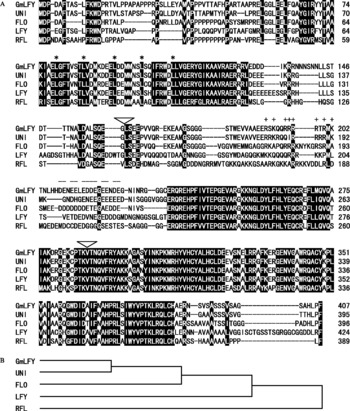
The sequences near the translation start site correspond to the eukaryotic consensus sequence GCC(AG)CCATGG (Kozak, Reference Kozak1999). We selected three different long-fragment insertion clones of the 5′ RACE-PCR product for sequencing, and the results of sequencing showed that their sequence length before the putative translation start site in this study was very short because of a high GC content (data not shown). Furthermore, the sequences of LEAFY proteins are quite conserved (Fig. 1). The sequence length and homology of the translated product of GmLFY lead us to conclude that we have obtained a full-length clone.
Alignment and dendrogram of several LFY/FLO proteins. (A) Comparison of the amino acid sequence of GmLFY with other LFY/FLO-like proteins: UNI in Pisum sativum (accession number: AF010190), FLO in Antirrhinum majus (accession number: M55525), LFY in Arabidopsis thaliana (accession number: M91208), and RFL in Oryza sativa (accession number: AB005620). The leucine repeats are marked with an asterisk. The basic and acidic regions are labelled ‘+’ and ‘-’, respectively. The conserved sites of introns are indicated by triangles. (B) Dendrogram of LFY/FLO proteins.
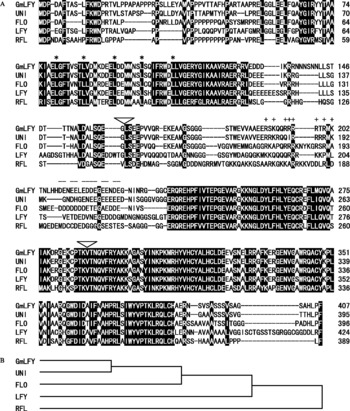
Comparison of genomic and cDNA sequences established the exon/intron structure of the soybean GmLFY gene. The first intron was 483 bp in length, while the second was relatively longer (887 bp in length). Two introns contained the canonical GT–AG binucleotide splice site junctions (data not shown). The conserved splicing sites of introns were observed between GmLFY sequence and other published LFY/FLO homologues (Fig. 1A) after alignment. The genomic and cDNA sequences for GmLFY have been deposited in GenBank under the accession numbers DQ448809 and DQ448810, respectively.
The deduced GmLFY protein containing 407 amino acid residues had a molecular mass of 46.0 kDa. A search in GenBank protein databases revealed that GmLFY shared 73.6% identity to Antirrhinum majus FLO, and 63.7% to Arabidopsis thaliana LFY. High sequence similarity was obviously observed among the homologues in other legume species, such as Medicago truncatula, Pisum sativum and Lotus japonicus. It exhibited 83.9% sequence identity to UNI of Pisum sativum. Further comparison of GmLFY with data from conserved domain databases (CDD) revealed that GmLFY showed 69.8% identity to the 393 residue conserved domain of the LFY/FLO protein (CDD accession number 41731, data not shown) at its C-terminus. The high similarity between GmLFY and other LFY/FLO-like proteins suggests that they may have conserved functions. However, it showed relatively low sequence identity (55.1%) to RFL, a LFY/FLO homologue of rice. A phylogenetic tree was constructed using GmLFY protein and selected LFY/FLO proteins from other plants (Fig. 1B).
GmLFY showed the presence of several typical motifs characteristic of transcription factors (Fig. 1A). First, the GmLFY protein had a Pro-rich tract (20–29) in the N-terminus, which could be involved in transcriptional regulation (Esumi et al., Reference Esumi, Tao and Yonemori2005). Secondly, a short leucine zipper of Leu79, 86, 94, 102, followed by a basic region, essential for protein dimerization and DNA binding, was also present. Thirdly, the protein contained a highly acidic region (between Asp208 and Glu213), a typical transcription activation domain, which appeared to interact with parts of the transcription complex (Weaver and Hedrick, Reference Weaver and Hedrick1997). Finally, the C-terminal region of GmLFY contained a serine-rich region (391–403), a putative activation domain. These motifs have been suggested to be required for the correct recognition and/or activation of promoter elements of downstream genes (Mitchell and Tjian, Reference Mitchell and Tjian1989).
Subcellular localization of the GmLFY–GFP fusion
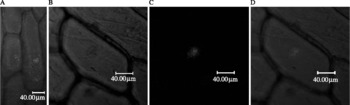
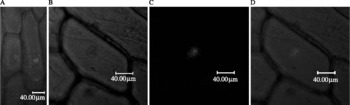
LFY was identified as a transcription factor by in vivo analysis (Busch et al., Reference Busch, Bomblies and Weigel1999; Wagner et al., Reference Wagner, Sablowski and Meyerowitz1999). However, we failed to identify a nuclear localization signal (NLS) for GmLFY (data not shown). Therefore, to assess the subcellular localization of the GmLFY protein, a construct containing a translational fusion of its ORF to the GFP reporter gene under the control of a 35S promoter was used to transform onion epidermal layers. Confocal imaging of GFP fluorescence showed that the GmLFY–GFP fusion protein was located in the nucleus (Fig. 2). In contrast, the GFP fluorescence was distributed throughout the cells when the onion epidermal layers were treated with the 35S::GFP construct (Fig. 2A). This suggests that GmLFY was located in the nucleus, although it did not contain a typical plant NLS.
Subcellular localization of GmLFY protein. Onion epidermal cells were transiently transformed with 35S::GmLFY-GFP (panels B, C and D) and 35S::GFP (panel A). After incubation for 24 h, cells were observed with a confocal microscope. Panel B is a bright-field image; panel C is a fluorescence image, and panel D shows the merged images.
Expression pattern of GmLFY in soybean tissues
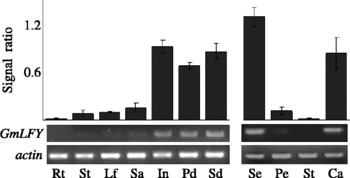
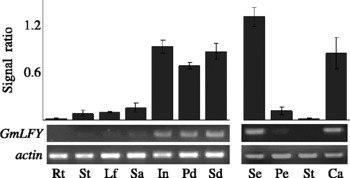
A semi-quantitative RT-PCR method was used for quantification of GmLFY expression, with the actin gene as an internal control. For RT-PCR, we designed a pair of gene-specific primers that flanked the second intron to avoid genomic DNA contamination. As shown in Fig. 3, expression of GmLFY was clearly detected in all of the examined reproductive tissues, such as inflorescence (In), pods (Pd) and developing seeds (Sd). Furthermore, we detected the transcripts in stems, leaves and shoot tips at relatively low levels, whereas no GmLFY transcript was detectable in roots. These results indicate that GmLFY may play multiple roles in soybean development, especially in the reproductive tissues. Moreover, GmLFY was highly expressed in sepals and carpels, but showed very low abundance in petals and stamens (Fig. 3), which was very similar to the expression pattern of ALF2, a LFY/FLO orthologue of apple (Wada et al., Reference Wada, Cao, Kotoda, Soejima and Masuda2002). This indicates that GmLFY, as well as ALF2, were possibly required during late development of sepals, petals and carpels.
Tissue-specific expression of the GmLFY gene in soybean tissues. From the left: Rt, roots of seedlings; St, young stems; Lf, leaves; Sa, vegetative shoot apices; In, inflorescence apices; Pd, young pods without seeds; Sd, developing seeds at 15 DAF; Se, sepals; Pe, petals; St, stamens; Ca, carpels. Three replicates of each experiment were performed independently, but only one of the similar images is shown here. Standard errors are indicated.
Expression of GmLFY in developing soybean seeds
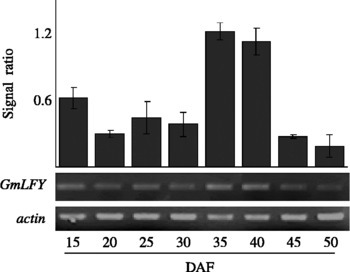
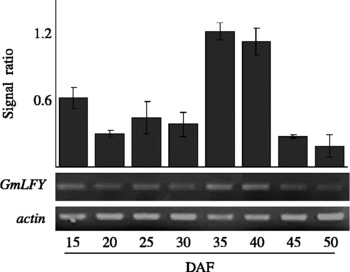
We investigated the expression pattern of GmLFY in developing seeds (Fig. 4). The expression of GmLFY roughly followed a bell-shaped pattern over the developmental period. It was expressed at a medium level in seeds at 15 DAF and then decreased in 20 DAF seeds. Thereafter, it increased sharply, reaching its maximum between 35 and 40 DAF, and decreased immediately after that time point. The expression pattern and expression level of GmLFY in the developing seeds were apparently dependent on the status of seed growth during seed filling.
Expression of GmLFY in developing soybean seeds. Three replicates were independently analysed with similar results, and a representative experiment is shown here. Standard errors are indicated. DAF, days after flowering.
Although many LFY/FLO-like genes have been characterized, so far there are no reports of LFY/FLO-like genes expressed in seeds, using comprehensive genomic or proteomic approaches. Beilinson et al. (Reference Beilinson, Moskalenko, Ritchie and Nielsen2005) identified a gene, differentially expressed in developing soybean seeds, which showed extensive similarity with the TERMINAL FLOWER 1 (TFL1) gene in Arabidopsis. TFL1 affects the developmental phases of Arabidopsis by delaying the up-regulation of LFY (Ratcliffe et al., Reference Ratcliffe, Bradley and Coen1999). Although the TFL-like gene was expressed in soybean seeds at 21 DAF, a LFY/FLO-like gene had not yet been demonstrated to be expressed in seeds at this developmental stage. We found the transcripts of GmLFY in seeds, supporting the putative role of the TFL1-like gene in the regulation of GmLFY transcript abundance in soybean seeds. Further analysis should be carried out to dissect the roles of the GmLFY and TFL1-like genes in developing soybean seeds.
Acknowledgements
This work was supported in part by National 973 project (2004CB117206), 863 project (2006AA1021C1, 2006AA10A111), National Natural Science Foundation of China (30490250), and an award grant for Outstanding Scholars from the Ministry of Education of China.