This article draws upon my experience using film and literature to teach political science majors and non-majors about war.1
In a typical semester, my class at Duquesne University has about 18–20 undergraduate students, whose majors have included pharmacy, forensics, and music. Few have any social-science training or experience writing the sort of analytic essays that constitute the graded assignments. I have also had a graduate section of two to five students from a master's-level Conflict Resolution and Peace Studies program in the same class. These students write a research paper in addition to the work assigned to the undergraduates.
Why Use Literature and Film to Teach a Course on War?
I devised the course as a way to connect my work in social science with my background and interests in the humanities, and because I thought such a course would be enjoyable for students. The course attracts non-majors, many of whom enroll out of interest in movies or war or both, and who, in the course of the semester, can become more engaged in thinking about the politics of war. For the majority in the class who have never studied war's social, cultural, and political significance, the course introduces the idea that war is a social phenomenon to be analyzed, rather than a quasi-natural phenomenon to be taken for granted.
The course also introduces issues in political psychology and cultural politics that non-majors, and even some majors, might not initially think of as part of the political science curriculum, particularly:
- What accounts for the attraction that war holds for many people?
- How is becoming a warrior linked to male identity?
- How does another group become “the enemy”?
- How do normal people become able to kill enemy soldiers and even non-combatants, and at what psychological price?
- What myths do societies create about war, and how can film and literature perpetuate or contest these?
For those with some background in political science or international relations, the more concrete and experiential perspectives offered in films and literature may help ground the abstract generalizations typical of scholarly perspectives on war. The individual-level perspectives in books like All Quiet on the Western Front or Tim O'Brien's Vietnam memoir If I Die in a Combat Zone can provide an inductive basis for theorizing political issues pertaining to war. For example, the scene in All Quiet in which the narrator's comrades naively speculate about the causes of war can serve as an entry-point for a discussion of international-relations theories about war's causes, or of soldiers' apparent indifference to the political decisions that have sent them to the battlefield. Discussing the film The Battle of Algiers can help make more concrete such concepts as nationalism, or the political, moral, and strategic problems of counterinsurgency warfare. Individual-level narratives in films and literature can counterbalance academic and popular images of war, insofar as the latter tend to exclude human-level concerns and costs.
The course also provides an engaging way for students to gain historical literacy. Through exposure to the course materials, students can learn about World War I, World War II and the Holocaust, the Algerian Revolution, the Vietnam War, the 1991 Gulf War, the Rwandan Civil War and genocide, and the current Iraq War. As students approach the works, I distribute a one-page hand-out (a sample appears with the course syllabus, available at www.policycenter.duq.edu/facLieberfeld.htm and www.apsanet.org/ps/lieberfeld07july.html) that provides historical context and salient biographical facts about the author or director.
The morality, politics, memory, and even the sensory experience of war are all contradictory, complex, and ambiguous. Since good literature and films about war are nuanced, studying them helps students practice more nuanced thinking. By sharpening their critical perspectives on the mythology and popular images of war, and by analyzing the cultural politics of literature and film, students can become more able decoders of political messages, as well as more sophisticated consumers of political information. As in other classes, students have opportunities to hone their expressive skills and practice the basics of reasoned argument, such as selecting appropriate evidence to ground their generalizations about a work and its meaning.
Course Themes and Content
This section is organized around the thematic questions raised at the outset concerning war's attractions, the connections between masculinity and willingness to kill, and the mythologization of particular wars for domestic political purposes.
Generation Kill, a book by a journalist embedded with a Marine unit during the invasion of Iraq, and Three Kings, a fiction film about the 1991 Gulf War, can promote discussion of what accounts for war's attraction in the popular imagination and for the emotional and physical highs of combat. All Quiet on the Western Front contrasts the vital intensity of war with the relative dullness of civilian life. Rambo: First Blood, Part II illustrates how the dichotomy between the warrior's world and the civilian bureaucracy can be spun into political myth.
The depictions in Full Metal Jacket and If I Die in a Combat Zone of basic training's manipulation of masculine identity are good starting-points for investigating links between war and masculinity, and, thus, between masculinity and the dehumanizing and killing of the enemy. The ideological connection between masculinity and willingness to kill human enemies is posited in Saving Private Ryan and more overtly in Generation Kill. Other works that highlight dehumanization of enemy out-groups and the killing it permits include Hotel Rwanda, Primo Levi's Survival in Auschwitz, Art Spiegelman's graphic novel Maus (part II of which, And Here My Troubles Began, stands well on its own), and All Quiet on the Western Front, as well as the documentary films Winter Soldier and The Fog of War, and, more subtly, Three Kings and The Battle of Algiers. To further explore the issue of representations of enemy “others” and their relevance for war, I have recently used a video documentary, Game Over: Gender, Race & Violence in Video Games.2
Though perhaps overly didactic, this documentary has the virtue of promoting student debate, since students may have more extensive knowledge of video games than of either film or literature. A key to keeping the discussion focused is to evaluate the presentation's actual claims in light of the evidence it provides. This might apply to Fahrenheit 9/11 as well.
A related theme is the psychological price paid by combat soldiers and by civilian survivors of war and genocide—costs often missing from official and academic discourses on war. The early scene in which General Mireau reviews the troops in Stanley Kubrick's Paths of Glory illustrates this erasure.3
I have also assigned Jonathan Shays's Achilles in Vietnam (Atheneum, 1994) and Odysseus in America (Scribner, 2002), which use innovative readings of Homer's epics to elucidate the effects of combat trauma. Shays's treatment is excellent, but possibly off-putting for some students, particularly those with no background in psychology or Greek mythology.
Some of the richest works use the extreme conditions of war to investigate what is human, and what is lost in becoming dehumanized. Both Maus and Survival in Auschwitz highlight this question. Hotel Rwanda not only helps students consider the motives and circumstances that lead to genocide, but also shows how the measure of its central figure's heroism is his widening range of concern for his fellow humans. The film's representation of the outside world's indifference to the genocide can open the way to considering why humanitarian and human-rights concerns are political as well as moral matters. Letters from Iwo Jima may also be of interest in that it breaks with the invisible or de-individuated enemies typical of the genre, by giving recognizable human qualities and individual personalities to enemy soldiers. While stock villains and undifferentiated enemies drain war of moral ambiguity, work such as Eastwood's calls attention to those ambiguities.
The meta-theme of the course is the contrast between the mythology typical of nationalistic and propagandistic conceptions of war, and the lived experiences of actual soldiers. Throughout, the course juxtaposes narratives that report soldiers' experiences, and their skepticism toward nationalistic and militaristic culture, alongside cultural products that romanticize war and that try to raise popular support for it. At the outset, I ask students to contrast the religious-nationalistic images of war in the poem “The Soldier,” written by Rupert Brooke early in WWI, with the poem “Dulce et Decorum Est,” written by fellow soldier Wilfred Owen. Owen describes a scene of death, blinding, and asphyxiation wrought by mustard gas, and advises readers not to repeat the “old Lie” about the sweetness of dying for one's country. Brooke and Owen's divergent perspectives can serve as reference points for juxtaposition and analyses of other works.
For example, much of O'Brien's work—particularly If I Die in a Combat Zone, and “How to Tell a True War Story” from The Things They Carried—engages the question of what is real experience in war and what is nationalistic mythology and cultural-political mythmaking. In the latter book, O'Brien also explores how fiction can at times articulate larger truths about war, particularly war's psychological effects, that more strictly factual accounts may fail to convey. O'Brien, like Owen and Remarque, sets out to refute the nationalist falsehoods that led to the death and maiming of his brothers-in-arms. Their work helps convey to students that popular ideas about war's inevitability, righteousness, and glory often serve particular political interests, while anti-war narratives that report their authors' direct experiences of war are concerned with puncturing nationalist mythology.
The first half hour of Private Ryan powerfully recreates the terror and sensory disturbances of combat, providing one of its more realistic cinematic representations. One can contrast Spielberg's vision of the invasion of Omaha Beach with the beach landing scene in the John Wayne vehicle The Sands of Iwo Jima, with its unflappable hero and a patently sanitized battle scene. Students can appreciate the differences in the films' willingness to depict the realities of death and suffering in war: while both are Hollywood products, the Wayne film's mythmaking naturalizes combat, while Spielberg's highlights the chaos and carnage of the battlefield. Of course Private Ryan is not anti-war: it differs from All Quiet on the Western Front or Kubrick's war films by presenting a nearly elegiac vision of a caring military bureaucracy and by imputing a strong link between killing and manhood.
Contrasting perspectives can help students see how cultural products may convey political messages, and that the “lessons” of a war, particularly a lost one, are heavily political. Students can recognize that a film like Rambo: First Blood, Part II draws more on the plot conventions of the action comic book than on the actual history of the Vietnam War, but focused analysis can help them understand the film's political messages and their significance. One can begin by analyzing with students how the film inverts the central realities of the war: in the film there is little doubt about the casus belli. According to this vision, the Vietnamese are merely pawns of the Soviet Union; they appear to have no national motives, or honor, or any fighting ability. U.S. soldiers are clearly victims and good men who never commit gratuitous acts of destruction or burn villages. And far from ever raping local women or using them as prostitutes, Rambo always respects women; in fact, a Vietnamese woman falls in love with him and, by extension, with the U.S. In this version the helicopters—a prime symbol of U.S. power in the real war—belong to the enemy, who uses them to attack the underdog American hero with a napalm-like explosive. In contrast to U.S. (and French) over-reliance on technology, Rambo merely carries a knife and bow and arrows. He knows the countryside and the local language, and travels unencumbered and at one with nature. He is the hunter, never the obvious, lumbering target described by O'Brien. Engaging students in a discussion of why the Reagan-era film inverts the central realities of the war can lead to consideration of how, following other lost wars, nationalists propagated the myth that the war could have been won had not disloyal groups at home betrayed the soldiers and stabbed their own societies in the back.4
As with Germany post-WWI, and France post-Algeria. I assign a chapter on the “stab-in-the-back” myth from Jerry Lembke's The Spitting Image (New York University Press, 1998). Susan Jeffords explores the cultural politics of hyper-masculine heroes like Rambo and the mythologization of the U.S. defeat in Vietnam in Hard Bodies: Hollywood Masculinity in the Reagan Era (Rutgers University Press, 1994).
Artificial images of heroism and glory can be usefully contrasted with blatantly satirical perspectives on war. For example, Kubrick's Dr. Strangelove memorably lampoons the fallibility of political and military leaders, as well as the culture that links war and masculine identity.
The media's reporting of war is a theme in several works, particularly Control Room (a documentary about Al-Jazeera television and the Iraq War), Three Kings, and parts of Fahrenheit 9/11. The Battle of Algiers and Generation Kill also comment indirectly on the political significance of the media in counterinsurgency warfare, and Hotel Rwanda illustrates how media can propagate genocidal ideology or help mobilize international opinion in favor of humanitarian intervention.
In terms of course organization, I usually begin with material dealing with World War I and end with material dealing with more recent wars, including the U.S.-led war in Iraq; however, the presentation of material is primarily thematic, not chronological. I identify several of the main course themes in early works, and keep referencing them as they reappear in subsequent works, while also layering in additional themes, rather than treating each theme discretely. I also vary the emotional difficulty of the works; due to the at-times intense and disturbing nature of the subject matter, I try to pace course materials so that students encounter a comic/satirical perspective every few weeks: Dr. Strangelove, Three Kings, and Maus all contain comic elements, and when the course is in danger of seeming unrelievedly heavy, I show the second half of Duck Soup for some (merciless) comic relief.
Developing Students' Capacity for Analysis
Students unaccustomed to analyzing the political content of cultural products often respond to works at the level of “I liked/didn't like it.” Early in the course I tell students that I select the films and books partly because I think students will enjoy them, but that this consideration is secondary to the work's content, and that they should not expect to like everything we study. Rather, the goal is to identify the central perspective in the work and what the work reveals about war.5
Primo Levi, in particular, will be difficult for some students, due not only to the subject matter, and to occasional foreign phrases and classical references, but also to the author's somewhat suppressed passion and clinical language, which can leave a superficial impression of dryness and detachment. I try to give students enough background on Levi's intentions so that they have an idea of what to expect and are better able to appreciate the reasons for the book's intensely detailed observations. I preemptively tell students that the work is worthwhile and express confidence that they will get a lot out of it, and at least some of them do.
Beyond merely describing what happens in a book or film, students should expand their capacities for analysis of the work's significance. Thus, students' responses should progress through the stage of “I liked it,” to “I can identify the author's intentions and articulate how the form of the work reflects those intentions,” and from there to “I can discuss the issues the work raises, see it in the context of other works, and understand its larger cultural/political significance.”
In order to move beyond “I liked it,” students need to learn to see film, especially, not as a fully-formed product whose origins are unquestioned, but as a carefully crafted fabrication reflecting deliberate choices by individuals and teams of people who have elected to tell a particular story in a particular way, and containing a political perspective that can and should be interrogated.
To show how films are deliberate constructions and, in the case of fiction films, complete illusions, one might draw students' attention to the deliberate choices that the director made regarding camerawork, lighting, soundtrack, acting, location, script, casting, editing, etc. For example, the class can consider how Kubrick pushes audiences to identify with the admirable Colonel Dax in Paths of Glory, rather than with the odious General Mireau, by choosing to shoot the early scene in the trenches from Dax's point of view, while having the camera retreat as Mireau approaches. One might also remind students of the constructed nature of fiction films by contrasting their actual locations—Mexico for Rambo, Arizona for Three Kings—with their fictional ones.
After contrasting the more realistic combat scenes in Private Ryan with those in The Sands of Iwo Jima, I also call students' attention to the mythologized nature of the Private Ryan narrative, as indicated, for example, by the impossibility of the film's framing story: Private Ryan, unlike his dead brother, wasn't part of the landing at Omaha Beach and could not possibly have the vivid memories of the landing that the film's framing narrative says he has. One might also note the implausibility of the scene in which General George Marshall takes time from directing the war effort in the aftermath of D-Day to express a personal interest in the Ryan family (and also happens to have in his desk a rare document like President Lincoln's letter to Mrs. Bixby).
Some students may be unclear about generic terminology, such as “documentary,” “memoir,” “fiction,” and “fiction-based-on-fact.” It may be helpful to ask them to identify each work's genre, while noting that some works deliberately blur these categories, particularly O'Brien's (although not If I Die in a Combat Zone). Some students may find this element of ambiguity in O'Brien's work, and the overt unreliability of some of his narrators, discomfiting. It may be helpful to discuss the difference between authors' deliberately misleading readers and their using a fictional version of real experience to express an underlying truth or reveal the complexities and ambiguities that often characterize soldiers' experiences of war.
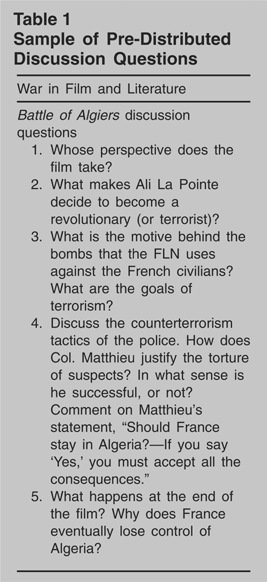
I also provide questions for in-class discussion, either before or after students read or watch the work under consideration (see Table 1 for an example). I sometimes have the class address these questions in small groups, which then report back to the whole class. Varying small-group with whole-class discussions seems useful, since some students do better with one setting or the other.
Sample of Pre-Distributed Discussion Questions

Most students do the reading and viewing voluntarily, but I find it useful to give weekly, extremely short quizzes, consisting of two factual, not interpretive, questions that should be obvious to anyone who did the assignment (e.g., “What is in the box that Paul gets at the airport in the first scene of Hotel Rwanda?”). Students can, for any reason, opt out of no more than two of these ridiculously easy quizzes during the semester.
Students should view the films outside of regular class time. The class can decide on a regular time for screenings in an on-campus auditorium (at which a designated student can, possibly for extra credit, run the DVD player and projector). While advocating that students see the films on a big screen, I also make a copy available for viewing in the library, and students can also rent (or possibly download) films to view at home. After they have watched a film outside class, I select some scenes for in-class screening and discussion.
In teaching a course about the cultural politics and politics of war, particularly regarding controversial current or recent events such as the Iraq War, one may well be faced with the question of how much of one's own political outlook to reveal. It may be helpful to explain to students that the guiding principle is distinguishing reality from myth. Rather than criticizing the adherents of particular political views or parties, the course tries to promote students' willingness to think critically, as opposed to unthinking acceptance of government propaganda.6
A concise overview of the extensive history of the U.S. government's use of Hollywood films as pro-war propaganda can be found in Jeffrey Smith, War and Press Freedom: The Problem of Prerogative Power (Oxford University Press, 1999), 215–9.
Author Bio
Daniel Lieberfeld teaches in Duquesne's programs in political science, peace studies and conflict resolution, and international relations, and in the Graduate Center for Social and Public Policy. His articles have appeared in the American Behavioral Scientist, American Scholar, International Negotiation, Film Quarterly, Journal of Peace Research, Logos, Middle East Policy, Negotiation Journal, and other publications. He is the author of Talking With the Enemy (Praeger, 1999).