Introduction
Junglerice [Echinochloa colona (L.) Link] is an annual C4 species that is considered to be among the most problematic grass weed species globally (Holm et al. Reference Holm, Plucknett, Pancho and Herberger1977; Rao et al. Reference Rao, Johnson, Sivaprasad, Ladha and Mortimer2007). This species is native to tropical and subtropical Asia and is a major weed in many crops across the world including rice (Oryza sativa L.), corn (Zea mays L.), sorghum [Sorghum bicolor (L.) Moench.], sugarcane (Saccharum officinarum L.), cotton (Gossypium hirsutum L.), peanut (Arachis hypogaea L.), and cassava (Manihot esculenta Crantz) (Holm et al. Reference Holm, Plucknett, Pancho and Herberger1977). In the United States, E. colona is distributed throughout the West Coast, all the southern states, several central states (Missouri, Kansas, Kentucky), and some northern states (Montana, Illinois, Virginia, Pennsylvania, New Jersey, Massachusetts, and Vermont) (USDA-NRCS 2017).
Echinochloa colona is known to have the ability to grow under a wide range of ecological conditions (Manidool Reference Manidool1992), including various adverse conditions such as high salinity (Sherif 2007), and is adapted to a range of habitats, including both cropland and non-cropland areas (Peerzada et al. Reference Peerzada, Bajwa, Ali and Chauhan2016). In recent years, there has been increased interest in E. colona, particularly in California, because of the increased prevalence of glyphosate-resistant (GR) populations of this species in agricultural cropping systems (Alarcón-Reverte et al. Reference Alarcón-Reverte, García, Urzúa and Fischer2013). Although this species commonly occurs in summer annual crops in California, concerns about its increasing prevalence and means of control have surfaced in high-value perennial cropping systems where glyphosate is a predominant POST control method for many weed species (Alarcón-Reverte et al. Reference Alarcón-Reverte, García, Urzúa and Fischer2013, Reference Alarcón-Reverte, García, Watson, Abdallah, Sabaté, Hernández, Dayan and Fischer2015; Moretti et al. Reference Moretti, Garcia, Fischer and Hanson2013). As such, there is renewed interest in improving knowledge on the biology and ecology of this species in California.
Many annual crop areas in California, including areas with relatively high soil salinity in the southwestern part of the San Joaquin Valley (SJV), have been converted into high-value perennial crops such as almond (Prunus dulcis, syn. Prunus amygdalus), grape (Vitis vinifera L.), and pistachio (Pistacia vera L.). For example, from 1985 to 2011, almond acreage increased from approximately 161,900 ha to 307,560 ha (Giesser and Horwath Reference Giesser and Horwath2016). Similar increases in cultivated area have also been reported for pistachio. In 2012, the total pistachio area in California was estimated at approximately 72,000 ha (California Department of Agriculture 2013). Scudiero et al. (Reference Scudiero, Corwin, Anderson, Yemoto, Clary, Wang and Skaggs2017) estimated that approximately 320,000 ha of the southwestern part of the SJV are saline, that is, these soils have electrical conductivity (EC) levels >4 dS m−1, with some areas having EC levels >16 dS m−1. As mentioned earlier, E. colona is being noticed with increased frequency in these areas (Moretti et al. Reference Moretti, Garcia, Fischer and Hanson2013). In addition, this species was prevalent even under frequent droughts in recent years in this semiarid, predominantly irrigated region of California. Therefore, information on adaptation of E. colona to these soil stress conditions in orchard systems in California is necessary.
Considerable information has been developed on the germination ecology of E. colona under a range of moisture and salt stress conditions (Chauhan and Johnson Reference Chauhan and Johnson2009). Similarly, information has also been developed on its growth and reproduction under a range of soil moisture (Chauhan and Johnson Reference Chauhan and Johnson2010) and salinity conditions (Chauhan et al. Reference Chauhan, Abugho, Amas and Gregorio2013). However, it is not known whether there are differences between the GR and glyphosate-susceptible (GS) biotypes of E. colona in their adaptation to soil and moisture stress conditions, seed production ability under salt stress conditions, and response to intraspecific competition. Therefore, the objectives of this study were to compare a GS and GR biotype of E. colona collected in the SJV in terms of: (1) germination at different water potential (ψ) levels, (2) germination at different salinity levels, (3) growth and reproductive ability at different salinity levels, and (4) response to intraspecific competition between the two biotypes.
Materials and Methods
Seeds Used for Experiments
Seeds used in these experiments were derived from lines originally collected from a vineyard in Tulare County, CA (35.928°N, 119.358°W) and an orchard in Kern County, CA (35.703°N, 119.358°W) in 2011, and previously characterized as GS and GR (approximately 6-fold resistance), respectively (Moretti et al. Reference Moretti, Garcia, Fischer and Hanson2013). The mother plants used to derive the lines were grown under identical conditions in a greenhouse set at 20 C throughout the day without supplemental lighting at the University of California–Davis, Davis, CA. The seeds were stored in a refrigerator at 5 C for approximately 6 mo. The two populations will hereafter be referred to as GS and GR.
Seed Germination under Different Water Potentials
Experiments were conducted in 2015 in a diurnal growth chamber (Model 2015, VWR International, Radnor, PA) located in the Horticulture Unit at California State University, Fresno, CA. Solutions of various water potentials (0, −0.149, −0.51, −1.09, −1.88, −2.89, −4.12, and −5.56 MPa) were prepared using polyethylene glycol (PEG 6000, Fisher Scientific, Houston, TX) according to the protocols of Hardegree and Emmerich (1994). These ψ levels were selected based on a preliminary study (unpublished data). The ψ of the solutions was calibrated with a thermocouple psychrometer (HR 33-T Dew Point Microvoltmeter connected to a C-52 Sample Chamber, Wescor, Logan, UT), as described by Nelsen et al. (1978) and Michel (1983). Prepared solutions were stored in 500-ml conical flasks at a constant temperature of 20 C. Twenty seeds each of the GS and GR populations were placed between two Whatman No. 1 filter papers in separate 100 by 15 mm petri dishes and wetted with 10 ml of the different ψ solutions. The petri dishes were sealed with parafilm (Parafilm MTM Wrapping Film, Fisher Scientific, Houston, TX) and placed in a growth chamber set at 27±2 C with a 12-h photoperiod. This temperature was chosen based on the reports of Chauhan and Johnson (Reference Chauhan and Johnson2009), who found no difference in germination of E. colona among 35/25, 30/20, and 25/15 C day/night temperature regimes. The experimental setup was a completely randomized design, with each treatment replicated five times and two experimental runs. Germinated seeds, defined as having clear extension of both the radicle and plumule, were counted and removed daily. Germination usually ceased by the 5th day. Any seed that failed to germinate in either treatment was collected, washed in distilled water, transferred to a petri dish with 0 mPa solution, and placed back in the chamber to test whether it would germinate. This process provided an estimate of the total number of germinable seeds per treatment. The cumulative numbers of germinated seeds were then expressed as percentages of the total numbers of germinable seeds (Thomas et al. 1994).
Seed Germination under Different Salinity Levels
Experiments were conducted in 2015 in the same growth chamber as described earlier. Solutions of different salt concentrations (25, 50, 100, 150, 200, and 250 mM) were prepared by dissolving 1.46, 2.42, 5.84, 8.77, 11.69, and 14.61 g of laboratory-grade sodium chloride (NaCl) (Fisher Scientific, Houston, TX) in 1 L of water. A 0 mM (control, deionized water) treatment was also included. The salinity of the salt solutions was confirmed with an EC meter (FieldScout Direct Soil EC Meter, Spectrum Technologies, Aurora, IL), and the concentrations corresponded to approximately 0, 2.5, 5, 10, 15, 20, and 25 dS m−1, respectively. These EC levels were chosen to mimic some of the soil EC levels found in the western part of the SJV. The germination protocols and experimental design were similar to those described earlier. The experimental design was similar to the water potential study, and the study was repeated once.
Soil Salinity Stress during Plant Growth and Development
The study was conducted at the California State University Horticulture Unit greenhouse in spring 2015 and repeated in summer 2015. The greenhouse temperature was set at a constant 22±3 C with no supplemental lighting. The GR and GS seeds were planted in plastic seedling trays containing a commercial potting soil (Sunshine® Mix #3, Sun Gro Horticulture Canada, Vancouver, BC, Canada) on April 13 and June 1, respectively, in the spring and the summer studies. At the 1-leaf stage (April 20 and June 8, respectively, in the spring and summer studies), seedlings were transplanted into 3.78-L polythene pots containing field soil. The soil was collected locally from a field that had no recent history of herbicide use. The seedlings were allowed to establish for 3 d before salinity treatments were applied. Salt solutions (EC of 0, 5, 10, 15, or 20 dS m−1) were prepared by dissolving laboratory-grade NaCl in deionized water. The amount of NaCl used to prepare each of the concentrations was 0, 3.2, 6.4, 9.6, and 12.8 g NaCl L−1 H2O. The concentrations were also calibrated with an EC meter (FieldScout Direct Soil EC Meter, Spectrum Technologies, Aurora, IL). In each treatment, plants were irrigated with 100 ml of a respective salt solution on alternate days beginning on the 4th day after transplanting. No supplemental fertilizer was added to any of the pots. The experimental design was a randomized complete block with factorial arrangement of treatments (E. colona biotype and salt level), and each treatment was replicated four times. Plant height (from soil level to tip of the panicle) was measured weekly and just before harvest. All the plants were destructively harvested on May 1 and July 20, in the first and second experiments, respectively. The number of seeds on each plant were counted, and the total aboveground biomass, including the seeds, was recorded after plants were dried in a forced-air oven at 60 C for 72 h.
Intraspecific Competition between GS and GR Echinochloa colona Types under Nonsaline Conditions
Studies were conducted outdoors under full sun, twice in 2015 and twice in 2016, at the California State University Horticulture Unit. Seeds of the GS and GR E. colona were planted as in the studies described earlier. Seeds were planted on April 2 and July 3, in the first and second experiments, respectively, in 2015; and on March 19 and June 18, in the first and second experiments, respectively, in 2016. Once the plants reached the 2- to 3-leaf stage (approximately 1 wk after planting), they were transplanted into 15.1-L polythene pots containing field soil that had no history of herbicide use. Each pot received four transplants with different ratios (4:0, 3:1, 2:2, 1:3, and 0:4) of GR and GS plants in a replacement series experimental design. Each plant was labeled with a small plastic stake for identification. Each treatment was replicated four times, and the experiment was arranged as a randomized complete block. All the pots were watered at 1.1 L pot−1 once every 2 d. Each pot was also fertilized with 100 ml of a solution containing 4 g of commercial fertilizer (Miracle-Gro®, Scotts Miracle-Gro Products, Port Washington, NY) twice during the growing season. After 6 wk of growth, all the aboveground biomass for each plant was harvested individually on May 16 and August 20 in the first and second experiments, respectively, in 2015; and on May 14 and August 14 in the first and second experiments, respectively, in 2016. Plant height was measured before harvesting. The plants were clipped at the soil surface, the number of seeds per plant were counted, and the aboveground plant parts and seeds were separated and stored in paper bags and oven-dried at 60 C for 72 h, and the dry weights were recorded.
Statistical Analysis
Biotype (GS and GR) and the imposed treatments (water potential, salinity, and intraspecific competition levels) were considered fixed effects, while experimental runs and replications were considered random factors. All possible interactions between the fixed and the random effects were also tested. In all cases, data were tested if the assumptions of ANOVA were met using the Shapiro-Wilk’s test for normality and Levene’s test for homogeneity of variance at a 0.05 level of significance. Data were log transformed before further analysis to meet the assumptions of ANOVA, when necessary. Data were analyzed using PROC GLIMMIX procedures of SAS v. 9.4 (SAS Institute 2012), and PDIFF option was used to separate the means whenever the ANOVA indicated significant difference at the 0.05 level.
For the water potential and salinity experiments, differences between the biotypes at each treatment were also analyzed using the GLIMMIX procedure of SAS; pdiff option was used to separate the means whenever the ANOVA indicated significant difference at 0.05 level. Data were further analyzed using nonlinear regression models and fit with a sigmoidal three-parameter model (SigmaPlot v. 12.3), which took the following form:
 $$y{\,\equals\,}a\,/\left\{ {1{\plus}exp\left[ {{\minus}\left( {x{\minus}x_{0} } \right)\,/\,b} \right]} \right\}$$
where y is the response variable; a is the upper asymptote (maximum); x is the fixed variable; x 0 is the water potential or salt concentration resulting in 50% value of y; and b is the slope of the curve at x 0.
The relative competitiveness among the biotypes was examined using replacement series indices (Equations 1 to 7) as proposed by Cousens and O’Neill (1993) and described by Bagavathiannan et al. (Reference Bagavathiannan, Norsworthy, Jha and Smith2011) and Kumar and Jha (Reference Kumar and Jha2016). Indices for aboveground biomass (shoot dry weight) per plant and seed production per plant were calculated as follows:
(a) Relative yield (RY):
 $$ {\rm RY}\left( {{\rm GS}} \right){\equals}{\rm P}\left( {{\rm GS}_{{{\rm mix}}} \,/\,{\rm GS}_{{{\rm mono}}} } \right)$$
 $${\rm RY}\left( {{\rm GR}} \right){\equals}\left( {1-P} \right)\left( {{\rm GR}_{{{\rm mix}}} \,/\,{\rm GR}_{{{\rm mono}}} } \right)$$
where RY(GS) and RY(GR) are relative yields of the GS and GR biotypes, respectively; P is the proportion of the GS and GR biotypes in the mixture; GSmix and GRmix are yields of the GS and GR biotypes in mixture; and GSmono and GRmono are yields of the GS and GR biotypes in monoculture, respectively.
(b) Relative yield total (RYT):
 $${\rm RYT}{\equals}{\rm RY}\left( {{\rm GS}} \right){\plus}{\rm RY}\left( {{\rm GR}} \right)$$
Indices RY and RYT were calculated for the various mixture proportions (1:3, 2:2, and 3:1). The calculated values of RY and RYT were compared with the expected hypothetical values (H O ) (i.e., RY: 0.25 [1:3], 0.50 [2:2], and 0.75 [3:1]; RYT: 1.00) using a single sample t-test at α=0.05.
(c) Competitive ratio (CR):
 $${\rm CR}{\equals}\left[ {\left( {1{\rm }-P} \right)\,/\,P} \right]\left[ {{\rm RY}\left( {{\rm GS}} \right)\,/\,{\rm RY}\left( {{\rm GR}} \right)} \right]$$
The deviation of CR from the expected value of 1.0 was determined using a one-sample t-test for aboveground biomass and seed production for each pair being compared at α=0.05.
(d) Relative crowding coefficient (RCC):
 $${\rm RCC}\left( {{\rm GS}} \right){\equals}\left[ {\left( {1-P} \right)\,/\,P} \right]\left[ {{\rm RY}\left( {{\rm GS}} \right)\,/\,\left( {1{\minus}{\rm RY}\left( {\rm GS} \right)} \right)} \right]$$
 $${\rm RCC}\left( {{\rm GR}} \right){\equals}\left[ {\left( {1-P} \right)\,/\,P} \right]\left[ {{\rm RY}\left( {{\rm GR}} \right)\,/\,\left( {1{\minus}{\rm RY}\left( {{\rm GR}} \right)} \right)} \right]$$
In comparison between GS and GR for aboveground biomass and seed production, the difference between RCC(GS) and RCC(GR) was tested with a Student’s t-test at α=0.05.
(e) Aggressiveness index (AI):
 $${\rm AI}{\equals}\left[ {{\rm RY}\left( {{\rm GS}} \right)\,/\,2P} \right]{\minus}\left[ {{\rm RY}\left( {{\rm GR}} \right)\,/\,\left( {2\left( {1{\minus}P} \right)} \right)} \right]$$
The deviation of AI from the expected value of 0 was tested for each variable using a one-sample t-test at α=0.05. The indices for CR, RCC(GS), RCC(GR), and AI were computed for the equal proportion (2:2) mixtures of the GS and GR biotypes.
Results and Discussion
Seed Germination under Different Water Potentials
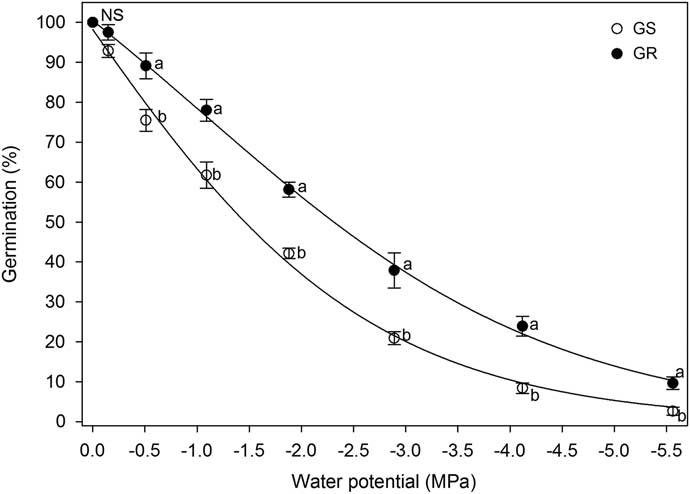
Data were consistent between the two runs, as no interactions (P>0.05) occurred between the experimental run and the biotype or Ψ. Therefore, data for the two experiments were combined. However, biotypes varied in percent germination at the different Ψ levels, as there was an interaction (P=0.0007) between biotype and Ψ; therefore, regression analyses were conducted separately for each biotype. Although overall seed germination was reduced as Ψ decreased, the GR biotype had greater germination than the GS biotype at all Ψ levels (Figure 1). The Ψ level at which 50% germination was reduced was estimated as −1.5 and −2.3 MPa, for the GS and the GR biotypes, respectively. Both biotypes germinated at considerably lower Ψ compared with an E. colona population from the Philippines in which maximum germination was reduced by 50% at −0.46 MPa and completely inhibited at −1 MPa (Chauhan and Johnson Reference Chauhan and Johnson2009). This suggests that E. colona populations from the SJV may have adapted to germination even under dry conditions. Further, the GR biotype evaluated in this study exhibited greater drought tolerance than the GS biotype. However, because this study included only a single GR line and a single GS line, it is not clear whether this may suggest a correlation or is merely coincidental; future research should specifically address the relationship between glyphosate resistance and environmental adaptation with a broader range of E. colona populations or near isolines differing only in glyphosate-response phenotype. The differences in E. colona responses between this study and that by Chauhan and Johnson (Reference Chauhan and Johnson2009) could be related to the selective pressures that the accessions were grown under; the populations from the Philippines may be more adapted to wetter, subtropical conditions, as they were collected from rice fields. The SJV E. colona was also more tolerant to water stress in comparison to other Echinochloa species studied elsewhere. For example, germination of barnyardgrass [Echinochloa crus-galli (L.) P. Beauv.] (Boyd and Van Acker Reference Boyd and Van Acker2004) and barnyardgrass (Echinochloa glabrescens Munro ex Hook. F.) was inhibited by 50% at approximately −0.33 MPa (Opeña et al. 2014).
Effect of polyethylene glycol–induced water potential levels on the germination (mean±standard error of the mean) of glyphosate-susceptible (GS) and glyphosate-resistant (GR) biotypes of Echinochloa colona seeds. Means within each water potential level with different letters are significantly different at a 0.05 level of significance according to the pdiff option. NS, not significant at the 0.05 level of significance.

Seed Germination under Different Salinity Concentrations
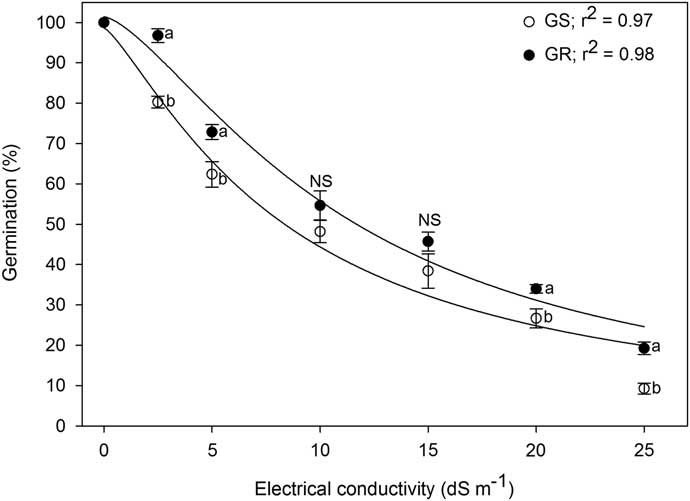
Data were consistent between the two runs, as no interactions (P>0.05) occurred between the experimental run and the biotype or EC level. Therefore, data for the two salinity experiments were combined. However, biotypes varied in percent cumulative germination at the different EC levels, as there was an interaction (P=0.0466) between biotype and EC level; therefore, regressions were conducted separately for each biotype. Although overall seed germination was reduced as EC increased, ANOVA conducted separately for the biotypes at each EC level showed that the GR biotype generally had greater germination than the GS biotype at all EC levels, except at 10 and 15 dS m−1 (Figure 2). Almost 20% of the GR seeds germinated, even at the highest level of EC tested, whereas only 9% of the GS seeds germinated at this level. The EC levels at which 50% germination was reduced were estimated as 8.5 and 12 dS m−1 for the GS and the GR biotypes, respectively. These results are similar to the findings of Chauhan and Johnson (Reference Chauhan and Johnson2009), who reported that germination of an E. colona population from the Philippines was reduced by 50% at 106 mM NaCl (approximately 10.6 dS m−1). Our results suggest that these E. colona populations from the SJV can germinate in strongly saline soils with an EC from 8 to 16 dS m−1 (this range is considered strongly saline according to FAO [1976]).
Effect of sodium chloride–induced salinity concentrations (electrical conductivity) on the germination (mean±standard error of the mean) of glyphosate-susceptible (GS) and glyphosate-resistant (GR) biotypes of Echinochloa colona seeds. Means within each electrical conductivity level with different letters are significantly different at a 0.05 level of significance according to the pdiff option. NS, not significant at the 0.05 level of significance.

Soil Salinity Stress during Plant Growth and Development
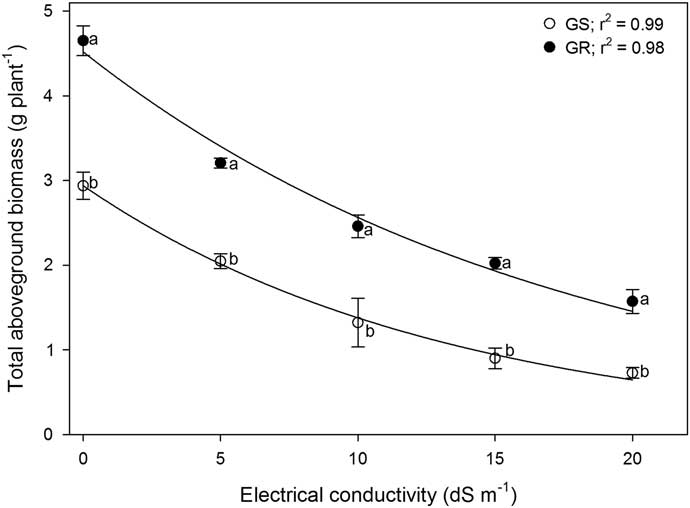
The GR and GS E. colona plants responded differently (P<0.0001) to salinity stress in terms of final aboveground biomass. No interactions occurred between the experimental run and EC level (P>0.05), but there was an interaction (P=0.023) between the biotype and EC level. Therefore, data for the two experiments were combined, but data were further analyzed separately for the biotypes (Figure 3). The overall aboveground biomass of the GR biotype was greater than that of the GS biotype at all EC levels tested; however, aboveground biomass of both biotypes declined with increasing EC levels. The EC levels that reduced aboveground biomass by 50% were estimated as 9 and 11.5 dS m−1 for the GS and the GR biotypes, respectively. Also, plant height at each sampling date was greater in the GR than in the GS biotype at all EC levels (unpublished data). For example, at the 0 EC level, the average heights of the GS and GR plants were 28.4±1.1 and 46.1±2.1 cm, respectively, and at the 20 EC level, they were 11.3±2.0 and 16±1.9 cm, respectively. In the E. colona biotypes evaluated in this study, aboveground biomass was reduced by approximately 65% and 55% in the GS and GR plants, respectively, at 13.5 dS m−1.
Effect of sodium chloride–induced salinity concentrations (electrical conductivity) on the aboveground biomass (mean±standard error of the mean) of glyphosate-susceptible (GS) and glyphosate-resistant (GR) biotypes of Echinochloa colona plants. Means within each electrical conductivity level with different letters are significantly different at a 0.05 level of significance according to the pdiff option.

In contrast to the aboveground biomass results, there was an interaction (P=0.0285) between the experimental runs, biotypes, and EC levels for number of seeds produced per plant. Therefore, data for the two experimental runs were analyzed separately. Furthermore, within each experimental run, there was an interaction (P=0.0038 and 0.0444 for rounds 1 and 2, respectively) between the biotype and the EC level; consequently, data were further analyzed for the effects of EC on seed production per plant within each biotype. Such interactions could be due to seasonal differences when the experiments were conducted. Although the experiments were conducted under same temperature settings in the greenhouse, the photoperiod could have affected the seed production, as no supplemental lighting was used in the greenhouse. The photoperiod in the second experiment was probably longer than in the first experiment, as the second experiment was conducted in midsummer, whereas the first experiment was conducted in late spring. The average daylength during April/May and June/July is 13.5 h and 14.5 h, respectively, at the study location (Weather Atlas, https://www.weather-us.com/en/california-usa/fresno-climate).
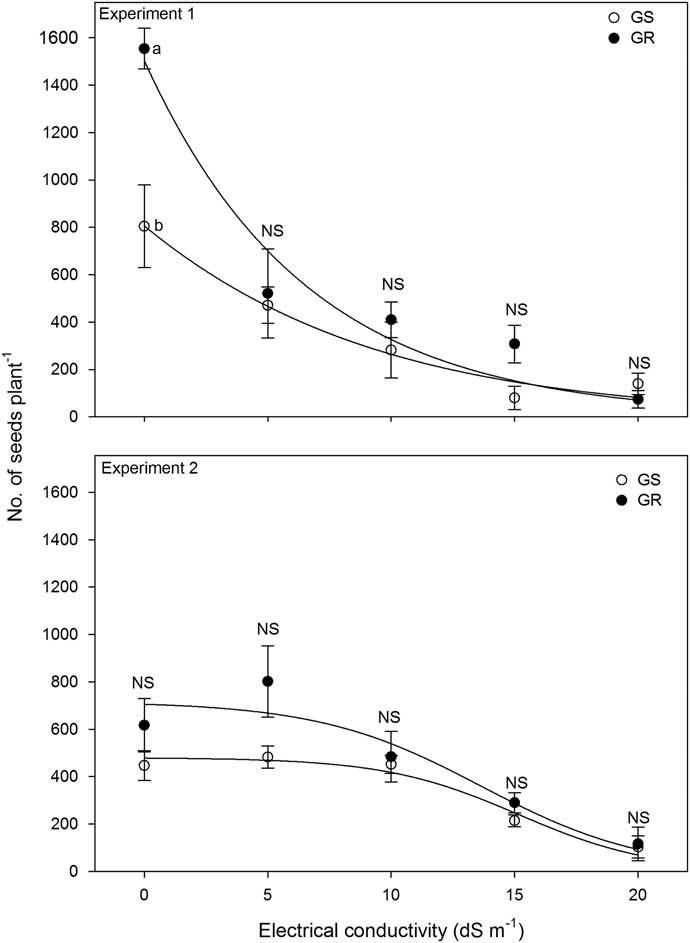
With the exception at 0 dS m−1 in experiment 2, the number of seeds produced per plant was greater for the GR biotype than the GS biotype at EC levels below 10 dS m−1; differences between the biotypes were not evident at higher ECs (Figure 4). On average, in both experiments, seed production per plant was reduced by more than 80% in the 20 dS m−1 compared with the 0 dS m−1 treatment. The E. colona plants still produced approximately 75 to 140 seeds plant−1, depending on the biotype and the experimental run. The viability of the seeds was not evaluated, although the seeds visually appeared similar in shape, size, and color. This suggests that E. colona can reproduce and persist even in highly saline conditions. No studies have been conducted on the effect of soil salinity on E. colona seed production.
Effect of sodium chloride–induced salinity concentrations (electrical conductivity) on the seed production (mean±standard error of the mean) of glyphosate-susceptible (GS) and glyphosate-resistant (GR) biotypes of Echinochloa colona plants in Experiments 1 and 2. Means within each electrical conductivity level with different letters are significantly different at a 0.05 level of significance according to the pdiff option. NS, not significant at the 0.05 level of significance.

Intraspecific Competition between GS and GR Echinochloa colona Biotypes
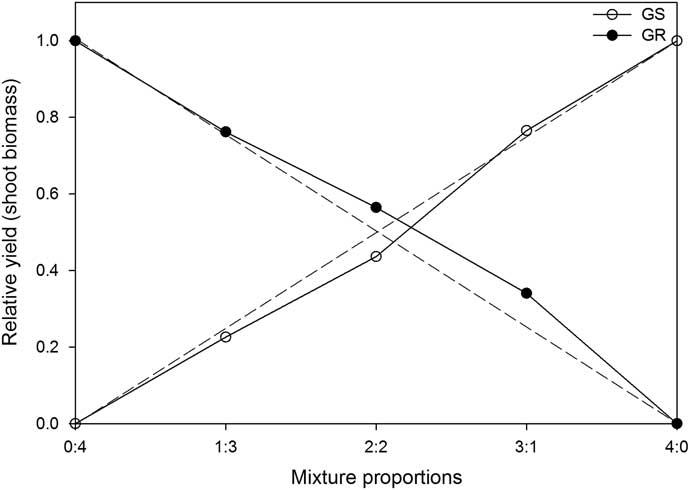
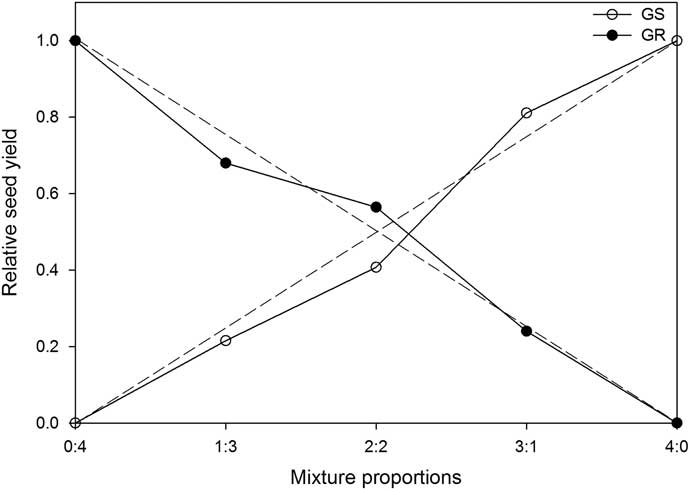
The replacement series experiment showed that the GR biotype was more competitive than the GS biotype of E. colona. The calculated replacement series indices provided estimates of whether the GS and GR biotypes grown at different mixture proportions were equally competitive. The value of RY index will be 0.25, 0.50, and 0.75 for the 1:3, 2:2, and 3:1 proportions, respectively. Significant deviations of RY from the expected value (H O ) indicate that the two biotypes differ in their competitive ability when grown together (Bagavathiannan et al. Reference Bagavathiannan, Norsworthy, Jha and Smith2011; Harper Reference Harper1977; Kumar and Jha Reference Kumar and Jha2016). The calculated values of RY for GS and GR E. colona differed significantly from H O values for both aboveground biomass and total seed production per plant (Figures 5 and 6). The RY index values of the GR and GS biotypes in the different proportions mentioned above were significantly greater and lower, respectively, than their corresponding H O values (Figures 5 and 6). Thus, it can be concluded that this particular GR biotype was relatively more competitive than this particular GS biotype when evaluated in terms of accumulation of aboveground biomass and seed production.
Relative yield (aboveground biomass) computed for different mixture proportions of glyphosate-resistant (GR) and glyphosate-susceptible (GS) Echinochloa colona plants. The dashed lines indicate the expected biomass production if the biotypes were equally competitive, as per Harper (Reference Harper1977).

Relative seed production computed for different mixture proportions of glyphosate-resistant (GR) and glyphosate-susceptible (GS) Echinochloa colona plants. The dashed lines indicate the expected seed production if the biotypes were equally competitive, as per Harper (Reference Harper1977).

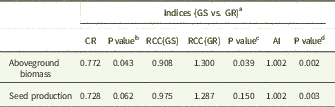
In replacement series experiments, the indices CR, RCC, and AI are used to determine the level of aggression between the competing mixtures in different proportions. When one competing plant is more competitive than another, the estimated values are: CR>1.0, RCC of one competitor>RCC of the other one, and AI>0. However, if CR=1, the RCC of both competitors are equal, and AI=0, then the mixtures being compared are considered equally competitive (Bagavathiannan et al. Reference Bagavathiannan, Norsworthy, Jha and Smith2011; Harper Reference Harper1977; Kumar and Jha Reference Kumar and Jha2016). In the current study, the estimated values of CR and AI for aboveground biomass were significantly different from the expected values of 1.0 and 0, respectively. However, for seed production, while the CR value was not significantly different, the AI index was significantly different from the expected values of 1.0 and 0, respectively (Table 1). A similar trend was observed for the RCC values of the GR and GS biotypes for aboveground biomass and seed production (Table 1).
Estimated indices [CR=competitive ratio, RCC(GS) and RCC(GR)=relative crowding coefficient for GS and GR biotypes, respectively] of aboveground biomass and seed production of glyphosate-susceptible (GS) and glyphosate-resistant (GR) Echinochloa colona when grown together at various proportions in the replacement series experiments averaged over experimental runs.

a Indices were estimated only for 2:2 proportions of GS and GR E. colona.
b P values for one-sample t-test for determining the deviations of CR from 1.0.
c P values for Student’s t-test comparing RCC(GS) and RCC(GR).
d P values for one-sample t-test for determining the deviations of AI from 1.0.
At the 50:50 (2:2) mixture, the GR plants amassed 57% more aboveground biomass than the GS biotype. The GR biotype in general produced more biomass at all ratios and had 76% more biomass than the GS biotype when grown alone. Similar trends were also observed in the number of seeds produced per plant. The GR plants produced approximately 10% more seeds per plant (2,905 vs. 2,589) than the GS plants at the 50:50 ratio. When the plants were grown alone under noncompetitive conditions, the GR plants produced approximately 17% more seeds per plant (3,932 vs. 3,253) than the GS plants. Therefore, this study indicated that this particular GR biotype of E. colona was more competitive than the GS biotype tested and had the ability to produce more seeds. Similar results showing a GR biotype being more competitive than a GS biotype have been reported in other weed species, for example, in rigid ryegrass (Lolium rigidum Gaudin) (Pedersen et al. Reference Pedersen, Neve, Andreasen and Powles2007), horseweed (Erigeron canadensis L.) (Shrestha et al. Reference Shrestha, Fidelibus, Alcorta and Hanson2010), and Palmer amaranth (Amaranthus palmeri S. Watson) (Vila-Aiub et al. Reference Vila-Aiub, Goh, Gaines, Han, Busi, Yu and Powles2014). However, our results contrast strongly with those of Bagavathiannan et al. (Reference Bagavathiannan, Norsworthy, Jha and Smith2011), who found no difference in competitive ability between herbicide-resistant and herbicide-susceptible biotypes of E. crus-galli, and Kumar and Jha (Reference Kumar and Jha2016), who reported a greater competitive ability in a biotype of kochia [Bassia scoparia (L.) A. J. Scott.] resistant to dicamba-fluroxypyr compared with a susceptible biotype. Therefore, the relative competitive ability of herbicide-resistant and herbicide-susceptible biotypes cannot be generalized and can vary by species.
In conclusion, this study showed that these E. colona biotypes from the SJV were highly tolerant to moisture and salinity stress during germination and growth and were able to complete their life cycle and produce seeds even at an EC level of 20 dS m−1. In particular, the GR biotype was more tolerant to moisture and salinity stress than the GS biotype during germination. Furthermore, the GR biotype produced more aboveground biomass and seeds than the GS biotype up to salinity levels of 10 dS m−1, but the two biotypes were equally affected at higher salinity levels. Statements on fitness penalty related to resistance cannot be made in this study, because the two biotypes were collected from different locations where the microenvironments may have played a role in their adaptation, growth, and fecundity. Nor can this finding be generalized for all GR and GS biotypes of E. colona, but it can be concluded that this particular GR biotype has the ability to outcompete this particular GS biotype and become more prevalent in the saline and nonsaline agroecosystems of the SJV. Furthermore, the findings suggest that even in the absence of glyphosate selection, the environmental conditions of the SJV impose advantages for salt-tolerant biotypes of E. colona and the evolutionary responses to both grower- and nature-imposed selections will contribute to the spread and shifting populations of E. colona and other weed species with high genetic variability and phenotypic plasticity.
Acknowledgments
This publication was supported by the USDA’s Agricultural Marketing Service through grant 15-SCBGP-CA-0046. Its contents are solely the responsibility of the authors and do not necessarily represent the official views of the USDA. We also acknowledge partial support from the California State University Agriculture Research Initiative grant (Project No. 16-02-015) and the Fresno State Provost’s undergraduate research grant to PY. No conflicts of interest have been declared. We thank Fresno State students Sarah Parry, Ryan Cox, and Jorge Angeles for their assistance during various phases of the study. We are also grateful to Calliope Correia (Horticulture Unit) and Wendy Cooper (Department of Biology Greenhouses) of Fresno State for facilitating the studies.