In an echo of architect Daniel Burnham's call to “make no little plans,”Footnote 1 Chicago's Grant Park Music Festival has operated on a grand scale since it was founded as Grant Park Concerts in 1935. Grant Park Festival claims to be the longest-running free classical music festival in the United States, and in its present form, the festival offers open rehearsals and thirty-two free concerts of primarily classical orchestral music over the course of two months in Pritzker Pavilion, an open-air amphitheater in Chicago's Millennium Park. The festival's initial success and its continued operation have become part of the city of Chicago's ongoing narrative of municipal exceptionalism. The festival's genesis reflects an unusual relationship between the City of Chicago Park District; the Chicago Federation of Musicians (or CFM, led by James Petrillo, before he went on to lead the American Federation of Musicians); and the Works Progress Administration (WPA). The festival both offers evidence of the lasting effects of the WPA on public arts institutions and provides a case study for exploring how a public music festival functions as an institution that is embedded in narratives of city life. Regardless of whether the stories of its founding are fact or urban legend, they contribute to the ways the festival is part of the city's identity and facilitates participants’ emplacement within the city.
In making this claim, I posit that Grant Park Music Festival, and festivals in general, should be viewed as institutions. Rather than viewing the festival in terms of discrete parts—the performing groups, their repertory, the band shell, the audience, and so on—an institutional view centers on a more holistic approach. In an essay on the Auditorium Theatre, Chicago's premiere performance space during the Gilded Age, Mark Clague argues that in the United States, institutions produce culture by bringing the various actors—such as patrons, performers, listeners, and composers—into contact with one another.Footnote 2 An institution functions as a “cultural machine” in which artistic, financial, and social forces intermesh like gears either to move the institution forward or to cause it to break down when not properly balanced.Footnote 3 This model offers a way of conceptualizing a music festival as a system of interworking pieces that come together to produce a whole greater than the sum of its parts. Clague's “cultural machine” echoes the earlier work of urban sociologist Harvey Molotch, who proposed the “city as a growth machine,”Footnote 4 and Terry Clark Nichols, who draws on Molotch to conceptualize the city as “an entertainment machine,” in which cultural amenities are a powerful economic driver.Footnote 5 For Molotch and Nichols, the city is powered by the interactions between its residents and visitors, private sector, and the policies and decisions of those in government. Municipal government and its policies are not incidental to cultural institutions but rather mutually intertwined and deeply enmeshed. The metaphor of a machine is especially apropos for Grant Park Music Festival as it grew from Chicago's municipal politics in the era in which the “Machine” was established and consolidated power.Footnote 6
Grant Park Festival does not quite fit the model Clague proposes, however. Ferdinand Peck built the Auditorium Theatre as an entrepreneurial venture to bring opera and other performing arts to Chicagoans of all classes while supplementing patronage and ticket sales with commercial activity, including a hotel, shops, and licensed goods within the building that housed the theater. Grant Park Music Festival was founded as a free concert series in an era of economic contraction. This distinction as a free concert series also sets the festival apart from other significant outdoor classical music festivals and venues such the Hollywood Bowl in Los Angeles; Ravinia in Highland Park, Illinois; or Tanglewood in Lenox, Massachusetts. A labor union, municipal agencies, and not-for-profit organizations have played a part in running the festival, not private business enterprise or wealthy patrons. Clague's model provides a schematic for untangling the festival's financial considerations, artistic goals, and social significance to Chicagoans, and in the process, it offers a way to examine what causes the gears to catch—whether economic difficulties, artistic differences, or social friction. Grant Park Festival's 1935 opening season provides a case study of the forces that powered the festival as a public “cultural machine.”
In the case of a music festival like Grant Park, I argue that the cultural machine powers the emplacement of the festival within the city. Some aspects of this process were quite intentional, as indicated by the organizers’ and performers’ ties to the city as well as the ways that the City of Chicago Park District supported the festival and performing arts organizations made use of Grant Park. The city, the union, and the media promulgated narratives of Chicago not only as a united civic entity reflected in its audiences and cultural institutions but also as a city with rich artistic resources that could be marshaled to help the city sustain itself culturally and economically during the depths of the Great Depression. Conversely, the listeners who came to Grant Park for evening concerts or who tuned in on their radios imagined their own relationships to the city based on their experiences of the music on the lakefront.
Festivals play a significant role in shaping civic identities and promoting a sense of emplacement among their constituents. Sociologist Jonathan Wynn explores how contemporary music festivals ranging from the Newport Folk Festival and Nashville's Country Music Association (CMA) Music Festival to Austin's South by Southwest festival shape people's understanding of the communities in which festivals take place.Footnote 7 Wynn is especially attentive to the spatial configuration of festivals and how the dynamics of space and place often give rise to counter narratives of emplacement that can be at odds with official branding. While Grant Park Music Festival's early years differ significantly from the contemporary music festivals described by Wynn, his work draws attention to how a festival—by its nature a temporary event—can be leveraged by many different entities within a locale to attract audiences, create particular place-based identities, foster community, and promote economic growth. Studying festivals as institutions composed of interactive gears complements the approach to analyzing festivals that Wynn proposes. The historical perspective of Grant Park Festival suggests that, although music festivals may not have emerged as a widespread cultural phenomenon in the United States until the pop and jazz festivals of the 1960s, the interactive dynamics of civic identity, economic growth, and placemaking were set in motion much earlier in the twentieth century by large-scale public festivals like the one in Chicago.
To reconstruct Grant Park Music Festival's opening season, I draw on archival material, including a set of scrapbooks kept by the Chicago Federation of Musicians containing newspaper clippings and annotated concert programs with commentary on attendance, audience reception, radio broadcasts, stage setup, and the weather. Major city newspapers covered the festival regularly. Significant secondary sources include two commemorative volumes dedicated to the festival. Grant Park Music Festival: A 60-Year Record includes a historical essay and lists of ensembles, soloists, and orchestral repertory for the period 1935–94.Footnote 8Sounds of Chicago's Lakefront honors the festival's seventy-fifth anniversary and offers a more comprehensive illustrated history.Footnote 9 Although these volumes have a hagiographic tone, they provide a useful overview of festival activities. With Grant Park Music Festival, public funding and a public performance space disrupted social constraints that governed the city's more typical professional performance organizations, while reinforcing racial differences that troubled Chicago then and now. Women had greater opportunities as professional musicians, and audiences enjoyed a wider range of orchestral repertory by US composers than performed by major orchestras of the time. But the racial segregation of the Chicago Federation of Musicians and the city's public spaces limited African American musicians’ access during the early years of the festival.
Opening Season: Music Festival as Cultural Machine
In early June 1935, the Chicago Park District announced that the city would host a series of free concerts by professional bands and orchestras from Chicago in Grant Park from July 1–September 2, 1935. Park District president Robert J. Dunham declared that the series would be “of distinct cultural value and a great influence in fortifying Chicago's position as the great summer capital of the Midwest.”Footnote 10 The concerts would take place in a bandshell located at the southern end of Grant Park, just north of the Field Museum. It had been erected in 1931 for a short summer season of free band concerts sponsored by then-Mayor Anton Cermak. This more ambitious season was presented as a part of Mayor Edward Kelly's program to provide cultural and recreational programming through the Park District. A closer look at the different facets of the opening season will demonstrate how Grant Park Concerts, like the Auditorium Theatre, became an enduring part of Chicago's music scene as the result of overlapping financial, artistic, and social factors.
The Financial Gear
The financial gear of Grant Park Concerts was essential to the founding of the festival, and its organizers were both motivated and constrained by the economic realities of the Great Depression. Mark Clague argues that in the early 1880s the primary motivator for the founding of the Auditorium Theatre were social forces underlying Ferdinand Peck's goal to create an opera house large enough to serve the broadening social classes of a growing city. Fifty years later, having funding in place was the key step to implement both the artistic and social vision of the festival. Starting a municipal festival when budgets were severely limited posed a challenge, but the musicians’ union and the city viewed the festival as a way to increase employment for musicians and capitalize on additional funding streams, of which the most important were the unions’ own funds and the Park District's infusion of money from the federal WPA. Moreover, the desire to keep the festival free for Chicagoans, many of whom struggled with unemployment, yet pay the musicians and park district employees meant that the financial model for Grant Park Concerts differed significantly from the opera houses and symphonies patronized by Gilded Age industrial barons.
Newspaper coverage credited Park District commissioner James C. Petrillo for convincing the park board of the necessity of the concert series and raising funds. Petrillo was also president of Chicago Local 10 of the AFM and thus well positioned to advocate for the festival with both the park district and his union membership. In an address to union members, published in the July 1935 issue of Local 10's journal Intermezzo, Petrillo explains why he advocated for the series and why union members should support it:
These concerts, the first of which is to be given July 1st, are not for the purpose of furnishing employment to unemployed musicians. Nor is it an unemployment fund from which these concerts are to be paid. Instead, we are inaugurating a campaign on a large scale, the purpose of which is to bring back music to the parks and outdoor places in Chicago. We realize that neither we nor anyone else can create employment where no real demand exists for it, but we are convinced, nevertheless, that there is a possible chance of bringing back music to the parks of Chicago and, with that end in view, this campaign has been started in the hope that in future years our members may be able to earn a living during the summer season.Footnote 11
Creating a concert series that employed union members was not a trivial matter. By 1933, seventy percent of professional musicians in the United States were out of work.Footnote 12 To stage the festival, CFM raised funds to support sixty-four concerts that would employ fifty to seventy-five musicians per night, each to be paid at full union scale. The bulk of the funding—$53,000, or almost $991,000 in 2019 dollars—came from the union,Footnote 13 but Petrillo claimed that additional sponsors such as the National Broadcasting Company (NBC), the Columbia Broadcasting System (CBS), and other anonymous patrons also contributed support.Footnote 14 Union leadership selected the orchestras and bands, but ensemble leaders chose musicians for their rosters. Petrillo made it clear that he expected union members to back his plan: “Now, in order to sell this plan to the public, it is necessary that the Local put its best foot forward. In other words, the bands and orchestras to be employed for this series MUST BE COMPOSED OF THE BEST MUSICIANS IN THE LOCAL.”Footnote 15 The festival, if successful, would provide quality concerts by employing Chicago's top professional musicians.
Economic forces provided a key motivation for Petrillo and the CFM, but the festival's financial considerations took a unique form. During the opening season, the union could not expect to recoup their costs because this was a free concert series. Although two major radio networks, CBS and NBC, helped support the initial season, there were no other corporate sponsors, and the identities of Petrillo's anonymous “subscribers” have remained unknown. Even so, the union and the city sought economic benefits and cultural capital that might accrue from sponsoring such a series. Petrillo hoped to increase employment of its membership, which would in turn benefit the Local. Petrillo's distinction between increasing employment and directly aiding unemployed musicians merits closer attention. The musicians who performed at the festival were unlikely to be completely unemployed. The city's premiere bands and orchestras, such as the Chicago Symphony Orchestra, the Civic Opera Orchestra, the Woman's Symphony Orchestra, and several professional wind bands, were scheduled to perform. These organizations may have curtailed their activities during the Great Depression, but by 1935 none had disbanded or ceased performing altogether. Instead, Petrillo sought to increase union employment indirectly, and he used the rhetoric of markets—the notion of “increasing demand” for live music—to justify this approach. Petrillo's strategy paid off, at least for these marquee ensembles. The success of the first summer concert series meant that the following summer union musicians in these top ensembles were once again employed. The concert series also increased the visibility of the organizations that participated. Following the end of the first Grant Park season, the Chicago Symphony Orchestra reported that subscriptions for its winter season had increased 200 percent.Footnote 16
The Chicago Park District assumed financial responsibility for the festival in 1936, and it most likely supported the festival at least in part with funds from the WPA. The Park District itself was a new municipal entity. Prior to 1934, the city had twenty-two independent park districts that administered parks and fieldhouses. In 1934, voters approved the Park Consolidation Act, which combined the districts under one administrative board and streamlined services. Importantly, this reorganization made the Park District eligible to raise municipal bonds and to receive relief funds through the WPA. By 1937, the Park District had received nearly $31 million from the WPA in support for labor and materials, which was supplemented with another $7.5 million raised from bonds. The Park District employed 20,000 WPA workers for everything from manual labor to skilled trades to professional services.Footnote 17 Between 1935 and 1941, the District received $82 million in federal funds through the WPA. Grant Park Concerts may have involved several different WPA initiatives. Designers, writers, and printers were employed to make pamphlets, posters, programs, and other publications for the Park District, while other WPA workers may have been employed as groundskeepers and stagehands. It does not appear, however, that other New Deal–era organizations, such as the Federal Music Project or the Illinois Music Project, directly supported Grant Park Concerts.
Mayor Edward Kelly was a major supporter of the festival. Although various funding mechanisms were proposed—selling concert programs, reserving seats—the mayor insisted that the concerts remain free. Kelly strongly supported arts and culture over the course of his career, which I discuss in greater detail below when addressing the social implications of the festival. His advocacy for free concerts helped garner the support of both audience members and the membership of the musicians’ union. When Kelly ran for reelection in 1939, the front page of Intermezzo urged CFM membership to vote for Kelly in the Democratic primary and again in the municipal election.Footnote 18 Kelly won re-election again in 1943 and remained mayor until 1947. Kelly's vision for the city coupled with Petrillo's goal to hire many different union bands and orchestras drove the artistic gears of the festival.
The Artistic Gear
The significant artistic work of the festival was made possible by this financial support, and the free concerts by Chicago's top professional music ensembles drew the crowds to justify the festival's existence. The artistic component of Grant Park Concerts was the most audible achievement in the founding of the festival. Chicago's most prominent professional orchestras—the Chicago Symphony Orchestra, Civic Opera Orchestra, and Woman's Symphony Orchestra of Chicago—and its best-known bands gave regular concerts that were acclaimed by music critics. While the response of regular audience members was not documented, disseminated, or archived the way professional newspaper critics’ opinions have been, the crowds suggest that listeners appreciated the opportunity to hear these groups perform a mix of canonical European masterworks, pieces by US composers that ran the gamut from patriotic songs to new premieres, and popular favorites. However, the artistic achievements of the festival would not have been possible without the technological innovations that enabled listeners to hear the concerts across the broad expanse of Grant Park and national radio networks.
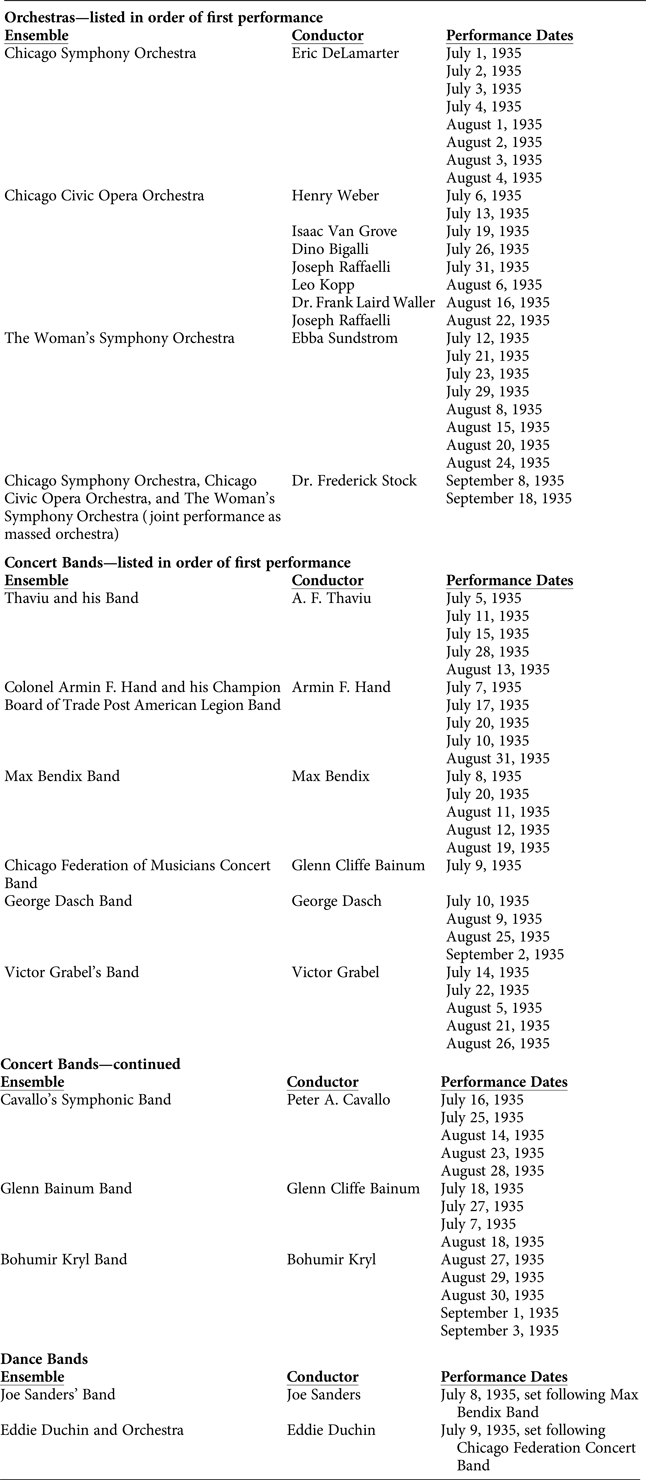
The groups that were programmed over the course of the summer season helped shape audience expectations of both the repertory one might hear at an open-air concert and also the kinds of ensembles one might see (see Table 1). While today Grant Park Music Festival is known for its resident symphony orchestra and chorus, concert programs and media coverage show that from 1935 to 1943 wind bands gave the majority of performances. Although orchestras gave outdoor performances in Chicago, including at both Chicago world's fairs (in 1893 and 1933), bands were much more commonly heard in open-air venues such as the city's parks and beer gardens.Footnote 19 Kelly's predecessor, Mayor Anton Cermak, had the Grant Park bandshell built in 1931 for performances by the Chicago Concert Band. Petrillo indicated that the decision to program symphony orchestras was an unusual but pragmatic choice. He justified their inclusion to his membership: “We decided to use orchestras as well as bands in the hope that we might thereby create some work for orchestras in the parks and other outdoor places in future years.”Footnote 20 This decision would have a lasting effect; it normalized the use of symphony orchestras in Chicago's city parks. Beginning in 1944, the city founded a resident professional orchestra, Grant Park Orchestra, funded from the budget of the park district.
List of Ensembles that Performed for the 1935 Season of Grant Park Concerts.1

1 List of ensembles compiled from concert programs included in the Chicago Federation of Musicians Scrapbook, 1935, American Federation of Musicians, Chicago Chapter Files, Harold Washington Library Center, Music Information Center.
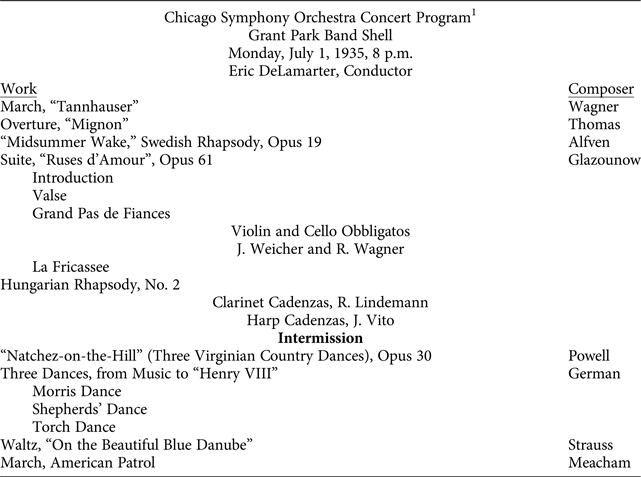
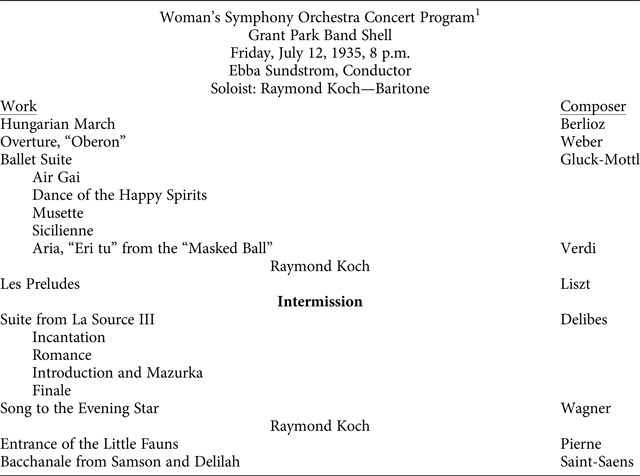
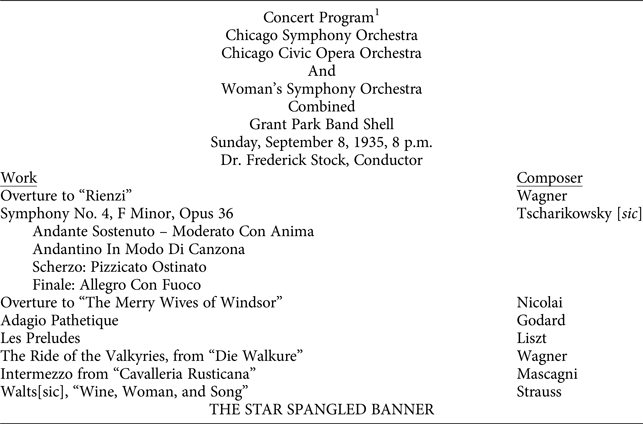
The repertory performed by the bands and orchestras during Grant Park Concerts’ opening season included canonical “serious” repertory as well as programs in potpourri form—a mix of well-known lighter classical works, transcriptions of opera arias and art songs with guest soloists, and arrangements of popular songs and folk music. Critics noted that the groups performing in the Grant Park series did not shy away from programming major works for outdoor performances and that audiences seemed to have no problem with longer canonical pieces typically heard in Orchestra Hall.Footnote 21 The programs from the Chicago Symphony Orchestra's and Woman's Symphony Orchestra's first concerts of the season and the massed orchestra concert featuring the Chicago Symphony Orchestra, Woman's Symphony Orchestra, and Civic Opera Orchestra at the end of the season included a wide range of repertory (see Tables 2–4). The bands played orchestral and operatic transcriptions and original pieces for band, and a few groups developed reputations for adventurous programming. Glenn Bainum's Band, in particular, played both lesser-known and new compositions. Lawrence Levine has traced the way that nineteenth-century tastemakers sought to establish cultural hierarchies through repertory,Footnote 22 but judging from the CFM records, it appears that audiences responded well to the summer concerts regardless of group or repertory. Certain groups, such as the Chicago Symphony Orchestra, and particular evenings, such the Fourth of July and the season finale, attracted the largest audiences. Once the festival was well established, however, it appears that ten thousand or more audience members showed up on any given evening as long as the weather was good. Listening, as I will discuss in the next section, took on importance as a shared civic experience.
Chicago Symphony Orchestra's Opening Night, July 1, 1935, Grant Park Concerts.

1 This table is transcribed from the concert program for the opening night of Grant Park Concerts, Chicago Symphony Orchestra, July 1, 1935. It did not offer dates of works, composers’ first names, or detailed concert notes, and it may not have reflected the entirety of the program. The conductor, Eric DeLamarter, was said to have interpolated additional works by composers from the United States into the program. These would have been announced from the podium. Chicago Federation of Musicians Scrapbook, 1935, American Federation of Musicians, Chicago Chapter Files, Harold Washington Library Center, Music Information Center.
Woman's Symphony Orchestra, Grant Park Concerts Season, July 12, 1935.

1 This table is transcribed verbatim from the concert program for the Woman's Symphony Orchestra's first performance for Grant Park Concerts on July 12, 1935. It did not offer dates of works, composers’ first names, or detailed concert notes, and in some cases, composers’ names are not spelled in the standard manner. Chicago Federation of Musicians Scrapbook, 1935, American Federation of Musicians, Chicago Chapter Files, Harold Washington Library Center, Music Information Center.
Massed Concert by the Chicago Symphony Orchestra, Chicago Civic Opera Orchestra, and Woman's Symphony Orchestra for Closing Night, September 8, 1935, Grant Park Concerts.

1 This table is transcribed from the final concert program for Grant Park Concerts’ first season on September 8, 1935. It did not offer dates of works, composers’ first names, or detailed concert notes. Chicago Federation of Musicians Scrapbook, 1935, American Federation of Musicians, Chicago Chapter Files, Harold Washington Library Center, Music Information Center.
James Petrillo noted that ensemble directors had the freedom to hire the musicians they wanted (as long as they were union members) and to program their own repertory,Footnote 23 but each program was to have at least one “American” work.Footnote 24 Not every director followed this directive, as many programs included only music by European composers. The Chicago Herald-Examiner’s music critic, Glenn Dillard Gunn, noted that conductor Eric DeLamarter was unaware of this rule when he programmed the Chicago Symphony Orchestra's first concerts and interpolated works that were not printed in the program.Footnote 25 The Orchestra's last concert of their opening run fell on the Fourth of July holiday and featured four works by US composers with distinctly ethnic or folkloric themes. In addition to “The Star Spangled Banner,” the orchestra performed Henry Kimball Hadley's concert overture, In Bohemia, op. 28, Victor Herbert's Irish Rhapsody, Leo Sowerby's “folk tune” The Irish Washerwoman, and Frank van der Stucken's March on American Airs. A fifth “folk tune” listed on the program, “Hill Billy,” was attributed to a composer named Saunders, but apparently the Chicago Symphony Orchestra did not perform it on this occasion.Footnote 26 “The Star Spangled Banner” quickly became the most frequently performed US work at the festival. Col. Armin F. Hand and his Champion Board Post American Legion Band (July 7, 1935) and Cavallo's Band (July 16, 1935) ended their programs with “The Star Spangled Banner.” Starting on Friday, July 19, 1935, every concert concluded with the national anthem. Programming “The Star Spangled Banner” reinforced the idea that the concerts were patriotic events and part of a bigger project to help rebuild the nation. It also meant that each group performed at least one composition that was closely associated with the United States.
Early in the 1935 season, a few local dance bands—including those of Joe Sanders, Eddie Duchin, and others—gave encore performances after the official concert ended. While notes on archived programs indicate that these groups were well received and that much of the crowd stayed, these appearances appear to have been isolated and perhaps experimental.Footnote 27 The newspaper critics, who tended to favor classical music, responded negatively to these events. In later summers, a few popular musicians, such as Rudy Vallee and Benny Goodman, made festival appearances accompanied by orchestras. The inclusion of dance bands during the first season was consistent with the position of the AFM, which sought to support all of its musicians during the Depression regardless of their performance domain.Footnote 28 In this sense, Petrillo's efforts extended not only to the bands that audiences expected to hear at a summer concert in the park, but also the orchestras associated with the indoor concert halls and dance bands more often found in the city's ballrooms.
The sound system used at the band shell was another component of Grant Park Festival's early artistic success. Public address systems had been in use since the first decades of the twentieth century, but the Western Electric system installed in the band shell seems to have been particularly effective. A company publication touted the system's “‘two-way’ loudspeakers” with “individual elements for reproducing bass and treble registers.” The system had an output of 100 watts and utilized three 116A preamplifiers, one 117A line amplifier, and two 118A power amplifiers. An operator adjusted the volume from a remote consul within the audience seating.Footnote 29 Early reviewers commented favorably on the reach of the sound and noted when the sound improved over the course of the summer. Glenn Dillard Gunn found the sound in the park satisfactory at the first concerts, writing: “The space is so vast that all traffic noises are too remote to disturb. The public address system functioned flawlessly last night, the tone of the orchestra carrying clearly to the most distant seats.”Footnote 30 The Tribune’s Edward Moore was effusive in his praise for the sound system: “There is a system of sound amplification that deserves a few compliments of its own. It carried the tone of the orchestra as far away as the entrance to the Field Museum, and the tone was undistorted and mellow.”Footnote 31 An annotated program from the CFM Concert Band performance on Tuesday, July 9, 1935 includes marginalia: “Due to the perfect set up figured out by [Glenn] Bainum, the balance was by far the best yet.”Footnote 32
Local music critics wholeheartedly supported the festival. Reviews of the first concerts were glowing, and a positive tone continued throughout the first season. Edward Moore wrote of the estimated fifty thousand people, who attended the Chicago Symphony Orchestra's Fourth of July concert:
It begins to look as though several cherished and ancient theories were due to go into the discard before the present summer series of concerts from the band shell in Grant Park is over. One of them is that a symphony orchestra is the chosen delight of only the cultivated few. Another is that mere music does not appeal to the public. A glance at last night's audience would to some degree have dispelled both.Footnote 33
If anything, reviewers took on a tone of boosterism as they championed the festival as evidence of the city's achievements in the arts. As Moore's comments indicate, critics believed that the festival showed that Chicago could offer professional music ensembles of the highest caliber, and its residents would flock to their performances. Chicago may have had a reputation as a city of industry and labor, characterized by the poet Carl Sandburg as the City of Broad Shoulders,Footnote 34 but stakeholders were anxious to show that it was also a city of serious listeners.
The Social Gear
The social component of Grant Park Festival helped power the artistic and financial gears, and the social impact of the festival, in turn, depended on the financial outlay and artistic content to generate interest in the festival and attract its audience. Festival organizers envisioned the concert series as providing uplift to the unemployed and the underemployed, who were perceived as having additional leisure time. The Park District leaders viewed their mission as shaping the city and fighting tendencies toward rebellion and social unrest that stemmed from economic stress. While the notion of social uplift through listening was grounded in the social hierarchies of the time period, the festival had a real lasting impact on the social status of the female musicians in the Woman's Symphony Orchestra of Chicago, many of whom found professional opportunities through the festival. However, participation in the festival was circumscribed by myriad social and physical boundaries present in the city, including those between neighborhoods, racial and ethnic groups, and extended to rules regarding who could belong to CFM Local 10.
The high level of artistic achievement and the financial support for the festival helped attract large crowds, but many of the key figures that supported the festival saw it as a force for social uplift. Mayor Kelly believed that with proper planning and support, the Park District could alleviate some of the social ills that afflicted the city during the Great Depression. Kelly, former president of the South Park District, championed parks both as places to appreciate nature and enjoy physical activity and as places for recreation centered on arts, handicrafts, and performance.Footnote 35 Following Grant Park Concerts’ first season, Park District president Robert J. Dunham reflected this perspective in his annual report: “For our citizens have, in general, become more and more ‘park conscious’ in recent years, especially in the field of recreation. The tendency toward shorter working hours and the unprecedented degree of unemployment have combined to throw an ever-growing burden on park recreation centers and their facilities for leisure pastime.”Footnote 36 Virgil K. Brown, director of the Park District's Division of Recreation, argued that programming arts as “a way to combat antidemocratic tendencies in a community is to make other subjects more interesting than radicalism, rather than to conduct a series of lectures on the evils of radicalism.”Footnote 37 Petrillo was staunchly anticommunist, and in this sense, the CFM, the mayor, and the Park District shared common cause in maintaining a political status quo while providing leisure time entertainment to Chicagoans.Footnote 38
Grant Park Concerts championed a particular social vision for Chicago that portrayed the city as its own savior from the depths of the Great Depression. Petrillo emphasized that the concert series was “by Chicago, for Chicago,” as it would feature the best ensembles and musicians from the city. In turn, these concerts would bring Chicagoans together in the city's central spaces. The second season of the festival was described as a success for the foot traffic that it brought into Grant Park:
The Grant Park Concert Series again brought melody into the heart of the city, to average audiences which over-ran the great open spaces of that park on the city's lake front door step. It was estimated that 3,000,000 came downtown to attend the series of nightly concerts, and there is no means of estimating how many more listened to them over the radio, as they were broadcast every evening.Footnote 39
In this view, a listening public radiated from Chicago's lakefront to the far coasts. Listeners shared a common experience of being together in the park and hearing the same music. The great numbers of people using the parkland over the course of the season helped justify its expense to the public. By emphasizing attendance numbers, the park district, CFM, and the newspaper critics contributed to the notion that attending concerts in Grant Park was a form of participation in civic life.
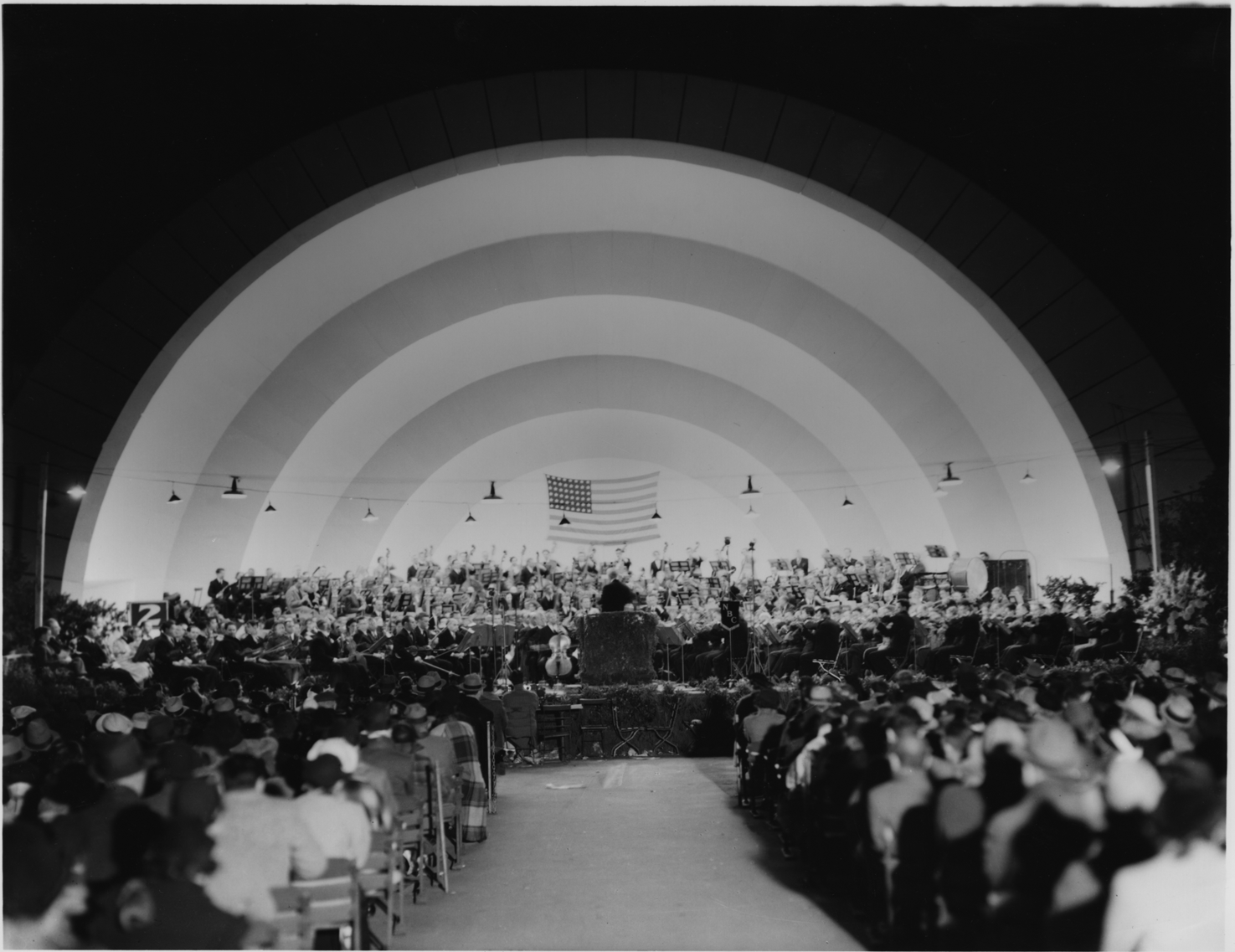
Grant Park Concerts had a large impact on female musicians’ employment as professional instrumentalists in the classical music sphere. The festival employed the Woman's Orchestra of Chicago ten times over the course of the 1935 season, including the gala finale and encore performance. This ensemble had been founded in 1925 by female students from Chicago's Bush Conservatory of Music with the aim to create more professional experiences for them after graduating from music conservatories.Footnote 40 The orchestra's concerts during the opening season of Grant Park Concerts were well attended and well received by Chicago area music critics, and, perhaps more importantly for the women's professional aspirations, these concerts were paid union performances and not volunteer performances. Anna-Lise Santella argues that the Woman's Orchestra set the standard for outdoor orchestral performances in Chicago because they, not the Chicago Symphony Orchestra, had performed in the bandshell at the 1933–34 World's Fair, A Century of Progress.Footnote 41 For the gala finale concert on September 8, 1935, and at the encore performance on September 18, 1935, the festival made history by combining the Woman's Symphony with the Chicago Symphony Orchestra and Civic Opera Orchestra on stage with Frederick Stock conducting. A photograph of the performance shows all 220 musicians integrated on stage; male and female musicians shared stands (see Figure 1).
Combined Chicago Symphony Orchestra, Civic Opera Orchestra, and Woman's Symphony Orchestra on stage, Grant Park Band Shell, September 15 or 18, 1935. Chicago Park District Records. Photographs, Series 1, Box 34, Folder 23. Special Collections, Chicago Public Library, Chicago, IL.

These were the second and third occasions that women played with one of the US major orchestras, the first being a previous massed orchestra concert that included the Woman's Orchestra at the rededication of Chicago's Auditorium Theatre in December 1932. The repertory at the gala performances included “women-themed” orchestral works that the Woman's Orchestra regularly performed, such as the overture to Merry Wives of Windsor, Johann Strauss's waltz “Wine, Women, and Song,” and Wagner's “The Ride of the Valkyries.”Footnote 42 The three orchestras continued to perform a joint season closer for the next three years of the festival.
The opportunities to perform professionally benefited not only the Woman's Symphony as an organization but also its individual musicians. When Helen Kotas, the first horn of the Woman's Symphony, was appointed the principal horn of the Chicago Symphony Orchestra in 1940, she became the first woman to join the orchestra and the first female principal chair of a major orchestra in the United States.Footnote 43 Women were included as regular members of Grant Park Orchestra when it was formed as the resident orchestra of the festival in 1944. Most of these women had played with the Woman's Symphony during previous seasons in Grant Park. By the second season, women held eight principal positions of the Grant Park Orchestra.Footnote 44
Despite the huge audiences who listened, the large number of professional musicians and park workers employed, and opportunities afforded large numbers of musicians, persistent patterns of discrimination and racial segregation cast doubt on the notion that the outdoor festival served all Chicagoans. The CFM, Local 10, excluded African American musicians until 1966. A separate union, Local 208, served professional African American musicians, but Grant Park Concerts only hired ensembles whose musicians who were members of Local 10. This practice was replicated elsewhere in the music industry as Local 10 instituted hiring practices that gave its members preference for work on radio broadcasts, recording sessions, and choice clubs.Footnote 45 African American musicians were excluded from any benefits of the festival's efforts to put musicians back to work. In a column in the Chicago Defender from February 1940, James Mundy noted, “One hundred thousand dollars in tax-payers money is paid out every year to white musicians for Grant Park concerts. For five years no professional Negroes have been engaged to perform there.”Footnote 46 Paul Robeson was the first African American musician to perform as a soloist in the concert series on July 28, 1940, with the Rico Marcelli Symphony Orchestra, and the young African American soprano Muriel Rahn followed as a soloist with Ennio Bolognini's orchestra August 29, 1942.Footnote 47 However, rank-and-file African American musicians were not hired because the festival favored groups in the white-only Local 10.
Newspaper coverage, Park District reports, and the CFM records do not provide information about audience demographics. Photographs from the early years of the festival show enormous crowds, but there is little to suggest their composition. European ethnic groups in the city responded favorably to the festival and celebrated performers who were perceived as members of their communities. Polish- and Italian-language newspapers covered the festival. Bohemian social clubs organized outings to hear Czech trumpet virtuoso Bohumir Kryl and his band perform. Although the majority of Chicago's African American community resided just a few miles south of Grant Park in the Bronzeville neighborhood, this distance may have been insurmountable in an era of segregated housing and racial discrimination.Footnote 48 Throughout the early decades of the twentieth century, ethnic white communities actively blocked access of African American families to parks and beaches throughout all of Chicago and especially along the boundaries of Bronzeville.Footnote 49 Following the 1919 Race Riots, which erupted from the retaliation of white ethnic beach goers against African American youth, many African Americans avoided city parks and beaches outside their immediate neighborhoods out of fear for their safety.Footnote 50 Well into the second half of the twentieth century, African Americans reported that they did not feel safe in certain parks.Footnote 51Chicago Defender music columnist, Neota McCurdy Dyett, exhorted readers who were musicians to attend as many of the free concerts as possible,Footnote 52 but coverage of the festival in Chicago's black press was somewhat muted.
The social gear of Grant Park Concerts draws attention to the social act of being together and listening to music. Photographs of Grant Park Concerts were reproduced in newspapers and city publications and show thousands of people focused on the bandshell framed by the Chicago's urban architecture. These photographs of crowds gathered in Grant Park became iconic of the city, and they have been echoed many times over in images ranging from their antithesis in the documentation of strife and conflict during the 1968 Democratic Convention to their contemporary analogues in the thousands peacefully gathering to hear President Barack Obama speak on election night in 2008. For the festival, organizers succeeded in attracting crowds to the park to listen to the various performing groups, and music became a social good shared by Chicago's citizenry. While Petrillo, Mayor Kelly, and park district leaders like V. K. Brown sought to tamp down any revolutionary impulses through park district programming, the festival offered pathways to real social change for some musicians. However, the festival also maintained social boundaries ingrained in a deeply segregated city.
Conclusion
By approaching Grant Park Music Festival as a “cultural machine,” I draw on a model for looking at a music festival as an institution formed of interlocking parts. In his essay on the Auditorium Theatre, Clague makes the claim that institutions are the primary movers of culture in US musical life.Footnote 53 I argue that festivals stand out as key institutions in the United States and are likewise powered by a combination of mutually interdependent financial, artistic, and social concerns. Although Grant Park Music Festival came to fruition over fifty years later than the Auditorium Theatre, through its complex interplay of financial, artistic, and social factors, it helped shape Chicago's music scene at a crucial time in the city's history. The success of the festival stemmed from the way financial, artistic, and social components of the festival interacted and reinforced one another in ways writ large and small. For example, while James C. Petrillo certainly provided the initial drive to establish the festival, its success stemmed from the availability of a bandshell in centrally located Grant Park, the cultural capital of Chicago's premiere music ensembles, and the power of the city's political machine fueled by the Works Progress Administration. The festival attracted favorable media coverage and a public eager to listen, which in turn contributed to its ongoing popularity. The festival also had a lasting impact on individuals, perhaps most dramatically reflected in the opportunities that were afforded to the women who performed with the Woman's Orchestra of Chicago. These women received professional employment at union scale, performed orchestral repertory to critical acclaim, and helped shift the notion of women's roles in professional orchestras. At the same time, some groups of professional musicians—especially African American members of Local 208—were systematically excluded from performing at the festival based on the city's explicit and implicit forms of racial segregation and discrimination. In each of these examples, the interplay of financial, artistic, and social components cannot be disentangled in the workings of the festival.
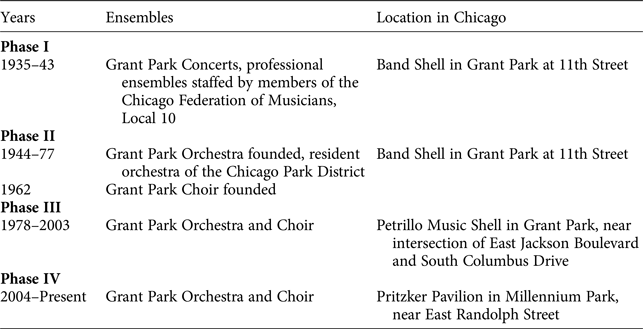
Grant Park Music Festival has had a lasting legacy in Chicago that continues to the present day (see Table 5). What I designate as the first phase of the festival ended in 1943. This was the last year that the Chicago Federation of Musicians was directly involved in selecting ensembles to perform for the festival season. In 1944, the Park District assumed full responsibility for festival planning and its costs and established the resident Grant Park Orchestra. The festival grew to include the Grant Park Chorus in 1962. The orchestra and choir continue as professional union ensembles for the duration of the summer season. In its present form, the festival is run by a nonprofit group, the Grant Park Orchestral Association, the City of Chicago Park District, and the City of Chicago Department of Cultural Affairs and Special Events. Since its founding, the festival has also moved location twice within Chicago's downtown lakefront parkland. The festival continued in the 1931 bandshell until it aged to the point that it was no longer safe. By 1977, a piece of ceiling had fallen during a rehearsal, smashing a cello, and, on another occasion, a grand piano fell through the floor, but luckily no one was injured.Footnote 54 In 1978, the festival moved to the Petrillo Band Shell, further north in Grant Park. In 2003, the festival moved once again to its present performance space in Pritzker Pavilion in Millennium Park. The festival has maintained a commitment to programming works by contemporary composers, many of whom are from the Americas, and balancing “serious” canonical works with lighter repertory. On summer evenings, residents as well as visitors continue to flock to Millennium Park to picnic and listen to the orchestra. Although the concerts do not attract the numbers once claimed by the Chicago Federation of Musicians and the city—Pritzker Pavilion and its Great Lawn seats only 11,000—the social ritual of joining the crowd to listen to the orchestra in the open air continues unabated.
Key Phases in the History of Grant Park Music Festival, 1935–Present.

A music festival, by its nature, is of limited duration, but in the case of Grant Park Music Festival, its effects resonated far beyond the bandshell on warm summer nights. As Andrew Mall notes in his essay in this issue, festivals complicate how we think of music scenes, but like other kinds of scenes, they offer an experience of a certain length, within a specific geographic location, and typically foster intense social interactions grounded in a shared musical experience. The intensity of the experience is enhanced by its annual occurrence. Grant Park Music Festival has been largely effective in creating a narrative of the city as unified in its ability, hard work, and resources to generate a festival even during the bleakest of times. Within this context, listening could be understood as a civic duty, and even today, Chicagoans look forward to the annual experience of sitting on the lawn in the center of the city and listening to its free concerts.
Moreover, Grant Park Music Festival likely inspired several outdoor music festivals in the city and the surrounding area. For example, in 1936, after a five-year hiatus during the Great Depression, arts patrons in Chicago's northern suburbs revived the Ravinia Festival, located on a picnic ground near the train line from Chicago to Milwaukee, as the summer home of the Chicago Symphony Orchestra. Both festivals continue today, but the organizations have made different strategic choices in programming, ticket prices, and amenities. Petrillo also spearheaded other concerts-in-the-parks initiatives concurrent with Grant Park Concerts and concert series at Navy Pier, which had mixed success. Other outdoor festivals also rounded out the summer season. The Chicago Tribune sponsored the annual Chicagoland Music Festival in Soldier Field. Anna Walker, an African American drama and music teacher who ran the music program at Union Park Fieldhouse, founded the West Chicagoland Music Festival. Photographs from the late 1930s show integrated ensembles of African American and white children performing together at the festival.Footnote 55 Festivals like these offer an alternate window on the different ways the city and other local organizations sought to engage its constituents through music, and in turn how these constituents laid claim to city spaces outside the Loop. Like Grant Park Concerts, these festivals would also rely on their own distinct intermeshing of financial, artistic, and social components.
None of these festivals were as long lasting as Grant Park Music Festival, but they created precedence for the various private and public festivals that take place in Chicago's parks today. The historical analysis of Grant Park Music Festival suggests that the “cultural machine” model may be a useful tool for better understanding how cities like Chicago have viewed contemporary music festivals as cultural amenities that draw tourists as well as residents that may be younger and more highly skilled members of what urbanist Richard Florida has called the “creative class.”Footnote 56 In addition to Florida's attention to the role of cultural amenities in economic development and urban identity, scholars such as Elizabeth Currid and Michael Seman have explored how arts scenes create economic clusters and spur particular types of urban revitalization.Footnote 57 As Jonathan Wynn has shown in his research, popular music festivals contribute to the branding of urban spaces. However, commercial popular music festivals operate quite differently from the model of a municipal institution found in Grant Park Music Festival as they are usually run by for-profit companies, are often geared toward visitors, and short in duration. In Chicago, festivals such as Lollapalooza, Pitchfork, and Riot Fest draw huge crowds to Grant Park, Union Park, and Douglas Park, but these events have led communities to question whether they and their attendees actually benefit the neighborhoods they visit. Does increased traffic at local businesses, for example, balance out limited public access to parks during these private events and the damage to public property incurred by their large crowds?
Meanwhile, the City of Chicago's Department of Cultural Affairs and Special Events, in collaboration with the Park District, works to entice residents and tourists into the city's parks to hear free concerts by local and international performers at festivals and annual summer concert series. The city now hosts many such festivals, including the well-known Chicago Blues and Chicago Jazz Festivals as well as the Gospel Music Festival, House Music Festival, World Music Festival Chicago, and the ongoing Music in Millennium Park series. Grant Park Music Festival helped create the cultural infrastructure that gave rise to these festivals, and it also helped generate an expectation among residents that parks provide not just recreational space but musical programming, too. Gathering together to listen became a shared civic activity that continues into the present.