Introduction
Only 12% of individuals who suffer an out-of-hospital cardiac arrest (OHCA) will survive to hospital discharge. 1 According to the American Heart Association’s (Dallas, Texas USA) chain of survival, early intervention through dispatcher-assisted cardiopulmonary resuscitation (CPR) can significantly improve outcomes for those with OHCA.Reference Lerner, Rea and Bobrow 2 When CPR is started by bystanders, the odds for survival increase by two to three times compared to starting CPR when Emergency Medical Services (EMS) arrives.Reference Lerner, Rea and Bobrow 2 Because of the increased odds of survival, the American Heart Association issued a science advisory recommending that dispatchers offer 9-1-1 callers pre-arrival instructions for bystander CPR.Reference Lerner, Rea and Bobrow 2
The implementation of dispatcher CPR instructions has demonstrated increased rates of bystander CPR both in the United States and abroad. In Seattle (Washington USA), dispatcher CPR instructions dramatically increased the frequency of bystander CPR from 26% to 68% in a 13-year period. 3 , 4 Early compressions by bystanders is likely a key factor which has improved Seattle’s cardiac arrest survival rate to 22%, compared to the 12% nationwide survival rate. 3 Similarly, Arizona’s (USA) bystander CPR rates have improved to almost 67%, 4 , Reference Bobrow, Spaite and Vadeboncoeur 5 and Harjanto, et al observed an increase in bystander CPR from 22% to 42% in Singapore with dispatcher instructions.Reference Harjanto, Na and Hao 6 While rates of CPR have increased, bystanders are only performing CPR in a little over one-half of the cardiac arrest cases, even with dispatcher instructions. There is variation in CPR rates across systems, and it is not yet understood how different factors affect the rates of bystander CPR in communities with dispatcher instructions.
As of 2013, children in the United States (<18 years) received bystander CPR at a rate of 56%, whereas adult bystander CPR was performed at a rate of 40%.Reference Go, Mozaffarian and Roger 7 Previous studies have documented that there may be an association between patient age and bystander CPR rates, but these studies did not determine whether a relationship existed between the two variables.Reference Holmberg, Holmberg and Herliz 8 , Reference Sasson, Magrid and Chan 9 Furthermore, the cities included in these studies did not provide CPR instructions and the associated outcome focused solely on age and bystander rate.Reference Holmberg, Holmberg and Herliz 8 , Reference Sasson, Magrid and Chan 9 The objective of this study was to determine if there is a difference in EMS-documented bystander CPR rates based on the age group of the OHCA victim when dispatcher CPR instructions are available.
Methods
Study Design
This was a retrospective chart review of EMS medical records for all EMS-treated OHCA patients in two municipalities within a single county that provided dispatcher-assisted CPR instructions. The study was approved by The Medical College of Wisconsin’s Institutional Review Board (Milwaukee, Wisconsin USA), which is the IRB for the EMS system as well.
Study Setting and Population
The study was performed in Milwaukee County, which covers a 241 square mile area with a population of approximately 900,000. At the time of the study, only two municipalities used the Priority Medical Dispatch System version 12.2 (Priority Dispatch Corp; Salt Lake City, Utah USA) and gave dispatcher CPR instructions. Neither community was accredited. One community conducted quality assurance using AQUA version 6.0 (Priority Dispatch Corp; Salt Lake City, Utah USA) and had a 70%-80% compliance rate. The other community dispatch used the card set version and did manual quality improvement on paper forms. No compliance information was available for the study period.
When a patient collapses in one of these communities, a citizen will access the EMS system by calling 9-1-1. If the 9-1-1 dispatcher suspects cardiac arrest, a tiered response is used. The closest unit will respond, irrespective of their training level or whether the unit is a part of the municipal fire department or a commercial EMS agency. However, it is important to note that many fire department units respond to scenes with a paramedic-trained first responder. All responders have an automated external defibrillator or a manual defibrillator. A municipal Advance Life Support ambulance staffed with at least two paramedic-trained responders is also simultaneously dispatched, and once they arrived, would be responsible for all care and patient transport.
For each cardiac arrest, EMS providers completed a standardized, electronic patient care medical record which was stored in a central database; EMS records of all OHCA patients from the included municipalities treated from July 01, 2012 through June 01, 2015 were included. Patients who lived in a skilled nursing facility or other health care setting, those found dead on arrival, or those who arrested after EMS arrived at the scene were excluded from the study.
Study Protocol
Electronically abstracted study data included if the arrest was witnessed and whether the patient received bystander CPR. Patient age was used to divide patients into three different groups. The groups were child (0-12 years), adult (13-54 years), and geriatric (≥55 years). These groups were defined based on the American Heart Association’s suggested transition from child to adult CPR when secondary sex characteristics are identified, and 13 years old was used as an estimate for the onset for puberty. While there is generally no consensus on the age cutoff point for the geriatric age group, the commonly used cutoff point of 55 was selected. The initial cardiac rhythm on EMS arrival was documented as Pulseless Electrical Activity, Asystole, or Ventricular Fibrillation/Ventricular Tachycardia. Also included in the demographic information were the patient’s gender, race, and whether the arrest occurred at home or in a public location.
Study Data Source
All data were obtained electronically from the Milwaukee County EMS medical record database, which was compliant with the National EMS Information System (NEMSIS; Salt Lake City, Utah USA) variable definitions; EMS crews directly provided the data using an electronic patient care system provided by their agency. These data were mapped to the county-wide database and electronically transferred so that the same data definitions were used for each medical record. All patient encounters are entered into the EMS medical record database; there were no exclusions. This database has been used for numerous prior research studies, but there are no published reports of its accuracy. The data were reviewed for quality improvement and corrections were made if errors were identified. Some of the variables used for this project may have been required by the individual agency’s electronic medical record system and did not allow the user to complete the record without entering the specified variable into the database. In other cases, missing variables would a have been stored as missing. Patient outcome data were obtained by a Milwaukee County employee by contacting the receiving hospitals and requesting the information. These data were then entered into the medical record by county staff.
Data Analysis
To determine if there was a significant difference in the rate of bystander CPR due to age, patients were stratified into three separate groups: child, adult, and geriatric. A Chi square analysis was performed comparing each age group and significance was determined using a P value of≤.05.
Results
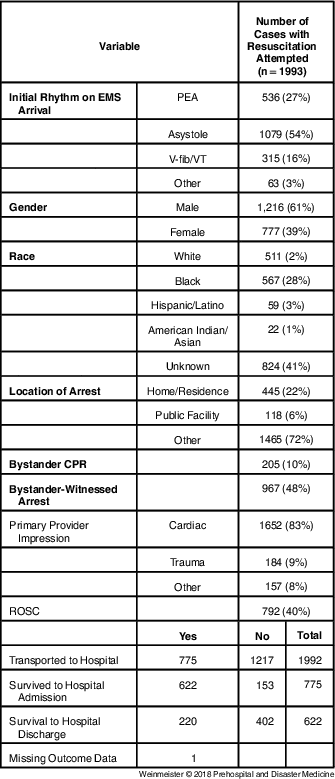
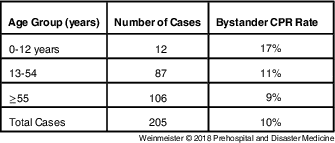
As shown in Table 1, a total of 1,993 cardiac arrests occurred during the study period, with more males in the patient population. Most of the arrests were documented as having a cardiac origin, with the majority showing Asystole as the initial rhythm. Bystander-witnessed arrests occurred in 48% of cardiac arrests, with a bystander CPR rate of 10%. As evidenced by Table 2, the highest rate of bystander CPR occurred in the child age group. The lowest rate of bystander CPR was in the geriatric age group. Chi square analysis determined that there was a statistically significant difference between age groups (P≤.01).
Patient Demographics

Abbreviations: CPR, cardiopulmonary resuscitation; EMS, Emergency Medical Services; PEA, pulseless electrical activity; ROSC, return of spontaneous circulation; VT, ventricular tachycardia.
Comparison of Bystander CPR by Age Group

Abbreviation: CPR, cardiopulmonary resuscitation.
Discussion
In communities that offered dispatcher-assisted CPR instructions, there was a statistically significant difference in bystander CPR rates based on patient age group. Callers reporting arrest in children were more likely to provide CPR. These findings are consistent with the American Heart Association’s national bystander CPR rate for OHCA, which demonstrates higher rates of CPR in children when compared to adults.Reference Holmberg, Holmberg and Herliz 8
Willingness to perform CPR has been well studied, and underlying factors including perceived inability to perform CPR correctly, fear of harming the patient, and bystander socioeconomic status can all effect whether a bystander performs CPR.Reference Platz, Scheatzle, Pepe and Dearwater 10 , Reference Swor, Khan, Domeier, Honeycutt, Chu and Compton 11 In CPR-trained individuals, Swor, et al demonstrated a bystander CPR rate of 35%, and the most commonly cited factor for failing to perform CPR was bystander panic.Reference Swor, Khan, Domeier, Honeycutt, Chu and Compton 11 In communities with dispatcher CPR, improved rates of bystander CPR and increased survival following cardiac arrest have been documented. 3 - Reference Harjanto, Na and Hao 6 It is concerning that in this community with dispatcher-assisted CPR instructions, the overall rate of bystander CPR was low (10%) compared to the rates in other dispatch communities (almost 67% in Arizona and 68% in Seattle). 3 - Reference Harjanto, Na and Hao 6
The results of this analysis show that age group is a contributing factor in providing bystander CPR, even when dispatcher CPR instructions are available in the community. This may be because children are more likely to be with a care taker and not a stranger, and this relationship may make bystanders more comfortable and willing to provide aid. Research has shown that family members are the most likely to perform CPR with dispatcher instructions in the event of a cardiac arrest.Reference Lerner, Sayre and Brice 12 In a recent study, family members made up the largest portion of bystanders who performed CPR on cardiac arrest victims (65%).Reference Naim, Burke and McNally 13 This study also found that non-home/public arrests had a higher rate of bystander CPR as these events were witnessed.Reference Naim, Burke and McNally 13 Home arrests were often unwitnessed as a majority occurred in infants, secondary to sudden infant death syndrome.Reference Naim, Burke and McNally 13 Unfortunately, most of the cases in this study had location marked as other and the effect of a public versus private location could not be examined. The records also did not document what the bystander’s relationship was to the patient.
Physical status of the bystander and body habitus of the patient affect whether a bystander is more or less likely to perform CPR. According to Hauff, et al, physical limitation was the most common cause of bystanders not initiating CPR when CPR instructions were offered.Reference Hauff, Rea, Culley, Becker and Eisenberg 14 This may provide an explanation for why geriatric individuals have a lower rate of bystander CPR. Older victims may be more likely to be with someone who is in their same age cohort and may have physical limitations that keep them from providing aid. The first CPR dispatcher instruction is to move the patient to the floor or hard surface. If a caller is physically unable to move the victim, they may never initiate CPR. Future studies should examine the effect of physical limitations on geriatric bystander CPR rates when dispatcher CPR instructions are available.
Prior work has shown that the bystander’s emotional state significantly effects willingness to perform CPR and has been documented as the most common barrier facing a family member when given CPR instructions.Reference Hauff, Rea, Culley, Becker and Eisenberg 14 A key function of the dispatcher is to steer the caller through their emotions to action.Reference Clawson, Dernocoeur and Murray 15 It is interesting that this process may be more successful in younger victims given how unexpected a youth cardiac arrest is likely to be. Previous studies have shown that the language used by dispatchers will impact if and how early CPR is started by a bystander; however, none of these studies have demonstrated different CPR rates based on age.Reference Tanaka, Taniguchi and Wato 16 , Reference Vaillancourt, Charette and Stiell 17
The results of this analysis highlight the importance of considering how CPR instructions are provided, determining whether different language might be needed based on the victim’s age group. Future investigations should focus on the language used in dispatcher scripts for different age groups and should examine how it impacts a bystander’s willingness to perform CPR.
Limitations
This study was a retrospective record review and as such has some limitations. Emergency Medical Service records were relied upon for documentation of bystander CPR, but in some cases, callers may have stopped providing care to let EMS enter and may not have been recorded as having provided bystander CPR. Also, providers may have simply failed to document the care that was provided before EMS arrival. However, it is unlikely that those inconsistencies in documentation would have been age-related. Thus, the differences in bystander CPR observed between age groups would not be due to documentation error.
Another limitation was the documentation by EMS providers regarding location of arrest. In 74% of the cardiac arrests, EMS documented a location as “other” instead of providing a specific location such as an airport or public building. Without knowing the circumstances surrounding an arrest, it is impossible to determine if there is a relationship between location and bystander CPR. Location of arrest may help to identify why children received bystander CPR at a higher rate than older patients, even with dispatcher CPR instructions.
All communities in this study offered dispatcher CPR instructions. However, information was not gathered on whether the instructions were actually given. It is possible that instructions were not offered to the callers. There is also no way of knowing why bystanders chose not to perform CPR. Future investigations should focus on determining why geriatric individuals do not get bystander CPR as often even when dispatcher instructions are available.
Conclusion
The rate of EMS-documented bystander CPR was low, even though these municipalities provided dispatcher-assisted CPR. The highest rates of bystander CPR were observed in children (0-12 years), demonstrating that bystanders are more likely to perform CPR on younger individuals, even in communities where dispatcher CPR instructions are available.