Introduction
Disasters are rare events with catastrophic consequences.Reference Brevard, Weintraub and Aiken 1 - Reference Armstrong and Frykberg 6 Although international mass-gathering events (MGE) present particularities that compound the potential impacts of disasters, they also offer the unique opportunity for adequate preparation.
Disaster management is divided commonly into prevention, mitigation, response, and recovery phases. Disaster preparedness is often focused on the mitigating and response phases. The risk assessment is a vital step in the disaster-preparedness continuum as it is the foundation of subsequent phases. 7
Indeed, the World Health Organization (WHO; Geneva, Switzerland) described the hazard analysis and risk assessment processes as the “basis for the subsequent process of planning, and for the allocation of resources.” 7 In 1999, the WHO published specific guidelines for managers and policy makers regarding a rational process of vulnerability assessment, emphasizing its importance in emergency preparedness. 8
The Euro 2012 is the European Football Championship organized by the Union of European Football Associations (UEFA; Switzerland), which occurred from June 8, 2012 through July 1, 2012 for the first time in Poland and Ukraine. Matches took place in eight different venues, split evenly amongst the host countries. 9 The aggregate attendance for the event was 1.3 million spectators with an average attendance per game of 45,435 spectators. 10
Donetsk, the fifth-largest city of Ukraine, with a population of one million people and covering a metropolitan area of more than two million inhabitants in the eastern part of the country, 11 was chosen as one of four host cities in Ukraine.
In this context, the objective of this report was to develop and apply a risk assessment tool geared specifically towards the city of Donetsk in preparation for the UEFA Euro 2012.
Methods
In June 2011, the Bethune Round Table, an international conference devoted to surgical issues in developing countries led by the Canadian Network for International Surgery (Vancouver, British Columbia, Canada) was hosted by the Center for Global Surgery (CGS) at McGill University Health Centre (Montreal, Quebec, Canada). Leaders of the Donetsk Research and Development Institute of Traumatology and Orthopedics (Donetsk, Ukraine) who were present identified a need for further disaster preparedness in anticipation of the upcoming Euro 2012 and approached the CGS to collaborate in disaster preparedness for the event.
In close discussion with the Donetsk Research and Development Institute of Traumatology and Orthopedics, a multidisciplinary committee was formed, comprising members of the Ministry of Emergency of Ukraine, the Donetsk Regional Public Health Administration (Ukraine), Donetsk National Medical University (Ukraine), and prehospital representatives of the Emergency Medical Services (EMS), as well as the police and fire forces.
Recognizing that risk assessment would be primordial in the process, a risk assessment tool was developed based on a template developed by the Major Emergency Management Group in Dublin (Ireland). 12 Preliminary risk assessment data were drawn from the WHO Europe's evaluation done in 2010. 13
Based on these initial findings, a comprehensive list of hazard categories was established and further classified into sub-types.
For each hazard, relevant past experiences and ensuing lessons were identified through an extensive literature review using the MEDLINE database (Medline Industries, Inc; Mundelein, Illinois USA). Other pertinent data, including newspaper and other written media, were attained through online searches. Search terms used for academic and grey literature included combinations of the following: disaster; accident; risk; hazard; assessment; event; mass-gathering; Ukraine; as well as each hazard type and sub-type. Data only published in Ukrainian or Russian were also included. The available data were then divided into “local” and “international” literature based on whether it originated from Ukraine or abroad, respectively.
Based on the available literature, and most importantly, in close discussion with the multidisciplinary team, prevention, mitigating, and recovery measures already in place for each hazard were enumerated.
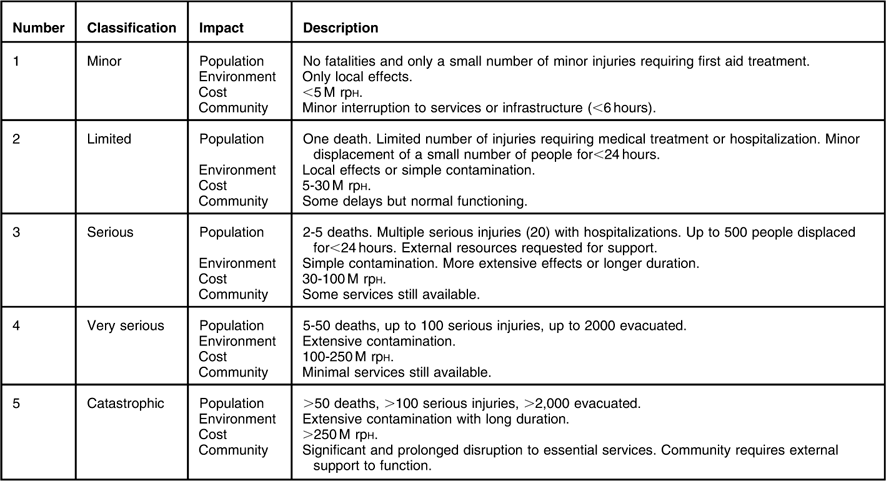
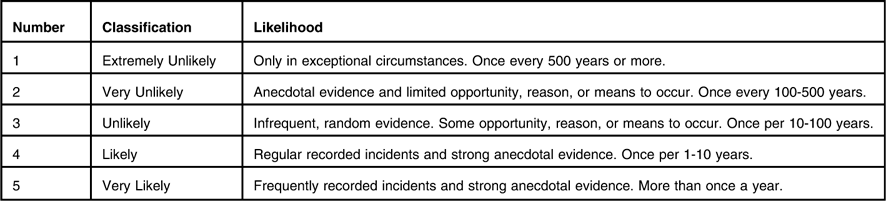
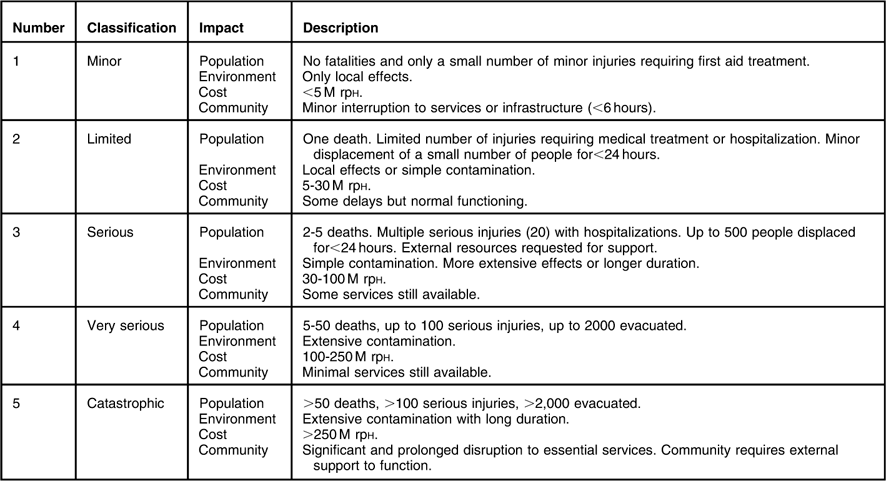
Previously described scales developed by the Dublin group were adapted to the Ukrainian context 12 (Tables 1 and 2). The potential impact, or severity of the consequences, was classified from “minor” to “catastrophic” based on the potential effects on the population (ie, deaths or injuries), environment, economy (ie, cost), and community. Predicted impacts were established based on previously available literature as well as consensus through exchanges with the multidisciplinary group. The likelihood, or probability of the event, ranged from “extremely unlikely” to “very likely,” depending on available historical frequencies and national/local intelligence.
Modified Dublin Classification 12 of Hazard Impact Used in the Risk Assessment Tool in Preparation for the UEFA Euro 2012
Abbreviation: UEFA, Union of European Football Associations.
Modified Dublin Classification 12 of Hazard Likelihood Used in the Risk Assessment Tool in Preparation for the UEFA Euro 2012

Abbreviation: UEFA, Union of European Football Associations.
Building upon the detailed risk assessment and taking into account the historical evidence, measures in place, and potential impacts and likelihoods, possible shortcomings were identified in the prevention, mitigation, response, and recovery phases of the disaster-planning continuum.
Ultimately, using all previous available data, measures to overcome any identified gaps in the various phases of disaster preparedness were suggested.
All findings were placed in a simple, table-based tool, to visually organize these hazards with their respective risk assessments and provided clear instructions on how to utilize it.
For hazards likely to arise and/or with significant consequences, a more detailed risk assessment was proposed, with specific plans for prevention and mitigation. Based on the previously available risk assessment template, 12 an individual hazard assessment template utilizing data from the risk assessment tool was presented.
Results
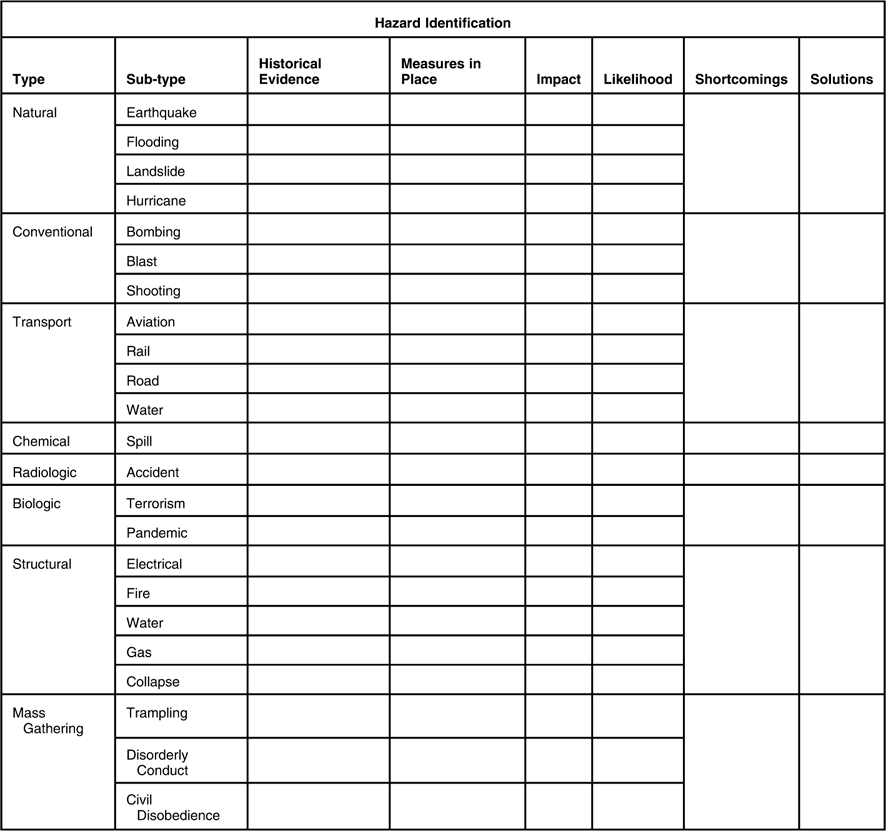
This risk assessment was performed from October 2011 through June 2012 using the table-based tool (Table 3). Based on previous literature, eight broad categories of potential threats, ranging from natural disasters to stadium-related factors, were identified. These categories were further subdivided into 23 sub-types and were adapted to be region- and event-specific (Table 3).
Risk Assessment Tool Template Developed and Applied in Preparation for the UEFA Euro 2012

Abbreviation: UEFA, Union of European Football Associations.
Articles from both scientific literature and local and international media were selected for each sub-type to characterize the various risks. These articles were chosen based on their relevance and applicability to this specific region and event. The most consistent lessons learned included the need for extensive pre-event risk assessments and periodically tested and drilled, comprehensive but realistic, disaster plans. Other important recommendations included redundant communication strategies with a centralized command center and clear transport routes.
Various measures were found to be already in place. Most importantly, local health care leadership demonstrated an excellent political commitment to emergency preparedness, especially in the period leading up to Euro 2012, as evidenced by their active pursuit of international collaboration in their disaster preparedness. Emergency and contingency funds were also made available for the event. Emergency Medical Services and national hospitals were found to be resourced adequately, with both human and material components. Finally, Ukraine had a proven record, in terms of emergency response, most notably in 1986 during the Chernobyl nuclear accident, 13 and more recently, during multiple mining accidents. 14 , 15
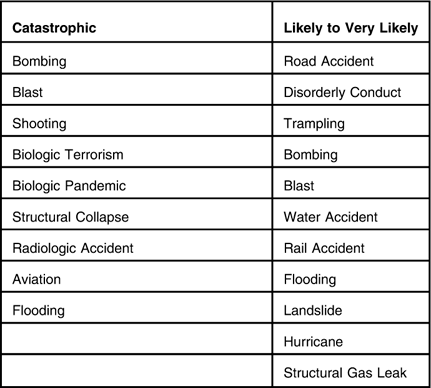
Nine specific hazards were qualified as potentially “catastrophic,” as defined by possibly causing more than 50 deaths or hundreds of injuries, leading to widespread environmental contamination, costing more than 250 million Hryvnia (approximately US $15.8 million), or triggering significant disruption to the community. Natural disasters, namely flooding; conventional hazards, such as bombing and blasts; as well as radiologic and biologic disasters, were noted to have a potentially significant impact (Table 4).
Hazards Identified as Having a High Potential Impact or High Likelihood of Occurring in Preparation for the UEFA Euro 2012

Abbreviation: UEFA, Union of European Football Associations.
Eleven specific hazards were identified as being “likely” to “very likely” to occur, as defined by having regular to high levels of recorded incidence and arising from once every 10 years to yearly. Most significant hazards included bombing and blast events, road accidents, and disorderly conduct and trampling related to MGEs (Table 4).
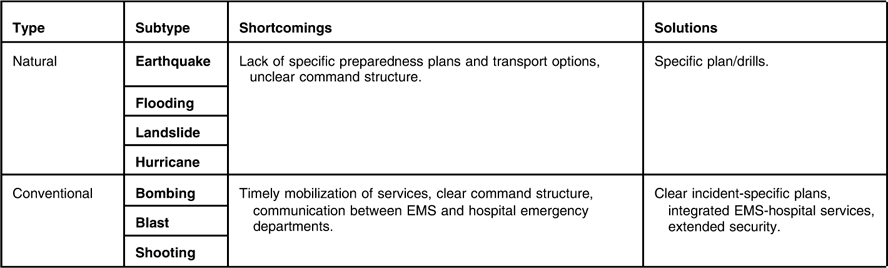
Overall, the local health care's disaster preparedness was found to be excellent. Nonetheless, general shortcomings related to the organization and mobilization of emergency services were most prominent (Table 5). Emergency Medical Services were found to not be integrated fully to hospital emergency departments, with the absence of a formalized dispatch system for mass-casualty events and of a referral system between hospitals and ambulances. Furthermore, despite the presence of strong individual components, a mobilizing, coordinating, and integrating system to oversee all levels of the emergency response needed to be developed.
Example of Presentation of Shortcomings and Solutions from the Risk Assessment Tool in Preparation for the UEFA Euro 2012

Abbreviations: EMS, Emergency Medical Services; UEFA, Union of European Football Associations.
In response to these shortcomings, improved inter-agency communication was the most imperative modification recommended. Disaster drills and table-top exercises were utilized to remediate this shortcoming. The implementation of the Trauma Team Training, a low-cost course emphasizing the multidisciplinary approach to trauma care, further solidified communication links. Broadly, an integrated EMS and hospital emergency department system was proposed, with a clear command structure, including the implementation of an incident command system. Specifically, suggested preventative measures included increased stadium security and riot police to deal with any mass-gathering-related incidents. Strict enforcement of zero tolerance for impaired driving was also brought forward as a preventative measure for the high likelihood of alcohol-related road accidents. The development of comprehensive, disaster-preparedness plans at the local, regional, and national levels was recommended, built on information available through the application of the individual hazard assessment template.
Discussion
Mass-gathering events represent a unique opportunity to prepare for potential disasters as they are scheduled and allow time for comprehensive risk assessments and planning. In this case, Euro 2012 was the first time this event was held in Ukraine and represented a unique opportunity for this country to showcase their disaster preparedness to the world. In light of the vast visibility associated with this event, local health care leadership extended their disaster-preparedness efforts to include external support for the risk assessment. In response to this plea, a novel risk assessment tool that builds upon previous experiences was developed and applied.
Indeed, several excellent risk assessment tools have already been developed. The Ministry of Public Safety and Solicitor General of British Columbia (Canada) developed a comprehensive hazard, risk, and vulnerability analysis toolkit. 16 This tool's strengths included an itemized agenda as well as a public consultation plan. Dublin's Major Emergency Management group developed a risk assessment framework that was alluded to previously. 12 Its clear and concise scales of impact and likelihood, as well as its individual hazard template, were used as the basis of the risk assessment tool. More recently, the Emergency Capacity Building Project (Active Learning Network for Accountability and Performance; London, United Kingdom) published the Harmonized Participatory Disaster Risk Assessment Tool, an aggregate of previously published risk assessment tools with a special focus on local community engagement in the risk assessment process. 17
The risk assessment tool presented in this report builds upon these tools and aggregates key elements to provide a simple, yet comprehensive, approach to performing a risk assessment. This tool focuses on the available literature to emphasize the similarity of the difficulties encountered in previous events, which provide valuable lessons to guide the risk assessment process. The incorporation of explicit scales helps classify the varying levels of likelihood and impact. The completed, table-based tool provides a clear, organized, situational analysis, pinpoints shortcomings that should be addressed, and suggests possible solutions. This clearly promotes multidisciplinary interaction and communication, which also leads to increased local community involvement. Finally, the individual hazard analysis template provides an invaluable tool to developing comprehensive incident-specific plans.
One important predicament encountered during the development of this tool was the potential dichotomy between the likelihood of an event and its impact. Indeed, the comparison of an event that is unlikely to occur but that could have catastrophic consequences, as opposed to an event that is benign but more likely to occur, presents a challenging dilemma. Even in settings with excellent resources, such catastrophic events present significant challenges. In the context of limited resources, one may choose to invest in the mitigation of more likely events even though their potential impacts are less. The catastrophic, but extremely unlikely, events may then be less prioritized.
The primary outcome of performing a risk assessment for the city of Donetsk in preparation for the Euro 2012 was achieved. However, significant secondary outcomes were also accomplished. Despite the fact that local facilities were prepared adequately for the event, inter-agency communication, notably between government and health care agencies, could be improved. It is important to note, though, that this specific problem is not exclusive to this area. In response to this, table-top exercises were implemented, during which representatives from governmental agencies, local health care authorities, as well as representatives from EMS, police, and fire services, were meeting face-to-face for the first time. The implementation of the Trauma Team Training, in addition to increasing local care capacity, further strengthened these lines of communication as now the various implicated agencies jointly participated in an interactive, team-focused course addressing trauma care.
In the future, this tool will be applied to a broader context at other MGEs. Quantitative measurements of the implementation of the recommendations will be implemented to validate the use of this tool.
This tool should be used as a call for a unified approach to the disaster-preparedness process. Indeed, easily accessible, user friendly, standardized templates for disaster preparedness in the setting of MGEs would not only facilitate the disaster-preparedness procedure, but also lead to higher quality research, and ultimately, improved disaster response. The development of such templates should be governed by an overarching agency, such as the WHO, which has had success with standardized tools in other fields, such as the WHO tool for emergency surgical services. 18 The dissemination of these templates, in addition to improved inter-agency communication, will undoubtedly lead to improved outcomes of disaster response as well as baseline functioning.
Limitations
This study does present several limitations. This risk assessment tool has only been applied specifically to the city of Donetsk in the context of the UEFA Euro 2012 and needs to be validated further in additional settings. Furthermore, no quantitative data were available regarding the actual implementation of the recommendations. This would be beneficial in order to validate quantitatively the effectiveness of the tool in the risk assessment process.
In addition, the scales used to categorize the impact and likelihood of each hazard present their own limitations. The scales were developed for the assessment of disasters in general, and not specifically for disasters in the context of MGEs. These scales require modifications in the future, as even a hazard deemed as “likely” to occur (or occurring annually) remains unlikely to occur during a 3-week event, and the potential impact of a disaster may be exponentially higher in the aggregated population at a MGE. More work is needed to develop scales geared specifically towards MGEs, using the growing body of literature available.
Conclusion
Risk assessment is the vital step in the disaster-preparedness continuum as it guides the subsequent phases. This simple, table-based tool provides an organized approach to the process and has been applied successfully to the city of Donetsk in the context of the UEFA Euro 2012 and should be applied and further validated in future MGEs.