Introduction
One of the most consistent epidemiological findings in psychosis research is the positive association between paternal age and risk of schizophrenia (Malaspina et al. Reference Malaspina, Harlap, Fennig, Heiman, Nahon, Feldman and Susser2001; Brown et al. Reference Brown, Schaefer, Wyatt, Begg, Goetz, Bresnahan, Harkavy-Friedman, Gorman, Malaspina and Susser2002; Byrne et al. Reference Byrne, Agerbo, Ewald, Eaton and Mortensen2003; Zammit et al. Reference Zammit, Allebeck, Dalman, Lundberg, Hemmingson, Owen and Lewis2003; El-Saadi et al. Reference El-Saadi, Pedersen, McNeil, Saha, Welham, O'Callaghan, Cantor-Graae, Chant, Mortensen and McGrath2004; Sipos et al. Reference Sipos, Rasmussen, Harrison, Tynelius, Lewis, Leon and Gunnell2004; Ekeus et al. Reference Ekeus, Olausson and Hjern2006; Wohl & Gorwood, Reference Wohl and Gorwood2007). It has been suggested that this association may be due to the increase in sporadic de novo mutations in male germ cells associated with age (Crow, Reference Crow1997, Reference Crow2000; Glaser & Jabs, Reference Glaser and Jabs2004), though alternative explanations have included psychosocial factors associated with parents' age, such as early parental loss (Agid et al. Reference Agid, Shapira, Zislin, Ritsner, Hanin, Murad, Troudart, Bloch, Heresco-Levy and Lerer1999; Morgan et al. Reference Morgan, Kirkbride, Leff, Craig, Hutchinson, McKenzie, Morgan, Dazzan, Doody, Jones, Murray and Fearon2007) or delayed age at marriage due to personality traits (Brown et al. Reference Brown, Schaefer, Wyatt, Begg, Goetz, Bresnahan, Harkavy-Friedman, Gorman, Malaspina and Susser2002; Zammit et al. Reference Zammit, Allebeck, Dalman, Lundberg, Hemmingson, Owen and Lewis2003). There is some evidence to suggest that the association of paternal age with schizophrenia may be restricted to people without a family history of psychosis (Malaspina et al. Reference Malaspina, Corcoran, Fahim, Berman, Harkavy-Friedman, Yale, Goetz, Goetz, Harlap and Gorman2002; Sipos et al. Reference Sipos, Rasmussen, Harrison, Tynelius, Lewis, Leon and Gunnell2004), but results on this issue are inconsistent (Pulver et al. Reference Pulver, McGrath, Liang, Lasseter, Nestadt and Wolyniec2004). Advanced paternal age has also been associated with several other health-related problems, such as low birth weight (Reichman & Teitler, Reference Reichman and Teitler2006), breast cancer (Choi et al. Reference Choi, Lee, Park, Noh, Ahn, Yoo and Kang2005), congenital malformations (Zhu et al. Reference Zhu, Madsen, Vestergaard, Olesen, Basso and Olsen2005; Yang et al. Reference Yang, Wen, Leader, Chen, Lipson and Walker2007), pre-eclampsia (Harlap et al. Reference Harlap, Paltiel, Deutsch, Knaanie, Masalha, Tiram, Caplan, Malaspina and Friedlander2002) and autism (Reichenberg et al. Reference Reichenberg, Gross, Weiser, Bresnahan, Silverman, Harlap, Rabinowitz, Shulman, Malaspina, Lubin, Knobler, Davidson and Susser2006).
In contrast to the large number of investigations on the association between paternal age and schizophrenia, data on the association of paternal age with bipolar disorder (BPAD) are more scarce. Some of the studies cited above have investigated the relationship between paternal age and other psychoses (Zammit et al. Reference Zammit, Allebeck, Dalman, Lundberg, Hemmingson, Owen and Lewis2003) or other psychiatric conditions (Malaspina et al. Reference Malaspina, Harlap, Fennig, Heiman, Nahon, Feldman and Susser2001), but did not find this association. One study found a positive association between paternal age and psychosis, including BPAD, using data from population-based studies in Sweden and Denmark (El-Saadi et al. Reference El-Saadi, Pedersen, McNeil, Saha, Welham, O'Callaghan, Cantor-Graae, Chant, Mortensen and McGrath2004), but non-affective and affective psychoses were not examined separately. A large number of cases of BPAD occur amongst people with no family history of the disorder, i.e. sporadic cases (Shih et al. Reference Shih, Belmonte and Zandi2004). Furthermore, there is increasing evidence that BPAD and schizophrenia may share common susceptibility genes (Craddock et al. Reference Craddock, O'Donovan and Owen2006; Farmer et al. Reference Farmer, Elkin and McGuffin2007). Therefore, if the association between paternal age and risk of schizophrenia in the offspring is actually due to sporadic mutations, it is possible that the risk of BPAD would also show a positive association with paternal age, but not with maternal age. A recent study looked at this association using a large dataset from Sweden (Frans et al. Reference Frans, Sandin, Reichenberg, Lichtenstein, Längström and Hultman2008). After controlling for maternal age, family history of psychotic disorder, parity and socio-economic status, offspring of men aged ⩾55 years were almost 40% more likely to receive an in-patient diagnosis of BPAD than the offspring of men aged 20–24 years, in a pattern similar to that observed for the association between paternal age and schizophrenia. However, differently from what has been described for schizophrenia, there was also a positive association between maternal age and BPAD, though it was weaker than the association with paternal age.
The aim of the present study was to further examine the relationship between paternal and maternal ages and risk of BPAD in their offspring, using data from a large population-based cohort based on the linkage of several Swedish registers. It was hypothesized that the incidence of BPAD in the offspring would increase with paternal age, in a pattern similar to that observed for schizophrenia, but there would be no association with maternal age. We also investigated whether any associations differed according to family history of psychosis and gender of the offspring.
Method
Sample
The cohort, which has been previously analysed for the association between paternal age and risk of schizophrenia in the offspring (Sipos et al. Reference Sipos, Rasmussen, Harrison, Tynelius, Lewis, Leon and Gunnell2004), consisted of 754 330 individuals born in Sweden between January 1973 and December 1980 who were still alive and resident in Sweden at the age of 16 years. The starting date for inclusion in the cohort was defined by the availability of information on parents' age in birth records. The closing date was set to allow a minimum period of 6 years at risk for a BPAD episode, from age 16 to 22 years, for those born in 1980. Information on cohort members was obtained by linkage of the Swedish medical birth registry, the population and housing census of 1990, the in-patient discharge register (from January 1974 to 31 December 2002), and the causes of death (up to 31 December 2002) and emigration registers (up to 31 December 2001). The analysis was based on records of people with a first hospital admission with a diagnosis of BPAD [International Classification of Diseases (ICD)-10 codes F30-31; Swedish version ICD-9 codes 296A (single episode of mania), 296C (BPAD, manic phase) and 296D (BPAD, melancholic phase)] between 1989 and 2002. Overall, 42 341 (5.6%) records were excluded from the analysis because of missing data on paternal age or one or more of the potential confounding variables examined. The remaining 711 989 subjects came from 532 740 families.
Variables
Paternal age was analysed first as a continuous variable. We then categorized paternal age in 5-year age bands. A number of variables were considered as potential confounders, based on previous studies on risk factors for BPAD and psychoses:
(1) subjects' gender;
(2) subjects' age on 31 December 2001;
(3) maternal age at index birth;
(4) place of birth [classified as main cities and suburbs, large cities and industry, rural areas, according to previous grouping of place of birth for the cohort (Harrison et al. Reference Harrison, Fouskakis, Rasmussen, Tynelius, Sipos and Gunnell2003)];
(5) obstetric characteristics (season of birth, gestational age in weeks, birth weight in grams, Apgar scores at 1 min and at 5 min, parity of mother, singleton, twin or multiple birth);
(6) family history of psychosis and of BPAD (hospital admission of father, mother or sibling with a diagnosis of psychosis, which included any non-affective psychosis not induced by substances, or BPAD – data came from the in-patient discharge register);
(7) death of a parent before the age of 15 years;
(8) childhood socio-economic position (derived from data from the Swedish population and housing census of 1990): highest of mother's or father's annual income (<100 000 Kr, 100 001–200 000 Kr, 200 001–300 000 Kr, >300 000 Kr), highest of mother's or father's socio-economic status (blue collar, white collar, self-employed, other), highest of mother's or father's education (<9 years, 9–10 years, full secondary school, higher).
Analysis
Statistical analysis was carried out using Stata 9.0 (StataCorp LP, USA). Cox's proportional hazard regression models were used to assess the association between paternal age and risk of BPAD in the offspring. Time in the study was counted from the day of the 16th birthday to the first admission with a diagnosis of BPAD or censoring, which occurred when the subject died, emigrated or at the end of the study period. Possible clustering of cases within families was accounted for by using robust variances for the hazard ratios (HRs). In order to investigate the strength of the linear association of paternal age with BPAD, both paternal and maternal ages were divided by 10 and analysed as continuous variables, so that the HRs for these associations estimate the change in risk of BPAD per 10-year increase in paternal age. Potential confounding effects of other exposure variables were controlled for by entering the covariates in the regression model and examining whether they altered the strength of associations with paternal age. In order to visualize changes in risk with paternal age, we tabulated HRs for paternal age grouped into 5-year age bands and using parents aged 21–24 years as the reference category. Similar analyses were performed to examine the association between maternal age and risk of BPAD in the offspring.
Collinearity between paternal and maternal ages was examined through computing the correlation between these two variables, by calculating their variance inflation factor (VIF), and by examining the width of the 95% confidence intervals (CIs) of both HRs for paternal and maternal ages when mutually adjusted in the Cox's proportional regression model (Armitage & Berry, Reference Armitage and Berry1994). Strong collinearity is considered present when the VIF is as large as 9 or 10, or when the CIs for the estimates of the coefficients of the two correlated variables become much wider when they are simultaneously in the same model, as compared with the CIs of the coefficients for each covariate separately. We then created a variable indicative of the number of parents (none, one or both) aged ⩾30 years, in order to look at a possible cumulative effect of parents' age on risk of BPAD. Finally, we investigated whether the association between parents' ages and risk of BPAD differed in subjects with and without a family history of psychosis by fitting a term for the interaction between parents' age and family history of psychosis to our models. We also tested for a possible interaction between gender of proband and paternal age. Statistical significance was calculated using Wald's tests. The population impact of paternal age on the incidence of BPAD was assessed by estimating the population attributable fraction (PAF) for paternal age of ⩾30 years, compared with paternal age of ⩽29 years.
Results
The mean follow-up time from age 16 was 9 years, with a minimum period of observation of 6 years and a maximum of 14 years. During the follow-up period, 493 (0.07%) participants were admitted to hospital with a diagnosis of BPAD (six were siblings), yielding an incidence of 7.7 (95% CI 7.0–8.4) cases per 100 000 person-years.
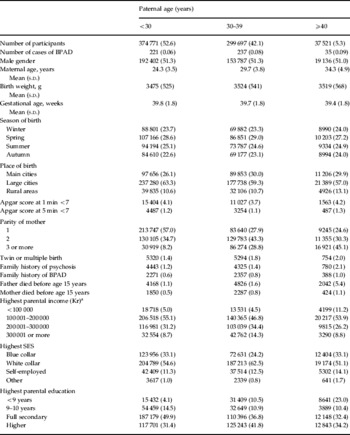
Paternal age was relatively strongly correlated with maternal age (Pearson's correlation coefficient=0.72, p<0.001, VIF=2.09), and with higher parity among mothers (Table 1). There were small differences in birth weight and gestational age according to paternal age group. There was a higher proportion of older fathers living in rural areas by the time of index birth. Index subjects from older fathers also tended to be twins more frequently, to have a family history of psychosis and to have experienced the death of one of their parents before the age of 15 years. Older fathers tended to have lower incomes and were more likely to be self-employed and to have received less education than younger fathers.
Distribution of potential confounding variables according to paternal age

BPAD, Bipolar affective disorder; s.d., standard deviation; SES, socio-economic status.
Values are given as n (%), unless stated otherwise.
a Kr 100 000=£7467, US$13238, €10953.
Paternal age and risk of BPAD in the offspring
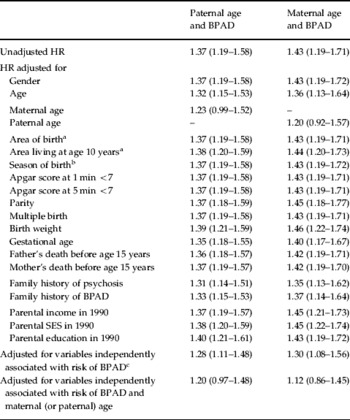
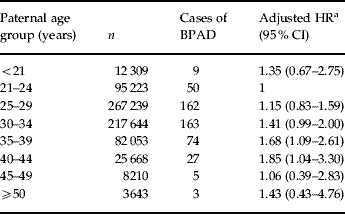
In the bivariate analysis, paternal age was positively associated with risk of BPAD in the offspring, with a 37% (95% CI 19–58%, p<0.001) increase in risk of BPAD in the offspring for each 10-year increase in paternal age (Table 2). This association was not confounded by any one of the potential confounding variables, with the exception of maternal age and, to a lesser extent, family history of psychosis (Table 2). After controlling for maternal age, the risk of BPAD for each 10-year increase in paternal age dropped to 23% (95% CI −1.0 to 52%, p=0.06), and adjustment for further potential confounders attenuated the risk estimate to 20% (95% CI −3.0 to 48%, p=0.09). The offspring of younger fathers (<21 years) had a higher risk for BPAD than children from fathers aged 21–24 years, and this risk then increased with paternal age until 44 years (Table 3). This trend did not persist for age groups 45–49 years and ⩾50 years, but absolute numbers of cases in the younger and older age groups were very small and the CIs of the respective estimates very wide. The PAF of incidence of BPAD for paternal age of ⩾30 years was 13% (95% CI 2–23%).
Risk of BPAD for each 10-year increase in paternal or maternal ages, unadjusted and controlling for potential confounding variables

BPAD, Bipolar affective disorder; HR, hazard ratio; SES, socio-economic status.
Values are given as HR (95% confidence interval).
a Main cities, large cities, rural area.
b Spring, summer, autumn, winter.
c Subject's gender and age, gestational age, family history of psychosis, parental socio-economic status in 1990 and highest parental education in 1990.
Risk of BPAD according to paternal age group, adjusted for potential confounding variables

BPAD, Bipolar affective disorder; HR, hazard ratio; CI, confidence interval.
a Adjusted for subject's gender and age, gestational age, family history of psychosis, parents' highest socio-economic status in 1990, parents' highest educational level in 1990 and maternal age.
Maternal age and risk of BPAD in the offspring
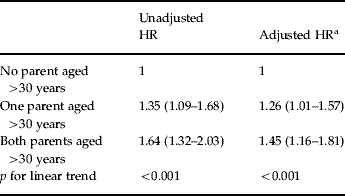
A very similar association and confounding effects were observed in relation to maternal age and risk of BPAD in the offspring. Before controlling for paternal age, a 10-year increase in maternal age was associated with a 43% (95% CI 19–71%, p<0.001) increase in the risk of BPAD (Table 2). Controlling for paternal age led to greater attenuation in the association between maternal age and risk of BPAD than when controlling the paternal age association for maternal age (HR 1.20, 95% CI 0.92–1.57, p=0.18). Further adjustment for confounding variables led to a HR of 1.12 (95% CI 0.86–1.45, p=0.41). However, the overall patterns of association suggested that both parents' ages may contribute to the risk of BPAD. In order to further examine this association, a categorical variable was created, in which index participants were classified as having no parent aged >30 years, having one parent aged >30 years or having both parents aged >30 years. A progressive increase in risk of BPAD was observed (Table 4), which persisted, but was slightly weakened after controlling for possible confounding factors, particularly family history of psychosis.
Risk of BPAD according to number of parents aged >30 years

BPAD, Bipolar affective disorder; HR, hazard ratio.
Values are given as HR (95% confidence interval).
a Adjusted for subject's gender and age, gestational age, family history of psychosis, parents' highest socio-economic status in 1990 and parents' highest educational level in 1990.
Parental age and risk of BPAD in the offspring according to family history of psychosis and offspring gender
Paternal age showed similar associations with risk of BPAD for both participants without (HR 1.20, 95% CI 0.96–1.50) or with a family history of psychosis (HR 1.17, 95% CI 0.65–2.09), whereas maternal age was positively associated with risk of BPAD only among participants without a family history of psychosis (HR 1.21, 95% CI 0.92–1.59) but not among those with a family history of psychosis (HR 0.77, 95% CI 0.37–1.57). Tests for interaction between parents' age at conception and family history of psychosis were statistically significant for maternal age (p=0.04), but not for paternal age (p=0.15). There was no evidence of interaction between probands' gender and parents' age on the risk of BPAD in the offspring.
Discussion
This study tested the hypothesis that paternal age, but not maternal age, is associated with offspring risk of BPAD. The expected association with paternal age was observed and was found to be independent from a series of potential confounding factors. This finding is in keeping with that of a recently published investigation, also based on Swedish population data, that examined the relationship between paternal age and risk of BPAD (Frans et al. Reference Frans, Sandin, Reichenberg, Lichtenstein, Längström and Hultman2008). Our cohort differs in terms of the range of confounding factors investigated and the narrower range of birth dates. However, in contrast to the relationship between paternal age and schizophrenia described in previous studies (Malaspina et al. Reference Malaspina, Harlap, Fennig, Heiman, Nahon, Feldman and Susser2001; Brown et al. Reference Brown, Schaefer, Wyatt, Begg, Goetz, Bresnahan, Harkavy-Friedman, Gorman, Malaspina and Susser2002; Byrne et al. Reference Byrne, Agerbo, Ewald, Eaton and Mortensen2003; Zammit et al. Reference Zammit, Allebeck, Dalman, Lundberg, Hemmingson, Owen and Lewis2003; Sipos et al. Reference Sipos, Rasmussen, Harrison, Tynelius, Lewis, Leon and Gunnell2004), the association between paternal age and risk of BPAD was not materially different from that with maternal age, in unadjusted and in mutually adjusted models. Indeed, a cumulative risk appeared to be present, where having both parents aged >30 years at the time of birth was associated with a higher risk than having only one older parent, which in turn had a higher risk than having no parent aged ⩾30 years at the time of birth.
Before adjusting for maternal age, the association between paternal age and risk of BPAD in the offspring followed the pattern observed for the association of paternal age with schizophrenia found in previous studies, which have shown increases in risk varying from 1.4 to 1.7 for each 10-year increase in paternal age (Malaspina et al. Reference Malaspina, Harlap, Fennig, Heiman, Nahon, Feldman and Susser2001; Brown et al. Reference Brown, Schaefer, Wyatt, Begg, Goetz, Bresnahan, Harkavy-Friedman, Gorman, Malaspina and Susser2002; Zammit et al. Reference Zammit, Allebeck, Dalman, Lundberg, Hemmingson, Owen and Lewis2003; Sipos et al. Reference Sipos, Rasmussen, Harrison, Tynelius, Lewis, Leon and Gunnell2004). However, unlike previous findings in relation to schizophrenia (Malaspina et al. Reference Malaspina, Harlap, Fennig, Heiman, Nahon, Feldman and Susser2001; Zammit et al. Reference Zammit, Allebeck, Dalman, Lundberg, Hemmingson, Owen and Lewis2003; Sipos et al. Reference Sipos, Rasmussen, Harrison, Tynelius, Lewis, Leon and Gunnell2004), the HRs for each 10-year increase in paternal age were somewhat attenuated after adjusting for maternal age. Furthermore, there appeared to be an association between maternal age and risk of BPAD, although the confounding effect of paternal age on maternal age associations appeared to be stronger than that of maternal age on paternal age associations.
In studies of schizophrenia, the association of maternal age with risk of disease is clearly confounded by paternal age (Malaspina et al. Reference Malaspina, Harlap, Fennig, Heiman, Nahon, Feldman and Susser2001; Zammit et al. Reference Zammit, Allebeck, Dalman, Lundberg, Hemmingson, Owen and Lewis2003; Sipos et al. Reference Sipos, Rasmussen, Harrison, Tynelius, Lewis, Leon and Gunnell2004). Such an effect was also seen here, but there was some evidence of a residual maternal age effect. One possibility would be that these mutually attenuated associations between paternal and maternal ages and risk of offspring BPAD were due to collinearity, since parents' ages are highly correlated. However, the correlation between maternal and paternal ages (r=0.72) is insufficient to account for these results, as indicated by the VIF<10. An alternative explanation is that paternal and maternal ages had mutually confounded associations, and that both paternal and maternal ages are associated with small increases in risk of BPAD. Indeed, maternal age can only confound the association between paternal age and risk of BPAD if maternal age itself is associated with the disease and, conversely, paternal age can only be a confounder in the association between maternal age and risk of BPAD if paternal age itself is associated with the disease (Rothman & Greenland, Reference Rothman and Greenland1998). Similar results were described in a recent investigation that also examined specifically the relationship between paternal age and risk of BPAD, using a nationwide Swedish dataset (Frans et al. Reference Frans, Sandin, Reichenberg, Lichtenstein, Längström and Hultman2008), where the associations of both paternal and maternal ages with risk of BPAD were attenuated when mutually adjusted.
The association between paternal age and risk of schizophrenia in the offspring has been attributed to the increased rate of spontaneous mutations in the male germ cell line observed with ageing. This ‘paternal age effect’ has been well established for a number of rare genetic diseases, where the mechanism is a base substitution in a single gene (Crow, Reference Crow2000; Glaser & Jabs, Reference Glaser and Jabs2004). Although no similar specific germ cell mutations have been identified in more complex traits as yet, there is no reason to assume that these might not account for a small proportion of variation in risk for such diseases, including BPAD (Crow, Reference Crow2000). Indeed, an increasing number of epidemiological studies have shown a positive association between paternal age and several adverse health outcomes (Harlap et al. Reference Harlap, Paltiel, Deutsch, Knaanie, Masalha, Tiram, Caplan, Malaspina and Friedlander2002; Zhu et al. Reference Zhu, Madsen, Vestergaard, Olesen, Basso and Olsen2005; Reichenberg et al. Reference Reichenberg, Gross, Weiser, Bresnahan, Silverman, Harlap, Rabinowitz, Shulman, Malaspina, Lubin, Knobler, Davidson and Susser2006; Reichman & Teitler, Reference Reichman and Teitler2006; Yang et al. Reference Yang, Wen, Leader, Chen, Lipson and Walker2007). It has also been suggested that if such ‘de novo’ mutations play a role in the aetiology of psychosis, then the association between paternal age and risk of psychosis would be stronger among individuals without a family history of psychosis.
The association between maternal age and risk of BPAD in the offspring was an unexpected finding, and its meaning is difficult to interpret. Maternal age is associated with a number of genetic mutations, more specifically chromosomal abnormalities (Crow, Reference Crow2000; Glaser and Jabs, Reference Glaser and Jabs2004), as observed in Down's syndrome, but such severe abnormalities have not been observed in cases of psychosis. Nevertheless, it is possible that the observed cumulative increased risk of BPAD might be due to the sum of diverse genetic mutations associated with paternal and maternal ages, each accounting for a small increase in risk. Alternatively, the cumulative increased risk of BPAD for children of older parents may represent environmental factors that are associated with parents' age. Another large cohort study conducted in Sweden (Ekeus et al. Reference Ekeus, Olausson and Hjern2006) found that both paternal and maternal ages were independently associated with an increased risk of schizophrenia, even after controlling for a number of potential confounders and for the other parent's age. The authors argued that older mothers are more likely to present obstetric complications, which in turn may increase the risk of schizophrenia. They also reported a negative association between maternal age and admissions due to substance abuse and suicide attempts, which could not be attributed to younger mothers' lower socio-economic condition. It has been suggested that having older parents would increase the likelihood of early parental loss, which in its turn may be a risk factor for psychosis. In our sample, index participants with older fathers were more likely to have experienced the loss of a relative before reaching the age of 15 years. However, we did not find any confounding by parents' death before the age of 15 years, and the number of participants who lost one of the parents at early ages was very small.
We did not find any suggestion that the association between paternal age and risk of BPAD is stronger among those without a family history of psychosis, compared with those with a family history, nor that such an association might interact with probands' gender. We did find some evidence for an interaction between maternal age, family history of psychosis and risk of BPAD in probands, which deserves replication before causal interpretations can be suggested, since this was an unexpected finding from an exploratory analysis.
Strengths and limitations
One of the strengths of the present study is the number of cases of BPAD (n=493), giving reasonable statistical power to examine the hypothesis proposed. Nevertheless, the actual number of cases of BPAD may have not been sufficient to detect relatively weak associations. The cohort design minimizes selection and information biases, since ascertainment of cases was independent of exposure measurement. We were also able to control for a series of potential confounding variables. One limitation of the study is that case identification was based on clinical diagnoses given to individuals who had been admitted to a psychiatric hospital and so some cases of BPAD with milder symptoms and behavioural problems not requiring admission may have been missed. Furthermore, some cases with more severe psychotic symptoms may have been given a diagnosis of schizophrenia or other non-affective psychosis, whereas some first-episode cases of non-affective psychoses might in fact receive a clinical diagnosis of BPAD, for this diagnosis may be associated with less stigma and better prognosis than a diagnosis of schizophrenia. However, such potential misclassification is unlikely to be related to parents' age, and missed cases would be very much diluted among non-cases of BPAD, having minimal impact on the estimates found. It is possible that a small proportion of the men declared to be the fathers of cohort members were not, in fact, their biological fathers, but such misclassification is likely to only dilute the observed associations slightly. There is an association between paternal age and schizophrenia in this same dataset. Information on potential confounders came from different sources, and some degree of random measurement error is likely to have occurred. However, the association between parental age and risk of BPAD was almost unchanged by any of the confounders included in the models, with the exception of family history of psychosis. It is possible that some residual confounding for family history persisted, since information on psychiatric admission was only available for parents and siblings for the period covered by the Swedish psychiatric registers, but it is unlikely that residual confounding alone could explain the observed results.
Conclusion
Unlike schizophrenia, the risk of BPAD seems to be associated with both paternal and maternal ages, and there may be a cumulative effect of parents' ages, but possible mechanisms involved behind these associations are unknown. Even if some risk factors for schizophrenia and BPAD are shared, these results suggest that there are also different factors involved in the aetiology of affective and non-affective psychoses. Clarification of the relationship between parents' age and risk of BPAD provides further evidence of some of the adverse consequences of delaying parenthood. Taking the limited power of the present study into account, the PAF indicates that it is possible that having children after the age of 30 years has either almost no impact on their risk of BPAD or increases their risk by some 20%. Such a perspective needs to be balanced against the likely positive effects of the greater financial stability and likely emotional maturity of older parents when giving policy advice concerning the current trend towards delaying the age at parenthood. Future research disentangling the pathophysiology underlying the observed associations may help to develop more effective interventions for those who suffer from this disorder.
Acknowledgements
P.R.M. received a post-doctoral fellowship from the Brazilian National Council for Scientific and Technological Development (Conselho Nacional de Desenvolvimento Científico e Tecnológico, CNPq-Brazil).
Declaration of Interest
None.