Introduction
Rare earth elements (REEs) include the 15 lanthanides, along with scandium and yttrium (IUPAC, Reference Connelly, Hartshorn, Damhus and Hutton2005), and are critical in the production of wind turbines, electric vehicles, solar cells, medical equipment, military technology and energy-efficient lighting (An, Reference An2015). However, lanthanide elements are in short supply, in part because REEs cannot be accessed economically from most deposits due to the very low solubility of the minerals and the necessity for concentrated sulfuric acid and/or sodium hydroxide at high temperature to extract REEs (Zhuang et al., Reference Zhuang, Fitts, Ajo-Franklin, Maes, Alvarez-Cohen and Hennebel2015; Brandl et al., Reference Brandl, Barmettler, Castelberg and Fabbri2016; Brisson et al., Reference Brisson, Zhuang and Alvarez-Cohen2016).
The Lachlan Fold Belt of Victoria and New South Wales, Australia, contains ~350 granite intrusions with a variety of granite types (I-, S- and A-type, see Frost et al., Reference Frost, Barnes, Collins, Arculus, Ellis and Frost2001 for classifications) and contrasting primary REE and P mineralogy. In fresh granites, REEs are found predominately in primary monazite [(Ce,La,Nd,Th)PO4] and allanite [(Ca,Ce,La)3(Fe2+,Fe3+)Al2O (Si2O4)(Si2O7)(OH)] with small amounts in accessory apatite [Ca5(PO4)3(F,Cl,OH)], zircon (ZrSiO4) and titanite (CaTiSiO5). As fresh granite is weathered, primary REE- and P-containing minerals are broken down – depending on the degree of weathering and their hardness and solubility. For example, monazite and zircon are highly weather resistant and therefore are found commonly in sediments as mineral placer deposits (Roy, Reference Roy1999; Sircombe and Freeman, Reference Sircombe and Freeman1999) whereas allanite, apatite and titanite are weatherable and breakdown easily to release REE and/or P (Banfield and Eggleton, Reference Banfield and Eggleton1989; Price et al., Reference Price, Velbel and Patino2005). The dissolution of REE-bearing minerals results in the mobilisation and distribution of REE3+ throughout the weathered profile (Nesbitt, Reference Nesbitt1979; Duddy, Reference Duddy1980; Banfield and Eggleton, Reference Banfield and Eggleton1989; Berger et al., Reference Berger, Janots, Gnos, Frei and Bernier2014; Sanematsu et al., Reference Sanematsu, Kon and Imai2015).
Phosphorus may precipitate with mobilised elements to form insoluble secondary phases such as the secondary uranium phosphates formed in the S-type granites of Lake Boga and Whycheproof, Victoria, Australia (Mills et al., Reference Mills, Birch, Maas, Phillips and Plimer2008; Birch et al., Reference Birch, Mills, Maas and Hellstrom2011), or the highly insoluble secondary lanthanide phosphates and lanthanide aluminium phosphates in the I-type granite of Bemboka, NSW, Asutralia (Banfield and Eggleton, Reference Banfield and Eggleton1989). Interestingly, regardless of their high insolubility the secondary lanthanide phosphates are removed from the overlying soil while being concentrated in the weathered rock below (Taunton et al., Reference Taunton, Welch and Banfield2000a,Reference Taunton, Welch and Banfieldb). The dissolution mechanisms remain unknown, but theoretical considerations such as measurements of REE complexation by siderophores (Christenson and Schijf, Reference Christenson and Schijf2011), organic acids (Goyne, et al., Reference Goyne, Brantley and Chorover2010) and biogenic dissolution of REE/P-bearing minerals (Cervini-Silva et al., Reference Cervini-Silva, Fowle and Banfield2005; Brisson et al., Reference Brisson, Zhuang and Alvarez-Cohen2016; Corbett et al., Reference Corbett, Eksteen, Niu, Croue and Watkin2017) hint at a potential microbiological role in dissolution.
The REEs were long thought to be biologically inert, until recently when it was shown they are incorporated into the active site of the lanthanide-dependent XoxF enzyme, a variant of methanol dehydrogenase found in most methylotrophic bacteria, and a potentially important driver in the cycling of carbon (Pol et al., Reference Pol, Barends, Dietl, Khadem, Eygensteyn, Jetten and Op den Camp2014; Huang et al., Reference Huang, Yu, Groom, Cheng, Tarver, Yoshikuni and Chistoserdova2019). In fact, xoxF genes have been found to be highly represented in the genomes of bacteria in soil (Butterfield et al., Reference Butterfield, Li, Andeer, Spaulding, Thomas, Singh, Hettich, Suttle, Probst and Tringe2016; Diamond et al., Reference Diamond, Andeer, Li, Crits-Christoph, Burstein, Anantharaman, Lane, Thomas, Pan, Northen and Banfield2019) suggesting that mechanisms may exist to solubilise REE minerals in the environment (Roszczenko-Jasińska et al., Reference Roszczenko-Jasińska, Vu, Subuyuj, Crisostomo, Cai, Raghuraman, Ayala, Clippard, Lien and Ngo2019). Additionally, P is required by all organisms for synthesis of nucleic acids and can be the primary production-limiting constituent because, although present in soil minerals, it may be sequestered into insoluble weathering products, including REE/P-bearing minerals (Nesbitt, Reference Nesbitt1979).
In this study, we used field-emission scanning electron microscopy (FE-SEM) and inductively coupled plasma mass-spectrometry (ICP-MS) to characterise qualitatively and quantitatively the geochemical remobilisation of P and REEs from primary and secondary lanthanide-silicate and lanthanide-phosphate minerals in granites classified as I-, S- and A-type granites. We assessed REE- and P-bearing mineral dissolution and precipitation in granites that had undergone slight to extensive weathering, at sub-microscopic scales. The work extends prior investigations of secondary lanthanide phosphate mineral formation in a single I-type granite (Banfield and Eggleton, Reference Banfield and Eggleton1989; Taunton et al., Reference Taunton, Welch and Banfield2000a,Reference Taunton, Welch and Banfieldb), by addressing the question of whether the process occurs in the three major granite types. None of the previous studies compared secondary lanthanide phosphate mineral formation and dissolution with weathering as a function of granite type.
Prior studies that investigated the weathering of one I-type granite found that allanite broke down during the early stages of granite weathering (Banfield and Eggleton, Reference Banfield and Eggleton1989), and the REEs released were precipitated on the surfaces of etched apatite crystals as highly insoluble secondary lanthanide phosphate and lanthanide aluminium phosphate minerals (Banfield and Eggleton, Reference Banfield and Eggleton1989; Taunton et al., Reference Taunton, Welch and Banfield2000a,Reference Taunton, Welch and Banfieldb). This process has not been studied in the less common A-type granites that also contain allanite as the primary REE-containing mineral and are distinguished from I- and S-type granites by higher YREE contents (White and Chappell. Reference White and Chappell1983). Nor has REE mineral weathering been considered for S-type granites, which contain monazite instead of allanite. Unlike allanite, monazite is highly weathering resistant, which is why it accumulates as a residual mineral in sand deposits (Roy, Reference Roy1999). Our further investigation of weathering of lanthanide minerals in granites extends prior work via the analysis of replicates of I-type granite and establishes the degree to which prior findings apply to all types. These results have implications for predicting REE and phosphorus mobility and bioavailability in soils derived from granitic rock types and provide clues regarding the types of sites that could be sampled for discovery of microorganisms and biogeochemical pathways with bioleaching potential.
Methodology
Sample locations and sample collection
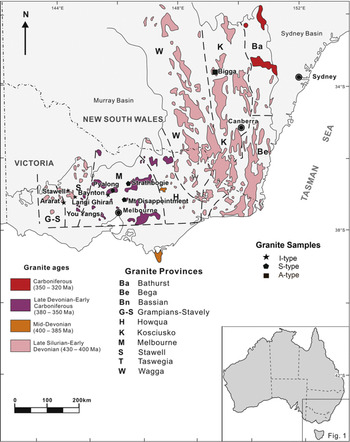
Thirty-nine hand specimens of fresh and progressively weathered granites were collected from nine locations in Victoria and New South Wales, Australia (Fig. 1). Samples were collected outwards from the central, freshest material towards increasingly weathered ‘zones’ where possible. Samples ranged in texture from hard freshest rock to disaggregated weathered rock, to finely grained, highly disaggregated material in the most weathered of samples. The highly weathered samples retained their granitic texture despite being very porous, therefore isovolumetric weathering was assumed following the classification of Anand et al. (Reference Anand, Gilkes, Armitage and Hillyer1985).
Geological map detailing the major distributions of granites and granite provinces in the Lachlan fold belt, South Eastern Australia. Modified after Hong et al. (Reference Hong, Cooke, Huston, Maas, Meffre, Thompson, Zhang and Fox2017).

Sample preparation and analysis
Given that apatite is the most likely source for P required for REE/P-bearing mineral precipitation, we focused on the surfaces of apatite crystals and relict apatite pits to locate secondary lanthanide phosphate minerals. As biotite contained euhedral apatite crystals up to 100 μm long, biotite grains were extracted from the weathered granite samples using tweezers under a binocular microscope and split along their cleavage plane using a scalpel to reveal interior basal planes. Biotite grains were used for monazite, apatite, titanite and secondary lanthanide phosphate characterisation using SEM energy-dispersive X-ray spectroscopy (EDX). Thin sections were prepared for allanite characterisation under SEM-EDX. Cleaved biotite grains were mounted on SEM stubs and glass slides using double-sided carbon adhesive, carbon-coated and secondary lanthanide phosphates were characterised using a FEI Teneo VolumeScope. Given their high average atomic number, REE/P-bearing minerals were located using back-scattered electron imaging (BSE), at an accelerating voltage of 10 kV. At least 60 biotite grains were examined per sample with anywhere from 0–30 secondary REE/P minerals analysed per sample. Mineral chemistry was determined using EDX analysis; was semi-quantitative and standardless with a predicted error rate of at least 10%. Minerals phase analysis was repeated and reproduced when possible to reduce experimental error. Fist sized rock samples were crushed using a rock crusher and then further milled into a powder using an agate ring mill. Whole-rock elemental analysis was performed using the Applied Technologies 7700 ICP-MS instrument (see Supplementary Materials for detailed methods) with an expected error rate of ~5%.
Results
Sampling of fresh and weathered granitic rocks
We collected fresh and weathered rock from nine sites located in Victoria and New South Wales, Australia. Mineralogy was determined on the basis of a combination of Victorian Geological Survey reports, thin sections and spot analysis via SEM-EDX (Table 1). The density of weathered rock compared to fresh rock was measured to provide an indication of the degree of alteration. Density was determined by weighing samples, then coating them in parafilm and weighing samples in water. Samples with densities >2.5 g/cm3 were classified as nearly fresh rock, 2.4 to 2.2 g/cm3 as lightly weathered, 2.1 to 1.9 g/cm3 as moderately weathered, 1.8 to 1.6 g/cm as highly weathered and < 1.6 g/cm3 as very highly weathered. Even in the most highly weathered samples granitic texture was retained, suggesting no substantial change in volume.
List of rock-forming and REE-bearing minerals of the granites sampled.

Abbreviations: Hlb, hornblende; Bt, biotite; Zrn, zircon; Apt, apatite; Mnz, monazite; Aln, allanite; Spn, sphene; Ms, muscovite; Fl, fluorite; and Chl, chlorite. Quartz, plagioclase and K-feldspars are found abundantly in all samples.
+ present; – none or not found
FE-SEM imaging of primary lanthanide and phosphate mineral weathering
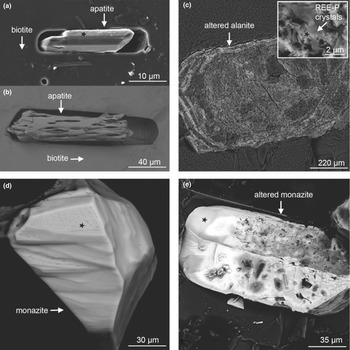
Apatite was found in I-, S- and A-type granites however, as expected, allanite was only found in I- and A-type samples and monazite only in S-type samples (White and Chappell, Reference White and Chappell1983). Apatite crystals that were oriented with their c axes parallel to the basal plane of biotite were the easiest to detect in biotite grains. At the microscopic level, increased weathering correlated with increased apatite dissolution, as observed by reduced apatite size (Fig. 2a) and surface pitting (Fig. 2b) compared to fresh unaltered apatite. Complete dissolution of apatite was determined on the basis of the identification of empty pits with hexagonal prism morphology within biotite grains. Zircon crystals were commonly observed embedded in biotite grains and were identified on the basis of their prismatic morphology and high Zr content. Monazite was common in biotite grains from all S-type granites. They were identified on the basis of their size (30–50 μm), irregular morphology and Ce, Nd, La, P and Th content. Allanite minerals were identified via thin section and analysed under SEM-EDX. Metamict allanite grains were visibly altered and fractured with REE/P-bearing minerals deposited on allanite surfaces (Fig. 2c). In lightly to moderately weathered S-type granites (Mount Disappointment and Strathbogie), monazite displayed no alteration (Fig. 2d). However, monazite in weathered Pyalong S-type granite was visibly etched and pitted (Fig. 2e). Examples of altered zircon and titanite were also observed in biotite grains from highly weathered I- and S-type granites displaying etching.
Scanning electron microscope images showing altered and unaltered primary lanthanide and/or phosphate bearing minerals: (a) and (b) dissolving apatite (Bigga, ei2 sp3), (c) altered allanite with crystal replacement (You Yangs, ei16 sp13), (d) fresh monazite (Mt Disappointment, ei16 sp17), (e) altered monazite (Pyalong, ei5 sp5). For EDX data, refer to Table 2 and Supplementary Table S2. SEM images captured at 10 kV. Black stars indicate site of EDX analysis.

Concentration of elements in secondary lanthanide- and phosphate-bearing minerals by EDX analysis. All phases analysed on biotite grains. Wt.% values are indicative and semi-quantitative. See Table S1 for full dataset.

– = not detected or below detection limit.
Secondary lanthanide phosphate morphology and abundance
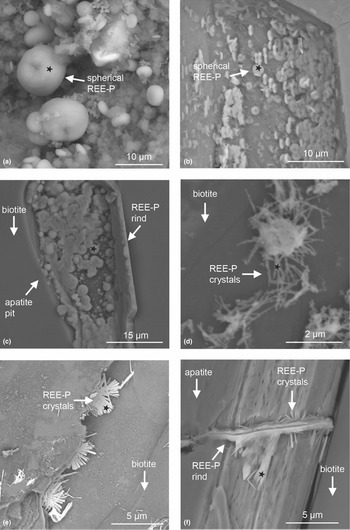
Granite material from all three S-type profiles were examined to determine the morphology of secondary lanthanide phosphate minerals. No secondary REE/P-bearing minerals were observed in the weathered S-type granite collected from Pyalong or Strathbogie, but samples collected from Mt Disappointment contained individual spherical aggregates typically 2.5 to 10 μm wide (Fig. 3a,b) that sometimes formed rinds replacing apatite (Fig. 3c). These spherical phases were found throughout the weathered profile except in the freshest material.
Scanning electron micrographs of secondary lanthanide phosphate minerals on biotite from S-type (a–c) and I-type (d–f) weathered granites. (a) individual spherical shaped minerals (Mt Disappointment, ei38 sp29); (b) biconcave minerals (Mt Disappointment, ei24 sp23); (c) spherical minerals forming rind replacing apatite (Mt Disappointment, ei22 sp22, refer to Fig. S1 for spectra); (d) individual euhedral crystal minerals (You Yangs, ei10 sp5); (e) aggregations of euhedral crystal minerals (Ararat, ei1 sp1); and (f) rind and crystals on apatite surface (You Yangs, ei19 sp15). For EDX data, refer to Table 2 and Supplementary Table S2. SEM images captured at 10 kV. Black stars indicate site of EDX analysis.

Secondary lanthanide phosphate minerals were identified in all weathered I-type granites, where they occurred as subhedral to euhedral crystals up to ~1 μm long and ~0.2 μm across (Fig. 3d) and as crystal aggregates on the surface of biotite and apatite and on biotite surfaces at distance from apatite pits (Fig. 3e,f). Secondary lanthanide phosphates were most abundant in the lightly and moderately weathered material and much less abundant in the highly weathered material. Only cerium oxides were observed in the very highly weathered material.
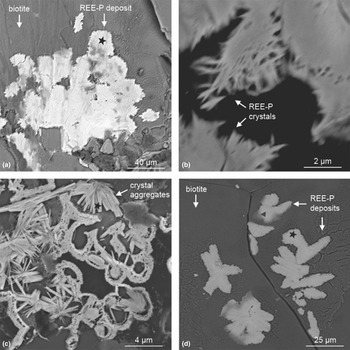
Interestingly, several sites contained deposits of lanthanide phosphate minerals (Fig. 4). The REE/P-bearing aggregates from the A-type Bigga samples were up to 100 μm across (Fig. 4a) and comprised radiating 1 μm long euhedral crystals (Fig. 4b). Similarly, biotite from the I-type Baynton granite contained large clusters of euhedral crystals that formed near circular rinds (Fig. 4c). Weathered I-type Stawell granite also contained large accumulations (~25 μm wide) of μm-sized REE/P-bearing crystals (Fig. 4d). In all of the three cases, the volume of secondary minerals was substantially larger than could be accounted for by apatite replacement. Thus, their formation probably required mobilisation of both lanthanides and phosphorus in solution, followed by precipitation on the surfaces of existing aggregates.
Scanning electron micrographs showing large aggregations of secondary lanthanide phosphate minerals on the surface of biotite extracted from A-type (a–b) and I-type (c–d) granites. (a) large deposit of secondary lanthanide phosphates (Bigga, ei28 sp48); (b) magnified view of (a) detailing individual euhedral crystal minerals; (c) euhedral crystal aggregations and hollow semi-circular rinds (Baynton, ei31 sp52); and (d) large radially growing deposits (Stawell, ei28 sp29). For EDX data, refer to Table 2 and Supplementary Table S2. SEM images captured at 10 kV. Black stars indicate site of EDX analysis.

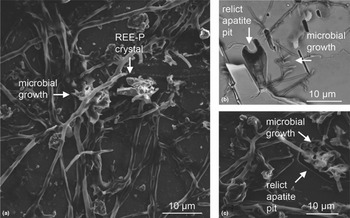
Field-emission SEM also showed that some weathered biotite grains had surfaces covered by filamentous microbial cells and some cells were associated directly with secondary lanthanide phosphate minerals (Fig. 5).
Microbial colonisation of biotite surface. (a) Filamentous microbial growth surrounding secondary lanthanide phosphate mineral; (b) microbial growth descending into relict apatite pits; and (c) distinct microbial growth structure covering surface of relict apatite pit. SEM images captured at 20 kV.

Secondary lanthanide phosphate chemistry
SEM-EDX was used to determine semi-quantitatively the chemical composition of secondary lanthanide phosphate minerals (Table 2), results are indicative and carry an expected error of at least 10% (refer to Supplementary Table S1 for full dataset). For each secondary REE/P mineral, lanthanide presence and concentration varied, even for minerals in the same sample. In all of the secondary REE/P minerals analysed, La, Ce and Nd were most abundant, followed by Y and Pr, consistent with crustal abundance.
Secondary REE/P-bearing crystals in I-type material primarily contained La, Ce and Nd. On the basis of the hexagonal crystal morphology and chemistry, the secondary lanthanide phosphates of the I-type granites are probably rhabdophane-group minerals (Ce,La,Nd,PO4·H2O). The REE/P from the I-type Baynton profile had the highest Nd concentrations (up to 44 wt.% Nd) of REE/P from all I-type sites (see Fig. S1 for spectra).
Interestingly, there were also many examples of secondary REE minerals containing F (~8 wt.%) and lacking P in the Bigga A-type granite. These F-containing secondary minerals contained high concentrations of REEs (~34–45 wt.%) with higher concentrations of Ce (~15–20 wt.%) compared to other REEs (see Fig. S2 for spectra). It is possible that they are F-containing Ce-rich REE-carbonates possibly related to bastnäsite [(La,Ce,Y)CO3F], parasite [Ca(Ce,La)2(CO3)3F2] and synchysite [Ca(REE)(CO2)2F] (Berger et al., Reference Berger, Gnos, Janots, Fernandez and Giese2008).
The secondary lanthanide phosphate minerals with spherical morphologies in S-type Mount Disappointment samples contained high Al (~5–16 wt.%), low total REE (~3–7 wt.%) and Ba (~1.5–5 wt.%) compared to euhedral secondary lanthanides (see Fig. S3 for spectra). Based on their chemistry and spherical morphology, these minerals may be florencite-(La) (La,Ce,Nd,Sm,Ba,Ca,Fe,Pb)Al3(PO4)2(OH)6.
Whole-rock compositional analyses
Inductively coupled plasma mass-spectrometry analyses of the whole-rock elemental composition from freshest to weathered granite samples are presented in (Supplementary Table S1). REE concentration data were normalised to freshest host granite compositions and plotted against sample density (g/cm3) (Figs 6 and 7). Given that weathering was isovolumetric, we used density measurements to determine whether an element had increased or decreased in a granite weathering profile. The REE concentrations in the freshest granite material were less than the REE concentration of the average upper continental crust (AUCC) (Fig. S4), indicating the lightly weathered state of the freshest material. The results show that S-type Mt Disappointment and Strathbogie were enriched in REEs relative to fresh material, implying retention of REEs during weathering. As weathering increased, Sc and Y fractionated from La, Ce, Pr and Nd, due to Sc and Y's similar ionic radius and geochemical behaviour to the HREEs (Fig. 6a,b). In contrast, the third S-type site Pyalong, exhibited a REE depletion as weathering increased (Fig. 6c). Phosphate concentration decreased throughout the weathered profile of Pyalong and Mt Disappointment (Fig. S5).
ICP-MS data of light rare earth element concentrations in S-type weathered granite samples relative to the freshest material. (a) Mt Disappointment; (b) Strathbogie; and (c) Pyalong. Data are normalised to fresh rock to determine level of REE fractionation and expressed as ‘enrichment factor’.

ICP-MS data of light rare earth element concentrations in I and A-type weathered granite samples relative to the freshest material. (a) Langi Ghiran; (b) You Yang; (c) Baynton; (d) Stawell; (e) Ararat; and (f) Bigga. Data is normalised to fresh rock to determine level of REE fractionation and expressed as ‘enrichment factor’.

Of the I-type granites, Langi Ghiran and You Yangs exhibited the largest enrichment of REEs. Interestingly, REE enrichment up to ~6 times occurs in moderately weathered Langi Ghiran material (1.9 g/cm3) but enrichment decreases with increased weathering. Scandium and Y were fractionated from other REEs and exhibited an increase of ~1 to 3 times relative to Langi Ghiran freshest rock at all degrees of weathering (Fig. 7a). Similarly, the You Yang samples exhibited up to ~4 times enrichment in the lightly weathered material, though enrichment decreased to close to initial concentrations as weathering increased, while Sc and Y were almost conserved throughout the weathered profile (Fig. 7b). Consistent relative abundances during weathering imply that Sc and Y were lost at the average rate of loss for all elements. Weathered Baynton samples exhibited a similar pattern of enrichment and then depletion in weathered material, but Sc concentrations did not vary (Fig. 7c). Cerium was enriched initially in moderately weathered material but then became depleted in the very highly weathered material. The observation of lower relative abundances of REE in highly compared to moderately weathered material suggests preferential dissolution of REE/P-bearing minerals compared to dissolution of other granitic minerals.
Weathering of Stawell granite resulted in a small enrichment of total REE in moderately weathered material and enrichment extent varied in samples exhibiting higher degrees of weathering. Sc was enriched up to almost 2× in the most highly weathered materials (Fig. 7d). REEs in weathered rock from the Ararat profile (Fig. 7e) exhibited some enrichment in the moderately weathered material while Ce was fractionated and enriched relative to other REEs in the most weathered material. These enrichments are minor and may be less when considering an expected error of 5%.
The A-type Bigga profile exhibited a modest REE enrichment in the lightly weathered material, a net loss in the highly weathered material and enrichment relative to initial concentrations in the very highly weathered material. However, Sc was enriched by ~3 times in the very highly weathered profile and was fractionated from the lanthanides throughout the profile (Fig. 7f). Change in phosphate concentration with weathering varied in I- and A-type granites. Bigga and Langi Ghiran exhibited a large increase in phosphate concentration in the lightly weathered region (Fig. S6).
Discussion
As reported for the I-type Bemboka Granodiorite in NSW, Australia (Banfield and Eggleton, Reference Banfield and Eggleton1989; Taunton et al., Reference Taunton, Welch and Banfield2000a,Reference Taunton, Welch and Banfieldb), allanite and apatite dissolved early during weathering, releasing REEs and P into solution. The observation of secondary lanthanide phosphates precipitated on the surfaces of apatite crystals suggested that REE release preceded release of phosphate so that as soon as REE-bearing pore fluids encountered apatite, precipitation of highly insoluble rhabdophane and/or florencite occurred. The current study extends these findings to A- and S-type granites and also documented secondary lanthanide phosphate formation at allanite surfaces (Fig. 2c). We infer that allanite released REEs into solution that already contained some phosphorus (probably due to early dissolution of apatite), and solution saturation with respect to REE/P-bearing minerals occurred immediately following release of REEs from allanite. The observation of both replacement of apatite and allanite by REE/P-bearing minerals in the same samples suggests spatial heterogeneity in mineral weathering and pore fluid chemistry. In all cases, substantial changes in mineralogy occurred in the early stages of weathering. The small sizes (~0.2 μm diameter) of euhedral secondary lanthanide phosphate crystals is consistent with high levels of supersaturation and rapid (and possibly episodic) precipitation, rather than consistent addition of atoms to nucleated crystals and growth to large size (Fig. 3d). Rinds of apparently nanocrystalline or amorphous REE/P material may also form by a similar process, but it is also possible that the rinds form by ongoing replacement of a leached layer on the apatite surface (Fig. 3f). The finding of extremely abundant REE/P-bearing minerals in the Bigga samples (Fig. 4a) suggests net transport of REE and P in solution, possibly implying that solutions were not sufficiently supersaturated for homogeneous nucleation to occur, so atoms were added to existing nuclei, probably located close to apatite or allanite surfaces.
An important observation from this study was the net loss of lanthanides in highly weathered material, despite substantial enrichment in moderately weathered material. Previously, loss of lanthanides, linked to dissolution of lanthanide phosphate minerals, was reported in soil (Taunton et al., Reference Taunton, Welch and Banfield2000a,Reference Taunton, Welch and Banfieldb). Here, the phenomenon preceded soil formation. However, highly weathered material exhibits substantial porosity and permeability, so microbial colonisation (as observed for the You Yangs samples) is not surprising (Fig. 5a). Given the very low solubility of rhabdophane, we anticipate that microbial compounds were involved in the dissolution of these minerals. Prior studies have suggested that strong complexing agents such as siderophores may be involved, but further research is needed to identify the molecules. Interestingly, many soil-associated microbes have extensive suites of genes for secondary metabolism (Crits-Christoph et al., Reference Crits-Christoph, Diamond, Butterfield, Thomas and Banfield2018), and some of the molecules produced could be involved in mineral dissolution, both to access P and lanthanides for enzymatic activity (Roszczenko-Jasińska et al., Reference Roszczenko-Jasińska, Vu, Subuyuj, Crisostomo, Cai, Raghuraman, Ayala, Clippard, Lien and Ngo2019).
Understanding of microbially-mediated REE-bearing phosphate mineral weathering may inform the development of new biomining strategies for extraction of REEs from low grade mine tailings (Zhuang et al., Reference Zhuang, Fitts, Ajo-Franklin, Maes, Alvarez-Cohen and Hennebel2015; Corbett et al., Reference Corbett, Eksteen, Niu and Watkin2018; Corbett and Watkin, Reference Corbett and Watkin2018). As sequestration of phosphate into secondary REE phases can limit P bioavailability in agricultural soils, the current study motivates investigation of microbial processes that can dissolve REE/P-bearing minerals. Such discoveries could provide a path to improving soil fertility without chemical fertiliser application (McLaughlin et al., Reference McLaughlin, McBeath, Smernik, Stacey, Ajiboye and Guppy2011). Further, the specific sites with evidence for substantial REE loss at high degrees of weathering (You Yangs, Langi Gihran and Baynton) may be ideal targets for research on microbial contributions to REE/P-bearing mineral dissolution.
Despite the fact that monazite (a mineral common in placer deposits; Roy, Reference Roy1999) is highly weather resistant, we detected highly etched and altered monazite surfaces in samples from the Pyalong site. Further, net losses, rather than the expected enrichment of REEs occurred during weathering of these samples. This observation suggests the existence of molecules in solution that could accelerate a process that would essentially not occur via an inorganic mechanism (i.e. no inorganically produced compound such as carbonic acid, sulfuric acid, or nitric acid could achieve this; Brisson et al., Reference Brisson, Zhuang and Alvarez-Cohen2016). The Pyalong granite was intruded into Baynton granodiorite, raising the possibility that soil-associated microbes that have mechanisms to dissolve rhabdophane and florencite may impact on the weathering of the Pyalong material.
Conclusion
SEM-EDX and ICP-MS data indicate that the phenomena of REE mobilisation, precipitation and ultimately REE/P mineral dissolution during granite weathering occurs in the three major granitic types. We show that dissolution of highly insoluble secondary REE/P minerals as well as monazite and allanite can precede soil formation. Questions remain regarding the likely biologically produced ligands that are responsible for solubilisation. It makes sense that certain microbes produce such molecules, as dissolution of REE/P minerals liberates both phosphates and the lanthanides required for lanthanide-dependent methanol dehydrogenase enzymes. Thus, the timing and progress of dissolution of REE/P during weathering and prior to soil formation can impact on both primary productivity especially in P-limited agricultural soils and the carbon cycle.
Acknowledgements
M.V. gratefully acknowledges support from the Fay Marles postgraduate fellowship and the Baragwanath Trust Travel Scholarship from The University of Melbourne. Thanks to the Advanced Microscopy facility at the Bio21 Institute, The University of Melbourne, for use of the EDX-SEM microscopy (www.microscopy.unimelb.edu.au).
Supplementary material
To view supplementary material for this article, please visit https://doi.org/10.1180/mgm.2020.90