Performance Management Can Be Fixed
Performance management (PM) is profoundly broken. It is universally disliked by managers and employees alike, it is seen as having little value, and it has failed to meet its intended goal of improving performance. The negative affect toward PM is at an all-time high, as reflected in the representative statistics shown below (Corporate Leadership Council, 2004, 2012).
• Among managers, 95% are dissatisfied with their PM systems.
• Among employees, 59% feel PM reviews are not worth the time invested; 56% said they do not receive feedback on what to improve.
• Almost 90% of human resources (HR) heads report that their PM systems do not yield accurate information.
Organizations are taking a hard look at their PM systems and experimenting with new approaches. For example, Adobe eliminated its PM reviews (Garr, Reference Garr2013). Cargill abandoned ratings and reduced its formal system steps. Microsoft recently announced that it was eliminating forced-rank ratings, and General Electric has made similar reforms (Bass & Green, Reference Bass and Green2013). There is a consensus that PM is broken, but given a long history of failed attempts to fix it (Pulakos & O’Leary, Reference Pulakos and O’Leary2011), the looming question is this: What exactly should organizations do? This article presents a promising five-step PM reform process, along with examples and results from our experience implementing this approach.
What Should Organizations Do and Not Do to Fix PM?
For over 50 years, we have repeatedly attempted to address dissatisfaction and disappointing PM results (e.g., lack of differentiation among employees) by tweaking PM systems. These attempts to fix PM have led to vicious cycles of reinventing PM processes only to achieve disappointing results and then reinventing these processes again and again (Pulakos, Mueller Hanson, O’Leary, & Meyrowitz, Reference Pulakos, Mueller Hanson, O’Leary and Meyrowitz2012). Pulakos and O’Leary (Reference Pulakos and O’Leary2011) have argued that, over time, formal PM systems have become increasingly bureaucratic and disconnected from the day-to-day activities they were initially designed to promote, such as communicating clear expectations, setting objectives, and providing quality feedback. Contributing to PM's bureaucratic and administrative emphases are implementations of PM processes that tend to focus on how to use automated systems and tools to complete PM activities. Pulakos and O’Leary (2011) further identified several unintended consequences of PM “best practices” that have undermined PM effectiveness and user satisfaction. Examples of these unintended consequences include the following.
1. A common best practice is to cascade goals so that each level supports goals relevant to the next higher level; the rationales for this are to ensure employees understand how their work relates to higher levels and to align the employee's work with the organization's strategic direction and goals. The reality is that organizational goals can be lofty and difficult to cascade to individuals, and it is time consuming and difficult to do this. By the time the cascade reaches individual employees, it has sometimes been several months in the making, the cascade may have been broken along the way, and the goals may not reflect effective goal statements or be the most critical to pursue.
2. To set expectations and motivate employees to deliver, we have engineered specific, measurable, achievable, realistic, and timely (SMART) goal-setting processes to initiate the annual PM cycle. However, writing SMART performance objectives or goals that cover an entire year is difficult, and many people are unable to capture the specificity that is required for SMART goals to effectively drive performance over such a long time. Other challenges include ensuring that the goals are fair and equivalent for similarly situated employees, which often does not happen, and writing meaningful goals that will not be outdated in weeks or months because of the constant change that characterizes today's work environments.
3. We have created procedures that sometimes end up being complex and elaborate rating processes to differentiate employee performance, some of which require fine-tuned judgments on many rating factors or require stack ranking each and every employee. There are many forces operating in organizational environments that impact ratings, not the least of which is that, even with defined rating standards and judgments, managers complete rating tasks from their own points of view, which can result in inconsistent judgments or an idiosyncratic use of rating criteria. Furthermore, when the rating task is overly complex or onerous, managers can become frustrated by the burden of making difficult judgments. It is also demotivating and disengaging for employees to have their performance boiled down to a single number, with which they are then labeled, unless it is the highest rating or ranking that is available. Because managers do not want to disenfranchise employees unnecessarily, ratings are often clustered at the high end of the scale.
These and other unintended consequences of PM “best practices” not only have failed to yield high quality PM outcomes but also have increasingly added more administrative steps and burdensome requirements to operationalizing PM. This has resulted in (a) overengineered PM processes, (b) periodic activity spurts that spike with PM activity due dates but then go flat with little to no activity in between, and (c) development of a “check the box” mentality that fails to address the behavioral and relationship drivers of effective performance. In the process of producing these outcomes, we have also created extreme dissatisfaction with PM systems (Culbert & Rout, Reference Culbert and Rout2010; Globoforce, 2011), indicating that further system fixes are not likely to be effective for improving the value of and satisfaction with PM processes.
As an alternative to continuing to reinvent formal PM systems, which has not proven fruitful, Pulakos and O’Leary (Reference Pulakos and O’Leary2011) proposed changing course and focusing directly on driving critical PM behaviors that have been shown to increase engagement and performance. This suggestion was based on CEB Corporate Leadership Council research (Corporate Leadership Council, 2004), which showed that employee performance and engagement are substantially higher in the presence of several key PM behaviors: managers setting clear expectations, providing regular informal feedback, and helping employees develop and succeed. Further support for the importance of key PM behaviors in driving critical outcomes comes from Google's Project Oxygen (Bryant, Reference Bryant2011), which identified eight habits of highly effective managers, such as making time for one-on-one meetings, helping employees solve problems, coaching employees, and helping employees develop. Google managers who demonstrated these behaviors had teams that performed better, stayed longer, and had better attitudes. Google began teaching the eight habits in training programs, as well as in coaching and performance review sessions with individual managers. These efforts yielded significant improvement in 75% of Google's least effective managers. Taken together, the CEB Corporate Leadership Council and Google research provide strong evidence that effective PM behavior is critical for increasing performance, engagement, and bottom-line results and that these behaviors can be learned with proper training and coaching. Of note is that these are the same behaviors that we intended to drive with formal PM system steps and process, but the formal systems have been unsuccessful in producing these behaviors.
Although manager behavior is important, it is not the entire answer. Managers cannot engage in effective PM alone, and it is a mistake to view PM as something managers “do” to employees. Instead, effective PM is the result of interactions between people—interactions that succeed or fail every day—in which the parties have joint responsibilities. Contributing to the reciprocal nature of PM is that the work environment has grown more complex and matrixed. Effective performance is increasingly dependent on working with a larger network of managers, peers, direct reports, and customers (Corporate Leadership Council, 2012). Setting clear expectations, providing timely feedback, and leveraging others’ skills and expertise to deliver become even more important when one is working with multiple peers, direct and indirect reports, and others outside of one's immediate team. Conventional PM tools and processes developed for the one manager–one employee dyadic model are insufficient for dealing with the complexities of today's work environment. These complexities cast an even greater spotlight on the criticality of effective PM behavior. Unfortunately, driving these behaviors throughout the organization will not be achieved through the bureaucratic administrative steps that characterize current PM systems.
A Way Forward
Figure 1 shows the fundamental shift in orientation that we believe is needed to drive effective PM behavior day to day (i.e., where PM needs to be tomorrow) rather than the cyclical, intermittent activities that characterize current formal PM systems (i.e., where PM is today). The latter is actually at odds with effective PM, which entails communicating and realigning expectations as requirements change, providing feedback in real time as needed, and continually helping employees develop to maximize their potential. The focus on PM behaviors we are proposing may imply that we are focusing on the PM process in isolation. This is not the case; moreover, this would be misguided for two reasons. First, although PM systems do not function well today, they can be linked to almost every other talent management process an organization executes. A systems approach to PM reform is needed in which changes are considered in the context of the organization's overall talent management strategy. We need to evaluate the impact of changes to the formal PM system on related talent management systems and outcomes, such as engagement, compensation, high potential identification, and leader development, and we must potentially make changes in these systems to align with the PM changes. Viewing PM reform too narrowly or in terms of simply “tweaking the PM system” is a mistake that can lead to unintended consequences and lost opportunities. Success requires approaching PM reform as a classic change intervention, in which a holistic strategy is needed to achieve the desired outcomes (Kotter, Reference Kotter2012). Gaining leaders’ attention to drive complex change requires a strong business case that is tied to the organization's strategy and success.
Performance management (PM) today and tomorrow. A: The characteristics of PM today include (1) lengthy, formal goal setting that begins the annual cycle; (2) development discussions that usually occur at the annual review and that often result in formal training; (3) feedback that occurs infrequently and on a schedule and that managers and employees avoid and view as perfunctory; (4) managers who are trained on how to complete steps, leading to a check the box mentality; and (5) ratings that are time consuming and complicated and that do not differentiate employees well. B: The characteristics of PM tomorrow include (1) real-time expectations and goals that change as the situation changes; (2) development as part of the daily work, which leverages experience; (3) real-time meaningful feedback to and from managers, peers, direct reports, and others; (4) employees who are all trained on how to engage in effective PM behavior; and (5) rating complexity and time that are streamlined to align with organization’s needs.

Before deciding how to change the PM system, it is critical to establish “the why” or a compelling reason to invest in change for the given organization. To gain maximum traction, the PM strategy needs to align with the organization's culture and values, enable the organization's priorities (e.g., customer focus, collaboration), and ideally, contribute to solving key business challenges (e.g., lack of agility, deficiency in global competitiveness, inconsistent innovation). In sum, in order to realize the outcomes PM promises, it is important to
• focus on driving the behaviors that matter,
• fit changes into the larger talent management ecosystem, and
• ensure that the business case for change is sufficiently compelling to attract and sustain the attention that is needed for change to occur.
We propose a five-step plan for PM reform based on the premise that embedding effective PM behavior in daily work is foundational for driving performance and engagement. The steps include the following:
Step 1. Plan change: Evaluate the current state and develop a PM strategy.
Step 2. Streamline the current system: Remove burdensome, low-value steps.
Step 3. Motivate change: Change mindsets about what PM is and prime behavior change.
Step 4. Embed change: Train behaviors and solidify behavior change.
Step 5. Evaluate: Demonstrate the impact on attitudes, performance, and business outcomes.
We take a holistic, change-management approach to achieve this, ensuring that proper supports are in place for implementation success. Below, we provide examples from implementing this approach at Cargill to add insight into how this type of change can be achieved.
Step 1. Plan Change
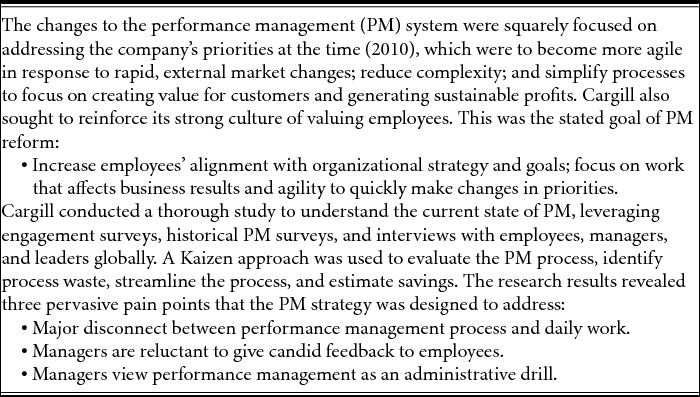
PM reform begins by evaluating the current PM system and developing a customized strategy to transform the PM process. We begin with a diagnostic process (e.g., existing employee survey or PM evaluation data, talent management system documentation, behavioral audit, and/or stakeholder interviews) to assess the current state of PM. The purpose is to assess the effectiveness of the current system and uncover pain points. The diagnostic also provides a baseline against which improvement can be assessed following the PM intervention. The planning phase also involves gaining a deep understanding of the organization's values, culture, and strategic priorities. Studying senior leaders’ communications provides insight into what is important to them, what they believe is required to achieve the company's goals, what they believe is in the way, and what is needed enable growth. Understanding these things is essential to build a compelling business case that will engage leadership in not only supporting change but also driving it. Table 1 describes how Cargill planned change.
How Cargill Planned Change
Step 2. Streamline the Current System
An inordinate amount of staff time (and hence cost) is devoted to PM activities; significant financial resources are also expended on automated PM systems. Organizations are thus investing billions of dollars in activities that employees, managers, and HR heads see as burdensome tasks that are of little value. An important goal of PM reform is to create value and improve attitudes toward PM. Accordingly, it is important to examine the most burdensome and low-value PM activities to determine whether they can be reduced in complexity or eliminated. We are not advocating that the entire PM system or any particular part of it be eliminated in all situations. Rather, the system streamlining process focuses on making the right choices about what PM system components are needed to address each organization's specific goals, culture, and needs. Several formal PM components are potential candidates for streamlining:
• As discussed above, cascading goals are a significant time sink and produce low return on investment (ROI) and value in most cases.
• An extensive goal-setting process used to initiate the annual PM cycle is also of questionable value. Different types of goals will be more or less effective depending on the type of work performed. Many jobs are better suited to ongoing project goals or behavioral expectations. The ROI of a formal goal-setting exercise to kick off PM annually is dependent on whether meaningful goals can be set that will retain their relevance throughout the year.
• Mandatory review sessions are often viewed as perfunctory tasks that are of little value because they occur at prescribed times (e.g., midcycle, end of cycle) rather than when feedback is needed to motivate or course correct behavior. Moreover, the focus of these reviews is often backward looking rather than forward looking, making them of little value for development.
• Narratives are used to document ratings and decisions, but there is often a lack of alignment among narratives, ratings, and rewards, which can prompt challenges to the PM process and put organizations at risk. In addition, when narratives are required, managers and employees often focus more on crafting the narrative than on meaningful performance conversations.
• Rating processes have grown overly complex, and organizations are starting to move away from the most egregious of these; for example, Microsoft eliminated stack-rank ratings. These rating processes are unpopular with employees and give an illusion of precision that does not exist in reality.
Of the PM components that can be potentially streamlined, the one that generates the most discussion is how much to streamline ratings. This is controversial because many people believe that ratings are essential for decision making. Although this is true in some cases, others have found that their performance ratings fail to differentiate sufficiently among employees to support differentiated decision making. Examination of HR decisions across organizations reveals that decisions are rarely based on performance ratings alone, and other factors often carry more weight than ratings.
This does not mean that all organizations should abandon ratings. In Cargill's case, the example we discuss here, the organization's strategy, culture, and needs were such that eliminating ratings made sense and contributed to the positive outcomes Cargill was able to achieve, but this will not be the case in all situations. Cargill, like Adobe, had small differences in pay increases across employees, so ratings could be removed fairly easily, with relatively little consequence. It is possible to eliminate ratings when there is more compensation at risk, but this requires implementation of alternative guidance and, potentially, processes to support decision making. The bottom line is that there is no one right answer to the question of what should be done with ratings or any other aspect of the PM system, for that matter. What we suggest, however, is that consideration be given to streamlining low-value aspects of the formal process that are burdensome and time consuming and that whatever PM activities are retained be useful for and directly in support of the outcomes the organization needs to achieve. To identify the best approach for handling ratings, it is helpful to conduct an exercise that examines the extent to which the organization uses ratings and the impact ratings have on decision making. It has been our experience that such an exercise sometimes yields surprising results, with at least some areas being less affected by ratings than people initially think. Below are several examples that illustrate this from our work across different organizations.
Dealing with poor performers
Many people believe performance ratings are needed to deal with poor performers. However, managing poor performance usually invokes a separate process (called a performance improvement plan or opportunity period) that puts employees on notice that their performance is below expectations. Documentation separate from the PM system is prepared to formalize the areas in which improvements are needed and the expected timeframes. Performance is then monitored and managed against these requirements. These performance improvement plans are used to manage poor performers because the primary PM system often does not contain sufficiently differentiated rating information or sufficient documentation to provide a basis for employee actions that can result from an opportunity period, such as separation.
Developmental feedback
One use of ratings is to diagnose areas for development. Unfortunately, to the extent that ratings are used for decision making, there can be decrements in both their accuracy and quality that undermine their effectiveness for development. This has prompted the use of separate processes that are strictly for development; one example is a 360 assessment that only the employee sees. Research has shown that development-only evaluations are both more accurate and more differentiated than ratings from the PM system. Of note is that the higher quality information these tools provide can erode quickly, if their purpose changes from development to decision making or if even small, seemingly innocuous changes are made (e.g., making 360 assessments available to the employee's managers rather than the employee alone).
Promotion
Some think performance ratings are an important input to promotion decisions. However, movement into other jobs often requires different competencies or proficiency levels that evaluations of current performance do not address best. For this reason, promotion decisions often rely on, and are better served by, assessments that better forecast an employee's ability to successfully perform the new role requirements.
Merit pay increases
Ratings are often viewed as the critical driver of merit pay increases. However, a good number of managers have reported that instead of using the rating processes, they retrofit their ratings to align with the pay increases they want or need to give employees. This occurs as a practical matter. Managers often have small raise pools. Pay increases in any given year are affected by factors outside employee performance, such as (a) what the risk of attrition is, (b) what the internal or external equity is, (c) where employees sit on their pay lines, and even (d) whose turn it is to get a larger increase this year—a phenomenon that results from small raise pools. To the extent that there is alignment between ratings and pay increases, it can be the latter driving the former. However, sometimes there is also a lack of alignment that can be difficult to both explain and defend.
Bonuses and stock options
These often result in more highly differentiated rewards than merit pay, and it is in situations with high variable compensation that we tend to find the most overengineered and complex rating systems, perhaps to give an illusion of precision and due process because more is at stake. However, manager calibration sessions or second-tier reviews are often used to ensure fairness in high stakes rewards. During these, initial ratings can be realigned; thus, it is often the discussion and not the ratings themselves that drives decisions.
Both research and practice have shown that more complex rating processes do not improve rating quality or outcomes (e.g., Landy & Farr, Reference Landy and Farr1980). Thus, it is prudent to simplify performance ratings to the greatest feasible extent while still addressing the organization's PM needs (e.g., a rating of record or input into decision making). In some cases, wholesale elimination of ratings may be the answer; in others, it will not be the answer. The key is determining the most effective solution on a case-by-case basis, based on what the organization's goals are and how PM fits into its larger talent management framework.
Replacing numerical ratings with broader categories is worth examining, especially as we consider what is gained by communicating a numerical rating to employees. It pins a number on the person that will only be satisfying if it is the highest number available. Neuroscience research shows that evaluations activate a flight or fight response, in which communicating less than top standing can decrease subsequent performance (Rock, Reference Rock2008). Given that managers do not gain anything by unnecessarily disenfranchising employees, it is no wonder that formal PM ratings show little differentiation. It is thus reasonable to consider the value of ratings from a motivational perspective, especially in light of the disengaging impact they can have on employees.
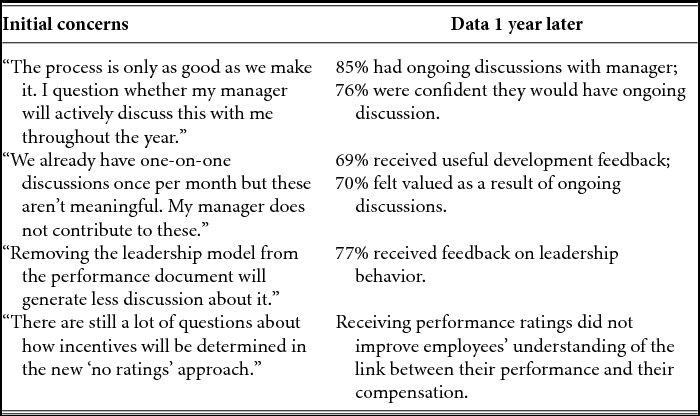
We have successfully streamlined goal setting, formal reviews, documentation, and ratings, with accompanying increases in manager and employee satisfaction. Sample results from Cargill appear in Table 2. Along with this, we are advocating increased focus on the ongoing PM behaviors that matter most for driving performance. However, this leaves open the important questions of whether there should be any formal PM process or tools and what these might be. In streamlining current systems, it is important to be mindful of fairness, legal defensibility concerns, and the need for due process in decision making. It is not advisable to eliminate PM activities that are important for fairness or defensibility, such as assessing performance against job-relevant criteria and proper documentation of decisions. Below, we discuss some tools and more episodic PM activities that we have found to be useful, either because they provide information that facilitates the key PM behaviors (discussed in detail in the next section) or because they add value beyond these. The items we suggest below all reinforce evidence-based practices for driving fairness and high performance, without adding a low-value process or significant burden.
Cargill Example Results
Establish role descriptions
Role descriptions that define the major duties and responsibilities of a position are a valuable resource for both managers and employees. Done right, these provide employees with an understanding of what the essential functions of their roles are and how their roles contribute to the organization's success. In addition, good role descriptions help anchor conversations about priorities, challenges, and actions that managers can take to either adjust responsibilities or remove barriers. The key is to create succinct role descriptions that capture the major responsibilities for each major job type and level. These are not only useful for establishing consistent baseline expectations for similar roles but they also help employees understand what the distinctions between levels are and what it takes to move forward in their careers.
Identify meaningful performance measures
Although ratings add little to decision making and can actually detract from performance by activating defense mechanisms, knowledge of results and effectiveness is essential for directing work effort. This requires an ongoing assessment of performance against a standard to identify gaps and make course corrections as needed. For example, a salesperson needs to know how close she is to her quarterly goal on an ongoing basis to know whether a change in her sales pitch is needed. An engineer producing a new design needs to know whether the design is acceptable or whether revisions are needed. Rather than having an elaborate year-end performance rating process, managers need to identify job-relevant methods for gaining information about one's performance in real time (e.g., process for gathering customer feedback, peer reviews of products). Identifying performance effectiveness indicators is especially important in knowledge or creative work, in which objective indicators of success do not exist, and employees may have varied opinions about what constitutes success. Once established, methods for assessing performance usually do not change frequently, but they should be examined periodically to ensure their meaning and relevance.
Conduct career conversations
The yearly review that provides backward-looking feedback is not only ineffective but also potentially damaging. Much like the performance rating, backward-looking feedback is threatening to one's self-image and can cause people to shut down because it is too late to make corrections. More useful and empowering is a forward-looking discussion of an individual's goals, the new skills or experiences that are needed to achieve these goals, and ideas for acquiring these skills or experiences. Although ongoing feedback conversations and in-work development are critical, there is also value in pulling up once or twice a year to discuss larger career aspirations and opportunities within the organization.
Step 3. Motivate Change
The promise of PM can only be realized if there is a shared mindset about what effective PM is. One goal of this step is to educate the workforce about how PM can add more value, especially for HR professionals who have been trained on traditional PM principles and who may be highly invested in the current system. The goal of this step is to create a shared understanding, anticipation, motivation, and positive affect for PM behavior change. Three points are key:
• It is ongoing day-to-day behaviors that lead to performance and engagement, not the formal PM system steps and process.
• Although managers play a critical role, day-to-day performance involves more than managers, and effective PM behavior needs to be extended to all colleagues in one's work network.
• Four critical PM behaviors—inspire, adapt, align, and grow—are foundational for high performance.
Important precursors of these behaviors are trust and open communication (Peterson & Hicks, Reference Peterson and Hicks1996). Noteworthy is that the four PM behaviors also build communication and trust, so engaging in these more frequently and effectively creates reciprocal reinforcement that improves relationships and further facilitates performance. Definitions of the four behaviors are as follows:
• Inspire: Link each individual's work to the organization's mission and its success.
• Adapt: Set shorter term goals and expectations that flex with changing situations.
• Align: Provide and receive regular, informal feedback to praise and course correct in real time.
• Grow: Develop as part of one's daily work by leveraging work experiences and others’ expertise.
An important aspect of motivating change is communicating the “WIIFM” (what's in it for me). This is what wins over individual hearts and minds, creating the motivation (attention), ownership, and positive affect that are required for meaningful behavior change (Cargill's WIIFM is shown in Figure 2). Although a compelling business case is critical for engaging leaders, personal motivation of individuals activates a passion (i.e., positive emotion) for change that dwarfs the engagement that can be obtained from a compelling business case alone. In addition, there is an overarching orientation that organizations can adopt that will facilitate PM behavior change and performance outcomes. It occurs through cultivating a culture in which employees are genuinely valued and motivated, which in turn maximizes engagement and performance. To engender this, we draw from Pink (Reference Pink2009), who argued that carrot-and-stick rewards are not effective for driving performance or behavior in today's complex work environment. Pink's theory of motivation proposed three essential elements:
• autonomy—the desire to direct one's own life,
• mastery—the urge to get better at something that matters, and
• purpose—the yearning to do what one does in the service of something larger than oneself.
Cargill's WIIFM (what's in it for me?).
An implication of Pink's (Reference Pink2009) work is that the PM behaviors that matter should be directed to maximizing these three motivational elements. We now turn to a more in-depth discussion of the four PM behaviors to show how this can be accomplished.
Inspire: Link each individual's work to the organization's mission and its success
An important function of PM is to align the activities of employees with the organization's mission and objectives. The best way to achieve this is through routine conversations with managers and others from which employees come to understand the organization's mission, environment, and factors that affect their daily work. Understanding what the big picture is and how the organization gets things done equips employees to make decisions and course correct in alignment with the organization's goals and realities. This not only empowers employees to perform more effectively but also provides meaningful connections between individual work and the organization's greater purpose.
Because organizational mission statements can be lofty and hard to translate into everyday work, managers need to help employees make connections between what the organization's mission is and what the employees do. What is important here is for managers to make sure each and every employee feels valued by helping employees understand where they fit, how their work is important, and why they matter, irrespective of how geographically distant they may be from the central business or how peripheral their work may be to core operations. This instills in employees a sense of purpose and is foundational for trust, open communication, engagement, and high performance. Managers also need to be able to describe in straightforward terms how the business operates, what keeps the lights on, and what the organization's unique approaches to sustaining operations are. They need to help employees identify opportunities for broader impact and contextualize decisions to help employees navigate increasingly complex roles. Finally, managers need to keep staff informed of factors inside and outside the organization that affect their work.
Employees are responsible for proactively seeking to understand the organization's business and the way their work fits in it. Employees should be able to describe how they contribute to the larger organization's mission and ask questions if needed to clarify this. Employees need to be proactive in identifying when their work is not aligned with the mission and work with their managers and network to reprioritize activities.
Adapt: Set shorter term goals and expectations that flex with changing situations
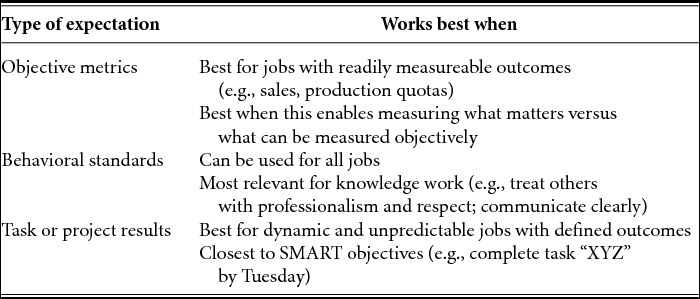
Communicating expectations is a core tenet of effective PM. Many organizations have overengineered this process to the point that it requires a significant investment but yields few actionable outcomes. Setting SMART objectives annually, for example, ignores the dynamic and ever-changing nature of work (Cascio, Reference Cascio1998; Pulakos, Mueller Hanson, & O’Leary, Reference Pulakos, Mueller Hanson, O’Leary, Varam, Budhwar and DeNisi2008; Pulakos & O’Leary, Reference Pulakos, O’Leary, Farr and Tippins2010). Rather than set goals once per year, research has shown that it is more effective to set ongoing expectations as needed and link feedback to these (Locke & Latham, Reference Locke and Latham1990). This benefits managers because it helps to ensure employees have a better grasp of what to do, making it more likely that work will be done right the first time and require less rework. It benefits employees because it helps them understand what they need to do and how their success will be measured. Different types of expectations may be set that focus on project or task results, behavioral expectations, or bottom-line results. The type(s) of expectations that make the most sense will vary by circumstance and type of work (Pulakos et al., Reference Pulakos, Mueller Hanson, O’Leary and Meyrowitz2012). Examples are shown in Table 3.
What Types of Expectations Work Best When
Align: Provide and receive regular, informal feedback to praise and course correct in real time
Closely aligned to clear expectations is receiving clear and direct feedback in real time rather than once or twice a year in formal review sessions. Years of research studies have shown that feedback immediately following a performance event has the most impact on performance. Done right, it accomplishes three things (Gregory, Levy, & Jeffers, Reference Gregory, Levy and Jeffers2008; Kirkland & Manoogian, Reference Kirkland and Manoogian2007; Murphy & Cleveland, Reference Murphy and Cleveland1995):
• strengthens the relationship between the recipient and the feedback provider,
• maximizes a positive outcome, and
• develops the recipient.
What does feedback done right mean? First and foremost, praise and recognition are underutilized. Managers are often taught the situation–action–impact model, in which they are trained to convey exactly what the person did (behaviorally) and what its impact was. This model may be useful for formal, constructive conversations to address consistently poor performance. However, the vast majority of constructive feedback opportunities are “teachable moments” when a misunderstanding occurs, something did not go as planned, or there is a problem to solve. These are naturally occurring feedback opportunities that are inherent in work and that can result in such things as edits to documents, problem-solving sessions, or postmortems on what could be done differently next time. This type of informal feedback is sometimes not even recognized as feedback, but it is usually the most meaningful feedback one gets in a work context.
There has been less attention devoted to informal than formal feedback; hence, there are fewer informal feedback models. However, recent research provides some important insights for how informal feedback should be provided and raises questions about the efficacy of formal feedback models. Pink (Reference Pink2009), for example, argued that people engage by getting there on their own, through trial and error experiences. This suggests that feedback focused on “telling” people exactly what they did wrong and need to do better will not be as effective as helping them discover this on their own. Coaching behaviors that ask the right questions and model behaviors employees can replicate are likely to be more productive than traditional “tell me” feedback approaches. Also supporting these notions is neuroscience research that shows people shut down in response to negative feedback (Rock, Reference Rock2008). However, they react very differently to more positive coaching behaviors on both a cognitive and emotional level. Guiding and challenging employees’ performance and growth stimulates different parts of the nervous system than discussing what they did wrong and need to fix.
Providing informal feedback benefits managers by improving employee skills and enabling employees to produce higher quality work with less input from the manager. Emphasizing employee strengths and giving praise creates positive emotion and performance increases that result from recognition and appreciation. Feedback benefits employees by giving them a clear sense of what they do well and should continue to do as well as helping them see what they can do differently in the future. Employees who are more capable can operate more autonomously, which is the key to motivation and job satisfaction. Employees also have important responsibilities in informal feedback processes. They need to seek out feedback, receive it well, and view it as important for learning and performance. Employees need to ensure they understand the feedback and the action that is needed. Finally, employees benefit from providing feedback to others. Increasingly, some of the most significant feedback challenges are handling feedback conveyed from peer to peer and in virtual environments. Employees also benefit by letting managers and other colleagues know whether adjustments are needed in the feedback they are providing (e.g., more examples or specific suggestions).
Grow: Develop as part of daily work by leveraging work experiences and others’ expertise
Employee growth is the shared responsibility of every employee and manager. Managers need to demonstrate a credible commitment to employee development and understand each employee's capabilities and career aspirations. An important behavior that was shown to drive performance in both Google and CEB Corporate Leadership Council research was managers taking a genuine interest in their direct reports and helping them advance in their careers. This responsibility goes beyond ensuring that employees have time for training. More important is agreeing on what capabilities the employee needs for the future and providing developmental experiences to enhance these capabilities on the job, where most development occurs. A credible commitment to development also includes things like making suggestions that help employees leverage others for learning and expand their networks inside and outside the organization. Employee responsibilities in the growth process include honestly evaluating their own capabilities, initiating conversations with their managers and others about their career aspirations, and looking for opportunities to take on new experiences and responsibilities. Key here is the employee's willingness to take on tough assignments to stretch and develop. Developing employees through experience serves managers because employees become more capable and become able to take on more responsibility, freeing up the manager's time. Development serves employees because it strengthens their mastery and accomplishment, helping to position them for future opportunities.
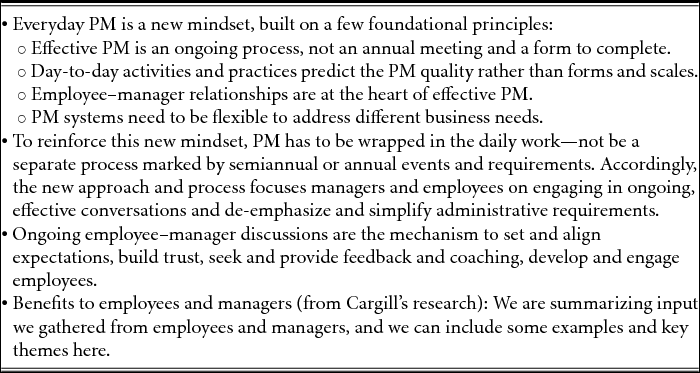
The specific process to motivate change needs to be customized to each organization's environment, maturity, and needs. However, this process typically entails a series of meetings, briefings, webinars, or other communications that (a) lay the foundation for change, (b) introduce the four behaviors that matter most, and (c) prime learning by showing how the change will benefit managers and employees. For example, organizational members can be shown what the existing levels of target PM behaviors are, what change is needed, and what impact that change will have. Done right, these activities drive anticipation and motivation for change, heightening attention and directing the focus that is needed for learning. It is important to establish across the organization a group of champions who will help develop and communicate the vision, help eliminate barriers, and help model the new mindset in their own business units. Cargill leveraged two such groups: the Talent Advisory Board and a PM Implementation Champion Group. The first consisted of senior business and HR leaders that helped shape the vision and make design choices; they also helped communicate and advocate the new mindset. The second group, composed of HR leaders, focused on educating, communicating, and influencing others to positively embrace and adopt the Everyday PM mindset while addressing cultural and business differences. The specific mindset Cargill drove is shown in Table 4.
A New Performance Management (PM) Mindset and Process: Cargill's Everyday PM
Step 4. Embed Change
The strategy used to embed change was an experiential on-the-job learning intervention. We chose this approach over other learning methods that occur outside of work because these were shown to be less effective for complex behavior change than in-work learning. The intervention was specifically designed to overcome barriers to on-the-job learning (Learning and Development Leadership Council, 2009), which include the following. Most people do not intuitively know how to approach, structure, or learn through experience. Part of the gap lies in not being able to recognize relevant learning opportunities. Other limitations include not understanding the need to make learning intentional and not knowing how to practice the right things and extract learning from experience—the latter of which is the most significant gap, as shown in Figure 3. Both managers and employees lack the time and expertise to effectively structure on-the-job learning to gain value from it.
CEB's corporate leadership council's model of effective on-the-job experiential learning.
We thus developed PM learning content that would provide purpose, structure, and guidance in how to learn from experience, what and how to practice, and how to extract learning. Research has shown the importance of providing structure for effective experiential learning (DeRue, Nahgang, Hollenbeck, & Workman, Reference DeRue, Nahgang, Hollenbeck and Workman2012). In our approach, we leveraged experiences readily available in day-to-day work by identifying routine activities that could serve to teach new and more effective habits related to the desired PM behaviors. We identified component behaviors that comprise the four PM behaviors. Some were manager only (e.g., managing performance problems), some were employee only (e.g., receiving feedback effectively), and others applied to both. For each behavior, we summarized the key information learners would need to know to execute the activity well, and we succinctly presented it in the form of “how-to” guides, tips, and short videos to model effective behavior.
To hardwire new PM behaviors, we incorporated deliberate practice (Ericsson, Krampe, & Tesch-Romer, Reference Ericsson, Krampe and Tesch-Romer1993) by creating a choreographed series of repetitive and iterative experiences that build on one another and lead to a step-by-step adaptation of new behavior. We included points at which the learner should seek feedback from others and reflect using the provided questions. Finally, we developed criteria to cue learners about outcomes that indicate effective learning and behavioral adaptation. The criteria were targeted to the point at which the behaviors could be performed successfully and fairly automatically, without significant cognitive or emotional strain (Fitts & Posner, Reference Fitts and Posner1967). Packaging the experiential learning content in an automated tool enables efficient, scalable implementation.
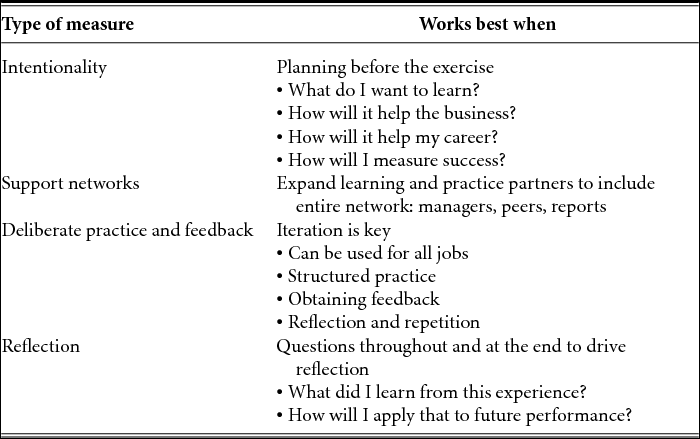
Learners and learning partners together engage in the learning activities by leveraging on-the-job opportunities to practice and hone their PM behavior. Learning partners are peers, managers, direct reports, or even customers who commit to supporting one or more learners. Two employees can serve as mutual learning partners, or small groups can be formed to learn together. Learning partners are especially useful in supporting PM behavior change because the content is inherently interactive and relevant to all individuals in one's work network. Although social learning strategies (e.g., discussion groups, communities of practice, internal coaches) can add value, learning partners play a more powerful role by committing to practice the target behaviors with learners and provide feedback under safe conditions. This happens because the concept of learning partners establishes that ineffective performance will occur and that coaching and feedback are essential during the learning process. Thus, learning partners might share how they felt while the learner was providing feedback or the extent to which expectations set by the learner were clear. Learning partners provide much more than social connectedness; they actually accelerate the organization's ability to weave effective new behaviors into daily work. This occurs because implementing the learning partner concept further focuses and engages the workforce in the change effort, which facilitates hardwiring of the new PM behaviors. The in-job experiential learning model recommended here is shown in Table 5.
A Model of Experiential Learning Extraction
On-the-job experiential learning is more effective than other learning methods for driving complex behavior change because work tasks inherently contain several critical and strong learning drivers (Davache, Kiefer, Rock, & Rock, Reference Davache, Kiefer, Rock and Rock2010), as follows.
• The work tasks for which learners are responsible capture their attention and have built-in relevance and ownership, all of which are important to hardwire learning.
• When learners apply new knowledge or concepts to real work, they discover how these play out across different people and situations, and learners can adjust their application accordingly. This provides contextualization, personalization, and varied learning experiences that are essential for deep learning.
• Naturally occurring work provides spaced opportunities for the practice that is important to solidify learning.
• Transforming one's network of colleagues into learning partners drives important social elements: learning generation by participants, connectedness, and opportunities for positive feedback as skills are honed.
Along with experiential learning, several other techniques can help bolster PM behavior change. For example, pulse surveys can be used periodically to assess progress on the PM behaviors. Feedback from these can be provided to individuals or used to monitor overall trends. A second strategy to reinforce change leverages success stories. For example, Cargill established a quarterly communications cascade that initially featured senior leaders but now identifies the “most engaging” managers from their engagement survey. These individuals are interviewed and their practices, experiences, and tips (e.g., success stories) are publically featured. Cargill has also linked employee engagement and PM in all relevant communications—making explicit that Everyday PM is a way to motivate and engage employees and that this is the path to high performance, which reinforces the WIIFM. Forums offer another strategy to share experiences and lessons learned.
Step 5. Evaluate
Evaluation and feedback are important components that are critical to embedding effective PM into the organization's culture. Evaluation data regarding attitudes toward PM, perceptions of value, and the presence of key PM behaviors are important to monitor over time. Providing managers and employees with regular feedback on how effective they are in engaging in the PM behaviors that matter is critical to sustaining change. It is also important to monitor business metrics such as profit, retention, and others that are potentially of interest to the organization. Mapping the results of the PM intervention to business metrics is not only important for evaluating ROI but also for reinforcing the target behaviors.
Summary and Conclusion
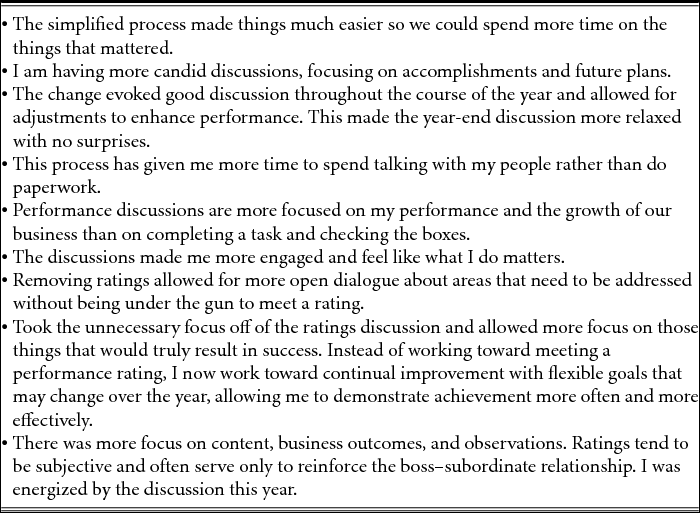
This article proposes a strategy for PM reform that incorporates fundamental changes in how we design and execute PM by streamlining formal PM processes and redirecting attention to critical, day-to-day PM behaviors. To provide a more concrete view of how this transformation can be accomplished, examples from Cargill's PM reform journey were provided in which they implemented their “Everyday PM” process. The new overall approach PM described here has shown promising results, at Cargill and elsewhere, especially with respect to engagement-related factors, such as satisfaction with the quality and frequency of feedback and perceptions about the value of PM. The positive comments from Cargill managers and employees shown in Table 6 show quite a contrast to the high levels of dissatisfaction and the typical negative comments that are seen in relation to PM systems. Although longer term studies are needed to evaluate ROI, prior research has established strong linkages between the focal PM behaviors and the performance outcomes.
Cargill Results: What Managers and Employees Are Saying
The core PM behaviors discussed here are not new. However, recent research suggested that ideas of what constitutes effective PM behavior might be misinformed. For example, behavioral feedback models that train managers to describe what the employee did ineffectively and needs to improve are unlikely to be effective in many feedback situations, most of which are teachable moments. For these situations, coaching skills are more effective than “tell me” models in driving both engagement and performance. We additionally pointed out the importance of connecting people to work and clarifying their purpose and importance to drive engagement. We also provided a new framing of goal setting that enables better customization to match the work. Finally, we suggested a stronger emphasis on leveraging work itself for employee development. Thus, we are proposing a redefinition of what several of the target PM behaviors mean and a redirection of them in ways that are more likely to drive engagement and performance.
The changes in mindset and behavior that are needed for PM reform are not trivial and will not happen overnight. In fact, multiple PM cycles may be needed to realize improved individual and organizational performance. However, once the right PM behaviors are solidified, they become self-perpetuating because, done right, they give people what they want from work. Implementation success relies on
• taking a holistic approach that considers how PM fits into the larger talent management landscape and aligning change with this bigger picture,
• treating PM reform as a change-management effort, and
• driving complex behavior change throughout the organization.
It is the last piece—driving complex behavior change—that is the most difficult. The goal, however, is for managers and employees to form very deep associations that hardwire new PM behaviors so that these become automatic and habitual. To achieve this, it is necessary to go beyond discrete training events that sit outside work tasks and instead leverage the work itself for learning, with its embedded, strong learning drivers.
Although there are many types of on-the-job experiential learning (McCauley, DeRue, Yost, & Taylor, Reference McCauley, DeRue, Yost and Taylor2013), being able to drive large-scale PM behavior change from a practical perspective requires scalable models. We offered one such approach here that builds purpose, structure, and direction into on-the-job learning of PM behavior by focusing learners on what to deliberately practice as part of their ongoing work, how to practice, how to extract learning from these experiences, and what indicators signal learning effectiveness. Although we have focused on PM reform, the proposed experiential learning techniques are applicable to any effort that necessitates complex behavior change (e.g., driving innovation, agility, collaboration, or aspects of the organization's culture). In addition, given the significant resources organizations invest in formal training, with very little evidence of ROI, the present on-the-job experiential learning model also holds significant promise for an individual contributor, for leaders, and for high potential development.
With respect to the focal topic of PM reform, however, we believe it's important to stop reinventing and overinvesting in formal PM systems. Instead, these should be streamlined to the greatest possible extent, and the substantial time and resources invested in them should be redirected to more productive work. There is no best way to streamline current PM systems, and there are no specific PM components that should always be retained or eliminated. These decisions need to be made on a case-by-case basis, and they will depend on the way that PM system information is currently used; the value of this information; and the specific strategy, PM goals, and needs of the given organization.