From government to business
Something has changed regarding world leaders and their political careers. Until recently, becoming president or prime minister was the highest accolade after a long and arduous journey through the institutional ranks; the last step before retirement or withdrawal to an undemanding seat on the back benches. Over the past few years, on the other hand, career paths for the highest-level politicians do not stop with politics but continue through a complex system of relationships that politics opens up for them. Whether we are talking about advisory and/or consultancy posts, or company directorships, the number of democratic leaders who go into business at the end of their term in office is steadily increasing. These leaders make full use of the personal and professional skills that guaranteed their original rise to power, but they also rely on government networks.
Things have changed radically from the days when leaders had no future once their days in command were over. Many monarchs and dictators have died while still in power, or were forcibly retired, and even modern democratic presidents, until fairly recently, held onto their posts for as long as possible before consigning themselves to the criticism of their successors. Recent heads of government, on the other hand, are enthusiastically seeking alternative ways to capitalize on their prestige and contacts portfolio, relieved from the scrutiny of the opposition and the administrative burden of those in public office. Their relatively young age has been a contributory factor, but ex-presidents and prime ministers are currently involved in a broad and diverse range of business activitiesFootnote 1 : they use their political background to write bestsellers, they open up libraries, set up think tanks and support international humanitarian aid projects (Keane, Reference Hufbauer2009; Theakston and de Vries, Reference Theakston and de Vries2012).
This growing number of opportunities goes hand in hand with another new phenomenon which has even greater implications for politics: former political leaders often end up in the world of business or international finance and they often prepare for these roles during their term in office,Footnote 2 which raises a number of rather controversial questions where democracy is concerned (Anderson, Reference Anderson2010). There are many examples of this happening on the international stage, beginning with one of the most consolidated democracies: when Tony Blair left Downing Street he became a consultant at JPMorgan Chase Bank on a salary of over 2 million pounds a year.Footnote 3 Although this is one of the more glaring examples, it is by no means an isolated case. In the United States, John and George W. Bush looked after the finances for the Carlyle Group. When Mulroney left the Canadian helm he became a consultant for Ogilvy Renault, and he is a board-member of many international firms. Josè Maria Aznar went from being Head of Spain to joining the board of News International. Bob Hawke, on the other hand, is making a fortune selling Australian land to the Chinese. Israeli leaders from Netanyahu to Olmert have followed in their footsteps, and even Barak, after being a partner in an American finance firm, founded his own company which is called after him, Ehud Barak Limited.
The trend appears to have no geographical confines, and is all the more relevant because it could refer to countries with different institutional settings and in different geopolitical areas. Moreover it seems to apply democracies, especially mature ones, those which – almost by definition – count on their leaders leaving power if they lose the elections. There are fewer and fewer ‘republican monarchs’ who choose, or who are forced, to withdraw to the sidelines once they leave their post as Head of government, hinting at a new and pervasive link between politics and business. This is in stark contrast to the myth – and model – of George Washington, who chose to step down and thus changed the course of American politics by opting to impose a time limit on any presidential mandate. The new generation business presidents use their term in office as a springboard towards a post-presidential future that is more active and better-paid than their previous post.
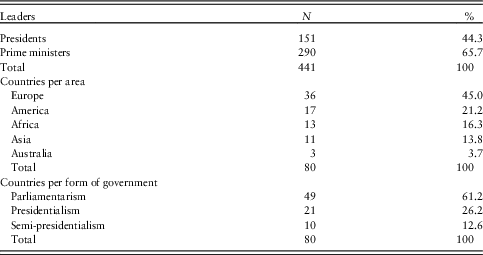
Despite the relevance of these changes, the issue of democratic leaders and their career paths has largely been ignored by political science. Any reference to the subject has only been in biographical works or national case studies, and they have all tended to focus on American presidents and British prime ministers. There is little empirical research comparing where leaders come from and where they go. The aim of this article is to go some way towards redressing this balance, analysing a data set of 441 leaders in 80 different countries, all members of the democratic genus,Footnote 4 over a period dating from 1989 to 2012. In Table 1 the distribution of selected leaders by office and a description of countries by geographical area and regime-type is presented.
Classification of selected leaders and national cases

Source: Own elaboration, see appendix A.
Attention will be focused on the political background of the prime ministers and presidents, how long they stay in power, the average age of heads of government, what professional pursuits they are involved in after their term in office and what career model they follow. The article concludes by proposing a post-presidential model which indicates some of the current trends and illustrates how former leaders are gaining decision-making power and visibility.
Primacy of politics
The professionalization of politics has been one of the pillars of democratic political systems throughout the 20th century and one of the pre-requisites for guaranteeing the supremacy of politics. The logic of a representative regime expects the electorate to be able to influence the people they elect, and these representatives, who nearly always give up the profession they had before entering politics, need to be able to act independently of certain social or economic constraints, especially without worrying about their own subsistence (Di Leo 2012). From a historical perspective, the decision to make public duties salaried posts marked the transition to the creation of a class of people that not only lived for politics but also lived off politics.Footnote 5
As we learn in Max Weber’s famous lecture from 1918,Footnote 6 the advent of ‘politics as a vocation’ is linked to the evolution of political parties from an elitist group to a mass organization, making them leading players in the institutionalization of a more stable and independent political class on both sides of the Atlantic. Where positions of power were concerned, in fact, political parties became responsible for the recruitment, training, selection and turnover of candidates. Any person’s career in politics depended heavily on how they had moved up the party ladder. Factors like experience in administration or local government and social visibility did not always count, it depended on the circumstances and national context (Cotta, Reference Cotta1979).
During the second half of the 20th century, career models in the major western democracies appeared fairly stable and fell within the confines set by State and parties. Italy offers a classic example of a restricted government circle with a clear institutional profile in terms of recruitment, specialization and career, anchored in the Christian Democrat style of government (Calise and Mannheimer, Reference Calise and Mannheimer1982). Although in France different government traditions mean that more weight is given to variables like a candidate’s social and educational background, ‘the pathway to the top’ still remains firmly tied to party affiliation and presence in parliament, though in slightly different measures depending on the period. The link between professional politics and political career is pretty self-evident: after a longitudinal study of the careers of over 1000 ministers, the conclusion was that ‘not only did most of them sit for a long time in Parliament, before or after their cabinet experiences, but they spent the essential part of their time in political or parapolitical activities long before their first election’ (Dogan, Reference Dogan1979: 21).
A general tendency thus emerges, one which Jean Blondel’s comparative study on political classes in government highlighted. At least where western and commonwealth democracies are concerned, party involvement is crucial for entry into parliament, and parliamentary activity is an absolute pre-requisite for becoming a Minister (Blondel, Reference Blondel1985: 63–64). The author also defines a ‘normal’, predominant career path for those who become government leaders. Most world leaders follow the same course, moving from one government job to another until they get to the top. There are very few outsiders, that is people who are not career politicians, who make it to the top without spending time in party political or institutional political activity (King, Reference Keane1981; Bennett, Reference Bennett1992), or without using military force. Heads of government number extremely few examples of white collar workers or business people among their ranks: ‘business is badly represented everywhere’ because ‘the political world does not attract many men from business – unless it is the case that businessmen do not have the qualities required for a successful career in politics’ (Blondel, Reference Blondel1980: 127). A trend that studies on the selection of ministers have also confirmed, showing that parliamentary experience remained as one of the necessary prerequisites to be selected for a governmental position (Blondel and Thiébault, Reference Blondel and Thiébault1991; Dowding and Dumont, 2009).
Can we claim that the career paths for political leaders have changed over the last 20 years? Recent transformations in political systems, and processes like personalization and increased mediatization of the relationship between leader and electorate would lead us to imagine that there is more space for outsiders, less importance attached to party militancy, and a shorter timescale for making it to the top (Verzichelli, Reference Verzichelli2010: 79). Some exemplary cases of people who became political leaders on the basis of non-political, or even anti-political, expertise do exist, and they are keen to put forward their career path as a valid alternative to that of the career politician (Campus, Reference Campus2006). A prime example is Silvio Berlusconi, who moved from the world of management and publishing to Head of government in an incredibly short space of timeFootnote 7 and has since continued to dominate, almost unchallenged, the whole of the Second Italian Republic. However, as far as a systematic study of government leaders is concerned, these examples are insufficient to call into question the existence of a different model of political career.Footnote 8 At the end of the 1990s for example, a study on how leaders were selected in six western nations provided empirical evidence that ‘those who come to office are experienced political figures … with … little room for young turks, political outsiders, or first timers’ (Davis, Reference Davis1998; Elgie, Reference Elgie2000: 963). Other more recent contributions have shown that even in presidential regimes, which are believed to offer greater opportunity to political outsiders, there is little variation in the way leadership positions are won (Samuels and Shugart, Reference Samuels and Shugart2010: 75–76).
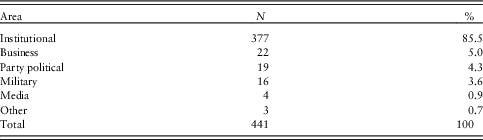
Analysis of our data set provided confirmation of this assertion. If we look at the positions held by democratic leaders before their term of office there is a marked prevalence of political posts. As can be seen from Table 2, government leaders have careers within politics in 85.4% of cases, whereas only 5% of leaders come to power as a result of their business or entrepreneurial activity. In the vast majority of cases, the prime minister’s seat is gained after a term on the back benches or after a position of ministerial responsibility, especially in parliamentary regimes. Where presidential regimes are concerned, on the other hand, positions of leadership in government are acquired through experience as governors, mayor or vice-president.
Professions of government leaders prior to their mandate

Source: Own elaboration, see appendix A.
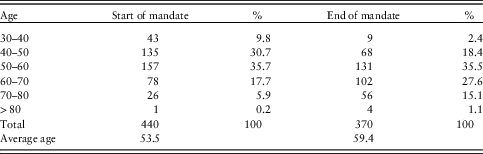
One piece of data that marks a real break with the past, and which is independent of political leaders’ background, is how fast their career track has become. More than 40% of presidents and prime ministers take over the leadership of the national executive before they are 50, and the average age over our whole sample is 53. Data showing leaders’ age at the end of their term of office shows that the majority end their time in government before they are 60 (Table 3). Barack Obama is the epitome of this tendency, having entered the White House at only 40. And Sarkozy is another example, having just stepped down from power at the age of 52.
Age of government leaders at the beginning of their first mandate and at the end of their last

Source: Own elaboration, see appendix A.
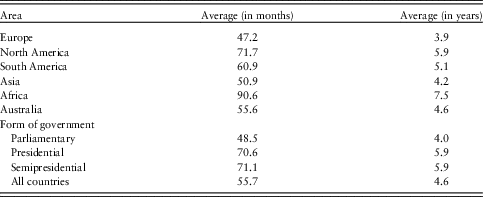
This situation does not arise because the leaders fail to stay in power for very long. In fact, many of them remain in office for at least a second term. If we think of the latest four presidents of the United States, for example, all of them were re-elected to a second term and this was the case for a third of leaders in our sample. Out of the 80 countries under consideration, government leaders remain in power for an average of 56 months with some slight differences depending on geographical area and form of government (Table 4). It should come as no surprise that presidential regimes guarantee better government stability, given that presidential actions are not subject to a parliamentary vote of confidence during the period in office.
Average duration of term of leadership by geographical area and form of government

Source: Own elaboration, see appendix A.
Nonetheless, presidents and prime ministers retiring from government have many active years ahead of them (Keane, Reference Hufbauer2009), and this acts as a springboard, launching them into new and important roles.
In addition to a lower average age, other relevant factors also seem to constitute a relevant premise to change leader’s career paths in their post-office life. First, presidents and prime ministers are acquiring more powers and visibility than in the past. At the beginning of the 1990s, two important volumes by Micheal Foley presented the thesis of the ‘rise of the British presidency’, suggesting a steady increase of prime ministerial power at the expense of the cabinet (Foley Reference Foley1993, Reference Foley2000). This influenced the debate on the various manifestations of presidentialization in many of the major parliamentary democracies (Helms, 2005). As a successful volume by Thomas Poguntke and Paul Webb (Reference Poguntke and Webb2005) has demonstrated, processes of ‘presidentialization of politics’ in a large group of countries have brought about relevant transformations leading presidents and prime ministers to gain a more central position in those political systems. Leaders control electoral processes where success is strongly related to their, more or less charismatic, personalities (Mughan, Reference Mughan2000; King, Reference King2002a), and they consequently become more and more autonomous vis á vis the party in governmental activities. They also largely increase normative powers through the expansion of decree laws and delegated legislation, depriving Parliaments of many of their long entrenched prerogatives, as the Italian case clearly shows (Musella, Reference Musella2012; Reference Musella2014). Moreover, the process of the internationalization of politics, while stimulating the active role of leaders in inter-governmental negotiations, offers them the opportunity to develop a significant network beyond national borders.Footnote 9 The shift of power from collegial to monocratic actors gives heads of government a more significant amount of political and relational resources that could be used in post-office life.
Another relevant factor can be identified in the closer relationship between politics and corporations. The relations between politics and business may realize various forms of collusion: from prepackaging the contracting-out of public works to circulation between top administrative posts and corporate boards of directors, to mere ‘coziness between ministerial officials and their counterparts in private industry and banking’ (Schneider, Reference Schneider1991 in Useem, Reference Useem1984; Calise and Lowi, Reference Calise and Lowi2010: 61). The documented phenomenon of ‘revolving doors’ refers to the fact that government service can serve as a conduit for joining the ranks of the corporate elite. So when politicians fail to get re-elected, they can be recycled into government or business positions – as the Italian case has clearly shown (Keane, Reference Hufbauer2009). In Northern America such processes have become so noteworthy that specific legal regulations have been established to close the revolving doors through which public officials sell their expertise and inside knowledge when they leave public officeFootnote 10 (see for instance the Canadian Federal Accountability Act, Government of Canada, 2006). Baumgartner et al (Reference Baumgartner, Berry, Hojnacki, Kimball and Leach2009: 199–200) analysed 1244 lobbyists working in the United States and confirmed that the average business in their sample has ‘about one recent former covered official working on its behalf’ (jobs such as members of Congress, congressional staff members, or high-level agency officials during the past 2 years).
As this article will show, heads of government are not left out from following these paths to business. On the contrary top level politics are interested in the promise of future job opportunities within firms even more frequently than in the past.
Career models
Over the last few years, research has shown the emergence of a new career pattern in politics. Certain diachronic studies at the American Congress have revealed such a growing tendency among MPs to voluntarily relinquish their parliamentary seat in favour of other forms of work that it could be claimed that ‘congressional experience significantly increases post-congressional wages in the private sector’ (Diermeier et al., Reference Diermeier, Keane and Merlo2005; Mattozzi and Merlo, Reference Masciulli, Molchanov and Knight2008: 597). This is the direction that many representative democracies seem to be taking. Although there are few politicians who willingly give up life in business to go into politics, the reverse seems to be less unusual (Samuels, Reference Samuels1999). Albeit at different levels of government, and with some differences relating to culture and tradition, what we are increasingly witnessing are career politicians who view politics as an intermediate phase in their career. This is a radical change which undoubtedly has repercussions on the mechanisms of representative democracies, especially where positions of political leadership are concerned.
Indeed, changes in presidents’ and prime ministers’ post-executive careers are relevant both for their novelty and for significant implications on democratic governments. They seem to weaken the traditional democratic principle for which elective representatives find the source of legitimation in elections and retire upon electoral defeat; on the contrary new leaders exercise powers in their post-office life too, even if popular consensus is declining. Moreover, when they obtain a golden exit into the boards of big corporations, this raises the question of how it is mutating the relations between politics and business, and to what extent the latter could influence and condition democratic leaders, after or even during their mandate.
The metaphor of the ‘dormant volcano’ was used in the past to describe the state of torpor that big presidents used to slip into; having vigorously fought their political battles, they would retire from the public arena once their term of office was over (Belenky, Reference Belenky1999). If we look at America in the last century, we see that very few former leaders managed to continue with any significant political activity; using their reputation or influence to promote other candidates, for example, or devoting their time and energy to a humanitarian cause. It was not until 1958 in the United States that the idea of a president being politically active after leaving the White House was formally broached, according former leaders a pension, office and support staff,Footnote 11 to avoid consigning commanders-in-chief of the world’s most powerful nation to obscurity once their term of office was over. In other countries, and in parliamentary regimes, retiring prime ministers were often offered a post in some ministry or in parliament. Whatever, on both sides of the Atlantic, the prospect that awaited former leaders was, if not retirement, at least a drastic reduction in their political activities.
Helped by a much lower average age, former leaders can now look forward to a very different future. Democratic leaders can be defined as career politicians in every sense, yet it is increasingly rare for them to become retired politicians.
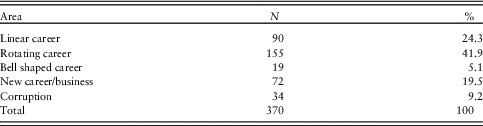
This shift can be explained using the three career patterns that Jean Blondel (Reference Blondel1980: 195) defined 30 years ago, with the inevitable addition of the emerging new model. The French political scientist set a continuum and at the far end he put the type of leader who slowly works their way up the political ladder to the higher echelons of government and then retires from active political life once their term as president is over (linear career). At the other extreme he puts the kind of leader who is on hire to politics from another field, and who returns to this profession once their contribution to society has been made (bell-shaped career). In the middle we find those politicians who remain ‘close to the corridors of power after their downfall from high office, hoping to return to the leadership position later and perhaps succeeding in remaining ministers’ (p. 196). In this case, the former leaders become members of an oligarchy, as often happens in continental Europe. As we can see, these three patterns may have been sufficient to describe the careers of political leaders thirty years ago, but now a completely new model is emerging. The pattern can be termed new career/business, and refers to those leaders who, after working their way up to the highest political positions, then work in a completely different field, often earning significant amounts of money. Their new jobs differ greatly from the government role they held before, but it is believed that the experience of the latter provides the resources and instruments necessary to gain entry into the new positions.
Table 5 shows the quantitative evidence for presidential career patterns over the last quarter of a century. We can see a drop to <25% in the proportion of former presidents who retire from politics after their term in high office, and generally the cause is illness or death. On the other hand 41.9% continue within politics, albeit in a different post, at a different level or in a different area of government, while 5% return to their previous profession. The most interesting figure, however, is the number of former leaders who enter the world of business. A fifth of all democratic leaders use their career in government as a springboard to a new career in business or financial consultancy.
Government leaders and their career patterns

Source: Own elaboration, see appendix A.
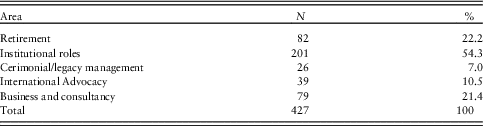
Similar conclusions are reached if we take a more detailed look at the various activities former presidents are involved in (Table 6), with 40% of them covering a role which is completely different from anything they have done before, even in the recent past, from humanitarian projects and setting up think tanks, through delivering well-paid lectures in prestigious academies to active involvement in corporate business and financial institutes.
Post-presidential roles

Source: Own elaboration, appendix A.
It is difficult to observe a correlation between the emergence of a new career path in market activities with business professions before their mandate (as classified in Table 2). Indeed only 18 former leaders had previous experience as entrepreneurs or managers.
Moreover post-office exits to private activities appears more common in parliamentary systems, with 78.4% of post-presidency individuals dedicated to business in these regimes, while this case is not frequent in presidential systems and very rare in semi-presidential systems. Concentration in European countries is about 61.5, although only 43.7% of the democracies in our sample belong to the Old Continent (as shown in Table 1). Although much more use needs to be made of that data in empirical analysis, one could suppose that the emergence of the former leaders occupied in business activities particularly seems to concern mature democracies with developed economies.
Post-presidency: a typology
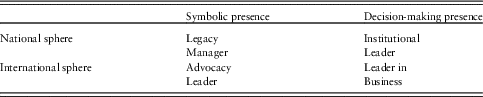
A look at the growing number and variety of post-presidential occupations enables us to highlight some general tendencies and to map out a taxonomy of former leaders. Leaders’ post-office activities are classified in Table 7 by the cross-tabulation of two variables concerning the most important lines of their evolution. The first analytical dimension refers to the nature of the post-presidential role that the former leader exercises. The ex-president could decide to devote himself to humanitarian causes or cultural projects, for instance writing books or founding think tanks: a job that could produce significant political influence but that does not imply formal responsibilities on the part of the former leader. On the other side, we find one of the most traditional employments of ex-leaders who not choose retirement, which consists of taking other positions in politics or administration, or the growing space open for a more active role for ex-heads of state or government in the private sector in decisional or consultancy positions.
Categories of former leaders

Source: Own elaboration.
Along the second dichotomy of our table, the range of post-presidential activities is described, considering whether they remain inside national borders or assume an international connotation. Rapid increases in international economic exchanges and the emergence of forms of international and supranational integration during the past decades have led heads of government to develop relations in a more globalized context, and this will offer more opportunities when they leave office. The internationalization of former leaders may refer both to post-presidential service in international organizations or to the involvement of ‘ex-presidents’ in directive roles in corporations acting on an international scale. As Lisa Anderson (Reference Anderson2010: 74) notes, the growing of international visibility and influence of former heads of state and government ‘is recognized by the members of the group themselves’, that have founded their own professional association, the Club of Madrid which ‘addresses issues of global concern and provides peer to peer counsel, strategic support and technical advice to leaders and institutions working to further democratic development’.Footnote 12
In the upper right quadrant of Table 7, (former) institutional leaders exercise a decisional activity at the national level. Since the average age of presidents at the end of their term of office is much lower than it used to be, it should come as no surprise that many of them take on other institutional roles, especially within national politics, and do not discount the possibility of returning to government. At the top or ‘near the top’, there is a significant, and growing percentage compared with the past, of former leaders who take on major roles in politics or administration, working for their successors. Italy would seem to be the epitome of this, a country where ‘a former prime minister back in government is much more common, reflecting the country’s governmental instability, “musical chairs” politics and frequent ministerial rotations’ (Theakston, Reference Theakston2010: 227). To illustrate the point, Giuliano Amato, who was Prime Minister from 1992 to 1993 and from 2000 to 2001, with a period as Minister of Institutional Affairs (1998–99) and at the Treasury (1999–2000) in between. More recently he held the post of Minister of Home Affairs (2006–08). The French constitution awards outgoing presidents a place on the Constitutional Council, while British former prime ministers could enter the House of Lords where a seat for life awaits them, so providing ‘a role and a platform for ex-prime ministers to continue a sort of part-time involvement with politics’ Footnote 13 (Theakston and de Vries, Reference Theakston and de Vries2012: 7). But the range of institutional occupations does not stop at national level. Many former presidents, in fact, take advantage of the opportunities afforded by multi-level governance, becoming city mayors or regional presidents. The French president, Giscard D’Estaing, became governor of the Auvergne region from 1986 to 2004 when he stepped down from office, while once again in Italy, after a process of regionalization of the State over the last couple of years, there has been a lot of movement of politicians from the sub-national to the national level, but also significant movement in the opposite direction.Footnote 14
Institutional roles are also taken up by former leaders at supranational or international level, such as members of European Parliament or commissioners or in NATO activities. In our data set these positions are contemplated in few but significant cases: for instance former Portuguese president Mário Soares entered the European Parliament in 1999 after his mandate, the ex-Estonian premier Siim Kallas was elected European commissioner and vice-president of the European Commission from 2004, Wim Kok who served as Prime Minister of the Netherlands presided over several high level groups for European Union, and, in particular, between April and November 2004 he was appointed by the European Commission to present a report on how to review the Lisbon Strategy, the Finn Harri Holkeri chaired the United States General Assembly in 2000–01.
In Table 7, in the top left-hand box we see a different type of ex-president: the ‘legacy manager’, who launches cultural and political initiatives essentially to manage his reputation and legacy: a role many former leaders in the past were preoccupied with, devoting a lot of time and energy to their own political heritage. As Theakston and de Vries (Reference Theakston and de Vries2012: 16) have noted, ‘with the transformation of the power and responsibility of the modern presidency, post-1945 former presidents have had a reputational interest in putting their time in office and their place in history in the best possible light’. They could be engaged in writing their memoirs, in founding libraries or other foundations with their name, in creating museums as permanent exhibitions that shape the popular memory of them, or in opening archives offering data on their political life. Today they could take advantage of new editorial opportunities to reach larger publics too. It is common to see them take up writing and cementing their position, and earnings, through autobiographies or volumes on political subjects (Keane, Reference Hufbauer2009). Despite the scandals that led to his resignation, or maybe as a result of them, Richard Nixon’s memoirs were a best-seller, selling over 330,000 copies. Jimmy Carter authored twenty works on different topics, sometimes autobiographical. Clinton’s book, My Life, generated earnings of over 15,000 dollars. Barack Obama has already signed a contract for a book that he will publish at the end of his term in office. Other former presidents assert their position by recounting their past experiences in the form of speeches or lectures which are just as well paid as the books. Clinton was paid figures in the region of 50,000 dollars for a lecture lasting one or 2 hours (Wice, Reference Wice2009).
For other former presidents, the tending of their political heritage implies constructing a good rapport with posterity. American presidents are particularly keen to keep their memory alive by building libraries which they name after themselves: before Roosevelt no president ‘designed his own national memorial’ (Hufbauer, Reference Helms2005: 23), after him the practice of setting up libraries took root and became a common way for former presidents to leave a reminder of their achievements much like temples or obelisks in the past.
In a certain sense, active support on behalf of the candidates they favour is another way that former presidents cultivate their political heritage or at least aim for political-institutional continuity. One such example is Clinton, who worked very hard during Al Gore’s presidential campaign and fought hard on his wife Hillary’s behalf when she stood in the presidential primaries and for the Senate. The end of their term in office does not signal an exit from the public arena for these former presidents who carry with them significant amounts of talent and expertise, and the non-marginal capacity to attract funding and media attention (Skidmore, Reference Skidmore2004: 6).
If we look at the bottom half of the table we can see another post-presidential tendency emerging: the internationalization of former presidents’ occupations. So many of them have become involved in international aid projects that it has been remarked that former presidents do not look to the past or to national politics but are keen, after retirement, to make a ‘commitment to make the world a better place’ (Morgan, Reference Morgan2012: 30).
It is becoming more and more common for presidents to go into the ‘second act’ not as elected representatives but as international emissaries (Updegrove, Reference Updegrove2006; Bernado and Weiss, 2009). Carter was a pioneer in this sense, drawing public attention to social problems that were not yet on the agenda. He collaborated with the World Health Organization for the prevention of disease in Guinea, he worked for the protection of the environment and he fought for world peace (Hodgson, Reference Hodgson1998) He was interviewed over 50,000 times on these issues (Schaller and Williams, Reference Schaller and Williams2003: 198), becoming the first former president, in 2002, to get the Nobel prize. In similar fashion, Bill Clinton set up the Foundation and Global Initiative to promote health, the environment and inter-religious dialogue. He worked alongside Bush to collect funds to provide aid to the victims after the massive damage caused by the tsunami in South-East Asia and, back home, after Hurricane Katrina. Outside of the United States, the most striking example of this humanitarian-type work remains Nelson Mandela who, after leaving office as President of South Africa in 1999, fought for human and civil rights, and received numerous honours, including the Nobel prize, in recognition of his work. In his post-presidential period, he worked as a promoter of social development in his home land, as a broker of peace in Africa and almost became, as has been pointed out, a kind of ‘global conscience’ (Daniel, Reference Daniel2006: 32).
Nonetheless, the real break with the past is the role that former leaders are playing in business and finance. The complete turnaround in American political philosophy says it all: from refusing retiring presidents the right to a pension, they are now happy for these same people to become ‘money-making machines’, light years away from the traditions of the founding fathers. It is also worth noting that in the classical Blondel typology on the political routes of world leaders there is no reference to business careers that follow political-institutional activity as a sort of reinvention of former leadersFootnote 15 (Blondel, Reference Blondel1980).
The bottom right hand box includes those numerous former heads of government who go on to work as financial consultants. Although there are also national-level business activities and corporate boards that former leaders join, ‘business roles’ in Table 7 refers especially to the growth of international activities. This path was probably forged by Margaret Thatcher in 1992 when she became ‘geopolitical consultant’ for the Philip Morris tobacco company on a salary of £250,000 a year, although she has remained occupied with party politics at home (King 2002b). Later this trend found its apotheosis in Tony Blair. Only days after his election victory he became a key arbitrator in the play-off between two industrial giants, Glencore and Axtra, with an annual salary of two and a half million pounds for his role as consultant for JPMorgan Chase. As ex-premier he manages to earn very significant amounts as consultant for the JPMorgan Chase bank and for the financial company Zurich Financial Services. It is no secret that the former premier has links with a Korean oil company with significant interests in Northern Iraq, the UI Energy Corporation. If we add the numerous lectures Blair delivers round the world, it is no surprise that he declares earnings of around 12 million pounds a year.
The business presidents category also includes those who are directly involved in the administration of commercial corporations: the Canadian, Brian Mulroney, has reached an almost record position, sitting on the board of directors of many prestigious multinationals,Footnote 16 and Aznar has been appointed as one of the directors of Rupert Murdoch’s media conglomerate, News Corporation. Former presidents also hold directorships in private corporations: the Austrian ex-chancellor, Klima, became director general of Volkswagen in Argentina in 2006, and the Finnish Esko Aho in 2008 became vice-president of the Nokia phone company. Gro Harlem Brundtland, former prime minister of Norway, was in 2007 working for Pepsi as a consultant; in 2004 the Swiss President Kaspar Villiger became a member of the board of directors of Nestlé and Swiss Re, and 5 years later he was elected Chairman of the Board of the Swiss banking giant UBS. After leaving presidential office the Mexican Zedillo held many jobs as an economic consultant in many international companies and organizations, for instance becoming a member of the Coca-Cola Company International Advisory Board. Zedillo now serves as a Director of the Union Pacific Corporation, which owns some of the railroads that he privatized during his presidency in Mexico.
Even more controversial is the direction the former German Chancellor, Gerhard Schröder’s, career took after he left office. During his period as leader, he was one of the most outspoken supporters of a new viaduct to transport gas from Russia to Germany. Once he left government, he was given a directorship in the Russian company Gazprom, who were responsible for building the viaduct, and has been a member of the multinational petroleum company TNK-BP since 2009. The former leader came in for some harsh criticism from the international press and the President of the International Business Commission for the American Congress, Tom Lantos, even went as far as accusing him of ‘political prostitution’ (Dunphy, Reference Dunphy2007) . This is not the point. However questionable Schröder’s behaviour might be, it does fit into a generalized, and worrying, process of redefinition of public ethics for outgoing presidents. Indeed democracy asks leaders to risk defeat in elections or to retire from office after the end of a limited term, but nowadays ex-leaders are still influential in domestic and international politics. While the ‘rapid expansion of the global market for the skills, expertise, reputations, and authority of former elected heads of state and government’ (Anderson, Reference Anderson2010: 76) could be investigated, this international web of ties and opportunities is reshaping the rules of democratic politics, as after losing an election ex-leaders find important channels to exercise power. Although it is difficult to understand what kind of consequences such opportunities may produce, the fact that leaders often prepare their post-mandate career when they are still in office leads us to suspect that they could use political resources for personal purposes.
There is no shortage of examples of corporations set up ex novo by former leaders either. The former Israeli leader, Ehud Barak, worked with the Electronic Data Systems multinational before creating the Ehud Barak Limited company. In this way former prime ministers become a kind of brand name, which obviously has nothing to do with previous political allegiances.
New ground
The position of leader has taken on a much more central role in contemporary democracies. The decline in party government, the growth of commercial media and the development of international summitry has ensured that leadership is given a greater prominence, as is evidenced by the growing number of specialist journals,Footnote 17 booksFootnote 18 and editionsFootnote 19 on the topic (Helms, Reference Helms2012). Comparative analyses of leaders are still something of a rarity, as most of the research in this field has an almost inherent tendency to adopt an individualized approach, more inclined to give ample space to exceptional, but individual, cases or to the national scenario (Schenker, Reference Schenker1982, Schenker, 1985). If it is true that ‘the bulk of studies of public leadership are essentially the studies of the lives and particular characteristics and behaviours of individuals occupying high public offices’, this has led people to overlook how interesting comparative analysis of political leaders is (Besley and Reynal-Querol, 2001; 't Hart and Uhr, Reference ‘t Hart and Uhr2008: 4; Bennister, Reference Bennister2012), and, consequently, to ignore the issue of what activities leaders are involved in before, and after, their term of office.
The question of how people arrive at the top of democratic institutions destroys a few myths. Although mass political parties are in crisis, they are still the primary channel for obtaining consensus. Democratic leaders are, for the most part, career politicians who make their way up through the political-institutional system in much the same way as they always did. Except that they reach the top much more quickly and their future prospects are very different. Former presidents tend to step down from government leadership after a fairly long period in office, 5 years on average, but they are much younger when they retire, usually under 60. The American president Taft’s advice to outgoing presidents leaving the White House was to take a generous dose of chloroform to ease the transition from world leader to private citizen, from a state of glory to the dust of political non-influence (De Vries, Reference De Vries2003; Wice, Reference Wice2009). This advice sounds strangely anachronistic nowadays.
The issue of government leaders’ destiny when their term of office comes to an end seems to strike at the heart of democracy and its institutional pillars, as they seem to depend ‘on the willingness of its most faithful servants to abandon their roles’ (Andersen, Reference Anderson2010: 65), and not on electoral success and defeat. This is the angle that early studies on former presidents adopted, highlighting how the former leaders continue to exercise significant influence and to occupy important posts within government, which means that there is very little turnover within the political classes. During the course of this article, we have seen how frequently former presidents continue to play a major political role, making best use of the impressive collection of skills and competencies that took them to the top of national government in the first place. Based on the fact that the average age of outgoing presidents is much lower these days, former leaders sometimes take on ministerial posts or work on their successor’s staff: it is the case for many prime ministers in parliamentary systems, in Italy as well as in Japan and Spain, from Giuliano Amato and Massimo D'Alema to Taro Aso and Mariano Rajoy Brey. They write bestsellers or they set up libraries or think tanks too. The most interesting point, however, is the new relationship between politics and private business that emerges from our study of post-presidential professional activity.
Indeed the fate of former leaders seems to lie more and more in the world of business with posts such as business consultants or directors. Former presidents have the kind of relevant information and network resources that make them an attractive proposition for corporations. A nagging doubt remains that they can establish special links with private companies during their term in office and make decisions that benefit these companies, losing that sense of distinction between public interest and the private interests they are busy protecting (Crouch, Reference Crouch2004).
Although from a historical point of view the professionalization of politics is what guaranteed its autonomy, the emergence of a career pathway leading from politics into business serves to illustrate its fragility. Until a few years ago a politician could hope to rise up through the political ranks to the higher echelons, even aspiring to positions of leadership. Nowadays, even the highest levels of politics are only an intermediate stage along a politician’s career path. In many cases, what awaits former political leaders is a career outside the world of politics, a position with a lot less collective responsibility and a much higher personal income.
Appendix A
Notes on Sources for the Comparative Study on Leaders
The first step when creating the database of political leader career patterns was to decide on the list of leaders to include in the study.
The data used in this article refers to 441 leaders in 80 countries, over a period dating from 1989 to 2012. National cases belong to either ‘full democracies’ or ‘flawed democracies’ in line with the classification system designed by The Economist research group (Democracy Index 2011: Democracy under stress, Economist Intelligence Unit, http://www.eiu.com//public/topical_report.aspx?campaignid=DemocracyIndex2011). As far as the leaders are concerned, we refer to presidents for the presidential or semi-presidential regimes, and to prime ministers in parliamentary regimes.
A biographical profile was drawn up for each president and prime minister, indicating, and representing numerically, the following information: country, position, date of birth, year and age when came to power, year and age when finished first term, year and age when started last term of office, year and age when finished last term, number of years in office, number of terms, role and activity pre-government, role and activity post-government, new organization or corporation, background, career pattern, type of post-presidency.
Information about the leaders and national case studies is the result of personal elaboration from a wide range of digital and published data available: Encyclopaedia Britannica, Wikipedia, Statesman’s Yearbook, Oxford University Press’s Dictionary of Political Biography and Dictionary of Contemporary World History, The Library of Congress Country Studies. We also used the collection of biographies from the Centro de Invistigación de Relaciones Internacionales (http://www.cidob.org/es/documentacion/biografias_lideres_politicos). Other useful sources include former leaders’ personal websites and biographical information on national leaders published on government websites.