Introduction
The growing consumer interest in fresh, local foods available at farmers markets, retailers and restaurants is frequently discussed in popular media and well documented in academic literature. In contrast, the growth potential of specialty foods made from locally/regionally sourced ingredients has received much less attention. However, in the 2016 report from the specialty food industry, retailers indicated that ‘local’ was the claim that most appealed to consumers (Tanner and Purcell, Reference Tanner and Purcell2016). In 2015, total specialty food sales exceeded $120 billion and comprised 14% of total food sales (Tanner and Purcell, Reference Tanner and Purcell2016). Small- and medium-sized farms have the potential to grow the farm products that are used as key ingredients in these value-added foods. In this paper, we define small- and medium-sized farms as those with annual sales <$1 million; small specialty food manufacturers (SFMs) are defined as those with sales <$500,000; medium and large SFMs are those with $500,000 or more in annual sales. While expansion of the specialty food industry represents an intriguing opportunity, to date, there has been little research that documents the current and potential participation of small- and medium-sized farmers in this market segment.
Specialty foods are a growing subset of the food sector. According to the Specialty Food Association (SFA), ‘Specialty foods are defined as foods or beverages of the highest grade, style, and/or quality in their respective categories (Specialty Food Association, 2017). Their specialty nature derives from a combination of some or all of the following qualities: uniqueness, origin, processing method, design, limited supply, unusual application or use, extraordinary packaging, or channel of distribution/sales’ (Specialty Food Association, 2017). Specialty food items are extraordinarily diverse and include products such as artisanal cheeses, shelf-stable and frozen foods made from fruits and vegetables, grain and nut-based products, and cured meats.
In this paper, we explore the factors important to SFMs when choosing ingredient suppliers and the benefits, barriers and challenges for small- and medium-sized farmers who want to sell products to SFMs and how such transactions can be developed, increased and streamlined.
Background/context
Challenges continue for small- and medium-sized farmers
Small- and medium-sized farms in the United States (US) face a variety of challenges. One problem is that they lack the economies of scale to compete with large-scale farms and imported products (Lev et al., Reference Lev, Stevenson, Clancy, King, Ostrom and Albala2015). Consolidated retail, foodservice and food manufacturing sectors often require large volumes, low prices and consistent supply. These sectors have developed vertically and horizontally integrated procurement systems that are global in scale and maximize efficiency (Jablonski et al., Reference Jablonski, Perez-Burgos and Gómez2011).
Although a growing number of small- and medium-sized farms successfully engage in direct market channels such as farmers markets and community-supported agriculture programs, these direct market niches generated <1% of total farm gate sales in the US in 2012 (McLaughlin et al., Reference McLaughlin, Hardesty, Gomez, King, Hand and Gomez2014). Further, as Hardesty and Leff (Reference Hardesty and Leff2010) and King et al. (Reference King, Hand, DiGiacomo, Clancy, Gomez, Hardesty, Lev and McLaughlin2010) have noted, farmers engaged in direct marketing incur significant marketing costs. Many medium-sized farms are too big to rely extensively on direct marketing, but too small to compete in commodity markets. These have come to be known as the ‘agriculture of the middle’ farms (Kirschenmann et al., Reference Kirschenmann, Stevenson, Buttel, Lyson, Duffy, Lyson, Stevenson and Welsh2008). According to Burns and Kuhns (Reference Burns and Kuhns2016), medium-sized farms (defined as those with gross cash farm income—GCFI—between $350,000 and $1 million) declined by about 5% between 1992 and 2012. However, these farms, together with farms with GCFI <$350,000 represent 90% of farms nationwide. Their future is important because medium-sized farms provide important environmental and social contributions, and support rural communities (Kirschenmann et al., Reference Kirschenmann, Stevenson, Buttel, Lyson, Duffy, Lyson, Stevenson and Welsh2008).
Intermediated channels such as restaurants, grocery stores, schools, hospitals or other institutions that, in turn, sell directly to consumers are another significant outlet for small- and medium-sized farms. The USDA estimated that local food sales through direct and intermediated channels totaled $8.7 billion in 2015 (USDA, 2016b). These channels expand the possibility for sales considerably and may be ripe for some small- and medium-sized farms. Institutional food service is an example of one expanding local foods intermediated channel. Schools (preK-12), colleges, universities, corporate cafeterias, hospitals and other institutions have been introducing or increasing local procurement for more than a decade. The most recent farm to school census for school year 2013–2014 found that schools purchased $790 million in local food (USDA Farm to School Census, 2015). Although farm to school sales offer opportunities for some farmers, procurement directly from farms sometimes represents a small percentage of the potential budget; only 5% of the produce purchased by foodservice programs at California's colleges and hospitals was sourced directly from farms (Feenstra et al., Reference Feenstra, Allen, Hardesty, Ohmart and Perez2011). However, the institutional food buyers and their customers prioritized local foods over organic.
Another strategy used by small- and medium-sized farms is to aggregate and distribute their products. For instance, farmers might distribute through ‘food hubs’, thereby allowing them to sell collectively to larger buyers than they would be able to individually. The USDA defines a ‘food hub’ as ‘a business or organization that actively manages the aggregation, distribution, and marketing of source-identified food products primarily from local and regional farmers to strengthen their ability to satisfy wholesale, retail, and institutional demand’ (Barham et al., Reference Barham, Tropp, Enterline, Farbman, Fisk and Kiraly2012). Food hubs have increasingly played an important role for mid-sized farmers and ranchers by helping them effectively access local markets (Hardy et al., Reference Hardy, Hamm, Pirog, Fisk, Farbman and Fischer2016).
The specialty food market as a potential new opportunity
The growth of the specialty food industry is undeniable. Dollar sales grew by more than 20% in 2015. Retail channels account for the majority of specialty food sales ($94 billion in 2015), with mainstream retailers such as Kroger, Costco and Target accounting for four-fifths of sales. Foodservice is the other major outlet for specialty foods ($26.5 billion) and growing faster than retail as consumers are dining out more frequently and wanting high-quality, flavorful food when they do (Tanner and Purcell, Reference Tanner and Purcell2016).
Determining what makes a food item ‘special’ is central to the success of this sector. Specialty food products often rely on credence attributes, which are product characteristics that cannot be easily verified by consumers and must be revealed through labeling or some other means of communicating with consumers. This may include characteristics or attributes such as whether ingredients are locally grown, organic, antibiotic-free or non-GMO. Consumers increasingly want to know who grew their food and how it was grown. According to the SFA's State of the Specialty Food Industry 2016 report, identification as ‘local’ is an important strategy for retailers to differentiate their products. James et al. (Reference James, Rickard and Rossman2009) found that consumers were willing to pay more for locally grown applesauce compared with applesauce that was labeled ‘USDA organic’, ‘low fat’ or ‘no sugar added’. Nie and Zepeda (Reference Nie and Zepeda2011) used food-related lifestyle model to identify characteristics of consumers who are most likely to purchase local foods, including specialty foods. Using stated preference data, Hu et al. (Reference Hu, Batte, Woods and Ernst2012) determined that consumers were willing to pay an average of 31 cents more per jar of blackberry jam for a product labeled as produced in the Appalachian region of Kentucky or Ohio. Feldmann and Hamm (Reference Feldmann and Hamm2015) conducted a literature review of 75 articles published between 2000 and 2014 in English that appeared relevant to consumer perceptions and preferences for local food; they determined that there are significant research gaps in various areas, including between processed and non-processed local foods.
While ‘local’ does deliver a marketing advantage, specialty food products can also garner more distant markets. As Campbell (Reference Campbell2009) points out, ‘Food from Somewhere’ [source identified, e.g., Prosciutto de Parma—ham from Parma, Italy] represents an attractive alternative to ‘Food from Nowhere’ [not source identified]. A local identity, which might be promoted by small- and medium-sized producers, represents a special case of ‘Food from Somewhere’ (Lev, Reference Lev2014). Within this framework, these products could also be marketed more widely, as long as sellers can capitalize on the production location. One can go into just about any grocery store today and see some product for which a key selling point is that it comes from a particular place and is produced according to specified practices. European producers have used this strategy to build markets for products such as Parmigiano Reggiano cheese, Kalamata olives and champagne. There are fewer examples in the US (Kona coffee, Idaho potatoes, Vidalia onions and Napa Valley wines, e.g.) and the legal and market structures are less developed (Barham, Reference Barham2010).
Consumer demand for specialty foods with ingredients grown by small- and medium-sized farms continues to increase, driven by consumers who view these products as affordable luxuries (Lev and Peterson, Reference Lev, Peterson and Zhao2012) and encouraging the emergence of new food businesses. In California, for example, Andrea Lepore, co-founder of Hot Italian pizzerias in Sacramento, Davis and Emeryville, is working on turning a 35,000 square foot former truck terminal in Sacramento into food factory: a sustainable, advanced shared commercial kitchen for nurturing new food entrepreneurs (Anderson, Reference Anderson2017). Tenants, who are SFMs, can buy ingredients (more than 120 crops) within 100 miles of the site. In Minnesota, a company that makes award-winning charcuterie has sourcing from small- and medium-sized local farms at the core of its business plan.
Some farmers are already producing specialty foods, such as jams, sauerkraut, cheese or baking mixes made with ingredients grown on their farms. They then market these items as part of their own operations (George et al., Reference George, Getz, Hardesty and Rilla2011). This type of value-added, vertically integrated production continues to be a part, albeit a small one, of the specialty food industry.
Our research included some vertically integrated enterprises, but more broadly examined how small- and medium-sized farms might add SFMs as a new market channel or sell larger volumes of products to SFMs. There have been very few studies that have examined supply chain opportunities, challenges and barriers in SFMs, and particularly for small- and medium-sized farms as ingredient suppliers to SFMs. Because the specialty food industry is growing rapidly and appears to value the unique strengths of small- and medium-sized farms, this sector may be a largely untapped new market channel for these farms.
Approach and methods
This research is exploratory. There are no data available regarding SFMs’ ingredients purchasing practices, nor the number or market share of small- and mid-sized farms that are supplying ingredients to SFMs. To assess whether supplying ingredients to SFMs represents an attractive outlet for small- and medium-sized farmers and ranchers, we used two methods: (1) a survey of SFMs and (2) in-depth interviews with a smaller set of manufacturers and farmers. We focused on specialty food products that had primary ingredients from one of four categories—dairy, meat, fruits/vegetables/nuts and grains. This focus provided variation across the subgroupings and limited the scope of the research.
We conducted a survey of 940 SFMs within these four product categories in three regions of the country (Minnesota/Wisconsin, Oregon/Washington and California) from June through September 2015. We selected these regions because there are clusters of SFMs in various parts of these states and we and/or our institutions have personal connections with many of them. Because of these connections, we expected to generate a higher response rate to our survey than if we had surveyed SFMs elsewhere.
Each region initially identified approximately 350 SFMs from existing contacts and various lists and databases, including a FoodHub membership directory, organic certification directories, state licensed food processor databases, the Winter Fancy Food Show Directory and other specialty food associations. We included manufacturers with primary ingredients in our four food groups. We excluded manufacturers that processed food that did not meet the SFA's definition of a specialty food or imported most of their key ingredients from outside the US. This resulted in a population of 940 firms.
We developed a questionnaire to gather data from SFMs about the key ingredients in their products, their modes of distribution and sales revenues. We questioned the firms about their ingredient suppliers, their relationships with suppliers and whether suppliers were small- and mid-scale farms that could be identified. The questionnaire also gathered information about the most important factors in choosing suppliers, benefits and challenges of working with small- and mid-scale farms, possible barriers of purchasing from these farms (if they do not already do so) and future interest in working with them. The questionnaire, Appendix A, is included as Supplementary Information.
All lists were sent to the Oregon State Survey Research Center (SRC), which has extensive experience in executing surveys. The SRC contacted all of the firms three times by email and once with a postcard with a request to fill out the survey online. Next, the SRC sent out paper copies of the survey to all firms that had not responded. Finally, because many more completed surveys had been received from the Oregon/Washington region, the Minnesota/Wisconsin and California region representatives (University of Minnesota and University of California-Davis, respectively) phoned non-respondent eligible companies using scripted language and methodology to encourage participation in the study by either completing the survey on the web or submitting a paper survey.
A total of 240 surveys were completed, for a response rate of 26%. While the goal was to have an equal number of completed surveys from each region, this was not the case even with the incorporation of the phone calls. The Oregon/Washington region provided 39% of the completed surveys followed by 31% for California and 30% for Minnesota/Wisconsin. Beyond this shortcoming, we are unable to judge the representativeness of the firms that responded because we do not have the necessary information on the non-responding firms. We cannot distinguish between responding and non-responding firms from the original database because identifying information was removed by the SRC when entering the data.
The statistical analyses performed on the survey data are χ2 tests for the difference in distributions of responses across groups. In most instances, there is one χ2 test for the entire table. In several tables, we conducted line-by-line statistical tests when responses were not mutually exclusive. For example, respondents could identify multiple modes of distribution. In these instances, we conducted χ2 tests for the distribution of ‘yes’ and ‘no’ answers.
In addition to the survey, in each of the three regions, we conducted in-depth interviews with eight SFMs and 12 small- and medium-sized farmers/ranchers, for a total of 24 SFMs and approximately 36 small- and medium-sized farmers in the fall/winter of 2016/2017Footnote 1. We divided both the manufacturer and farmer interviews equally across the four ingredient categories and selected firms and farms to interview based on our knowledge of the sector. In many instances, we used the business relationships revealed in initial interviews to identify those we would interview subsequently.
We created protocols for these interviews based on what we learned from the surveys. The in-depth interviews focused on providing more details about the challenges and opportunities related to both sets of businesses. The interviews for both SFMs and farmers included questions about the history of the operation, ingredient sourcing practices, relationships and obstacles, purchases from farms (SFMs) and marketing strategies (see Appendix B and C, in Supplemental Information). As detailed in subsequent sections, the interviews allowed us to determine how and why decisions are made and business practices are established. After completing the interviews, the project team identified emerging themes and discussed how specific examples fit those themes. The main themes from the survey will be reported along with examples from the in-depth interviews.
Findings
We first describe key findings from the SFM survey that are most relevant to small- and medium-sized farmers. Then, we describe qualitative findings from the in-depth SFM and farmer interviews that provide more detail and nuance about the relationships, opportunities and challenges for this new sales channel.
General characteristics of survey respondents
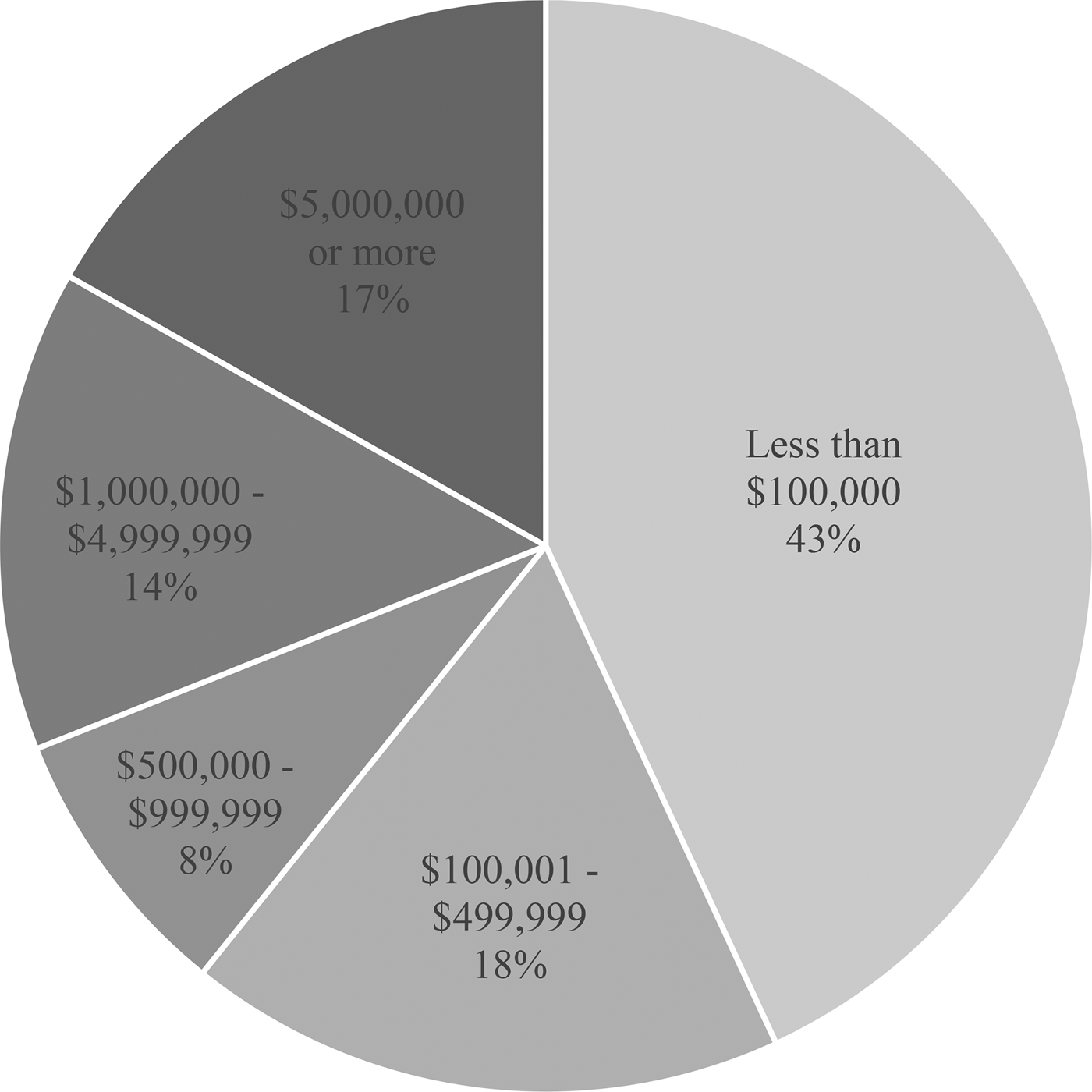
Survey respondents ranged in size from <$100,000 in sales to more than $5 million (see Fig. 1). The largest number (43%) fell within the smallest category (<$100,000). The distribution of firms by key ingredient was: 48% fruit/vegetable/nuts/herbs; 24% dairy; 19% grain/flour and 9% meat.
Size distribution of surveyed specialty food manufacturers by annual sales.

Distribution channels and scope of distribution
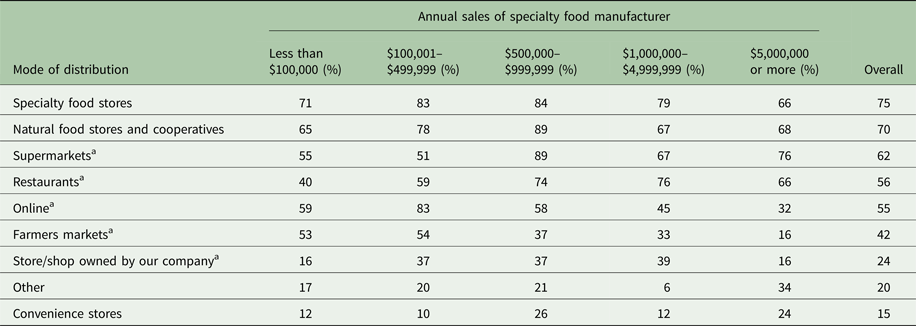
Specialty foods are distributed through a variety of retail channels (Table 1). Specialty food stores are the most widely used retail channel (75% of all respondents use this channel), followed by natural food stores and cooperatives, then supermarkets. More than half of the firms in our sample distribute their products through restaurants and online.
Mode of distribution of specialty food manufacturers, by sales category

a Use of this mode of distribution differs significantly across size categories at the 0.01 level.
Firms in the three intermediate sales categories are more likely to operate stores where they sell their own products and this differs significantly across size categories. Use of the supermarket channel is relatively low for firms in the two smallest sales categories and is highest for firms in the middle and largest sales categories. Not surprisingly, use of farmers markets falls steadily as firm sales increases. Restaurant sales are generally higher for larger firms; and use of online channels is highest for firms in the $100,001–$499,999 category and falls steadily as the level of annual sales increases.
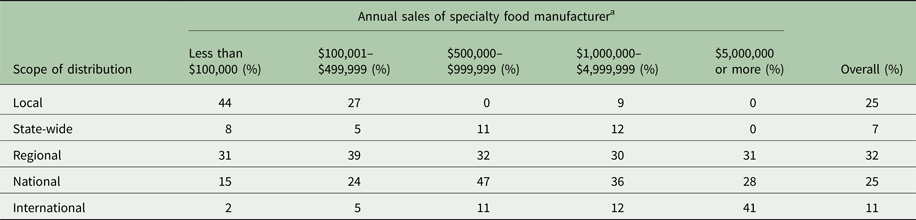
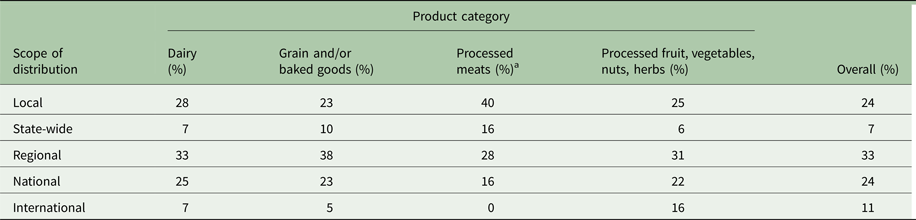
About one-third of SFMs distributed their products locally or statewide and two-thirds distributed products more broadly (regionally, nationally or internationally). The smaller firms, as characterized by sales, tended to distribute more locally and the largest firms were more likely to distribute internationally (Table 2). Table 3 shows the scope of retail distribution by product category. There is no particular pattern by product category except that processed meats tend to be distributed more locally compared with the other product categories.
Scope of retail distribution of specialty food manufacturers, by sales category

a Patterns in the scope of distribution are significantly different across annual sales categories at the 0.01 level.
Scope of retail distribution of specialty food manufacturers, by product category

a The processed meat category is significantly different from the overall average at the 0.05 level.
Sourcing key ingredients
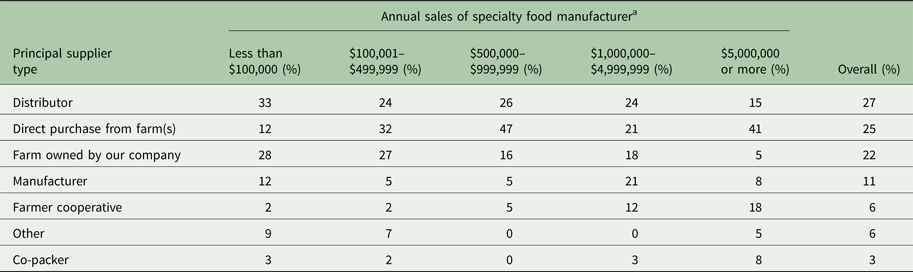
Table 4 shows the principal supplier types, i.e., the single most important supplier type for the company. Most firms have more than one supplier for their key ingredient. Distributors are the most common principal supplier type, followed by direct purchases from farms and procurement from a farm owned by the respondent's company. Almost half of the SFMs surveyed source the primary ingredients in their products directly from farms (25%) or from their own farm (22%). The distribution of principal supplier types differs across firms by annual sales. The medium and largest SFMs (as characterized by sales) are more likely to source more direct purchases from farms, while the smallest sales firms often rely on a distributor or farm owned by their company as principal suppliers. These smaller firms may be too small to buy significant quantities from farms other than their own. As they grow, they may have more flexibility to source key ingredients through direct purchases from farms or from farmer cooperatives.
Principal supplier type of specialty food manufacturers, by sales category

a The distributions of principal supplier types across firms grouped by annual sales are significantly different from the overall distribution at the 0.01 level.
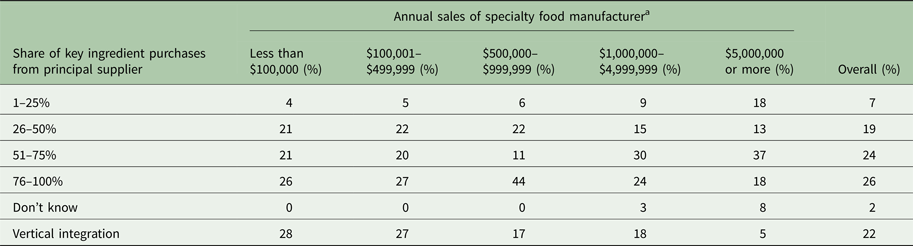
Vertical integration, which occurs when a farm owned by the SMF is the principal supplier of the key ingredient, is fairly common for lower sales firms but is much less common for those SFMs in the larger sales categories as Table 5 shows. It is also important to note that many SFMs rely heavily on their principal supplier. Overall, 22% are vertically integrated and 26% source 76–100% from their principal supplier. SFMs in the largest sales category are much more likely to have diversified the supply of their key ingredient.
Share of key ingredient purchases from principal supplier of specialty food manufacturers, by sales category

a The distributions of principal supplier concentration across firms grouped by annual sales are significantly different from the overall distribution at the 0.05 level.
Most of the vertically integrated SFMs we interviewed had annual sales of <$500,000, but we did conduct interviews with several larger SFMs that were vertically integrated. Most had grown to the point where they were no longer able to source exclusively from their own farms. We also interviewed several SFMs that started out sourcing their key ingredient from their own farm but subsequently decided to focus on manufacturing and shifted their sourcing to an outside source.
In our interviews with farmers, we asked them what percentage of their farm production they sold to a SFM. There was substantial variation in the percentage of total sales that the 36 farmers who were interviewed derived from SFMs. It ranged from <2% to close to 100%. However, in nearly all cases, the SFM share of total sales was relatively small, with <20% being the most common share of annual gross sales. Some farmer-suppliers benefitted by selling relatively large volumes to a single SFM, and they appreciated being able to plan ahead for production to be sold to a SFM, but nearly all continued direct sales through farmers markets or CSA shares. For many, selling to a SFM was a good alternative to entering the highly competitive wholesale market. For at least two farmers, selling to SFMs represented a market for products that were not desirable through other channels [e.g., seconds (lower quality produce), waste bones]. One of these farms sold to a natural food co-op, a couple of grocery stores, CSA members and restaurants, in addition to selling to a SFM. The co-ops and grocers, and the CSA customers to some extent, wanted the more attractive vegetables. But the SFM did not care if a carrot was crooked or a cabbage was misshapen. A diversified California farmer/rancher was pleasantly surprised when a relatively new SFM contacted him because she had seen organic meat from his ranch at her grocery store and wanted to buy the bones. To efficiently complete the transaction however, he had to make delivery arrangements to the SFM through his distributor. In general, sales to SFMs complemented other market channels, rather than representing the majority of sales.
Identifying farmer suppliers
Most SFMs (72%) could identify at least one farm from whom they purchased products. Although most of these purchases were direct from a farm or sourced from a farm owned by the SFM, some product (22%) was purchased through distributors. There was no clear pattern across firm sales categories; however, firms with annual sales below $100,000 were least likely to be able to identify a farm supplier.
According to our respondents, small- or medium-sized farms (annual sales <$1 million) make up more than half (54%) of the farms that supply the key ingredients. In general, as Table 6 shows, when they buy from farms, the smaller SFMs (those with <$500,000 in annual sales) are most likely to source ingredients from small- to medium-sized farms (sales <$1 million). Meanwhile, the medium-sized and larger SFMs (sales >$500,000) are more likely to source ingredients from larger farms (sales >$1 million), indicating that the larger farms may have a greater capacity to supply the higher ingredient volumes requirements of larger SFMs.
Predominant size of farm ingredient suppliers by sales category

a The distributions of predominant size of farm suppliers across firms grouped by annual sales are significantly different from the overall distribution at the 0.01 level.
Supplier relationships
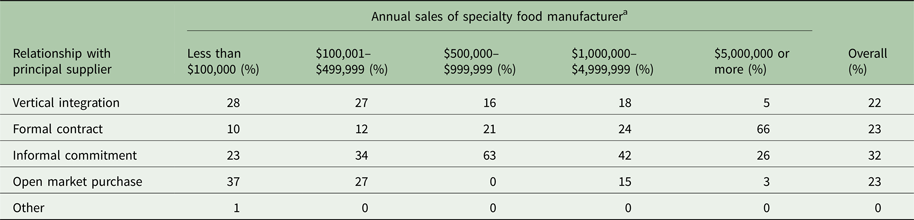
SFMs maintain relationships with suppliers in different ways, ranging from vertical integration to open market purchases. In preliminary discussions with SFMs, we learned that many had relationships with suppliers that could be categorized as relational contracts (MacNeal, Reference MacNeal1973; MacLeod, Reference MacLeod2007) where buyers and sellers trade repeatedly without having formal contracts. In these cases, relation-specific terms of trade for price and quality may be adjusted over time by mutual agreement. We wanted to ascertain the types of relationships and their importance for these SFMs. Additionally, this information may be useful to farmers who want to sell into this market. As Table 7 shows, the largest group, about one-third of SFMs, had informal ‘handshake’ commitments with their principal suppliers, which we consider to be equivalent to relational contracts. About one-quarter were vertically integrated, so that their own farm provided the key ingredient. Formal contracts were used by 23% of SFMs and open market purchases by the remaining 23%. The smaller SFMs were either vertically integrated, had informal commitments with suppliers or used open market purchases. The largest SFMs ($5 million or more in sales) tended to use formal contracts with their suppliers.
Relationship of specialty food manufacturers with key supplier by sales category

Note: While we did not define the relationship types in our questionnaire, they can be described as follows:
A Formal Contract is a written agreement that specifies legally binding terms of trade for time of delivery, price, quantity and/or quality. It is sometimes referred to as a ‘forward contract’.
An Open Market Purchase is a transaction made without any previous agreement; such transactions include ordering from a distributor, and purchasing at a farmers market or retailer.
a The distributions of principal supplier relationships across firms grouped by annual sales are significantly different from the overall distribution at the 0.01 level.
Table 8 shows how the predominant size of farms supplying key ingredients differs for firms grouped by their relationships with their principal supplier. We see here that 80% of the vertically integrated firms indicate that they source their primary ingredients predominantly from small- and medium-sized farms, often their own. This is consistent with our theory that extending the farm business into specialty food manufacturing is a strategy being pursued by small- and medium-sized farms to increase their profitability. Our in-depth interviews also support this theory. For example, one California creamery said that it was too difficult to be profitable by just producing the raw material. They needed a value-added product to improve their bottom line, so they started making cheese. It is also noteworthy that few small- and medium-sized farm suppliers (<$1 million in annual sales) are primary suppliers to firms that use formal contracts.
Predominant size of farm ingredient suppliers by specialty food manufacturer's relationship with principal supplier

a The distributions of predominant size of farm suppliers across firms grouped by relationship with principal supplier are significantly different from the overall distribution at the 0.01 level.
The duration of a firm's relationship with its key supplier is important to understanding how these relationships work; to be meaningful, it must be measured relative to the length of time a firm has been in business. We asked SFMs both how long they had been buying from their principal suppliers and how long they had been selling products produced with their key ingredient. By far, the most common response is that firms have been purchasing from their principal supplier for as long as they have been making products with the key ingredient. This suggests that the supplier relationships are very stable.
This finding was reinforced during our interviews. In Washington, a processor of branded meat products stressed the importance of long-term relationships with all of his meat suppliers. He seeks out farms that have their own production system and that sell through multiple market outlets—that is, he does not want to have suppliers who sell only to him. He believes this helps to reduce instability for both his firm and the farms. An Oregon rancher who supplies this processor indicated that he always seeks to determine in advance if the potential customers have a business that will work well with his ranch. One key factor is whether they place a high value on the story of his ranch; if they do not, he fears that his lamb can easily be replaced by lamb from somewhere else.
Important factors in choosing a supplier
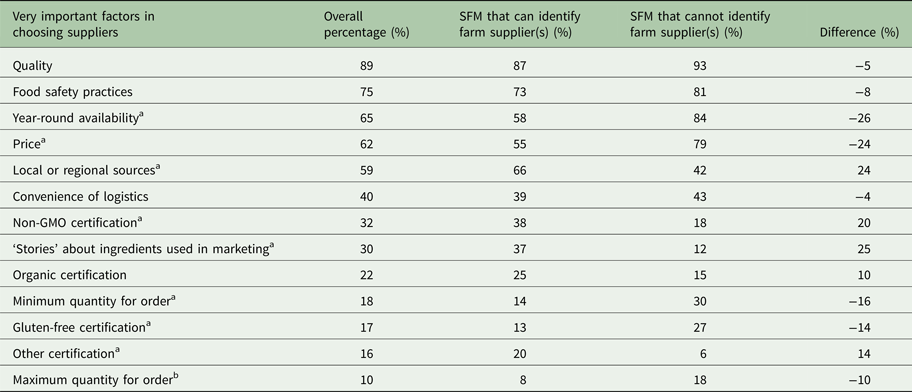
We asked survey respondents to rate the importance of 13 factors in choosing suppliers for their key ingredient. Table 9 shows the number and percentage of firms identifying each factor as ‘very important’. Quality is clearly the most important factor. Other important factors, rated as very important by over 50% of the respondents, are food safety practices, year-round availability, price and local/regional sources.
Differences in very important factors in choosing suppliers by specialty food manufacturers that can identify farm suppliers and those that cannot

a Importance of this factor differs significantly with farm supplier categories at the 0.01 level.
b Importance of this factor differs significantly with ability to identify farm supplier categories at the 0.05 level.
There are statistically significant differences in the factors that are ‘very important’ to SFMs that know at least one farm supplier for their main ingredient when compared with SFMs that do not know any of their farm suppliers. Quality and food safety are most likely to be rated as a very important factor in choosing suppliers among both SFMs that can identify and those that cannot identify at least one farm supplier for their primary ingredient. Beyond these two factors, it is apparent that SFMs that can identify a farm supplier have significantly different criteria for selecting a supplier when compared with SFMs that cannot identify a farm supplier. ‘Local or regional sources’ and ‘non-GMO certification’ are considerably more likely to be considered very important by SFMs that identify a farm supplier. For example, a Wisconsin sausage maker that was interviewed shared the effort he made to ensure that his ingredients were sourced from local farms, including scheduling pick-ups and delivery to processors. Conversely, year-round availability and price were considerably more important to SFMs that cannot identify a farm supplier. These differences should provide marketing guidance to farms seeking to become suppliers to SFMs.
Benefits and challenges of working with a known farm
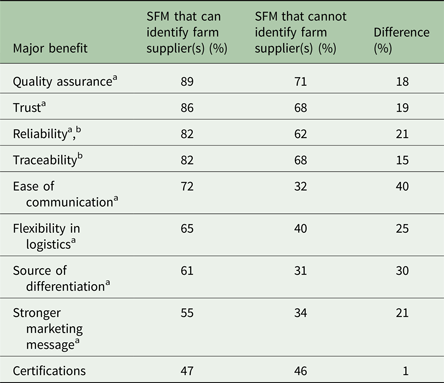
Quality assurance, trust and traceability are widely recognized by SFMs as benefits to purchasing ingredients that can be traced back to a farm, regardless of whether or not the SFM could identify or not identify at least one farm as an ingredient supplier. However, ‘ease of communication’ and ‘source of differentiation’ were much more likely to be recognized as benefits of farm traceable ingredients by SFMs that could identify at least one farm as an ingredient supplier (Table 10). This was observed in our interviews as well. The proprietor of a California creamery interviewed noted some benefits of a close relationship with her farmer suppliers: It enabled her to verify that they were following animal welfare practices and gave her the opportunity to provide them with immediate feedback about milk quality. This close relationship would not have been possible with larger suppliers. Farms seeking to become suppliers to SFMs may want to emphasize these benefits. In some cases, the need for good communication leads to major business decisions. In our interviews, we heard from an established, medium-sized Oregon cheese manufacturer that decided to purchase a farm and produce its own cow's milk, so it would have a better way of handling both quality and communication issues; this reduced the SFM's uncertainty.
Major benefits to specialty food manufacturers in purchasing ingredients that can be traced back to farm(s)

a Importance of this benefit differs significantly with ability to identify farm supplier(s) at the 0.01 level.
b Importance of this benefit differs significantly with ability to identify farm supplier(s) at the 0.05 level.
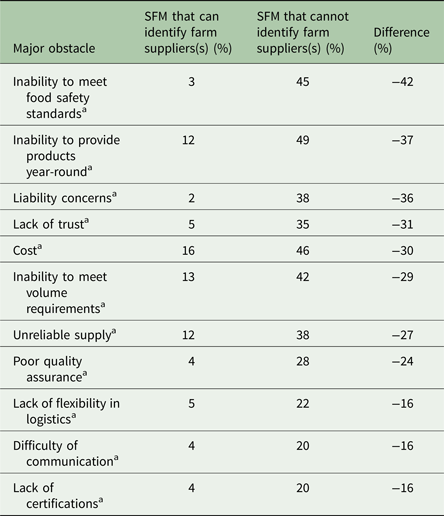
SFMs that cannot identify at least one farm supplier identified significantly more major obstacles (either expected or experienced in the past) in purchasing ingredients that can be traced back to a farm, compared with SFMs that can identify at least one farm supplier (Table 11). More than 40% of the SFMs that cannot identify at least one farm supplier faced (or expect to face) obstacles including: inability to provide products year-round (49%); cost (46%); inability to meet food safety standards (45%) and inability to meet volume requirements (42%). The most frequently identified obstacle among SFMs that can identify at least one supplier was cost, and it was only mentioned by 16%. Based on the information in this table, we believe SFMs and farm suppliers would benefit from an organized event where SFMs and farms can meet each other and discuss potential supply relationships and SFMs with successful relationships with farms could share how they overcame various obstacles.
Major obstacles to specialty food manufacturers in purchasing ingredients that can be traced back to farm(s)

a Importance of this obstacle differs significantly with ability to identify farm supplier(s) at the 0.01 level.
Discussion
A key finding from this study is that one of the important ways SFMs obtain ingredients for their products is sourcing directly from farms. One-quarter of all SFMs in this study purchased directly from farms, and another 22% sourced their key ingredients from a farm owned by their company. Together, this accounts for almost half of all SFM respondents. The level of sales of the SFM is related to how much they buy directly from farms. The smaller SFMs (especially those with sales under $100,000) tended to buy more from a distributor, if they were not buying from a farm owned by their company. This may be because, as some of our interviewees suggested, prices were lower and flexibility was greater with distributors. As SFM firms’ sales increased, they were more likely to purchase directly from farms or from farmer cooperatives.
It is important to note, however, that most SFMs also purchased their key ingredients from multiple suppliers (farms, distributors and others). Regardless of the level of sales, most SFMs diversified their procurement sources. For many SFMs, diversification increased as they became more experienced and realized the importance of having multiple suppliers to reduce risk. Procurement from small- and medium-sized farms was often part of this diversified portfolio. One California creamery, for example, started out making cheese using only sheep milk from its own farm and a few other small, local sheep dairies. However, due to unreliable and limited supply, the creamery expanded and diversified the types of animal milk it buys and now uses goat, cow and water buffalo milk as well. In another example, an Oregon small farm/meat processor started out just processing pork from its own farm, but then diversified its sourcing to include beef and lamb from other farms.
For 54% of SFMs, small- and medium-sized farms are the predominant supplier of their key ingredient. Some might conclude that this is a fairly low percentage compared with the percentage (88%) of small farms in the US (USDA, 2016a). We view this as an opportunity for small- and medium-sized farms to diversify their portfolios, not necessarily to make SFMs their main markets. Farmers and potential SFM buyers will need to meet each other and discuss whether a supplier relationship is suitable for both parties. A California diversified farm and a California nut grower, along with growers in Minnesota, mentioned that farmers’ markets were an excellent location for making farmer–SFM connections, especially when both parties are vendors. In addition to farmers markets, other opportunities for making connections include introductions at meetings, food shows, workshops or conferences; speed-dating style events (introduction and quick information exchange between two parties) for farmers and SFMs; mutual friends; and directly approaching an SFM that has a good reputation.
The survey and interviews found that informal, ‘handshake’ agreements are the most common form of relationship with SFMs. However, as farms and SFMs grow, formal contracts become more likely. In some instances, formal, written contracts were required of small- and medium-sized farms. For instance, one California dairy started with informal relationships with her farmer suppliers, but eventually moved to written contracts—not because of lack of trust, but due to food safety requirements and third party audits being required of her by distributors she sold to.
The survey and interviews also revealed that relationships between farmer suppliers and SFMs were durable over time. Once trusting relationships were formed, they tended to last. Interviews with both SFMs and farmers, however, suggested that relationships between similarly scaled firms tended to work best. When scales differed, issues such as sufficient processing capacity, loss of control in decision making and liability emerged as problems. For example, a medium-sized California fruit farmer described difficulties that he had working with small-scale SFMs because they lacked the capacity to handle his crops when he was ready to harvest. Conversely, a diversified, medium-sized California farmer regretted his decision to expand his production significantly and sell most of it to a very large SFM. He stated that he lost control of his farming business by becoming aligned with such a large food business. A large-scale California fruit grower questioned the processing knowledge of small-scale SFMs; he was concerned about the liability his farm could be exposed to if an inexperienced SFM caused a food safety problem. When small- and medium-sized farms sold to small- and medium-sized SFMs, their volumes and need for flexibility seemed to match.
For some small- and medium-sized farms, vertically integrating by processing some of their own raw ingredients/crops into value-added products (such as jams, jellies, baked goods, dried fruits, artisanal cheeses or charcuterie) was a valuable strategy. Thus, instead of selling to another SFM, they became their own SFM customer. Although this approach comes with its own challenges, it was mentioned by multiple small- and medium-sized farmers as a strategy for strengthening their businesses. This type of diversification can generate cash flow year-round and convert excess crops into profitable products. For farmers, vertical integration also facilitates the recordkeeping required to meet various regulations. There is better quality control of ingredients if they are coming from one's own farm, and there are no delivery issues. Vertical integration works well and is easiest when the farmer is sourcing small amounts of ingredients. In order to expand the business, farmer/manufacturers may need to buy from other farmers or even distributors.
For small- and medium-sized farms that are looking to sell ingredients to SFMs, it is important to know which key factors or criteria are important. The survey and interviews both strongly identified quality, food safety practices, year-round availability, price and local/regional sourcing as very important. However, the most significant differences for those SFMs who knew a farmer supplier compared with those who did not are: stories about ingredients, local/regional sourcing and non-GMO certification. This suggests that for small- and medium-sized farms that want to make connections with SFMs, they might consider focusing their marketing efforts on these three attributes. The local sourcing criterion may also be a way for small- and medium-sized farms to differentiate themselves from their competitors.
For SFMs, the survey found that quality assurance, trust and traceability were the major benefits to purchasing ingredients that can be traced back to a farm. For SFMs that actually knew a farm from which they made purchases, ease of communication and source of differentiation were significantly more likely to be major benefits than for those SFMs that could not identify a farm. This suggests again the importance of communication between farmer and SFM. As our interviews also revealed, SFMs rely on ongoing information from farmers and vice versa. One medium-sized jam manufacturer in California stated that she prefers to work directly with the farmer rather than with the farm's sales staff because the farmer has a more accurate assessment of the ripeness of the crop.
Obstacles for SFMs that could identify a farm were much less common than for SFMs that could not identify a farm, according to the survey results. This suggests that perceptions of problems are different or that once relationships are formed, farmers and SFMs find ways to resolve the issues to their mutual satisfaction. They appear to at least be willing to try since the durability of their relationships was strong, according to the survey results.
Conclusion
Consumers’ growing interest in locally and regionally produced foods is clearly generating opportunities for small- and medium-sized farms to become suppliers of ingredients to SFMs, or to vertically integrate and become SFMs themselves. To our knowledge, this is the first study to assess the opportunities and challenges small- and medium-sized farms face when participating in the specialty food industry in Minnesota, Wisconsin, and on the West Coast. Our findings indicate that some small- and medium-sized farms have successfully supplied SFMs. To do so, they need to be aware of SFM's key sourcing criteria, including quality and meeting food safety standards. Additionally, small- and medium-scale farms may want to emphasize their farm story, local/regional sourcing and non-GMO certification, especially to SFMs that want to have a stronger link to their farm suppliers.
In all likelihood, SFMs will not be the primary market for small- and medium-sized farms. That said, they can be an important complement to a farm's existing markets and may be more stable and predictable than direct-to-consumer sales. SFMs may also be able to take product that is less desirable for direct to consumer sales. For instance, they may be able to turn fruit and vegetable seconds into jams, salsas, kimchi or cider. Bones or less desirable cuts of meat may be what specialty soup maker needs.
There are limitations to our research. This study focused on the specialty food sector on the West Coast and in Minnesota and Wisconsin. We cannot conclude that the results apply nationwide. Growing opportunities in some parts of the country may be more limited, thereby constraining the range of ingredients that can be used in regionally produced specialty foods. Additionally, the specialty food marketplace in some parts of the country is relatively small due to low population density and/or the limited capacity of households to pay premium prices for these products. Although we present some information from our interviews describing how sales of SFMs can improve the profitability of small- and medium-sized farms, we did not quantify the impact of sales to SFMs on the profitability of small- and medium-sized farms; research on this topic is clearly warranted.
Overall, our interviews and survey results indicate that the specialty food industry is an emerging market channel that represents a diversification opportunity for small- and medium-sized farms. This can include selling to SFMs or may involve a farm vertically integrating to become an SFM itself. The first option is by far the easiest. Farmers wanting to become vertically integrated must recognize that this requires a much different skill set than being a crop or livestock producer. Additionally, becoming a SFM often requires considerable capital investment to develop processing capacity and an entirely separate marketing program. Support from cooperative extension or business development programs could increase the likelihood of success by small- and medium-sized farms becoming suppliers to SFMs or developing such ventures themselves.
Supplementary material
The supplementary material for this article can be found at https://doi.org/10.1017/S1742170517000722.
Acknowledgements
The authors wish to thank the many specialty food manufacturers, farmers and ranchers who participated in this study. This project was supported by Agriculture and Food Research Initiative Competitive Grant no. 2015-68006-22906 from the USDA National Institute of Food and Agriculture.