Posttraumatic stress disorder (PTSD) is a debilitating condition that can result after a child is exposed to an environmental event involving actual or threatened death, injury, or harm to one's physical integrity. Up to 82% of children will experience at least one such event before adulthood (Breslau, Wilcox, Storr, Lucia, & Anthony, Reference Breslau, Wilcox, Storr, Lucia and Anthony2004; Cuffe et al., Reference Cuffe, Addy, Garrison, Waller, Jackson and McKeown1998; Giaconia et al., Reference Giaconia, Reinherz, Silverman, Pakiz, Frost and Cohen1995), resulting in a PTSD prevalence rate of 5% in the general child population (Merikangas et al., Reference Merikangas, He, Burstein, Swanson, Avenevoli and Cui2010). Rates of PTSD vary, however, depending on the type of event to which children are exposed. Child maltreatment, including physical abuse, sexual abuse, and neglect, affects 700,000 children under the age of 18 each year in the United States (US Department of Health and Human Services, 2010) and increases the risk for a number of adverse developmental outcomes, including low educational achievement (Lansford et al., Reference Lansford, Dodge, Pettit, Bates, Crozier and Kaplow2002; Perez & Widom, Reference Perez and Widom1994), sexually transmitted infections (Hillis, Anda, Felitti, Nordenberg, & Marchbanks, Reference Hillis, Anda, Felitti, Nordenberg and Marchbanks2000), teenage pregnancy (Noll, Shenk, & Putnam, Reference Noll, Shenk and Putnam2009), and obesity (Bentley & Widom, Reference Bentley and Widom2009). Child maltreatment is also one of the most reliable predictors of PTSD symptoms (Copeland, Keeler, Angold, & Costello, Reference Copeland, Keeler, Angold and Costello2007; De Bellis, Hooper, Woolley, & Shenk, Reference De Bellis, Hooper, Woolley and Shenk2010; Tolin & Foa, Reference Tolin and Foa2006), with maltreated children 5–10 times more likely to meet full PTSD diagnostic criteria as young adults than nonmaltreated, psychiatric controls (Scott, Smith, & Ellis, Reference Scott, Smith and Ellis2010). PTSD prevalence estimates range between 30% and 37% in adults with a documented history of child maltreatment (Widom, Reference Widom1999), considerably higher than the 7% estimate found in the general adult population (Kessler et al., Reference Kessler, Berglund, Demler, Jin, Merikangas and Walters2005). Thus, child maltreatment poses an increased risk for PTSD and PTSD symptoms throughout the life span, resulting in significantly higher medical costs even when compared to more prevalent psychiatric conditions, including all other anxiety disorders (Marciniak et al., Reference Marciniak, Lage, Dunayevich, Russell, Bowman and Landbloom2005) and major depressive disorder (Ivanova et al., Reference Ivanova, Birnbaum, Chen, Duhig, Dayoub and Kantor2011).
Although the risk that child maltreatment poses for subsequent PTSD symptoms is clear, not all maltreated children develop PTSD symptoms (Collishaw et al., Reference Collishaw, Pickles, Messer, Rutter, Shearer and Maughan2007), suggesting that additional, mediating variables explain how some maltreated children go on to develop PTSD symptoms and others do not. Researchers have examined both psychological and neurobiological processes related to child maltreatment and PTSD symptoms to identify such mediating variables. Psychological processes are mediational pathways explaining how an event, such as child maltreatment, leads to an increased risk for a particular outcome, such as PTSD symptoms. Experiential avoidance is one such process, and it has gained considerable attention recently because it is related to a number of adverse psychological outcomes (Aldao, Nolen-Hoeksema, & Schweizer, Reference Aldao, Nolen-Hoeksema and Schweizer2010). Experiential avoidance is an unwillingness to experience painful or aversive private events, such as unwanted thoughts, emotions, memories, and physiology, with attempts to control, suppress, or inhibit the form or frequency of these private events and the contexts that occasion them (Hayes, Wilson, Gifford, Follette, & Strosahl, Reference Hayes, Wilson, Gifford, Follette and Strosahl1996). Child maltreatment, like other forms of trauma, can prompt painful private events, such as reoccurring images or recollections of the event, heightened physiological reactivity, and increased fear and anxiety. These events may generate attempts to alter, suppress, or otherwise control specific private events so that the aversiveness of the experience can be reduced. This can establish the use of avoidance strategies, a key symptom cluster of PTSD, while actually maintaining or increasing other PTSD symptoms (Cameron, Palm, & Follette, Reference Cameron, Palm and Follette2010; Rosenthal, Cheavens, Lynch, & Follette, Reference Rosenthal, Cheavens, Lynch and Follette2006).
Previous research has demonstrated that child maltreatment is related to higher levels of experiential avoidance (Gratz, Bornovalova, Delany-Brumsey, Nick, & Lejuez, Reference Gratz, Bornovalova, Delany-Brumsey, Nick and Lejuez2007; Sullivan, Meese, Swan, Mazure, & Snow, Reference Sullivan, Meese, Swan, Mazure and Snow2005) with higher levels of experiential avoidance predicting the development of PTSD symptoms above and beyond initial symptom severity (Plumb, Orsillo, & Luterek, Reference Plumb, Orsillo and Luterek2004). Experiential avoidance has also demonstrated mediation of child maltreatment and several global measures of adult psychiatric distress (Marx & Sloan, Reference Marx and Sloan2002; Polusny, Rosenthal, Aban, & Follette, Reference Polusny, Rosenthal, Aban and Follette2004). Experiential avoidance may even play a mediational role in PTSD symptom development for maltreated children (Shenk, Putnam, & Noll, Reference Shenk, Putnam and Noll2012) and explain how some of these individuals develop subsequent PTSD symptoms and others do not. Such research would guide prevention and intervention strategies toward more effective targeting of psychological processes influencing PTSD symptom development.
Child maltreatment also affects multiple neurobiological processes that recent theory outlines as potential mediators of the relationship between child maltreatment and subsequent PTSD symptoms. For instance, allostatic load (McEwen & Wingfield, Reference McEwen and Wingfield2003) specifies that severe or chronic stress, such as child maltreatment, affects multiple, interrelated stress-mediating systems, such as the endocrine and autonomic systems, that increase the probability of adverse psychological development (Juster et al., Reference Juster, Bizik, Picard, Arsenault-Lapierre, Sindi and Trepanier2011). The respiratory sinus arrhythmia (RSA) is an estimate of parasympathetic control over cardiac activity and is an example of one such stress-mediating pathway, because it is responsible for regulating sympathetic activity during and after environmental challenge (Porges, Reference Porges2003). Child maltreatment can limit the protective effects of RSA by reducing estimates observed in adolescent females at rest (Miskovic, Schmidt, Georgiades, Boyle, & MacMillan, Reference Miskovic, Schmidt, Georgiades, Boyle and MacMillan2009), as well as in adult females during challenge (Dale et al., Reference Dale, Carroll, Galen, Hayes, Webb and Porges2009). Reduced RSA estimates at rest and greater reductions during challenge are predictive of poor psychological outcomes in children due to an underregulation of sympathetic activity (Beauchaine, Gatzke-Kopp, & Mead, Reference Beauchaine, Gatzke-Kopp and Mead2007). Reduced RSA can therefore promote hyperaroused physiological states, a key symptom cluster of PTSD, and research with adults has found reduced RSA estimates at rest for those with PTSD (Blechert, Michael, Grossman, Lajtman, & Wilhelm, Reference Blechert, Michael, Grossman, Lajtman and Wilhelm2007; Hopper, Spinazzola, Simpson, & van der Kolk, Reference Hopper, Spinazzola, Simpson and van der Kolk2006). Similar research with adults has found that stress paradigms elicit stronger reductions in RSA estimates for those with PTSD symptoms (Keary, Hughes, & Palmieri, Reference Keary, Hughes and Palmieri2009; Sack, Hopper, & Lamprecht, Reference Sack, Hopper and Lamprecht2004). Thus, existing theory and research posit that disruptions in RSA, specifically reduced influence over sympathetic activity, may serve as a potential biological pathway explaining how child maltreatment promotes the risk of subsequent PTSD symptom development.
The hypothalamus–pituitary–adrenal (HPA) axis is another stress-mediating system responsible for promoting and resolving the biological response to environmental challenges (Chrousos & Gold, Reference Chrousos and Gold1992). Disruptions in cortisol profiles, an index of HPA axis activity, are linked to several subsequent psychological and health outcomes (Miller, Chen, & Zhou, Reference Miller, Chen and Zhou2007). Both hyper- and hypocortisolism profiles have been observed in maltreated samples at rest (Cicchetti & Rogosch, Reference Cicchetti and Rogosch2001; King, Mandansky, King, Fletcher, & Brewer, Reference King, Mandansky, King, Fletcher and Brewer2001) and during chemical or laboratory stress paradigms (Carpenter et al., Reference Carpenter, Carvalho, Tyrka, Wier, Mello and Mello2007; Hart, Gunnar, & Cicchetti, Reference Hart, Gunnar and Cicchetti1995; Heim et al., Reference Heim, Newport, Heit, Graham, Wilcox and Bonsall2000). Each of these cortisol profiles observed during rest and challenge are related to current and subsequent PTSD symptoms (Bremner, Vermetten, & Kelley, Reference Bremner, Vermetten and Kelley2007; Carrion et al., Reference Carrion, Weems, Ray, Glaser, Hessl and Reiss2002; Lemieux & Coe, Reference Lemieux and Coe1995; Santa Ana et al., Reference Santa Ana, Saladin, Back, Waldrop, Spratt and McRae2006; Yehuda, Reference Yehuda2001). Although identifying a specific cortisol profile related to PTSD in maltreated samples has been difficult, due in part to changes in HPA axis activity observed across development (Trickett, Noll, Susman, Shenk, & Putnam, Reference Trickett, Noll, Susman, Shenk and Putnam2010), atypical cortisol profiles such as hyper- and hypocortisol responses are consistently linked to both child maltreatment and PTSD symptoms. Such research suggests that cortisol may serve as a potential mediating pathway between exposure to child maltreatment and subsequent PTSD symptom development. However, cortisol concentrations vary according to a diurnal pattern (Kiess et al., Reference Kiess, Meidert, Dressendorfer, Schriever, Kessler and Konig1995), and recent maltreatment is more strongly associated with PTSD symptoms (Kendall-Tackett, Williams, & Finkelhor, Reference Kendall-Tackett, Williams and Finkelhor1993). Accounting for these factors can strengthen inferences made about the role of cortisol as a potential mediator of PTSD symptoms in maltreated children (Shea, Walsh, Macmillan, & Steiner, Reference Shea, Walsh, Macmillan and Steiner2005).
Formal mediational tests of the specific indirect effects of RSA and cortisol activity are lacking and represent an important area for future research. A multiple levels of analysis approach (Cicchetti & Blender, Reference Cicchetti and Blender2004; Cicchetti & Dawson, Reference Cicchetti and Dawson2002), where researchers incorporate knowledge from various subdisciplines and examine several psychological and neurobiological processes simultaneously, is needed to advance a developmental psychopathology perspective on the identification of potential mediators of the relationship between child maltreatment and PTSD symptoms. Child maltreatment is an environmental event that affects multiple risk processes that also co-occur (Dale et al., Reference Dale, Carroll, Galen, Hayes, Webb and Porges2009; Gordis, Granger, Susman, & Trickett, Reference Gordis, Granger, Susman and Trickett2008). This co-occurrence can exert an additive risk impact where multiple processes affected by child maltreatment each contribute to the increased probability of adverse development, such as PTSD symptoms. Testing several potential mediators simultaneously within a multiple levels of analysis framework can therefore assess the cumulative effect of child maltreatment on several risk processes while minimizing the risk of attributing mediational status to a single process when other relevant processes are omitted from the analysis. A simultaneous test of multiple risk processes also allows each individual mediator to compete for variance in a specified outcome, leading to more rapid and effective identification of the putative mediational processes responsible for the development of PTSD symptoms in maltreated populations. A final important advantage of this approach is that results have direct clinical utility for prevention and intervention programs. Identifying one or more mediators prioritizes clinical resources toward those processes most influential in increasing the risk of subsequent PTSD symptoms. Clinical interventions that directly alter risk processes can then be delivered following an instance of maltreatment or after PTSD symptoms emerge.
Adopting a multiple levels of analysis approach, the current study simultaneously tested the indirect effects of experiential avoidance, RSA, and cortisol in mediating the relationship between child maltreatment and subsequent PTSD symptoms using a sample of maltreated and nonmaltreated adolescents. Two primary hypotheses were tested. First, the set of potential mediators would mediate the relationship between child maltreatment and subsequent PTSD symptoms after controlling for relevant covariates and baseline estimates. This hypothesis tests the additive risk impact of experiential avoidance, RSA, and cortisol when testing mediation of the relationship between child maltreatment and PTSD symptoms. Second, experiential avoidance, RSA reactivity, and cortisol reactivity would each constitute a significant indirect effect of the relationship between child maltreatment and PTSD symptoms when simultaneously estimating the other risk processes. This hypothesis will identify the most potent specific indirect effects contributing to PTSD symptoms, thereby informing prevention and intervention programs serving children who have been maltreated.
Method
Sample
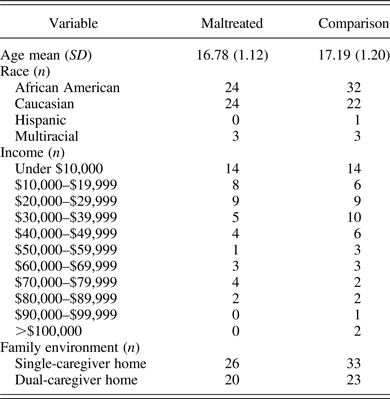
A sample of 110 adolescent females between the ages of 14 and 19 years of age participated in this study. Adolescent females were selected because older children experiencing trauma are most likely to develop PTSD symptoms (Copeland et al., Reference Copeland, Keeler, Angold and Costello2007), with females more likely to experience different forms of child abuse (US Department of Health and Human Services, 2010) and more likely to develop PTSD symptoms (Breslau et al., Reference Breslau, Wilcox, Storr, Lucia and Anthony2004). Two distinct groups of adolescent females participated. A child maltreatment group (n = 51) was recruited from Child Protective Service (CPS) agencies investigating allegations of physical neglect or contact physical or sexual abuse. With the assistance of CPS caseworkers, a consecutive referral process identified families who had a child with a substantiated case of maltreatment and who were willing to be contacted by research staff about participation in the study. A nonmaltreated, comparison group (n = 59) was recruited using posted flyers in a primary care outpatient clinic servicing the general medical complaints of at-risk, adolescent females. This outpatient clinic was chosen as a recruitment site because it serves a population with a similar demographic profile as that of the maltreated group. At the time of entry into the study, the mean age of the total sample was 17.00 years (SD = 1.17, age range = 14–19 years), 58% of the adolescents were from single-caregiver homes, the median annual family income level was $40,000–$49,000, and the sample population was 42% Caucasian, 51% African American, 1% Hispanic, and 6% multiracial. Demographic information is presented by group membership in Table 1.
Demographic information for maltreated and comparison groups at study entry

Procedure
All study procedures were approved by the local Institutional Review Board prior to data collection. Causal inferences about the effects of potential mediators assessed in observational research are strengthened when there is proper temporal ordering of events that follow a logical or theoretical pathway (Maxwell & Cole, Reference Maxwell and Cole2007; Preacher & Hayes, Reference Preacher and Hayes2008). Adolescent females who had experienced substantiated child maltreatment prior to study entry and a nonmaltreated comparison group were recruited to participate in an assessment of potential mediators of PTSD symptoms. This same cohort was then followed 1 year later to reassess PTSD symptoms and determine whether the set of potential mediators, as well as individual mediators, exerted a significant indirect effect on subsequent PTSD symptoms. To illustrate the actual temporal relationships among the predictor, the set of potential mediators, and outcome variable assessed in this study, child maltreatment is presented as Time 1, the assessment of mediators as Time 2, and the subsequent PTSD assessment as Time 3.
Determination of child maltreatment (Time 1)
Child maltreatment was determined by a CPS investigation that resulted in a substantiated/indicated designation of child maltreatment. All substantiated/indicated designations of child maltreatment were made prior to the onset of this study, and individual case records were reviewed and screened for eligibility and recruitment purposes. Participants in the maltreated group were required to have had a substantiated/indicated designation of maltreatment within the 12 months prior to study participation. Of the 51 participants in the maltreatment group, 49% had experienced sexual abuse, 45% had experienced physical abuse, and 16% had experienced physical neglect, with 10% experiencing more than one form of abuse. Comparison females were screened and excluded if they had had a substantiated case of child maltreatment within the 12 months prior to study participation.
Assessment of potential mediators (Time 2)
All appointments were scheduled between 11 a.m. and 5 p.m. Participants completed a general interview about current health habits, self-report questionnaires, a semistructured interview assessing PTSD symptoms, and a stressor paradigm measuring physiological reactivity. The stressor paradigm involved participants first completing a 5-min resting condition, where each participant sat comfortably in a chair while listening to soft music and watching slow-moving images on a computer screen. Participants then completed a combined stressor task to elicit reactivity across different physiological systems. A combined performance and interpersonal stressor was chosen given varying autonomic and HPA axis responses to different stressor types (Stroud et al., Reference Stroud, Foster, Papandonatos, Handwerger, Granger and Kivlighan2009). The performance aspect of the stressor paradigm involved each participant completing a series of affect recognition tasks (Porges, Cohn, Bal, & Lamb, Reference Porges, Cohn, Bal and Lamb2007). Participant responses were timed, and each participant was asked to identify the emotion as quickly as they could while not making any mistakes before the time elapsed. The average length of time to complete the affect recognition task was 7.45 min (SD = 1.19). The interpersonal stressor involved participants viewing a series of video clips of parent–adolescent conflict. The time required to view all videos was 8 min.
Assessment of subsequent PTSD symptoms (Time 3)
Study participants were recontacted 1 year later to complete the same semistructured interview assessing PTSD symptoms completed at Time 2. Of the original sample, 5% (n = 6) was unable to complete the subsequent PTSD symptoms assessment, indicating a 95% retention rate throughout the course of the study.
Measures
General demographics and health habits form
Demographic information was assessed via self- and caregiver report and included age, race, family income, and family constellation (single-caregiver vs. dual-caregiver homes). Health habits were assessed at Time 2 to determine their potential influence on RSA and HPA axis reactivity. Specific health habits assessed included pregnancy status, use of steroids (topical, oral and inhaled), cigarettes, over-the-counter (aspirin, ibuprofen) and prescription drugs (psychotropic, seasonal allergies, oral contraceptive), whether participants ate anything 1 hr prior to their appointment, and whether participants exercised or drank caffeine on the day of their appointment.
RSA
Interbeat intervals (IBIs), the time measured in milliseconds between heart contractions, were recorded via electrocardiogram (ECG) using disposable Ag/AgCl electrodes placed on the chest and abdomen of each participant. IBIs were detected in real time using a QRS peak detection algorithm applied to the ECG data and stored on the Biolog 3991x/2-EIR system manufactured by UFI Inc. IBIs were subsequently transferred to a computer via USB for later inspection. CardioEdit and CardioBatch software (Brain–Body Center, University of Illinois at Chicago) were used to visually inspect and edit IBI streams for artifacts. Editing consisted of integer arithmetic, such as dividing intervals when detections are missed or adding intervals when spuriously invalid detections occur. After editing IBI data streams, the amplitude of RSA was calculated by summing the variances of heart rate activity across the band of frequencies associated with spontaneous respiration during adolescence and young adulthood. The natural logarithm of the extracted variance for each successive 30-s epoch was calculated as the measure of the amplitude of RSA. The average across epochs within the resting (RSARest) and stressor conditions (RSAStress) was used to characterize individual differences in RSA. These procedures are statistically equivalent to frequency domain methods (e.g., spectral analysis) for the calculation of the amplitude of RSA when heart period data are stationary (Porges & Byrne, Reference Porges and Byrne1992). Reliable ECG recordings were not obtained on 3 participants and therefore could not be used in data analysis. A manipulation check was performed to assess if the stressor paradigm significantly changed values of RSA from resting to stressor conditions. A paired samples t test indicated that RSA estimates declined significantly from the resting to stressor condition, t (105) = –3.52, p < .001.
Cortisol
Cortisol reactivity was assessed across five samples collected at strategic times to detect resting and stress responses. Each participant was instructed not to eat or drink 1 hr prior to participation. Upon arrival, each participant was asked to swish water in her mouth prior to beginning her appointment. The first sample (CortisolRest) was collected approximately 25 min (M = 25.30, SD = 0.24) after participants began their study appointment to give them time to acclimate to the research environment and procedures. Samples 2 through 5 were collected 5, 10, 20, and 30 min post stressor to detect the maximum cortisol response to the combined stressor, CortisolStress. Saliva was obtained through passive drooling into 20-ml polypropylene vials and stored at –80°C until assayed. Samples were assayed in duplicate using a highly sensitive enzyme immunoassay from Salimetrics. The test has a lower limit sensitivity of <0.003 µg/dl and average intra- and interassay coefficients of variation 3.35%–3.65% and 3.75%–6.41%, respectively. A manipulation check was performed to assess if cortisol concentrations changed significantly from resting to stressor conditions. A paired samples t test indicated that cortisol concentrations, on average, did not change significantly from the resting to the stressor condition for the total sample, t (108) = 0.71, p = .48.
Acceptance and Action Questionnaire (AAQ)
Experiential avoidance was measured using the 22-item version of the AAQ (Hayes et al., Reference Hayes, Strosahl, Wilson, Bissett, Pistorello and Toarmino2004). Items are rated on a 7-point Likert scale ranging from never true to always true with higher scores representing higher levels of experiential avoidance. Example items include “Anxiety is bad,” “I try hard to suppress thoughts and feelings that I don't like by just not thinking about them,” and “I'm not afraid of my feelings” (reverse scored). The AAQ has demonstrated reliability (α = 0.70–0.79) and convergent validity with measures of anxiety (r = .59, p < .01), depression (r = .75, p < .01) and child trauma (r = .18, p < .01). The reliability of the AAQ at Time 2 was α = 0.72.
PTSD symptoms
The Comprehensive Trauma Interview (CTI; Barnes, Noll, Putnam, & Trickett, Reference Barnes, Noll, Putnam and Trickett2009) is a semistructured interview assessing a wide variety of information following an instance of child maltreatment. The CTI has demonstrated good interrater reliability with information collected from CPS investigations (κ = 0.70–0.87). The CTI has a specific section devoted to the assessment of PTSD symptoms across each symptom domain (reexperiencing, avoidance, and hyperarousal) outlined in the DSM-IV-TR. Examples of questions are “Have you ever had painful images, memories or thoughts of what happened?” “Have you ever avoided doing things or getting into situations that reminded you of what happened?” and “Have you ever been jumpy, on edge, or easily startled because of what happened?” Responses to questions are coded (0 = no, 1 = yes) with composite scores generated for each PTSD symptom domain as well as total PTSD symptoms. Reliability of the total PTSD symptoms composite score used in statistical analysis was α = 0.89 at Time 2 and α = 0.91 at Time 3.
Data analytic strategy
A multiple mediator model was employed to identify the total and specific indirect effects of RSAStress, CortisolStress, and AAQ scores when explaining the relationship between child maltreatment and subsequent PTSD symptoms. The multiple mediator model was performed with Mplus, Version 6 (Muthén & Muthén, Reference Muthén and Muthén1998–2010), using the maximum likelihood estimator to account for missing data. This method of testing mediation is particularly useful in the current study because it tests the indirect effects of each mediator simultaneously and through its use of bootstrapping. Bootstrapping is a nonparametric, resampling procedure for estimating the standard errors of indirect effects and their corresponding confidence intervals with optimal accuracy (MacKinnon, Lockwood, & Williams, Reference MacKinnon, Lockwood and Williams2004). By randomly sampling from n observations and estimating indirect effects k times with replacement of observations, estimates of the total and specific indirect effects, their standard errors and confidence intervals can be obtained. This is also the opportunity to enter variables into the multiple mediator model as statistical covariates. Results of the current multiple mediator model are based on k = 5000 bootstrap samples with bias-corrected, 95% confidence intervals (BC 95% CI).
Results
Data screening
Participants who reported being pregnant (n = 6) were excluded from statistical analyses. Chi-square and serial analysis of variance tests were used to evaluate differences between maltreatment and comparison groups on demographic, health, and study-related variables at Time 2. Results indicated significant between-group differences on the use of prescribed steroid medication (steroid use = 1, no steroid use = 0), χ2 (1) = 5.27, p = .02, odds ratio = 5.64, 95% CI = 1.14–28.02, and cigarette use (cigarette use = 1; no cigarette use = 0), χ2 (1) = 7.81, p = .01, odds ratio = 5.07, 95% CI = 1.53–16.82, with the maltreated group using steroid medication and cigarettes more often than the comparison group. There were no significant differences between groups on race, income, family constellation, medication use (prescription, over-the-counter), the use of caffeine prior to the study, whether participants exercised on the day of their appointment or ate in the hour prior to the study (ps = .11–.81). The analyses of variance indicated that the maltreated group was marginally younger, F (1, 102) = 3.37, p = .07, η2 = 0.03, had significantly higher AAQ scores, F (1, 102) = 5.99, p = .02, η2 = 0.06, and had more PTSD symptoms at both the Time 2, F (1, 102) = 15.19, p < .001, η2 = 0.13, and Time 3 assessment, F (1, 96) = 16.06, p < .001, η2 = 0.14. There were no significant group differences on the time of day the first cortisol sample was collected (RSARest, RSAStress, CortisolRest, or CortisolStress, ps = .12–.41).
Cortisol concentrations continue to decline throughout the afternoon and into the evening hours (Kiess et al., Reference Kiess, Meidert, Dressendorfer, Schriever, Kessler and Konig1995); therefore, the relationship between the time the first cortisol sample was collected and the observed cortisol concentration was examined. Although there was no significant difference between the maltreated and comparison groups as to the time of day when the first cortisol sample was obtained, the time of day when cortisol was first collected was systematically related to observed cortisol concentrations (r = –.22, p = .02). This result indicated that samples collected later in the day had cortisol concentrations that were lower than in samples collected earlier in the day. Because age, steroid use, and cigarette use were either marginally or significantly different between groups at Time 2, and because the time of day when the first cortisol sample was collected was systematically related to observed cortisol concentrations, all of these variables were used as covariates in subsequent statistical analyses.
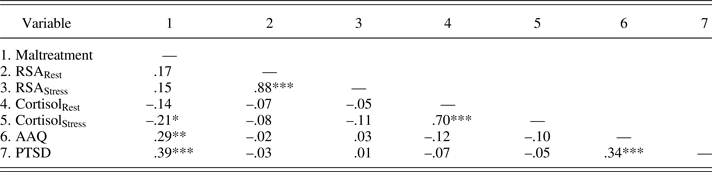
A partial correlation matrix, controlling for age, steroid use, cigarette use, and the time of day when the first cortisol sample was collected, was then estimated to assess the relationships among variables to be included in the multiple mediator model (see Table 2). Although the manipulation check for cortisol indicated that cortisol values did not change significantly from resting to stressor conditions for the entire sample, the partial correlation matrix revealed that the maltreated group exhibited significantly lower concentrations of cortisol, or a hypocortisol profile, during the stressor condition once age, steroid use, cigarette use, and time of day when the first cortisol sample was collected were controlled. The relationships between experiential avoidance and each PTSD symptom domain at Time 3 were then estimated to ensure that experiential avoidance was not highly correlated with any one domain, specifically the avoidance domain. The results indicated that AAQ scores were moderately correlated with all three PTSD symptom domains: reexperiencing (r = .25, p = .01), avoidance (r = .34, p < .001), and hyperarousal (r = .34, p < .001). However, there were no significant differences in the strengths of the relationships among symptom domains.
Partial correlation matrix for variables used in the multiple mediator analysis
Note: Age, steroid use, cigarette use, and sampling time were controlled in the matrix. Maltreatment was coded as 0 = comparison, 1 = maltreated; RSARest, respiratory sinus arrhythmia (RSA) assessed during rest; RSAStress, RSA assessed during stressor; CortisolRest, cortisol assessed during rest; CortisolStress, cortisol assessed during stress; AAQ, Acceptance and Action Questionnaire; PTSD, posttraumatic stress disorder symptoms at Time 3.
*p ≤ .05. **p ≤ .01. ***p ≤ .001.
Multiple mediator analysisFootnote 1
Hypothesis 1:
The set of potential mediators would mediate the relationship between child maltreatment and subsequent PTSD symptoms.
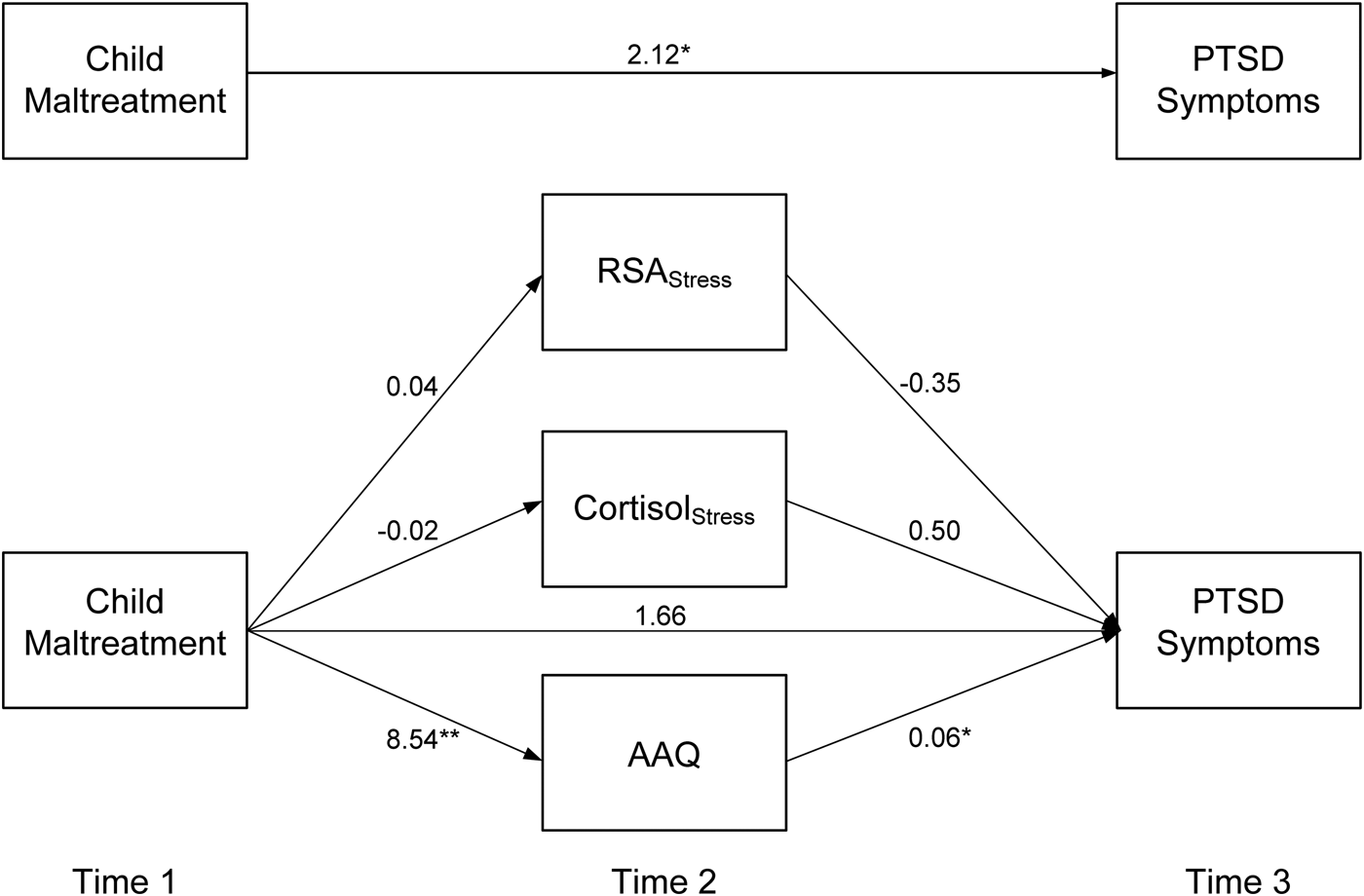
CortisolRest, RSARest, and Time 2 PTSD symptoms were added to the list of covariates that included age, steroid use, cigarette use, and the time of day when the first cortisol sample was collected. All directional and nondirectional relationships between the predictor, list of covariates, set of mediators, and the outcome were estimated and freely correlated in the model. Model fit indices indicated that the overall multiple mediator model provided a good fit to the observed data, χ2 (9) = 11.75, p = .23 (comparative fit index = 0.99, root mean square error of approximation = 0.05, standardized root mean square residual = 0.03). The total indirect effect, or the sum of each specific indirect effect tested in the multiple mediator model, was significantly different from zero, point estimate = 0.46, BC 95% CI = 0.06–1.21, indicating that the set of proposed variables mediated the relationship between child maltreatment and PTSD symptoms. As seen in Figure 1, the total effect for child maltreatment on PTSD symptoms was significant (b = 2.12, p = .03); however, the direct effect, when the set of mediators were estimated in the model, was nonsignificant (b = 1.66, p = .09), providing further evidence of a mediation effect.
Hypothesis 2:
Experiential avoidance, RSA reactivity, and cortisol reactivity would each constitute a significant indirect effect of the relationship between child maltreatment and PTSD symptoms.
The specific indirect effects of each proposed mediator were then examined to determine which proposed mediator or mediators contributed to the overall mediation effect. Results demonstrated that the confidence interval around the point estimate for the specific indirect effect of the AAQ did not include zero, indicating that the AAQ contributed significantly to the mediation effect when simultaneously estimating the contributions of RSAStress and CortisolStress (point estimate = 0.49, BC 95% CI = 0.11–1.20). The proportion of the total effect accounted for by the AAQ is 0.49/2.12 = 0.23, indicating that the AAQ accounted for 23% of the total effect of child maltreatment on subsequent PTSD symptoms (MacKinnon, Reference MacKinnon2008). The unstandardized parameter estimates reported in Figure 1 indicated that child maltreatment was significantly related to higher levels of experiential avoidance with higher levels of experiential avoidance significantly related to more, subsequent PTSD symptoms. The specific indirect effects for RSAStress or CortisolStress, as well as the unstandardized parameter estimates for each path, were not significantly different from zero and therefore did not contribute significantly to the mediation effect.
The results of the multiple mediator model. *p ≤ .05. **p ≤ .001.
Pairwise contrasts comparing the strength of each specific indirect effect relative to another indirect effect in the model were estimated for each proposed mediator. Results demonstrated that the BC 95% CI around the contrast comparing the indirect effects for AAQ versus RSAStress did not contain zero (point estimate = 0.50, BC 95% CI = 0.09–1.23), indicating that the indirect effect for AAQ was significantly stronger in comparison to RSAStress. The indirect effect for AAQ was also significantly stronger when compared to the indirect effect of CortisolStress (point estimate = 0.49, BC 95% CI = 0.08–1.21). There was no significant difference between the indirect effects of RSAStress and CortisolStress.
Discussion
Several limitations should be considered before interpreting the results of this study. First, mediational modeling was used to examine the contributions of several variables in a single statistical model to identify pathways to PTSD symptom development for maltreated children. Although these variables have both theoretical and empirical relevance for child maltreatment and PTSD symptom development, additional mediators almost certainly exist but were not tested in this study. Experiential avoidance accounted for a significant proportion of the variance in subsequent PTSD symptoms, but a large amount of variance remains unexplained. Alternative models testing experiential avoidance with other potential mediators, such as quality of parenting and interpersonal relationships (Collishaw et al., Reference Collishaw, Pickles, Messer, Rutter, Shearer and Maughan2007), hold considerable promise in future research. Second, the effects of child maltreatment in this sample are limited to those with a substantiated case of maltreatment. Substantiated cases of maltreatment can exert stronger effects on PTSD symptoms when compared to self-report measures of child maltreatment (Scott et al., Reference Scott, Smith and Ellis2010); thus, results cannot necessarily generalize to other methods assessing child maltreatment. The comparison group was screened for substantiated maltreatment occurring in the 12 months prior to study entry. It is possible that participants experienced maltreatment at some point in their lifetime prior to the year before study entry, thereby potentially limiting the fidelity of the comparison group. Third, the sample for this study consists entirely of females with the maltreated group experiencing higher rates of sexual abuse than found in the general maltreatment population. This study targeted females specifically to identify mediators of PTSD symptom development in the subpopulation of maltreated children at greatest risk for PTSD. It is therefore not unusual that a higher rate of sexual abuse was observed in this study, as females are more likely than males to be sexually abused (Sedlak et al., Reference Sedlak, Mettenburg, Basena, Petta, McPherson and Greene2010). It is important to emphasize that the findings of this study therefore only generalize to the adolescent female subpopulation, and the extent to which the current results generalize to maltreated males or the larger maltreatment population can only be determined by future research. Fourth, severity of maltreatment was not assessed in this study. More severe types or cases of maltreatment may increase active attempts to avoid painful private experiences. Examining the relationship between maltreatment severity and varying levels of experiential avoidance is an important area of future research. Fifth, timing within the menstrual cycle was not assessed, but it can influence hormone concentrations, particularly cortisol. Future research should assess and control the effect of menstrual cycle timing on cortisol concentrations.
Despite these limitations, the results of this study are based on a strong, longitudinal test of several potential mediators of the relationship between child maltreatment and PTSD symptoms. The set of mediators was identified using a multiple levels of analysis approach that integrated prior theoretical and empirical findings from several scientific subdisciplines (e.g., autonomic, endocrine, psychological) to advance a more complete developmental psychopathology perspective of the relationship between child maltreatment and PTSD symptoms. The results supported the mediational effect of experiential avoidance when simultaneously estimating the indirect effects of two neurobiological processes responsible for managing environmental demands. This suggests that the more maltreated participants avoided painful thoughts, emotions, memories, and physiology, the more PTSD symptoms they reported 1 year later. In addition, these results were estimated while accounting for the effects of several important covariates, including prior levels of PTSD symptoms. The effect for experiential avoidance was uniform across PTSD symptom clusters, demonstrating that it is related to moderate increases in reexperiencing, hyperarousal, and avoidance symptoms. These results suggest that experiential avoidance following child maltreatment plays an important role in the development of PTSD symptoms. These results also suggest that maltreated children who did not use strategies to avoid painful private events, or who engaged in experiencing private events with awareness and acceptance, were more resilient to abuse and less likely to develop PTSD symptoms. Together, these findings offer an alternative interpretation of the role private events play in the development of PTSD symptoms. For instance, etiological models of PTSD (Ehlers & Clark, Reference Ehlers and Clark2000) assign a primary role to the presence and influence of negative cognitions or appraisals following a traumatic event. However, the presence of these private events may be a less important aspect to consider when explaining how PTSD symptoms develop. It may be more useful to assess and understand how maltreated children relate to such private events, including but not limited to negative cognitions and appraisals, as opposed to the mere presence of these events. This study provides evidence that relating to private events with either acceptance or avoidance, not simply the presence of these events, can have a significant, differential impact on the development of PTSD symptoms.
Contrary to expectations, cortisol and RSA reactivity did not exert significant indirect effects. One explanation for this may come from longitudinal research showing that women who were sexually abused have higher resting cortisol concentrations during childhood, comparable estimates to nonsexually abused peers during adolescence, and significantly lower concentrations in adulthood (Trickett et al., Reference Trickett, Noll, Susman, Shenk and Putnam2010). Thus, an adjustment of the HPA axis may be occurring in maltreated samples across development with profiles assessed in younger and older developmental stages tied more strongly to PTSD symptoms. There is also variation in findings reported across studies examining the relationship between RSA and PTSD using adult (Sahar, Shalev, & Porges, Reference Sahar, Shalev and Porges2001) and child samples (Scheeringa, Zeanah, Myers, & Putnam, Reference Scheeringa, Zeanah, Myers and Putnam2004); thus, there may be a similar adjustment in RSA control during adolescence that prevents detection of a relationship between child maltreatment and PTSD symptoms.
Another explanation may be that the stressor used in this study had mixed effects in achieving levels of reactivity, particularly for cortisol. RSA reactivity did change significantly from resting to stressor conditions whereas cortisol reactivity did not. However, the maltreated group did display a hypocortisol reaction during the stressor condition once relevant demographic variables and health-related behaviors were controlled. This finding is consistent with previous research showing a relationship between child maltreatment and hypocortisol reactions during stress paradigms (Hart et al., Reference Hart, Gunnar and Cicchetti1995). Thus, the stressor did elicit a cortisol stress profile consistent with prior research, thereby providing an adequate test of its relationship with subsequent PTSD symptoms. Although there is support for a relationship between hypocortisolism in adults with PTSD (Yehuda, Reference Yehuda2001), this relationship is not always found in samples of adolescent females exposed to child maltreatment (MacMillan et al., Reference MacMillan, Georgiades, Duku, Shea, Steiner and Niec2009). This study adds to this literature with adolescents and suggests that RSA and cortisol reactivity may not be as strong as other indicators for maltreated adolescents when evaluating the putative mediators for subsequent PTSD symptoms. Several studies have shown that RSA and cortisol moderate several psychological outcomes in children experiencing maltreatment (Gordis, Feres, Olezeski, Rabkin, & Trickett, Reference Gordis, Feres, Olezeski, Rabkin and Trickett2010; Gordis, Granger, Susman, & Trickett, Reference Gordis, Granger, Susman and Trickett2006) or interparental conflict (El-Sheikh, Harger, & Whitson, Reference El-Sheikh, Harger and Whitson2001; El-Sheikh & Whitson, Reference El-Sheikh and Whitson2006). It may be more appropriate for future research to consider RSA and cortisol reactivity as moderators of the relationship between child maltreatment and subsequent psychological outcomes and not as mediators of this relationship.
There are specific, clinically relevant implications for prevention and intervention of PTSD symptoms within maltreated populations based on these results. For example, secondary prevention programs can incorporate a focus on disrupting experiential avoidance as part of an overall program assisting adolescents recovering from child maltreatment. This method of prevention could disrupt the pathway from maltreatment to PTSD symptoms and thereby prevent the development of subsequent PTSD symptoms. Such implications, however, illustrate the need for future research on clinical methods that directly and effectively target experiential avoidance. Several existing, well-established interventions for children (Cohen, Mannarino, & Deblinger, Reference Cohen, Mannarino and Deblinger2006) and adults (Foa & Rothbaum, Reference Foa and Rothbaum1998) with PTSD target avoidance using various adaptations of exposure (imaginal, written exercises, in vivo). Exposure, although typically used to counteract overt behaviors generated to avoid places or situations that prompt reminders of the trauma, may be one tool for targeting experiential avoidance of painful private events. Future research on the effects of exposure on experiential avoidance seems worthy and could result in more innovative applications of exposure that more directly target relevant psychological processes in maltreated patients and improve treatment response rates. However, experiential avoidance is a global approach to all painful private events, not just overt behaviors or private events specific to child maltreatment or PTSD, and there are several interventions available using novel methods to target experiential avoidance directly and broadly. Interventions promoting acceptance of private events in conjunction with behavioral change strategies (Hayes, Strosahl, & Wilson, Reference Hayes, Strosahl and Wilson1999; Linehan, Reference Linehan1993; Segal, Williams, & Teasdale, Reference Segal, Williams and Teasdale2002) have a growing empirical base. These interventions use methods such as mindfulness, acceptance, and cognitive defusion to disrupt experiential avoidance and improve clinical outcomes (Forman, Herbert, Moitra, Yeomans, & Geller, Reference Forman, Herbert, Moitra, Yeomans and Geller2007). The efficacy of these interventions and their methods for targeting experiential avoidance may be an avenue to explore in future clinical research examining mechanisms of change and improvements in PTSD outcomes. By promoting a willingness to experience difficult thoughts, emotions and memories, children who have been maltreated may be able to counteract patterns of experiential avoidance and promote the experiencing of abuse needed to achieve optimal recovery.