INTRODUCTION
The end-of-life process is accompanied by such biological and psychological manifestations as pain, dyspnea, nausea, vomiting, fatigue, agitation, mental confusion, and anxiety, which are difficult to manage (Araújo & Linch, Reference Araújo and Linch2011). Before this phase of life is completed, there is a need for interventions guided by the palliative care philosophy and defined by the healthcare team in conjunction with the patient and family members, designed to help patients improve their quality of life and approach death with dignity (Girond & Waterkemper, Reference Girond and Waterkemper2006; Araújo & Linch, Reference Araújo and Linch2011)
Established as one of the methods for relief of pain and other symptoms refractory to previously used treatments, palliative sedation is defined as the application of sedative medications to induce a decreased level of consciousness in patients undergoing the final phase of life in the interest of enhancing comfort and providing a “good death” (Girond & Waterkemper, Reference Girond and Waterkemper2006; Nogueira & Sakata, Reference Nogueira and Sakata2012). There are several guidelines that address palliative sedation as a practice to be employed in this context, including those published by the World Health Organization (WHO, 2009), the European Association for Palliative Care (EAPC) (Cherny & Radbruch, Reference Cherny and Radbruch2009), and the International Association for Hospice and Palliative Care (IAHPC, 2009).
A few studies published between 2013 and early 2014 addressed different aspects of palliative sedation, including indications, prevalence, monitoring, duration, medications used, and ethical issues. These reports confirmed that palliative sedation is a legitimate therapy to be utilized in a palliative context and highlighted the need for more research to provide basic knowledge about the process of sedating in a palliative manner, as well as the broadening of skills by professionals involved in this practice (see Maltoni et al., Reference Maltoni, Scarpi and Nanni2013).
The National Cancer Institute (INCA) of Brazil also considers palliative sedation or sedation at the end of life as a necessary resource and emphasizes its need if employed properly by trained and skilled professionals (Ministério da Saúde, 2001). The National Academy of Palliative Care and the Brazilian Association of Palliative Care—through the establishment of guidelines, research protocols, conferences, and other events—promote discussion about the behaviors and practices that constitute the palliative philosophy, among them palliative sedation (Conselho Regional de Medicina do Estado de São Paulo, 2008; Arantes & Sardenberg, Reference Arantes and Sardenberg2012). The Federal Council of Medicine (CFM) in Brazil issued a code of ethics related to patient autonomy at the end of life, including the use of a living will (Conselho Regional de Medicina do Estado de São Paulo, 2008; Conselho Federal de Medicina, 2010; 2012).
According to the chairman of the Committee on the Terminality of Life of the Brazilian Association of Intensive Care Medicine (AMIB) and a member of the Technical Chamber of Terminality Life of the CFM, Dr. Rachel Moritz, “Palliative sedation is already well advanced in terms of global acceptance. However, it is necessary that criteria about dosages of medications and their correct application are also established in Brazil, in the same way as was done by the Spanish Society of Palliative Care.” She added, “Barring unforeseen events, palliative sedation under an appropriate protocol would establish physicians' conduct to safeguard the human dignity of their patients and to prevent the end of life occurring in the midst of unbearable suffering” (Moritz, Reference Moritz2011).
One can see that, though several studies about palliative sedation are available, this therapeutic modality remains a source of debate. We developed the current study in order to describe the process of palliative sedation from the viewpoint of physicians and nurses working in palliative care in Brazil.
METHOD
This descriptive, quantitative study was conducted from May to December of 2011, with 32 physicians and 29 nurses, who worked or had worked in Brazilian facilities, who had formally or informally adopted the practice of palliative care, and who voluntarily agreed to participate in our research project.
We chose to utilize the method which employs a convenience sample, of the snowball type (Etter & Perneger, Reference Etter and Perneger2000), frequently used to locate and recruit “hard-to-reach populations,” due to difficulties encountered in obtaining authorization to conduct a study in institutions where palliative care and the practice of palliative sedation had been formally established, or to even have access to potential professional participants.
Data collection was performed after the project was approved by the ethics committee of the Universidade Federal de São Paulo (Federal University of São Paulo, protocol no. 0648.0.174.000–10) by means of a questionnaire adapted from the instrument used by Moyano and colleagues (Reference Moyano, Zambrano and Ceballos2008), who approved its use.
In its original version, the Spanish instrument consisted of 20 questions, 10 of which were related to the sociodemographic characteristics of respondents and 10 to the palliative sedation process. When translated into Portuguese, it was deemed necessary to add some questions for it to be adequate to the proposed objectives. Thus, the final version of the translated instrument consisted of 28 questions and was subdivided into three parts: (1) the sociodemographic and professional characteristics of respondents; (2) a description of the palliative sedation process and the clinical profile of patients referred for this measure; and (3) the opinions of physicians and nurses about the practice.
A letter of invitation with explanations about the research and the terms of free and informed consent (TFIC) were sent electronically to potential participants, who represented the network of contacts of the researchers. After agreement to participate, through the return of a signed TFIC form, the questionnaire was sent out and respondents asked to return it within 20 days. If not returned on schedule, the instrument was resent, and they were given another 20 days for completion. Some 208 questionnaires were sent out and returned over several rounds, and the collection period ended after seven months. We obtained 61 completed instruments (29.3%).
Data analysis was performed using the Statistical Package for the Social Sciences (SPSS, v. 19). Descriptive statistics were employed to characterize the study participants and the process of palliative sedation, with quantitative variables summarized as means and standard deviations, and categorical variables as absolute numbers and percentages. Depending on adherence to the normal curve, the chi-square (χ²) test or Fisher's exact test was employed to verify an association between the decision-making process of healthcare professionals for an indication of palliative sedation and such variables as gender, profession, training in palliative care, and prioritized symptoms (dyspnea, delirium, pain, and psychological suffering). The significance level was set at 5% (p < 0.05%).
RESULTS
The mean age of the 32 physicians (52.5%) and 29 nurses (47.5%) participating in the study was 34.3 years, and the predominant gender was female (77%/47). Only two of the professionals (3.3%) indicated that they were specialists in palliative care, with 20 (32.8%) in oncology and pediatric oncology. The remainder (32/52.4%) referred to other specialties, such as intensive care or geriatrics. The majority of professionals (24/39.3%) reported working in a public institution. Only 20 (32.8%) of the 61 participants were part of a palliative care team. Some 37 (60.7%) reported having had training in palliative care, 28 of whom (45.9%) obtained this training during undergraduate and/or graduate education; only 7 (11.5%) received this qualification through institutional training. Length of experience in palliative care ranged from 3 to 26 years, with a mean of 4.6 years.
The mean number of patients treated per month was 43.3; of these, an average of 7.3 received sedation in a palliative manner, and lung cancer was the most frequently treated type of cancer. All professionals considered palliative sedation to be an appropriate part of palliative care.
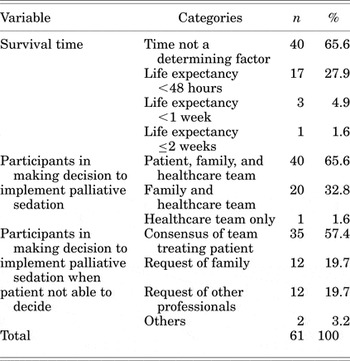
According to data for 40 participants (65.6%) reported in Table 1, the survival time of patients during the final phase of life was not a determining factor for an indication of palliative sedation. These professionals all felt that the patient, the family, and healthcare team should participate in the decision-making process. When a patient did not have the ability to make this decision, 35 professionals (57.3%) indicated that the decision to undertake palliative sedation should be reached by means of a consensus within the healthcare team.
Variables considered in decision-making process for the indication of palliative sedation (São Paulo, Brazil, 2011)

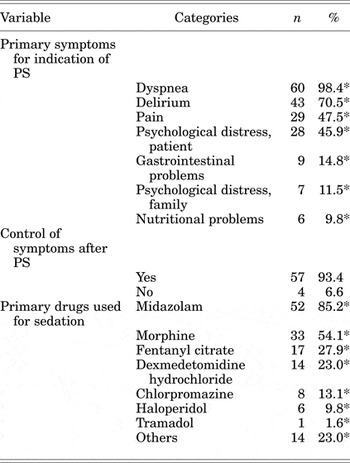
One can see from Table 2 that dyspnea, delirium, pain, and psychological suffering were among the refractory symptoms manifested by patients that indicated a need for palliative sedation (reported by 98.4, 70.5, 47.5, and 45.9% of subjects, respectively). Almost all professionals (57/93.4%) noted that these symptoms were controlled after palliative sedation was implemented.
Management of palliative sedation (São Paulo, Brazil, 2011)

* PS = palliative sedation.
Each relative frequency was calculated based on the total sample (61 subjects). The total does not correspond to 100% because each individual could cite more than one category of response.
The therapeutic maintenance strategies for a patient receiving palliative sedation included oxygen therapy (55/90.2%) and intravenous hydration (37/60.7%) (see Table 2). The majority of participants (54/88.5%) reported using palliative sedation continuously, and the primary medications mentioned were midazolam (52/85.2%) and morphine (33/54.1%). Such other medications as levomepromazine, phenobarbital, lorazepam, and propofol were also reported.
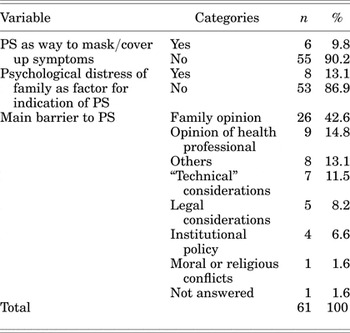
Professionals felt that there were ethical differences between palliative sedation and euthanasia and that palliative sedation was not a way to cover up or mask symptoms that affected patients and/or their families (55/90, 2%). It was also noted that the opinion of family members was the main barrier to instituting palliative sedation (26/42, 6%) see (Table 3).
Opinion of professionals about the palliative sedation process (São Paulo, Brazil, 2011)

There was no statistically significant difference between the variables of gender, profession, and training in palliative care and an indication for this measure, whether or not survival time was taken into account. Dyspnea was the only one of the four main signs and symptoms that had a statistically significant relationship with survival time (p = 0.042). There was also a statistically significant difference for the variables of training of professionals in palliative care and family involvement in decision making (p = 0.017).
DISCUSSION
The different aspects of the palliative sedation process addressed in this study raised a number of questions about the practice in Brazil, points that touched upon the aspects of professional training and the technical, legal, and bioethical issues involved in professional decision making.
The opinion of the physicians and nurses who participated in our study converged with the main national and international guidelines on the subject (Ministério da Saúde, 2001; Cherny & Radbruch, Reference Cherny and Radbruch2009; Nogueira & Sakata, Reference Nogueira and Sakata2012). This is reflected in the fact that the percentage of patients who were referred for palliative sedation (16.8%) was within the range cited in the literature (10–30%) (Ferreira, Reference Ferreira2006; Santos et al., Reference Santos, Valle and Barlocco2009). According to research conducted in 2006 in six European countries, these differences may be reflections on variations in the work environment, differences between institutional guidelines, training, experience, and perceptions of professionals involved in the process (Miccinesi et al., Reference Miccinesi, Rietjens and Deliens2006).
On the other hand, a report from the Hospice and Palliative Nurse Association (Campbell, Reference Campbell and Ritomy2011) indicated that the prevalence of palliative sedation in terminal patients is unknown. The difficulty of assessing this practice may be related to the fact that, despite its clear definition and the clearly defined criteria for its use, the practice of sedating in a palliative manner is still the cause of ethical dilemmas for many. This gives rise to a variety of actions, depending on the commitment of those involved in this process (Girond & Waterkemper, Reference Girond and Waterkemper2006; Elsayem et al., Reference Elsayem, Curry and Boohene2009; Nogueira & Sakata, Reference Nogueira and Sakata2012). One Dutch study cited the importance of palliative sedation as proposed by specialists on a palliative care team, according to the framework of the guidelines promulgated by the European Association for Palliative Care (Maltoni et al., Reference Maltoni, Scarpi and Nanni2013).
An important finding of our study is that all professional respondents believed that there are profound ethical differences between palliative sedation and euthanasia. With the integration of palliative sedation into the palliative care setting, it can be said that the practice vies with orthotanasia (death at the right time) within the process of humanization of death, with alleviation of symptoms through the use of means adequate for treating a dying patient (Girond & Waterkemper, Reference Girond and Waterkemper2006; Moyano et al., Reference Moyano, Zambrano and Ceballos2008; Cherny & Radbruch, Reference Cherny and Radbruch2009; Nogueira & Sakata, Reference Nogueira and Sakata2012).
Another convergent aspect is what is referred to as the relationship between survival time and an indication for palliative sedation. Survival time was not a determining factor in implementation of palliative sedation for most of the physicians and nurses in our study (65%). The available literature has shown that there is no significant difference in overall survival between patients who needed to be sedated and those who did not with respect to survival time after onset of sedation (ranging from hours to a few days) (Moyano et al., Reference Moyano, Zambrano and Ceballos2008; Blondeau et al., Reference Blondeau, Dumont and Roy2009; Elsayem et al., Reference Elsayem, Curry and Boohene2009). This was evidenced in a Spanish study where patient survival with palliative sedation was 3 days (Calvo-Espinos et al., Reference Calvo-Espinos, Ruiz de Gaona and Gonzalez2014). Another Spanish study reported a mean survival time of 1.2 days for patients sedated in a palliative manner (Nabal et al., Reference Nabal, Palomar and Juvero2014). A literature review study published in 2013 also confirmed that palliative sedation had no impact on patient survival (Maltoni et al., Reference Maltoni, Scarpi and Nanni2013).
With regard to the main symptoms that lead professionals to indicate palliative sedation, studies have described delirium, dyspnea, and pain as the most frequent presented by patients as indicators for palliative sedation (Elsayem et al., Reference Elsayem, Curry and Boohene2009; Calvo-Espinos et al., Reference Calvo-Espinos, Ruiz de Gaona and Gonzalez2014; Dumont et al., Reference Dumont, Blondeau and Turcotte2014; Koper et al., Reference Koper, van der Heide and Janssens2014). A similar result was obtained in our study. We also found that psychological suffering of the patient was sometimes considered an indication. It is noteworthy that dyspnea was the only sign that reached statistical significance when related to length of survival and indication for palliative sedation (p = 0.042).
Some studies in the literature provide important discussions about considering existential suffering as an indication for palliative sedation. All participants in a study conducted by Blondeau et al. (Reference Blondeau, Dumont and Roy2009) agreed that such refractory physical symptoms as pain and physical suffering should be considered as an indication for sedation. When that suffering was emotional or existential, some interviewees expressed discomfort in applying sedation, while others indicated that existential suffering was not a sufficient indication. Corroborating these data, a comparative study performed among physicians in Switzerland and Canada (Dumont et al., Reference Dumont, Blondeau and Turcotte2014) found that all the professionals had similar attitudes about indications for palliative sedation in the case of existential suffering. Research conducted in the Netherlands (van Deijck et al., Reference van Deijck, Krijnsen and Hasselaar2010) found that—aside from physical symptoms—patient anxiety, weariness, loss of dignity, and existential angst were frequently cited as refractory symptoms whose presence predisposed an indication of sedation.
The literature also indicates that the patient would be the best person to define when the suffering caused by uncontrollable symptoms was intolerable, justifying a request for sedation, and that this decision should be made in conjunction with the patient, family, and healthcare team (Silva, Reference Silva2008; Morita et al., Reference Morita, Akechi and Sugawara2002). This opinion was also observed among our participants. A significant number of our subjects (35/57.4%) declared that a consensus among the healthcare team should be achieved when the patient was not able to make the decision. Boceta Osuna et al. (Reference Boceta Osuna, Nabal Vicuña and Martínez Peñalver2013) found that palliative sedation was proposed by the team that treated the patient in 66.6% of cases. Noninclusion of family members in this context contradicts the opinion expressed above, as well as the national and international guidelines on the subject.
Our study found that resistance to the institution of palliative sedation from family members was mainly caused by provision of insufficient information, fear that sedation would shorten life, and a belief in the existence of other forms of symptom relief. Maltoni et al. (Reference Maltoni, Pittureri and Scarpi2009) found that family members would react more positively if they felt welcome to express their needs and were included in the decision-making process. It is important to emphasize that a convergence of opinion with respect to care for a patient in the final stages of life among all involved in the process was essential in driving the outcome, as this enabled communication and decision making and made patients and family members more comfortable with the experience. It also provided a favorable environment in which all questions, concerns, and perceptions could be expressed, understood, and addressed (Miccinesi et al., Reference Miccinesi, Rietjens and Deliens2006; Campbell, Reference Campbell and Ritomy2011; Morita et al., Reference Morita, Akechi and Sugawara2002).
Other data that corroborated international guidelines were related to the medications employed to provide palliative sedation (Maltoni et al., Reference Maltoni, Scarpi and Nanni2013). Most of the pharmaceuticals cited by participants in our study (e.g., midazolam, morphine, and levomepromazine) were referenced in several other studies and mentioned in the guidelines of the Brazilian National Cancer Institute (Ministério da Saúde, 2001).
According to the EAPC (Cherny & Radbruch, Reference Cherny and Radbruch2009), the indication for and maintenance of intravenous hydration and enteral nutrition should be independent of whether palliative sedation is administered or not. In our study, oxygen therapy and intravenous hydration were the therapeutic measures most frequently cited. A similar result was observed in a study conducted in Portugal (Gonçalves et al., Reference Gonçalves, Cordero and Almeida2012). The decision to maintain or withdraw therapeutic measures is a very individualized one, and the opinions of the patient and family members should always be considered when evaluating the possible benefits or harm (Ministério da Saúde, 2001).
Our study found that there is a high percentage of professionals (60.6%) without any specific training in palliative care. These data corroborated the claim that much has to be done regarding education, research, structure, organization, assistance, and training of the human actors in the area of palliative care. This gap in the education of medical professionals often requires that they develop the skills necessary for care and management of patients at the end of life on the fly, within their own practice (Camargo & Kurashima, Reference Camargo and Kurashima2007). It is noteworthy that the training of professionals in palliative care in our study was associated in a statistically significant manner (p = 0.017) with the participation of family members or the healthcare team when the patient was not able to take part in the decision-making process.
SIGNIFICANCE OF RESULTS
Our findings about palliative sedation should motivate professionals to more deeply engage in the debate about the use of and issues surrounding this process. The complexity of the actions that converge around the different conceptions of what is understood to be palliative sedation could lead physicians and nurses to conduct the process of palliative sedation in different ways. We should emphasize that our sample was limited to 61 professional participants, which may reflect the difficulty involved in conducting research on palliative sedation in Brazil. The beliefs and practices of the professional participants in our study about palliative sedation generally agree with those encountered in the literature. Inclusion of critical thinking, technical knowledge, personal and professional experience, and a multidimensional assessment of patients during the final stages of life is necessary for safe and effective implementation of palliative sedation, thus ensuring fulfillment of its prime objective, which is to minimize suffering at the end of life.