Introduction
Rapid delivery of appropriate emergency medical care is critical for the optimal management of injured subjects. Law enforcement personnel are frequently the first responders on-scene, arriving before Emergency Medical Services (EMS) 70% of the time. Reference Hawkins, Shapiro and Sever1 Moreover, EMS personnel are often staged off-scene until scene safety can be guaranteed, resulting in delays in patient contact and care. Reference Gratton, Garza, Salomone, McElroy and Shearer2,Reference Kirkwood and Tietsort3 On average, staging results in an additional 4.5-minute delay prior to initiation of EMS care. Reference Gratton, Garza, Salomone, McElroy and Shearer2
Although uncommon, law enforcement officers (LEOs) may be required to use force while performing their duties. Reference Hall, Kader, McHale, Stewart, Fick and Vilke4 This use of force is a continuum ranging from simple police presence to less-lethal methods (blunt, chemical, and conducted energy devices), ultimately escalating to deadly force, with the potential for life-threatening injuries. 5–Reference Bozeman, Stopyra and Klinger7 Although deliberate deadly force may involve unusual circumstances, including the use of vehicles to stop threats, the most common deadly force situation encountered involves the use of firearms.
There is currently no universal requirement for LEOs to render aid to injured individuals, even if wounded by law enforcement. In 2016, the Police Executive Research Forum identified promptly rendering first aid as one of 30 guiding principles for police use of force. 8 Prior literature has demonstrated that LEOs can perform life-saving medical interventions, including the use of automated external defibrillators, naloxone, and hemorrhage control measures. Reference Gratton, Garza, Salomone, McElroy and Shearer2,Reference Callaway, Robertson and Sztajnkrycer9–Reference Stiles, Cook and Sztajnkrycer12 The purpose of the current study was to describe the demographics of medical care rendered by LEOs immediately after an officer-involved shooting (OIS) incident, including the time to render such care.
Methods
Study Design and Setting
Video footage was analyzed of US law enforcement OIS occurring from February 15, 2013 through December 31, 2020 from content publicly available on the “PoliceActivity” YouTube (YouTube; San Bruno, California USA) channel. 13 In order to be included in the study, the video both needed to contain an OIS and needed the ability to determine a continuous timeline. If more than one video of the same incident was available, the video containing the most comprehensive continuous timeline after the OIS was selected for final study inclusion. Videos were excluded from the study if the following circumstances existed: nonoperative video link, no individual injured in the OIS, non-continuous time frame, or duplicated event.
A de novo data collection instrument was developed in Microsoft Excel (Microsoft Corporation; Redmond, Washington USA). Data points included date of incident, type of recording, and LEO duty assignment. Additional information documented included nature of call, mechanism of injury, time-of-injury (TOI), whether the individual was visibly moving immediately following injury (reflecting obvious signs of life), number of LEOs visible on-scene at TOI, and medical care provided by LEOs.
Earliest identifiable EMS presence on-scene included either arrival of a visible EMS unit at the scene or arrival of EMS personnel at the patient’s side. Law enforcement medical care not included in video footage, injury location(s), transport to hospital, and individual outcomes were recorded, when available, by using linked PoliceActivity incident summaries and media reports identified by searching the open access search engine Google Chrome (Google; Mountain View, California USA). At least two media sources were utilized to confirm outcome.
Eight reviewers (SM, AK, CB, SB, AK, AL, SM, and JW) independently viewed and coded 30 videos. The ninth reviewer (MS) independently viewed and coded 112 videos. After each video was independently coded, results were reviewed by SM, AK, and MS to identify any discrepancies until one final data set was attained.
The study was reviewed by the Mayo Clinic (Rochester, Minnesota USA) Institutional Review Board (16-009898) and deemed exempt.
Data Analysis
Coded results were summarized as frequency counts and percentages. Analyses were performed using descriptive statistics and Fisher’s exact tests. Pearson Correlation Coefficients were calculated to determine association between care rendered by LEOs as time progressed. P values less than .05 were considered significant.
Results
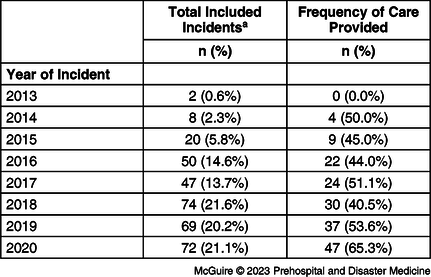
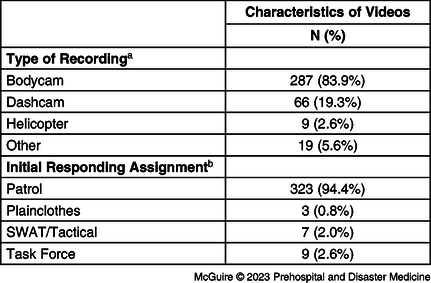
Ten (10) of the original 352 videos were excluded from analysis due to deviation from study protocol (eg, nonoperative video link, no subject injured in shooting, non-continuous time frame, or duplicated event). A total of 342 videos were included in the final analysis, representing incidents in 39 states (Table 1). Video type and initial duty assignment of officers responding to the incident are provided in Table 2.
Frequency of Care Provided by Law Enforcement Based Upon Officer-Involved Shooting Incidents Included in Final Study (n = 342)

a R = 0.8101.
Recording Type and Initial Responding Assignment Included in Analysis (n = 342)

a Videos could include compilation of more than one type of recording.
b This represents the duty assignment of responding officers, not the number of officers responding to the incident.
Characteristics of Wounding and LEO Care
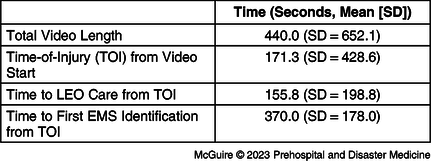
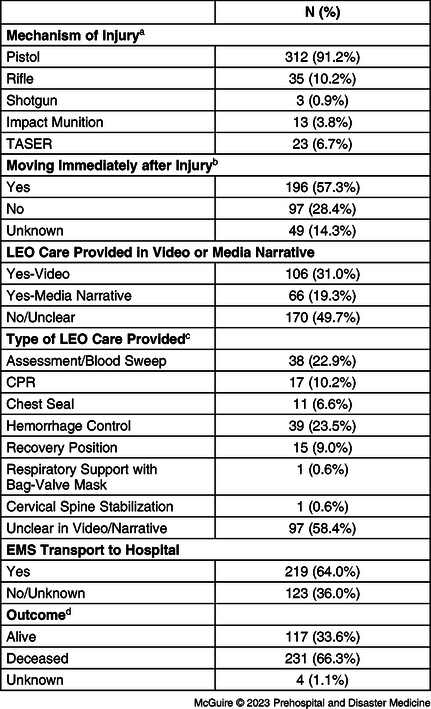
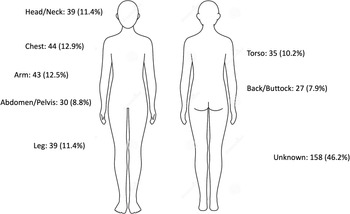
Time analyses are provided in Table 3. On average, 2.8 (SD = 1.9) officers (range 1-15 officers) were on-scene at TOI. The number of LEOs on-scene at TOI could not be determined in 26 of the videos. Mechanism of injury is listed in Table 4. Anatomic location of injuries is provided in Figure 1.
Time Points for Key Events Based Upon Video Start Time

Abbreviations: TOI, time-of-injury; LEO, law enforcement officer; EMS, Emergency Medical Services.
Characteristics of Wounding and LEO Care (n = 342)

Abbreviations: LEO, law enforcement officer; CPR, cardiopulmonary resuscitation; EMS, Emergency Medical Services.
a Individual subjects may be injured by more than one type of mechanism, or mechanism of injury may be unclear on video.
b Two-hundred and ninety-three (85.7%) of the videos continued past the time-of-injury.
c Percentages refer to the 166 individuals who received LEO care. LEOs could provide more than one type of care to a single individual.
d Videos could show more than one subject injured.
Location of Subject Injuries from Entire Cohort (n = 342).

Two-hundred and ninety-three (293; 85.7%) videos continued past the TOI; in 66.9% of these cases, subjects were noted to be moving after injury. Law enforcement rendered care to subjects in 172 (50.3%) of the incidents, as evidenced either in the videos (n = 106) or media narratives (n = 66). The average elapsed time from TOI to LEO providing medical care was 155.8 (SD = 198.8) seconds (Table 3). Over time, LEOs rendered care more frequently (R = 0.8101; Table 1). The nature of the care rendered is provided in Table 4.
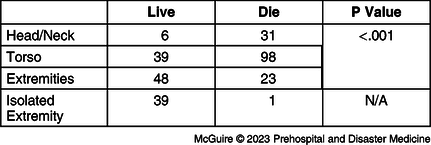
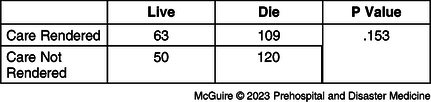
Emergency Medical Services were first identifiable on-scene on average 370.0 (SD = 178.0) seconds after TOI, representing an average 214.2-second delay in care compared to the average time LEOs rendered care (Table 3). The majority of subjects (66.3%) succumbed to their injuries. Subjects with head or truncal trauma were more likely to succumb to their injuries than those injured in an extremity (P <.001; Table 5). Isolated extremity trauma had a mortality of 2.5%, the single death occurring due to a single gunshot wound to the thigh. No significant difference in mortality outcome was noted based on whether medical aid was rendered by LEOs (Table 6; P = .156).
Patient Outcome Based Upon Location of Injury

Note: Individual patients may have sustained more than one injury, including simultaneous injury to head/neck or torso and extremity injury.
Patient Outcome Based Upon On-Scene Care Rendered by Law Enforcement

Discussion
The current study attempted to describe care provided on-scene by law enforcement in the immediate aftermath of OIS, and the time to initiate such care. Given that the injuries in this study involved law enforcement use of force, by definition, officers were on-scene at TOI 100% of the time. Medical care was provided by LEOs to injured individuals in just over one-half of all incidents (50.3%). The number of individuals sustaining obviously fatal wounds during the initial LEO assessment is, however, unclear. Although 97 individuals were not noted to be moving immediately after the OIS, cardiopulmonary resuscitation (CPR) was performed on 17 (Table 4). Some decision making regarding initiation and delivery of medical care may have been based upon the assessment that non-moving individuals were deceased.
Care rendered by LEOs during these incidents increased over the course of the study. Although this may simply reflect annual variability, this may alternately reflect a changing response pattern driven by increasing awareness by police leaders of the importance of rendering care, 8,Reference Chang, Williams, Sangii, Britt and Rogers14–Reference Kaufman, Karp and Delgado16 as well as potential changes in public expectations after several high-profile OIS occurring during the study period.
Care was initiated, on average, 156 seconds after TOI (Table 3). Although this delay may appear lengthy, there are several potential operational reasons for this delay, including the presence of a single officer and multiple subjects, weapons located near the subject that prevented approaching, uncontrolled scenes, and the officer being injured during the incident. It took slightly more than six minutes on average for EMS to arrive on-scene to provide definitive care (Table 3). A prior study noted a similar 4.5-minute delay in EMS access to potentially dangerous scenes. Reference Gratton, Garza, Salomone, McElroy and Shearer2 In the current study, LEOs were able to begin rendering care on average three minutes and 34 seconds before EMS arrival. It must be noted that the time to render care and the nature of the care rendered are not necessarily the same. For maximum impact, appropriate care must be rendered at the appropriate time.
Although extremity injuries were noted in only one-quarter of subjects (Figure 1), the most common care provided by law enforcement personnel was extremity hemorrhage control. This may reflect the fact that the minimum medical training requirement for 80.2% of US law enforcement agencies is American Red Cross Basic First Aid/CPR or equivalent, Reference Landry, Aberle, Dennis and Sztajnkrycer17 prioritization of massive hemorrhage control in Tactical Emergency Casualty Care (TECC), 18 or exposure to civilian Stop the Bleed programs. Reference Schroll, Smith and Martin19–Reference Jacobs, Wade and McSwain21
The importance of early intervention has been enshrined in concepts like the “golden hour” and the “platinum ten minutes.” Reference Forrester, August, Cai, Kushner and Wren22–Reference Eastridge, Mabry and Seguin25 Despite LEOs rendering aid to injured individuals on average 214.2 seconds prior to EMS arrival, no significant mortality outcome differences were noted between initial LEO or EMS care (Table 6). This most likely reflects the severity of the underlying injuries (Table 5), Reference Schellenberg, Inaba and Cho6 as suggested by the fact that 33.1% of patients were not moving immediately after the OIS, that 10.2% received CPR suggesting traumatic cardiac arrest prior to EMS arrival, and that the overall mortality was 66.3% (Table 4). Numerous studies have suggested an improved survival outcome in patients with penetrating truncal trauma transported to trauma centers via law enforcement vehicle rather than by EMS. Reference Band, Salhi, Holena, Powell, Branas and Carr26–Reference Jacoby, Reeping and Branas29 This has been attributed both to lack of delay in law enforcement transport from point-of-injury and to performance of non-value added procedures by EMS. Reference Seamon, Fisher and Gaughan30,Reference Ruelas, Tschautscher, Lohse and Sztajnkrycer31 The fact that law enforcement rendered care earlier than EMS and yet produced no survival benefit should not be construed as suggesting that law enforcement should not be rendering aid on-scene. Only one patient succumbed to isolated extremity trauma (Table 5), and hemorrhage control was the most common medical intervention provided by LEOs (Table 4). Rather, the current data may suggest that targeted law enforcement interventions coupled with expedited law enforcement transport for selected patients, as opposed to remaining on-scene pending EMS arrival, may be required for optimal outcome. The specific nature of both these life-saving interventions and patient cohort must still be clarified. Until that time, using TECC guidelines is appropriate. 18
The use of CPR in traumatic cardiac arrest is controversial. There are data to suggest that closed chest compressions in individuals with cardiac arrest secondary to hemorrhagic shock are not helpful and may in fact be harmful. Reference Smith, Rickard and Wise32–Reference Luna, Pavlin, Kirkman, Copass and Rice35 Under such circumstances, law enforcement may be better served focusing on other potentially more value-added interventions as described in TECC guidelines (massive hemorrhage control with tourniquets or hemostatic agents, airway management, and chest seal placement) prior to initiating CPR. 18 However, during OIS events, the decision to not perform CPR may both be difficult for the officers, who may be used to initiating CPR in out-of-hospital medical cardiac arrest, Reference Hawkins, Shapiro and Sever1,Reference Alonso-Serra, Delbridge, Auble, Mosesso and Davis11,Reference Klassen, Core, Lohse and Sztajnkrycer36 and may also have negative perceptions by the community.
Limitations
There are several limitations to the study. Videos were identified through a public domain entertainment YouTube channel, and therefore are neither complete nor comprehensive of all OIS incidents during the time-period. There are undoubtedly videos that were not posted to the data site and therefore not included in the study. The number of body-worn cameras and other recordings for incidents occurring during the study period is unknown. The Bureau of Justice Statistics (Washington, DC USA) suspended its arrest-related deaths data collection in 2014, and in 2015, published preliminary findings in which it extrapolated an estimated 1,216 arrest-related homicide deaths from June 1, 2015 through March 31, 2016. Reference Banks, Ruddle, Kennedy and Planty37 The current study included all law enforcement-related shootings, rather than being limited to fatal incidents. As a consequence, the percentage the cohort represents amongst all law enforcement incidents during the study time period was unable to be determined. Based upon extrapolated data from 2015-2016, it was anticipated that the inclusion rate is likely quite low. As the data source used in the study is essentially formed by a convenience sampling, the impact of sampling error cannot be determined. These results therefore may not be representative of care provided at the majority of OIS events in which law enforcement renders medical care. However, the fact that the final cohort included videos from 39 states would suggest some degree of generalizability.
Included videos contained body-worn cameras, dashcams, and/or helicopter footage, all of which have limitations in terms of visual clarity and distance distortion, sound, and motion artifacts given the dynamic, rapidly evolving nature of these incidents. Specific elements included in the data collection instrument were not always visible. While specific law enforcement interventions were identified, the appropriateness and correct performance of these interventions were not quantified in this study. Moreover, as a public domain YouTube channel, the publicly released videos were frequently shortened to focus upon the actual shooting incident rather than subsequent medical care. The lack of these data points may further limit definitive conclusions regarding value-added law enforcement medical interventions.
No information is available regarding specific EMS interventions performed on these patients, nor on any changes in patient condition as a consequence of these interventions. As such, law enforcement and EMS interventions are unable to be compared, and specific EMS interventions were unable to be determined beyond those provided by law enforcement that may have benefited this patient cohort. It was also unable to be specifically determined which law enforcement interventions were beneficial and which required subsequent intervention by EMS, as vital sign, laboratory, and outcome data (other than mortality) are lacking. The association of low mortality from isolated extremity hemorrhage with high frequency of extremity hemorrhage control interventions suggests a benefit, but definitive causality is lacking.
The study was limited to US law enforcement. As such, global generalizability is lacking. Finally, despite precise instructions, initial abstraction review, and final dataset review for discrepancies, the utilization of nine individual reviewers may have contributed to fluctuations in data interpretation and recording.
Conclusion
Law enforcement officers rendered medical care in just over one-half of all incidents, with data suggesting a likely trend towards LEOs rendering more care over time. Although no significant mortality difference was noted between initial LEO versus EMS care in the current study, this finding must be interpreted cautiously given the nature and limitations of the study design. Specific interventions, such as extremity hemorrhage control, may have impacted select patients. Improvements in LEO care may not only improve long-term outcomes for those surviving their initial injuries, but also result in a reduction of possibly preventable deaths. Future studies are needed to determine optimal LEO care for these patients, including defining the role for law enforcement transportation, as well as LEO medical training and equipment needs.
Conflicts of interest/funding
The authors declare no conflicts of interest. No funding was received for this work.
Author Contributions
MDS conceived the study concept. All authors collected the data. SSM and MDS analyzed the data. SSM wrote the first draft, and all authors read and approved the final manuscript.