Indonesia is a country prone to many natural hazards and subsequent disasters. One of the biggest disasters occurred on September 28, 2018: an earthquake of 7.9 magnitude followed by tsunami and liquefaction in Central Sulawesi Province (GLIDE number: EQ-2018-000156-IDN). This disaster mainly attacked 3 districts of Central Sulawesi: Palu, Sigi, and Donggala. Central Sulawesi is a province of Indonesia that is located on the northern end of Sulawesi Island. The province consists of 12 districts and 1 city (Palu) with an area of 61,841 km 2 with population of 2.96 million. 1 A total of 4547 people were killed or lost, 172,999 people were displaced, and 185 health facilities were damaged. There was a need of 1834 temporary housing for 84,584 internally displaced people (IDPs). 1 The affected people needed health support, but the disaster also affected the health system.
Palu City was the worst disaster-affected district, with a large number of severely damaged houses, including health centers and IDPs, because many people were living close to coastal areas. A huge number of deaths also were reported in Palu City partly because of attending a festival at Palu Bay. The District of Palu has a population of 385,796 and a life expectancy 70.3 y. The disaster caused 2132 deaths and 531 were lost. The disaster also damaged or destroyed 42,864 houses, 14 hospitals, and 12 primary health centers (PHCs). 1
The worst condition due to liquefaction occurred in Sigi District and caused a huge number of deaths, IDPs, and houses with serious damage. These conditions shut down the provincial offices of Palu and Sigi temporarily. The District of Sigi has 237,011 people with a life expectancy 69.1 y. Damage from the disaster included 434 deaths and 116 people lost, 30,538 houses damaged or lost, and 1 hospital and 14 PHCs damaged.
The population of the District of Donggala is 301,591, with a life expectancy 66.4 y. There, 249 people died, and 54 were lost due to the disaster. Other effects are 21,452 houses damaged or lost and 2 hospitals and 18 PHCs damaged. 1 Before the disaster, people in all 3 districts could access health care easily using motorcycles, cars, or boats.
Health service is the right of all people in Indonesia. 2 In a disaster setting, all affected people have a right to health services as a basic need. Government and local government are responsible for disaster management, including providing health care. 3 The Sendai Framework for Disaster Risk Reduction has a global target “(d) Substantially reduce disaster damage to critical infrastructure and disruption of basic services, among them health and educational facilities, including through developing their resilience by 2030.” 4
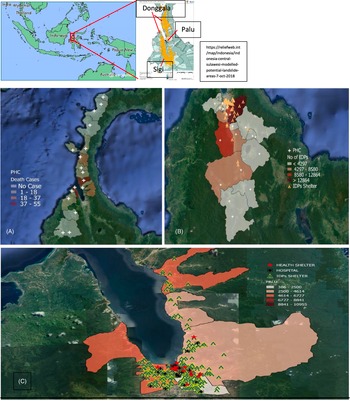
Health system disruption by disaster causes critical damage to the physical, mental, and social well-being of affected people. There were 44 of 50 PHCs destroyed and damaged in the Districts of Palu, Sigi, and Donggala 1 (Figure 1). PHCs are the closest point of care for the affected people. Therefore, we conducted this study to know health system disruption at the PHC level by semi-structured interviews of PHC workforces 1 y after the disaster in 3 severely affected districts of Central Sulawesi Province.
Three affected districts in Central Sulawesi (A: District of Donggala, B: District of Sigi, C: District of Palu). The color of affected area indicates the number of death cases (A), number of IDPs (B), and number of houses with serious damage (C) due to the disaster. Quantum GIS (QGIS) was used to map the situation with data compiled from the Provincial Health Office of Central Sulawesi and National Disaster Countermeasure Agency of Indonesia.

Conceptual Framework
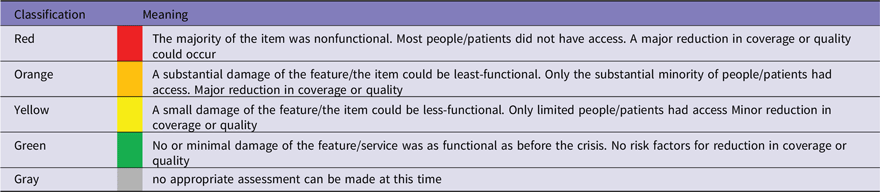
In this study, we applied the World Health Organization (WHO) conceptual framework to mapping of the public health situation postdisaster. Reference Rim5 Disaster-affected health system disruption in PHC included disruption on management, budget, human resources, drug supply, Early Warning Alert and Response System (EWARS) of epidemic prone disease (EPD), human resource migration, health facility damage, and health services access at the time of interview. These categories followed theory of health management Reference Muninjaya6 and Indonesia National Health System. 7 Health management included disruption of management, budget, human resources, human resources migration. Meanwhile, Indonesia National Health System included drug supply, EWARS, health facility, and health services access.
Disruption of “management” means health authorities was not in place and/or not able to take, transmit, and execute decisions. Disruption of “budget” means financial resources for health services were reduced, and PHCs were not able to pay the cost of health services (drugs and fees). Disruption of “human resources” means disruption of health providers to serve people in the health facility.
Disruption of “drug supply” was disruption of the medical supply chain. Disruption of “EWARS of EPD” means there was a problem on health system’s epidemic surveillance, alert, and response capability. “Human resource migration” means displacement/migration of human resources for health service away from the affected population. “Health facility damage” was measured as structural and functional damage. Disruption of “health services access” was caused by the disruption of surrounding roads by tsunami and/or liquefaction of the land.
The color of health system disruption was decided by the respondent based on criteria informed by the interviewer. This was classified into red, orange, yellow, green, and grey, with criteria as follows in Table 1.
Classification of health system disruption

Methods
Study Location
This study was a qualitative study using descriptive and projective analysis. The study was conducted in the Districts of Palu, Sigi, and Donggala of Central Sulawesi Province in March 2019. This research was based on EWARS in Emergency and Rapid Risk Assessment on Epidemic Prone Diseases in 3 affected districts of Central Sulawesi, conducted by the Indonesia Epidemiological Association (PAEI) in collaboration with WHO Indonesia. It was approved by local government with WHO registration number 2019/878088-0. The ethical review has been obtained by the School of Medicine, Universitas Islam Sumatera Utara, Indonesia, with referral number N0.047/EC/KEPK.UISU/I/2020.
Participants
Participants of this study were informants from 36 PHCs of 3 districts, which consisted of 13 persons in Palu, 11 persons in Sigi, and 12 persons in Donggala. The informants were persons in charge for disaster in each PHC. They were surveillance officers or chiefs of emergency medical teams of disasters in each PHC. Participants determined the current condition of the health system in primary health care, particularly on EPD, postdisaster by means of self-assessment. The participants in this study were surveillance officers who were in charge before and after the disaster. Surveillance officers who were heavily affected by the disaster have been delayed in completing the instruments.
Data Collection
Data collection was through a semi-structured interview based on the Public Health Situation Analysis by the WHO. Reference Rim5 The interview was conducted during March 2019 (a half year after the disaster) and was person to person (interviewer and respondent). The interviewers had been trained before data collection.
District of health has listed the surveillance officer name by PHC and categorized the surveillance office into affected and nonaffected PHC. The interviewer set up the schedule for interviews based on the phone number that was provided by district health officers. For PHCs located in affected and remotes area, the interviewer and surveillance officer conducted a meeting outside the PHC. When the interview was not completely finished or the head of the PHC needed to be consulted, the surveillance officer would arrange a second interview on another day. The interview was estimated to take 30-45 min.
Instrument
We used, as guidance for interview, criteria stated in the instrument, which consisted of informant criteria, subject to be asked, way of asking, coloring criteria, and probing. Please see the supplementary material. The informants may answer freely based on their knowledge and information. We collected the repsonses until the half year after the disaster as existing and the expectation from the time of interview up to 1 y as projected.
The questionnaire consisted of 4 parts. The first part focused on participant information, and second part consisted of primary health-care system status postdisaster (accessibility, demography, telecommunication, preparedness, and logistic stock). The third part was EWARS performance in timeliness and completeness postdisaster. The fourth part described the health crisis relative to health system disruption before, during, and postdisaster projection; humanitarian response; and health/disease risk. Each participant used color as a health system situation score to capture the condition of the PHC.
Data Analysis
We performed descriptive and qualitative analyses for recent disruption and 1 y upcoming projection for each topic of health system disruption. We used qualitative content analysis based on the information taken from the interview and discussion with the informants. We analyzed health disruption stated by the informants, made a reduction to take the key messages, and then made conclusions for each category of the disruption. The existing situation at 1 mo, 2 mo, and 3-6 mo after disaster and projection during 6-12 mo after the disaster were summarized for each PHC in 3 districts as colored tables.
Results
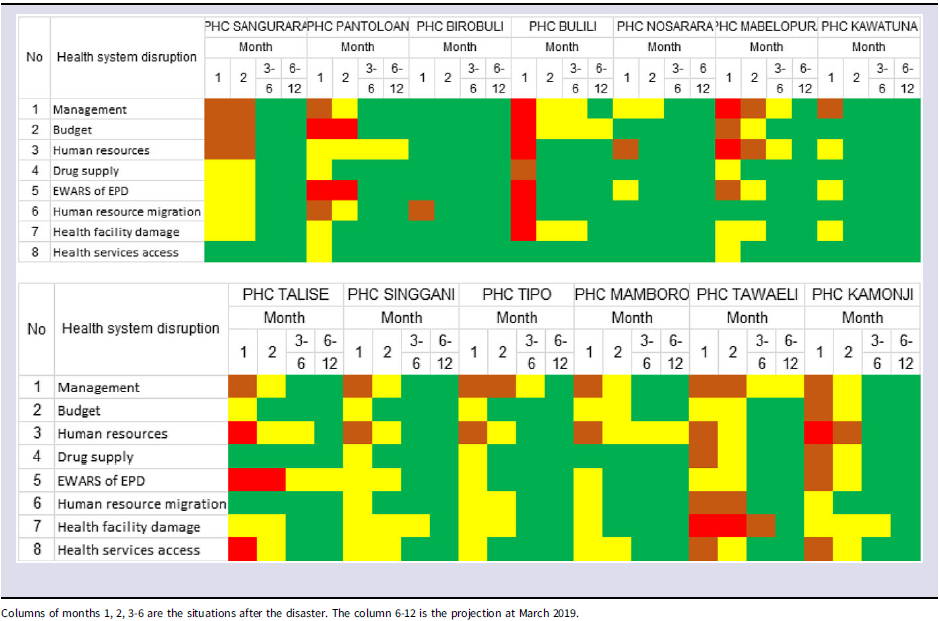
Of 13 PHCs, 10 were inundated by tsunami and 3 were damaged from the shake in the District of Palu. Three PHCs had direct damage from liquefaction and the surrounding access routes were damage by it. Generally, the health system disruptions occurring in the Palu District were to management, budget, human resources, EWARS of EPD, health facility damage, and health access. Health system disruption at the PHC level generally lasted for 2 mo and mostly recovered or was getting better after 3 mo. There were 6 PHCs that had more serious problem than others according to the severity of the damage. PHC Bulili was affected by liquefaction and faced severe disruptions to most of the categories but quickly recovered in the second month (Figure 1C; Table 2).
Health system disruption and projection at the PHC level in the City of Palu

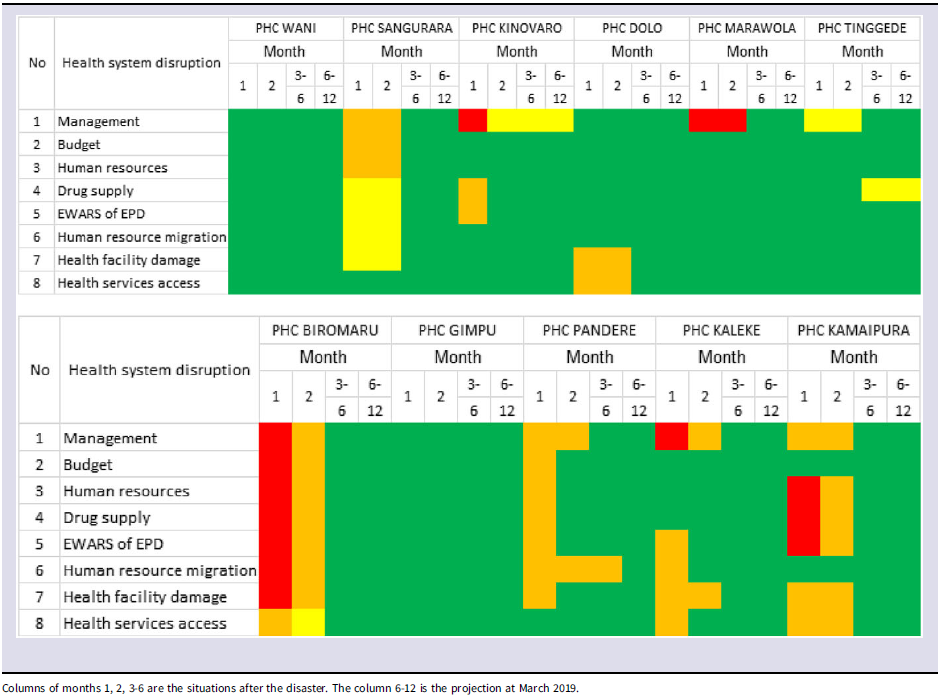
Sigi is an inland province, and it was affected on a large scale by liquefaction. Health system disruptions in the District of Sigi were to management, human resources, drug supply, and EWARS of EPD. Health system disruptions at the PHC level were generally recognized within 1 mo after the disaster and recovered mostly to green after 2 mo, except for PHC Bilomaru and PHC Kamaipura. These 2 facilities sustained severe damage in many categories because of the shake and liquefaction. Rehabilitation of the general buildings were managed under authority of the district government, but health facilities can be supported by district, provincial, and central governments. After 3 mo, most of the problems were solved in the Sigi District. There were 5 PHCs that had more serious problems than others, because of the direct or indirect damage from the disaster (Figure 1B; Table 3). The damages were related to functionality of the facility building, management, and access.
Health system disruption and 1-y projection at the PHC level in the District of Sigi

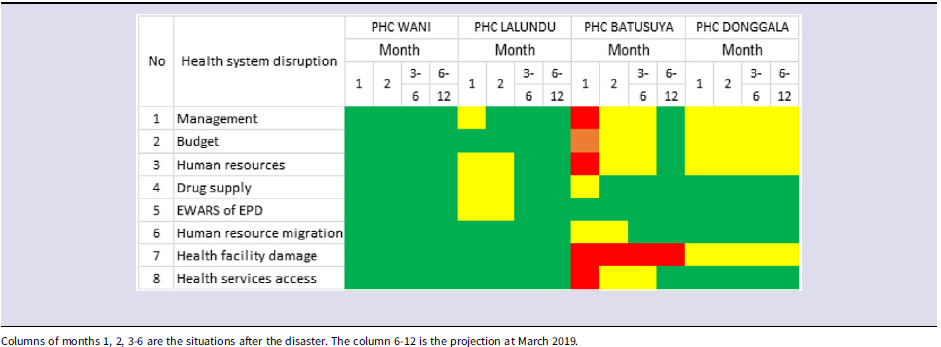
The epicenter of the earthquake was in Northern Donggala. This district was affected both by the shake and tsunami. We got answers from 4 of 15 PHCs in this district that were most affected by the disaster. Except PHC Lalandu, 3 PHCs were located close to the coastline. In the District of Donggala, the disruptions were much less than the other 2 districts, except for PHC Batsusuya that recieved structural (building) damage from the tsunami. The main items of health system disruption were health services access, management, human resources. In other PHCs, most of the items recovered to normal after 2 mo (Table 4). PHC Donggala was the PHC located closest to the beach and suffered for a longer time with disruption of management, budget, and human resource items because of the relatively greater need of assistance. This PHC was structurally safe, but due to lack of human resources, recovery from problems of management and health workers was quite longer than other PHCs. PHC Donggala did not have “human resource migration.” In summary, existing and projected health system disruption at the PHC level in the City of Palu were worse than those in the Districts of Sigi and Donggala due to the higher impact of disasters.
Health system disruption and 1-y projection at the PHC level in the District of Donggala

Disruption on Management
Disruption of management occurred in 12 of 13 PHCs in the District of Palu; 3 of which were red in color and 7 were orange in color. This meant that there was nonfunctional and least-functional management in the majority of PHCs in this district. In the District of Sigi, 8 of 11 PHCs had disruption of management, with 4 rating red in color and 3 orange in color. This indicated that the management disruption was similar in the District of Palu to the majority of other PHCs that had nonfunctional and least-functional management. Meanwhile, in the District of Donggala, 3 of 4 PHCs had disruption of management, 1 of which was red in color and none were orange in color. The disruption in this district was quite a bit lower than in the other 2 districts. Generally, the disruption at the PHC level in the 3 districts lasted for 2 mo and mostly recovered or was getting better after 3 mo.
Disruption on Budget
Of the 13 PHCs in the District of Palu, disruption to the budget occurred in 10 PHCs, 2 of which rated red in color and 3 orange in color. In the District of Sigi, disruption was seen in 3 of 11 PHCs, with 1 rating red in color and 2 orange in color. Similarly, disruption in the District of Sigi occurred in 2 of 4 PHCs with no PHC rating red color and only 1 PHC had orange color. This indicated that the disruption in the District of Palu was the most severe disruption. In general, the disruption lasted in 1 or 2 mo and recovered after 2 mo in these districts, except in District of Donggala for 6 mo.
Disruption on Human Resources
In terms of human resources, disruption occurred in 12 of 13 PHCs in the District of Palu, with 4 rating red in color and 6 orange in color. The disruption in this district was the most severe problem. In the District of Sigi, the disruption was less. Four of 11 PHCs had disruption of management, with 2 being red in color and 2 orange in color. However, in the District of Donggala, 3 of 4 PHCs had disruption of human resources, but in only 1 PHC was it red in color and none were orange in color. Generally, disruption at the PHC level in these districts lasted for 2 mo and mostly recovered or was getting better after 3 mo, except in the District of Donggala, which took 6 mo.
Disruption on Drug Supply
In PHCs of the Palu District, disruption of drug supply occurred in 8 of 13 PHCs, with none being red in color and 3 orange in color. In the District of Sigi, the disruption was seen in 4 of 11 PHCs, but these 4 demonstrated more serious problems, with 2 red in color and 2 orange in color. The disruption in the District of Donggala was less, with only 2 of 4 PHCs rating yellow color, and none rating in the red or orange categories. In general, disruption at the PHC level in three districts lasted for 2 mo and mostly recovered after 3 mo.
EWARS of EPD
The disruption of EWARS of EPD occurred in all 13 PHCs in the District of Palu, with 3 rating red in color and 3 yellow in color. This meant the disruption became a serious problem in the District of Palu. In the District of Sigi, 6 of 11 PHCs had disruption, with 2 rating red in color and 3 orange in color. Meanwhile, in the District of Donggala, the disruption was very minor, with 1 of 4 PHCs rating yellow in color. The disruption at the PHC level lasted for 2 mo and mostly recovered after 3 mo in all 3 districts.
Human Resource Migration
Migration of human resources after disaster occurred in 9 of 13 PHCs in the District of Palu, 1 of which rated red in color and 3 orange in color. This became the most severe problem compared with other districts. The problem occurred in 4 of 11 PHCs in the District of Sigi, 1 of which rated red in color and 2 orange in color. In the District of Donggala, the problem was only seen in 1 of 4 PHCs, with yellow in color. The problem lasted for 1-2 mo in all 3 districts and mostly recovered after 3 mo.
Health Facility Damage
Health facility damage occurred in 11 of 13 PHCs in the District of Palu, with 2 rating red in color and 2 in orange. Six of 13 PHCs in the District of Sigi had this problem, 1 of which rated red in color and 4 orange incolor. Meanwhile, the problem occurred in 1 of 4 PHCs in District of Donggala but in red color. Generally, the problems at the PHC level in these districts lasted for 2-3 mo and mostly recovered or was getting better after 6 mo, except in the District of Donggala, which took 12 mo.
Health Services Access
Access of health services disruption occurred in 8 of 13 PHCs District of Palu, 1 of which rated red in color and 2 orange in color. It was the worst situation compared with other 2 districts. In the District of Sigi, disruption was seen in 4 of 11 PHCS, rating orange in color. The disruption occurred in only 1 of 4 PHCs in the District of Donggala, but it rated red in color. The disruption at the PHC level lasted for 2 mo and mostly recovered after 3 mo in the Districts of Palu and Sigi, but the problem was remained until 6 mo.
Discussion
PHCs are the frontline of a health system and are a critically important part of health development in Indonesia. Disruption of the health system at the level of the PHC caused by disaster can cause major health problems, including spread of communicable disease, increasing death rate, and increasing uncontrolled noncommunicable disease (NCD), and problems of treatment for minor injury. It also causes problems for water, sanitation, and hygiene (WASH) and supply of food and drugs. Reference Jusuf8 More importantly, the assessment and surveillance of such health-related issues largely depend on the functionality of the PHCs. It is impossible to make a political and operational decision without the data of actual disruption of health-related issues assessed by PHCs. Thus, business continuity of PHCs is very important in disaster response. We conducted this research to identify the vulnerability of PHCs and limiting factors of speed of recovery to improve the preparedness to future disasters as a business continuity plan (BCP) of PHCs.
Problems of management, budget, and human resources should be prioritized to solve in the postdisaster period to ensure that health services can be accessed. Health access should be fixed at first priority, and services should be restored immediately after disaster until the status becomes normal, especially in the disaster period, while affected people need help. Management of health care after a disaster is part of the management cycle, including planning, organizing, actuating, and controlling. Reference Terry9
Disruption of budget allocation seemed to be a problem 1 mo after disaster in most PHCs. The budget provided by government needs to include preparation for disaster. As Indonesia has maps on risky areas of disaster, those areas that have potential for disaster should prepare a budget for risk reduction, preparedness, mitigation, and emergency response. Local government should also allocate the budget. 3 Unfortunately, not all local government allocates the budget. A study in Aceh, Indonesia, showed that no significant statistical relationship exists between the disaster budget and the level of disaster risks among districts or cities, while the total budget of the local governments has a significant positive correlation with the disaster budget. Reference Fahlevi, Indriani and Oktari10 So, the districts that have risk of disaster should allocate specific monies in their budgets to preparedness and rapid response for health matters at the PHC level.
Human resources is one important category for preparedness pre-, during, and postdisaster. Both health providers and the community should be involved in the planning before a disaster. Preparedness for disaster should be planned and trained well. In the Sub District of Pelabuhan Ratu, West Java, a study showed that the people in Pelabuhan Ratu were not prepared for the earthquake and tsunami with regard to knowledge, attitude, policy, and emergency plan, early warning system, and human resource mobilization. Reference Paramesti11 For the earthquake condition, health personnel together with the community have essential roles in dealing with disaster, from the initial stage following the earthquake (day 1-3), during the emergency period (day 3-30), until the rehabilitation and reconstruction phase (> 1 mo) Reference Widayatun and Fatoni12 Therefore, human resources migration is the issue to be handled wisely, although in many case, the employees are also affected by disaster. The Chief of the PHC should support its human resources, including their family, to avoid their migration. Predisaster BCP with a good discussion with employees and possible stakeholders could raise their awareness to the obligation and merit of staying and providing health services.
Problems with drug supply occurred only in the first month after disaster in all PHCs. Although the problem tends to be resolved in the second month, drug supply must be improved especially in the disaster-prone areas, such as Central Sulawesi. Drug supply is one aspect of the health system that should be provided by the Indonesian government. 7 Some types of drugs can be standardized and stocked in the district storage focusing on prevention of communicable disease and controlling NCDs, such as hypertension and diabetes mellitus (DM). A study in the United States after hurricane Katrina indicates that drug markets must be functional or restored quickly during and after a natural disaster. Reference Dunlap, Graves and Benoit13
EWARS of EPD might be disrupted due to damage of to health facilities and lack of human resources, Internet, and information systems. This access should be restored as soon as possible to detect EPD after a disaster. The restoration includes fixing the system and deploying human resources. This system consists of 23 infectious diseases that is reported weekly in an ordinary time. 14 After a disaster, however, daily surveillance of EPD should be conducted at least for 2 wk to detect outbreak earlier and to respond promptly.
If a PHC was structurally damaged, health service must be provided using another functional building as much as possible. In the disaster period, problems of access to the health facility could also worsen the patient’s disease. For example, patients with DM may develop renal failure that needs hemodialysis, which is difficult to achieve in the affected area. Because of aging of the society, this condition became a cornerstone for medical and logistical needs for chronic patient treatment in disasters. Reference Sever, Lameire and Van Biesen15 Providing access for health services to patients with NCDs is now becoming the main effort rather than to those with injuries. Reference Murakami, Sasaki and Pascapurnama16,Reference Suda, Murakami and Nakamura17
Collaborative intervention between PHCs, district health offices, cadres, and volunteers to take action together is a must in a disaster. To support this collaboration, innovative technology in information system and disaster management communication should be developed. Reference Meissner, Luckenbach and Risse18 Health promotion should be conducted during the emergency situation, rehabilitation, and mitigation. The promotion can be conducted through mass campaign or disseminating leaflet or posters. The promotion should be provided by school students, religion groups, health providers, or donor agencies. Reference Priyanto19 The Ministry of Health might develop efforts on disease prevention and environmental health, including medical services, and mental health resilience, during and after disaster. 20
Health services can be restored quicker if there is good preparation before disaster. After experiencing the 1995 Great Hanshin-Awaji Earthquake and Sarin gas release in a subway in Tokyo, tertiary hospitals were designated as disaster-base hospitals in Japan, and some of them established an emergent decontamination area and have available chemical-resistant suits and masks. Hospitals in Japan joined the nationwide Emergency Medical Information System (EMIS) so that they can be called upon at the time of a disaster. Reference Okumura, Suzuki and Fukuda21,Reference Egawa, Murakami, Sasaki, Santiago-Fandino, Sato and Iuchi22 Health workers have very important roles not only in the period of impact, during the emergency, but also in the phase of reconstruction. Health workers should act fast, although not promising the results, focus, and coordinate with the leaders. Reference Sinaga23 In the 2011 Great East Japan Earthquake (GEJE), health-care systems were highly vulnerable to the loss of advanced technological tools. Surveillance should be promptly initiated after a disaster by developing a surveillance system that is tailored to the local setting, establishing a support team network, and integrating the resources that remain, or will soon become, locally available. Reference Iwata, Oki and Ishiki24
To prevent the spread of disease or another health problem, the resilience of the health-care system, especially at the PHC level is necessary. Based on a study in the Taro District after the 2011 GEJE, there was no noticeable increase in severe injury, but there was manifestation of and deterioration in lifestyle-related diseases (eg, diabetes, hypertension, obesity). The only clinic in the town needed to move the evacuees to neighboring hospitals or safer evacuation centers because lifelines were not available at the first evacuation center. Health-care activities gradually returned to their predisaster levels, but it took a long time to fully recover because of the decrease in population and the reconstruction of the town required the reconstruction of the world’s largest sea wall. Reference Kuroda25
Ministry of Health, Provincial and District Health offices need to collaborate with National Disaster Countermeasure Agency (BNPB), local government, and Non-Governmental Organization (NGOs) to solve health system problem. In preparation, all stakeholders should follow guidelines to maintain health services during a disaster. Collaboration to re-establish health facility function soon after disaster can be made before a disaster. There are several limitations in this study. The evaluation of damage extent of each item was done in a subjective descriptive or qualitative manner. We did not measure the accessibility to the mental health service.
Conclusions
Health system disruptions occurring in the Central Sulawesi Province at the PHC level were disruptions in management, budget, human resources, EWARS of EPD, drug supply, human resource migration, health facility damage, and health service access according to direct and indirect damage. These disruptions occurred within 1-2 mo and were projected to become better after 3 mo in most PHCs. Existing and projection of health system disruption at the PHC level in the City of Palu were worse than those in the Districts of Sigi and Donggala due to higher impact of the disaster. Because disruption of PHC function harms the people’s access to health and the decision-making process of disaster recovery in local and central governments, business continuity plans for PHCs are necessary.
Supplementary material
To view supplementary material for this article, please visit https://doi.org/10.1017/dmp.2021.368
Acknowledgments
The authors thank the Director of Indonesia Epidemiological Association (PAEI), WHO Representative to Indonesia, Head of Central Sulawesi Provincial Health Office, Head of District Health Office of 3 Districts (Palu, Sigi, and Donggala), Head of Primary Health Centers in Palu, Sigi, Donggala, who were involved in the study, for supporting the successful study.