

Commentary in the last two decades has brought to light a major musical change at the turn of the thirteenth century: the fusion of the realms of polyphony and secular song, so far carefully separated both in medieval theory and in musical sources. Several corpora have been identified as the first sites of this hybridisation, often with the intent to shed light on the origins of fourteenth-century polyphonic song.Footnote 1 The chronological range of this change is clearly circumscribed by the sources of these repertories, which mostly date from between 1300 and 1320.Footnote 2 These first corpora give us information as well on the key players in the process of hybridisation. To a large extent, it is the genre of the motet which underpins the patterning of these new songs. On the other hand, it is the popularisant choreographic genres of the vernacular song, especially the rondeau, which provide most of the material and the sectional formal structures.
In the process of fusion, the more elevated registers of the chanson de trouvère are excluded: they remain confined within the boundaries of the monophonic tradition. From this perspective, it is generally acknowledged that hybridisation between polyphony and the higher registers of trouvère lyric poetry actually does not occur before Machaut's first polyphonic songs, in a phenomenon consequently understood as a reversal of registers: lyric poetry of the trouvères breaks out from its monophonic constraints by seeping into a polyphony that symmetrically drops the popularisant registers of the dance-like song with which it had so far exclusively been associated.Footnote 3
The traditional distinction between the lyric chanson of the trouvères and the genres involved in polyphony takes a variety of forms. First, it is grounded on cultural realities: before Machaut, there is a divergence between the traditional secular monody of the trouvères and the learned polyphonic practice of Parisian clerics. This opposition is evident in the sources, divided between provincial chansonniers and Parisian books of polyphony.Footnote 4 But this distinction should also be located within the traditional rhythmic categorisation of genres. The latter brings together measured genres, therefore connecting dance-like songs, subject to a strict metric-rhythmic structure due to their choreographic origins, with the polyphony of the motet, which constitutes the apogee of rhythmic modality developed in Parisian polyphony. From this perspective, the motet constitutes a special case for inserting material coming from rondeaux, rondets and caroles. In this traditional rhythmic categorisation, trouvère chanson, on the contrary, is to be found at the other extreme, with declamatory structures which are not governed by any precisely measured system.Footnote 5 It is for that matter remarkable that at the beginning of the fourteenth century, this fundamental rhythmic distinction was reformulated in both musical and theoretical sources. By 1300, Adam de la Halle's grands chants are still copied in a non-mensural notation, whilst his motets, polyphonic rondeaux and interpolated monophonic refrains clearly distinguish longa and brevis.Footnote 6 At the same time, Johannes de Grocheo still theorised an opposition between music composita or mensurata, comprising organum, motet and hocket, and music ‘non ita praecise mensuratam’, including trouvère song.Footnote 7 With his ‘not so precisely measured’ music, Grocheo invites endless debate on the rhythmic interpretation of the trouvère chanson. Nonetheless, it seems quite clear that the latter should be positioned at some remove from modal polyphony and the motet.Footnote 8
Finally, the divergence between motet and trouvère lyric poetry is further based on the apparent incompatibility of their respective poetic-musical forms. Governed by regular arrangements of rhymes and balanced relationship of lines, trouvère chansons rely on both a sonic and numerical symmetry, and largely depend on formal types created by large-scale repetition. This is just the opposite of the motet. Frequently pointed out by scholars as the site of eccentric versification and heterogeneous language, the motet was sometimes perceived as a baroque quirk emerging from Notre-Dame classical forms.Footnote 9 In addition to its erratic versification is its fundamental heteromelism: in a genre much more emphasised for its numeric-rhythmic structures than for its melodic construction, melodic repetition has never been deemed a relevant phraseological technique.Footnote 10 While these traits appear somewhat overemphasised in view of the expansive repertory,Footnote 11 the customary fabric of the motet certainly lays out a groundwork inimical to the development of large-scale repetition and repetitive formal types. In fact, only the collection of the eight rondeau-motets of the chansonnier fr. 12615 has so far been identified.Footnote 12 Consequently, when the respective forms of trouvère chansons and motet are compared with each other, it is often simply to stress their fundamental difference.Footnote 13
As a consequence of this multifaceted opposition, very few thirteenth-century exchanges between polyphony and the trouvère chanson have been identified. On the one hand, it is with the choreographic and refrain genres, rather than with the trouvère chanson, that the motet more normally makes exchanges. On the other hand, with the exception of the rondeau-motets, it is not hybridisation which would be at stake between song and motet, but a more modest phenomenon of borrowing. The integration of song material may affect some aspects of a motet, yet usually leaves the customary features of the latter unchallenged. These aspects can be concerned with the language register, the motet building its own discourse on the lexical, syntactic and narrative springs of the songs ‘de bonne vie’ and further rondets ‘type-cadres’.Footnote 14 Borrowings can also occur through the citation of musical and/or poetic fragments coming from dance-like and refrain genres.Footnote 15 On the other hand, exchanges with the specific registers of the trouvère lyric are habitually restricted to two aspects: the borrowing of the lower register of the pastourelle and more rarely of the courtly register, and a dozen motets whose motetus are located elsewhere as trouvère songs.Footnote 16 If it were not for these exchanges with song registers and trouvère melodies, polyphony and the lyric chanson of the trouvères seem to remain in a state of conflict, from the point of view of ethics, rhythm and language as much as form. And when the first specimens of hybridisation between trouvère chanson and polyphony finally arise in the course of the fourteenth century, it is the death knell of troubadour and trouvère practice and culture that seems to be tolling.Footnote 17
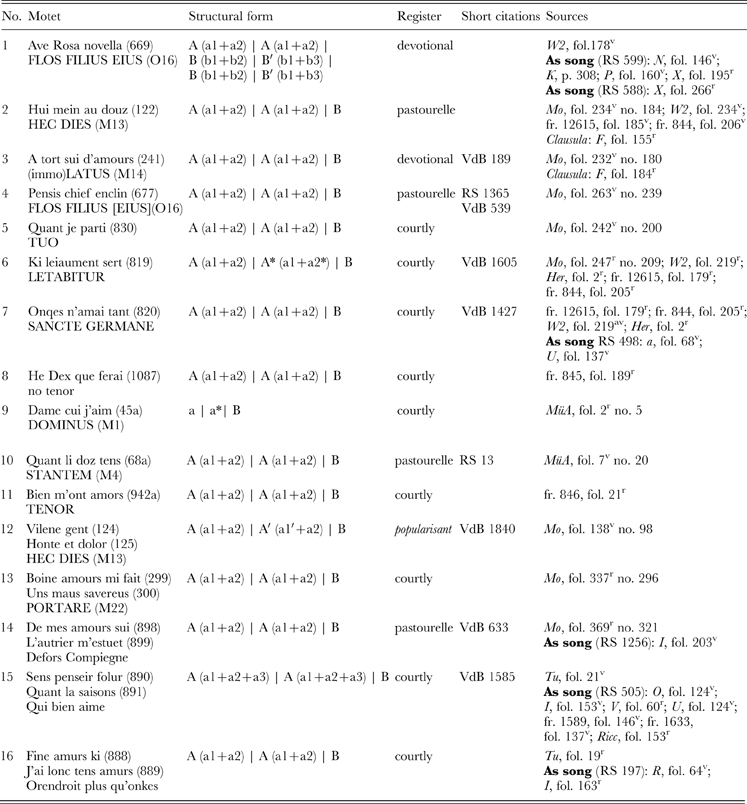
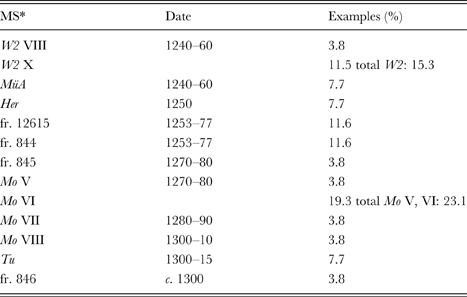
Amongst the investigations of hybridisation between polyphony and vernacular song, a significant corpus has been overlooked. It consists of sixteen thirteenth-century motets, the formal structures of which are rigorously modelled on the formal types of vernacular lyric chansons, and especially the one related to high registers, i.e. the AAB or pedes-cum-cauda form, a term used by Dante Alighieri in his treatise De vulgari eloquentia to designate the AAB form of vernacular song (see Table 1Footnote 18).Footnote 19 A few general features link these works together. They are French motets, with the exception of a single Latin piece. Eleven works are two-voice motets, only four are three-voice and one further motet is preserved without tenor. In fourteen cases, the AAB form is carried by the motetus. The twenty-six manuscript witnesses to these sixteen works preserved across nine sources provide a limited number of examples, but the fourteen from the Parisian books of polyphony – especially W2 and Mo – associate most of this corpus with the central Parisian repertory (see Table 2, where the Parisian sources are listed in italic).Footnote 20 Above all, this corpus constitutes a challenge to preconceived ideas of the relationships between motet and trouvère chanson. First, the connection between the two genres is not based on the customary criteria of register or shared material, but on the very criterion habitually justifying their opposition: the formal structure.Footnote 21 This corpus, moreover, indicates that the transfer of form between motet and lyric chanson comes with a transfer of registers. With eleven high-register motets, courtly or devotional, and five with lower register, these works have in effect nothing to do with dance-like songs, but much more with the genres of the chansons de trouvère, first and foremost the highest ones (see Table 1, column marked ‘register’). Several manuscripts for these motets further contribute to partly blurring the well-established dichotomy of sources in the thirteenth century. Out of the twenty-six examples, eight are preserved in provincial chansonniers rather than in books of polyphony.Footnote 22 Ultimately, the sources as a whole indicate that the first specimens of hybridisation between polyphony and trouvère chanson are likely to have appeared much earlier than generally admitted: twenty-one copies of these works are located in codices falling chronologically between codex W2 and the old corpus of Mo, i.e. between c. 1240 and c. 1280. Only five further copies are found in sources covering the period 1280–1320, i.e. between the new corpus of Mo and Tu (Table 2).Footnote 23
The sixteen AAB motets: sources, form, registers and material

Sources of the twenty-six witnesses of the sixteen AAB motets, and their assumed date
* Italics indicate Parisian sources.
In short, all the objections usually levelled at a connection between motet and chanson de trouvère in the thirteenth century may be systematically refuted by the features of these sixteen works. On this account, whilst the relatively modest dimensions of this corpus might not be likely to call into question the global teleology of the encounter between polyphony and chanson, study of this repertory constitutes an important backlighting to the well-understood success story of the reversal of registers and of hybridisation between polyphony and the lyric chanson in the course of the fourteenth century.
Structural form of the motets: the cogs of the pedes-cum-cauda mechanism
Several theoretical treatises are relevant to the sixteen motets of the corpus, since they broach the composition of poetic-musical forms of the secular lyric chanson.Footnote 24 It is with this theoretical background, as well as with the existence of a significant corpus of songs, that the forms of these motets can now be compared, in order to assess the impact of the formal structures of the trouvère lyric chanson, and to show that the elements of the repetition of the AA block are those of a formal type.
Amongst the various theoretical essays on vernacular poetry, Dante's unfinished treatise De vulgari eloquentia reveals the most about the AAB motet corpus.Footnote 25 Written just after 1300, it offers a comprehensive but retrospective survey of the high-style vernacular poetry of the thirteenth century. It thus includes poetry in oïl, supplying a few examples from Thibaut de Champagne's work. Furthermore, the comprehensive technical approach to versification offered by Dante proves especially useful and appropriate to the current investigation: relationships between the organisation of melody, rhymes, and line lengths are accurately detailed, and thought out according to the overall formal structure of the songs.
In Dante's treatise, musical form is seen as the primary principle that determines the formal structure of the poem. Thus it is with melodic segmentation that Dante is concerned in the chapters devoted to the forms of chanson, supplying descriptions that correspond in every respect to the melodic segmentation of the AAB motets. Dante first classifies the formal structures of the chanson according to the criterion of melodic repetition, distinguishing forms without a diesis (division), i.e. devoid of any repetitive scheme,Footnote 26 from those with a diesis. The latter proposes a division between two distinct sections, at least one being framed by repetition. Dante then advances three further subcategories, depending on the placement of the repeated section: before the diesis, we have the form pedes cum cauda; when after the diesis, Dante speaks of a form frons cum versibus. If both sections are repeated, he calls this form pedes cum versibus.Footnote 27 Dante therefore suggests the three formal types: AAB, ABB and AABB. Amongst those, the AAB form is by far the most widespread in the trouvère repertory;Footnote 28 this is also the nearly exclusive structure of the motet corpus, since only motet no. 1 opts for a pedes cum versibus form (See Table 1 above, column ‘form’).
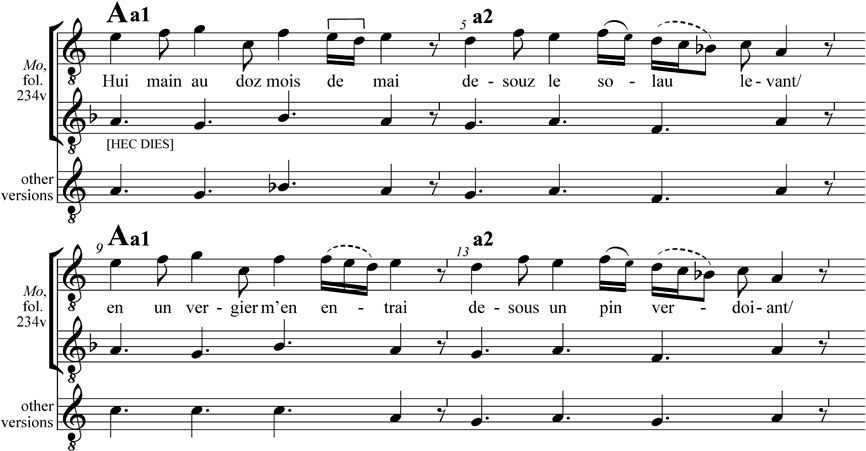
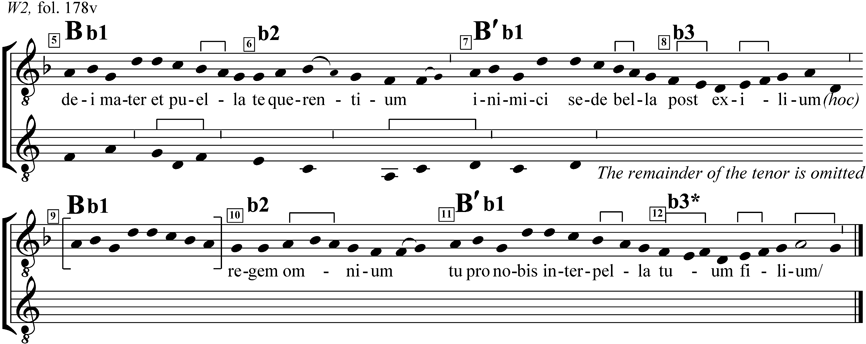
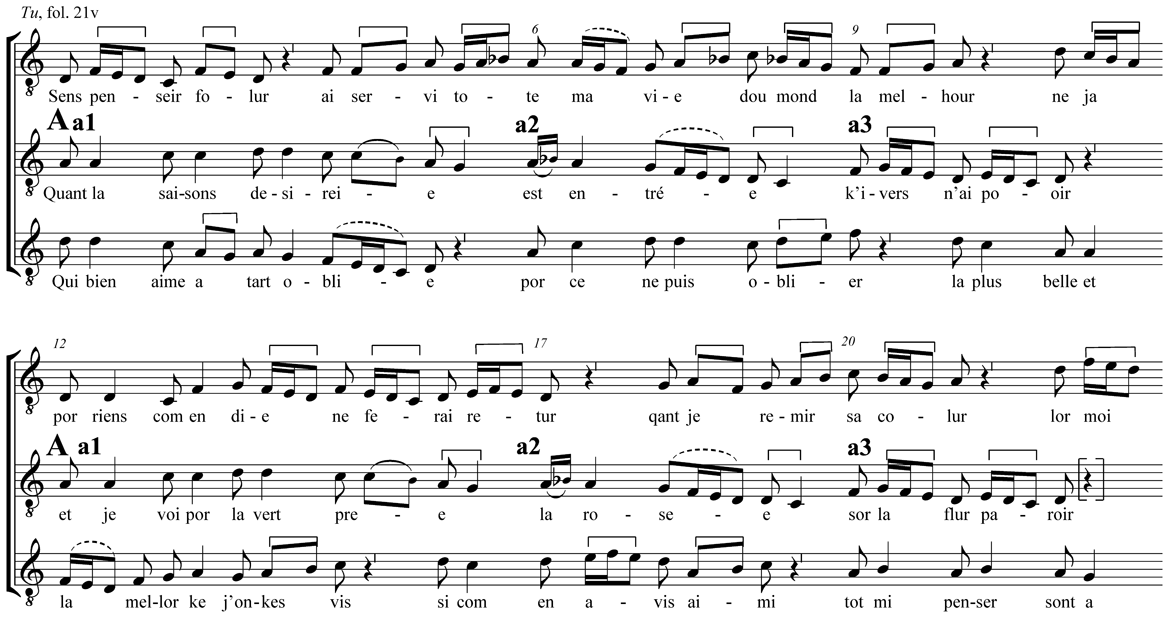
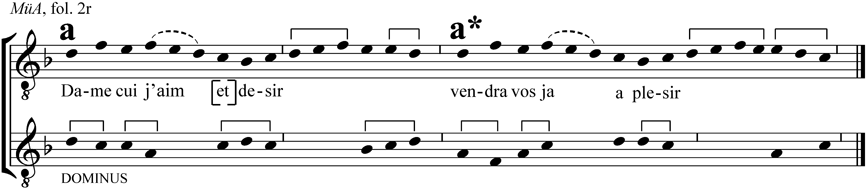
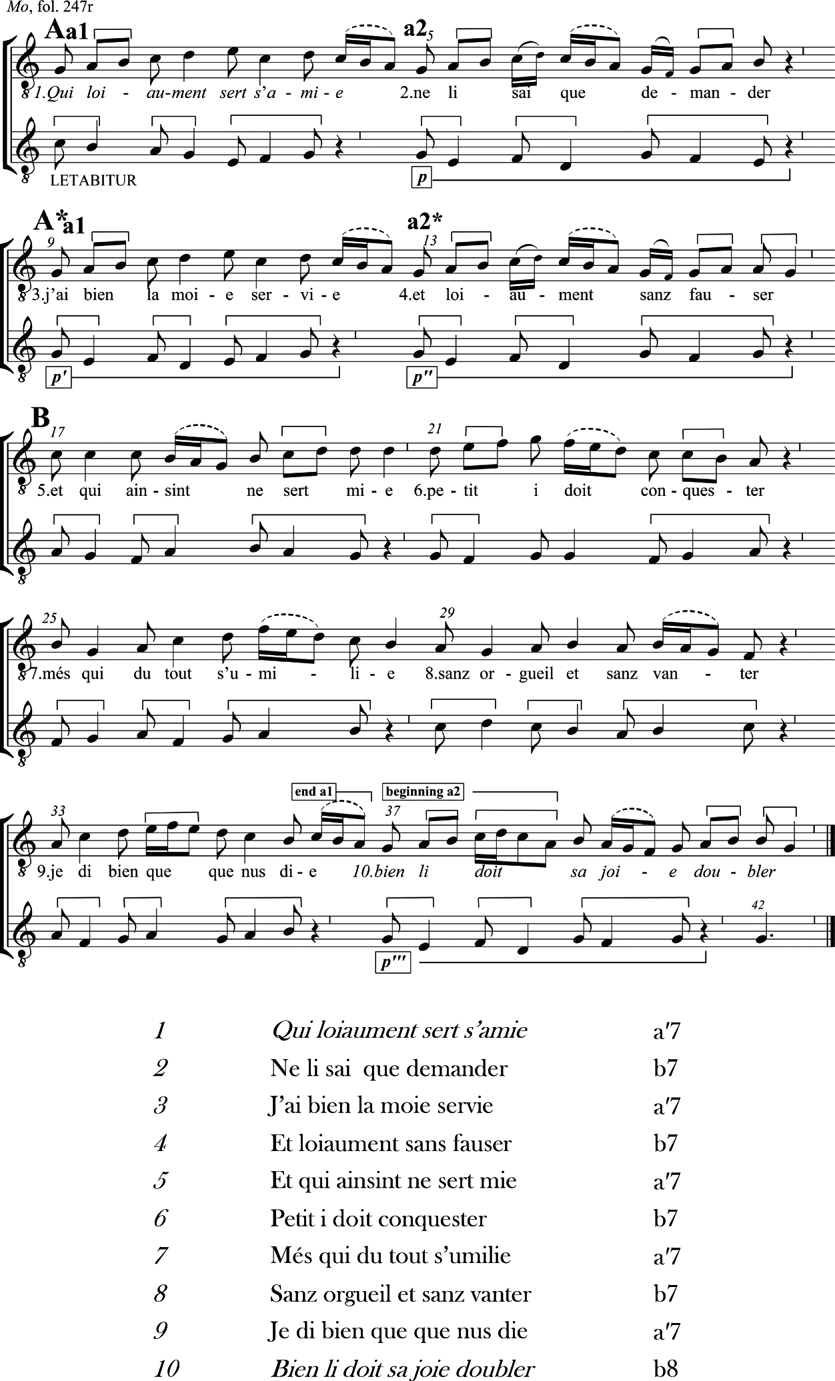
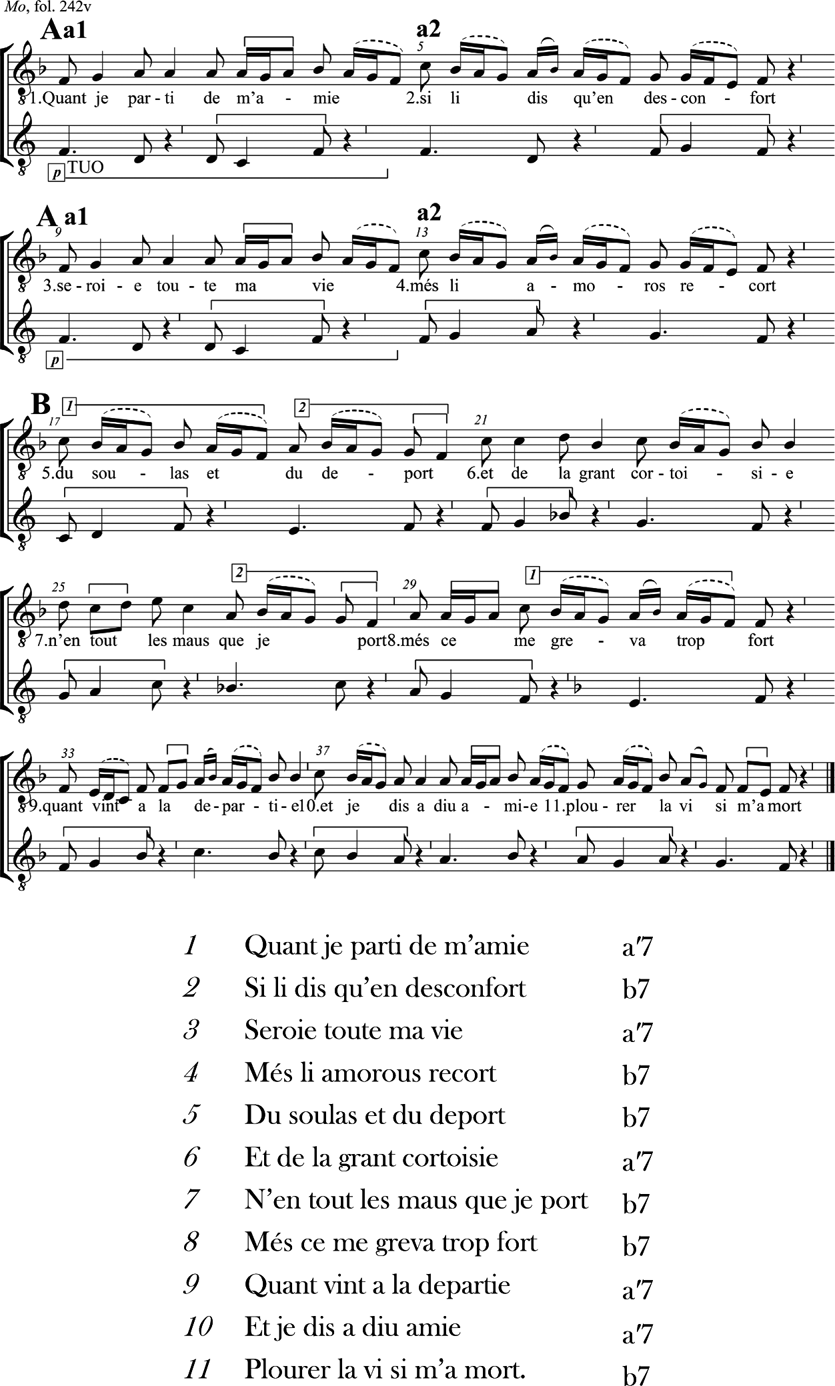
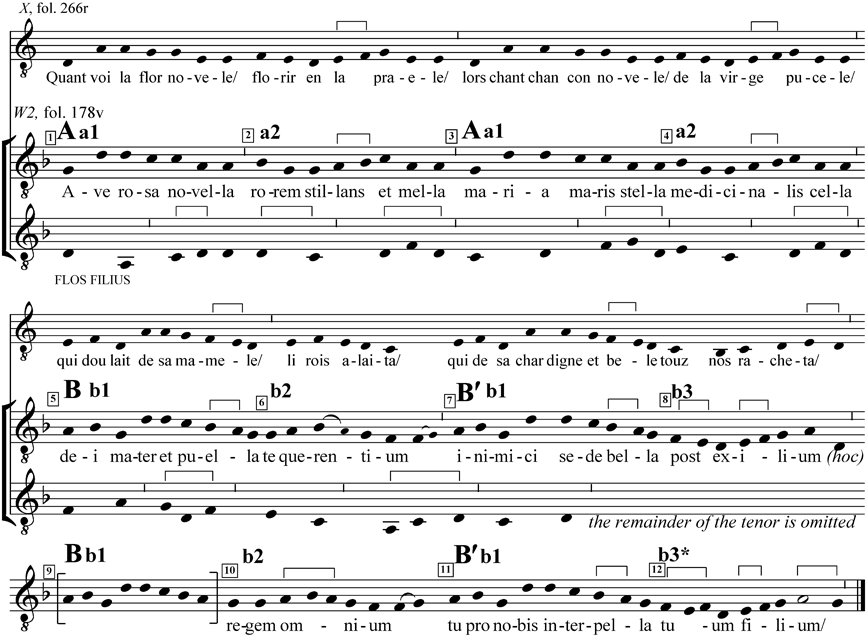
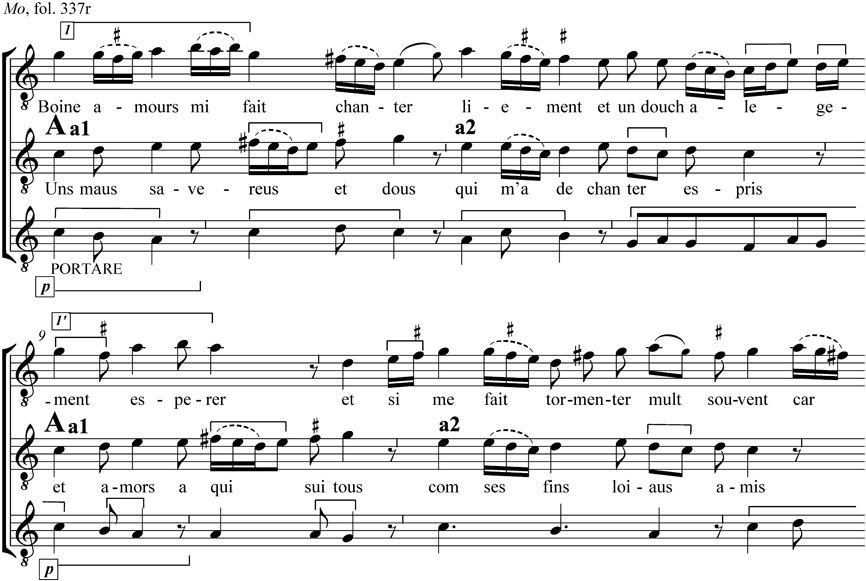
Even more precisely, Dante describes the internal organisation of the repeated sections, proposing two possible schemes: the main case shapes pedes – or versus – to include two elements each, while a more special case allows an odd number of elements, specifically three.Footnote 29 This norm also applies to the motet corpus. In effect, fourteen out of the sixteen works are built according to the A (a1+a2) | A (a1+a2) | B form: the A pes is divided into two elements a1 and a2, then is strictly repeated, as shown in motet no. 2 (Example 1). Motet no. 1, in pedes cum versibus, also has its B block split into two elements, b1 and b2 or b3 (Example 2). Moreover, the entire versus is duplicated, the motet finally exhibiting the overall form A (a1+a2) | A (a1+a2) | B (b1+b2) | B′ (b1–b3) | B (b1+b2) | B′ (b1+b3*).Footnote 30 The division of the A pes into three elements is also represented in the corpus: motet no. 15 (Example 3) shows a pedes cum cauda form according to the declension A (a1+a2+a3) | A (a1+a2+a3) | B. Finally, the case of a one-element pes, theoretically possible from Dante's treatise, occurs in motet no. 9 (Example 4) and its form a | a* | B.
Motet no. 2, block AA (perf. 1–16)
Motet no. 1, block BB′BB′ (from 5 to the end)
Motet no. 15, block AA
Motet no. 9, block AA
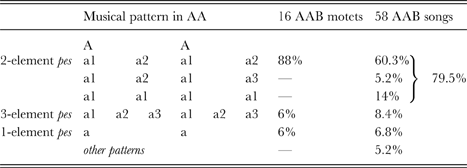
The comparison of these various exemplifications of the AAB form in the motet corpus with a sizeable group of trouvère songs with a pedes-cum-cauda form (Table 3)Footnote 31 indicates that the standard of a two-element pes is found in the same proportions in both repertories. The motet corpus, however, tends to stereotype the melodic pattern of the pedes, with the strict repetition of two elements a1 and a2, whilst the chanson offers more variety in this respect, for example supplying four a1 elements in a row, or substituting an a3 element for the a2 element in the second pes. Finally, the rarer cases of odd one- or three-element pedes are still shared in identical proportions by both the chanson and the AAB motet forms (see Table 3).
Musical pattern of the AA block
In the reiteration of musical sonorities between the A phrases, the sixteen motets display a remarkable melodic stability. This is a crucial point, not only because the motet is not normally associated with strict repetition, but also because the necessity of strictness in melodic reiteration is specified by Dante, and appears as one of the prerequisites of his formal types. Whilst one cannot indeed find melodic irregularities that would compromise the accuracy of the repetition of A, the same two types of variants as in AAB songs can be picked out: a few small ornamental variants as in motet no. 2 (Example 1; compare perfections 3 and 11); and the variant due to differentiated or ‘ouvert-clos’ cadences framing the endings of the two A phrases, as in motet no. 9 (Example 4).Footnote 32
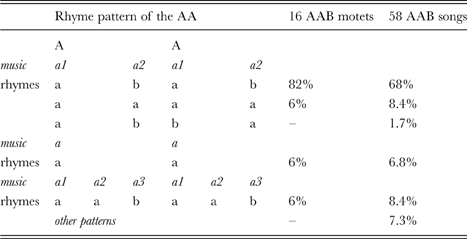
The propensity of the motet corpus to duplicate then stereotype the pedes-cum-cauda form is also notable regarding the poetic sonorities. Harmony of poetic sonorities in the overall strophe constitutes a linchpin of vernacular poetry,Footnote 33 and Dante develops precisely the organisation of rhymes within the pedes. For him, either the lines of each pes rhyme with one another, following an aa | bb or aa | aa scheme; or each line of the first pes rhymes with its equivalent in the following pes, resulting in alternate rhymes ab | ab. Table 4 shows that this rule is followed by the sixteen motets and in almost all the songs. But the motets again consolidate an arrangement otherwise more variable in the chanson, with their near exclusive recourse to the alternate-rhyme pattern. Such an organisation is detectable, for example, in motet no. 6, with its alternation of rhymes in ‘-ie’ and ‘-er’ on the four initial lines of the AA block (Example 5). The recurrence of this pattern should be assessed within the larger context of the motet repertory. On the one hand, the crossed-rhyme scheme for the four initial lines generally constitutes a fairly rare choice: for comparison, in the collection of French motets preserved in the sixth fascicle of Mo, alternate rhymes count for only 30 per cent of the sixty-six works.Footnote 34 This arrangement thus seems specifically devised for these sixteen motets on the model of the chanson. On the other hand, this symmetry of poetic sonorities suggests an alternative view to a frequently expressed affirmation in motet investigations, postulating that the scattered examples of melodic repetition or imitation would be motivated by a reiteration in the poem.Footnote 35 In this corpus, none of the works displays any text repetition corresponding to melodic reiteration: just as in the AAB structure of the chanson, the link between poetry and music is somewhat more subtle, and lies rather in the parallel of poetic and music sonorities. In this respect, this corpus is hardly an exception: the recourse to various poetic colores of sonorities rather than textual repetition is a consistent feature of both Latin and French motets framed by repetitive formal types.Footnote 36
Rhyme pattern of the AA block
Motet no. 6, music and poem
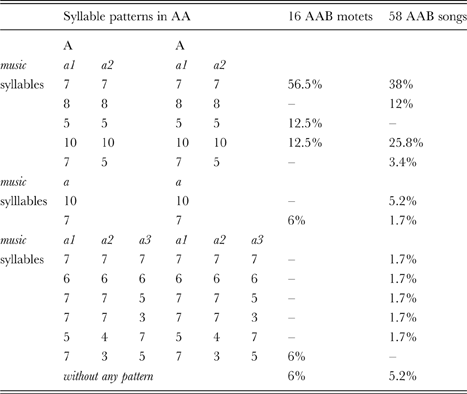
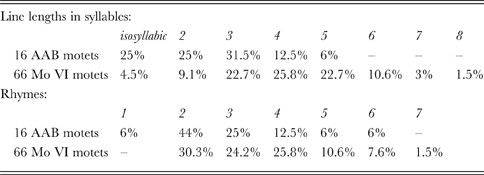
Segmentation and repetition of the lengths in the repetitive block is as critical as those of the sonorities in the make-up of the formal type, recalling that harmony of line length is another linchpin of vernacular poetry. For Dante, this numerical harmony calls for each line of the first pes to have the same length as its equivalent in the following pes.Footnote 37 In fact, only a small proportion of songs and one motet defy this rule, appearing ‘without any pattern’ in Table 5.Footnote 38 Furthermore, in almost all songs and motets, strict isosyllabism is found in the four lines of the AA block. Between the two corpora, the difference lies rather in the choice of the line lengths: whilst both adhere to Dante's theory with its recommendation for 10-, 7- and 5-syllable lines,Footnote 39 it is noticeable that AAB motets once again tend to stereotype this principle by mostly resorting to the heptasyllable (Table 5). The versification scheme of the AA block in motet no. 6 (Example 5 above) examplifies these poetical norms, with its initial four isosyllabic lines of seven syllables. In general, these characteristics constitute a remarkable group in the otherwise heterosyllabic context of the motet repertory: amongst the motets recorded in the sixth fascicle of Mo, only 24 per cent show an isosyllabic pattern under the four initial lines, and 13.5 per cent display four heptasyllabic lines at their beginning. This outstanding feature of the AAB motets again betrays the influence that the pedes-cum-cauda form imprints on the realisation of these sixteen works.
Syllable patterns of the AA block
In his treatise, Dante argues twice for the necessity of the numerical symmetry of line lengths in the pedes: ‘Pedes ab invicem necessario carminum et sillabarum equalitatem et habitudinem accipere; quia non aliter cantus repetitio fieri posset. Hoc idem in versibus esse servandum astruimus.’Footnote 40 Here there is a twofold doctrine: versification ought to be thought out with a view to musical repetition; but above all, musical reiteration is regarded as rigorous only if both phrases have an identical overall length. In the realm of the chanson, this isochronism finds expression in terms of syllable count. But as soon as the form is transferred from the non-measured field of the trouvère chanson into the modus rectus system of the motet, this isochronism is expressed as a strict symmetry of the musical length between A and A, both phrases being rigorously balanced in terms of musical perfections. All thirteen motets of the corpus that we can safely measureFootnote 41 indeed exhibit an identical musical length between the two phrases:
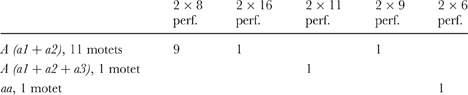
The AAB form does not therefore appear only as a structure based on the segmentation and repetition of a melodic unit. In the background of the numeric-rhythmic rationalism of Parisian polyphony whose structure is controlled by number and proportion, the AA block of the motets also segments and repeats a metric unit. It is remarkable that the AAB motets establish a norm for that metric unit: the length of the AA block is mostly based on a sixteen-perfection pattern, to be then divided into two A phrases of eight perfections each, as above. Motet no. 2 (Example 1 above) is a good example: the A phrases equally divide the sixteen-perfection repetitive block into two eight-perfection units. But it further segments this given metric frame by splitting each A phrase in turn into two isochronic elements a1 and a2 of four perfections each. Finally, the AA block in this motet segments the metric frame of the repetition according to a stereotyped pattern that is shared by nine out of the thirteen measurable motets of the corpus:

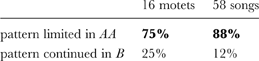
A few characteristics stretched out on the scale of the overall repetitive forms of the chansons are outlined in Dante's treatise. First, the sectionalism inherent in the forms with diesis of course creates a rupture between the two blocks. In the case of the songs and motet no. 1 (see Example 7 below) in pedes cum versibus, i.e. exhibiting two sections framed by the same degree of repetition, it is the very nature of the poetic-melodic material that ensures the contrast between the two blocks. In the instance of pedes-cum-cauda forms, it is the uniqueness of the repetitive structuration of AA that distinguishes it from the B block. Some AAB motets and songs admittedly show repetitions in B, as does motet no. 5 (Example 6) with its reiterated motifs 1 and 2. Still, it never reaches the degree nor the dimensions of the AA repetition. The caesura between the blocks is also created by the versification. Dante does not supply any accurate clues to the poetic form applied to the overall work,Footnote 42 but it is clear that the versification scheme is specific to the AA block in motets and songs alike:
Motet no. 5, music and poem
Motet no. 1 overlaid with song RS598 Quant voi la flor (1st stanza)
In effect, AA versification pattern is most often restricted to this section, so much so that musical diesis and poetic diesis are almost systematically simultaneous. A last feature shared by both corpora concerns the numeric ratio between blocks AA and B: the extent of the repetitive block in the overall length of the work is the same in the sixteen motets (41, 5%) as in the songs (41, 16%).Footnote 43 In this way, both in the make-up of the AA block and the whole AAB form, these sixteen motets offer a stereotyped formal type, moulded according to the segmentation and repetition of poetic-musical sonorities and lengths that take up, stereotype and normalise the format of the AAB form of chanson. We can then refer to these AAB motets as pedes-cum-cauda motets.
The citation as a compositional reference between the chanson and the pedes-cum-cauda motet
Between the sixteen pedes-cum-cauda motets and the chanson de trouvère, a fusion emerges from the sharing of the same formal structures. However, it goes beyond this sharing alone. It has already been shown that the fusion came with a transmission of poetic registers; it also comes, in a number of works, with a shared citation between both repertories. In effect, at least ten motets share material with trouvère chansons. This shared citation is not a second instance of correlation between these repertories, which would be alien to that of form. On the contrary, it lies at the very core of the formal sharing: it acts as an agent of the hybridisation, according to three distinct modalities.
The first modality corresponds to extensive citations of songs. In the motets nos. 1, 7, 14, 15 and 16, the entire repetitive part is found as a song elsewhere in another source (see Table 1, column ‘sources’, see ‘as song’ in bold type). It is therefore the shared material itself that carries the formal type, as in motet no. 1, where the repetitive motetus is musically identical to a trouvère song (see Example 7). The issue of the provenance of the material is critical in the compositional practice of these five works, determining the direction and location of the hybridisation process. Do these pedes-cum-cauda motets result from the ingestion and adaptation of songs within the polyphonic complex? Or are these songs only motet parts divorced from their polyphonic context, their form having been deemed favourable to their transfer to a monophonic environment?Footnote 44 In the AAB corpus, motet no. 1 (Example 7) appears to be a simple case. In the unique Latin motet of the corpus, the music of its motetus matches with two vernacular songs: the devotional song RS 598 Quant voi la flor novele (florir) and the pastourelle RS 599 Quant voi la flor novele (paroir).Footnote 45 Here, the marks of polyphonic adaptation are so clear and numerous that they signal the pre-existence of at least one of the two songs. The author of the motet duplicates the versus block of the song, turning the AABB′ form into an unusual AABB′BB′ form (from  onwards). With or without this duplication, this motetus hardly adapts to the pre-existing tenor. On the one hand, at least as it is copied in W2, the lower part proves too short to fit the overall motetus. On the other hand, both parts exhibit at certain points vertical successions of fourths, sixths, seconds and sevenths on the first longa – or brevis – of the perfections. Yet, the melody of the song has been transposed when ‘motetised’, probably in order to suit the pitches of the tenor. Finally, the motetus proves defective in several places, including a large lacuna (phrase
 ), misaligning poem and music, with the monosyllable ‘hoc’ incorrectly placed at the end of the line, under the last pitch of phrase
 . This motet appears to be a contrafactum and a somewhat defective polyphonic setting of the earlier devotional song, and the tenor has certainly been retained for its intertextual relevance to the poem of the upper voice.Footnote 46
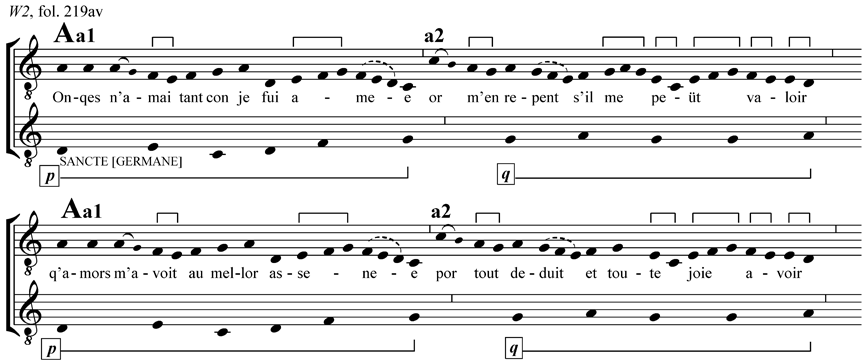
Motet no. 7 (Example 8) constitutes a further case of a polyphonic setting of a song, Onques n'amai tant con je fui amee (RS 498), found in chansonnier U. This motet is built on a Latin pseudo-liturgical tenor: whilst it retains the words of the responsory Sancte Germane V O sancte Germane, otherwise used as basis for two Parisian compositions, it exhibits an unknown melisma.Footnote 47 Tenor segments p and q, placed under each element a1 and a2 respectively, even tend to indicate that the tenor is especially invented in order to match the AAB form of the motetus. Moreover, this peculiar part has challenged the scribes' competence: in all the sources of this motet, both the tenor word and the melisma exhibit countless inconsistencies, discrepancies and lacunae.Footnote 48 Here again, the words SANCTE GERMANE seem to have been picked out for extra-musical reasons.Footnote 49
Motet no. 7, block AA
Two three-part motets also obviously borrow their AAB voice from a trouvère chanson. The secular tenor of motet no. 15 (Example 3 above) appears to be newly invented in order to create a polyphonic setting of the pre-existent song Quant la saisons desireie (RS 505) placed in the motetus. In effect, the beginning of the tenor is itself introduced by the short citation vdB 1585 ‘Qui bien aime a tart oblie’, which is never given with the same music across the ten works that make use of it, and which is lodged at quite different points of their respective structure.Footnote 50 It consists of a proverb rather than a refrain tied to a melody, and this indicates that the overall tenor is not a pre-existing melody, but rather a newly invented one, designed to fit the prior song of the motetus. This song, moreover, is preserved in chansonnier U, in a section presumably dated about sixty years earlier than Tu, where motet no. 15 appears as an unicum.Footnote 51 In Tu, for that matter, the work is copied within a cycle of motets with secular pseudo-liturgical and/or invented tenors.Footnote 52 The AAB part of motet no. 14, now placed in the tenor, is obviously a pre-existing song as well. This song also appears as the tenor of a motet recorded in the same seventh fascicle of Mo, at no. 309. In both works, the text of the tenor is given in the form of a textual incipit, clearly referring to a well-known text. The musical, formal and intertextual project carried out by these motets testifies that these two pieces were composed as a playful twofold experiment with pre-existing material.Footnote 53 In the end, out of the five pedes-cum-cauda motets whose AAB parts coincide with a song, only motet no. 16 remains challenging. It shares its AAB motetus with the song RS 197 Orendroit plus qu'onkes mais preserved in chansonniers fairly contemporary with the copy of the motet in Tu. And whilst the register and form prompt us to think that this part is a citation of a pre-existing monody, nothing guarantees the direction of the transfer in this particular case.Footnote 54
Although they lack any concordance in the extant chansonniers, the motetus of motets nos. 11 and 13 are also likely to quote a pre-existing song. The tenor of no. 13 shows modal irregularities in several places (Example 9). This peculiar rhythmic pattern is doubtless to be understood as the consequence of the form of the motetus. The author needs to link certain repetitive elements of the motetus with identical segments of the tenor: beginnings of the two a1 elements in the motetus take place on the same p segment of the tenor, and under the same motive 1 of the triplum (perfections 1 and 9). The author ‘forces’ these convergences by means of an irregular pattern of the tenor (perfections 7 and 8), which allows the premature return of segment p. The same procedure recurs in block B of the motet.Footnote 55 Finally, the overall irregularities of the modal pattern necessary to correlate the repeated phrases vertically certainly find an explanation through the contrapuntal constraint of a double citation: both song and tenor are pre-existing and have been superimposed.Footnote 56 As for motet no. 11, it is recorded amidst monophonic songs in chansonnier fr. 846. It presents two stanzas, just as a very short grand chant would do, and the scribe does not even endeavour to conceal that the tenor is newly invented, naming it TENOR. A close examination of the relevant folio of the work shows that this part is an addition to the song.Footnote 57 The tenor is notated right after the motetus in the middle of a line, but its staves are not aligned with those of the upper voice, and look like a clumsy extension of those of the motetus. This tenor certainly does not constitute a very late addition: whilst the text hand might differ between the two parts, the music hand is doubtless the same. Furthermore, the added staves do not reach beyond the frame of the writing block. This peculiarity shows rather that there were two phases in the conception, drawing up and copying of this work: first the two-stanza monophonic song, then the polyphonic setting with the addition of the tenor. Eventually, in four certain cases (nos. 1, 7, 14 and 15) and most probably two further works (nos. 11 and 13), the pedes-cum-cauda motets are built by absorbing a pre-existing trouvère song into the polyphony. These extensive citations are determining for the make-up of the form as they carry the AAB formal type, of which the motet then offers an adaptation and polyphonic setting.
Motet no. 13, block AA
The second type of role played by citation in the hybridisation between motet and chanson is due to short citations.Footnote 58 Six further motets of the corpus in effect share this type of material with the chanson (see Table 1, column ‘short citations’).Footnote 59 Amongst them, motets 3, 6 and 12 reveal the formal impact of short citations on the make-up of the AAB part. The effect of these inserted samples is a well-known phenomenon: a musical and/or poetic link may be woven between the newly composed music and poem and the quoted material.Footnote 60 In trouvère chansons, a poetic-musical affinity can at times similarly be found between the AA and B blocks, resulting in a formal unity on the scale of the stanza.Footnote 61 This type of work is heightened in motet no. 6 (Example 5 above), in which the integration of a citation involves the overall form of this part.Footnote 62 This piece is a motet enté – that is to say, it makes use of a short citation divided within the motetus. The first citation line is given at the beginning of the part, and the second line is heard at the closing (see lines in italic in the transcription). These two phrases of music and text together make up the citation vdB 1605 ‘Qui loiaument sert s'amie | Bien li doit sa joie doubler’, which is also found in the pre-existing song RS 1660 Por li servir en bonne foi, with the same textual and musical form.Footnote 63 The tension resulting from the dissociation of the two elements of the citation largely accounts for the AA*B form of the motetus. The elements a1 are produced by the first citation phrase: not only the melody but the rhyme in ‘-ie’ and the heptasyllable as the four-perfection metre (perfections 1–4 and 9–12). The second citation phrase is responsible for the rhyme in ‘-er’ and the melodic pattern – although a perfection is subtracted in the process – of elements a2 (perfections 5–8 and 13–16). The double juxtaposition of a1 and a2 in AA* thus takes on a specific meaning in the context of the motetus form: it enables a double hearing of the juxtaposition of the poetic-musical sonorities coming from the two citation phrases that are separated by the ente technique. Here is a way to reconstruct what had been separated and of preparing, from the beginning of the motet, the appearance of the second citation phrase. Between perfections 17 and 35, no melodic material coming from the citation is to be heard, but the citation retains its hold over the poetry through the continuous use of the same alternate rhymes ‘-ie’/‘-er’ and of the heptasyllable. Lastly, perfections 35 and 36, just preceding the occurrence of the second citation phrase, allow the poetic sonorities and musical ending coming from the first phrase of the citation to sound. Consequently, throughout the motet, three points of juxtaposition between the respective material of the first phrase and of the second can be heard, around perfections 5, 13 and 37. The AAB form is therefore to a large extent the fruit of the technique of insertion of the short citation, and assigns to the latter the role of generating the formal type.
The third type of function attached to citation in the hybridisation between motet and chanson is again due to the short citation, but is marked out from the second type by the fact that it plays the role of a pivot relating the genre of the motet to the form of the chanson de trouvère. Certainly significant is the fact that all the short citations imported in the pedes-cum-cauda motets are found in at least one trouvère song framed by an AAB form with two-element pedes, alternate rhymes and isosyllabism in the AA block. In other words, the song which is referred to through the shared citation provides a model and a formal reference for the make-up of the AAB part of the polyphony. Motet no. 4 is a good example. The AAB motetus includes two different citations, each being placed at an end of the part (here italicized):Footnote 64
Both citations are found in a pastourelle and a chanson de rencontre respectively, both exhibiting an AAB form. They thus twice supply the motet with the same narrative, registral and formal context. This context is clear for the second citation vdB 539, earlier found in the AAB-patterned chanson de rencontre RS 575 En avril au tens novel, as the final refrain of the first stanza (the lines are italicized):Footnote 65
A comparison of the texts of the song and motet no. 4 shows that both poems first evoke a knight wandering in the countryside, according to the stereotype of the chanson de rencontre. In the song, the knight then meets a shepherd, saddened to have lost his shepherdess and desiring to win her back. At the closure of the stanza, we hear his lament: this is our citation. In the motetus, it is now the shepherdess who encounters the knight; she turns him away because her shepherd, who had lost her, wins her back with a song. The song of the shepherd is heard in the distance: this is our citation. The two works sound like the two sides of the same story, the first being seen by the knight/shepherd couple, the second by the knight/shepherdess couple, in both cases concluding with the same citation that constitutes a narrative and musical link between the two pictures.Footnote 66 The function of the short citation here is clear: it acts as a medium between the song and the motet, which enables the transfer of a register, of a narration, of a musical sample and of a form from the one to the other.
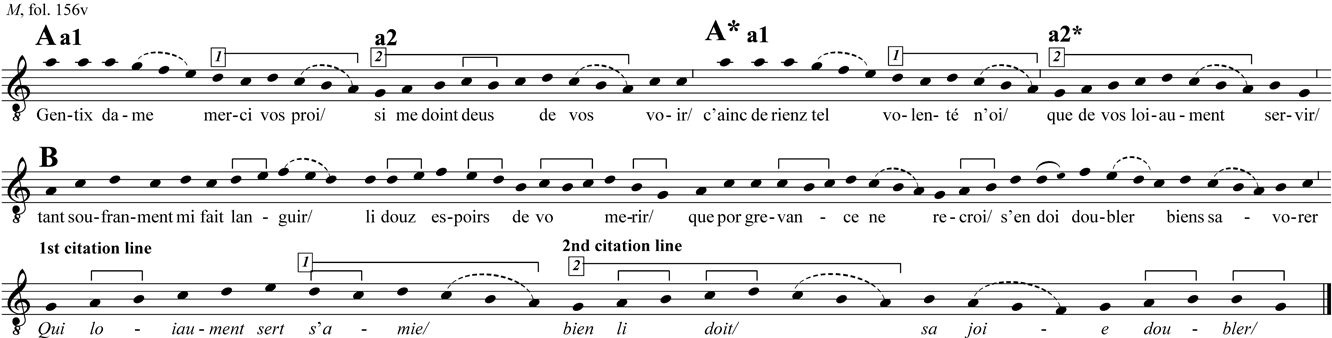
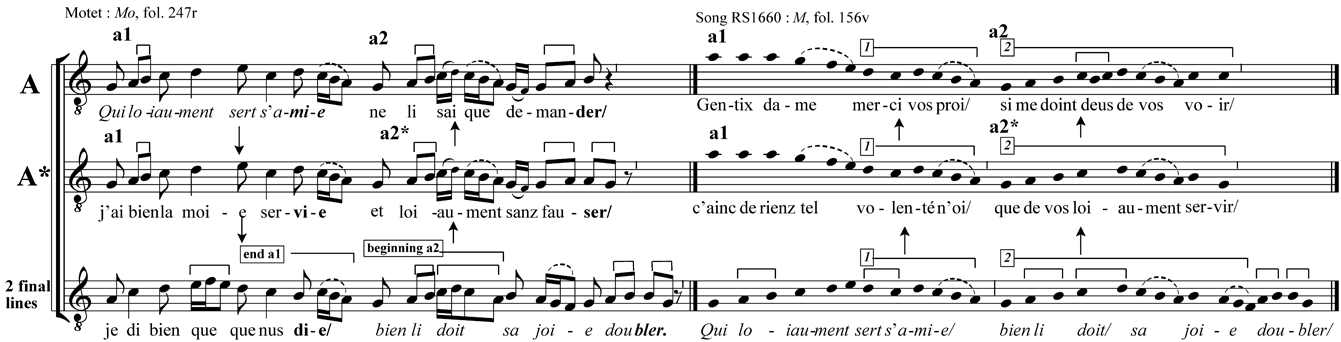
Finally, a short citation may at the same time generate the form and function as a pivot between genres. In motet no. 6, this second function is as evident as the first one already examined above. In effect, citation vdB 1605 also acts as a medium between the motet and the form of the courtly song RS 1660 Por la servir en bonne foi, where it is found as a non-divided refrain closing the fifth stanza (Example 10, last system in italic). This song exhibits an AA*B form, rigorously identical to that of the motet, with two-element pedes showing differentiated cadences, isosyllabism and alternate rhymes. But the convergence of the forms is even more subtle: the process already noticed in the motet also links the AA* material with the final citation in the song. In the latter, the end of a1 is in effect melodically inferred from the first citation phrase (motives 1, bracketed in the example), while a2 elements stem from the second citation phrase (marked 2 in the transcription). Admittedly, the citation is not divided in the song, but the same compositional and formal process lies at the core of both motet and song. A comparative analysis of AA* blocks and the final lines in the motet and the song (Example 11) shows that in both works, three points of contact are heard between the two segments of the refrain. For the motet and the song alike, a2 is inferred from the second citation phrase; in the motet, a1 coincides with the first citation phrase placed at the beginning, whereas in the song, a1 is derived from the first citation phrase placed at the end. In motet no. 6, it is most likely that the author seized upon the song as a formal model, the citation also performing a pivotal function in relating the two works.
The song RS1660 Por la servir en bonne foi, 5th stanza (transposed a 5th higher)
Relationships between block AA and final lines, motet no. 6 and song Por la servir (transposed a 5th higher)
In the pedes-cum-cauda motet corpus, citation appears to be a determining agent in the fusion between motet and chanson: it is critical by its capacity to link. This ability has been emphasised in various ways, allowing individual works, registers and genres to relate to and confront each other.Footnote 67 In the case of pedes-cum-cauda motets, the pivotal function of the citation applies to the form of the related works, and implies the compositional process itself. In effect, the citation generates the form at the scale of individual works when it links heterogeneous poetic-musical materials by means of repetition. But at the scale of genres as well the citation acts as a medium between the genre of the motet and the form of the chanson, behaving like a formal reference reporting the compositional frame of the chanson within the polyphonic organism of the motet.
Mutation of the motet texture: from pedes-cum-cauda motets to motet-chansons
By the end of the thirteenth century, the perspectives offered by the genre of the motet are multiple, forming a landscape that is split up into various possibilities for different polyphonic textures. Amongst them, the influence of popularisant choreographic songs is critical in the resulting texture of three-voice secular motets.Footnote 68 The impact of the chanson de trouvère on the texture of the pedes-cum-cauda motets is to be assessed in the same way. The cultural and historical implications of this corpus are clear, drawing the picture of a precocious fusion between polyphony and trouvère chanson. The musical implications for the chanson are fairly evident: subjected to polyphony, precise measure and narrative shortening, the chanson is denatured once it is absorbed by the motet. It remains to assess, conversely, the implications of the formal and compositional principles of the trouvère chanson for the polyphonic texture of the motet. A predatory organism genetically conceived by and for the integration of heterogeneous materials, the motet has a hard task here, since its recurring polyphonic inclinations – individuation and hierarchical organisation of parts, melodic and harmonic variety, overlapping of ordines and poetic heterophony of texts – are put to a severe test once they have to assimilate sectionalism, isomelism and harmony of poetic and musical lengths and sonorities from the trouvère chanson. In sum, which polyphonic object results from the fusion of form, materials and compositional practices of chanson and motet?
A first consequence of the hybridisation is palpable in the relationship between tenor and upper voices, which contributes to turning the traditional texture of the motet into the texture of a motet-chanson. In effect, the AAB corpus to a large extent indicates a reversal of the usual prerogatives of the parts. Traditionally, the tenor is the liturgical and pre-existing part whose numeric-rhythmic structure determines the polyphonic whole. This structure largely collapses in the pedes-cum-cauda motet. In motets no. 14 and 16, the traditional tenor even disappears, giving way to a secular song. In seven further motets, it is the hierarchy of parts which is reversed: the tenor is newly invented (motets no. 5, 6, 7, 11, 16), rearranged (no. 13) or modified (no. 2), being at times secular or pseudo-liturgical, and in every case determined by the form of a motetus which in a number of works becomes the pre-existing part. The sense of the newly invented tenors is always clear: they are designed so as to match the structural form of the motetus. The case of motet no. 7 (Example 8) has already been examined: under each phrase A, the pseudo-liturgical tenor rigorously repeats the same segments p and q. Neighbour of this motet in no fewer than three sources, motet no. 6 is also built on a newly invented pseudo-liturgical tenor LETABITUR (Example 5).Footnote 69 Here again, the varied reiterations of segments p, p′ and p″ under the repetitions of the AA* block (perfections 5–16), and again of p′′′ under the varied return of a2 on the final citation (perfection 37), are motivated by the formal adherence to the upper voice. This formal adherence is not at all necessary: it is a strategy. In reality, there was no need to forge identical segments in a newly invented tenor to make it contrapuntally acceptable for the AAB part. The aim here was indeed to extend the form to the polyphonic whole, and so to offer a polyphonic setting of the pedes-cum-cauda form. Nowhere is it more evident than in motet no. 2, for which manuscript Mo supplies a modified version of the melisma HEC DIES. Example 1 transcribes the AA block in Mo, and in ossia the tenor according to the concordances of this motet in the other sources. These other sources match the conventional melody of the melisma. The arrangement in Mo is quite clear: as it is notated, the tenor gives the same melodic-rhythmic portion twice, under phrase A (perfections 1–8) and its return (perfections 9–16). It is most unlikely that the scribe could have made a mistake for such a well-known and widely used melisma. Nor was this alteration prompted by the necessities of the counterpoint, which is most acceptable in the other versions of this motet. The rewriting was made only for the purpose of making a global polyphonic setting of the AAB form of the motetus.
Invented or arranged tenors in the corpus give a different perspective on the genre of the motet. According to a broadly accepted idea, the possibility – and most often the impossibility – of repetition in the upper parts of motets would be conditioned by the pattern of the tenor.Footnote 70 In the AAB motet corpus, however, a non-repetitive tenor is definitely not a hindrance to the repetitive formal type: a sole case shows a light melodic irregularity in the repetition of the motetus, obviously due to the pre-existing tenor.Footnote 71 In the other cases, whenever needed, it is always the tenor that is emended. Reciprocally, a repetitive tenor is not a sine qua non for the make-up of a repetitive motet. In the corpus, only one pre-existing tenor has an AAB pattern favourable to the motetus form, and even then the author contrives to playfully sidestep and overlap it when building the motetus.Footnote 72 In the pedes-cum-cauda motet, the tenor is allotted the ancillary role of accompanying the AAB part. The consequences are as important for the resulting polyphonic texture as for the very compositional process of the motets. This is indeed the sketch of a new hierarchy of parts in polyphony, where the motetus becomes the ‘forming’ part. It becomes the vox principalis in respect of which the polyphony is designed, and whose tenor is formally dependent.Footnote 73 Moreover, this phenomenon is not isolated: the growing supremacy of the motetus and the consequent arrangement of tenors can also be detected in the rondeau-motets of fr. 12615.Footnote 74 And the shift of the centre of gravity in polyphony towards the middle voice is clear in Adam's polyphonic songsFootnote 75 as well as in Walter Odington's De Speculatione Musicae, for whom in the motet ‘maxime visendus est medius cantus ut per se sit decorus’.Footnote 76
The reversal of the roles affects the polyphonic complex to a large extent, especially in the two-part motets. First, it generates an overall synchronisation of the ordines of the tenors with those of motetus, thus inscribing sections and articulations of the form on the scale of the tenor–motetus bicinium. The concomitance of the ordines is very obvious at the key articulations of the form: at the closing of each A phrase, as witnessed by motet no. 1 (Example 7, ends of  and
 ); but also through further polyphonic caesurae imposed at the end of each a1 and a2 elements, as in motet no. 2 (Example 1, perfections 4, 8, 12 and 16).Footnote 77 In motet no. 6 (Example 5) for example, the formal organisation of the four a1 and a2 elements of the AA block in the motetus is underpinned by a synchronous metric segmentation of the tenor with four ordines of four perfections each, reinforced by melodic parallelisms of segments p and its variants. This vertical metric organisation, moreover, spreads across the whole work. The ordines of the motetus are systematically four or eight perfections long, and are continually underpinned by four-perfection ordines in the tenor – with the exception of the final citation, from perfection 37. In both this work and the two-voice AAB motets of the corpus, the melodic-metric segmentation of the form is inscribed in the vertical dimension of the formal type, thereby resulting in synchronic and hypermetric texture. This feature runs counter to the intrinsic texture of a genre otherwise remarkable for the asymmetry of its phrases and the overlapping of its parts.Footnote 78
The cohesion between tenor and motetus in the pedes-cum-cauda motets certainly involves the harmonic dimension of the works. The tendency to reiterate the same polarities in the tenor under both phrases A of the motetus draws a reiterated harmonic career between equivalent perfections of phrase A and its return:Footnote 79

The repetition of sonorities therefore exceeds the monophonic dimension of the AAB form and lies within the harmonic framework. This characteristic has, as a corollary, the shaping of coherent harmonic cadential schemes at the key articulations of the form around specific pitches. Motet no. 6 (Example 5) is typical of this feature: the end of the first phrase A (perfection 8) gives a weak harmonic sonority E/B. The strong cadence G/G is heard at the closure of block AA* (perfection 16), then again at the closure of the work, resulting in an overall cadential pattern II–I–I. Moreover, the strong sonority G/D sounds again at the end of segments a1 (perfections 4 and 8). The harmonic cadential schemes at the key points of the AAB form may be mapped as follows:Footnote 80
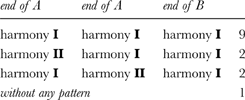
Out of the whole corpus, only one motet is devoid of any coherent cadential scheme on the polyphonic scale of the form. Elsewhere, the pedes-cum-cauda form is inscribed within a harmonic framework that constructs a tonal coherence taking part in the identification of the melodic-metric segmentation within the vertical dimension of the formal type. This coherence seems like the outcome and the polyphonic echo of the ‘structural tones’ of trouvère chanson.Footnote 81 In any case, it is certainly outstanding in the genre of the motet, for which the different endeavours to derive systems of pitch organisation and hierarchy have proved somewhat unfruitful.Footnote 82
Finally, the rationalisation of the texture of the pedes-cum-cauda motets applies to the poetic sonorities and lengths as well. In motet no. 6 (Example 5), only two rhymes rule the whole work and, with the exception of the second citation phrase (perfection 37), a strict seven-syllable isosyllabism coincides with the musical four-perfection hypermetry of the motet. This case is far from being isolated: Table 6 shows that this restriction in the number of rhymes and poetic lengths in AAB motets is exceptional when compared with the French two-voice motets of the sixth fascicle of Mo. In this respect, again, the pedes-cum-cauda motet provides a rationalisation and a normalisation of the poetical fabric, which distances itself from the heterophonic and heterometric practices that constitute the more customary hallmark of most of the repertory.
Comparison of line lengths and rhymes between the AAB motets and the sixth fascicle of Mo
The pedes-cum-cauda motet rests on a combination of melodic, metric, polyphonic and poetic springs which contribute, both in the vertical dimension of polyphony and on the horizontal scale of parts, to the make-up of a remarkably standardized overall texture. Above all, these springs do not work in isolation, but like interdependent cogs articulating an overall mechanism. This is especially visible in two-part works, whose highly unusual structures turn these pedes-cum-cauda motets into real motet-chansons. Motet no. 5 offers an outstanding global play of metric and sonic coherence (Example 6). This work is built on a tenor TUO whose melisma is unknown elsewhere in the liturgical repertory and which is almost certainly newly invented. In the AA block (perfections 1–16), the poetry and music of the motetus and the tenor are articulated so as to make up a sixteen-perfection section, divisible into two eight-perfection units, themselves further divided into four-perfection entities. This four-perfection cell constitutes the hard core of this AA block and of the overall work: in it are included the heptasyllabic line, the talea of the tenor and the ordo of the motetus. At the polyphonic level, these various elements fit perfectly well with each other: in AA, a1 elements end on weak cadences F/B♭ with a feminine rhyme in ‘-ie’ (perfections 4 and 12); a2 elements end on conclusive cadences F/F with a masculine rhyme in ‘-ort’ (perfections 8 and 16). This cadence and rhyme are repeated at the closure of the work. Furthermore, the AA repetition of the motetus is strengthened by the return of the segments p under the two a1 elements (perfections 1–4 and 9–12). The structural grip of the heptasyllable, the four-perfection cell and the two rhymes in ‘-ie’ and ‘-ort’ remain active in block B of the motet. Until the end, the tenor is articulated on the same four-perfection talea, and each talea, until perfection 32, is concluded by the pitches F or C. Synchronously, each musical phrase of the motetus keeps pace with this four-perfection norm, corresponding to a heptasyllabic line. The global polyphonic articulation of AA also remains valid in B, combining, until perfection 32, the strong cadences F/F or F/C with the rhyme in ‘-ort’ (perfections 20, 28 and 32), and the weak cadences F/B♭ or B♭/B♭ with the rhyme in ‘-ie’ (perfections 24 and 36). Therefore, throughout this work, the continual synchronisation, hypermetry and poetic-musical cohesion of the parts imbue this motet with a texture of exceptional unity.Footnote 83
The whole corpus is distinguished by a mutation of the motet structure, which generates hybrid polyphonic items resulting from the fusion between motet and trouvère chanson. The three-voice motets, and particularly the late nos. 13 and 16, retain certain traditional features of the motet, and offer polyphonic exploration of the chanson texture which appears to be close to that of motets based on choreographic songs by 1300. But the other works break with the traditional structure of motet, kneaded and reshuffled by the structure of trouvère chanson, which, applied to the polyphonic whole, prolongs and metabolises the form of the pedes-cum-cauda motet into the texture of motet-chansons.
Contextualizing the corpus: repetitive motets, chansons-motets and polyphonic songs
It is certainly a hybridisation between motet and chanson that the pedes-cum-cauda motet corpus allows us to hear, and one that exceeds the process of borrowing, customary in the motet from its origins until the last decade of the thirteenth century. Behind the transfer of a formal type, many lines of transmission arise between these repertories. Registers, poetic and musical materials, and compositional processes of the chanson seep into the motet structure together with the formal type, so much so that the polyphonic texture seems to be remodelled by unfamiliar principles coming from a distinct repertory. These sixteen works, moreover, bear witness that this hybridisation prepares the ground well before the fourteenth century, producing its first specimens as early as the 1240s. Furthermore, these motets are not isolated from contemporary musical experiments. Before 1250, the fusion between the chanson de trouvère and polyphony is also evident in the repertory of the Parisian polyphonic conductus, within which some works import the music of an entire trouvère song,Footnote 84 or make use of the structural form of the chanson.Footnote 85 These early cases of interpenetration within the motet or the conductus constitute the most visible part of an already vivid practice of exchange between the chanson and the Parisian repertory. This practice is discernible in the poetic-musical material very occasionally circulating between clausula and chanson,Footnote 86 or more generally through certain contrafactum processes and stylistic permeability between chansons and Parisian genres.Footnote 87 In this practice of exchange, the testimony of the pedes-cum-cauda corpus, moreover, insistently indicates that the migrating material tends to originate in the chanson repertory rather than in polyphony.Footnote 88
More generally, the pedes-cum-cauda motets are highly instructive for the repertory of the motet itself, in that they allow us to reassess the very limited domain in which musicological claims have confined the repetitive structures of this genre up till now. These sixteen works are actually only a portion, the most obviously linked to the trouvère chanson, of a larger corpus of twenty-seven motets framed by the AAB formal type.Footnote 89 This latter corpus, furthermore, is one among those exhibiting repetitive conventional forms, besides the sixteen thirteenth-century rondeau-motetsFootnote 90 and a smaller collection which has also remained in the shadow, including seven motets with an ABA segment.Footnote 91 The pedes-cum-cauda motet corpus should not be consigned to the fringes of the genre. The total of parts involved in the ABA, rondeau-motet and AAB corpora provide a collection of sixty-three voices framed by a conventional formal type, counting for more than 5 per cent of all the voices included in the repertory.Footnote 92
Even more generally, the AAB corpus certainly ought to be put in the perspective of the emergence of the fourteenth-century polyphonic chanson, calling for its role and significance to be assessed. Site of hybridisation between polyphony and chanson, standardised poetic-musical form in a middle part becoming vox principalis, newly invented or rearranged tenors according to upper parts, synchronism of parts, hypermetry, rationalised cadential patterns and normalised poetic fabric: the most salient features of the pedes-cum-cauda motets could be those of the fourteenth-century formes fixes. Of course, its specific form shares common characteristics with that of the ballade. It is therefore hardly surprising that two AAB motets in particular have attracted the attention of a few scholars in search of the ontology of the polyphonic ballade.Footnote 93 Yet, the continuity between the AAB motets and the polyphonic ballade runs into several obstacles, and here we reach the very limits of this collection of works. Admittedly remarkable and significant for its outstanding features, its impact on the long-term polyphonic picture, on the other hand, appears to be quite uncertain. First of all, these motets prove limited in number, and show few concordances throughout the different sources. Secondly, despite a notable density in some fascicles of Mo or W2 (see Table 2 above), they turn out to be far too dispersed across various manuscripts of varied origins and epochs, where they never appear as a coherent and compact cycle of consecutive and homogeneous works. Most of all, continuity between the pedes-cum-cauda motet and the polyphonic ballade does not stand up to a chronological examination. When compared to the polyphonic practice of the rondeaux, which turns out to be unbroken and substantial between the rondeau-motets of fr. 12615 and Machaut's polyphonic rondeaux,Footnote 94 the polyphonic setting of the AAB form has very little to offer with regard to continuity. In fact, the only extant AAB polyphonic works for the period running from 1280 to Machaut's first polyphonic ballades – at the earliest in the late 1330sFootnote 95 – are the five pedes-cum-cauda motets nos. 11, 13, 14, 15 and 16. Especially revealing is the great sparsity of AAB motets in Tu and in the seventh and eighth fascicles of Mo (Table 2), and their total eclipse in Adam's polyphonic song corpus, that is to say all the collections usually identified as being the alpha of polyphonic song. Eventually, with the exceptions of five pedes-cum-cauda motets scattered across the sources, the core of the AAB corpus concentrates on a temporal stratum circumscribed by the tenth fascicle of W2 and the sixth fascicle of Mo, between c. 1240 and c. 1280. By the end of the century, motets offering polyphonic settings of the AAB formal type are more on the way to extinction than to expansion. Significantly, after the two latest extant pedes-cum-cauda motets preserved in Tu around 1300–15, the experiments of the AAB form before Machaut's ballades only consist of monophonic or purely poetic ballades,Footnote 96 standing out against a thirty-year-long complete polyphonic silence.Footnote 97 It is all in all unlikely that AAB motets could constitute a corpus influential enough to serve as a prototype or a precursor to a genre which is to emerge about seventy years after the peak in activity of the motet corpus. Consequently, the construction of a continuum between the pedes-cum-cauda motets and Machaut's polyphonic ballades turns into an artificial enterprise, resting on a purely speculative teleology.
And yet, pedes-cum-cauda motet and polyphonic ballade have this in common, which betrays the early contribution of the AAB-form corpus to the musical developments to come: both are indebted to the courtly lyric chanson, and both are involved in the same innovative process that dislocates trouvère monody into an indeterminacy of registers, a syncretism of genres, a synthesising of language and forms, and a subjection to measured rhythm and polyphony. However, the relationship of each to the chanson de trouvère is quite dissimilar: when the polyphonic ballade emerges, the grand chant and the culture of the trouvères already belong to History; what the ballade seizes is not the grands chants themselves, but an outdated poetic tradition that it revives under another form. On the contrary, the relationship between pedes-cum-cauda motets and the chanson is straightforward, instantaneous and symbiotic: the former directly appropriate monophonic songs and forms of a contemporaneous courtly tradition; and when this tradition dies out by the end of the century, so does the AAB motet. This common destiny brings these sixteen motets into what they are above all and into the real crux of their modernity: polyphonic and measured settings of trouvère songs, which appear amongst the very first polyphonic song experiments in the thirteenth century.