Introduction
Persons with dementia frequently present behavioral and psychological symptoms that reduce their quality of life, make care more difficult to provide, and contribute to caregiver burden. The umbrella term “behavioral and psychological symptoms of dementia” (BPSD) was originally adopted by participants of a consensus conference organized by the International Psychogeriatrics Association in 1996. BPSD were defined as signs and symptoms of disturbed perception, thought content, mood, or behavior that frequently occur in patients with dementia (Finkel et al., Reference Finkel, Costa, Silva, Cohen, Miller and Sartorius1996). BPSD are in fact comprised of two main subgroups. In this study, we focus on behavioral symptoms of dementia (BSD), which include various observable manifestations such as screaming, hitting, resisting care, wandering, sexual disinhibition, and cursing. They differ from psychological symptoms of dementia, such as depression and delusions, which are usually assessed on the basis of interviews with the patient or a relative. The prevalence of various forms of BSD has been found to range from 12% (disinhibition) to 63% (apathy) in a community setting (Aalten et al., Reference Aalten, de Vugt, Jaspers, Jolles and Verhey2005). In long-term care facilities, 85% of residents with dementia show at least one symptom of agitation, of which general restlessness is observed most frequently (44%; Zuidema et al., Reference Zuidema, Derksen, Verhey and Koopmans2007). BSD have been found to be associated with various factors including severity of cognitive impairment, use of certain drugs, and sleep difficulties (Ray et al., Reference Ray, Taylor, Lichtenstein and Meador1992; Algase et al., Reference Algase1996; Cohen-Mansfield and Libin, Reference Cohen-Mansfield and Libin2005). Insomnia, disability, depression, pain, and gender have also been found to be associated with BSD (Cohen-Mansfield and Libin, Reference Cohen-Mansfield and Libin2005; Lemay and Landreville, Reference Lemay, Landreville and Columbus2011).
Delirium is also frequently found in persons with dementia. The essential feature of delirium is a disturbance of consciousness that is accompanied by a change in cognition that is not accounted for by dementia. The disturbance develops over a short period of time and presents a fluctuating course. It is usually a consequence of a general medical condition, substance intoxication or withdrawal, use of a medication, or toxin exposure, or a combination of multiple factors. Associated features of delirium include behavior problems such as perceptual disturbances, psychomotor agitation or retardation, and altered sleep–wake cycle (American Psychiatric Association, 2000). Risk factors of delirium include but are not limited to older age, severity of dementia, dehydration, malnutrition, acute illnesses (pneumonia, myocardial infarction, etc.) medication use (Fick et al., Reference Fick, Agostini and Inouye2002; Elie et al., Reference Elie, Boss, Cole, McCusker, Belzile and Ciampi2009; McCusker et al., Reference McCusker2012), and use of physical restraints (Inouye, Reference Inouye2006; Voyer et al., Reference Voyer, Richard, Doucet and Carmichael2009; Reference Voyer, Richard, Doucet, Cyr and Carmichael2011). Delirium superimposed on dementia is particularly frequent among older persons, with prevalence ranging from 22% to 89%, and may have serious complications and poor prognostic implications (Fick et al., Reference Fick, Agostini and Inouye2002).
It has been argued that BSD may be due to an underlying delirium and that behavioral or cognitive changes in a patient with dementia are often misattributed to diurnal variation of symptoms or to the dementia itself rather than to a superimposed delirium (Fick et al., Reference Fick, Agostini and Inouye2002). Conversely, behavioral disturbances have been shown to be significant risk factors for delirium and may contribute to this risk by their impact on other factors associated with delirium such as use of physical restraints and certain drugs (Voyer et al., Reference Voyer, Richard, Doucet and Carmichael2009; Reference Voyer, Richard, Doucet, Cyr and Carmichael2011).
The relation between delirium and BSD has important practical implications. Persons with dementia and behavioral disturbances typically receive more medication (Stevenson et al., Reference Stevenson2010). Care of these patients is also more difficult and more costly (Okura and Langa, Reference Okura and Langa2011). If behavioral problems are caused in part by delirium, healthcare professionals should be particularly vigilant to identify and treat delirium, a transient condition, rather than use medication to control behavior, such as atypical antipsychotics that are modestly effective and present serious health risks (Sink et al., Reference Sink, Holden and Yaffe2005; Schneider et al., Reference Schneider2006). Also, if behavioral problems contribute to delirium, they should be prevented or managed with safe and effective treatments that do not increase the risk of delirium, such as psychosocial interventions (O'Connor et al., Reference O'Connor, Ames, Gardner and King2009). Delirium superimposed on dementia may lead an individual to refuse his medication, to eat and drink less, to fall, to have insomnia, and so on. All of these may become perpetuating factors of delirium (Canadian Coalition for Seniors' Mental Health, 2006).
To date, only a few studies have compared behavioral and psychological symptoms of patients with delirium superimposed on dementia with patients with dementia alone. Cole et al. (Reference Cole, McCusker, Dendukuri and Han2002) found that the mean number of symptoms of delirium is higher in persons with delirium compared to those without delirium irrespective of the presence of dementia. They concluded that delirium appears to be phenomenologically similar among patients with or without dementia, although patients with dementia tend to have more symptoms. More recently, Meagher et al. (Reference Meagher, Leonard, Donnelly, Conroy, Saunders and Trzepacz2010) reported that patients with either comorbid dementia and delirium or delirium alone present more severe non-cognitive symptoms of delirium (sleep–wake cycle disturbance, perceptual abnormality, affective lability, thought process abnormality, and motor retardation) than patients with dementia alone. However, only thought process abnormalities and motor agitation remained statistically significant after correction for multiple testing.
Current knowledge in this area is limited in two ways. First, previous studies have focused exclusively on symptoms of delirium. BSD include a broad range of manifestations, some of which may not be captured by measures of delirium because they are not typical manifestations of this disorder (e.g. aggressive behavior). Holtta et al. (Reference Holtta2011) reported overlap between delirium and neuropsychiatric symptoms in patients with dementia. They found that 85% of patients with both dementia and delirium suffer from multiple neuropsychiatric symptoms, and nearly one in three patients with such symptoms fulfill criteria for delirium. Second, it is unknown if causes of BSD in patients with delirium superimposed on dementia differ from those found in patients with dementia alone. Examining if the correlates of BSD vary according to the presence or absence of delirium would help shed some light on this issue.
The purpose of this study was to extend this area of research by addressing three main questions: (1) Do persons with delirium superimposed on dementia present more BSD than persons with dementia alone? (2) Do these groups differ on specific forms of BSD? (3) Do the correlates of BSD vary according to the presence or absence of delirium? To examine Question 2, we selected and controlled for potential confounding variables (cognitive problems, and use of antipsychotics and benzodiazepines) on the basis of their reported relationship with both delirium and BSD. Question 3 was addressed by including the same variables as well as others (insomnia, disability, depression, pain, and gender) that have been found previously to be associated with BSD.
Methods
The method has been described elsewhere (Voyer et al., Reference Voyer, Richard, Doucet and Carmichael2009; Reference Voyer, Richard, Doucet, Cyr and Carmichael2011) and will be summarized here.
Participants' selection
Participants were recruited in three long-term care facilities and one long-term care unit of a large regional hospital. A convenience sampling procedure was used. All residents aged 65 years and older with a diagnosis of dementia in their medical chart and no history of psychiatric illness (psychotic disorders, bipolar disorders, and major depressive disorders with psychotic features) were eligible for the study.
Measures
Delirium
The Confusion Assessment Method (CAM) is an established and widely used test to assist with detection of delirium (Wei et al., Reference Wei, Fearing, Sternberg and Inouye2008). This instrument has been shown to be sensitive (94% to 100%) and specific (90% to 95%) compared to the diagnosis of a psychiatrist (Inouye et al., Reference Inouye, van Dyck, Alessi, Balkin, Siegal and Horwitz1990). The tool assesses the nine criteria for delirium specified in the Diagnostic and Statistical Manual of Mental Disorders, 4th edn (American Psychiatric Association, 2000), i.e. (1) acute onset and fluctuation of symptoms over the course of the day, (2) inattention, (3) disorganized thinking, (4) altered level of consciousness, (5) disorientation, (6) memory impairment, (7) perceptual disturbances, (8) psychomotor agitation or retardation, and (9) altered sleep–wake cycle. The presence of Criteria 1 and 2 plus the presence of either Criterion 3 or 4 is indicative of a definite delirium. For a diagnosis of probable delirium, the first criterion changes to “acute onset or fluctuation of symptoms over the course of the day” and the rest of the algorithm remains the same. In the present study, residents who met the criteria for definite or probable delirium were defined as having delirium. In the context of this study, inter-rater agreement was satisfactory: κ = 0.53 (95% CI: 0.03–1.00) for CAM definite delirium and κ = 0.71 (95% CI: 0.21–1.00) for CAM probable delirium.
Behavioral Symptoms of Dementia
These were assessed using the 29-item Nursing Home Behaviour Problem Scale (NHBPS; Ray et al., Reference Ray, Taylor, Lichtenstein and Meador1992). All but one of the items (hallucinations) refer to directly observable behaviors. This scale has shown good inter-rater reliability and a high level of convergent validity (Ray et al., Reference Ray, Taylor, Lichtenstein and Meador1992). The frequency of each behavior during the last three days is reported using a five-point Likert scale ranging from 0 (never) to 4 (always). A five-factor solution explaining a total of 58% of the total score variance was previously identified with our sample of patients with dementia through principal component analysis (Fraser et al., submitted). These factors are aggressive/uncooperative behavior (seven items, e.g. “Fights or is physically aggressive: hits, slaps, kicks, bites, spits, pushes, pulls”; “Resists care”), sleep problems (three items, e.g. “Has difficulty falling asleep;” “Awakens during the night”), wandering/trying to leave (three items, e.g. “Wanders, tries to escape or go to off-limits places;” “Enters others' rooms inappropriately”), irrational behavior (three items, e.g. “Sees or hears things that are not there;” “Says things that do not make sense”), and agitation (three items, e.g. “Fidgets, is unable to sit still, restless;” “Does something over and over, even though it does not make sense”). Total and factor scores are obtained by summing individual item scores and are all continuous variables.
Cognitive Problems
Dementia severity was assessed using the Hierarchic Dementia Scale (HDS; Cole and Dastoor, Reference Cole and Dastoor1987). The maximum score for the entire scale is 200 points. Older adults who are cognitively intact generally achieve the maximum or close to the maximum number of points. The validity and reliability of the scale are well established (Ronnberg and Ericsson, Reference Ronnberg and Ericsson1994).
Medication
Use of benzodiazepines and antipsychotics over the previous 24-hour period was recorded.
Insomnia
The Insomnia Severity Index (ISI; Bastien et al., Reference Bastien, Vallieres and Morin2001) was used. Each of the seven items is rated on a 0–4 scale, with higher total score indicative of severe insomnia. Internal consistency and concurrent validity of this scale have been demonstrated by Bastien et al. (Reference Bastien, Vallieres and Morin2001).
Comorbidity
Comorbidity was assessed through a chart review using the validated and reliable Charlson Comorbidity Index (Charlson et al., Reference Charlson, Pompei, Ales and MacKenzie1987). The overall score ranges from 0 to 37 with higher scores indicating greater comorbidity.
Disability
Functional autonomy of the resident was measured according to the Functional Autonomy Measurement System (SMAF; Hebert et al., Reference Hebert, Carrier and Bilodeau1988). The total score ranges from –63 to 0. The absolute value of the total score was used; therefore, higher score is indicative of severe autonomy impairment. The original version of this scale has shown good test–retest and inter-rater reliability (Desrosiers et al., Reference Desrosiers, Bravo, Hebert and Dubuc1995).
Pain
Pain was assessed using the DOLOPLUS-II (Wary and Doloplus, Reference Wary and Doloplus1999). Each of the ten DOLOPLUS-II items (somatic complaints, protective body postures adopted at rest, self-protection of sore areas, expression, sleep pattern, washing and/or dressing, mobility, communication, social life, behavioral problems) is rated on a 0–3 scale with higher scores indicative of increased difficulties due to pain. The validity and reliability of this measure has been supported in the literature (Zwakhalen et al., Reference Zwakhalen, Hamers and Berger2006).
Depression
Depression was assessed using the Cornell Depression Scale (Alexopoulos et al., Reference Alexopoulos, Abrams, Young and Shamoian1988). It consists of 19 items corresponding to five dimensions (mood-related signs, behavioral disturbance, physical signs, cyclic functions, ideational disturbance). In this study, the assessor indicates if the symptom is 0 (absent), 1 (mild to intermittent), or 2 (severe). The scale has good test–retest reliability (r = 0.75) and excellent internal consistency (α = 0.83; Camus et al., Reference Camus, Schmitt, Ousset and Micas1995). Inter-rater reliability and concurrent validity are also well established (Kørner et al., Reference Kørner2006).
Procedure
Each resident was observed over a seven-hour period by two trained research nurses, both of whom collected different information at different times during the day. To make the most of the observation time per resident, the nurses evaluated a maximum of three residents per day. In order to homogenize the observation period between the different recruitment sites, observations took place during the day shift schedule, i.e. 7:30 am to 3:30 pm or 8:00 am to 4:00 pm, depending on the long-term care facility involved.
A first research nurse was responsible for assessing the presence of delirium with the CAM as well as the severity of dementia using the HDS. In order to complete the CAM, she used various data sources (chart, family members, nursing staff, and a baseline cognitive assessment of the resident conducted seven days prior to the evaluation of delirium). In addition, three structured assessments of symptoms of delirium had to be performed over the seven-hour observation period prior to completing the CAM. A second research nurse, blinded to resident delirium status, collected baseline characteristics (age, sex, marital status, level of education, days since admission to facility, level of functional autonomy, and comorbidity) and medication use (previous 24 hours before assessment with the CAM) based on the medical chart and direct observation. She also assessed BSD (last three days before CAM) as well as insomnia, depression, and pain (last seven days before CAM). The procedures followed were in accordance with the ethical standards of the local committee on human experimentation.
Statistical analysis
SAS software (version 9.2) was used for data analysis. Descriptive statistics, such as percentage, mean, and standard deviation, were calculated first. Next, t-tests were conducted to compare participants with and without delirium on BSD. In order to control for confounding variables that may explain the relation between delirium and BSD, we performed a series of multiple regression analyses of delirium on BSD controlling for cognitive problems and use of antipsychotics and benzodiazepines. In these analyses, the parameter estimate indicates the average difference on BSD between the levels of each variable (e.g. difference between delirium and no delirium). The statistics take into account the other variables in the model.
To investigate interaction between delirium and each covariate (cognitive problems, use of antipsychotics and benzodiazepines, insomnia, disability, depression, pain, and gender), multiple regression models were fit separately for each combination. Significant interaction effects between covariates and delirium were identified and interpreted based on the covariate's effect estimate for each group. Each covariate effect estimate indicates the degree to which an increase of one unit of a given variable is associated with a change in BSD. For example, an estimate of 3.81 for insomnia in participants with delirium would mean that an increase on a single unit on the insomnia scale is associated with a 3.81 increase on the BSD scale in that group. Because of the exploratory nature of these analyses, significance level was fixed at p < 0.10. For all other tests, significance level was fixed at p < 0.05. When multiple univariate significance tests were used, p was adjusted using Bonferroni's method. Exact p values are reported unless p < 0.01.
Results
Of the 293 eligible residents, proxy consent was obtained for 54.6% of them (160 residents). More precisely, 41.6% of proxies did not respond and 3.8% of them refused to give their consent. Following enrolment, three residents died before the evaluation, one was transferred, and another hospitalized, leaving a total sample of 155 participants. Of these, 109 (70.3%) were ascertained delirious according to the CAM (definite or probable). Mean age was 86.3 (SD = 6.9) and the majority were women (73.5%). Mean time since admission to facility was 2.6 years (SD = 2.3). The degree of cognitive impairment in this population was moderate with a mean score of 91.22 (SD = 49.42) on the HDS. The majority of the residents (84%) had a high level of comorbidity (score ≥6 on the Charlson Comorbidity Index). More than two-thirds of the residents were showing significant deterioration in their functional autonomy (score ≥29 on the SMAF). Antipsychotics were used by 81 participants (52.26%) and benzodiazepines were used by 78 participants (50.32%).
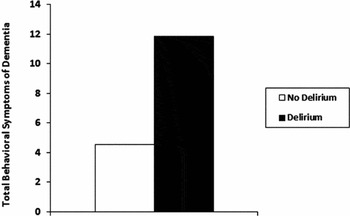
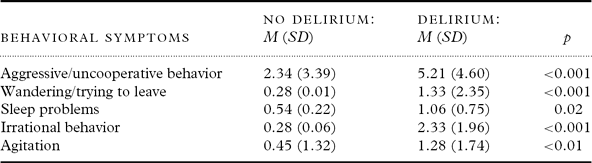
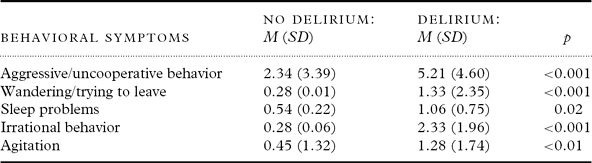
Mean total BSD scores for participants with and without delirium are shown in Figure 1. It can be seen that participants with delirium present significantly more BSD, p < 0.0001. Between-group comparisons for each category of BSD are shown in Table 1. Results show that participants with delirium present significantly more of most types of BSD. The difference on sleep problems, although not significant after adjusting using Bonferroni's method, is substantial and in the same direction.
Total behavioral symptoms of dementia.

Specific subtypes of behavioral symptoms of dementia as a function of delirium
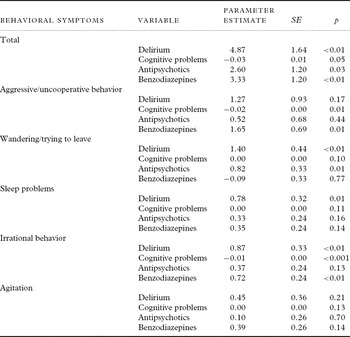
Results of the first series of multiple regression analyses are presented in Table 2. For total BSD, delirium is a significant predictor and the variance explained for the model as a whole is significant, p < 0.0001. The importance of delirium in explaining specific types of BSD is variable. Delirium is associated with wandering/trying to leave, sleep problems, and irrational behavior but not with aggressive/uncooperative behavior or agitation. Cognitive problems are associated with aggressive/uncooperative behavior and irrational behavior. Benzodiazepines are associated with both aggressive/uncooperative behavior and irrational behavior whereas antipsychotics are associated only with wandering/trying to leave. Total variance explained by each subtype of BSD model is significant and ranges from 7% for both sleep problems, p = 0.01, and agitation, p = 0.01, to 39% for irrational behavior, p < 0.0001.
Parameter estimates for variables included in multiple regression analyses on behavioral symptoms of dementia

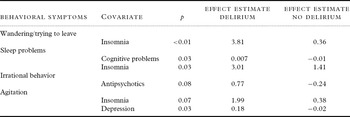
Most multiple regression analyses on BSD using delirium and each covariate separately did not show significant interaction effects. Those interactions that were significant are presented in Table 3. All covariates in this table show a positive association with behavioral problems in the group with delirium. Insomnia is positively associated with wandering/trying to leave, sleep problems, and agitation in both groups but more strongly in participants with delirium. Antipsychotics use is positively and more strongly associated with irrational behavior in the presence of delirium while the reverse is true in the absence of delirium. A similar pattern is found for the relation between depression and agitation. Finally, cognitive problems are negatively and more strongly associated with sleep problems in the group of participants without delirium.
Significant interactions with delirium on behavioral symptoms of dementia

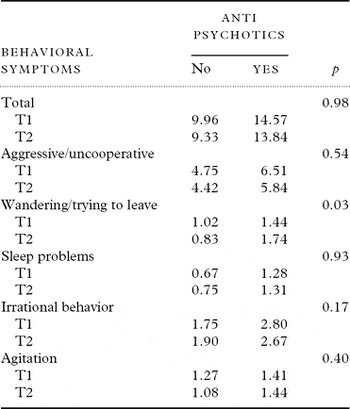
The finding of weak association between antipsychotics use and BSD, shown in Table 2, is intriguing since these agents are commonly used for treating BSD, especially aggressive behavior. Since we had data on drug use and BSD at two separate time points (separated by a seven-day interval), we examined if the difference in BSD between these time points was related to antipsychotics use in patients with delirium. t-tests were performed to compare participants who received antipsychotics and those who did not on the difference in BSD between each time point. Results are shown in Table 4 and none of the comparisons were significant.
Behavioral symptoms of dementia in persons with delirium superimposed on dementia as a function of time and antipsychotics use

T1 and T2 refer to time points for the collection of data on behavioral symptoms separated by a seven-day interval. p was adjusted using Bonferroni's method.
Discussion
Our results indicate that persons with delirium in addition to dementia present significantly more BSD than persons with dementia alone. Delirium remained significantly associated with BSD in general and with three subtypes of BSD (wandering/trying to leave, sleep problems, and irrational behavior) even after controlling for cognitive problems and drug use. This is consistent with symptoms and associated features of delirium including disorganized thinking, perceptual disturbances, psychomotor agitation, and altered sleep–wake cycle (American Psychiatric Association, 2000). It is also in line with results of previous studies (Cole et al., Reference Cole, McCusker, Dendukuri and Han2002; Meagher et al., Reference Meagher, Leonard, Donnelly, Conroy, Saunders and Trzepacz2010).
It is surprising that the difference between the groups on agitation did not remain significant because psychomotor agitation is a typical feature of delirium (American Psychiatric Association, 2000). It has been suggested that hypoactivity is more frequent in delirium superimposed on dementia (Fick et al., Reference Fick, Agostini and Inouye2002). On the other hand, delirium was still associated with wandering/trying to leave after controlling for confounding variables. Although this type of behavior can be regarded as a consequence of the increased level of motor activity often found in delirium, the absence of difference in agitation between our groups suggests that other factors may be involved. It is also possible that disorientation, another associated feature of delirium, contributes to wandering/trying to leave. On the other hand, this behavior may increase the risk of delirium (e.g. through an increase in antipsychotics use). An alternative explanation is that the potential or tendency to wander and leave one's residence is already present in persons with dementia and increased by the presence of delirium. In any case, our results point to a very serious risk to patients' security.
This study also explored if the correlates of BSD vary according to the presence or absence of delirium. In general, interaction effects were not significant suggesting that the variables associated with BSD in persons with delirium superimposed on dementia are more similar than different to those in persons with dementia alone. However, the relation between BSD and some patient characteristics does seem to vary depending on the presence or absence of delirium. Insomnia, in particular, appears to be more strongly associated with different forms of BSD in persons with delirium. Despite a significant interaction, it should be noted that there is obviously some redundancy between the severity of insomnia, as measured by the ISI, and the sleep problems factor of the NHBPS. This particular relation is therefore not very informative. Future research should continue to examine the issue of interaction with delirium and consider other potential correlates of BSD, such as relationships with caregivers, which were not included in this study.
Our results also suggest that the use of antipsychotics had no effect on BSD even when comparing BSD rates twice separated by a one-week interval and controlling for delirium status. In other words, giving these drugs had no effect on BSD, even on aggressive behaviors. Use of antipsychotics was however associated with slightly more wandering/trying to leave, which can be hypothesized to be the result of extrapyramidal adverse effects (Lonergan et al., Reference Lonergan, Britton and Luxenberg2007).
The main findings of this study have important implications. First, they indicate that delirium is associated with a higher level of BSD. Clinicians should consider delirium as a possible contributing factor and target for management of BSD. Inversely, they should consider that BSD is a risk factor for delirium (Voyer et al., Reference Voyer, Richard, Doucet and Carmichael2009; Reference Voyer, Richard, Doucet, Cyr and Carmichael2011). Second, wandering/trying to leave, sleep problems, and irrational behavior may be especially useful as signs of delirium superimposed on dementia. Third, patients with both conditions may be at increased risk of wandering/trying to leave and may thus require particular attention in order to provide them a safe environment and prevent them from leaving their home by themselves. Fourth, since both BSD and delirium increase burden in those caring for persons with dementia (Sourial et al., Reference Sourial, McCusker, Cole and Abrahamowicz2001; Milisen et al., Reference Milisen2004), it is likely that the increased level of BSD in persons with delirium superimposed on dementia results in more caregiver burden. Future studies should examine this issue. If this is confirmed, educating caregivers to detect delirium so that persons who present this disorder receive appropriate treatment would seem an important strategy to reduce both BSD and caregiver burden.
There are also limitations to this study. One limitation is that there are other forms of BSD and BPSD that are not captured by the NHBPS but that could be examined in future studies. These include resistance to care, anxiety, depression, inappropriate sexual behavior, and eating disorders. Another limitation is that BSD were assessed by recalling manifestations over a period of one week. Future work should include observational data on BSD to address the potential biases of retrospective data. Third, the design of the study precludes any conclusions about causality. Behavioral problems can be a risk factor of delirium as well as a symptom of both delirium and dementia. It would be useful to obtain prospective data to help untangle the complex relationship between BSD, dementia, and delirium. Lastly, because of the relatively small sample size, the results of this study need to be replicated. Future research in this area is needed to address these shortcomings and further understand the relation between delirium and BSD.
Conflicts of interest
None.
Description of authors' roles
P. Landreville wrote the paper; P. Voyer designed the study, supervised the data collection, and assisted with writing the paper; and P.H. Carmichael was responsible for the statistical design of the study and for carrying out the statistical analysis.
Acknowledgments
This study was made possible by the financial support of the Quebec Health Research Funds, the Quebec Nursing Research Funds, and Saint-Sacrement Hospital Foundation. The authors thank Lise Doucet, Christine Danjou, Sophie Dufort, Christine Noebert, and Marie-Pierre Poulin for their dedicated work.