Introduction
The role of extracurricular activity in higher education is receiving increasing attention from researchers. Whilst some writers have explored its contribution to more holistic forms of student development (e.g., Kuh, Reference KUH1995; Braskamp, Trautvetter & Ward, Reference BRASKAMP, TRAUTVETTER and WARD2008), there has been a proliferation of research about its contribution to facilitating future social and economic advantage in a labour market where having a degree is no longer considered enough (Tchibozo, Reference TCHIBOZO2007; Tomlinson, Reference TOMLINSON2008; Stevenson & Clegg, Reference STEVENSON and CLEGG2011; Lehmann, Reference LEHMANN2012). Although often undefined in the policy and research literature, extracurricular activity is widely considered to comprise cultural, voluntary or sporting activities organised within the university (Stevenson & Clegg, Reference STEVENSON and CLEGG2011) but can also include internships or study abroad (Stuber, Reference STUBER2009; Bathmaker, Ingram & Waller, Reference BATHMAKER, INGRAM and WALLER2013). As it will be demonstrated in the literature review below, research has established links between students’ potential to participate in extracurricular activity and pre-existing cultural and social resources. Studies also highlight how through extracurricular activity, students are able to refine these resources to facilitate future social and economic advantage.
In many cases, opportunities for extracurricular activity exist vis-à-vis organisations that are external to, but have partnerships with, universities, e.g., business, the public and third sectors. Oakwood and Selwood (Reference OAKWOOD and SELWOOD2010) noted that in the UK, there has been a ‘burgeoning’ of partnerships between universities and cultural organisations, largely influenced by initiatives promoting knowledge transfer and callings for universities to make a civic contribution to their communities. Collaboration with the cultural sector, however, also presents interesting opportunities for extracurricular activity.
The university in this study has partnerships with several cultural organisations within the city, including theatres and a major art gallery. This has involved university sponsorship for these organisations, collaborative projects between artists and academics, and provided students with discounted or free tickets to many shows and exhibitions – not only enabling students to get to know their university city – but also providing opportunities for learning beyond the classroom for students on drama, cultural studies, sociology and art and design courses. In contrast to student societies housed within the student union, this type of extracurricular activity has been facilitated by senior management by consequence of partnership. In 2013, the university extended its partnership to also include the city’s concert hall and orchestra, creating a new extracurricular opportunity for students: the provision of a concert hall pass that granted students and a ‘plus one’ free access to classical concerts. Students were invited to apply for a pass through a variety of different routes: competitions and ballots advertised on the university website, email invitations, leaflets and announcements on the virtual learning environment.
In contrast to the aforementioned partnerships, there were no direct links here between academic research/study and the concert hall, i.e., the university does not have a music department, although some students have been granted scholarships in recognition of their musical achievements prior to joining. The musical ‘offer’ from the university and its students, prior to the launch of the pass, was therefore somewhat limited, although some musical opportunities were on offer through student-led choral and music and gospel choir societies.
According to the university website, the concert pass aimed ‘to extend the student experience far beyond the classroom [and to break] down barriers to attendance and encourage students to try a musical experience they might not have considered previously’.
Our research aimed to gain further insights into the university’s motivations for promoting this unique form of extracurricular activity and to investigate how these compared with the student experience. It explored the perspectives of the vice chancellor and students, setting out to answer the following research questions:
What were the vice chancellor’s views about the contribution of the pass to student learning outside the classroom, and why did the university support this initiative?
What motivated students to attend concerts, and what did they believe to have gained from this experience?
To what extent was this opportunity successful in breaking down the so-called ‘barriers’?
Given the university’s emphasis on learning ‘beyond the classroom’ and ‘breaking down barriers’, the study was informed by research that has investigated the relationships between extracurricular activity and social and cultural resources. This work is highly pertinent since the university in question is an English ‘post-1992’ institution, whose students, as Reay, Crozier, and Clayton (Reference REAY, CROZIER and CLAYTON2010), have pointed out, typically come from less privileged backgrounds. (Post-1992 universities are former polytechnics that received the status of university in 1992 and have contributed to the development of mass higher education in the UK.) Since orchestral concert attendance, however, is hitherto un-researched and atypical with respect to extracurricular activity, our study was also cognisant of theories of cultural consumption and music genre stereotypes. These provided us with additional insights into cultural and social factors that may impact students’ responses to the initiative.
We begin the paper with a review of the related literature and then outline our research methods and sampling. The findings are then presented in two main sections, examining the perspectives of the vice chancellor and students and emerging themes within. Finally, we consider the contribution of the study to the field of knowledge in extracurricular activity, where we deliberate appropriate forms of institutional support for widening student participation.
Extracurricular activity and the development of social and cultural competencies
The involvement of university students in extracurricular activity has been researched with respect to employability, motivators for and barriers to participation and social reproduction. Researchers have pointed out that by consequence of widening of participation in higher education, employers take having a degree for granted and therefore increasingly look for applicants to distinguish themselves with extra credentials (Tchibozo, Reference TCHIBOZO2007; Tomlinson, Reference TOMLINSON2008; Stevenson & Clegg, Reference STEVENSON and CLEGG2011; Lehmann, Reference LEHMANN2012). These include ‘soft’ skills and social and cultural competencies that can be developed through extracurricular activity. Participation in extracurricular activity may also present opportunities for developing ‘embodied cultural capital’ (Bourdieu, Reference BOURDIEU and Richardson1986), i.e., the tastes and manners of the middle class. As Stuber (Reference STUBER2009, p. 881) explains, through networking with a diverse student body and, or, members of the community or business leaders, students have opportunities to ‘refine their sociability and interpersonal skills’. Connections made through networking may also enable further opportunities both on and off-campus.
Several researchers have found, however, that students’ participation in extracurricular activity, or lack of it, can be influenced by social filters. Stevenson and Clegg (Reference STEVENSON and CLEGG2011, p. 239) claim that students who are orientated towards the future, and have developed ideas about possible selves, are more likely to be ‘acting in the present, through their engagement in a series of extracurricular activities […] to create a convincing narrative into the future’. Visions of possible selves are commonly influenced by past academic experience, socioeconomic status, social circles and psychological well-being.
Lehmann (Reference LEHMANN2012) and Stuber (Reference STUBER2009) similarly emphasise how involvement can be strongly affected by social background, where working-class students’ relative lack of financial resources and social networks can be barriers to participation. By contrast, more privileged students arrive on campus with ‘cultural resources that motivate their participation and social resources that facilitate their involvement’ (Stuber, Reference STUBER2009, p. 877). It is worth noting a deficit approach of these writers in conceptualising social resources and networks. Here, social networks seem thought of as exclusionary, (semi) formal, and a means of reproducing the privileges of a dominant group, involving investment in social relations for the purpose of a return (Lin, Reference LIN1999). According to this conceptualisation, young people are considered as consumers of social capital (Morrow, Reference MORROW2002). This position seems to disregard the possibility that young people (from all social backgrounds) can also be producers of social capital and networks that exist in different layers and intersections of society, and that networks can also be formed by affective ties or friendships and local allegiances (Putnam, Reference PUTNAM2000; Morrow, Reference MORROW2002).
Taking the former view of social capital and networks, however, Clegg (Reference CLEGG2011, p. 95) explains how ‘once in the field, middle-class students at university are more able to de-code what Bernstein describes as the “invisible pedagogy” and to elaborate, display and accumulate additional capitals’. Stevens, Armstrong and Arum (Reference STEVENS, ARMSTRONG and ARUM2008) go so far as to conceive of higher education as an ‘incubator’, where advantaged students hone and develop existing social and cultural competencies. By contrast, Reay et al. (Reference REAY, CROZIER and CLAYTON2010) and Redmond (Reference REDMOND2010) found that working-class students in post-92 English universities tend to understand university comprising purely in terms of academic study, rather than student life in the broader sense.
Constraints on working-class students’ involvement in extracurricular activity can be generated by living at home, family responsibilities, the need to work and cost (see Stuart et al., Reference STUART2011). Stuber (Reference STUBER2009, p. 897) suggests that working-class students’ socialisation or ‘habitus’ (Bourdieu, Reference BOURDIEU1984) can also hinder enthusiasm for ‘newer cultural repertoires [which are] less authentic than those acquired during childhood’. Interestingly, Stuber (Reference STUBER2009), Lehmann (Reference LEHMANN2012) and Bathmaker et al. (Reference BATHMAKER, INGRAM and WALLER2013) all advocate that universities should consider ways to make extra-curricular opportunities more attractive and accessible to a wider array of students in order to level the playing field.
Theories of cultural consumption and music genre stereotypes
In order to shed some additional light on cultural or social factors that may impact on students’ orientation to the extracurricular activity in question, we also looked to theories of cultural consumption and music genre stereotypes. Historically, theories of cultural consumption have been informed by Bourdieusian concepts, according to which a society’s elite defines itself in relation to distinctive and exclusive cultural tastes and practices. As Miles and Sullivan (Reference MILES and SULLIVAN2012, p. 312) explain, the ‘inter-generational transmission of tastes and practices was fundamental to the production of social class differentials in educational and subsequent occupational attainment’. This theory, also known as the ‘homology’ argument, assumes the elite will tend to prefer high culture, and a greater proportion of the ‘masses’ will be more likely to participate in popular culture. Over time, however, studies of behaviour have painted a more complex picture (Peterson & Simkus, Reference PETERSON, SIMKUS, Lamont and Fournier1993; Peterson & Kern, Reference PETERSON and KERN1996).
Rather than cultural tastes directly dovetailing with social stratification, cultural consumption of the two groups have been found to contrast less markedly. The ‘omnivore–univore’ argument contends that the higher social strata enjoy ‘high-brow’, ‘middle-brow’ and even ‘low-brow’ culture, while the lower social strata remains largely restricted to more popular culture (Peterson & Simkus, Reference PETERSON, SIMKUS, Lamont and Fournier1993; Peterson & Kern, Reference PETERSON and KERN1996). ‘Thus, the crucial distinction is not between elite and mass but rather between cultural omnivores and cultural univores’ (Chan & Goldthorpe, Reference CHAN and GOLDTHORPE2005, p. 194).
However, further work by Chan and Goldthorpe (Reference CHAN and GOLDTHORPE2007) found the omnivore–univore theory to be simplistic in representing the range of cultural consumption in present-day society. They conceptualise cultural consumption in relation to ‘means’ and ‘ends’. Means refers to economic capacities and education, whereby ‘education’ is understood to combine intellectual ability and capacity together with knowledge of different cultural forms. Ends may relate to intrinsic motivation, where individuals engage in social action for enjoyment’s sake but may equally be associated with extrinsic motives to express a lifestyle associated with a particular status, which can be more influential than social class.
To some extent, the relationship between cultural consumption and status finds resonance in the research on musical genre stereotypes, where the focus is on young people and their identity. Rentfrow and Gosling (Reference RENTFROW and GOSLING2003) established that young people consider music to be a better communicator of identity than the clothing they wear, the movies they watch or the hobbies they pursue, where music is used to ‘to make identity claims’ (Rentfrow, McDonald & Oldmeadow, Reference RENTFROW, MCDONALD and OLDMEADOW2009, p. 239). Young people not only link music genre preferences with social category but also make connections with psychological characteristics. Issues of identity may also affect what Hargreaves (Reference HARGREAVES1982) referred to as ‘open-earedness’, i.e., openness to different musical genres. According to Leblanc (Reference LEBLANC1991), who tested this notion, younger children are more open and willing to listen to a broader range of musical styles up until the age of eight. As they move into teenage-hood, they become more reluctant to listen to a range of styles and are more inclined to favour popular music, probably because of pressures to identify with their peer group through acculturation. Later in adulthood, however, Leblanc claims that there is a tendency for people to become more open, although this declines again later in old age. Although there is some debate about the oversimplification of this theory, given other factors at play, e.g., openness to different experiences as a personality trait, gender or influences of research design (Hargreaves, Comber & Colley, Reference HARGREAVES, COMBER and COLLEY1995; Hargreaves & Bonneville-Roussy, Reference HARGREAVES and BONNEVILLE-ROUSSY2018), the broad tenets of this theory are generally accepted.
Methods and sample
The study employed mixed methods (survey and interview) over a 3-month period in 2014. The student perspective was investigated through an online survey sent by email to the 340 students who had claimed a pass. Aiming to reach a wider target population in the first instance (Morrison, 1983), the survey enquired about demographic information, previous musical experiences (including those in a concert hall), motivations for attendance and student pass-related experiences. Semi-structured interviews were then conducted with self-selecting students (n = 8) from the survey to further explore reasons for emerging trends. The survey respondents were recruited by email from a mailing list of students who had registered for a pass made available by the orchestra, yielding a 25% response rate. The researchers also interviewed the vice chancellor who had initiated the scheme with the chief executive of the orchestra. Ethical approval for the research was obtained from the university ethics committee.
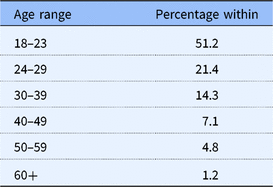
The ages of the respondents can be seen in Table 1. Almost half of the participants can be classified as ‘mature students’, which is notable given that just 31% of the university’s students are 21 or over. Similarly, four of the eight interview participants were mature students, three of whom were postgraduates. The other four interviewees were younger undergraduate students.
Age Range of Survey Participants

Just over three quarters of the survey respondents had attended non-selective schools, whilst 16.5% and 8% had attended selective and private schools, respectively. These figures are in line with school backgrounds of other students in the university (and other post-1992 universities in the UK), who predominantly come from non-selective secondary education and, in this respect, can be said to be broadly representative of the student population of the university.
Findings
The vice chancellor’s perspective
Personal development, confidence, developing cultural and social resources
The vice chancellor firmly endorsed the importance of extracurricular activity commenting that university is not only ‘what happens in the lab or […] in the classroom, but also, what happens outside; that is fundamentally important’. In his view, such activities ‘complement the disciplinary study [and] contribute to making each of us an individual’. Furthermore, he suggested that the university had a role to play in providing access to such experiences.
The point is: this is what you get if you come to XXXX University. This is what you can expect […] this is going to take you to places, either you don’t think existed or to which you certainly didn’t think this university was going to take you […] We’re going to show you this interesting world around you.
Like Lehmann (Reference LEHMANN2012), the vice chancellor advocates institutional support for extracurricular activity. Whilst he does not make explicit remarks about the relationship between such support and students’ social backgrounds, he implies that without institutional backing, some students may lack the confidence to participate independently in such activities. He considers the concert hall experience, which he compares with an expensive restaurant, as a potential vehicle for developing self-confidence.
You walk into a restaurant and there are four forks on this side and six knives on that side and ten spoons on that side and you think, hold on a minute, I’m not used to this. You feel uneasy, you feel uncomfortable. But if you’ve been there already and you realise it’s not the end of the world whichever one you pick up, that’s the inner self confidence. It’s not making a mess of things. It’s the inner self confidence that you can deal with something of the unexpected, that you don’t feel stupid in the environment. So all our students should feel comfortable in walking into such a place, walking into a symphony, being able to comment – ‘actually, I like this a lot, I didn’t like that’.
The vice chancellor also links the notion of confidence with knowledge about classical music, which, he claimed, could help students to ‘feel that they can connect with the world’. Through learning about classical music and the norms of the concert hall, students may develop social and cultural resources they may not have had when entering the university.
This is about getting our students to engage in this sort of world which many of our students will never have touched before they come here. So the driver here is to get our 25,000 students to experience this part of culture that is part of society and culture, basically, being very global […] And to open their minds, to challenge them […] You can engage with it, you can become a better person, you can open up opportunities for yourself, whether it is just career driven or whether it’s just enjoying life.
In his reference to career-driven opportunities, he implies that attending concerts and learning about classical music may perhaps develop the extra-credentials that enhance employability. His intention to include students, who are unlikely to have visited a concert hall in the past, ‘into an existing cultural canon’ (Khan, Reference KHAN2013, p. 365), resonates with Bourdieu’s position that cultural capital should be redistributed, so that marginal groups have access to existing elite environments (Miles & Sullivan, Reference MILES and SULLIVAN2012). In his comparison of learning about the norms of a concert hall to an expensive restaurant, the vice chancellor also suggests that students may acquire embodied cultural capital (Bourdieu, Reference BOURDIEU and Richardson1986).
Thus, the data imply that the vice chancellor conceptualises the value of extracurricular activity in similar terms to the benefits discussed in the literature, i.e., as a means for developing cultural and social resources to potentially steer social and employment networks. Conscious of his students’ social backgrounds, he seems of the opinion that the university has a responsibility in facilitating access to extracurricular opportunities. These views seem underpinned by the notion that classical music, as a form of high or legitimate culture, has a ‘civilising’ role (Khan, Reference KHAN2013, p. 94). Interestingly, they seem to resonate with the arts and cultural policies of New Labour. According to Bennet and Silva (Reference BENNETT and SILVA2006), Labour’s cultural policies linked questions regarding access to cultural resources and opportunities to those of integration of the marginalised into the ‘mainstream’, potentially reinforcing existing hierarchies of culture, rather than valuing culture in a broader sense. Furthermore, the vice chancellor’s view does not seem to recognise that confidence or connections to the world may be developed through other means, rather that it can only be developed through interaction with existing hierarchies.
In our exploration of the student perspective, we investigate how students view the benefits of the pass, whether the removal of price tag incentivises participation, and which other factors may motivate or hinder concert attendance.
The student perspective: influences on and barriers to participation
Age
The demographic data collected would suggest that mature students were more interested in taking up the pass. Interestingly, these findings run contrary to those established by Stuart et al. (Reference STUART2011) who that found that older students are less likely to engage in extracurricular activity. The fact that students were able to attend with a plus one may have helped to remove barriers as they could take along family members rather than leaving them at home. The results can also be explained, however, by Chan and Goldthorpe’s (Reference CHAN and GOLDTHORPE2007) claim about the influence of ends on cultural consumption and their relationship with social status. Younger students are less likely than older ones to view classical concert attendance as a lifestyle choice that enhances status amongst peers. Put simply, classical music does not reflect their popular culture dominated world (Sandow, Reference SANDOW2012), and thus, they are less likely to socially identify with this genre (Rentfrow & Gosling, Reference RENTFROW and GOSLING2003). Leblanc’s (Reference LEBLANC1991) theory of open earedness is also helpful here, which claims that adults are more open to a variety of musical genres when the peer pressures of adolescence have dissipated.
Honing existing cultural and social resources
The influence of existing ‘cultural resources’ on pass uptake is identifiable in the data collected about students’ prior musical education or expressed interest in classical music. 64% of the survey respondents who had some sort of musical educationFootnote 1 requested a pass compared to 36% of those who requested a pass but did not. Twelve respondents within the survey claimed to have applied for a pass as they were already interested in classical music or had an appreciation for the city’s orchestra.
The influence of existing cultural resources was also evident in the interview data. As one of the mature students commented, ‘My husband and myself have long gone to the [orchestra] even though we live quite a long way away […] I would go anyway’.
A younger pharmacy undergraduate explained how ‘even without the pass I would go to the concerts. […] I would travel independently or with family and friends when I was younger.’ In fact, he explained that he had opted to study at the university because of the range of culture on offer within the city. He was a cultural ‘omnivore’ who was grateful for being able to further develop his cultural knowledge: ‘Attending more often, frankly, has been a very different experience. I think you get to know the orchestra and have a better idea why the orchestra selects different pieces and such’.
Two of the interviewees were instrumental musicians. A violinist, who played in the youth branch of the orchestra, was interested in attending when ‘the repertoire that they played was the same as what the youth orchestra do.’ She liked ‘to know what is out there and about different conductors.’ She had attended with people she knew ‘already have interest in classical music’, indicating how both existing cultural and social resources prompted her uptake of the pass.
Similarly, an undergraduate student, who had received a university scholarship for his prior musical achievements, attended concerts with a ‘particular friend who comes from a similar musical background’. He had gone to the launch event for student pass holders, which was ‘fantastic because you could hear the conductor talk privately about the pieces that were going to happen before the performance.’ This student was motivated to visit the concert hall as it was socially, culturally and educationally relevant to him.
A mature undergraduate student with an extensive musical education had made the most of the pass not only to hone her own cultural resources but also to develop these in her children.
There was a poster up about questions with the conductor 10 minutes after that night’s performance. After the interval, I said to Katy [pseudonym]: ‘We’re going to be late getting home. .. Would you like to stay and ask a question? You’ll need to think of a question to ask’. She waited and asked a question. The conductor answered and then sat next to her. ‘What is your name?’ And she said Katy. ‘And how old are you?’ She said ‘seven’ and ‘What is your favourite piece?’ She just said the name of the piece and I really didn’t think that she had been looking at the programme. Now she listens to a CD when she gets home from school putting away her school uniform. That in itself gives me a lot of satisfaction.
The data therefore suggest that those students who were most motivated to attend were already familiar with and had a special interest in classical music. Whilst we cannot claim that they are representative of all students who applied for a pass, this trend implies that that the initiative presented an opportunity to hone existing cultural, and in some cases social resources, rather than breaking down barriers and trying a new musical experience. In line with Stuber’s (Reference STUBER2009, p. 877) findings, these students had existing ‘cultural resources that motivate[d] their participation’ and felt socially at ease in the concert hall as they had either been before, or had friends or family who readily accompanied them. The students represented here also have knowledge of ‘different cultural forms and modes of their appreciation’, to which Chan and Goldthorpe (Reference CHAN and GOLDTHORPE2007) have alluded as means for cultural consumption.
Removal of financial barriers and desire to broaden cultural horizons
Whilst on the one hand, the trends above imply that those with existing cultural and social resources were more likely to seek out a pass, there is some evidence that the access to free tickets also motivated those with lesser financial resources. Eight students in the survey claimed that they had applied for the pass for this reason. Another nine remarked that the pass provided them with an opportunity to attend a cultural event that would otherwise be difficult to afford.
So to some extent, the pass arguably ‘broke down [financial] barriers’, resonating with the rationale for the pass on the university website and the aspirations of the vice chancellor. From our data, however, we cannot be sure to what extent these students were also influenced by their musical education or existing interest in classical music, i.e., which factor was most influential, since the survey did not ask respondents to prioritise their motivations.
Furthermore, there is data that suggest that the provision of the pass prompted some to ‘try a musical experience that they might not have considered previously’. Fifteen of the survey respondents claimed that they had opted for a pass in order to have a new experience or to broaden their horizons. One remarked that it ‘gives me a new experience and something different to do in the week’ whilst another commented how they had applied for a pass ‘to experience the [orchestra] as I had never heard that type of music live before.’ There is a possibility, therefore, that institutional backing of extracurricular activity, as advocated by Stuber (Reference STUBER2009) and Lehman (Reference LEHMANN2012), motivated them to acquire cultural resources that were not pre-existing.
Absence of social support and networking opportunities
The story of a younger undergraduate student, ‘Sarah’, highlights how ‘social resources’ may be equally if not more important than cultural resources in influencing participation. Sarah explained that she had only attended one full concert and then part of another (her friend had fallen ill and they had left early), that she had wanted to go again, but had only one friend who had been interested in going as ‘everyone else thinks that it is not odd, but kind of not their cup of tea really […] I don’t think, based on what I’ve seen, that anyone would want to go really’. She had felt comfortable when she had attended with this particular friend as he ‘is really into classical music and would be able to name everything, and he would be like this instrument … and this instrument …’
At the time of interview, Sarah was no longer in contact with this friend, could not find anybody else to accompany her and did not want to go alone. She would be happier ‘if [she] found more people to go with, to go every month or so and to really make a night of it: to go to have dinner before, dinner afterwards, or to go for some drinks or something’. She was also very conscious of her age in comparison to the rest of the audience: ‘We were the youngest people there and it was really odd … everyone else was all dressed up and we were just like this.’ She felt the age of the audience and the age of those generally perceived to be interested in classical music were barriers to her fellow students, in spite of her own curiosity.
If students don’t have an interest in it they will think, oh it’s just boring old stuff for older people, but no it is not. It can be anything really: […] Yeah, that is what that guy brought to that concert. He was playing classical guitar and he was doing lots of different things […] Yeah, this conductor was kind of interesting to watch. It was good to see that they are passionate about what they are doing.
Sarah’s story shows how, in spite of a desire to try out a new cultural experience and tendency towards cultural ‘omnivoreness’, her confidence was hindered by the absence of social support. She also seemed reluctant to associate herself with a music genre that was not popular amongst her peers (Rentfrow & Gosling, Reference RENTFROW and GOSLING2003). Interestingly, the importance of a social support network to make the most of the extracurricular activity was also highlighted by the students who already had classical music knowledge. The undergraduate violinist wanted to have an ‘opportunity to know people who have the passes to make more friends with people who have similar interests to you […] then you have someone to discuss the music with.’ The undergraduate pharmacy student remarked how ‘at the Freshers’ Fair there was a large base of student-led societies, but there was no theatre appreciation or Thespian group, no literature group or Philharmonic music … It was mostly sports-based.’ He wanted ‘opportunities to connect with fellow students’. Even the student who had been awarded the scholarship for music commented that there was ‘no real camaraderie throughout. You’re kind of individually attending.’
Given that these views came from students who had actually applied for a pass and had attended concerts with friends or family who were similarly interested, it is reasonable to suggest that the need for social support may be even stronger amongst the students who did not apply in the first place. Indeed, it might be inferred that social barriers could present greater obstacles to participation than financial barriers.
Discussion
In exploring our first research question (What were the vice chancellor’s views about the contribution of the pass to student learning outside the classroom, and why did the university support the initiative?), we have learnt that he hoped students would develop cultural and social resources, especially if these are lacking prior to arrival at university. He would like them to acquire knowledge about classical music as a wider educational experience. The cultural and social experience of the concert hall may contribute to personal development and foster confidence, enabling interaction in a variety of future social networks. His intention seems to be to include students who are unlikely to have visited a concert hall in the past, resonating with Bourdieu’s position that cultural capital should be redistributed, so that marginal groups have access to existing elite environments in order to become more socially mobile. Indeed the data suggests that the vice chancellor conceptualised the value of concert hall attendance to the advantages of extracurricular participation in the literature, that is, as a vehicle for developing cultural and social resources to steer social and employment networks.
This position would imply the need to conform to middle class values, where individuals can build social and cultural capital through participation and engagement leading to ‘life improvement’. Problematically, this may also assume that students from working-class backgrounds want to become middle class, and that they enter higher education and the wrap-around experience to meet this aspiration. Furthermore, as Bennett and Silva (Reference BENNETT and SILVA2006) and Miles and Sullivan (Reference MILES and SULLIVAN2012) point out, such assumptions are susceptible of overlooking the important matter of ‘cultural relevance’, or cultural tastes that can be influenced by demographics such as age, a strong theme in the student data that will be addressed again below in relation to students’ motivations.
From a more positive perspective, the vice chancellor seemed very keen to develop students holistically, whereby exposure to new experiences and perspectives can play an important part in acculturation (Quinlan, Reference QUINLAN2011). Whilst the notion of holistic development in higher education has received considerable attention in the United States, there has been comparatively little regard for this in the United Kingdom (Quinlan, ibid). With British universities under increasing pressure to demonstrate value to students and families who are paying higher fees, consideration of holistic development to enhance the ‘student experience’ may indeed be a pertinent issue.
Given the time constraints of the study and the intangible nature of cultural and social resources or holistic development, we have not been able to research in great depth whether the student pass has fulfilled the vice chancellor’s aspirations, especially with regard to future lives. It should also be noted that only 340 students applied for a pass, which represents just 0.01% of the total student population at the university, so these aspirations could only affect a tiny proportion of the 25,000 students.
In response to the second research question, (What motivated students to attend concerts and what did they believe to have gained from this experience?), we have found, in line with findings from Bathmaker et al. (Reference BATHMAKER, INGRAM and WALLER2013), Lehman (Reference LEHMANN2012) and Stuber (Reference STUBER2009), that students with existing resources were more motivated and more adept in honing these further. Indeed, Sarah’s story revealed how difficult it was for a student lacking particular social resources to access the concert hall, in spite of curiosity. It may have been the case that those who experimented with the new cultural experience were more confident and independent than she. However, Sarah’s experiences reveal a potential relationship between degree of confidence in certain social situations and students’ perceived barriers to participation.
Aside from this, students’ motivations seemed shaped by cultural relevance. This is evident in the data implicating greater popularity among mature students. It seems reasonable to deduce that younger students were less enthusiastic since classical music is a genre identified with an older demographic. The pass was probably more attractive to those who had some musical education since cultural tastes or practices are affected by not only age but also habitus (Gale, Reference GALE2011). As Stuber (Reference STUBER2009, p. 897) claims, institutional support may have limited impact, as ‘the habitus that guides students’ approach to the extra-curriculum is relatively durable’. In answering the third research question, (To what extent was this opportunity successful in breaking down the so-called barriers?), therefore, the data suggest that the initiative seemed to break down financial barriers for those who felt confident to enter the milieu of the concert hall. However, it was less successful in breaking down psychological ones for those who did not think they belonged or viewed the social network within as exclusionary. In fact, Sarah seemed less self-assured in re-attending the concert hall following her initial visit, running contrary to the vice chancellor’s aspiration for the initiative to develop confidence.
So what are the implications? Bathmaker et al. (Reference BATHMAKER, INGRAM and WALLER2013, 741) argue that now that educational advantage is no longer just based on exit awards, there is a ‘need for universities to address maximising the experience of university and actively providing opportunities to have “more than a degree”’. Our findings imply that such active consideration involves not only attention to financial constraints but also the influence of habitus and, or, existing social and cultural resources, and how these promote or hinder engagement.
When participation, however, is hampered by lack of student confidence rather than cultural irrelevance, a more staged strategy from the university may be required. This could involve, as a preliminary step, the facilitation of networking opportunities where students become more assured in building bridges and linkages to people and groups outside their immediate circle, i.e., the ‘know-how’ that assists in building social capital (see OECD, 2015). Universities may play a powerful role in assisting students to navigate transitions to young adulthood, exposing them to new experiences and perspectives both in and outside the classroom (Quinlan, Reference QUINLAN2011).
In order to facilitate this, Quinlan (ibid, p. 14) advocates a holistic learning environment where extracurricular activity connects with and extends the classroom experience. This model would perhaps constitute a more effective and structured form of institutional support for extracurricular activity, relevant to students’ interests and less dependent on pre-existing cultural and social resources. Decisions regarding whether such an approach should focus on developing the ‘whole student’, soft skills for the labour market, a combination of both, and how such initiatives should marry with existing pathways of study, will depend on the university’s and students’ priorities. Nonetheless, if a degree is ‘no longer enough’, the university’s role in managing extracurricular activity and widening related participation may well rise on the higher education agenda.