The production of food for human consumption involves complex interactions between social and environmental aspects of the systems (Ericksen, Reference Ericksen2008). These interactions include food production, processing and packaging, distributing and retailing, and consumption (Ingram et al., Reference Ingram, Ericksen and Liverman2010). Significant social, economic, ethical and environmental issues arise from all of these activities. For example, over one billion people lack adequate access to food (Altieri, Nicholls, & Funes, Reference Altieri, Nicholls and Funes2012; Food and Agriculture Organization [FAO], 2012), production methods have resulted in major loss of biodiversity and severely degraded environments (Altieri, Reference Altieri2009, Reference Altieri, Nicholls and Funes2012; Deutsh, Dyball, & Steffen, Reference Deutsh, Dyball and Steffen2013; Gliessman, Reference Gliessman2007), and escalating food prices have led to social unrest in many countries (FAO, 2012; Lang, Reference Lang2010).
One response to these challenges is the discourse of food sovereignty, which argues that food is an indelible human right, thus presenting a radically different way of conceptualising food systems. At its core, food sovereignty asserts the rights of peoples and nations to control their own food systems, including markets, production models, food cultures and environments (Wittman, Desmarais, & Wiebe, Reference Wittman, Desmarais, Wiebe, Wittman, Aurélie and Wiebe2010). From its original focus on peasant farmers in developing nations (Martinez-Torres & Rosset, Reference Martinez-Torres and Rosset2010; Wittman et al., Reference Wittman, Desmarais, Wiebe, Wittman, Aurélie and Wiebe2010), the concept of food sovereignty has spread to developed nations, including Australia. Movements agitating for food system reform in Australia have embraced elements of food sovereignty in a range of initiatives. These include farmer support networks, including farmers’ markets, food co-operatives and small food enterprises, and individual and community garden projects (Australian Food Sovereignty Alliance, 2013). However, in a developed nation context, the primary grounds for valuing food sovereignty initiatives are different to those that hold in a developing nation context. Foremost of these is that in a developed nation context, food sovereignty can develop through urban consumers’ ability to understand the injustices that their food choices have on global food systems.
This discussion paper is situated within the context of food sovereignty in Australia. We argue that the educative value that stems from producing food in Australian urban settings can bring significant benefits to producers and consumers in both developed and developing nations. We contend that learning through urban food production can be a transformative learning experience leading to the development of a critical consciousness of food system challenges more generally. The article offers environmental educators an insight into the nexus between the food sovereignty movement and critical pedagogy theory, with the aim of contributing to further understandings of how environmental educators can be part of the movement towards sustainable food systems.
The article first introduces the two educational theories that are used to situate the arguments throughout the discussion. Following this, we pose the contributions food sovereignty can make towards changing how societies understand and participate in food systems. We then proceed to discuss how Australian urban consumers and producers can build a greater understanding of the socio-political elements of food systems through the transformative learning experiences and critical consciousness developed through urban food production.
Education Theory
Throughout this article, we draw from the notions of transformative learning (Mezirow, Reference Mezirow and Welton1995, Reference Mezirow1997) and critical consciousness (Freire, Reference Freire2013). These theories are used to highlight the educative value of urban food production in Australia and the contributions it makes to food sovereignty.
A transformative learning process allows groups and individuals to develop alternative understandings of the world through meaningful action (Mezirow, Reference Mezirow and Welton1995, Reference Mezirow1997; Taylor, Reference Taylor2007). This action can challenge an individual's ‘frame of reference’: the way in which they understand and engage with the world (Mezirow, Reference Mezirow1997). Although transformative learning is largely used in a formal educational context, it is highly relevant in an urban food production context, as it is direct, personally engaging and reflection-based. These experiences can lead to genuine transformation in thinking (Taylor, Reference Taylor2007), thus contributing towards changes in food system conceptualisation.
Understanding the skills and effort it takes to physically produce food is only one aspect of the learning value derived from activities that bring consumers closer to the realities of food production. Developing deeper ethical concern for, and political engagement with, food systems more generally is another core aspect. This insight is drawn from the work of critical educator Paulo Freire (Reference Freire2013). Freire argues that through understanding the political and ethical ramifications of the system in which people operate (in our case, food systems), action can be taken to influence and shift the governance mechanisms that control that system.
Food Discourses and La Via Campesina
The social inequities and environmental harm inherent in currently dominant industrial food systems have led to critical discussion about how they should be reformed (Ingram, Ericksen, & Liverman, Reference Ingram, Ericksen and Liverman2010; McIntyre, Herren, Wakhungu, & Watson, Reference McIntyre, Herren, Wakhungu and Watson2009). These discussions have generated a debate about whether the guiding framework around which food policies and production systems should be organised is food security or food sovereignty.
The language of food security, defined as when people have physical and economic access to food that meets people's dietary needs as well as their food preferences (FAO, 2012) emerged from high level policy dialogues (Jarosz, Reference Jarosz2011; Pimbert, Reference Pimbert2009). While it is commonly present in food debates, focusing on food security perpetuates the idea that food is a commodity to be accessed from markets (Jarosz, Reference Jarosz2011; Lee, Reference Lee2007, Reference Lee2012). Food security focuses on the availability of food surplus in liberal markets being given priority to intensive agricultural system, while ignoring many environmental ramifications of food production and social justice issues, such as land distribution (Lee, Reference Lee2012). Consequently, focusing on food security as a driver of agricultural policy can result in the task of ensuring people have access to being appropriated by global industrial agri-businesses, as if it were just another market commodity (Carney, Reference Carney2011; Jarosz, Reference Jarosz2011; Kirwan & Maye, Reference Kirwan and Maye2013).
Food security discourse has led to productivist-focused agricultural policies (Lang & Heasman, Reference Lang and Heasman2004). Productivist systems frame consumers as passive, with their sole role in food systems as economic agents selecting products based on price and convenience. Any social or environmental ramifications from their actions is externalised (Lang & Heasman, Reference Lang and Heasman2004). In distinction to this, the food sovereignty discourse asserts that food is a fundamental human right, and thus frames food as more than a market commodity.
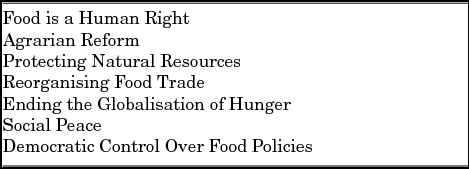
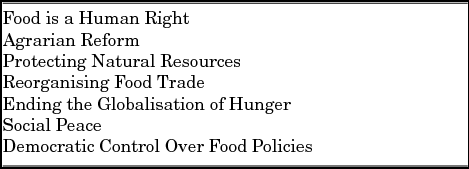
Food sovereignty emerged as a direct critique of the surplus focused ideas of food security. Globally defined by the peasant farmer organisation La Via Campesina (Via Campesina, 1996), food sovereignty has an ethical concern for societies and ecological systems within the principles of food sovereignty (see Table 1). Although quite broad (Patel, Reference Patel2009), the uptake of some of these principles by consumers, producers and policy makers in their food decisions can begin to shift the discourse away from a market-oriented view of food towards a more holistic one.
La Via Campesina's Food Sovereignty Principles (Via Campesina, 1996)
Food sovereignty thus presents an opportunity for a transformative process by requiring critical awareness of equity, social justice and ecological sustainability in food systems (Pimbert, Reference Pimbert2009). Understanding how the two discourses exist in a current Australian context provides the grounding to explore the linkages between the education theories introduced earlier and food sovereignty.
Food Security and Food Sovereignty in an Australian Context
The discourses of both food security and food sovereignty, as presented above, are relevant to the current Australian food system. At a national level, the current visions for food production have been laid out in the Agricultural Competitiveness Green Paper (Commonwealth of Australia, 2014). While some attention is given to environmental sustainability, the document largely perpetuates the focus on high production of staple commodities for international markets. The business-as-usual approach driving agricultural systems focused on high production and exports acts as another example of food policies operating within competitive productivism and neoliberal ideologies (Dibden, Potter, & Cocklin, Reference Dibden, Potter and Cocklin2009; Lawrence, Richards, & Lyons, Reference Lawrence, Richards and Lyons2013; Rose, Reference Rose2012; Rose & Davila, Reference Rose and Davila2013).
As a means of creating alternatives to these productivist systems, a range of civically organised groups have emerged throughout Australia. For example, the Australian Food Sovereignty Alliance mobilised active food citizens with interests in the political elements of food systems to build a People's Food Plan (Australian Food Sovereignty Alliance, 2013). This plan follows the principles of food sovereignty as a means of focusing on food as more than a market commodity through creating understanding of the ethical, cultural and ecological ramifications of productivist food systems (Rose, Reference Rose2013).
To discuss the food sovereignty discourse in practice, we explore urban food production systems in Australia. Urban food consumers in Australia can play a crucial role in shifting the thinking and practice of food systems through building greater understanding of their food choices. This suggests potential links between food sovereign individuals in affluent urban contexts and the educational value they gain from engaging in urban food production practices.
In developed country urban contexts, the majority of people consume food that is produced by others in landscapes that are likely to be distant to them (Burton et al., Reference Burton, Lyons, Richards, Amati, Rose, Desfours and Barclay2013). This has led to a growing disconnect between urban dwellers and the origins of their food (Dixon, Reference Dixon2011). This disconnect can be partially addressed through urban dwellers engaging in food-growing practices in urban settings, where they can develop an understanding of what food growing entails. Furthermore, it has the potential of generating greater awareness of the impact agricultural policy has in foreign landscapes, leading to the development of critical consciousness in urban food producers.
To contextualise the educative value of food production in an urban context, we outline a series of examples through which this can occur within existing Australian urban production systems. The undoubted benefits that urban food production can provide to urban poor in developing nations where they can have secure sovereign rights over food they produce themselves is not immediately transferable to a developed urban context, as in Australia. For example, a significant proportion of the world's two billion peasant farmers are in developing countries, with a majority of them living in semi-subsistence levels (Falvey, Reference Falvey2010).
In Australia, it is unlikely that affluent but time-poor urban consumers will produce sufficient food to meet their basic dietary needs (i.e., sovereign production of their immediate food security). If the cities’ rural hinterlands, understood as the agricultural regions surrounding them, is taken into account, much greater degrees of self-sufficiency are possible for key ‘traditional’ produce, such as lamb and beef, wheat and apples (Deutsh, Dyball, & Steffen, Reference Deutsh, Dyball and Steffen2013). However, even where a city can provide the sufficient calorific requirement of its population, it remains unlikely that urban consumers would be satisfied with it. Habituated expectation of year-round choice, including for exotic produce that the region cannot produce, low price and convenience of food, would see consumers unwilling to restrict their diets to the seasonally available produce of their immediate region.
Like many other affluent nations, the primary health-related problem faced by Australia's urban poor in relation to food is over-consumption of a narrow range of highly processed fatty, sugary and salty foods leading to obesity and a range of cardiovascular problems (Barosh, Friel, Engelhardt, & Chan, Reference Barosh, Friel, Engelhardt and Chan2014; Dixon et al., Reference Dixon, Omwega, Friel, Burns, Donati and Carlisle2007). In this regard, it is not so much that healthy alternatives are not physically available, but a complex mix of socio-economic factors, including marketing, affordability and social expectations that make unhealthy food choices appear comparatively affordable and convenient.
Urban Food Systems
Urban food production systems are emerging as an alternative that have been labelled by some as contributing towards greater understanding of food systems in urban dwellers (Burton et al., Reference Burton, Lyons, Richards, Amati, Rose, Desfours and Barclay2013; Hansen, Reference Hansen, Wittman, Desmarais and Wiebe2012; Prime Minister's Science, Engineering and Innovation Council [PMSEIC], 2010). Not only can urban food production spaces enhance understanding of food production, they can also provide opportunities for radical social and political change (Burton et al., Reference Burton, Lyons, Richards, Amati, Rose, Desfours and Barclay2013). Participation in urban food production also has benefits in terms of active lifestyle, community engagement and appreciation of fresh, wholesome food. Advocates of urban food systems are probably on stronger ground when they promote these benefits than to argue on the basis of the total volumes urban food systems in affluent countries are likely to yield. When considered as a percentage of the total volumes the urban population consumes, production from urban food systems is likely to be very small. It is certainly not going to meet an affluent urban population's expectations for year-round availability of food choices, including food stuffs that the region is environmentally or climatically incapable of growing. It seems inevitable, and probably both environmentally and socially desirable, that the bulk of food consumed in cities is produced by efficient farmers from outside the urban area. Rather than seek to grow all their own food, urban consumers should recognise their dependency on these remote farmers and adequately reward those who are providing them with sustainably produced healthy food (Deutsh et al., Reference Deutsh, Dyball and Steffen2013; Pearson & Dyball, Reference Pearson, Dyball, Pearson, Newton and Roberts2014; Porter, Dyball, Dumaresq, Deutsch, & Matsuda, Reference Porter, Dyball, Dumaresq, Deutsch and Matsuda2013).
Despite a strong agricultural production history, there has been little research on the extent of urban-based production in Australia (Larder, Lyons, & Woolcock, Reference Larder, Lyons and Woolcock2014). There are, however, documented examples on the contributions that urban gardening systems bring to knowledge, awareness and community building in an Australian context (Burton et al., Reference Burton, Lyons, Richards, Amati, Rose, Desfours and Barclay2013; Edwards & Mercer, Reference Edwards and Mercer2010; Lyons, Richards, Desfours, & Amati, Reference Lyons, Richards, Desfours and Amati2013; Mason & Knowd, Reference Mason and Knowd2010). Gardens in which communities collaborate to grow food exist in a wide array of forms, from school programs to prisons, collectively owned land or guerrilla gardening in single plots of land (Lyons et al., Reference Lyons, Richards, Desfours and Amati2013; Pudup, Reference Pudup2008). These spaces for food systems offer opportunities for citizens to participate in the range of elements that are present in food systems, such as production, picking, distribution and consumption (Lyons et al., Reference Lyons, Richards, Desfours and Amati2013). Urban food production systems, however, are limited by citizens’ knowledge, financial commitment and time availability to take part.
The contribution to learning and understanding food systems that Australian urban food production makes has been recently studied. For example, Edwards and Mercer (Reference Edwards and Mercer2010) collated the research experiences from mapping food production in the urban Melbourne setting, finding that there are a range of emerging landscapes within the city that can continue to grow and manifest themselves as elements of localised food systems. Similarly, other studies in Melbourne explored the socio-political, economic and ecological opportunities that urban food systems offer (Lyons et al., Reference Lyons, Richards, Desfours and Amati2013), and the contributions they bring to urban resilience and addressing vulnerability (Burton et al., Reference Burton, Lyons, Richards, Amati, Rose, Desfours and Barclay2013). Mason and Knowd (Reference Mason and Knowd2010) argue that the growing popularity of urban food systems in Sydney offers an opportunity for urban dwellers to create alternative food systems within the constraints of the Australia productivist and neo-liberal oriented food system. At an educational curriculum level, the Stephanie Alexander program offers an opportunity for schoolchildren to learn and engage with learning about food, some of which takes place in urban schools (Block et al., Reference Block, Gibbs, Staiger, Gold, Johnson, Macfarlane and Townsend2012). Canberra is rapidly developing spaces where urban dwellers can rent patches of land and grow produce outside their homes (Pialligo Garden Plots, 2013). Similarly, the Brisbane-based program, Food Connect, has provided an opportunity for urban dwellers to access food directly from growers from the surrounding regions, minimising value chains and creating closer linkages between producers and consumers (Kelly, Reference Kelly2010). Irrespective of the total volumes produced by these initiatives, their presence in the landscape provides the broader community a picture on the environmental and social realities of food production.
Discussion
Urban agricultural systems form part of the food sovereignty movement, where people have control over their immediate landscape, making decisions on what to grow and how to grow it, and with the potential of developing informal food distribution systems with neighbours and communities (Burton et al., Reference Burton, Lyons, Richards, Amati, Rose, Desfours and Barclay2013; Hansen, Reference Hansen, Wittman, Desmarais and Wiebe2012). The lessons that can be learnt from urban gardens are valuable for understanding the social justice issues within the broader food system, and the active participation and control of citizens over their immediate food systems fit well within the food sovereignty principles (Hansen, Reference Hansen, Wittman, Desmarais and Wiebe2012). Throughout this section, we embed the theories of transformative learning and critical consciousness into the practice of urban production, highlighting the educative value and the contributions to food sovereignty in an Australian context.
Throughout the world, innovative farmers are regenerating degraded landscapes and transforming the currently unsustainable systems of food production into sustainable ones (Altieri, Reference Altieri, Nicholls and Funes2012; Altieri & Toledo, Reference Altieri and Toledo2011; for some examples, see Altieri, Reference Altieri2009; Gliessman, Reference Gliessman2007; Gliessman & Rosemeyer, Reference Gliessman and Rosemeyer2010; for Australia, see Soils for Life, 2012). However, to sustain this transformation, these farmers will require the ethical concern and action of the urban consumers who have the power to purchase these products and to politically support their efforts more generally.
Urban food production systems create opportunities for informal learning and experience sharing, thus acting as important pedagogical sites (Walter, Reference Walter2012). Through the action of growing food and understanding the linkages that exist throughout food systems, urban dwellers can develop broader, including global, awareness of social and ecological injustices in food systems. This can give rise to active ecological citizens (Dobson, Reference Dobson2003) in the form of consumers who contest industrial commodification of food systems.
Ecological citizens are concerned about the implications that their actions have on the environment, as well as food producers in their immediate region and abroad (Dixon, Reference Dixon2011; Kneafsey, Dowler, Lambie-Mumford, Inman, & Collier, Reference Kneafsey, Dowler, Lambie-Mumford, Inman and Collier2013). The involvement of these critically aware consumers extends beyond mere economically rational choice-making, and takes the form of political activism concerned with rights, expectations and obligations around the governance of food systems. It is through this engagement with the politics and governance of food that food sovereignty becomes relevant in urban Australian contexts.
Awareness and understanding develops through meaningful action. As posed earlier, transformative learning takes place when individuals meaningfully participate in activities that allow them to challenge their existing frames of reference (Mezirow, Reference Mezirow1997). Growing food in Australian cities can create a transformative experience for people who would otherwise be passive consumers of industrial food systems. The resulting shift in worldview leads to new awareness of food choices made in urban settings and a fundamental reconceptualisation of the individual's role and responsibility in food systems.
Although Australian urban producers will inevitably depend on global food chains for some of their food intake, their critical understanding of the social and ecological issues of their consumption preferences will generate demand for ethically and environmentally sound products from these global markets. This outcome is directly in line with the food sovereignty discourse, which calls for people to have the capacity to decide and influence their food systems.
The links between growing food and understanding the global injustices of food systems, however, may not be clear initially. Making this connection requires significant effort from the urban consumer to educate themselves through peer growers and alternate food system groups in their area. This social process of urban production enhances the opportunity for developing a critical consciousness over food systems. The food sovereignty discourse acknowledges that changing farming practices will be insufficient to address the social, economic and environmental issues associated with global food systems.
Political action needs to be taken to transform the neoliberal, business-as-usual agricultural policies that exist worldwide. Of course, not every urban gardener is interested or able to make this broader political connection. For such individuals, the value of urban food production would lie in areas such as the health benefits of active living, community involvement and the pleasure of growing some part of what you eat. These are all valid grounds for defending urban food projects. The argument here is that by linking to broader education outcomes, urban food projects have a much greater potential for important social learning. Furthermore, community movements have an important role in fostering social change by trialling new systems of production and new ways of understanding. Although small scale, these prototypes can prepare the ground for future adoption by the broader society, including by inherently conservative formal institutions of governance (Fischer et al., Reference Fischer, Dyball, Fazey, Gross, Dovers, Ehrlich and Borden2012).
Urban food systems can thus provide an educative contribution to positively facilitate consumers’ development of ecological citizenship. Through consumer awareness of their relationship with, and concern for, local food systems, political support for minimum social and environmental standards can be extended to all the food-producing landscapes and producers, wherever these landscapes and producers are. The argument is that engaged ecological citizens who demand local sustainable food systems would extend principles of rights and standards to all landscapes.
Given the nature of the dominant visions for agricultural development in Australia, it is imperative that critical consciousness rapidly filters across Australian thinking in order to challenge the business-as-usual ideas posed within it. We contend that the growing trend in availability of urban food production systems in Australian cities can contribute the educative value necessary to form part of this process.
Sustainability educators can form part of this movement through encouraging students and peers to critically understand the food systems they are connected with. The use of Freire's (Reference Freire2013) critical consciousness framework can be embedded into a range of education programs that focus on food education. Educators can embed political theory, environmental sustainability and social justice issues into food curricula to allow students an opportunity to understand the current injustices in food systems. This would allow for formal education settings to promote students’ ability to critically reflect on food systems and take purposeful action, one of which can be through promoting transformative experience for others through urban food production systems.
Further to this, critical consciousness can take place without educators being involved in the process. This is inherently more difficult, as learners may face barriers in understanding the systemic environmental and social implications of their food choices. This can, however, be generated through the collective action of food production and by creating a transformative group experience in urban settings, allowing for sharing of knowledge to occur and contributing toward greater critical consciousness.
Concluding Remarks
Despite having a highly productive agricultural system, Australia still has a lot to learn about fair, just and ecologically sustainable food systems. The food sovereignty discourse proposed by La Via Campesina has elements that Australian consumers and urban food producers can learn from, as part of the movement requires change in food systems. We have argued that urban dwellers can help this movement rapidly expand if transformative learning and critical consciousness occurs through the action of urban food production.
This learning can take place through the actual practice of growing food and developing understanding of the intricacies of food production. If practised in a shared context, experiences from a range of urban gardeners allows for greater collective insights into what sustainable food production systems may look like. The challenge lies in making the leap from merely producing food to developing critical awareness of the global injustices that exist in food systems. These injustices are thoroughly exposed by the food sovereignty discourse, which generated largely from developing country contexts, but has since generated action towards alternative food systems in developed countries, including Australia.
Sustainability educators, at all education levels, can facilitate the links between understanding food production and the global ramifications of food choices. This can range from within-curricula education of the systemic implications of urban food consumption practices, to extra-curricular education for urban food producers in the form of informal discussion groups and reading groups or through sharing sessions.
Education has a potentially transformative value and the ability to foster critical awareness of particular issues. In what is, and will remain, an interconnected world, the actions that both peasant La Via Campesina farmers and urban Australian consumers and producers take to influence policy makers will continue to give momentum to challenging business-as-usual models of food systems. The food sovereignty discourse can exist in different socio-political contexts, but strive towards the same goal of just and ecological sound food systems throughout the world.
Critical awareness of food systems is imperative if the discourse of food sovereignty is to gain traction in Australian urban settings. Urban Australian landscapes are beginning to meet some of the food sovereignty principles, allowing citizens to control their food production systems and food choices, and have autonomy and sovereignty over their immediate food growing areas. Although these urban practices are unlikely to meet the food requirements of the Australian population in total outputs of food produced, they can act as catalytic places where social and political action can begin to gestate. It is this social and political understanding of food systems that the food sovereignty discourse calls for if it is to challenge the market-oriented notions of food as a commodity that exist in the current Australian agricultural policy context.
Acknowledgments
We would like to thank Thomas Sloan for his extensive feedback throughout the writing process. We would also like to thank the two reviewers for their valuable insights and contributions.
Author Biographies
Federico Davila is a Human Ecology PhD Scholar at the Fenner School of Environment and Society. He holds a Master of Environment (Research) and a Bachelor of Interdisciplinary Studies (Sustainability). Federico's research areas include food security and food sovereignty interactions in a developing country context, with a focus on smallholder farmers and sustainable development. He is also involved in teaching undergraduate courses at the Fenner School of Environment and Society, and remains engaged in a series of sustainability education projects.
Robert Dyball convenes the Human Ecology program in the Fenner School of Environment and Society at the Australian National University. His current research centres on the application of dynamic systems thinking to problems in Human Ecology and Sustainability Science more generally. He is involved in a range of projects that focus on Sustainable Cities, in collaboration with the University of Tokyo, National University of Singapore and the University of Copenhagen as part of the International Alliance of Research Universities (IARU). This cluster of projects takes the vulnerability of cities to processes affecting global food security as a central theme. He is also involved with a range of activities around Education for Sustainability, and is particularly interested in linking teaching about sustainability with the University's campus management practices in order to engage students in practical and applied research. Robert is President of the international Society for Human Ecology (SHE) and hosted the SHE conference at the ANU in February 2013, jointly with the International Conference on Sustainability Science in Asia (ICSS-Asia). Robert is Ex-Chair of the Human Ecology Section of the Ecological Society of America (ESA). He has also been academic advisor to Australasian Campuses Towards Sustainability (ACTS). He has been awarded an Australian Learning and Teaching Council (then ‘Carrick’) citation for Outstanding Contribution to Student Learning.