Clostridioides difficile infection (CDI) affects >450,000 people annually in the United States, leading to 30,000 deaths.Reference Lessa, Mu and Bamberg1 Of those with CDI, ~15% progress to severe disease and 20% have CDI recurrence.Reference Hensgens, Dekkers, Goorhuis, LeCessie and Kuijper2–Reference McFarland, Surawicz, Rubin, Fekety, Elmer and Greenberg4 The optimal laboratory diagnosis of CDI remains unresolved; several available testing modalities vary in cost, timeliness, and diagnostic accuracy.Reference Kufelnicka and Kirn5 The most recent guidelines from the Infectious Disease Society of America (IDSA) and the Society for Healthcare Epidemiology of American (SHEA) recommend an algorithmic approach, wherein toxin tests and nucleic acid amplification testing (NAAT) are assigned specific roles.Reference McDonald, Gerding and Johnson6
A standalone NAAT for CDI offers a fast turnaround time as well as high sensitivity and specificity for detection of C. difficile in the stool, compared to other testing modalities.Reference Deshpande, Pasupuleti and Rolston7,Reference Peterson, Manson and Paule8 However, a standalone NAAT with no institutional criteria for submitting stool specimens can potentially overdiagnose patients who are colonized with C. difficile and may lead to unnecessary treatment.Reference Polage, Gyorke and Kennedy9 Although qualitative standalone NAAT assays may have low value in predicting clinical outcomes, quantitative polymerase chain reaction (PCR) leveraged through toxin B amplification cycle threshold (Ct) values may offer additional predictive value.Reference Dionne, Raymond, Corbeil, Longtin, Gervais and Longtin10 Several studies have shown that PCR Ct values inversely correlate with C. difficile toxin burden and/or toxin-positive disease and can be used as a predictor of poor outcomes of CDI.Reference Kamboj, Brite and McMillen11–Reference Hitchcock, Holubar, Hogan, Tompkins and Banaei17 However, the data supporting the use of PCR Ct are limited, and results vary regarding the ability of PCR Ct to accurately predict severe disease, recurrence, or mortality.Reference Davies, Planche and Wilcox12,Reference Truong, Schroeder and Gaur18
In this study, we sought to determine the association between PCR Ct values and CDI disease severity, recurrence, and mortality among adult patients with hospital-onset CDI.
Methods
Design and study population
This single center, retrospective cohort study included all adult patients (aged ≥18 years) admitted to Cleveland Clinic, a tertiary-care hospital, from June 2014 to September 2015, who were diagnosed with hospital-onset, healthcare facility-associated (HO-HCFA) CDI. CDI was defined as the presence of diarrhea (≥3 unformed stools in 24 hours) or toxic megacolon (radiological documentation of abnormal dilation of the large intestine) with a positive stool result using a Simplexa C. difficile Universal Direct PCR assay (Focus Diagnostics, Cypress, CA). The highest Ct considered positive by the Simplexa assay according to the manufacturer is 40. The institutional criteria for testing stool samples for CDI included the presence of unformed stools with no prior test for CDI within the previous 7 days. Patients with a history of CDI diagnosed within the past 8 weeks or with unresolved, ongoing CDI were excluded from the cohort. HO-HCFA CDI was defined as CDI in which diarrhea symptom onset and/or specimen collection was performed on or after hospital day 4 with the date of admission indicated as day 1, or within 4 days of discharge with discharge date as day 1. The Cleveland Clinic Infection Prevention internal surveillance database was used to identify patients with HO-HCFA CDI. The study was approved by the institutional review board of the Cleveland Clinic, Cleveland, Ohio, with a waiver of informed consent.
Data collection
Demographics and clinical characteristics, including relevant comorbid conditions, laboratory data, exposure to antibiotics and immunosuppressive agents, CDI treatment, and outcomes (ie, severity of CDI, colectomy, 30-day all-cause mortality, and recurrent CDI), were retrospectively collected for all patients using a standardized data collection form. Previous antibiotic exposure was defined as any systemic antibiotic therapy within 90 days before the current admission, and concurrent antibiotic use was defined as any systemic non-CDI antibiotic use for up to 7 days after the diagnosis of CDI. PCR Ct values for each patient were obtained separately through the Department of Laboratory Medicine at the Cleveland Clinic after all other data collection was completed to ensure that Ct value did not influence data extraction. Independent infectious diseases specialists (uninvolved in primary data collection and blinded to Ct results) reviewed 30-day mortality cases and adjudicated CDI-attributable mortality independently. We decided a priori not to include patients or episodes of CDI if they did not have sufficient information or had no traceable follow-up data after hospital discharge.
Outcome definitions
Recurrent CDI was defined as an episode of CDI that occurred ≤8 weeks after the onset of a previous episode and for which an effective course of therapy for CDI was completed. Severe infection was a CDI case with an elevated white blood cell count (≥15,000 cells/mL) or elevated serum creatinine (≥1.5 times baseline) creatinine. Severe–complicated infection was a defined as CDI case associated with hypotension or shock, ileus, and/or megacolon. All definitions were adopted from Clinical Practice Guidelines by IDSA/SHEA.Reference Cohen, Gerding and Johnson19
Statistical analysis
Univariate associations between continuous and categorical patient measures including severe complications (yes or no), 30-day mortality (yes or no), 8-week recurrence (yes or no), and CDI complication classifications (mild, severe, or severe–complicated) were tested using either the χ2 test, the Fisher exact test, analysis of variance (ANOVA), or the Kruskal-Wallis test. Box plots were used to illustrate the differences in mean Ct values between patients for 8-week recurrence, 30-day mortality, and the presence or absence of a severe complication. Univariate and multivariable logistic regression methods were used to examine the relationships between Ct values and CDI severity, 8-week recurrence, and 30-day mortality. The optimal Ct cutoff value was also determined after the receiver operating characteristic curves (ROCs, using the maximum sums of specificity and sensitivity as cutoffs) were assessed. For the multivariable logistic regression model analyses, the variables of interest for associations with 8-week recurrences were Ct value (continuous variable), age ≥65 years, Charlson comorbidity index, previous inpatient length of stay (if hospitalized in the past 90 days), history of CDI, ratio of highest creatinine to baseline creatinine, fluoroquinolone exposure in the past 90 days, and concurrent use of non-CDI antibiotics after diagnosis of CDI. For 30-day mortality, the variables of interest were Ct value (continuous variable), age ≥ 65 years, Charlson comorbidity index, fluoroquinolone exposure in the past 90 days, minimum albumin within 4 days of infection, ratio of highest creatinine to baseline creatinine, hypotension and/or shock within 4 days of CDI, and maximum WBC within 4 days of infection. For severe complications, the variables of interest were Ct value (continuous variable), age ≥65 years, Charlson comorbidity index, minimum albumin within 4 days of infection, ratio of highest creatinine to baseline creatinine, hypotension and/or shock within 4 days of CDI, and maximum WBC within 4 days of infection. The regression diagnostic methods of variance inflation factors and condition indices were used to test these variables for independence relative to one another. Any variable with a variance inflation factor or a condition index <10 was considered to exhibit an acceptable level of independence from the other variables in the analysis and was retained. For 8-week recurrence, previous hospital length of stay was not sufficiently independent from the other variables and was excluded from that multivariable analysis. Logistic regression methods were used in the multivariable analysis to identify terms that were statistically significant. Unadjusted and adjusted odds ratios (aORs) and their corresponding 95% Wald confidence intervals (CIs) were calculated to determine the associations. A 2-sided P < .05 was considered statistically significant.
Results
In total, 409 patients with HO-HFA CDI were identified, of whom 91 patients were excluded: 72 did not have their Ct values recorded and the remaining patients did not meet the inclusion criteria. The final cohort included 318 adult patients, among whom 51% were male and the mean age was 62 years. Table 1 shows the overall demographic characteristics, underlying comorbidities, treatment and outcomes for the entire cohort and compares between patients with and without 30-day all-cause mortality. Two-fifths of the patients had been hospitalized within the past 90 days, 8.5% had a previous history of CDI, and more than half (53%) had had an intensive care unit (ICU) stay in the month preceding CDI. The common antibiotic exposures in the past 90 days included cephalosporins (48%), piperacillin-tazobactam (48%), and fluoroquinolones (37%). Most patients had concurrent non-CDI antibiotic exposure (54%) after diagnosis of CDI. The median hospital length of stay (LOS) was 17.5 days, with a median LOS after CDI diagnosis of 7 days. The mean Ct value for all positive study samples was 32.9 (range, 23–40). A box plot showing the distribution of the Ct values is available in Supplementary Fig. 1 (online).
Demographic and Clinical Characteristics of the Patients With Hospital-Onset, Healthcare Facility-Associated (HO-HCFA) CDI and 30-Day Mortality

Note. SD, standard deviation; IQR, interquartile range; CDI, Clostridioides difficile infection; LOS, length of stay; WBC, white blood cell; Cr, creatinine; ICU, intensive care unit.
a 299 had 30-day follow-up data available. Ct, cycle threshold.
b Charlson comorbidity index is age adjusted.
c Dialysis-dependent subjects were excluded.
CDI severity
In our cohort, 103 (32%) patients developed severe CDI and 35 (11%) patients developed severe–complicated CDI. Complications attributed to CDI included ileus in 34 patients, hypotension and/or shock in 25 patients, and colectomy in 2 patients. The mean Ct values ± standard deviation (SD) were not significantly different across the 3 CDI groups: mild-to-moderate (33.1 ± 3.7), severe (32.7 ± 3.6), or severe–complicated (32.3 ± 3.0; P = .41). The mean Ct value was also not significantly different when patients were grouped as with (severe and severe–complicated) and without complications (32.6 ± 3.4 vs 33.1 ± 3.7; P = .23) (Supplementary Fig. 2a online). In the multivariate model after adjusting for other variables, the variables that remained independently associated with severe complications were age > 65 years (OR 0.45, 95% CI, 0.21–0.98; P = .04), maximum WBC count within 4 days of CDI (OR, 1.35; 95% CI, 1.24–1.47; P = .04), and hypotension and/or shock within 4 days of CDI (OR, 6.09; 95% CI, 1.45–25.56; P = .01) (Supplementary Table 1 online).
Mortality
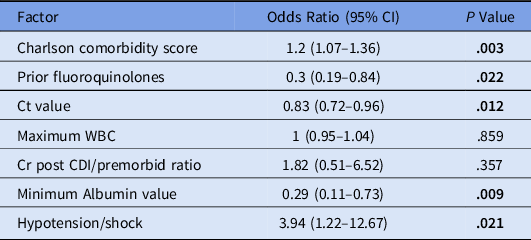
In total, 299 patients had 30-day follow-up data available. Of those, 33 patients (11%) died within 30-days of the initial diagnosis of CDI. Adjudication by infectious disease specialists identified the 30-day CDI attributable mortality rate to be 2.3% (n = 7). The univariate comparison between patients with and without mortality is depicted in Table 1. CDI patients with 30-day mortality tended to be older (69.6 ± 13.6 vs 60.7 ± 16.5 years), to be sicker, and to have higher Charlson comorbidity index scores (10.1 ± 4.5 vs 7.6 ± 3.8). The mean Ct value (±SD) was lower in patients with 30-day mortality compared with survivors (31.5 ± 2.5 vs 33.0 ± 3.7; P = .003) (Supplementary Fig. 2b online). In the multivariate model after adjusting for other variables, the remaining significant variables independently associated with 30-day mortality were Charlson comorbidity score (OR, 1.20; 95% CI, 1.07–1.36; P = .003), prior fluoroquinolones (OR, 0.3; 95% CI, 0.11–0.84; P = .022), minimum albumin levels within 4 days of CDI (OR, 0.29; 95% CI, 0.11–0.73; P = .009), hypotension and/or shock within 4 days of CDI (OR, 3.94; 95% CI, 1.22–12.67; P = .02), and Ct value (OR, 0.83; 95% CI, 0.72–0.96; P = .01) (Table 2). Based on the receiver operating characteristic (ROC) curve, a cutoff point of Ct ≤ 34.1 was identified (C-statistic = 0.61) (Supplementary Fig. 3a online).
Multivariable Regression Analysis for 30-Day All-Cause Mortality

Note. CI, confidence interval; WBC, white blood cell count; Cr, creatinine; CDI, Clostridioides difficile infection. Bold indicates statistical significance.
CDI recurrence within 8 weeks
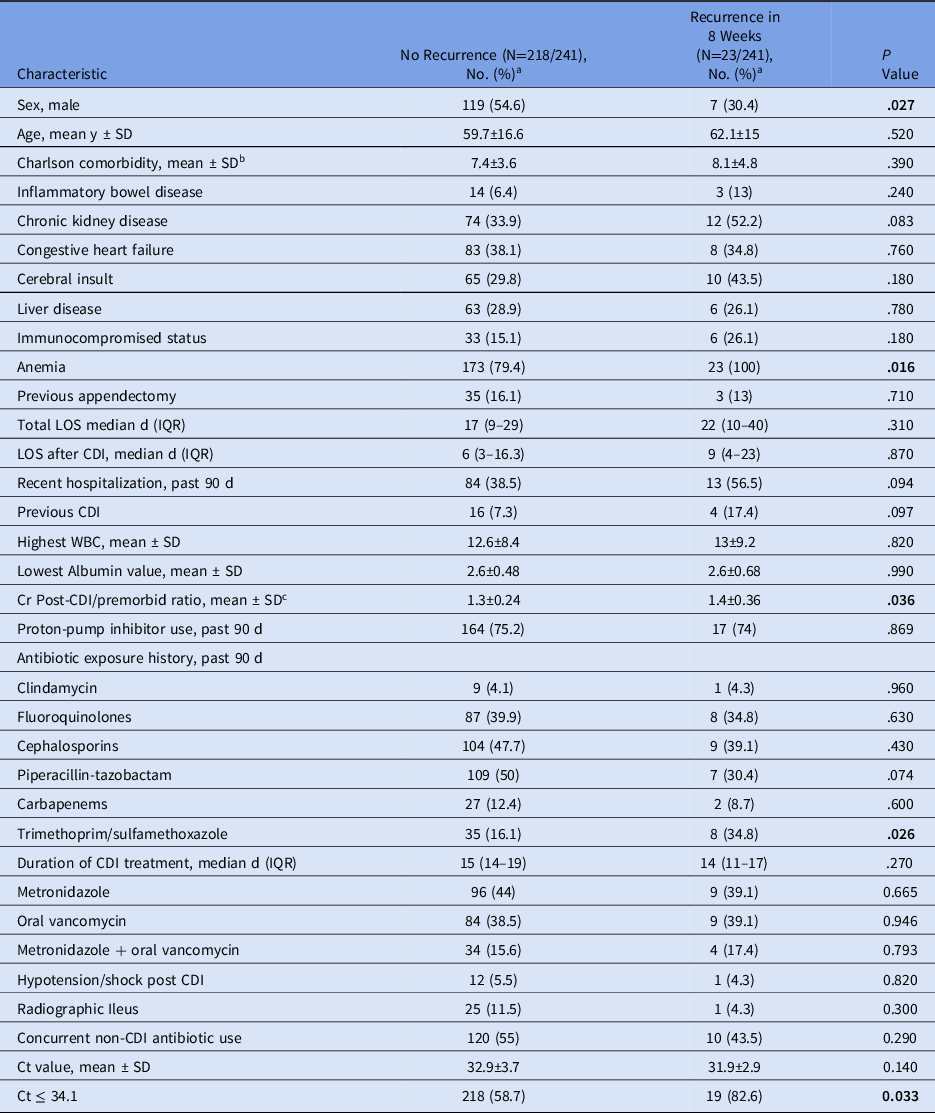
In total, 241 patients had 8 weeks of follow-up data available. Of those, CDI recurrence occurred in 23 (9.5%) patients within 8 weeks of index CDI. The mean Ct value was not significantly different in patients with 8-week recurrence compared to patients with no recurrence (31.9 ±2.9 vs 32.9 ±3.7; P = .17) (Supplementary Fig. 2c online). The univariate comparison between patients with and without recurrence is depicted in Table 3. In the multivariate model after adjusting for other variables, the only significant variable that was independently associated with 8-week recurrence was the ratio of highest creatinine to baseline creatinine (OR, 6.52; 95% CI, 1.49–28.60; P = .013) (Table 4). Based on the ROC, a cutoff point of Ct ≤ 34.1 was identified (C-statistic, 0.60) (Supplementary Fig. 3b online).
Clinical Characteristics of the Patients With 8-Week CDI Recurrence

Note. CDI, Clostridioides difficile infection; SD, standard deviation; IQR, interquartile range; LOS, length of stay; WBC, white blood cell; Cr, creatinine. Bold indicates statistical significance.
a 241 had 8-week follow-up data available.
b Charlson comorbidity was age-adjusted.
c Dialysis-dependent subjects were excluded.
Multivariable Regression Analysis for 8-Week Recurrence

Note. CI, confidence interval; Cr, creatinine; CDI, Clostridioides difficile infection. Bold indicates statistical significance.
Discussion
The laboratory diagnosis of CDI remains a subject of ongoing debate. Current IDSA/SHEA guidelines recommend choosing appropriate testing methods depending on whether there are prespecified criteria that limit inappropriate testing in the hospital or institution.Reference McDonald, Gerding and Johnson6 Although standalone NAAT has a quick turnaround time with high sensitivity and specificity compared to the other tests, NAAT assays risk overdiagnosis, which can lead to unnecessary treatments and undue burden on patients.Reference Polage, Gyorke and Kennedy9 The use of PCR Ct to quantify C. difficile burden (and, subsequently, to predict outcomes of CDI) has been studied, with mixed results.Reference Davies, Planche and Wilcox12,Reference Origüen, Orellana and Fernández-Ruiz13,Reference Reigadas, Alcalá, Valerio, Marín, Martin and Bouza15,Reference Hitchcock, Holubar, Hogan, Tompkins and Banaei17,Reference Jazmati, Hellmich, Ličanin, Plum and Kaasch20 In our study, among 318 patients with HO-HFA CDI, PCR Ct values at the time of diagnosis were not independently associated with CDI severity or recurrence within 8 weeks but were independently associated with 30-day all-cause mortality.
At least 2 previous studies have reported that lower PCR Ct values are associated with increased risk of 30-day mortality, and 1 study has reported that Ct values are not associated with all-cause mortality. In a 2017 study that evaluated 1,650 stool samples, Garvey et alReference Garvey, Bradley, Wilkinson and Holden21 reported that the mean Ct of all samples was 27.1 and that Ct values of ≤26 were associated with a significantly increased risk of 30-day all-cause mortality. In a larger study using 8,853 diarrheal samples, Davies et alReference Davies, Planche and Wilcox12 reported that CDI patients who died had lower Ct values than survivors (25.5 vs 27.5; P= .02) and that patients with Ct ≤ 25 had a 1.45 times greater risk of mortality than patients with Ct > 25. In our study, although CDI patients with 30-day mortality had lower Ct values than survivors, the mean Ct values were considerably higher (31.5 vs 33; P = .03). For each unit decrease in Ct, the odds of 30-day mortality increased by only 17%, even after adjusting for confounding variables. In a 2015 study, Rao et alReference Rao, Micic and Natarajan22 evaluated 1,144 CDI patients with a median Ct of 34.1 and did not find a significant association between Ct values and 30-day all-cause mortality. Some of the differences in Ct values could be attributable to different underlying patient populations and testing algorithms, including the specific PCR testing platform and assays used. Also, our patient cohort was generally sicker, with lower serum albumin and higher WBC count, 2 factors that have previously been associated with increased risk of mortality in patients with CDI. A few studies have suggested that Ct values can be provided routinely along with CDI laboratory test results to assist with clinical decision making, that is, to identify patients who are at increased risk for 30-day mortality. However, in our study, the mean Ct values among patients with and without 30-day mortality were not large enough to be clinically meaningful for important clinical decision making. Larger prospective multi-institutional studies across different patient populations may be needed to further evaluate this factor.
The role of PCR Ct in predicting CDI recurrence within 8-weeks also appears to be controversial. In our study Ct values were not independently associated with recurrence of CDI within 8 weeks. This finding appears to be in agreement with at least 2 previous studies (ie, Davies et alReference Davies, Planche and Wilcox12 and Kamboj et alReference Kamboj, Brite and McMillen11) that reported nonsignificant differences in mean Ct values among patients with and without recurrence. In contrast, Origuen et alReference Origüen, Orellana and Fernández-Ruiz13 reported a recurrence rate of 15.8% (36 of 227 episodes) and that patients with Ct < 25.65 had 3.45 times greater odds of recurrence than those with Ct ≥ 25.65. A few other studies have identified a significant association between lower Ct values and poor outcomes, which included recurrent CDI.Reference Origüen, Orellana and Fernández-Ruiz13,Reference Reigadas, Alcalá, Valerio, Marín, Martin and Bouza15,Reference Reigadas, Alcalá and Marín16 However, all of the aforementioned studies included very few patients with recurrence, and the recurrence rates were higher than the 10% recurrence rate in our study, which may explain some of the differences. Therefore, despite some evidence that PCR Ct is able to predict disease recurrence of C. difficile, larger, prospective studies are needed to confirm its potential utility.
Whereas prior studies have suggested the association of PCR Ct values with C. difficile disease severity, we found no significant differences in PCR Ct values for patients with mild-to-moderate, severe, or severe–complicated CDI. In our multivariable model, PCR Ct values were not independently associated with CDI disease severity. Jazmati et alReference Jazmati, Hellmich, Ličanin, Plum and Kaasch20 reported that patients with severe CDI had significantly lower PCR Ct values than patients with mild-to-moderate disease, though this study had a relatively smaller sample size and compared PCR Ct values from 54 patients. Reigadas et al,Reference Reigadas, Alcalá, Valerio, Marín, Martin and Bouza15 in a study involving 129 patients, found that PCR Ct was independently associated with poor-outcome CDI, with 8 of 43 poor outcomes attributed to development of severe CDI. Reigadas et alReference Reigadas, Alcalá and Marín16 performed a subsequent external validation study across 14 hospitals with 223 patients and reported similar results. However, neither study reported specific analyses regarding the association of PCR Ct with C. difficile disease severity.
The strengths of our study include its contribution to an ongoing debate regarding the value of PCR Ct in laboratory diagnosis of CDI. We collected samples from a relatively large number of patients, 318 patients diagnosed with HO-HFA CDI. Also, the study design reduced the influence of confounding by ensuring that data extraction of PCR Ct data was performed separately from collection of patient outcome data and by collecting extensive data related to patient comorbidities.
Our study also has several limitations. First, our study was performed at a single tertiary care center, meaning that some of our findings may not be generalizable to patient population at other hospital settings, especially given the relatively higher WBC count and lower albumin levels of patients overall compared to other related studies. Also, it may be inappropriate to do a direct comparison of Ct values across different PCR platforms or assays, and some variability in Ct values should be expected. Second, our study risked misclassification bias because it included all symptomatic patients with a positive PCR for C. difficile, without the requirement of a positive toxin assay. Although we followed predetermined institutional guidelines regarding indications for C. difficile testing, we aimed to minimize this bias. In addition, some patients were lost to follow-up, and 8-week follow-up data were available for 76% of patients included in the study, which reduced the number of patients included in the analyses regarding CDI recurrence. Lastly, PCR Ct values were only obtained at the time of diagnosis, and they represent a single snapshot in time; therefore, they may not be representative of the lowest value for each patient.
In conclusion, in this study we identified that lower PCR Ct values for CDI were independently associated with 30-day all-cause mortality but not with severity of disease or recurrence within 8 weeks. Our findings suggest that PCR Ct values may not play an important and/or meaningful predictive role in clinical decision making during the management of patients with CDI. Larger, prospective studies are needed across different patient populations to confirm our findings.
Supplementary material
To view supplementary material for this article, please visit https://doi.org/10.1017/ice.2020.1405
Acknowledgments
Financial support
No financial support was provided relevant to this article.
Conflicts of interest
Dr Deshpande has received research support from Clorox, is a consultant for Merck, and is on the advisory board of Ferring Pharmaceuticals. S.S.R. has been an employee of bioMerieux since August 13, 2019, and reports research funding from bioMerieux, BD Diagnostics, Affinity Biosensors, Hologic, Diasorin, Roche, and Accelerate during the study period while employed in the department of Laboratory Medicine at Cleveland Clinic. All other authors report no conflicts of interest relevant to this article.