INTRODUCTION
While age-related cognitive decline is common in the elderly, evidence from the Northwestern University SuperAging Program suggests that it is not inevitable (Harrison, Weintraub, Mesulam, & Rogalski, Reference Harrison, Weintraub, Mesulam and Rogalski2012; E. Rogalski et al., Reference Rogalski, Gefen, Mao, Connelly, Weintraub, Geula and Mesulam2018; E. J. Rogalski et al., Reference Rogalski, Gefen, Shi, Samimi, Bigio, Weintraub and Mesulam2013). A rare cohort of “SuperAgers,” explicitly defined as adults over the age of 80 with excellent episodic memory ability for their age that is at least as good as average normative values for middle-age adults, have been identified to study factors that contribute to remarkable memory ability in advanced age (Cook et al., Reference Cook, Sridhar, Ohm, Rademaker, Mesulam, Weintraub and Rogalski2017; Gefen et al., Reference Gefen, Shaw, Whitney, Martersteck, Stratton, Rademaker and Rogalski2014; E. J. Rogalski et al., Reference Rogalski, Gefen, Shi, Samimi, Bigio, Weintraub and Mesulam2013).
While SuperAgers are selected on the basis of above-average-for-age episodic memory ability, their test performance in other cognitive domains, including attention, language, and executive function, is only required to be in the average range for their age. This specific strength in episodic memory was selected by the larger SuperAging program as the defining feature of the cohort because it is one of the most common complaints of older adults, is vulnerable to aging, and is the principal feature of Alzheimer’s disease dementia. Given the influence of non-episodic memory cognitive functions, such as working memory and processing speed, on episodic memory performance in general populations (Constantinidou et al., Reference Constantinidou, Zaganas, Papastefanakis, Kasselimis, Nidos and Simos2014; Hertzog, Dixon, Hultsch, & MacDonald, Reference Hertzog, Dixon, Hultsch and MacDonald2003; Verhaeghen & Salthouse, Reference Verhaeghen and Salthouse1997), it is conceivable that SuperAgers have superior performance in other cognitive domains that may contribute to their superior episodic memory performance. Identification of additional areas of cognitive strength may be important for understanding mechanisms that support episodic memory in older age.
A previous investigation of adults over the age of 75 who performed within the top 20% on an episodic memory composite (so-called “optimal memory performers”) found these older adults also outperformed their “typical memory” peers on composites of processing speed and executive function (Dekhtyar et al., Reference Dekhtyar, Papp, Buckley, Jacobs, Schultz, Johnson and Rentz2017). Similarly, in a cohort of physicians aged 28–92, the cognitive performance of top-performing physicians over the age of 75 overlapped with the mean cognitive performance of individuals under the age of 35 across multiple domains including memory, attention, reaction time, visuospatial perception, and perceptual reasoning (S. Weintraub, Powell and Whitla, Reference Weintraub, Powell and Whitla1994). Given the estimated above-average intellectual functioning of this physician cohort, the top-performing older physicians likely performed at least within the above-average range for their age, if not better. These findings in other high-performing older adult cohorts would lead to the hypothesis that SuperAgers may have additional areas of cognitive strength; however, in contrast to the high level of performance across multiple cognitive domains documented in the aforementioned studies, preliminary findings from 18 SuperAgers demonstrated within-group performance variability on measures of attention, language, and executive functioning at their initial study visit (Gefen et al., Reference Gefen, Shaw, Whitney, Martersteck, Stratton, Rademaker and Rogalski2014), with test performance ranging from the low average to superior-for-age range. This suggests that, as a group, SuperAgers do not necessarily have superior-for-age performance in cognitive domains other than episodic memory and may indeed show intraindividual variability across cognitive domains (e.g., average performance vs. superior performance). To date, SuperAgers’ performance on cognitive measures beyond episodic memory has not been rigorously investigated.
The present study sought to characterize the neuropsychological profile of SuperAgers compared to a group of their same-age peers with average-for-age episodic memory (“Average Memory Older Adults”) to determine whether SuperAgers’ superior performance for their age is isolated to episodic memory or part of a broader superior cognitive profile spanning multiple domains. The contribution of performance in non-episodic memory domains that may contribute to the superior episodic memory performance of SuperAgers was also examined.
METHOD
Baseline visit data from SuperAgers and cognitively average 80+-year-old adults with average-for-age memory performance (Average Memory Older Adults) enrolled in the Northwestern University SuperAging Program were used in the analyses. Detailed Program inclusion criteria have previously been reported (E. J. Rogalski et al., Reference Rogalski, Gefen, Shi, Samimi, Bigio, Weintraub and Mesulam2013). Briefly, all participants are community-dwelling, English-speaking adults over the age of 80 who are free of significant neurological or psychiatric illness. Inclusion criteria also contained neuropsychological test limits in cognitive domains vulnerable to age-related decline (S. Weintraub et al., Reference Weintraub, Salmon, Mercaldo, Ferris, Graff-Radford, Chui and Morris2009) as follows for each group:
-
1) SuperAgers must perform at or above the mean performance for 56–64-year-old adults (i.e., standard score of 10 or better for 56–64-year olds) on the delayed free recall of the Rey Auditory Verbal Learning Test (RAVLT (Schmidt, Reference Schmidt2004)), a 15-item word list learning test of episodic memory, based on Mayo’s Older Americans Normative Studies (MOANS) normative values (Ivnik et al., Reference Ivnik, Malec, Smith, Tangalos, Peterson, Kokmen and Kurland1992). This equates to a delayed free recall raw score of at least 9 of the 15 words (i.e., scaled score of 10 or better). SuperAgers need only to perform within one standard deviation of the average normative range for their age, or better, on non-episodic memory tests including the 30-item Boston Naming Test (Kaplan et al., Reference Kaplan, Goodglass and Weintraub1983) using age, sex, and education-corrected normative values (Jefferson et al., Reference Jefferson, Wong, Gracer, Ozonoff, Green and Stern2007) and the Trail Making Test Part-B (Reitan, Reference Reitan1955) and Category Fluency Test (Animals (Morris et al., Reference Morris, Heyman, Mohs, Hughes, van Belle, Fillenbaum and Clark1989)) using age, sex, education, and race-corrected normative values for 80–85-year olds (Heaton et al., Reference Heaton, Miller, Taylor and Grant2004).
-
2) Average Memory Older Adults are required to perform within the average normative range for their age on the RAVLT delayed recall, which equates to recalling 3–7 of the 15 words (i.e., scaled score of 7–11 for their age) (Steinberg, Bieliauskas, Smith, Ivnik, & Malec, Reference Steinberg, Bieliauskas, Smith, Ivnik and Malec2005). They must also perform within one standard deviation of the average normative range for their age, or better, on all non-episodic memory tests that are listed above.
Additional inclusion criteria for the present study required that all participants who were seen for an 18-month follow-up visit maintained their cognitive status (SuperAger or Average Memory Older Adult) from baseline to follow-up to minimize the inclusion of individuals with emerging cognitive impairment or dementia. At the time of analysis, 66 SuperAgers and 29 Average Memory Older Adults were enrolled in the SuperAging Program and completed Baseline and 18-month follow-up visits. Of these, 10 SuperAgers and 4 Average Memory Older Adults demonstrated a change in cognitive status from Baseline to their 18-month follow-up visit and were excluded (SuperAger scores declined, Average Memory Older Adult scores either improved or declined). Two centenarians, both participants in the “average memory older adult group,” were also excluded as adequate test normative values are not available for this remarkable group. Fourteen individuals recalled 8 of the 15 RAVLT words and were not included in either study group; while removal of these individuals may reduce the study sample size, the intention was to develop stronger cognitive phenotypes and thus better understand differences between the study groups. In addition, SuperAgers and Average Memory Older Adult controls have been defined uniformly using these criteria for more than a decade. Maintaining uniform criteria is methodologically and conceptually important for interpreting these outcomes within our larger set of studies on SuperAging. This led to a final study sample of 56 SuperAgers and 23 Average Memory Older Adults.
Neuropsychological Assessment
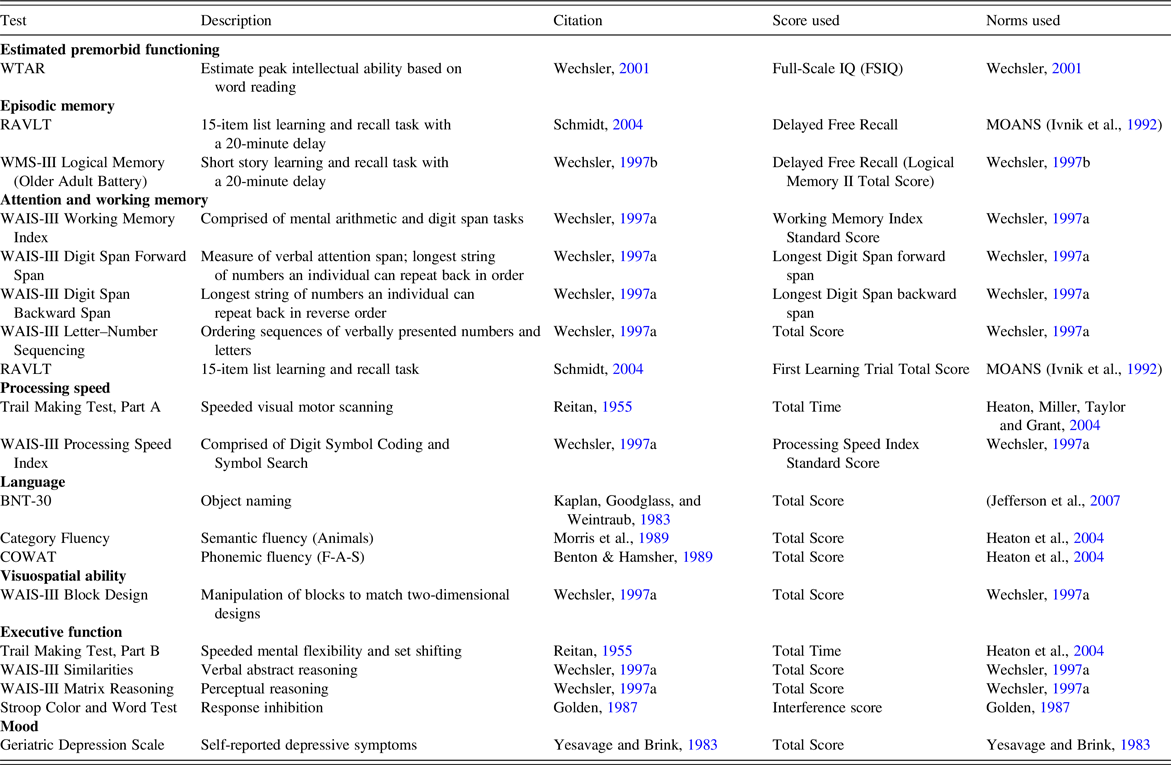
All participants received a standardized battery of measures that includes tests of episodic memory, attention, executive functions, and language as previously reported (Gefen et al., Reference Gefen, Shaw, Whitney, Martersteck, Stratton, Rademaker and Rogalski2014). In addition to the aforementioned tests used for inclusion into the SuperAging Program, the present study used data from the measures summarized in Table 1 to more fully characterize the neuropsychological profiles of SuperAgers in comparison to their average memory peers. These measures were specifically selected by the SuperAging Program for their sensitivity to age-related cognitive changes as well as those due to emerging Alzheimer’s dementia and related disorders (E. J. Rogalski et al., Reference Rogalski, Gefen, Shi, Samimi, Bigio, Weintraub and Mesulam2013; S. Weintraub et al., Reference Weintraub, Salmon, Mercaldo, Ferris, Graff-Radford, Chui and Morris2009). All measures were administered in standardized fashion according to each test’s protocol. The normative values used for each measure were carefully selected by the larger SuperAging Program to be the most robust norms available at the time for adults over the age of 80 with regard to both normative sample size and availability of specific age brackets for adults over the age of 80.
Summary of neuropsychological measures

BNT-30=30-item Boston Naming Test; MOANS=Mayo’s Older Americans Normative Studies; RAVLT=Rey Auditory Verbal Learning Test; WAIS-III=Wechsler Adult Intelligence Scale, 3rd Edition; WMS-III=Wechsler Memory Scale, 3rd Edition; WTAR=Wechsler Test of Adult Reading.
Data Analysis
All data analyses were performed using SAS (version 9.4) and R (version 3.5.3) including the package vegan.
Independent sample t-tests and Fisher’s exact tests were used to examine group differences in demographics as well as the Full-Scale Intelligence Quotient (FSIQ) and depressive symptoms, as appropriate.
Analysis of covariance (ANCOVA) was used to analyze between-group differences on neuropsychological measure raw scores, and included age, sex, and years of education as covariates. Bonferroni correction was applied within each cognitive domain to control for multiple comparisons when multiple tests were implemented (e.g., episodic memory, attention, working memory, processing speed, language, executive function). All tests were two-tailed. The homogeneity of regression coefficients was satisfied for each ANCOVA.
Composite scores were generated for each cognitive domain that had multiple test scores to capture gestalt performance across cognitive domains and to determine the contributions of non-memory cognitive domains to superior episodic memory performance. Composites were created for each of the following domains by transforming normative scores from individual subtests into z-scores and then averaging them: attention (WAIS-III Digit Span forward span, RAVLT Trial 1), working memory (WAIS-III Arithmetic, Digit Span backward span, and Letter–Number Sequencing), processing speed (Trail-Making Test Part-A, WAIS-III Digit Symbol and Coding), language [BNT-30, phonemic fluency (FAS), semantic fluency (Animals)], and executive functioning (Trail Making Test Part-B, WAIS-III Similarities, and Matrix Reasoning). As only one visuospatial measure was given, no composite was created for this domain. Given the use of RAVLT Trial 1 within the attention composite and RAVLT delayed free recall being a key determinate in SuperAging status, a bivariate correlation was conducted within each group to determine whether there was a correlation between performance on RAVLT delayed free recall and RAVLT Trial 1.
To determine the influence of performance in non-episodic memory domains on episodic memory performance on the RAVLT delayed recall (the defining criterion for SuperAger inclusion), multiple linear regression with backward entry was conducted using the RAVLT delay z-score as the dependent variable and using all five composite scores as independent variables. All participants were included in this analysis, regardless of group status. From the multiple regression model, the unique variances of each composite score and shared variances of two or more composites scores were calculated using variance partitioning analysis with the R package vegan (Oksanen et al., Reference Oksanen, Blanchet, Friendly, Kindt, Legendre, McGlinn and Wagner2019). The adjusted canonical R 2 was computed.
Study procedures were approved by the Northwestern University Institutional Review Board. Written informed consent was obtained from all participants prior to the initiation of study procedures. Research was completed in accordance with the Helsinki Declaration.
RESULTS
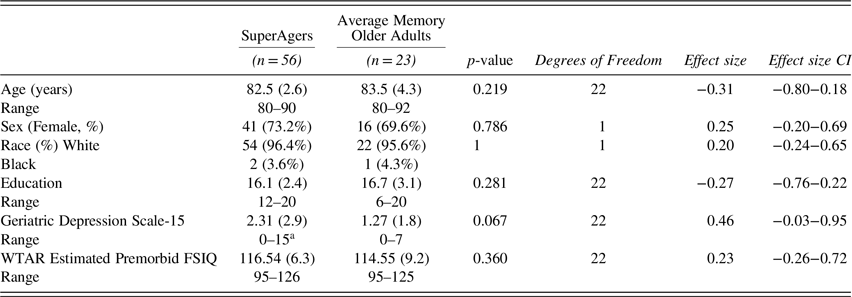
Fifty-six SuperAgers and 23 Average Memory Older Adults met the inclusion criteria and all were included in the present analysis. No significant between-group differences were detected in demographic characteristics of SuperAgers and Average Memory Older Adults including age, gender, race, and years of education (p’s > 0.05; Table 2). Between-group differences were also not detected with regard to estimated premorbid intellectual functioning or self-reported depressive symptoms (p’s > 0.05; Table 2).
Demographic characteristics of SuperAgers and older adults with average episodic memory

There were no significant differences between SuperAgers and Average Memory Older Adults. WTAR=Wechsler Test of Adult Reading; FSIQ=Full-Scale Intelligence Quotient.
a The range of SuperAgers’ Geriatric Depression Scale scores was 0–15. Please note that one SuperAger reported a score of 15 while all other SuperAger scores fell in between 0 and 9.
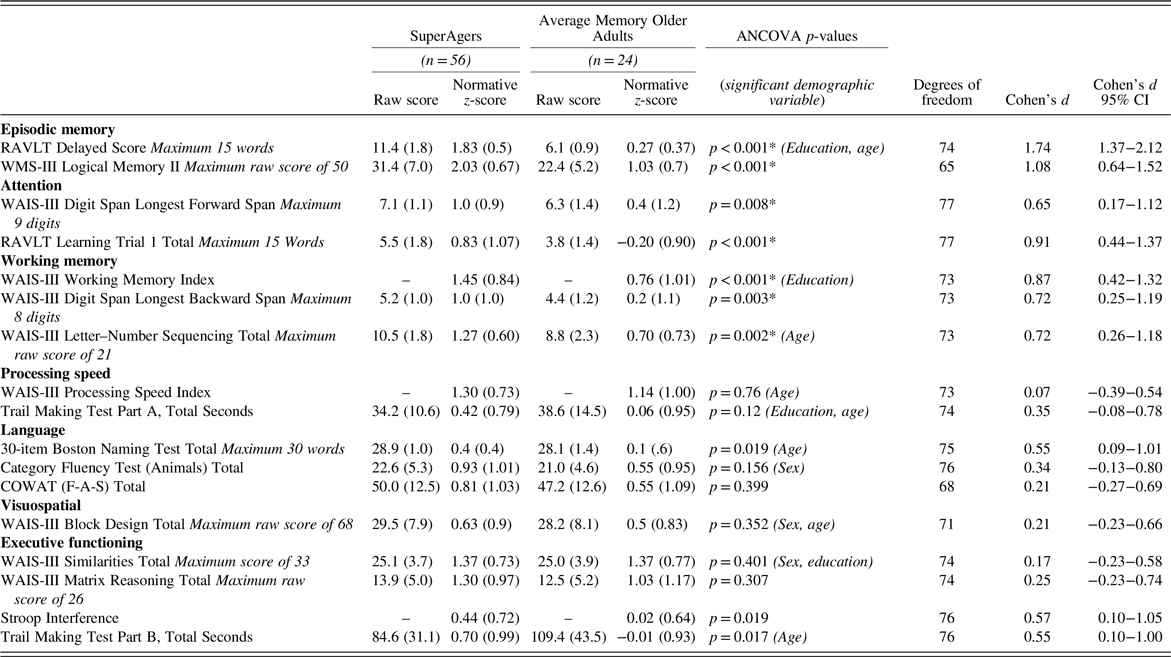
Neuropsychological performance is discussed by the cognitive domain below. Means and standard deviations for each measure are shown for both groups in Table 3.
Neuropsychological performance in SuperAgers and older adults with average episodic memory

Means and standard deviations are shown for each group for both raw scores and normative values. Maximum possible scores are included for raw score test results when available. P-values are shown both for independent t-tests between the groups and ANCOVAs controlling for age, sex, and years of education.
CI = Confidence Interval; NS = no significant between-group difference; RAVLT = Rey Auditory Verbal Learning Test; WAIS-III = Wechsler Adult Intelligence Scale, 3rd edition; WMS-III = Wechsler Memory Scale, 3rd edition.
* Indicates a significant difference between the two groups.
Episodic Memory
Consistent with inclusion criteria, SuperAgers outperformed their average memory peers on the RAVLT delayed recall controlling for age, education, and gender (F(1, 74) =174.59, p < 0.001, d = 1.74 (CI: 1.37−2.12): Age F(1,74) = 5.66, p = 0.020; Education F(1,74) = 5.85, p = 0.018; Gender F(1,74) = 0.57, p = 0.453 Table 3), with their mean performance falling in the superior normative range for their age and average normative range for middle-age adults. SuperAgers also outperformed their average memory peers on the WMS-III Logical Memory II (F(1, 65) = 27.09, p < 0.001, d = 1.08 (CI: 0.64−1.52), Table 3), suggesting that their superior episodic memory performance extends to measures beyond the RAVLT.
Attention
SuperAgers demonstrated significantly better performance than the Average Memory Older Adults on both the WAIS-III longest Digit Span forward span (F(1, 77) = 7.49, p = 0.008, d = 0.65 (CI: 0.17−1.12) Table 3) and first learning trial of the RAVLT (F(1, 77) = 16.25, p < 0.001, d = 0.91 (CI: 0.44−1.37), Table 3). Normatively, mean performance on both the longest Digit Span forward span and the first learning trial of the RAVLT fell in the high average range for SuperAgers and in the average range for the Average Memory Older Adults. Thus, SuperAgers may have a better immediate verbal attention span than their peers.
Working Memory
On working memory tasks, SuperAgers demonstrated significantly better performance than their average memory peers on all assessed measures including the WAIS-III Working Memory Index (controlling for education, F(1, 73) = 15.65, p < 0.001, d = 0.87 (CI: 0.42−1.32): Education F(1,73) = 4.36, p = 0.040), Letter–Number Sequencing (controlling for age, F(1, 73) = 10.15, p = 0.002, d = 0.72 (CI: 0.26−1.18): Age F(1,73) = 4.17, p = 0.045), and longest Digit Span backward span (F(1,77) = 9.54 p = 0.003, d = 0.72 (CI: 0.25−1.19)) (Table 3).
Processing Speed
There were no significant between-group differences on individual measures of processing speed including the WAIS-III Processing Speed Index (F(1,73) = 0.09, p = 0.759, d = 0.07 (CI: −0.39−0.54): Age F(1,73) = 5.82, p = 0.018) and Trail Making Test Part A (F(1,74) = 2.53, p = 0.116, d = 0.35 (CI: −0.08−0.78): Age F(1,74) = 8.09, p = 0.006; Education F(1,74) = 10.83, p = 0.002; Gender F(1,74) =0.52, p = 0.471; Table 3). Mean performance for both groups fell in the average normative range on the Trail Making Test Part A and high average normative range on the WAIS-III Processing Speed Index. The lack of group difference in this domain suggests that the aforementioned between-group differences in episodic and working memory performance cannot simply be attributed to differences in processing speed.
Language
There were no significant between-group differences on individual language measures including object naming (F(1,75) = 5.70, p = 0.019, d = 0.55 (CI: 0.09−1.01): Age F(1,75) = 5.50, p = 0.022), and semantic (F(1,76) = 2.05, p = 0.156, d = 0.34 (CI: −0.13−0.80): Gender F(1,76) =2.049087, p = 0.156) and phonemic verbal fluency (F(1, 68) = 0.72, p = 0.399, d = 0.21 (CI: −0.27−0.69)) (p’s > 0.017, Table 3). Mean performance for the Average Memory Older Adult group fell in the average normative range for all three language measures while mean performance for SuperAgers fell in the average range for object naming and phonemic fluency and in the high average range for semantic fluency.
Visuospatial Abilities
There were no significant between-group differences on the WAIS-III Block Design measure of visuospatial construction (F(1,71) = 0.88, p = 0.352, d = 0.21 (CI: −0.23−0.66): Age F(1,71) = 5.20, p = 0.026; Education F(1,71) = 5.06, p = 0.028; Gender F(1,71) = 2.90, p = 0.093; Table 3) and mean performance for both groups fell within the average normative range.
Executive Functions
There were no significant group differences on individual measures of executive function including Trail Making Test Part B (F(1,76) = 5.96, p = 0.017, d = 0.55 (CI: 0.10−1.00): Age F(1,76) = 10.72, p = 0.002); Stroop Interference (F(1,76) = 5.75, p = 0.019, d = 0.57 (CI: 0.10−1.05)); and WAIS-III Similarities (F(1,74) = 0.71, p = 0.401, d = 0.17 (CI: −0.23−0.58): Age F(1,74) =0.0008, p = 0.976; Education F(1,74) = 26.68, p < 0.001; Gender F(1,74) = 6.21, p = 0.015); and Matrix Reasoning (F(1,74) = 1.06, p = 0.307, d = 0.25 (CI: −0.23−0.74)) subtests (Table 3). The performance of both groups was at least in the average normative range.
Relationship between Episodic Memory Performance and Other Cognitive Domains
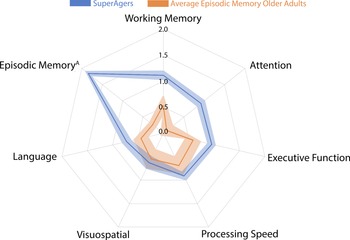
Composite scores were generated for each cognitive domain that had multiple test scores (e.g., working memory, attention, processing speed, language, and executive functioning) to capture gestalt performance across cognitive domains and to determine the contributions of non-memory cognitive domains to superior episodic memory performance. Given the availability of only one visuospatial measure from the larger SuperAging Program, a composite was not created for this domain. While on average the composites highlight SuperAgers’ strengths in attention and working memory compared to the Average Memory Older Adults (Figure 1), there was also variability in performance among the SuperAgers at the individual level across cognitive domains, which can be qualitatively summarized by three observations. First, approximately 20% of the SuperAgers (n = 11), scored within one standard deviation of the mean on each of the aforementioned cognitive composites, leaving episodic memory as the isolated area of cognitive strength. Another approximately 20% of the SuperAgers (n = 11) performed more than one standard deviation above the mean across four domain composites, including attention, working memory, processing speed, and executive function in addition to their superior memory performance. Third, the remainder of the sample (n = 34, 60.72%) did not show consistent performance above or within one standard deviation across cognitive domains, speaking again to the idea of intragroup performance variability on non-episodic memory domains.
Neuropsychological profiles of SuperAgers are unique from Average Memory Older Adults. Mean z-scores (dark line) and standard deviations (shading) are provided for composite measures of attention, working memory, executive function, language, and processing speed as well as episodic memory performance (A based on the RAVLT delayed recall score) and visual-spatial function (based on the Block Design score). Of note, inclusion criteria specified the allowable range for episodic memory performance for each group and were intentionally different; however, the data are shown for illustrative purposes in order to visualize the performance across multiple cognitive profiles at one time. Mean composite scores for SuperAgers fell within one standard deviation of the mean for attention [mean, standard deviation (SD): 0.92, 0.63], executive functioning (mean, SD: 0.95, 0.53), processing speed (mean, SD: 0.90, 0.60), and language (mean, SD: 0.72, 0.60) while the mean working memory composite was greater than one standard deviation above the mean (mean, SD: 1.11, 0.61). In contrast, mean composite scores for the Average Memory Older Adults fell within one standard deviation of the mean for all assessed domains including working memory (mean, SD: 0.54, 0.77), attention (mean, SD: 0.09, 0.69), executive functioning (mean, SD: 0.59, 0.65), processing speed (mean, SD: 0.69, 0.82), and language (mean, SD: 0.44, 0.60).

Next, a multiple linear regression was conducted to determine the amount of episodic memory performance explained by performance in other cognitive domains and predict RAVLT delay z-score based on composite measures of working memory, attention, processing speed, language, and executive functioning. Across all participants, a significant regression equation was found that included the attention and executive function composites (F(2,63) = 10.9, p < 0.001) and explained 20.4% of the variance in RAVLT delay z-score (adjusted R 2 = .18; Table 4). Both attention and executive function composites were significant positive predictors of the RAVLT delayed free recall score.
Multiple linear regression results table: significant predictors of episodic memory score

CI = Confidence Interval; SE = Standard Error.
Variance partitioning was used to decompose the adjusted R 2 into unique and shared variance. The majority of the regression effect was explained by variance that was unique to attention composites (14%). Executive function composites explained 2.8%, and the shared variances of both attention and executive function composites explained 4.4%. The unique effect of attention composites is significant with p = 0.003, whereas the unique effect of executive function composites is not (p = 0.061).
Given that the dependent variable (RAVLT delayed free recall score) and one measure within the attention composite score (RAVLT Trial 1 immediate recall score) came from the same test, a Pearson’s product-moment correlation was conducted within the SuperAger cohort. No statistically significant correlation was seen between these two measures [r = 0.19 (CI: −0.08−0.43), t-statistic = 1.42, degrees of freedom = 54, p = 0.16]. While a failure to reject the null hypothesis cannot be interpreted as acceptance of the null, this lack of correlation increases confidence in the results of the aforementioned regression.
DISCUSSION
As a group, SuperAgers outperform their peers with average-for-age episodic memory on individual measures of attention and working memory while performing similarly to their peers on individual measures of processing speed, language, visuospatial construction, and executive functioning. However, within the SuperAging group, there was variability in performance across non-memory domains, such that only a subset of SuperAgers performed in the superior range across most non-memory domains while the majority of SuperAgers show various cognitive strengths, but do not show uniform above-average cognitive performance. The idea that participants selected on the basis of superior episodic memory do not necessarily have superior abilities across non-memory cognitive domains may be expected given the selective impairment evident in different neurodegenerative syndromes (e.g., Alzheimer’s disease dementia primarily affecting the memory system, primary progressive aphasia primarily affecting the language system), as well as typical adults who may have various cognitive strengths and weaknesses (S. Weintraub & Mesulam, Reference Weintraub, Mesulam, Boller and Grafman1993). Nonetheless, understanding the mechanisms by which elderly cohorts are able to maintain particular strength in episodic memory, such as the Northwestern University SuperAgers, has the potential to help elderly adults maintain memory ability and minimize the risk of developing Alzheimer’s disease dementia.
Other studies of cognitively high-performing cohorts of older adults selected for above-average episodic memory have shown varying neuropsychological profiles in regard to non-memory cognitive domains; however, it is difficult to fully compare studies as the criteria for defining high-performing older adults, the younger age groups to which they are compared, and the cognitive assessment measures used differ from one study to another. For example, Sun and colleagues (Reference Sun, Stepanovic, Andreano, Barrett, Touroutoglou and Dickerson2016) identified a group of older adults, aged 60–80, with episodic memory performance on par with young adults, aged 18–32, who also outperformed their typical memory peers on Trial 1 of a list learning task, but not on measures of sustained attention, processing speed, working memory, verbal fluencies, or speeded set shifting. Within the Harvard Aging Brain Study, individuals aged 75 and older selected on the basis of above average-for-age episodic memory also outperformed their typical memory peers on measures of processing speed and executive functioning, the latter of which included tests categorized in the present project as measures of working memory (Digit Span Backward) and verbal fluencies (Dekhtyar et al., Reference Dekhtyar, Papp, Buckley, Jacobs, Schultz, Johnson and Rentz2017). It is important that care should be taken in this research to explicitly define the high-performing group, their comparison groups, and the specific measures used rather than to assume that all high-performing elderly are a homogenous group. Such careful curation will allow for the identification of unique features within specifically defined, high-performing cohorts, which may ultimately enable the determination of various pathways that contribute to extraordinary cognitive performance in older age.
Performance on composite measures of attention and executive function predicted approximately 20% of the variance in episodic memory performance among SuperAgers. This amount of explained variance is approximately equivalent to the amount of variance in episodic memory performance in non-demented older adults populations that is explained by neuropathologic variables such as neurofibrillary tangles, amyloid plaques, cerebral cortical microvascular lesions, and brain weight (Bennett, Wilson, Boyle, Buchman, & Schneider, Reference Bennett, Wilson, Boyle, Buchman and Schneider2012; Cholerton et al., Reference Cholerton, Larson, Baker, Craft, Crane, Millard and Montine2013). This suggests that the percentage of explained variance in SuperAger episodic memory performance may be similarly relevant. This finding contrasts with previous work that has found working memory and processing speed (vs. attention and executive function) to be predictors of episodic memory performance, with changes in these variables predicting changes in episodic memory among cognitively intact older adults and those with amnestic Mild Cognitive Impairment (Constantinidou et al., Reference Constantinidou, Zaganas, Papastefanakis, Kasselimis, Nidos and Simos2014; Hertzog et al., Reference Hertzog, Dixon, Hultsch and MacDonald2003; Verhaeghen & Salthouse, Reference Verhaeghen and Salthouse1997).
The relationship between the attention and executive function composites with episodic memory within the SuperAger cohort is intriguing. Research in both “typically” aging adults and those with frontal lobe dysfunction tends to suggest a role of executive functioning in episodic memory performance, perhaps due to difficulties with organization and clustering strategies (see Bucker, Reference Bucker2004 and Baldo & Shimamura, Reference Baldo, Shimamura, Baddeley, Kopelman and Wilson2002 for reviews). Use of the RAVLT word list does not allow individuals to use traditional semantic clustering strategies, but other types of organization, such as serial clustering, or individually devised strategies may still be possible and may assist with stronger encoding and ultimately better recall performance. Future investigations may wish to quantify participants’ approach to learning and recall to determine the potential impact of strategy use on episodic memory performance in SuperAgers and their average memory peers. It is also possible that a combination of attention and executive functioning abilities reduce an individual’s susceptibility to interference and improve filtering capacity during memory encoding or retrieval, contributing to better overall episodic memory performance (Baldo & Shimamura, Reference Baldo, Shimamura, Baddeley, Kopelman and Wilson2002; Cook Maher et al. Reference Cook Maher, Sridhar, Rademaker, Breiter, Reilly, Weintraub and Rogalski2019). This may be another avenue for future investigation.
Practically, the relationship between episodic memory performance and both attention and executive functioning may influence the selection of potential strategies to bolster episodic memory functioning in older adults. For example, prior investigations have focused on identifying ways to improve working memory performance in older adults, including training individuals with low visual working memory capacity in filtering efficiency with gains lasting for at least 3 months post-training (Li, He, Wang, Hu, & Guo, Reference Li, He, Wang, Hu and Guo2017). More recently, the use of high-definition transcranial alternating current stimulation to simultaneously target prefrontal and temporal brain regions has been investigated, although current gains appear to be rather short-lived (approximately 50 min) (Reinhart & Nguyen, Reference Reinhart and Nguyen2019). Strategies used to improve attention have also been investigated, including the use of videogames to improve attentional capacity and sustained attention (Anguera et al., Reference Anguera, Boccanfuso, Rintoul, Al-Hashimi, Faraji, Janowich and Gazzaley2013; Green & Bavelier, Reference Green and Bavelier2003) and the use of aerobic exercise in conjunction with cognitive training to improve sustained attention (Joubert & Chainay, Reference Joubert and Chainay2018), although strategies to improve the span of attention in older adults appear more limited. Future research may investigate whether such strategies aimed at improving attention or executive functions ultimately contribute to the maintenance of episodic memory performance in non-demented older adults.
The contribution of executive functioning to episodic memory performance is interesting given the lack of statistical difference between SuperAgers and their average memory peers on individual tests within the executive functioning domain. Sample size limitations in both groups may be one contributing factor, as the mean group scores on the Trail Making Test Part B were almost one standard deviation apart; however, performance on other measures of executive function was not as differentiated. Executive functions represent a large, complex cognitive domain and future research may wish to investigate specific aspects of executive functioning as they relate to episodic memory.
Along with the study’s relatively smaller sample size is the accompanying limited range of demographic characteristics, including race. SuperAgers represent a rare cognitive phenotype that is being studied in depth through the Northwestern SuperAging Program. Both the rarity of the phenotype and rigor of assessment contribute to limited sample size and characteristics. Average memory adults are also required to meet tight cognitive ranges and undergo the same rigors, in-depth assessment as SuperAgers, which contribute to more limited samples. While study findings require validation in larger samples with a broader representation of demographic and socioeconomic features, these initially reported results are valuable. Future work may also include a middle-age adult control sample to better understand how SuperAgers’ cognitive performance in non-memory domains compares to their younger counterparts against whom their episodic memory performance is compared.
Participants within the longitudinal Northwestern SuperAging Program receive only one visuospatial measure and as such, we were not able to create a visuospatial composite to include in the multiple linear regression analyses. Given that there is a general lack of evidence correlating visuospatial ability with verbal episodic memory, such as measured by the RAVLT, we would not expect visuospatial performance to be a significant predictor of test performance in the present study. However, this remains a limitation of the present investigation and may be an area to address in future studies.
In conclusion, this investigation represents an important step in characterizing the neuropsychological profile of the SuperAger cohort and potential cognitive mechanisms supporting such performance.
SUPPLEMENTARY MATERIAL
To view supplementary material for this article, please visit https://doi.org/10.1017/S1355617721000837.
ACKNOWLEDGMENTS
The authors would like to thank Jaiashre Sridhar and Daniel Gutstein for their assistance making and formatting the figures for this manuscript.
FINANCIAL SUPPORT
This work was supported by the National Institutes of Health (R01 AG045571, AG13854), and the Davee Foundation.
CONFLICT OF INTEREST
None.