Introduction
The population of older persons in Western societies is rapidly increasing. Depression is a common psychiatric condition in old age and associated with decreased daily functioning and increased use of health services (Beekman et al., Reference Beekman, Deeg, Braam, Smit and Van1997). Therefore, a better understanding of all aspects of depression in older persons, including its risk factors and causes, is of great importance.
Blood pressure has been associated with depression, but inconsistently. A higher blood pressure earlier in life has been reported to increase the risk of depressive symptoms in late life (Gao et al., Reference Gao2013). In contrast, cross-sectional studies in older persons showed a relationship between low blood pressure and depressive symptoms (Lenoir et al., Reference Lenoir2008; Ng et al., Reference Ng, Feng, Niti and Yap2010), although not consistently (Bosworth et al., Reference Bosworth, Bartash, Olsen and Steffens2003), and in a longitudinal study older persons with lower blood pressure had a higher risk of developing depression (Siennicki-Lantz et al., Reference Siennicki-Lantz, Andre-Petersson and Elmstahl2013).
These findings suggest that the relationship between blood pressure and depressive symptoms depends on age vulnerability. Furthermore, inconsistent findings could be due to the use of different measures for the assessment of (symptoms of) depression and different cut-off values for ‘‘low and high blood pressure’’. It has also been suggested that blood pressure is differentially associated with distinct symptom domains of depression. Two cross-sectional studies in older persons reported low blood pressure to be specifically associated with low positive affect but not with negative affect (Jorm, Reference Jorm2001; Kim et al., Reference Kim, Bae and Cho2010). In particular, apathy has been shown to correlate with negative affect (Andersson et al., Reference Andersson, Krogstad and Finset1999), and to become a more prominent symptom of late-life depression in comparison to early life depression (Krishnan et al., Reference Krishnan, Hays, Tupler, George and Blazer1995), which may reflect a different relationship of blood pressure with depression at old age.
Importantly, apathy has been described not only as a symptom of depression and other late-life neuropsychiatric syndromes, but also as a syndrome in its own right. Recently, diagnostic criteria have been proposed, characterizing the syndrome of apathy by diminished motivation in the cognitive, behavioral and emotional domains of daily functioning (Robert et al., Reference Robert2009). Thus far, most research on the relationship between blood pressure and apathy was done using methods that were not compliant with (the recently proposed criteria to diagnose) apathy as a syndrome. Two cross-sectional studies in community-dwelling older persons free from depression found a higher blood pressure to be associated with the presence of symptoms of apathy, according to a score above the cut-off of the three apathy questions of the 15-item Geriatric Depression Scale (GDS-3A) (Ligthart et al., Reference Ligthart2012) or the Apathy Scale (Yao et al., Reference Yao2009).
To date, no study investigated the association of blood pressure with symptoms of apathy or other depressive symptom domains in older persons with a concomitant depressive disorder. Hypothetically, some inconsistent results concerning the relationship between blood pressure and depression in older persons (Bosworth et al., Reference Bosworth, Bartash, Olsen and Steffens2003; Lenoir et al., Reference Lenoir2008) could be attributable to differences in the prevalence of distinct symptom domains of depression, which have been shown to have different relations with blood pressure. Knowledge about these associations would improve our understanding of the complex relationship between blood pressure and late-life depression, and may have important consequences regarding its prevention and treatment.
The aim of this study was to investigate whether in a depressed older population various blood pressure measures were associated with different symptom domains of depression. We hypothesized that higher blood pressure would specifically be associated with the presence of apathy symptoms, but not with mood or somatic symptoms of depression.
Methods
Study design
All data in this study were derived from the NESDO. NESDO is an ongoing multi-site, naturalistic cohort study that originally included at baseline 378 depressed and 132 non-depressed persons aged over 60 years. For 33.1% of the depressed persons it was their first episode. NESDO was designed to examine the course of depressive disorders in older persons. To represent various settings and stages of psychopathology, depressed persons were recruited in five regions in the Netherlands from both general practices and out- and in-patient clinics of regional facilities for mental care. Persons with a primary diagnosis of dementia, persons who were suspected for dementia according to the clinician, or who had a Mini-Mental State Examination score (MMSE) under 18 (out of 30 points) or insufficient command of the Dutch language were excluded. The study protocol (Comijs et al., Reference Comijs2011) was approved centrally by the Ethical Review Board of the VU Medical Center (VUMC) in Amsterdam and subsequently by the local ethical review boards of each participating center. Written consent was obtained from all eligible participants.
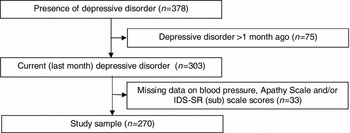
This sub-study is based on the baseline assessment of NESDO (2007–2010). Baseline measurements were performed at the participating sites or at participants’ homes and were conducted by trained research assistants, mainly consisting of psychologists and mental health care nurses (Comijs et al., Reference Comijs2011). Analyses were restricted to the 303 persons who met DSM-IV criteria for major depression, minor depression or dysthymia within the past month, to be able to assess the association between current blood pressure and current apathy/motivation, mood and somatic symptoms of depression. Because of missing data on blood pressure measurements, Apathy Scale scores and/or Inventory of Depressive Symptoms-Self Report (IDS-SR) subscale scores in 33 persons, a sample of 270 depressed persons was analyzed (Figure 1).
Flow diagram NESDO study population

Measurements
Depression
Diagnosis of depression and dysthymia according to Diagnostic and Statistical Manual (DSM) IV criteria (American Psychiatric Association, 2000) was assessed with Composite International Diagnostic Interview (CIDI; WHO version 2.1; life-time version). The CIDI is a structured clinical interview that is designed for use in research and has high validity for diagnosing depressive and anxiety disorders (Wittchen et al., Reference Wittchen, Robins, Cottler, Sartorius, Burke and Regier1991). Questions were added to determine DSM-IV diagnosis of current minor depression. Severity of depression was assessed using the self-rated version of the 30-item IDS-SR (Rush et al., Reference Rush, Gullion, Basco, Jarrett and Trivedi1996) with scores ranging from 0–84 and higher scores indicating more serious depression. Three subscales of the IDS-SR have been established among older depressed persons in the NESDO population discriminating a distinct motivation (IDS-SR motivation), mood (IDS-SR mood) and somatic (IDS-SR somatic) symptom domain with scores ranging from 0–15, 0–27, 0–24 and, respectively, higher scores indicating greater severity (Hegeman et al., Reference Hegeman, Wardenaar, Comijs, Waal, Kok and van der Mast2012). Additionally, the Apathy Scale was used as a self-report questionnaire to more precisely assess symptoms of apathy. The Apathy Scale (a short version of the Apathy Evaluation Scale) has a good one-week test–retest (r = 0.90) and inter-rater reliability (r = 0.81) and internal validity (Starkstein et al., Reference Starkstein, Mayberg, Preziosi, Andrezejewski, Leiguarda and Robinson1992). The Apathy Scale used as a self-report measure showed a similar internal validity (Pedersen et al., Reference Pedersen, Alves, Larsen, Tysnes, Moller and Bronnick2012), compared to the observer-rated measurement (Cronbach's α = 0.69 and 0.76, respectively). The Apathy Scale consists of 14 items with four possible answers ranging from 0–3 points. In all analyses the Apathy Scale score was used as a continuous measure, with higher scores indicating more symptoms of apathy.
Blood pressure measures
SBP and DBP were measured twice in supine position using an electronic Omron sphygmomanometer. Mean values were calculated. MAP was calculated according to the formula ([2* DBP + SBP]/3). MAP reflects vascular resistance, such as the resistance of the smaller arteries perforating cerebral white matter (Guo et al., Reference Guo2009).
Demographic and clinical characteristics
Demographic and clinical characteristics including age, gender, education level, marital status and smoking behavior were assessed with standard questionnaires. The MMSE was used to assess global cognitive functioning (Folstein et al., Reference Folstein, Folstein and McHugh1975). The severity of chronic pain was graded by the Chronic Pain Grade (Von Korff et al., Reference Von Korff, Ormel, Keefe and Dworkin1992). The Alcohol Use Disorders Identification Test (AUDIT) was used to measure alcohol use (Babor et al., Reference Babor, Kranzler and Lauerman1989). The presence of chronic diseases was documented by means of a self-report questionnaire (Kriegsman et al., Reference Kriegsman, Penninx, van Eijk, Boeke and Deeg1996). Older persons were asked whether they currently or previously had a stroke, a heart condition (including angina pectoris, myocardial infarction, heart failure and cardiac arrhythmias), peripheral arterial disease, diabetes mellitus or any other disease. Current use of medication was recorded by the medication that the participants brought in. Use of psychotropic medication was defined as self-reported frequent use (>50% of the time) of antidepressants (selective serotonin reuptake inhibitor, tricyclic antidepressant, venlafaxine or any other antidepressant), benzodiazepines, antipsychotics, anti-epileptics, dopaminergics, anti-cholinergics and/or opioids. Use of antihypertensive medication included the (daily) use of beta-blockers, calcium antagonists, angiotensin-converting enzyme (ACE)-inhibitors, angiotensin-II-receptor-blockers or diuretics.
Statistical analysis
Characteristics of study participants are presented as number (percentage), mean (standard deviation) or median (interquartile range) where appropriate. Pearson's correlation coefficients were computed for the Apathy Scale with each IDS-SR subscale, and for the IDS-SR subscales with each other. Multiple linear regression analyses were used to investigate the association of SBP, DBP and MAP as continuous independent variables on the one hand and Apathy Scale scores, IDS-SR total, IDS-SR motivation, IDS-SR mood and IDS-SR somatic scores as continuous dependent variables on the other hand. Unstandardized betas (β) were calculated per 10 mmHg increase in BP measures.
Analyses were performed unadjusted in the crude model. Based on the literature, the following covariates were introduced as possible confounders: in the minimally adjusted model age and gender, and additionally, in the fully adjusted model, marital status, education (in years), use of alcohol ≥ 14 drinks/week, use of antihypertensive or psychotropic medication, MMSE score, chronic pain grade and number of chronic diseases (cardiovascular disease excluded). Furthermore, in both models the Apathy Scale score was additionally adjusted for the IDS-SR mood and somatic subscales (but not for the IDS-SR motivation subscale, since this subscale measures symptoms of apathy), thereby certifying that the association of blood pressure and apathy was not attributable to other symptoms of depression. Also, in both models each IDS-SR subscale was adjusted for the other two subscales.
Finally, we added smoking and diabetes to the fully adjusted model to explore the influence of these cardiovascular risk factors to our findings. No multi-co linearity existed (all Variance Inflation Factors < 5). Statistical analyses were performed using SPSS version 20. A probability value less than 0.05 was adopted as indicating statistical significance.
Results
Demographic and clinical characteristics
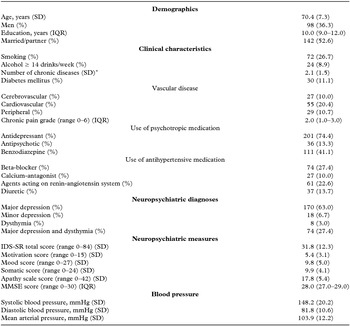
The mean age of the depressed older persons was 70.4 years (standard deviation (SD) = 7.3) and 98 (36.3%) were men. The mean Apathy Scale score was 17.8 (SD = 5.4). The mean IDS-SR motivation, mood and somatic subscale scores were 5.4 (SD = 3.1), 9.8 (SD = 5.0) and 9.9 (SD = 4.1), respectively (Table 1).
Demographics and clinical characteristics of depressed older persons# (n = 270)

SD = standard deviation, IQR = interquartile range, #current depressive disorder in the past month: minor depression, major depression and/or dysthymia; *vascular disease excluded; IDS-SR = inventory of depressive symptoms-self report; MMSE = mini-mental state examination; mmHg = millimeters of mercury.
Correlations for apathy scale and IDS-SR total or subscale scores
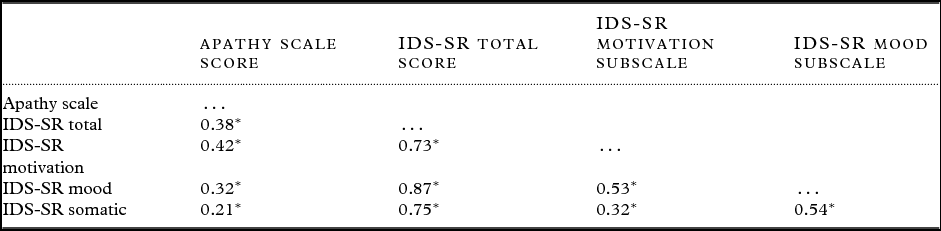
The Pearson correlation coefficients (r) between the Apathy Scale and the IDS-total or subscale scores are shown in Table 2. The IDS-SR total and subscale scores were all significantly correlated with the Apathy Scale score, with the IDS-SR motivation subscale showing the strongest correlation (r (268) = 0.42, p < 0.01).
Pearson correlations coefficients for apathy scale scores and IDS-total or subscale scores. (n = 270)

IDS-SR = inventory of depressive symptoms-self report.
*Significant correlation at the 0.01 level.
Blood pressure measures and apathy scale and IDS-SR subscales scores
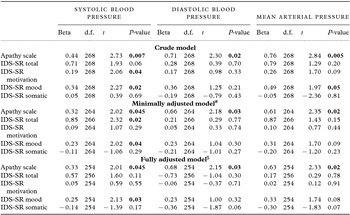
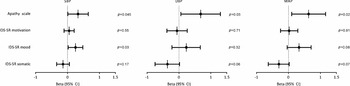
Table 3 shows that a higher SBP (Beta 0.33, t(254) = 2.01, p = 0.045), a higher DBP (Beta 0.68, t (254) = 2.15, p = 0.03) and a higher MAP (Beta 0.63, t (254) = 2.33, p = 0.02) were associated with higher Apathy Scale scores in the fully adjusted model. Furthermore, after full adjustment a higher SBP was associated with higher IDS-SR mood subscale scores (Beta 0.25, t (254) = 2.13, p = 0.03). No other associations were found for SBP, DBP or MAP with IDS-SR total or subscale scores in the fully adjusted model. Results remained largely similar after adding smoking and diabetes mellitus in the fully adjusted models (data not shown). The different associations of blood pressure measures and IDS-SR subscale and Apathy Scale scores are visualized in figure 2.
The association of blood pressure with IDS-SR and apathy scale scores in depressed older persons (n = 270)

Unstandardized Beta's were calculated per 10 mmHg increase in blood pressure measures. IDS-SR = inventory of depressive symptoms-self report. d.f. = degrees of freedom.
#Minimally adjusted model: gender and age.
§Fully adjusted model: age, gender, marital status, education, use of alcohol, antihypertensive and psychotropic medication, MMSE, chronic pain grade, number of chronic diseases. Additionally in both models: each IDS-SR subscale is adjusted for the other two subscales and the Apathy scale is adjusted for the IDS-SR mood and IDS-SR somatic subscale.
Change in IDS-SR subscale and apathy scale score for increase in blood pressure measures. (n = 270)

Discussion
The main finding of this study is that in depressed older persons higher SBP, DBP and MAP are particularly associated with more serious apathy according to the Apathy Scale. Contradictory to our expectations, blood pressure measures were not associated with the IDS-SR motivation subscale. This may be explained by that the Apathy Scale is a more precise instrument to establish symptoms of apathy than the IDS-SR motivation subscale. Also, blood pressure measures showed inconsistent associations with distinct depressive symptom domains; only a higher SBP was associated with more mood symptoms. Furthermore, we did not find any associations of blood pressure measures with increasing severity of depression according to the IDS-SR total score. These findings suggest that the relationship between higher blood pressure and depression at old age may be particularly driven by symptoms of apathy.
It has been suggested earlier that some of the inconsistent results concerning the relationship between blood pressure and depression in older persons (Bosworth et al., Reference Bosworth, Bartash, Olsen and Steffens2003; Siennicki-Lantz et al., Reference Siennicki-Lantz, Andre-Petersson and Elmstahl2013) could be attributable to specific associations of blood pressure with distinct symptoms of depression (Jorm, Reference Jorm2001; Kim et al., Reference Kim, Bae and Cho2010). However, so far limited data are available on the relationship of blood pressure with symptoms of apathy in depressed older persons. Only in community-dwelling older persons free from depression a relationship has been suggested between higher blood pressure with the presence of symptoms of apathy, according to a score of 2 or more points on the three apathy questions of the 15-item GDS-3A (Ligthart et al., Reference Ligthart2012) or to a score within the most apathetic quintile of the Apathy Scale (Yao et al., Reference Yao2009).
Different pathophysiological mechanisms may explain our findings. According to the vascular depression hypothesis, cerebral white matter lesions may lead to symptoms of depression by disrupting functional connectivity (Thomas et al., Reference Thomas, Perry, Kalaria, Oakley, McMeekin and O’Brien2003). The prefrontal region has been related to not only late-life depression (Thomas et al., Reference Thomas, Perry, Kalaria, Oakley, McMeekin and O’Brien2003) but also to apathy as a syndrome (Levy and Dubois, Reference Levy and Dubois2006). Yet, a longitudinal study showed that in community-dwelling older persons, those with cardiovascular disease were at higher risk of developing symptoms of apathy, according to a score of 2 or more points on the GDS-3A, but not of depression (van der Mast et al., Reference van der Mast2008). Another study in depressed older persons showed different brain areas to be related to symptoms of apathy, as assessed with the Apathy Evaluation Scale, and other depressive symptoms (Lavretsky et al., Reference Lavretsky, Ballmaier, Pham, Toga and Kumar2007). Possibly, a higher blood pressure, being a major vascular risk factor, may cause localized lesions in the brain, which particularly increase the risk of symptoms of apathy, rather than other depressive symptoms. As vascular disease may be on the causal path from higher blood pressure to symptoms of apathy, we did not consider it as a confounder.
The present study has several strengths. We used validated measures specifically developed for older persons. Also, the main finding is not confounded by use of antidepressants, benzodiazepines and/or antipsychotics as the observed estimates did not essentially change after adjustment for psychotropic medication. Furthermore, by adjusting for mood and somatic symptoms we clearly demonstrated that the found association between high blood pressure and symptoms of apathy was not attributable to the presence of these depressive symptoms.
However, there are limitations that need to be considered when interpreting these results. First, the observational, cross-sectional design makes it impossible to determine causal relationships. Although we hypothesize that high blood pressure precedes symptoms of apathy, symptoms of apathy might cause high blood pressure as a result of reduced physical activity due to diminished motivation. Also, apathy possibly leads to nonadherence to medical treatment, such as the use of antihypertensive medication, which could potentially cause a higher blood pressure. Second, inherent to the methods used in the NESDO study, conclusion in this study are confined to apathy as a symptom of depression, rather than a syndrome in its own right (as defined by specific diagnostic criteria). Third, due to missing data on mostly the Apathy Scale a ‘‘complete case-analyses’’ was performed in a smaller study sample. We decided not to use multiple imputation techniques, since we expected these missing data not to be missing at random. Participants with more severe apathy (and thus possibly unwillingness or inability to answer questions) were more likely to render missing data. Imputing data would therefore still have resulted in an underestimation of the true effect size. Even in the current smaller population with possibly less (severe) apathy, power was sufficient to detect an association of higher blood pressure with more symptoms of apathy. Fourth, we performed multiple comparisons for blood pressure measures with IDS-SR (sub) scale scores and Apathy Scale scores, thereby potentially increasing the probability of type I errors (the error of rejecting a 0-hypothesis, while it is actually true). The Bonferroni correction can be used to reduce the chance of type I errors, however always at a cost of increasing the probability of type II errors (wrongfully retaining the 0-hypothesis). As the Bonferroni correction has been considered to be a too conservative method to use in multiple comparisons with correlated outcomes (Perneger, Reference Perneger1998), which is the case in the current study, we chose not to use this method. Finally, due to the lack of neuroimaging data, we were unable to identify older persons with unrecognized cerebrovascular pathologies. Future studies should incorporate neuroimaging techniques in an experimental design to assess the influence of blood pressure and cerebral vascular disease on symptoms of depression and apathy.
In conclusion, higher blood pressure measurements, including SBP, DBP and MAP, were particularly associated with more symptoms of apathy in a depressed older population. In order to disentangle the complex relationship between blood pressure and late-life depression, attention should be paid to the association of blood pressure with distinct symptoms of depression, in particular with apathy symptoms.
Conflicts of interest declaration
None.
Description of authors’ roles
R. van der Mast formulated the research question.
A. de Craen provided input on statistical analyses.
R. van der Mast, H. Comijs, P. Naarding and W. de Ruijter provided guidance on the structure of the manuscript and feedback in all drafts.
H. Comijs, P. Naarding and R. van der Mast are key members of the NESDO research consortium and have made substantial contributions to the conception and design of the study and acquisition of the baseline data.
J. Moonen performed a literature search, conducted all analyses, wrote the first draft of the manuscript and incorporated suggested changes from co-authors on revisions.
All authors contributed to and have approved the final manuscript.
Acknowledgments
The infrastructure for NESDO is funded through the Fonds NutsOhra, Stichting tot Steun VCVGZ, NARSAD The Brain and Behaviour Research Fund, and the participating universities and mental health care organizations (VU University Medical Center, Leiden University Medical Center, University Medical Center Groningen, Radboud University Nijmegen Medical Center, and GGZ inGeest, GGNet, GGZ Nijmegen, GGZ Rivierduinen, Lentis, and Parnassia).