Time, we are told, is the single most used noun in the English language.Footnote 2 We are very concerned with time, hyper-conscious of it and (apparently) discuss it a lot. It would be easy to think that this concern is an affect of modernity, but it is not necessarily so. ‘In our daily talk, nothing is more familiarly or more easily brought up than is time’, Augustine remarked at the end of the fourth century c.e.Footnote 3 Even so, basic distinctions in concepts of time typical of different ages and societies might be expected. An influential idea that one still finds occasionally suggested about time in Roman antiquity is that certain peoples thought of time as an endless repetition of cycles and replaying of types, whereas others conceived of time as linear in nature, ever moving forward through new temporal vistas. This scholarly canard was refuted long ago by Arnaldo Momigliano.Footnote 4 Jews, Christians, Greeks, Romans and others were perfectly capable of conceiving of time and process as being either cyclical or linear depending on the context in which they were thinking and writing.Footnote 5 Romans were certainly able to conceive of time as a continuously linear process extending from the past into the future. When they did, my questions are: what types of extension and what sort of pictures of the future were involved? And, did there exist a concept of a distant future that would be inhabited in as complex and knowable a fashion as the present? Just one dominant Roman view adds complexity to both questions. It was a view of the future that placed emphasis on continuity out of the present in the shape of one's posteri, one's direct descendants and successors. What was to follow in time was envisaged as posteritas. The standard dictionaries assure us that, in addition to succeeding generations and posterity, posteritas means something like futurity, future time or even the future itself. But a close inspection of the lemmata for this family of words, as well as for the more obvious futurus, futurum and futura, reveals nothing like our common idea of the future among their primary meanings.Footnote 6 The claim or assertion that posteritas can mean the future has all the utility of filling out one blank cheque with another, since it begs the question of how Romans envisaged a complex futurity. The problem involves both the nature of time projected out of the present and the idea of a separate future located in an ideal space, the latter sometimes configured as a utopia.Footnote 7 The question is further complicated since, as in our own day, diverse ways of seeing the future were involved. Careful investigations of concepts of time held by Romans, including futurity, have shown that they tended to think of time in spatial terms: in general, the future was in front of them, the past was behind.Footnote 8 As students of metaphor have argued, this is a near universal spatial representation of time shared by most humans.Footnote 9 Unfortunately, this universality does not advance an analysis of Roman futurity very far, although the spatial aspect of time will necessarily become an ancillary part of my argument.
In favour of an ability to project a substantial continuity into the future, one could point to the fact that the Romans had a system of time computation that was firmly linear and had the possibility, indeed the actuality, of an infinite, equally measured, step-by-step progression into the future. a.u.c. dating, like the Seleucid year or our own b.c.e./c.e. system, could have provided this type of point-anchored universal projection into time not yet existing, a means by which one could readily and easily specify collections of precise points in future time. Unlike the Seleucids and their subjects (and imitators), the problem is that, other than the antiquarians, very few Romans employed this system.Footnote 10 In everything from the marking of items of quotidian commerce such as transport amphorae to the dating of government measures like senatus consulta, annual consular dating remained by far the norm. A further problem is that the mere existence of a point-forward linear dating system is not, in itself, sufficient to produce a complex futurity. The Seleucid system, and a number of copy-cat schemes and similar ones found subsequently, including, eventually, our own anno Domini (in any event, post-Roman in its general application), never themselves produced the full version of ‘the future’ with which I am concerned.Footnote 11 The existence of a continuous linear system of time computation is only a possible trace or enabler of something that might exist. As will be argued in what follows, dominant Roman concepts of the future seem more short-term, fragmented and tentacular in nature and more dependent on personal connections and immediate concerns. Belief and credit, fides, both linked by inherent elements of futurity, depended on what the individual trusted would happen. Instead of a contiguous solid landscape, mainstream images of future events seem to have envisaged them as a network of relationships, personal and material, that were tied to the present and (even more for the social elites) to the past.Footnote 12 For a large number of reasons such as these, I remain uncertain about how the Romans pictured a complex future time.
I THE PROBLEM
This uncertainty of mine has been cued in part by the behaviour of the managers of the Roman state, the emperors and their advisors. For example, and the example is typical, in the late 160s c.e., when the emperor Marcus Aurelius was facing serious armed threats along the northern and eastern frontiers of the Empire, he mobilised the imperial army for war. The armed forces were by far the single largest draw on the annual revenues of the Empire and Marcus soon found the resources of the state treasury completely drained. What was his response? Having run through the surplus of 2.7 billion sesterces accumulated in the treasury by his predecessor Antoninus Pius and not being willing or able to extract more from current tributary collection, the desperate emperor, we are told, was reduced to selling off the household furniture of the palace, the imperial tableware, his wife's gold-embroidered silk robes and valuable family jewellry at an auction in the Roman Forum to raise the cash needed by the state.Footnote 13 The elements of the story might be nothing more than an entertaining vignette, perhaps even a bit fictitious. But the author and his sources, having had a lot of time to think about it, could not imagine an emperor who had run to the end of the state's current resources doing anything different. The emperor could do ‘bad things’ to acquire the desperately needed funds (on which more below), but Marcus would never be accused of such a thing. We know of no case where the managers of the Roman Empire attempted or even thought of regularly doing what is obvious to any modern government: namely, to draw against the state's future assets, to seek present credit and make payments against future receipts.Footnote 14 With regard to government financing in England in the age of Charles II, it has been noted that tax farmers were forced to lend money to the state in advance on the security of the revenues that they were to acquire from it later. The historian knew of no instance (nor do I) where this happened in Roman antiquity.Footnote 15 Instant borrowings to cope with present crises, often in the manner of non-repayable seizures, sometimes did happen, but they are not at all the same as the systematic use of future credit. Often, as in 82 b.c.e., when the state had exhausted its revenue streams and savings to support current expenditures — war was the cause, again — there were few alternatives that were envisaged. In this case, the consuls of the year and the Senate ordered the melting down of gold and silver ornaments in the temples to keep the troops paid.Footnote 16 The same Sullan age also witnessed the recourse to proscriptions or political purges of the wealthy as another quick fix for state debt. Even so, these measures remained so rare and sporadic that they point to the same problem.Footnote 17 An analysis of the relationship between financial institutions and the underwriting of the military reached the conclusion that the interdependence of agricultural production and tributary collection ‘was never mediated through the medium of systematic credit’.Footnote 18 Why? Or better, why not? Why did Marcus not act and think differently?
The managers of the Empire were certainly aware that there was a future and that it bore a genealogical relationship to the past. As the emperor Marcus Aurelius mused to himself one day, the present was a repetition of things that had happened in the past and the same would apply to the future. Rather depressingly for him, one could easily imagine ta esomena from the past.Footnote 19 The problem is that this looks very much like a familiar typology, like posteritas and the posteri writ large. But what, other than this, could even the emperor of Rome envisage? To what complex ideas about time did he have access? In one of the more focused contemplations of the problem, at the end of antiquity in the last books of his Confessions Augustine arrived at the firm conclusion that the future no more existed than did the past.Footnote 20 The one had vanished from the present, while the other had no actual existence since it had not yet arrived in the present.Footnote 21 We might suppose that Augustine's focus, like that of most persons of his time, was so rooted in the present that he could only imagine the future as something that did not exist and only came into existence when it arrived in the present.Footnote 22 In the Augustinian background is a lineage of thinking extending back through Cicero to Plato and Aristotle, in which states of consciousness of time were linked to states of knowledge. The Latin equivalents of Aristotle's discussion of the mental functions of ‘awareness of what is, hope for what will happen, remembrance of what has happened’ were intelligentia, prouidentia and memoria.Footnote 23 Although Augustine was implicated in a project that was radically to alter the future, the tradition that he reflects is one where ‘things that might or will happen’ are coped with by prouidentia — a kind of foresight which in almost every passage in Cicero, Augustine and others includes an element of divine inspiration.Footnote 24 The rather oddly foreshortened perspective on time that this attitude suggests, so fixed in the present and with a heavy dependence on magical revelation for knowledge of the future, sets one of the main parameters for our investigation. It has pragmatic aspects. If it is true that ‘the functioning of any economic system is tied to the existence of a definite system of dispositions towards the world and, more precisely, towards time’, then what were the links between the two in the world of Marcus Aurelius?Footnote 25
In essaying a speculative foray into this history of a human idea, it is necessary first to set out the terms of the inquiry, to define more explicitly what I mean by the future. I do not mean a sense that there are individual things that could, will or might happen tomorrow, the day after that, next season, next year and so on.Footnote 26 Almost all human societies have shared a fragmented and particularistic sense of futurity in which there are things that will occur that have not yet happened, as, for example, ta mellonta among the Greeks.Footnote 27 These occurrences which have not yet taken place might or might not be knowable. One had few resources in the face of this problem. Seers might be consulted to gain knowledge of what things might strike a person or a community, for good or for ill — like the slave mantic Eunous, who, in the Sicilian slave war of the 130s b.c.e., belched fire and flames from his mouth, had dreams and visions, and raved oracular-like about events that were to come — that is to say, ta mellonta.Footnote 28 This talent, I take it, is something like Augustine's prouidentia: a magical or divine ability to see things or events deeply embedded in time yet to come. The pervasive presence and consultation of oracles, seers, mantics, readers of signs, dream interpreters, horoscope casters, dice oracles, prophetic readings and pronouncements, among other such instruments, are themselves signs of how radically uncertain and unstable forthcoming and possible events were seen to be. The same attitude is reflected in Jesus’ ability to predict future things: that is, to foretell discrete events that will happen.Footnote 29 Our idea of what this knowledge and attitude must have meant is so established that we are confidently informed by a standard dictionary of New Testament Greek that the phrase to mellon means ‘the future’.Footnote 30 An investigation of the texts cited by the editors reveals a problem: virtually all of them refer to specific events that might happen. There could be trust in the idea, since even the sceptical and highly educated had hard proofs that the accurate prediction of specific future events was possible. Augustine reports that he was much impressed not by mantics or by seers, but rather by ‘scientific’ treatises written by learned men based on observations in which they were able to predict the day and the hour of an eclipse, whether it would be partial or total. And their forecasts were confirmed because the eclipse happened exactly as they had predicted.Footnote 31 Although this might well have been a dominant idea of the time, this simple awareness that certain discrete events might or even would happen is still not what I mean by the future. And it is this difference between a sensibility that individual things might happen and a concept of ‘the future’ that is the focus of my problem. Even if they were certain that specific events might occur in time, there was another firmly held idea that validated the vital function of the prophet and the seer. It was a picture of the future that was held by at least some theoretical thinkers and by pragmatic Roman jurists. They held that the future was already fully determined: everything that was to happen was fixed and was going to happen in the way that it was. The problem with the future was our knowledge of it, which was radically uncertain.Footnote 32 Given this epistemological problem, any complex construction set in future time was perhaps an unlikely prospect.
The future I have in mind is a much more substantial thing than the fragmented time just considered. It is a grander vision of a consistent space-time dimension where not just specific things might or might not happen. It is an expanse of time that has an almost palpable sense of a structurally occupied place: the future. It is time that is densely populated with things that are planned, known and solidly pictured. All advanced industrial and post-industrial societies have colonised future time in this fashion. There has been a systematic occupation of not yet existing time by extensive planning for almost every aspect of the public sphere, whether the forward planning of schools and hospitals or of whole governments. And there are the far-seeing provisions of modern business and military establishments. This future involves the allocation of resources and expenditures, the acquisition of funding and raw materials, the loaning of monies and the extension of credit. Modern credit is not much more than the belief, hence the trust, that such a complex not-yet-existing world will materialise on time. Not only do the big economic institutions of government and private corporations depend vitally on this future, so do private individuals who think in terms of their education, their health, their insurance against illness and old age, the ways in which they will acquire basic living circumstances of housing and transport. When all these dimensions of futurity are combined, they produce a highly complex mapping of future time and the consciousness of a near tangible reality without which our modern societies would not be possible. This is the future that we all recognise: an omnipresent thing to which we hardly give a second thought. Yet nowhere in the advanced cultures of the Roman Empire can I clearly see a concept of the future such as the one that I have just outlined. There were, to be sure, ideas of future action but nothing that can be identified as constructing the coherent interlinked thing that we call ‘the future’. Nor is there anything in the language of the time that would betray the existence of such a concept — nothing that we could translate as ‘the future’ despite a plethora of verb forms indicating specific futurity and a multitude of references to things that might or might not happen in time that did not yet exist. It has been noted that ‘nothing is more foreign to the pre-capitalist (we might say pre-modern) economy than representation of the future (le futur) as a field of possibles to be explored and mastered by calculation’.Footnote 33 The problem is that Rome does not fit into the stark polarity between capitalist and pre-capitalist that is offered here. Manifestly, it was something different.
Generative parts of the modern concept are reasonably well known. I would like to begin by noting that the fundamental breakthrough that powered the military revolution in early modern Europe was a fiscal one. The opening of the resources of trading companies, banks and other institutions of credit was the critical development that enabled nation states to amortise the expenses of large armies and, even more, the immense costs of war.Footnote 34 By this mechanism, the emerging nation states considerably expanded the numbers of men and kinds of equipment that they could deploy on the field of battle, and the lengths of time that they could keep both in place. This revolution in credit was a watershed moment that enabled the new European states, beginning in the fifteenth and sixteenth centuries, to borrow heavily against future assets to finance special heavy current fiscal demands, mainly for warfare. Somewhat earlier, the same patterns seem to be detectable — albeit on a rather smaller scale — in the city-states of thirteenth- and fourteenth-century Italy, like Florence, that might have been leading the way in this new behaviour. With them, states were beginning to borrow systematically against future assets in order to finance present expenditures.Footnote 35 Long ago, in a justly famous paper, Earl Hamilton saw that large-scale borrowing against future assets by states was a modern or, to be more exact, an early modern development. He tersely noted that ‘a national debt is one of the few important economic phenomena without roots in the ancient world’.Footnote 36 The importance of this use of future assets in the formation of the new military behemoth of the modern state can hardly be overestimated.Footnote 37 It is perhaps one of the most fundamental of divides that separate ‘us’ from ‘them’.Footnote 38 In the case of early modern and modern states, to keep a large state stable, tax or tributary receipts alone have never been sufficient: ‘to smooth out the costs of wars — to spread out the expense into the years of peace — a system of sustainable government borrowing was necessary’.Footnote 39 By the eighteenth century, the ability of states to engage in this sort of borrowing was taken for granted; indeed, it was embedded in the constitution of the United States.Footnote 40 This specific kind of debt is a special case since it requires a vividly and concretely imagined future and the ability rationally to exploit it. It is therefore not the usual quotidian debt and credit that seem to have existed, in some sense, since time out of mind. It is a quite different type of credit.Footnote 41
II A FRAGMENTED FUTURE
The way out was an invention of early modern European states. But why? Four conditions have been proposed for its emergence: the state must have revenues in coin; it must face real economic shocks (mainly for premodern states, as Stasavage notes, those incited by the excess costs of war); it must have limits on its means to acquire the necessary funds by other methods such as surtaxation; and, last, lenders must have some reasonable belief that the state can and will repay.Footnote 42 Our problem is that the Roman Empire fulfilled at least the first three criteria and it might even have met the fourth (it never got around to testing it). Almost certainly, to take a lower-level test case, the democratic Greek city-states, especially Athens, must have met the fourth criterion, and yet there is little evidence that they consistently borrowed against their sometimes considerable future assets.Footnote 43 Detailed investigations of the full range of borrowing by the Greek poleis have catalogued numerous instances of state borrowing, but almost all of the loans were short-term responses to immediate crises (almost all of them provoked by warfare) and many of them were ‘internal loans’ from citizens, civic benefactors or temple treasuries.Footnote 44 Where states like Athens and others did borrow from their own citizens or private individuals, confidence that the ‘loans’ would be repaid (much less with interest) seems to have been the one thing that was lacking.Footnote 45 Where we can trace such loans in detail, as for example those from the temple of Zeus Olympios at Epizephyrian Locris, they seem to share the common characteristic of being made in crisis situations — in this case, almost certainly in circumstances provoked by the pressures of war — with the assumption that repayment would be over short terms.Footnote 46 In sum, public borrowing, when it was done, was an exceptional thing, a response to precise, isolated, immediate and unforeseen needs, each individual case mediated by a specific decision of the citizen body.Footnote 47 The logical conclusion is that Greek city-states never knew the concept of a consolidated public debt, but rather used a staccato-like series of targeted fixes that are precisely the opposite of state borrowing that was part of any long-term calculation of future prospects. A modern investigator concludes a detailed analysis of the existing evidence: ‘Public borrowing, as it was practised by the Greeks, therefore had nothing in common with public debt as it is found today in modern states: without doubt it was frequent, but it was never regularised or systematic, and it was never conceived as a tool of investment or of economic regulation.’Footnote 48 The same appears to be true of the Roman imperial state, if the detailed evidence from the province of Egypt can be extrapolated to the whole.Footnote 49
The fact that the managers of the Roman Empire never consistently borrowed against the state's own long-term future assets is surely linked to another observation, one that applies to simpler and for the most part private economic transactions. The typical behaviour has been noted, and the observation about it has never been refuted: most loans were usually for short terms and the amortisation of credit and debt was almost unknown.Footnote 50 It is not that such instruments of credit did not exist. For example, book entries called nomina or notations of ‘promises to pay’ or promissory notes could be used to close a purchase without having the actual monies transferred. But every indication that we have is that such ‘promises to pay’ were assumed to be short-run matters.Footnote 51 In these instruments of credit, the future was not deep or long-term. Much as with the mutua cum stipulatione attested in the Agro Murecine tablets (of which more, presently), it is the thin temporal purview of almost all of the transactions that is apparent. This peculiar nature of private loans and the virtual absence of amortisation are, I think, the imperial state's big aporia writ small. Scale itself, however, does not seem to be the problem. It is often stated that towns and municipalities in the Roman Empire borrowed against future assets, but the evidence for them actually doing so is painfully scant.Footnote 52 One official notice of such a capability, in the so-called Lex Irnitana, reflecting the terms of the Flavian municipal law governing the Roman towns of the Iberian peninsula, raised substantial barriers to the possibility, fixing the total that could be borrowed at an amount not to exceed 50,000 sesterces per annum. This amount, to put it bluntly, is a paltry sum in terms of the long-term financing of major municipal projects, less than the minimum wealth qualification required of a single decurion. It would not have sufficed for any infrastructural project like a major road.Footnote 53 Claims have been made about municipal borrowing on future receipts, as, for example, in appeals to the arrangement made between the municipality of Munigua in Spain and one of its revenue contractors. In that case and in others, however, the reality seems to indicate an occasional arrangement made in answer to a crisis situation and not to any systematic use of future resources to cover present expenditures.Footnote 54 Indications that municipalities did not normally engage in such long-term use of future resources include facets of costs extending out of the present: ‘the failure of municipal authorities to take into account the future expenses which new buildings necessarily entailed’ was apparently normal.Footnote 55 Sometimes the future expenses for constructions were covered by the benefactors who built them, but most often they were not. The future, in this sense, was not systemic.
We must face the cold fact that this credit revolution in state financing was one that was never even considered by the managers of the Roman state, in part because the fiscal instruments and institutions to provide large-scale credit did not exist. But those absences also created a feed-back loop in ideas, so the lack was also due, in part, to a deficit in the concept. Government financing was therefore a rather brittle and inflexible thing, one that quickly encountered fixed ceilings of expenditure that were crudely linked to the limits of the state's tributary system.Footnote 56 The relationship between state, fiscal instruments and economy was a brutish zero-sum game. War appears to have been the main cause of recourse to state borrowing, or to other less civil means.Footnote 57 Ordinarily the exorbitant costs of war were recovered by the violent seizure of the existing property of others.Footnote 58 There might be some apparent exceptions, like the crisis of 215 b.c.e. in the war with Hannibal when the state's treasury simply ran out of stored coinage. Loans from a foreign king and surplus tribute exactions did not suffice to meet the high fiscal demands of the war. In this circumstance, it is sometimes claimed that the Roman state had recourse to credit.Footnote 59 What actually happened is that the societates contracting to supply the state and the army agreed to be paid later, when the state did get the money. The arrangement was short-term, rarely repeated, and it was still based on the current cash receipts of the state.Footnote 60 It was seen just for what it was: a crisis fix for an extreme emergency, not a normal management of the state's resources. Other than the internal retrieval of funds enabled by the political purges that invariably followed bouts of civil war, the usual compulsion was to find another war whose booty would pay for the one just waged. But any recourse to war quickly revealed the limits of the state treasury to cope with the costs. In fighting the Mithridatic war in 88–87 b.c.e., for example, the government rapidly ran out of money to support Sulla's operations in Greece. The response? The consuls sold off ‘holdings of King Numa set apart for sacrifices’ netting some 9,000 libral pounds of gold. We are told that the Senate did not wish to take these measures, but that they were forced to do so by ‘the fierce hand of dire necessity’.Footnote 61
The same pattern repeats itself century after century. At the end of the first century c.e., the ‘dire necessity’ of warfare and military expenditure (including raising army pay by a third) soon forced the emperor Domitian's hand. He responded with the same devices: denunciations, purges and confiscations of the resources of the wealthy, currency devaluation and having taxes, including that on the Jews, collected more rigorously.Footnote 62 The consistent responses are another way of saying that they saw no other option. And if seizing the existing wealth of the rich was not sufficient, then one was driven to robbing the gods themselves. When the new funds from the public sales in Rome did not suffice, Sulla took a normal course of action: he pillaged the bullion holdings of the great temples at Delphi, Epidauros and Olympia.Footnote 63 Simply confiscating stored silver and gold to meet debts remained a normal tactic, as when Maximinus ‘Thrax’ took the throne in 235 c.e. and needed the liquid revenues for the same purpose of covering war costs. He seized the monies stored in the treasuries of the cities and the stored wealth of the temples.Footnote 64 I hardly need add Augustus and the wealth of Egypt or Constantine and the seizure of the temple treasures of the eastern empire to this list.Footnote 65 Rather than having future resources of its own, the imperial state was involved in a constant zero-sum struggle with other revenue holding entities, from municipalities to temple complexes, for what were perceived to be the fixed currently available resources. From Constantine onwards, as we know, the late imperial state, in desperate need of more reliable war financing, moved to control a substantial part of the revenues of the towns and municipalities for its own use.Footnote 66 Although it is difficult to estimate how much central state receipts and expenditures accounted for in the sum of the various economies of the Empire, they were probably in a 5 to 7 per cent range of the total annual wealth.Footnote 67 As a single force concentrating liquid assets in demand and supply, the proportion was significant, and the failure of the men running the government even to contemplate borrowing on these considerable future assets, thereby encouraging the formation of larger banking and fiscal institutions, is troublesome.
III PLANNING IN THE FUTURE
The documentation of complex forward planning seems to exhibit this same lack of depth in the perception of the future. A piece of advice literature bearing the title De rebus bellicis, composed by a strange if inventive writer in the late 360s or early 370s, exhibits typical attitudes.Footnote 68 The tract is the standard type of counsel addressed to Roman emperors either in reality or, as in the case of numerous Christian apologetics, as a creative fiction for the purpose of self-authentication. The text has been preserved together with a series of pragmatic documents including descriptions of Rome and Constantinople, geographic treatises, road itineraries — all suggesting an aura of utility. The improvements, innovations and reforms suggested by the anonymous author pertain to the future in the sense that they are useful or utilitarian things that will have to be instituted by the emperors in the place of things now existing.Footnote 69 The anonymous author refers specifically to the divine foresight, the diuinitatis prouidentia and the caelestis instinctus, that enabled him to see what was needed and that would furnish the emperors with the same understanding. The inspiration seems more like the magical insight of a seer or a prophet that could foresee precise events than anything having to do with logical systemic forward planning about the future structure of the Roman imperial state.Footnote 70 In terms of the future, it is, once again, the posteri to whom the author makes reference, and one strongly suspects that he, too, is thinking of discrete things that might be done in future time, items that the emperor, armed with divine insight (and the writer's advice) might be able to see and to implement.Footnote 71 The piecemeal and discontinuous nature of the fixes being proffered seems to match the assumed nature of future time.
It will surely be objected that there must have been complex forward planning of businesses and state enterprises where my criterion of the consistent commitment and involvement of large numbers of persons based on a complex future ‘out there’ was met. Admittedly, there surely must have been some, but even where such planning is present, the weakness and fragmented nature of the projections is apparent. We might take the operations of the Roman imperial army as an example. It has rightly been remarked that the Roman army was hugely time dependent, that its affairs were run on a singularly Roman concept of time that was widespread and uniform throughout the Empire, and that its operations implicated very large numbers of persons.Footnote 72 Army officers had to form reasonably exact estimates of the logistical needs of the forces being marshalled for a forthcoming campaign. To assist in these matters, there was a large number of handbooks on military tactics, in effect stratagems that a field commander might apply to a specific problem that could be faced on a future battlefield. The perhaps surprising deficit, one that continues to dismay modern historians who have looked repeatedly into these texts, is that there is little evidence in them for any large-scale forward planning — anything that might count as strategic thinking about the state's position vis-à-vis its future resources. Rather agonisingly, the military manuals present us with a large number of specific situations each of which is met by an equally specific stratagem, what we might prefer to call a tactic; that is, another short-term fix. What is apparent is a high degree of relatively isolated variation. Even the most technical manuals, coming at the end of a long track of development, tended to associate their suggested tactics with the modes of predicting chance future events enabled by various divinatory techniques.Footnote 73 In this same fashion, the most advanced Greek manuals that the Romans inherited, the handbooks of Aineias ‘Tacticus’, Asklêpiodoros and Onêsandros, were either strictly focused on episodic devices designed to achieve specific individual objectives or were cast at an ‘extremely high level of abstraction’ that reduced their advice almost to philosophical pieties.Footnote 74
Roman exemplars of the genre, like Frontinus’ Strategemata, are the same, with little or no attention to long-term planning. Investigation of these treatises reveals how specific to the exemplary situation and how very rhetorical they are, to the point of being almost useless in any complex battlefield reality.Footnote 75 The military manuals might not be merely anecdotal, but even those authored by Romans who had held provincial army commands, like Frontinus and Arrian, reflect the same fragmented and rhetorically presentist aspect to their advice.Footnote 76 The later, sometimes more pragmatically oriented tactical manuals of sixth- to tenth-century Byzantium reveal no substantial change.Footnote 77 The tactical advice manuals might be dismissed as rhetorically informed confections entirely divorced from reality, but detailed studies of the actual logistics of the Roman army reveal surprisingly little evidence of systemic forward planning of the type with which I am concerned.Footnote 78 Even if these facts indicate the confines of a problem, it bears restating that I am attempting to understand differences and not to set any necessary or unrealistic limitations on the scope of action of persons at the time. If there was no forward planning by resourcing the future, this did not mean that Roman army commanders could not conduct successful campaigns of great complexity. Manifestly, they did. In an analogous field, we can say that not having an institutionalised future-based credit world on which they could draw, did not mean that public or private builders were incapable of executing elaborate projects.Footnote 79 They built such large-scale edifices by using resources extending out of the present.
Situations where Roman actors had to imagine a complex network of institutions and practices that would function in the future and which required complex projection into the future surely did exist. The so-called municipal charters offer an instance of a template for such projected future frameworks and developments, but, as we have seen, they had built into them real restrictions that hedged in the local government's ability to take on debts and to seek long-term credit.Footnote 80 Nevertheless, institutional arrangements of such future complexity are known. The alimenta schemes known from Italy and elsewhere in the Empire are a specific example of the type.Footnote 81 Both imperial alimenta and local private schemes in Italy and in the provinces were intended to support selected ‘poor’ children. The normal way in which we would fund such schemes is to invest the money at interest and have the interest off the principal support the fund with annual amounts, or, in the case of public schemes, to have government set aside expected incomes from future revenues and to budget from them to pay for the concurrent costs. But that is not what the Romans involved did: not Pliny the Younger at Comum, not Aulus Quinctilius Priscus at Ferentinum and not the emperor Trajan at Veleia and the Ligures Baebiani.Footnote 82 To achieve this goal, private and imperial alimentary schemes in effect turned the modern approach to such a problem upside-down.Footnote 83 In one form or another, benefactors would acquire land and then have the leaseholders pay annual ground-rents to the collective body (frequently, a municipality) that was administering the beneficent scheme. The Trajanic alimenta schemes worked in the same fashion.Footnote 84 The state compelled individual landowners to take loans — in effect, perpetual mortgages — on their properties. They would then repay the debts at a (roughly) 5 per cent rate of interest on the loan. It was these collected funds that would be used to fund the alimenta scheme to support some of the less-well-off children in a given town.Footnote 85 Neither the money to invest, nor actually having the funds, were seen as problematic. From the government's perspective, credit was not the problem: it had to have the massive amounts of money on hand which it proposed to give out as loans to the property holders.Footnote 86
All the private alimenta schemes for which we have evidence about their funding followed this same procedure. For what motive? There was a certain fear of the future, a lack of confidence, it must be said, that seemed to be anchored (if Pliny's case can be taken as typical) in the institutions themselves — or the lack of them. In considering monies for a beneficial foundation that was to provide an annual banquet for his fellow citizens at Comum, Pliny wrote to Caninius Rufus that he had opted to use a complex formula to tie the money to a landed estate which would then be indebted to make payments on the debt to the town. He did this, he says, so that the monies would be made safe past the current generation.Footnote 87 No great complexity, no use of banks and no significant financial intermediation is evident that might have helped to finance the long-term functioning either of the alimenta or of Pliny's scheme. The lack of trust or confidence in the long-term future actions of corporate bodies like municipalities was such that benefactors making monetary donations to towns to finance annual festivities in the future used the frank device of a threat to give all the money away to a neighbouring town should the municipality concerned fail to institute the terms of the gift.Footnote 88 It was a desperate, if personal, gambit in the face of no workable alternative in the future served by dependable financial institutions. In fact, banking institutions are rarely if ever mentioned in any of Pliny's many financial dealings. As much seems to be confirmed by the role of banks in Roman Egypt, for which we have the most detailed evidence in hundreds of loan contracts. What these decisively show is that there was widespread borrowing and lending by individuals, but that banks were not involved either in making loans or in credit formation. To quote Lerouxel: ‘Private banks existed, even flourished, and the sources on their operations are numerous, but they did not engage in lending money … This observation seems to run contrary to common sense, but the results are absolutely certain … banks did not play any role in the credit market.’Footnote 89 Although banks did not serve this function in Egypt, individuals did — and sometimes for substantial amounts — as in the case of maritime loans. Once again, however, they did this for specific ad hoc and short-term projects.Footnote 90 More to the point, when private financiers did lend, as we know from money managers’ records from the Bay of Naples, the sums are generally derisory so far as ‘big finance’ was concerned and, much more important for my argument here, the loans were temporally very short-term arrangements.Footnote 91 A detailed study of loans made in Roman Egypt reaches the same conclusion: the great majority of recorded loans were for one year or less — indeed, mostly less.Footnote 92 We must suspect that the main force conducing to these strong annual or seasonal limits within which borrowing and lending was conducted was the predominantly agricultural basis of the whole economy.Footnote 93 The dynamic of rural production formed a reasonably predictable annual cycle of repeated events, points of selling of crops and repayment of debts, that could be counted on by creditors.
In almost all of these instances, borrowers and lenders seem to work forward from a ‘point-present’ stance with the known resources in the present and the ones to be paid at that specific time for each year. For example, the state frequently worked with five-year forward planning units for its tribute collection and expenditure arrangements, including the contracting of state projects like army supply and road building. In the longer-term reality, this was more than a five-year horizon, since in practice many of the contracts were tralatician: both in the renting of ager publicus and in the contracting with the publicani, most quinquennial contracts, we suspect, were rolled forward again and again.Footnote 94 In the private sphere, agricultural tenancy agreements were also conventionally contracted in five-year units, although sometimes, as in Egypt, for briefer time spans between one and three years.Footnote 95 Like the specific funding for the operation and maintenance of large construction projects like baths or aqueducts by benefactors, such obligations were continued forward from a point in the present. When discussing periculum or the risk of loss involved in such commercial matters and obligations, the jurists conventionally thought of time as a future that was coming towards one in the present as opposed to that which was praeteritum or had ‘gone away’.Footnote 96 In the perspective of these time frames, a more important point about credit than just the amounts is involved. It is not the case that no financial ‘firms’ fronted loans — if not typical of banks in Egypt, there were such ‘money-men’ from families in Italy (like the Sulpicii of Puteoli and various others in Herculaneum) who did engage in making monetary loans. But the nature of these loans and whatever credit that they created (truly restricted in most of the cases) was determined not so much by the amounts of money involved as by the extent of time that was envisaged. Manifestly most of these loans were nothing like the long-term multi-decade investments that would create a more substantial future, but were very short-term things. In fact, a great number of them seem to be not much more than what we would call bridging loans. Both the small monies involved in most loans and the very short terms remain true of rural contexts and much later times.Footnote 97 Periods of interest payment are most often not specified (in the case of the Sulpicii, for example) because the normal maxima were understood to be monthly; even longer-term loans were expected to be settled within a number of months.Footnote 98 In every instance where a specific due-date for the repayment of the loan was set, it was within a matter of weeks.Footnote 99 The same short-term temporality is also found in the loans fronted by the Pompeian ‘banker’ Lucius Caecilius Iucundus.Footnote 100 These short-term time frames were matched by the equally short spatial radius within which these firms operated.Footnote 101 The one factor, time, tended to be linked to the other, space.
IV MANAGING IN THE FUTURE
With these perspectives in mind, I would like to consider a case that presents problems analogous to those raised by the alimenta and the amortisation of debt, one that affected a large number of people and that necessitated a consideration of futurity. These are the legal problems involved with what we today would call ‘life annuities’.Footnote 102 The difficulties were posed by the instance where an heir in a last will and testament was required to pay an annuity to a legatee for the legatee's lifetime. The problem was to estimate how long a legatee was likely to live and so to estimate the sums of money involved.Footnote 103 The calculations involved instruments of government and taxation, in this case the 5 per cent tax, the uicesima hereditatium, imposed by Augustus on certain inheritances.Footnote 104 An interesting observation is that there had developed a forma or a schedule by which the life expectancy of the legatee could be calculated. It is almost certainly correct, I think, to see the origins of this formula in the government offices of the collectors of the inheritance tax.Footnote 105 What the ‘life table’ reported by the jurist Ulpian reveals is a rational projection of likelihoods into future time, into a world where annual funds and incomes of a certain kind will exist to be paid. Analogous to the creation of two-dimensional perspectives (to be discussed presently), the modes used appear to be rough and ready, a combination of different fixes that got the job done in an acceptable fashion.Footnote 106 But in these calculations there is still no evidence for the use of amortisation to adjust for effects in the future, of how much future funds might be worth less than they are in the present.Footnote 107 The estimates of future effects that produced the formula were probably derived ‘from a limited use of statistics coupled with some shrewd guesswork’.Footnote 108 This was a type of rational calculation that enabled the ‘populating’ of future time. If not quite the complex futurity of modern insurance schemes, it seems to be an initial foray of the kind. Even so, both the limited application of the concept and the hypothetical nature of the idea must be noted. Although the Ulpianic calculations were available, the jurist Macer informs us that they were rarely used: the future value of an annuity or an analogous arrangement, a usufruct assigned to a municipality, was usually estimated using the rule-of-thumb of a generation of thirty years.Footnote 109 Even more to the point in estimating the possibility of a long-term future is the extent to which futurity would be considered in the assignment of usufructory rights to corporate bodies like municipalities. Since the assignment was not to an individual human but to an ideal body that never died (for the most part), here was the possibility of considering and creating a perpetual structure that would exist in the future. But the jurists never allowed this. In fact, they explicitly limited such arrangements to one hundred years’ maximum. As has been shown, the concept was tied to the idea of the future being limited to the maximum lifetime of a single human, in this case to the single longest-lived human born in the collectivity of individuals who had existed at the time that the contractual agreement was first made.Footnote 110
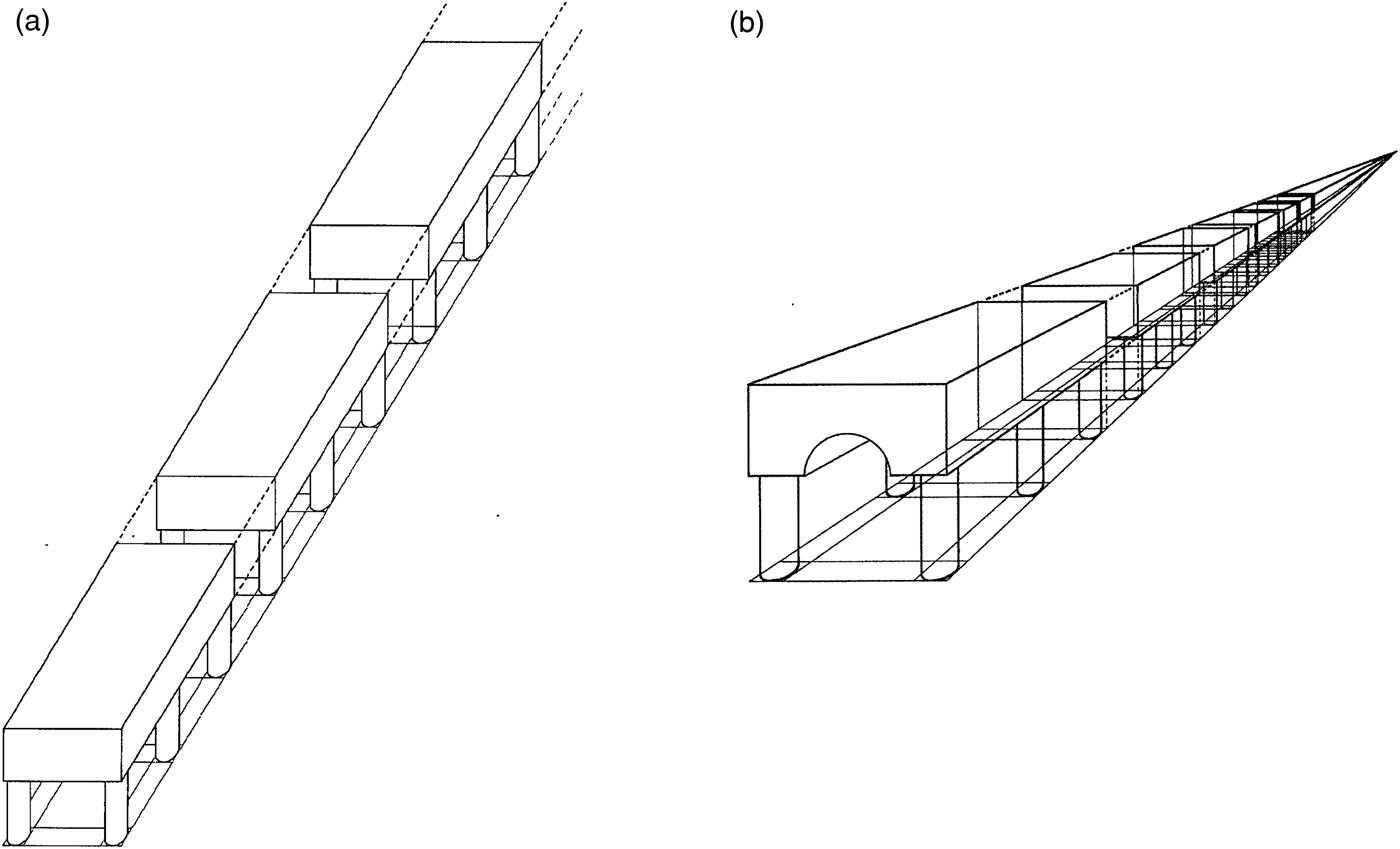
This case points to several other comparable ones in the law where the jurists had to establish norms that contemplated a future and made complex formal provisions for what would happen in a later time. The problem is that neither the construal of life-annuities or of usufructs seems to have been related to dense general mental conceptions outside the artificial thought-world of the jurists. Like the laws governing the purchase of a hope or an expectation, a spes, the concepts seem strangely foreshortened. The law does contemplate future arrangements, but in a rather limited fashion that considers only situations that emerge directly out of a given present circumstance: the future appearance of this crop, this child or that inheritance. In a strange ahistorical optimism that seems to mark many of the statements on this matter, it has been remarked that the development of these legal concepts seems to be cut off in the later Empire just before they appear to have been on the verge of experiencing a flourishing development of new modern concepts — an unachieved ‘symphony’ of Roman juridical doctrine, as it has been dramatically put.Footnote 111 I rather doubt this. It is analogous to the claim that Roman military intervention in the East at the end of the Republic somehow cut off the logical development of Greek city-state borrowing into the formation of a true long-term public debt.Footnote 112 This, too, seems improbable. What seems more likely is that most persons subscribed to a compressed time-schema inside of which various tactics were employed to cope with a specific problem and circumstance. So although the claim that the Romans did not have universally applied concepts of amortisation and depreciation is true, it does not mean that they did not have these tools in some form. As an instance of valuing the construction of walls in Vitruvius shows, the concept and its application did exist, but in a rather selective form: depreciation was applied to some types of stone-built walls, but not to standing walls built of brick.Footnote 113 When he does apply amortisation or depreciation, Vitruvius does not envisage the depreciation as involving a complex serially-stepped concept of a gradual ‘lessening of worth’ in the future, but rather a consistent one-eightieth loss of the original value that applied to every year in the future.Footnote 114 This temporal perspective, I would argue, is analogous to the parallel linear orthogonal perspective in Roman wall paintings: space, and therefore time, was more generally seen as diminishing (or growing) in equal segmentary units extending into the future (or the past). It does not share the concept of cumulative change, growth or the incremental diminishing of a given value to a vanishing point (see Fig. 1a and b).
(a) A portico with a uniform plan that is supported by equal columns ad infinitum (from Sinisgalli Reference Sinisgalli2012: 51, fig. 29); (b) A portico which assumes the slopes of a delimited cone to a vanishing point (from Sinisgalli Reference Sinisgalli2012: 54, fig. 31). (Reproduced with permission of the author)

V SPACE/TIME
The temporal perspective that has been explored so far is, I would argue, vitally connected to a problem of spatial perception. Since time and space are dimensions that are knit together in forming the reality of space-time, it is only logical that human experience interprets them in a similar fashion, the one by analogy to the other. A host of modern cognitive studies have demonstrated that humans have a propensity to represent time in spatial metaphors, although different cultures and languages picture things like the future and the past in distinctive ways.Footnote 115 There are good reasons to believe that concepts of space in Roman antiquity — insofar as it is possible to discover a central coherence in them — were comparatively disjointed, lacking a formal overarching unity.Footnote 116 If we are to speculate about the continuities between space and time in the Roman world, ideally an investigation of actual ‘spatial practices’ would perhaps be the best way to proceed.Footnote 117 Other than studies of movement through space, however, little has been done that could furnish the basis for this type of investigation. To restrict our focus to concepts, the problem is to find a case that will permit a test of the analogy to depth of time to the quality of the perception of space. Aspects of the fiscal world described above functioned in a strangely compressed present that seems flattened and two-dimensional when compared with the perspectives in which present-day economic dealings function. They impart something like the impression that a modern viewer has when looking at a Roman wall painting. The perspective in these paintings, as Panofsky argued, is the ‘expression of a specific and fundamentally unmodern view of space’. It is a way of representing space that produces a visual impression in which the world ‘becomes curiously unreal and inconsistent, like a dream or a mirage’.Footnote 118 The similarity of the visual and economic effects suggests that decorative wall frescoes might enable such a test. With them, one might ask how it was that perspectival depth was represented when the artist was presented with the constraints of a two-dimensional surface, a flat linear dimension analogous to ‘the present’ in time? The question here does not pertain as much to the near-physical representation of the future ‘out there’, but rather to a quality of space that reflects the potential of a dynamic moving through space to a distant point.
In Roman wall paintings that are our test case, we do not find any single-point modern type of perspectival representation. Given this fact, one tendency has been to deny that there was any consistent way of presenting a uniform projection of depth into the ‘future’ of space, to hold that coherent in-depth space is ‘denied’. The background is treated, as it has been phrased, as un spazio negato.Footnote 119 Any suggestion that the Romans did not have any perspective because they did not have a modern perspective, however, would be a spatial argument analogous to stating that they had no concept of a substantial futurity at all — which I would argue to be considerably overdrawn, indeed false.Footnote 120 Consequently, it is necessary to ask what alternative types of perspective they did have and how these might be connected to different senses of time. Considering the matter more closely, we see that Roman painters deployed what has been called ‘a variety of spatializing tactics’ to achieve an effect of depth in perception.Footnote 121 These included techniques such as using variable size and layering of objects in order to produce a sense of ‘before and after’ and ‘in front and behind’, the use of lighter and darker colours, the use of simultaneous horizontal and aerial views. It is not my purpose here to engage in a detailed critique of what type of perspective this is or why Roman wall painters exploited these various devices in attempts to convey spatial depth to the viewer — the debates have gone on for well over a century.Footnote 122 As with time, their main concern was not to produce a unified field of depth, but to pursue different ones: to impart a sense of vividness (being present) and sequence. Suffice it to say that these painters did not put into practice the modern mathematical rational system of infinite single-point perspective of the entire visual frame that emerged in the fifteenth and sixteenth centuries — whether because they simply did not conceive of inventing the necessary techniques or because the viewers and patrons were not looking for this kind of picturing (which might have looked as odd to them as their paintings do to us).Footnote 123 What they settled on by the end of antiquity is what has been described as a paratactical syntax of images set in ‘conventional perspectives of a cartographical type’.Footnote 124
The essential point for our analysis is not as much the negative (‘they did not have modern perspective’) as it is to understand what sort of use of perspective they did have and what this suggests about time frames.Footnote 125 In the so-called second style paintings at Pompeii it has been convincingly demonstrated that the painters engaged in a series of perspectival devices, namely parallel orthogonal and convergence perspective systems, or, occasionally, a combination of these.Footnote 126 Even where something akin to this perspectival system was perhaps known, the cases where it can be demonstrated to have been applied to produce a whole picture, are exceedingly few.Footnote 127 Close inspection of representations from Egyptian wall paintings and Assyrian royal reliefs forward to the paintings created at the end of Roman antiquity has confirmed the same problematic of representation, one that more or less matches Panofsky's analysis of ‘ancient spatial’ concepts.Footnote 128 Even if this was the preferred mode of representing space, it is not the case that the artists of the time lacked the requisite technical knowledge or geometrical expertise to do otherwise. Rather, there was a systemic lack of impetus to put these known techniques to work to produce the specific visual effects to which we are accustomed. In fact, the problem, as with the apparent fragmentation of time, might not even be with perspective per se. Just as their concern was not with a deep long-term time frame that unified everything, so in representing space they were not concerned with using a single overriding system of perspective.
The use of different perspectival techniques was in aid of a fundamentally different purpose in wall painting that only partially applies to the problem of time. What might be called the ‘embedded’ nature of the uses of perspective indicates that various types of single-point perspective were tactics used in the pursuit of other supervening aims, such as presenting a striking visual spectacle or explicating the narrative of a story.Footnote 129 I suspect that this mix of time and space also finds its reflection in the type of fictive writing that is most identified with mirroring the peculiar time and space of the Empire, namely the novel. Bakhtin's concept of the chronotope, and specifically the chronotope that he finds to be characteristic of the genre of the Graeco-Roman novel, must be relevant to the argument here.Footnote 130 The type of linear sequential following of points that he sees as characteristic of the novel is surely also related to the hodological mappings of space that were also characteristic of the time.Footnote 131 Both aspects can be witnessed in the spiral narratives of the columns of Trajan and Marcus Aurelius where one finds the same relationship of space to time. There is a linear, sequential following of points but one in which there is no deep context of space: the same devices of foreshortening, stepping, gradation of figures or forefronting and backgrounding are used to produce an impression of spatial depth.Footnote 132 The production of vividness, that is a sense of present-ness, and of sequencing was more important than perspective as such.
Given these tests and observations, looking at time, specifically the future, from the reverse perspective of space, one is led to speculate that Roman perspective was a fragmented tactic adapted to producing effects in a present. If time was like space, then their future existed, but was adumbrated. In the context of space, their futurity seems to have been located somewhere between the ‘eternal present’, the virtual absence of any depth perspective in wall paintings of Pharaonic Egypt, and the creation of ‘modern perspective’ in the fourteenth and fifteenth centuries in Western Europe.Footnote 133 It must be emphasised that they had the techniques available to them and surely could have applied them. They chose not to do so, and systematically subordinated the possible use of single-point perspective to other more important aims. Moderns, conversely, forced the whole picture into a grid of single-point visual perspective. Coordinated with this latter move was the emergence of banks as large-scale lending institutions, the concept and reality of a national public debt, common use of double-entry book-keeping, mathematical calculations of future risk assessment, the emergence of the first modern constructions of utopias, the invention of mechanical clocks and other aspects of modernity.Footnote 134 The networking of these practices and their relationship to the new perspective, I would argue, was not accidental.
VI ENVOI
For Roman emperors, estate managers, municipal aediles and private business agents, time passed and was known to do so in a narrow and compressed linear fashion. Rational calculations of different kinds of future consequences within this concept of time were possible and certainly included economic ones. For example, there were provocations to economically rational calculations. Economic actors could plan and act to achieve compendia or ‘savings’, for example, that can be shown to have involved, in however rudimentary a fashion, calculations of assets and expenditures through future time.Footnote 135 Even in these cases, however, what must be imagined is a fragmented vision of the future, extending in most cases to the instance at hand or the forthcoming year. It was this real world of the quotidian planning in which most persons were engaged that produced their quality of time. The sum of their practical life experiences was somewhere between the time world described by Pierre Bourdieu for the Algerian Kabylie and a modern concept of time linked to a complex and fully envisaged future.Footnote 136 As Bourdieu remarked, the productive and social relations of the communities in the Kabylie (as late as the 1940s and 1950s) made it difficult, if not odd, for them to envisage ‘an immense and open future as a broad field of innumerable possibilities’ available to human control. Instead, time, like space, was experienced as ‘discontinuous, made up of a series of heterogenous islets of differing duration’.Footnote 137
The Roman time that I have described is far more coherent and operates with a future that is certainly more complex and extensive than this, although still without the future of modernity. Faced with this last problem, one is prompted to ask the question: did there ever appear a future closer to our complex long-range one firmly located in distant spaces in the millennial-long arc of time between the second century b.c.e. and the fifth c.e.? The elements that I am seeking are three: first, a clear concept of an autonomous future that was in and of itself a reservoir of valuable resources — a future that was complex in its picturing and development; second, a future that was non-trivial in the sense that not just an elite few, a Tacitus or a Pliny, accepted it as a notional thing, but rather one with which very large numbers of persons were pragmatically integrated; and, finally, one where behaviour in the present was firmly oriented to this future and accordingly was involved in planning for it. Perhaps it is only in new Christian values emerging on the sill of Late Antiquity that we might see some of the first tentative steps toward a quality and structure of the future which most Romans of earlier ages apparently did not share. For complex conceptual, institutional and experiential reasons, they had a less elaborate, less deep and more fragmented view of the future. The absence is a history not just of a deficit, but also of its consequences for ideas and behaviour.