


Introduction
Headaches can be a serious health problem for children and adolescents, with adverse effects on well-being (Sillanpää and Aro, Reference Sillanpää and Aro2000); therefore it is essential to have effective treatments. Preventive treatment options can be derived from the psychological domain, but many children and adolescents with recurrent headaches do not have ready access to these treatments, as they are not ubiquitously offered. One way of expanding the accessibility of preventive treatments is the implementation of self-help programs, in particular via internet-based interventions (IBI). IBI are able to transcend barriers and thus make treatment more easily available (particularly to those living in remote areas without treatment options). So far, only one study (Hicks, Baeyer and McGrath, Reference Hicks, Baeyer and McGrath2004) has examined an IBI including mail and telephone contact for paediatric recurrent headache and abdominal pain in a randomized controlled trial. The authors reported significant reductions of the pain score (assessed through a pain diary) for the IBI at post-treatment and follow-up.
The present study evaluated an IBI including chat communication for recurrent headache.
The main aims of this pilot study are:
1. Evaluation of the efficacy of an internet-based training in reducing headache and pain catastrophizing. It was hypothesized that cognitive-behavioural self-help (CBT) would lead to greater improvement than education (EDU) and that the results would remain stable at 6-month follow-up.
2. Evaluation of satisfaction with the internet-based format and subjective headache improvement.
3. Evaluation of the patient-trainer-alliance and whether IBI impedes a positive alliance is examined.
Method
Participants
Eighteen patients with migraine and/or tension-type headache (at least two headache attacks per month) aged 10 to 18 (mean = 13.4, SD = 2.6) were recruited for the study. They were randomly assigned to the two conditions. Pre-treatment comparisons revealed no significant differences between groups regarding age, diagnosis, headache variables (frequency, intensity, duration), and pain catastrophizing. After completing the post-assessment, participants of EDU were given the opportunity to complete CBT.
Procedure
The treatments were evaluated in a comparative design.
CBT included 6 self-help sessions (focusing on education on headaches, stress management, relaxation, cognitive restructuring, self-assurance strategies, problem solving) based on a face-to-face training manual (Kröner-Herwig and Denecke, Reference Kröner-Herwig and Denecke2002). The sessions could be downloaded on a weekly basis from the training website. In addition, the patients had 6 weekly chat sessions with the trainer, in which the assigned exercises were reviewed.
EDU consisted of the first training session of CBT on headache information plus chat communication (and thus served as an active control group). EDU patients had the same number of chat contacts as those in the CBT, but the chat focused on the diary records of the previous week rather than on cognitive-behavioural elements. Two additional chat sessions (booster sessions) were performed in both groups 4 and 8 weeks after the end of training. In CBT the main topics of the training, including coping strategies, were reiterated, in EDU the diary records were discussed.
Trainers
Three graduate students of clinical psychology served as trainers supporting the children (via the chat). The students received intensive training prior to conducting the treatment as well as weekly supervision (from a PhD student/psychotherapist in training).
Internet specifics
The patients had access to the training web-site (self-help sessions) and the chat from their own home computers by means of standard browsers. They received the passwords for the sessions on a weekly basis (during the chat) and were encouraged to download and read the text material and to print out and complete the exercise handouts. The feasibility of the training material was assessed before; in particular, we examined the comprehensibility of the training website and the ease of use of the chat with 5 children and adolescents with recurrent headache (10–16 years, 4 female and 1 male). In addition, the trainers had structured chat guidelines for both conditions.
Measures
The central outcome variables were frequency, duration, and intensity of headache assessed by means of an internet-based 4-week diary. Clinical significance was defined as a reduction of 50% or more in headache frequency compared to the baseline. Pain catastrophizing was assessed (by mail) using the German version of the Pain Catastrophizing Scale for Children (PCS-C, Crombez et al., Reference Crombez, Bijttebier, Ecclestone, Mascagni, Mertens, Goubert and Vertraeten2003). The diary and PCS-C were administered at pre-treatment, post-treatment, and 6-month follow-up, but the patients also completed the diary during the training. After treatment, patients and parents were asked to complete a postal questionnaire about their satisfaction and their perceived change in headache. In an internet-based questionnaire (based on Krampen and Wald, Reference Krampen and Wald2001) the patient-trainer-alliance was assessed in the second, fourth, and last session (patient's view only). Two subscales, the “patient-therapist-alliance/assistance” scale and the “helping to cope with problems” scale, were adapted for use with children and adolescents and the conditions of an internet-based training.
Statistical analyses
These were used to examine the changes in outcome variables between group comparisons. Treatment outcomes for each condition were also computed. When prerequisites of t-tests were not achieved, nonparametric testing was used (Mann-Whitney U-Test or Wilcoxon paired rank sum test). For all tests, the level of significance was set at p > .05, two-tailed.
Results
Of the18 patients, 2 (one in each condition) dropped out at post-treatment by failing to return the questionnaires and headache diaries. On average, the chat sessions were longer in CBT than EDU (mean duration: CBT: Mdn = 55.0 min, range 45.8–75.0 min; EDU: Mdn = 41.3, range 28.2–58.0 min). The difference was not significant (U = 18.0, p > .05).
No significant differences were found between the two treatment groups at post-treatment in any of the outcome variables (frequency: t = 0.239, p > .05; intensity: t = −0.995, p > .05; duration: U = 27.0, p > .05; pain catastrophizing: t = −2.051, p > .05).
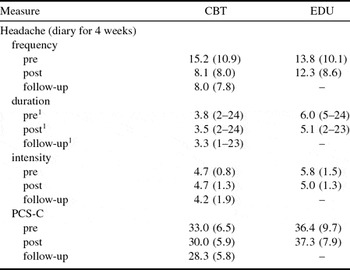
The frequency of headache decreased significantly from pre- to post-treatment (t = 2.480, p < .05) in CBT, but not in EDU (t = 1.016, p > .05) (see Table 1). Duration and intensity of headache did not change significantly in either group (CBT: intensity: t = −0.708, p > .05; duration: z = −0.681, p > .05; EDU: intensity: t = 0.881, p > .05; duration: z = 1.483, p > .05). Five patients in the CBT group reached the criterion of clinical significance at post-treatment; only 1 patient in the EDU group fulfilled this criterion. Pain catastrophizing was significantly reduced in CBT at post-treatment (t = 2.427, p < .05), but not in EDU (t = 0.010, p > .05). Treatment effects maintained at 6-month follow-up (only CBT, n = 10). No significant deteriorations or improvements took place between post-treatment and follow-up (frequency: t = −0.938, p > .05; intensity: t = 0.594, p > .05; duration: z = −0.533, p > .05; pain catastrophizing: t = 0.742, p > .05). Only 3 patients showed clinically significant improvement, 5 (who reached clinical significance at post-treatment) reported a marked improvement in a telephone interview after follow-up, but failed to return the diaries.
Headache variables and pain catastrophizing (means and SD)

1Medians and Range of duration are given, because of violation of prerequisites of t-test.
All patients and parents reported satisfaction with the training (self and parent rating; 0 = not satisfied, 3 = very satisfied; CBT: self-rating: Mdn = 3.0, range 2–3; parents' rating: Mdn = 2.0, range 1–3, EDU: self-rating: Mdn = 2.0, range 1–3, parents' rating: Mdn = 2, range 1–3). Six patients and 8 parents in the CBT group reported subjective improvement of headache directly after the training; whereas 4 members of EDU experienced subjective improvement, supported by 3 parents. There are no significant differences between the two groups regarding satisfaction (U = 16.0, p > .05) or subjective improvement of headache (U = 29.0, p > .05).
The results of the “patient-therapist-alliance/assistance” scale showed no significant differences between the groups (the scale ranges from 0–3, higher scores signify higher patient-trainer alliance/helping to cope with problems, CBT: Mdn = 2.8, range 2–3; EDU: Mdn = 2.7, range: 2–3; U = 21.0, p > .05). The scores on the “helping to cope with problems” scale revealed significant differences (CBT: Mdn = 2.0, range 1–3; EDU: Mdn = 1.0, range 0–2; U = 6.0, p < .05).
Discussion
The outcome measures demonstrate significant reductions of headache frequency from pre-to post-treatment in CBT, but not in EDU. Descriptively, conditions show some reduction in duration and intensity of headache, but the reductions fail to reach significance; thus the assumed superiority of CBT could not be shown by inter-group-comparisons. The improvement in CBT remained stable at the follow-up. While 5 patients of CBT reached clinical significance at post-treatment, only 1 in the EDU group fulfils this criterion (> 50% reduction), but it would be premature to draw any conclusions about general efficacy of CBT for reducing headache. The significant changes in pain catastrophizing in CBT emphasize the importance of cognitive restructuring of thoughts about pain and coping with headache. The training format and the chat contacts with the trainer were well accepted by all patients. They reported high satisfaction with the internet-based self-help training. Furthermore, both groups evaluated patient-trainer-alliance/assistance as positive and CBT reported significantly more help regarding coping through the trainer. The lower perceived help through the trainer in EDU did not influence the relationship between patient and trainer. The findings imply that the internet-based training does not impede a positive alliance.
Limitations
Only a small number of paediatric headache sufferers were treated; thus the power of the present study is low. Therefore conclusions about the general efficacy of CBT cannot be drawn as yet. A further limitation relates to the cost effectiveness of the training: inspection of the time spent in chat communication (involving the presence of the trainer) revealed CBT-IBI to be of similar efficiency as face-to-face CBT. This was in contrast to our expectation of a superior efficiency of the internet format. Nevertheless, the chat communication was generally well accepted by the patients and seems to have allowed for the development of a positive patient-trainer alliance. The internet format therefore appears to be a viable alternative, particularly when face-to-face intervention options are lacking.
Clinical implications and future directions
The present results support future examination of efficacy of IBI in children and adolescents with recurrent headaches.
Acknowledgements
The authors gratefully acknowledge funding by the German Research Foundation (Number: KR756/16-2). We also thank Barbara Bürmann, Anna-Lena Mejri and Gwendolen Müller for their valuable assistance in conducting the study.




Comments
No Comments have been published for this article.