The focus of this paper will be on the development of traits that fall within the domain of conscientiousness and their overlap with psychopathology, specifically from the domain of externalizing disorders. Conscientiousness is one of the “Big Five,” which are the five replicable trait domains found in common language and in many personality inventories (extraversion, agreeableness, conscientiousness, emotional stability, and openness/intellect; John, Naumann, & Soto, Reference John, Naumann, Soto, John, Robins and Pervin2008). Each of the Big Five represents a broad domain of specific traits united by common themes (Goldberg, Reference Goldberg1993). Conscientiousness itself is defined as a broad domain encompassing individual differences in the propensity to follow socially prescribed norms for impulse control; to be goal directed, planful, and able to delay gratification; and to follow norms and rules (John & Srivastava, Reference John, Srivastava, Pervin and Oliver1999). The breadth of this definition clearly indicates the multifaceted nature of the conscientiousness domain.
The definition of conscientiousness is remarkably similar to the definition of the latent trait that lies behind externalizing disorders, which is described as disinhibitory personality or a general inability to control impulses (Krueger, Markon, Patrick, Benning, & Krammer, Reference Krueger, Markon, Patrick, Benning and Kramer2007). The similar definitions suggest an overlap with common features shared between the two constructs. For example, disinhibitory personality has sometimes been included in discussions of the etiology of externalizing psychopathology (Krueger et al., Reference Krueger, Markon, Patrick, Benning and Kramer2007). Little is known, however, about how the two constructs relate to one another beyond their similar definitions. This is unfortunate, because the two fields of personality and psychopathology, which have historically studied these constructs separately, could benefit from using these constructs in conjunction, most notably in the area of development.
In this paper, we first describe what conscientiousness is. Subsequently, we discuss the interface between conscientiousness and externalizing psychopathology. We then provide an overview of the known developmental changes in conscientiousness across the life course, while highlighting the importance of these changes for externalizing psychopathology. Confronting the interface between conscientiousness, externalizing psychopathology, and developmental issues invited one direct question that we thought best to address with data. What is the shared environmental etiology of both conscientiousness and externalizing psychopathology? Specifically, we report on three studies examining the childhood experiences associated with both conscientiousness and externalizing behaviors. Last, we consider future directions.
What is Conscientiousness?
As we noted above, conscientiousness is a broad family of personality traits. It is therefore important to review just what a personality trait is and the common way traits are conceptualized. A trait is defined as “a tendency to respond in certain ways under certain circumstances” (Tellegen, Reference Tellegen, Cicchetti and Grove1991, p. 622), or more generally speaking, the tendency to think, feel, and behave in a relatively enduring and consistent fashion across time in trait-affording situations. Clearly, given its definition, conscientiousness should be, and is, an important correlate of a wide swath of social behavior. From a societal perspective, people who are highly conscientious are less likely to commit crimes (Miller & Lynam, Reference Miller and Lynam2001) and more likely to be committed and involved with their work, family, and community (Lodi-Smith & Roberts, Reference Lodi-Smith and Roberts2007). At the individual level, conscientiousness is related to more effective functioning in multiple domains, such as marriage (Roberts & Bogg, Reference Roberts and Bogg2004), work (Judge, Martocchio, & Thorseon, Reference Judge, Martocchio and Thoresen1997), and health (Roberts, Walton, & Bogg, Reference Roberts, Walton and Bogg2005). The predictive validity of conscientiousness for outcomes such as mortality and divorce is on par with cognitive abilities or socioeconomic status (Roberts, Kuncel, Shiner, Caspi, & Goldberg, Reference Roberts, Kuncel, Shiner, Caspi and Goldberg2007).
What is the composition of the family of traits within the conscientiousness domain? Several studies have focused on identifying the lower order structure of conscientiousness using two approaches. One route to identifying the structure of conscientiousness is to examine lexically derived trait adjectives, as was done to develop the Big Five (e.g., Goldberg, Reference Goldberg1993). In a lexical study (Roberts, Bogg, Walton, Chernyshenko, & Stark, 2004), five components found in previous lexical research on the lower order structure of conscientiousness were identified: industriousness (tenacious vs. lazy), reliability (dependable vs. unreliable), orderliness (organized vs. sloppy), impulse control (cautious vs. careless), and decisiveness (decisive vs. indecisive). Unlike previous research, two additional, interpretable facets were found: formalness and conventionality. Both of these dimensions appeared to represent blends of conscientiousness with high and low openness to experience, respectively.
A second route to identifying the underlying domain of conscientiousness is an examination of the factor structure of personality inventories that measure conscientiousness-related traits. In a second study of scales drawn from personality inventories, the factor structure of 36 different scales assessing aspects of conscientiousness was examined (Roberts, Chernyshenko, Stark, & Goldberg, Reference Roberts, Chernyshenko, Stark and Goldberg2005). The 36 measures of conscientiousness were best subsumed by six factors: impulse control, conventionality, reliability, industriousness, orderliness, and virtue. Interestingly, there is striking convergence across the lexical and questionnaire studies: industriousness, reliability, orderliness, impulse control, and conventionality replicated across these disparate samples and assessment techniques suggesting that, at a minimum, these five factors make up the underlying structure of conscientiousness.
Two aspects of this five-facet interpretation of conscientiousness are worth noting. First, no existing personality inventory includes all five, which renders any existing system of assessing conscientiousness inadequate. Most inventories fail to incorporate the conventionality facet, which is often mistakenly identified as an aspect of low openness. Despite this preconception, across these two studies conventionality was more strongly related to conscientiousness than openness. Second, in both studies the remaining facets of conscientiousness showed good levels of convergent and discriminant validity with the remaining Big Five, with the exception of the reliability facet. The latter is almost equivalently correlated with conscientiousness and agreeableness.
What Is the Relationship Between Conscientiousness and Psychopathology?
It has become increasingly clear that the overlap between normal and abnormal levels of personality (i.e., psychopathology) makes it difficult to argue that the two constructs are distinct (Widiger, Verheul, & van den Brink et al., Reference Widiger, Verheul, van den Brink, Pervin and John1999). This is especially true for conscientiousness and externalizing psychopathology, where a number of studies document an association with conscientiousness and the disorders that comprise externalizing psychopathology. For example, conscientiousness is linked to conduct disorder and antisocial disorder, specifically the impulse control facet (Krueger, Caspi, Moffitt, Silva, & McGee, Reference Krueger, Caspi, Moffitt, Silva and McGee1996; Lynam, Luekefeld, & Clayton, Reference Lynam, Leukefeld and Clayton2003; Tackett, Reference Tackett2006). Conscientiousness also overlaps with substance and drug abuse (Lynam et al., Reference Lynam, Leukefeld and Clayton2003; Sher & Trull, Reference Sher and Trull1994; Walton & Roberts, Reference Walton and Roberts2004). Likewise, the personality trait of constraint, which is strongly related to conscientiousness, is highly associated with the latent trait of externalizing (Krueger et al., Reference Krueger, Hicks, Patrick, Carlson, Iacono and McGue2002). Reaffirming these findings are recent meta-analyses that establish a strong tie between conscientiousness and externalizing psychopathology (Ruiz, Pincus & Schinka, Reference Ruiz, Pincus and Schinka2008; Saulsman & Page, Reference Saulsman and Page2004).
The empirical overlap between conscientiousness and various forms of psychopathology invites the question of just how traits and psychopathology are related in general. The most common perspective is that conscientiousness represents “normal” personality, whereas psychopathology represents “abnormal” functioning. In fact, the most widely held assumption is that psychopathology represents extreme forms of normal personality variation (see Walton, Roberts, Krueger, Blonigen, & Hicks, Reference Walton, Roberts, Krueger, Blonigen and Hicks2008). Unfortunately, this implicit assumption is not adequately tested by the simple empirical correlation between conscientiousness and various forms of psychopathology, such as externalizing disorders. As it turns out, there are a variety of ways of conceptualizing the correlation between normal and abnormal traits (e.g., Caspi & Shiner, Reference Caspi, Shiner, Damon and Eisenberg2006; Clark, Reference Clark2005; Tackett & Krueger, Reference Tackett, Krueger, Hankin and Abela2005; Widiger & Smith, Reference Widiger, Smith, John, Robins and Pervin2008).
The most basic model, the maintenance or pathoplasty model, conceptualizes personality traits and psychopathology as separate constructs. Personality traits are not necessarily causes of psychopathology but may influence the expression of psychopathology in form, severity, timing, or treatment (Clark, Reference Clark2005). For example, individuals suffering from depression and suicidal tendencies who are also higher in openness to experience may be more creative in the ways they contemplate suicide. Little empirical evidence for this model exists for conscientiousness and externalizing disorders, but this model has been useful in understanding the overlap between conscientiousness and eating disorders (Widiger & Smith, Reference Widiger, Smith, John, Robins and Pervin2008). For example, conscientiousness may differentiate what type of eating disorder a person develops, with those higher in conscientiousness being prone to develop anorexia and those low being more prone to develop bulimia. Similarly, it is quite possible that conscientiousness can influence the types of externalizing behavior performed, the context of the behaviors, and the propensity for relapse, and the possibilities for rehabilitation.
A second model, described as the vulnerability model, posits that personality traits set in motion processes that lead to the development of psychopathology. In this sense personality traits can be seen as the core of psychopathology, where conscientiousness represents an integral element in the formation and causation of externalizing psychopathology. Longitudinal evidence supports the vulnerability model for conscientiousness and externalizing psychopathology. For example, impulsivity in childhood is associated with increased antisocial behaviors in subsequent stages of childhood and adolescence (Henry, Caspi, Moffit, Harrington, & Silva, Reference Henry, Caspi, Moffitt, Harrington and Silva1999; Lynam et al., Reference Lynam, Caspi, Moffitt, Wisktrom, Loeber and Novak2000; Sigvardson, Bohman, & Cloninger, Reference Sigvardsson, Bohman and Cloninger1987; Wright, Caspi, Moffit, & Silva, Reference Wright, Caspi, Moffitt and Silva1999). Impulsivity or disinhibition is more strongly related to life-course persistent antisocial delinquency than adolescence limited delinquency (Moffitt, Caspi, Dickson, Silva, & Stanton, Reference Moffitt, Caspi, Dickson, Silva and Stanton1996). This suggests that an impulsive disposition may be partially responsible for the life-course persistent individual's long-term antisocial behaviors.
Impulsivity and disinhibition also predict alcohol and drug abuse in adolescence and early adulthood (Block, Block, & Keyes, Reference Block, Block and Keyes1988; Brook, Whiteman, Cohen, Shapiro, & Balka, Reference Brook, Whiteman, Cohen, Shapiro and Balka1995). Moreover, conduct disorder is predicted by poor self-control in childhood (Sanson & Prior, Reference Sanson, Prior, Quay and Hogan1999). A number of other studies link low levels of impulse control in childhood to broad measures of externalizing in late childhood (Eisenberg et al., Reference Eisenberg, Guthrie, Fabes, Shepard, Losoya and Murphy2000; Rubin, Burgess, Dwyer, & Hastings, Reference Rubin, Burgess, Dwyer and Hastings2003) and adolescence (Olsen, Schilling, & Bates, Reference Olson, Schilling and Bates1999). Not as many studies extend into adulthood, but the ones that do suggest that low levels of conscientiousness represent a risk factor for the development of externalizing behaviors in adulthood (e.g., Clark & Watson, Reference Clark and Watson1999; Miller & Lynam, Reference Miller and Lynam2001; Walton & Roberts, Reference Walton and Roberts2004).
Although the vulnerability model has garnered the most attention from researchers, it is possible that this relationship occurs not because normal level personality causes psychopathology, but because normal level personality and psychopathology lie on a similar underlying dimension. This dimension may manifest as normal level variations earlier and as psychopathology later in life, thereby making it seem as if one is causally prior. This viewpoint is represented in the spectrum model (Widiger & Smith, Reference Widiger, Smith, John, Robins and Pervin2008), where constructs are not discrete and qualitatively different from one another. Instead, these constructs represent different points on the same underlying continuum, governed by similar neuropsychological systems. Externalizing psychopathology may be conceptualized as an extreme form of a personality continuum that could be titled disinhibition, and conscientiousness is a less extreme manifestation of this same construct.
Evidence for the externalizing spectrum largely comes from behavior genetic studies. A sizable component of heritable variance is shared amongst substance dependence, antisocial behavior, and conscientiousness (Krueger et al., Reference Krueger, Hicks, Patrick, Carlson, Iacono and McGue2002; Young, Stallings, Corley, Krauter, & Hewitt, Reference Young, Stallings, Corley, Krauter and Hewitt2000). This suggests that the overlap between conscientiousness and externalizing is attributable to similar genetic etiology. This finding is strengthened by a number of shared biological systems between conscientiousness and externalizing psychopathology. For example, similar neurotransmitters systems, genes, and brain regions are associated with both conscientiousness and externalizing behaviors (Fox, Henderson, Marshall, Nichols, & Ghera, Reference Fox, Henderson, Marshall, Nichols and Ghera2005; Nelson & Trainor, Reference Nelson and Trainor2007). This research has made it clear that the two constructs share some underlying features and cannot be easily separated at a phenotypic level because of a shared genotypic level.
The spectrum model is consistent with the notion that a trait like conscientiousness captures the normal part of the continuum, whereas externalizing disorders capture the extreme ends of the continuum. Of interest, a recent study calls into question this widely held assumption (Walton et al., Reference Walton, Roberts, Krueger, Blonigen and Hicks2008). Using an item response theory approach, Walton et al. (Reference Walton, Roberts, Krueger, Blonigen and Hicks2008) showed that putatively normal trait measures of conscientiousness were, in actuality, assessing the same range of the underlying continuum assessed by related measures of psychopathology, such as psychopathy or conduct disorder (Walton et al., Reference Walton, Roberts, Krueger, Blonigen and Hicks2008). Item response theory is one of the few analytical techniques that allow one to estimate the “difficulty” or extremeness of particular items on the underlying dimension or construct. Walton et al. (Reference Walton, Roberts, Krueger, Blonigen and Hicks2008) showed that items from specific facets of normal personality not only were on the same dimension as psychopathy but also were just as difficult or likely to be endorsed. This is one of the first formal tests of the idea that normal personality measures assess a different part of the same spectrum, or dimension, as psychopathology. The findings clearly call into question the widespread assumption that abnormal traits are more extreme than normal traits.
The finding that normal and abnormal traits assess the same range of the trait dimension inspires alternative interpretations of their association. One alternative that has yet to be considered is one that we would describe as the multidimensional model. Specifically, most forms of psychopathology are multidimensional in nature, consisting of several related dimensions (Widiger & Clark, Reference Widiger and Clark2000). This multidimensional complexity may be the reason for both the overlap between measures of normal personality and the perceived rareness of psychopathology that is often confused with the idea that disorders are extreme. Specifically, it is simply harder to score high on several dimensions than on one. Given this difficulty, it is subsequently rare to find people who possess all of the features of specific disorders of psychopathology. The rareness of scoring higher on two or three dimensions would lead to the mistaken conclusion that very few people suffer from psychopathology and are therefore extreme on the dimension, which would also be a rare occurrence. Within this model, “normal” personality traits would simply be one of several dimensions that make up the configuration of dimensions that define disorders. More succinctly, there may be no difference between normal and abnormal traits.
Last, one of the oldest perspectives on the link between abnormal and normal personality is quite possibly the least popular. As Freud espoused in many of his writings (Freud, Reference Freud and Strachey1930/1961a), psychopathology may precede normal development. Because they have yet to be successfully socialized and because they lack key personality structures, children may be more likely than adults to exhibit various forms of psychopathology, such as narcissism, aggression, and borderline qualities. Normal personality only emerges with successful development and even then can be reversed through extremely stressful events that lead to regression (Freud, Reference Freud and Strachey1909/1961b).
What is striking about this last perspective is that it has received so little empirical attention. This oversight may have reasonable causes. Freud's ideas have fallen out of favor, and it is policy not to diagnose children with personality disorders. Only recently have researchers developed tools to assess personality disorder dimensions in children (De Clerq, De Fruyt, & Widiger, Reference De Clercq, De Fruyt and Widiger2009). In contrast, there is indirect evidence in favor of this model. As will be discussed in the following sections, most longitudinal studies of personality development show a clear developmental trend for personality to improve starting in adolescence (Branje, Van Lieshout, & Gerris, Reference Branje, Van Lieshout and Gerris2007) and continuing through young adulthood and midlife (Roberts, Walton, & Viechtbauer, Reference Roberts, Walton and Viechtbauer2006). Furthermore, studies of specific forms of psychopathology, such as narcissism, show clearly that people become much less narcissistic with age (Foster, Campbell, & Twenge, Reference Foster, Campbell and Twenge2003). Of course, an improvement in personality does not mean that children necessarily start out plagued with psychopathology, although it does point to the possibility.
One piece of evidence missing from the discussion of the interface between conscientiousness and externalizing psychopathology, which could consequentially provide rapprochement between views of normal–abnormal overlap, is the developmental picture detailing the antecedents to both syndromes. To this end, we will provide an overview of the evidence for continuity and change in conscientiousness and the factors associated with these developmental patterns across the life course. Another missing piece of the puzzle is the etiology of conscientiousness and whether it differs from related forms of psychopathology such as externalizing disorders. To this end, we will report data from several studies in which we attempt to map out whether conscientiousness and externalizing disorders have a shared environmental etiology.
How Does Conscientiousness Develop Across the Life Course?
Both cross-sectional and longitudinal studies show that people become more conscientious with age, and that these increases often occur quite late in life (Helson & Kwan, Reference Helson, Kwan and Hampson2000; Helson & Wink, Reference Helson and Wink1992; Roberts, Walton, & Viechtbauer, Reference Roberts, Walton and Viechtbauer2006; Srivastava, John, Gosling, & Potter, Reference Srivastava, John, Gosling and Potter2003). For example, numerous cross-sectional studies have demonstrated that older individuals are higher in conscientiousness than younger individuals. In five different cultures, individuals past the age of 30 were more conscientious than younger individuals (McCrae et al., Reference McCrae, Costa, Pedroso de Lima, Simoes, Ostendorf and Angleitner1999). A closer examination of this cross-sectional pattern in a large Internet and international samples find that conscientiousness increases in each decade of life up to age 60 (Donnellan & Lucas, Reference Donnellan and Lucas2008; Srivastava et al., Reference Srivastava, John, Gosling and Potter2003).
Multiple longitudinal studies also have shown increases in conscientiousness with age. Changes in conscientiousness were analyzed in a meta-analysis of 92 longitudinal studies spanning the period from age 10 to 101 years (Roberts et al., Reference Roberts, Bogg, Walton and Caspi2006). Traits belonging to the domain of conscientiousness increased in young adulthood (age 20–40), middle age (40–60), and old age (60–70). Several aspects of these meta-analytic findings are important to highlight. First, the effects were heterogeneous, which means that despite the general upward trend, some studies did not find increases in conscientiousness with age (e.g., Costa & McCrae, Reference Costa and McCrae1988). Furthermore, the effect sizes were modest within decades. In contrast, when accumulated across the life span, conscientiousness increased a full standard deviation from young adulthood through old age. These results strongly suggest that traits from the domain of conscientiousness increase throughout the life course. Most conspicuously, conscientiousness did not show any consistent pattern of change between the ages of 10 and 22. These results clearly indicate that conscientiousness-related traits are the subject of developmental pressures far later in the life course than typically considered in developmental research.
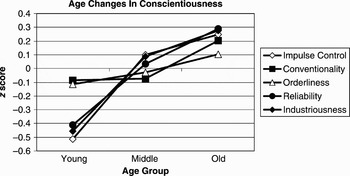
Very little research has focused on the underlying structure of conscientiousness and whether specific aspects develop in a similar fashion. In a recent study, we examined age differences in the five replicable facets of conscientiousness across the life course (Jackson et al., Reference Jackson, Bogg, Walton, Lodi-Smith, Wood and Harms2009). As shown in Figure 1 the general trend is for conscientiousness-related traits to increase with age. That being said, we found particular differences across facets and age periods. For example, we found marked differences on measures of industriousness between young adulthood and middle age, but not between middle and old age. This is consistent with the role demands of young adulthood and midlife, which emphasize work and achievement as opposed to the demands of old age and retirement, in which achievement related activities should be on the wane. Complementing these changes in young adulthood were differences in conventionality between middle and old age, but not young adulthood and middle age. Thus, it appears that becoming the pillar of society may necessitate increases in conventional and traditional behaviors and attitudes (Mitchell & Helson, Reference Mitchell and Helson1990). Surprisingly, the facet of impulse control, which is arguably the most “temperament” like construct of the underlying facets of conscientiousness, showed the most consistent and pervasive differences across all age periods. Overall, people become more controlled with age. Finally, the orderliness facet of conscientiousness demonstrated no significant age differences whatsoever. The latter finding raises concerns over developmental studies that use short measures of personality, because these measures tend to overemphasize orderliness (e.g., Saucier, Reference Saucier1994) and thus attenuate any chances of finding developmental changes over time.
The age differences in the five major facets of conscientiousness.

Why Does Conscientiousness Change in Adulthood?
This question can be further broken down into two more specific, yet related questions. First, why do personality traits, and conscientiousness in particular, change so much in young adulthood (e.g., ages 20–40)? Second, what are the mechanisms of change? In this case, what are the mechanisms that are particular to changes in conscientiousness and do they overlap with factors related to externalizing?
We have attempted to explain the fact that young adulthood is the fulcrum for personality trait development with the social investment principle (Roberts & Wood, Reference Roberts, Wood, Mroczek and Little2006). The social investment principle states that investing in normative social institutions, such as age-graded social roles in young adulthood, is one of the primary drivers of personality trait development (Lodi-Smith & Roberts, Reference Lodi-Smith and Roberts2007; Roberts, Wood, & Smith, Reference Roberts, Wood and Smith2005). In psychological terms, young adulthood is a time when people build identities by making psychological commitments to social institutions in the form of social roles, such as work, marriage, family, and community. Social roles come with their own set of contingencies and expectations that create a reward structure that calls for becoming more socially dominant, agreeable, conscientious, and less neurotic. Moreover, the dominant pattern of role investments seen in quasi-universal tasks of social living, such as developing a family and career occurs in young adulthood (Helson, Jones, & Kwan, Reference Helson, Jones and Kwan2002). In turn, these quasi-universal transitions in young adulthood help to explain the normative patterns of personality change that result from role investments during this time of the life course.
What are the mechanisms that might be responsible for the effect of role experiences on personality trait change? People might simply change in response to contingencies in the environments found in social roles. For example, supervisors and spouses reward and punish specific behaviors in an effort to get individuals to be optimal employees or marriage partners. Sampson and Laub (Reference Sampson and Laub1990) argued that wives changed their delinquent husbands by punishing their husbands' cavalier behaviors. Alternatively, these same wives may reward prosocial activities with greater affection and regard for their husbands. Likewise, employers reward invested behavior with concrete incentives like paychecks and promotions. Presumably, long-term exposure to specific reward and punishment schedules should result in different patterns of personality trait change.
The key psychological socializing mechanism within the social investment experience lies in the symbolic meaning of the roles to which people commit themselves. The act of commitment exposes a person not only to the contingencies contained in the new social role but also the role expectations for appropriate behavior (Sarbin, Reference Sarbin, Worchel and Byrne1964). For example, people will come to their work or key relationships with a set of expectations for how they should act that are derived from their experiences watching significant others in the same types of roles (Caspi & Roberts, Reference Caspi, Roberts, Pervin and John1999). Moreover, influential people in a person's social world will hold and communicate expectations that serve as discriminative stimuli for future rewards and punishments. Whether generated by others or the self, role expectations exert control over behavior, such that if a person violates the expectations they will be punished or if they conform to the expectations they are rewarded with social regard.
By definition the process of social investment is pervasive, but remains voluntary. That is, some people can choose not to invest in societal institutions in a normative fashion, which is highly relevant to the overlap between conscientiousness and externalizing. In fact, we have described the social investment process as essentially the opposite of the antisocial path followed by individuals expressing externalizing tendencies (Lodi-Smith & Roberts, Reference Lodi-Smith and Roberts2007). Thus, some individuals will not only avoid investing in the normal social roles of young adulthood but also may even do the opposite. The expectation would be that individuals who forgo the normative trends will not show the typical increases in traits such as conscientiousness and may even show decreases on traits that most people show increases.
It should be noted that the inspiration for the social investment principle was inspired by research on the lives of delinquent men. Specifically, Sampson and Laub (Reference Sampson and Laub1990; Laub & Sampson, Reference Laub, Sampson, Colby, James and Hart1998) showed that the development of bonds to social institutions reduced delinquent behavior in adulthood. Sampson and Laub (Reference Sampson and Laub1990) defined social bonds as social investments made in work, marriage, and to one's community. They also argued that simply receiving employment or getting married did not confer the salutary effect of these social contexts. Rather, the positive effect of these roles occurred when one became committed to a job or developed a strong attachment to a spouse. Sampson and Laub (Reference Sampson and Laub1990) found that job stability and a strong emotional attachment to one's spouse significantly reduced delinquent and criminal activity in men (see also Laub, Nagin, & Sampson, Reference Laub, Nagin and Sampson1998). Consistent with the gradual increases in conscientiousness across the life course, Laub et al. showed that the effects of a strong emotional attachment to one's spouse were gradual and cumulative over time. That is, as the quality of a man's marital relationship increased, the probability of him committing a crime decreased with each passing year.
Several longitudinal studies have demonstrated that experiences in work and marriage are associated with changes in personality traits and conscientiousness in particular. For example, women who achieved higher levels of occupational attainment in work tended to increase on achievement, responsibility, and self-control, demonstrating that more continuous investment in work is related to increases in traits from the domain of conscientiousness (Roberts, Reference Roberts1997). Results from an ongoing longitudinal study of both men and women replicated and extended these findings. Specifically, success and involvement in work were associated with increases in the industriousness and impulse control facets of conscientiousness in young adulthood (Roberts, Caspi, & Moffitt, Reference Roberts, Caspi and Moffitt2003).
In the domain of relationships, remaining in a close intimate relationship in young adulthood is related to increases in constraint, a facet of conscientiousness related to impulse control (Robins, Caspi, & Moffitt, Reference Robins, Caspi and Moffitt2002). Similarly, engaging in a serious partnership for the first time in young adulthood is associated with decreases in neuroticism and increases in conscientiousness (Neyer & Asendorpf, Reference Neyer and Asendorpf2001; Neyer & Lenhart, Reference Neyer and Lehnart2007). Avoiding divorce and maintaining a marriage-like relationship for a longer period of time in young adulthood also is associated with increases in responsibility in young adulthood and prospectively in midlife (Roberts & Bogg, Reference Roberts, Bogg, Walton, Chernyshenko and Stark2004). These longitudinal studies show that investment in the conventional roles of work and intimate relationships can explain, in part, the increases in conscientiousness found in young and middle adulthood.
As noted above, one of the key mechanisms for personality trait development are the expectations people hold for themselves and for others. Consistent with the changes seen in conscientiousness across the life course, people expect teenagers to be less than conscientious than older individuals (Wood & Roberts, 2007). In contrast, people who have taken on work and family roles and who are older are expected to be more conscientious. To the extent that life goals can be construed as representing expectations for oneself, there is evidence for their role in personality trait change. Specifically, in a 4-year longitudinal study of college students, it was found that increases in goals for investing in a family and in a successful career predicted increases in conscientiousness (Roberts, O'Donnell, & Robins, Reference Roberts, O'Donnell and Robins2004). The important feature of this idea is the fact that actual experience is not necessary for personality change to occur. To some extent then, personality change can come about by simply changing one's mind. Of course, people often overestimate how easy that really is.
As we noted above, the social investment process is normative and widespread, but not universal. That is, some people opt to follow a different path or delay the onset of adult social roles. Several studies have examined specific nonnormative behaviors and how they relate to personality trait change. In a longitudinal study of women coming of age in the 1960s, it was found that women who continued to smoke marijuana as they moved into middle age failed to increase on measures of conscientiousness as was normative for the sample (Roberts & Bogg, Reference Roberts and Bogg2004). Similarly, men and women who continued problematic alcohol behaviors in the transition from adolescence to young adulthood tended to maintain levels of impulsivity rather than decline as was normative (Littlefield, Sher, & Wood, in press). Analogously, men and women who participated in counterproductive work behaviors, such as fighting, stealing, and defrauding their workplace, became less controlled and more neurotic over time (Roberts, Bogg, Walton, & Caspi, Reference Roberts, Bogg, Walton and Caspi2006). These studies highlight two important developmental issues. First, changes in personality may derive in a bottom-up fashion from changes, or the lack thereof, in behavior. Second, these studies indicate that increases in conscientiousness are not universal. People can opt out of the normative choices of young adulthood and by doing so delay what appears to be maturation.
What About the Development of Conscientiousness in Childhood?
As this review shows, ongoing research is beginning to paint a clear picture of how and why conscientiousness develops in adulthood. Ironically, far less is known about how conscientiousness develops in childhood. Of course, research has shown that conscientiousness, like almost all other psychological traits, is heritable (Krueger & Johnson, Reference Krueger, Johnson, John, Robins and Pervin2008). There is also evidence tying childhood temperamental dimensions, such as persistence and disinhibition, to adult measures of conscientiousness (Caspi et al., Reference Caspi, Harrington, Milne, Amell, Theodore and Moffitt2003). Nonetheless, this paints a rather opaque picture of the development of conscientiousness. Very few studies have examined the etiology of conscientiousness from childhood to adulthood in such a way that we can identify the key processes and mechanisms responsible for a person to grow into an adult who is more or less conscientious.
In contrast, much more is known about the etiology of externalizing disorders, which are the purview of psychopathology. Greater attention has been paid to these phenomena than the “normal” components of personality, such as conscientiousness. For example, a core list of psychosocial factors have been identified as antecedents to externalizing behaviors, and these factors can be roughly organized into three domains: family factors, peer groups, and social disadvantage (Rutter, Giller, & Hagell, Reference Rutter, Giller and Hagell1998). Furthermore, the first two domains appear to be primary environmental antecedents, as the effects of social disadvantage are largely mediated by family factors and peer group experiences (Rutter et al., Reference Rutter, Giller and Hagell1998).
Family factors that contribute to antisocial behaviors include being born into a large family, being born to teenage parents, and experiencing a broken home (Rutter et al., Reference Rutter, Giller and Hagell1998). The mechanisms responsible for the effects of these social and demographic factors appear to be more psychological than sociological in nature. For example, children born into large families by young parents are more likely to experience poor parenting, such as ineffective monitoring, capricious punishment, and unresponsiveness. In turn, poor parenting is a much stronger predictor of antisocial outcomes than living in a large family (Patterson, Reference Patterson1982). Likewise, broken homes and hostile family environments are also strongly related to externalizing behaviors (Farrington, Reference Farrington2005). One of the most consistent family factors associated with externalizing behavior is the experience of abuse and neglect. For example, being victimized as a child is associated with a 50% increase in criminal activity later in life (Widom, Reference Widom, Stoff, Breiling and Maser1997). Antisocial behavior appears to be even more strongly related to childhood abuse (Kessler, Davis, & Kendler, Reference Kessler, Davis and Kendler1997).
Peer groups also play a significant role in the development of externalizing disorders. At a pragmatic level, many externalizing behaviors are undertaken in social groups (Reiss, Reference Reiss, Tonry and Norris1988). The facilitating effects of peer groups can manifest externalizing behaviors either through selection or socialization effects (Rutter et al., Reference Rutter, Giller and Hagell1998). In terms of selection, individuals may choose to associate with certain peer groups in order to manifest their externalizing tendencies in a social group. That is to say, people may choose to belong to a group that does drugs because they already do drugs themselves. In contrast, individuals may join peer groups and be influenced to adopt new externalizing behaviors because of peer pressure. Through either mechanism, peer groups have been shown to maintain externalizing behaviors if they are made up of members who already participate in these behaviors (Farrington, Reference Farrington, Tonry and Morris1986).
Given the empirical overlap between conscientiousness and the externalizing spectrum, it makes sense to examine the factors known to cause externalizing behaviors and test whether they also predict variation in conscientiousness. One of the few studies to examine the antecedents to conscientiousness emerged out of the research on the types of experiences typically linked to psychopathology, such as the experience of abuse and neglect in childhood (Rogosch & Cicchetti, Reference Rogosch and Cicchetti2004). Consistent with the externalizing findings, children who experienced greater levels of maltreatment, in the form of combined abuse and neglect were dramatically lower on age 6 ratings of conscientiousness. Of interest, the experience of maltreatment was not associated with differential patterns of change in conscientiousness between ages 6 and 9. Rather, the differences at age 6 were exhibited once again at age 9, with the maltreated children scoring lower on conscientiousness. This study would support the argument that conscientiousness and externalizing share similar etiological pathways.
Fewer studies have examined environmental conditions and both conscientiousness and externalizing in the same sample. One such study points to a possible dissociation between the etiology of conscientiousness and externalizing disorders. Prinzie et al. (Reference Prinzie, Onghena, Hellinckx, Greitens, Ghesquire and Colpin2003) reported correlations among childhood conscientiousness, mother's tendency toward lax or coercive parenting, and externalizing behaviors. Of interest, lower conscientiousness was associated with lax parenting, but not coerciveness. In contrast, externalizing was associated with coercive parenting and not laxness. Therefore, the developmental pathways for conscientiousness and externalizing behavior may differ. Moreover, one thing not considered in developmental research to date is the possibility that the lack of negative parenting may not be sufficient to foster conscientiousness. For example, prosocial investment in one's children may be a key element in developing higher levels of conscientiousness both in adolescence and later in life.
Given the general rarity of studies that have examined the environmental and experiential antecedents to conscientiousness and externalizing we thought it would be prudent to report data from several studies in which we have tested the association between childhood experiences, both positive and negative, and conscientiousness and between childhood experiences and both conscientiousness and externalizing. In addition to examining some of the typical negative environments associated with externalizing, we also tested whether positive childhood environments and experiences would predict conscientiousness. We decided to include these types of experiences under the assumption that the lack of negative experiences may not be sufficient to make someone conscientious. It also reflects a parallel to the social investment model. Specifically, it is possible that for people to invest in their social world in young adulthood, they would have to be invested in by their family, peer groups, and community when they were young. It would be sensible that being invested in by others would help to foster conscientiousness above and beyond any effect of negative life experiences or the lack thereof.
To this end, we report data from three studies. The first study draws on data from our ongoing longitudinal study of the development of conscientiousness, which tracks an age stratified sample of Midwesterners (Jackson et al., Reference Jackson, Bogg, Walton, Lodi-Smith, Wood and Harms2009). During the second wave of the study, we asked participants to report on childhood abuse experiences and whether they correlated with concurrent levels of conscientiousness. In the second study, we drew upon data from a longitudinal study of German high school students. In this study, background information on childhood and adolescent experiences related to being invested in was assessed. In addition, personality ratings were available from the parents of these students. This afforded us the unique opportunity to control for parent personality in the correlation between conscientiousness and childhood experience, as one of the most salient confounds in retrospective reports would be shared genetic effects with parents. Specifically, conscientious parents may invest in their children, who in turn, respond because they also are conscientious. By controlling for parental conscientiousness we can provide a more rigorous test of the idea that it is the experiences that matter, not the parents' personality or genes. Finally, we report on a study in which we asked a sample of undergraduates to rate their personality, externalizing tendencies, and a host of positive and negative childhood experiences. This study provides the best test of whether the same childhood experiences predict both externalizing and conscientiousness.
Study 1
Participants and procedure
One hundred sixty-eight female and 106 male (N = 274) members from a Midwestern college community participated in Study 1. Participants ranged from 19 to 94 years of age (M = 51.25, SD = 16.43), consisting of 6% African American, 2% Hispanic/Chicano/Mexican American, 2% Asian, 88% Caucasian, and 2% listed as “other.”
Measures of conscientiousness
The five replicable facets of conscientiousness were measured with the five self-report scales from the Conscientiousness Adjective Checklist (CAC; Jackson et al., Reference Jackson, Bogg, Walton, Lodi-Smith, Wood and Harms2009). The CAC was developed in an attempt to cover the five facets of conscientiousness: industriousness, orderliness, impulse control, reliability, and conventionality (see Roberts, Walton, et al., Reference Roberts, Walton and Bogg2005). Participants rated the adjectives on a 5-point scale from strongly disagree (1) to strongly agree (5). Reliabilities for each scale were good, ranging from .65 to .87, with a mean of .78.
Environmental measures
Retrospective ratings of childhood and adolescent experiences were measured with three scales. A subset of 9 true or false statements about conflicts between family members from the Family Environment Scale (Moos & Moos, Reference Moos and Moos1986) were used to measure anger, criticism, disagreement and general levels of clashing between members in the family. Childhood abuse was assessed by 17 true false items from the Conflict Tactics Scale (Strauss et al., Reference Straus, Hamby, Finkelhor, Moore and Runyan1998) that span specific acts of discipline from yelling to burning on purpose. We also used the sexual abuse subscale from the Conflict Tactics Scale, which consists of two items that assess unwanted sexual advances before the age of 18.
Results
Lower levels of conscientiousness in adulthood were related to greater family conflict in childhood (r = −.21, p < .05). When we examined the patterns across the five facets of conscientiousness, we found the strongest associations with the impulse control (r = −.21, p < .05), reliability (r = −.24, p < .05), and conventionality (r = −.24, p < .05) facets. In contrast, the orderliness and industriousness facets were not related to childhood family conflict. Childhood abuse, both physical and sexual, was not related to conscientiousness in adulthood. Thus, it appears that the more severe forms of abuse were not related to conscientiousness.
Study 2
Study 2 sought to replicate these findings of Study 1 in a larger sample and identify other candidate environments and experiences that would predict levels of conscientiousness. Study 2 also assessed the personality of the participant's parents, allowing a way to control for shared genetic effects that could explain the correlation between environment and personality.
Method
The data come from the second cohort of a large, ongoing German study (Transformation of the Secondary School System and Academic Careers) conducted by the Max Planck Institute for Human Development, Berlin, and the University of Tubingen (see Lüdtke, Trautwein & Husemann, in press). At the initial testing at Time 1, 2,135 high school students (mean age = 19.45, SD = 0.72) completed a Big Five personality measure. In addition, a subset of parents (N = 868) reported their personality using a short Big Five factor instrument assessing each factor with a single item.
Personality
Conscientiousness was measured using the German version of the NEO Five Factor Inventory (Costa & McCrae, Reference Costa and McCrae1992). Extensive work on the German translation has demonstrated the instrument's high reliability, validity, and comparability with the English original (e.g., Borkenau & Ostendorf, Reference Borkenau and Ostendorf1993; Lüdtke, Trautwein, Nagy, & Köller, Reference Lüdtke, Trautwein, Nagy and Köller2004).
Parenting quality
A survey was constructed to measure various dimensions of parenting. A total of six items (α = .69) measured the quantity and quality of parent–child communication. Three items (α = .81) measured students' overall positive evaluation of their parents' parenting style; and additional three items (α = .64) measured authoritarian parenting style, and a single item asked whether students experienced spanking during their childhood and adolescence.
Results
A positive relationship with parents was associated with higher levels of conscientiousness (r = .21, p < .05). Likewise, living in a family that communicated with one another effectively was associated with higher levels of conscientiousness (r = .16, p < .05). These measures of the family environments are similar to a large component of the Family Conflict Scale used in Study 1. Controlling for parent levels of conscientiousness did not change the correlations, suggesting that the findings do not rely on shared characteristics of parents and children.
Growing up with authoritarian parents was only weakly associated with conscientiousness (r = −.07) as was the experience of being spanked (r = −.06). Along with the findings from Study 1, this suggests that discipline strategies are not strongly related to the development of conscientiousness.
Study 3
Study 3 was constructed to replicate the findings from Study 1 and Study 2 with more comprehensive measures of childhood environments. Another aim of Study 3 was to look at the overlap between conscientiousness and the externalizing spectrum. Even though the externalizing spectrum has been associated with conscientiousness (e.g., Miller & Lynam, Reference Miller and Lynam2001), it is unknown whether both syndromes possess a shared etiology. Because extensive research has identified candidate environments for the externalizing spectrum, especially antisocial behaviors (Rutter, Giller & Hagell, Reference Rutter, Giller and Hagell1998), we tested whether these same environments were associated with varying levels of conscientiousness.
Method
Participants and procedure
A total of 55 female and 61 male (N = 116) students were recruited from an introductory psychology course at a large Midwestern University. The participants completed questionnaires in return for partial class credit. Participant age ranged from 18 to 25 years of age (M = 19.2, SD = 1.2); 62.5% were identified as Caucasian, 10.7% as Hispanic, 13.4% as Asian American, 5.4% as African American, and 6.3% as other.
Personality measures
CAC
As in Study 1 the CAC was used to assess the five facets of conscientiousness. All scales showed adequate reliabilities above .70.
Externalizing Spectrum Model (ESM), Short Version
A 100-item version of the ESM questionnaire (Krueger, Markon, Patrick, Benning, & Kramer, Reference Krueger, Markon, Patrick, Benning and Kramer2007) was used to assess the externalizing spectrum. The short version of the scale uses items from the 23 subscales to capture two reliable subfactors of the externalizing spectrum. The first subfactor includes items from scales such as aggression, empathy, and excitement seeking. The second subfactor includes items from scales such as alcohol abuse, drug abuse, and theft scales (for a complete breakdown of each subfactor, see Krueger et al., Reference Krueger, Markon, Patrick, Benning and Kramer2007). Overall, the reliability for the entire 100-item ESM was .92, with α values of .74 and .93 for Subfactor 1 and Subfactor 2, respectively.
Environmental measures
Two existing questionnaires were used to measure parenting practices. The 25-item Parental Bonding Instrument (Parker, Tupling, & Brown, Reference Parker, Tupling and Brown1979) was used to assess parental care (α = .93) and overprotection (α = .84). The Parental Care Scale measures the extent to which a person experienced a warm, loving, and affectionate parenting style, whereas the Overprotection Scale measures the extent of control and freedom that parents allowed. The 41-item Alabama Parenting Questionnaire Child Form was used to assess various parenting practices (Shelton, Frick, & Wootton, Reference Shelton, Frick and Wootton1996). Subscales include parental involvement (the amount of interest a parent shows in the child's activities; α = .89), positive parenting (supportive and encouraging behaviors; α = .83), poor parental monitoring (lack of supervision of the child's activities, α = .78), and inconsistent discipline (conflicting responses to a child's behavior, α = .74).
Results
Correlation between conscientiousness and externalizing
As Table 1 shows, there was a significant, albeit modest correlation between conscientiousness and the externalizing dimensions. When broken down by the facets of conscientiousness, it was revealed that the correlation between conscientiousness and externalizing derived almost entirely on the relation between externalizing and the conscientiousness facets of conventionality and impulse control. Externalizing was not significantly associated with the industriousness, orderliness, or reliability facet of conscientiousness.
Correlations between conscientiousness and externalizing factors

Note: N = 110.
* The correlation is significant at least at the .05 level (two tailed).
Childhood environments related to adult personality
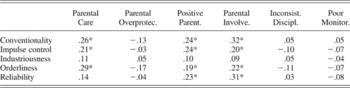
Next we correlated the conscientiousness scales with retrospective measures of childhood experiences (Table 2). High parental care was linked to higher scores on the facets of impulse control (r = .20, p < .05), reliability (r = .29, p < .05), and conventionality (r = .25, p < .05). Similarly, positive parenting was associated with higher scores on the facets of impulse control (r = .24, p < .05), reliability (r = .19, p < .05), conventionality (r = .24, p < .05), and orderliness (r = .31, p < .05). These findings suggest that children who experienced parents that were caring, affectionate, and encouraging had higher levels of conscientiousness in adulthood. In addition, parental involvement was also associated with most facets of conscientiousness. Children with parents who took greater interest in their child's activities had higher levels of impulse control (r = .20, p < .05), conventionality (r = .32, p < .05), reliability (r = .22, p < .05), and orderliness (r = .31, p < .05).
Correlations between conscientiousness facets and childhood environment

Note: N = 110.
* The correlation is significant at least at the .05 level (two tailed).
In contrast, several parenting measures were unrelated to adult levels of conscientiousness. There were no significant associations with parental overprotection, poor monitoring/supervision, or inconsistent discipline. This suggests that discipline practices and the amount or type of supervision a child receives does not strongly relate to later levels of conscientiousness.
Childhood environments, externalizing, and conscientiousness
Because conscientiousness and externalizing spectrum are overlapping constructs we next tested whether similar environments in childhood predicted both conscientiousness and externalizing behaviors (Table 3). As described above, parental care was significantly related to higher levels of conscientiousness. Similarly, high parental care was negatively associated with the externalizing superfactor (r = −.24, p < .05) and both subfactors. Likewise, parental involvement was negatively associated with the externalizing spectrum (r = −.20, p < .05), specifically factor 2 (r = −.23, p < .05), which emphasizes drug and alcohol abuse. This suggests that parental care and parental involvement influence both externalizing and conscientiousness.
Correlations between externalizing factors and childhood environment

Note: N = 110.
* The correlation is significant at least at the .05 level (two tailed).
Positive parenting encompasses behaviors that are supportive, encouraging, and that demonstrate interest in their child's activities. Although these environments were associated with higher levels of conscientiousness in adulthood they are not strongly associated to facets of externalizing spectrum (see Table 3). Inconsistent discipline is conceptualized as conflicting responses to a child's behavior and was not related to conscientiousness. However, inconsistent discipline was significantly related to externalizing (r = .31, p < .05) for both subfactors (r = .33, r = .34, both p < .05). Likewise, poor monitoring, although not related to conscientiousness, was strongly associated with externalizing behaviors (r = .41, p < .05).
In summary, conscientiousness and the externalizing spectrum show some etiological overlap, consistent with their phenotypic overlap in adulthood. However, some childhood environments were mainly linked to conscientiousness, whereas others were mainly associated with externalizing. Although not definitive, this suggests that conscientiousness and externalizing behaviors have a shared, but not perfectly overlapping etiology.
Summary and Synthesis
We described what we know about conscientiousness, how it overlaps with psychopathology, and how it develops, as well as some of the etiological antecedents to conscientiousness and how they do and do not overlap with the externalizing spectrum. Conscientiousness is a multifaceted domain with clear associations with dimensions that fall into the externalizing spectrum. The question of how conscientiousness relates to psychopathology is still not entirely clear. In adulthood it follows a developmental path that is quite consistent with externalizing disorders. Just as conscientiousness goes up with age, there are commensurate decreases in alcohol and drug abuse, violence, and antisocial activities including criminal activities (Hare, McPherson, & Forth, Reference Hare, McPherson and Forth1988). The phenotyptic overlap, genetic overlap, and synonymous developmental patterns in adulthood argue quite strongly for a model in which conscientiousness and externalizing are inextricably intertwined (e.g., Littlefield, Sher, & Wood, in press).
In contrast, there is a conspicuous lack of critical childhood developmental information that would help to reveal the nature of the relation between conscientiousness and externalizing behavior. Most of the research to date on the links between conscientiousness and similar traits has either been cross-sectional or has assumed that traits are causes of disorders and have thus not taken a developmental perspective on the association. Simply correlating childhood temperament with some action taken later in life says little or nothing about the development or etiological nature of the relation between personality and psychopathology. What is needed is a thorough investigation of the precursors to both conscientiousness and externalizing and then assiduous tracking of the thoughts, feelings, and behaviors that eventually coalesce to become the adult trait of conscientiousness and externalizing psychopathology (e.g., De Clercq, De Fruyt, & Widiger, Reference De Clercq, De Fruyt and Widiger2009).
Our three empirical studies represent a start down this path. Although these studies are not methodologically sophisticated, they still reveal some overlap, but a more interesting divergence between conscientiousness and externalizing. Consistent with the social investment model of personality development, it appears that positive events and relations with family members are important for the development of both conscientiousness and some forms of externalizing. In contrast, more severe forms of abuse and harsh, inconsistent parenting techniques were not associated with conscientiousness, but were associated with externalizing as one would expect. In light of the various ways of conceptualizing the relation between these two families of constructs this is a provocative finding as it alludes to different etiological pathways for conscientiousness and externalizing disorders. If this initial finding turns out to be true, then it would appear to undermine the spectrum model.
The primary weakness of the three studies described here is that none of them focused on samples that would be characterized as being at high-risk for psychopathology. We would be reticent to argue that the findings would generalize to high-risk samples. Of interest, we would be equally reticent to argue that high-risk samples would generalize to “normal” samples, which highlights one of the difficulties bridging the divide between normal personality and the study of psychopathology. An overreliance on one or the other type of sample limits our ability to understand the potential relations between these two perspectives of psychological functioning. For example, our findings pointing to separate etiological pathways may only hold for high functioning samples. In contrast, the difficult experiences faced by high-risk samples may be so extreme as to preclude finding effects for separate etiological pathways, making it appear as if both conscientiousness and externalizing derive from the same source.
The potential confounds that emerge from focusing exclusively on low or high-risk samples may also undermine dimensional approaches to understanding psychopathology (Helzer, Kraemer, & Krueger, Reference Helzer, Kraemer and Krueger2006). Focusing almost exclusively on groups of high-risk individuals who possess a number of extreme and unique qualities may make viewing them as a distinct category somewhat irresistible. In contrast, when examining normal personality variation, there is almost no evidence for discrete groups and subsequently less motivation to categorize people. It seems reasonable to proscribe a higher level of interaction between personality psychologists and psychologists studying psychopathology, as etiological and classification issues would be most profitably investigated with samples that bridge the range from low to high risk in a systematic fashion.
Going forward, the interface between normal and abnormal personality would benefit greatly from informed longitudinal research that tracks these issues in childhood and adolescence and then follows individuals into adulthood. Specifically, it would be useful if researchers approached the task from an integrative perspective that bridges not only normal to psychopathological models, but also bridges different ages. For example, just as personality psychologists seldom interact formally with clinical psychologists, so do personality psychologists fail to conduct productive exchanges with temperament researchers. The intellectual splintering undermines our ability to conduct productive research on the development of traits, such as conscientiousness, and psychopathology, such as externalizing disorders, because it leads to incommensurate methods. Temperament researchers develop their age-specific, unique measures. Personality psychologists and psychopathologists develop their own seemingly unique measures of “normal” and “abnormal” functioning, and each guild often studies discrete age groups. Too often psychologists have chosen to Balkanize themselves, creating increasingly focused niches that undermine cross-fertilization.
In contrast, an integrative vision would entail the development of measurement models that are inclusive of personality and psychopathology and could be applied equally well to children, adolescents, and adults. Such a model would be challenging, but clearly not impossible to develop. We hold out hope that the interface of “normal” personality traits, like conscientiousness, and forms of psychopathology, such as externalizing disorders, may motivate the type of research that would lead to these integrative perspectives on psychological functioning.