I. Introduction
CRITICAL elections around the world have hinged on voters’ preferences toward trade policy and international economic cooperation. Politicians routinely highlight geopolitical concerns in political rhetoric over trade, and public opinion often shapes and restricts politicians’ decisions to engage in economic statecraft.Footnote 1 Understanding how citizens interpret the links between geopolitics and trade can help us make sense of variation in whether governments embrace international economic exchange in the shadow of conflict. Yet while trade is a central pillar of cross-border cooperation, we still have very limited knowledge of whether and how geopolitical factors inform popular support for trade with other nations.
A vast body of scholarship in international and comparative political economy examines the determinants of public opinion on trade policy, citing the importance of economic and cultural factors.Footnote 2 Separately, the security literature establishes voter preferences as a key determinant of foreign policy-making related to matters of war and peace.Footnote 3 But fundamental questions still remain about the links between these two international policy domains.Footnote 4 Do geopolitical considerations shape mass preferences on trade policy? Are voters more likely to prefer trade with allies over adversaries, and why? What factors do citizens consider when evaluating tighter economic links with countries that present—or don't present—security threats?
This article offers theory and evidence to show that geopolitics matters critically for public opinion on trade, and that a priori beliefs about the geopolitical relationship with a foreign country are key determinants shaping whether voters wish to trade with that partner. Following Robert Blackwill and Jennifer Harris, we conceptualize geopolitics as “the art and practice of using political power over a given territory,” which includes a consideration of “what constitutes this power, and how it is increased and spent down.”Footnote 5 We contend that public perceptions of power relations between nations structure popular support for international commercial exchange.
We theorize that geopolitics affects voters’ attitudes on trade through a process of motivated reasoning in which underlying affective factors are moderated by more logical considerations to shape aggregate preferences. This approach incorporates within one framework psychological and rational-strategic determinants that have been highlighted in different strands of scholarship. The starting point of our theoretical analysis is the extensive literature on political psychology and social psychology that finds that prior beliefs held by voters about a given object (such as a politician or political party) shape a host of other attitudes regarding that object.Footnote 6 We apply this insight to the study of public opinion on trade, and conjecture that voters’ attitudes about economic exchange with a particular foreign country stem from their prior beliefs about that country.
Citizens hold distinct sets of beliefs about foreign nations with different geopolitical profiles. Adversaries typically provoke heightened perceptions of threat, based on such factors as fear or even racial or ethnoreligious competition. This leads the public to view adversaries unfavorably—triggering an automatic, affective response that in turn leads citizens to oppose granting trade benefits to adversaries. Symmetrically, allies are deemed to be worthy commercial partners because citizens hold them in a positive light. This emotive logic accords with ample evidence suggesting that public attitudes toward trade are informed not just by pure economic considerations, but also by core values, morals, or similar affective responses.Footnote 7
Psychological responses explain why public support differs regarding trade with allies versus adversaries, and yet we also expect strategic factors to influence individuals’ preferences for trade with different geopolitical partners—as the scholarship in international relations suggests. Our theoretical framework elucidates how rational considerations can alter mass support for trade by amplifying or attenuating it. There's extensive evidence that motivated reasoning leads individuals to accept new information if it matches their preexisting ideas; citizens update their beliefs asymmetrically, trusting information that conforms with their prior beliefs and discounting it otherwise.Footnote 8 In this case, the motivated reasoning process affects whether citizens desire to trade with partners when they consider the channels through which trade may alter dyadic power relations.
First, we consider the theory of security externalities, which argues that nations prefer trade with allies over adversaries because trade is expected to augment the partner's military capabilities.Footnote 9 In our account, public opposition to trade with adversaries should rise when the security dimensions of trade are invoked. At the same time, we expect that rationalist concerns will weaken individuals’ prior beliefs. Insights from the liberal peace theory prompt us to hypothesize that citizens previously opposed to trade with adversaries can begin to support trade cooperation if they anticipate that trade will promote peace. Although numerous psychology studies illustrate how difficult it is to convince people to alter their beliefs,Footnote 10 we argue that when members of the public learn that trade can advance peace, they set aside some of their preexisting hostilities toward adversaries.
In this article, we focus on the United States and India, the world's two largest democracies, and marshal a wide range of empirical evidence—gleaned from observational analyses, vignette and conjoint survey experiments, and historical case studies—to test these ideas rigorously. Our observational investigation examines whether in the absence of any primes, geopolitical factors feature prominently in the public's evaluation of trade with adversaries. The vignette experiments allow us to isolate the primary effect of a partner's ally/adversary status on respondents’ trade attitudes, as well as the added effects of security externalities and peace mechanisms. The conjoint experiment asks respondents to select their preferred trading partner between pairs of countries with various economic and geopolitical attributes, permitting us to manipulate many other trade partner characteristics that have been identified as important determinants of trade policy preferences. These methods facilitate comprehensive tests of competing hypotheses; the case studies demonstrate the real-world relevance of our claims.
We find a preponderance of evidence demonstrating that geopolitics is a central determinant of public opinion on trade. In the vignette experiment, only 39 percent of respondents support trade with adversaries, indicating that referenda on trade agreements with geopolitical rivals lack majoritarian support. By contrast, 58 percent of respondents favor trade with allies, all else equal. Security considerations perceptibly alter voters’ trade attitudes. When informed that trade will increase an adversary's military capabilities, a mere 30 percent of respondents express willingness to trade with that partner. But support for trade with adversaries rises to 65 percent when voters expect trade to foster peace, as long as the trade won't increase the partner's military.
Our conjoint experiment benchmarks the magnitude of geopolitical determinants of trade attitudes. Public support for trade agreements drops by a sizable twenty-seven percentage points when the partner is an adversary rather than an ally, overshadowing by a large margin the treatment effect of individuals’ preferences for trade with other democracies relative to nondemocracies (thirteen percentage points). Moreover, this magnitude is as large as the size of sociotropic economic determinants of trade preferences that have been well established in previous studies—indicating that the vast empirical literature on trade attitudes has overlooked a key impetus of international economic cooperation.
Taken together, the evidence shows that geopolitical factors operate in a systematic manner and in ways that are consistent with our theoretical microfoundations. This article thus brings to bear new theory and evidence to explain how power relations between nations shape mass attitudes toward globalization. Forming a better understanding of public opinion in this arena extends the international relations literature about the drivers of globalization, and also informs many public policy debates about economic cooperation. For example, policymakers seeking to encourage liberalization may wish to consider the triggers and influences of mass support for such policies. More broadly, our findings help to explain why governments constrained by public opinion sometimes choose trade cooperation, and at other times inhibit economic exchange.
II. How Do Geopolitics Affect Public Opinion on Trade?
The theoretical framework we develop draws on both psychological and rational-strategic determinants to explain how geopolitical factors affect mass preferences on trade with allies and adversaries. Psychological constructs, such as prejudice, ethnocentrism, and national superiority, are known to influence a wide range of sociopolitical attitudes.Footnote 11 The trade preferences scholarship has also established that individuals tend to evaluate international economic linkages in us-versus-them terms, with in-group favoritism triggering opposition to trade with foreign partners.Footnote 12 Diana Mutz and Eunji Kim show that Americans evince the most support for trade when other Americans are the primary beneficiaries and when the trading partner loses more than Americans do from the deal.Footnote 13 Here, interest in relative gain drives voters to privilege trade policies that hurt out-groups over policies that generate a mutually beneficial exchange for both partners.
But does support for trade shift depending on the geopolitical profile of the trade partner in question, and if so, why? There are compelling reasons to believe that perceptions of out-groups vary according to whether the foreign nation is an ally or an adversary. Individuals typically view adversaries in an antagonistic light, perceiving them as enemies that are hostile, strange, and generally bad.Footnote 14 Adversaries may evoke fear based on military histories or the threat of future hostilities. In cases where adversarial relations are prefaced by cultural conflict, such as ethnoreligious strife, intergroup competition might undergird perceptions of threat. Affective reactions shape a host of attitudes.Footnote 15 We predict, correspondingly, that enemy perceptions inhibit support for international economic exchange. By contrast, allies evoke positive associations, leading individuals to support trade with confederates instinctively. This claim fits with Andrew Rose's conclusion that countries tend to trade more with other countries that their citizens admire; it also fits with Matthew DiGiuseppe and Katja Kleinberg's finding that individuals prefer to sign trade agreements with allies.Footnote 16
We theorize that more rationalist concerns can moderate emotive reactions toward trade with foreign partners who have particular geopolitical profiles. Through a process of motivated reasoning, individuals accept logical considerations that corroborate their prior beliefs, in turn amplifying the strength of their preexisting attitudes.Footnote 17 We predict, for example, that individuals will evince more pronounced opposition to trade when they learn that trade would bolster an adversary's military capabilities and enhance the probability of its prevailing at war. Here, strategic estimations buttress preexisting ideas about the foreign nation, and also influence willingness to establish trade relations with it. At the same time, we contend that logical concerns can attenuate prior beliefs. Learning that closer commercial linkages promote peace between nations should weaken opposition to trade with adversaries, for instance, if individuals judge peaceful relations with enemies to be materially beneficial and update their trade preferences accordingly.
What rational considerations, then, do individuals use to interpret linkages between geopolitics and trade? We now draw on two prominent strands of international relations scholarship on the geopolitical determinants of trade—security externalities and the liberal peace theory. Although both theories have conventionally served as state-centered approaches to trade politics, they also hold important implications for understanding individual-level preferences, as we will now elaborate.
The first theory argues that international commerce between rivals creates negative security externalities because it allows an adversary's domestic resources to be used more efficiently and permits the economic gains from trade to be diverted to military use.Footnote 18 States fear that their adversaries will become stronger and thus have a greater probability of victory in potential future conflicts.Footnote 19 States with dissimilar interests may face particular incentives to renege on trade agreementsFootnote 20 because doing so can harm their trading partners by preventing the partners from obtaining military resources and reducing their economic might.
By contrast, trade between states that have similar security interests carries positive security externalities because states seek to bolster the military capabilities of their allies. This increases incentives to ensure that trade agreements are honored.Footnote 21 The presence of a military alliance is a powerful indicator of similar security interests, as alliance commitments are typically made between states with common security concerns. Additionally, such alliances are costly to reverse due to the domestic and international punishments meted out for abrogating commitments,Footnote 22 as well as the threat of retaliation.Footnote 23 If citizens understand the logic of this argument, they should prefer trade with allies over adversaries; the more trade helps an adversary, the more citizens should favor limiting trade with that state.
But rationalist considerations also provide theoretical grounds for an opposite prediction. The liberal peace hypothesis predicts that international trade engenders peace by fostering economic interdependence, which then creates incentives to avoid war since conflict stands to disrupt profitable connections.Footnote 24 In most versions of the liberal peace hypothesis, public opinion is assumed to play a key role in the causal chain.Footnote 25 Disputes are thought to harm commercial arrangements, since conflict threatens the gains derived from trade.Footnote 26 Citizens and economic agents, such as firms, therefore have motivations to lobby their government to refrain from costly conflicts with trading partners. Moreover, trade leads to greater contact and communication between citizens across borders, creating shared communities and values and leading citizens to push for policies that engender peace.Footnote 27 Political elites follow suit, as they depend on citizen support and lobbying contributions from firms to stay in office.Footnote 28
This logic has a rich intellectual historyFootnote 29 and remains so prevalent that it has often been used to support liberalization between states and between adversaries in particular. For example, the World Trade Organization's mission statement says that by increasing free trade, the institution will “foster peace and stability.” Furthermore, the establishment of the European Economic Community, the US decision to cultivate trade with China, and a variety of other policy choices have been premised on the logic that trade would bind adversaries together and prevent war.Footnote 30 Overall, then, advocates of the liberal peace theory argue that all else equal, citizens should support free trade with all states, including adversaries with whom trade could help nurture peace. Moreover, if citizens prioritize curbing hostilities, they should favor trade with adversaries.
A priori, it isn't clear whether incentives to avoid trade with adversaries or to promote it should dominate. On average, citizens gain economically from trade by receiving cheaper prices for goods or by experiencing relative wage increases from exports; these advantages incentivize them to prefer avoiding disputes with trading partners. At the same time, citizens pay costs for fighting wars, whether through increased taxes and forfeited revenues that could have been spent on public services, or through conscription and casualties.Footnote 31 Such costs could thus lead them to eschew economic agreements perceived to benefit adversaries.Footnote 32 Whether and how these rationalist considerations alter affective negative beliefs about adversaries remain open empirical questions. Our research design and experiments adjudicate between these competing theoretical possibilities.
III. Surveys and Samples
To test how geopolitics influences trade preferences, we conducted a series of surveys. The first is an observational study that elicited, without any prompting, open-ended answers about respondents’ trade preferences; the second is a vignette experiment that gauged support for trade with a country that has different geopolitical characteristics; and the third is a conjoint experiment that asked respondents to compare two hypothetical trading partners with randomly varying attributes and select the one they prefer. We describe the studies’ research designs in more detail below.
To recruit participants for these tests, we used the Amazon Mechanical Turk (MTurk) platform, chosen for its cost and efficiency gains relative to other convenience samples. MTurk samples are more representative of the broader population than in-person convenience samples, although less so than internet-based panels or national probability samples.Footnote 33 Correlations are high between MTurk samples and those of nationally representative samples,Footnote 34 and many studies employing MTurk have replicated the findings of nationally representative surveys, especially in the domain of trade preferences.Footnote 35 Research by Connor Huff and Dustin Tingley is particularly relevant to our study; it demonstrates that MTurk respondents are employed in similar industries and live in similar geographic regions on the rural-urban continuum as those found in nationally representative surveys.Footnote 36
But MTurk survey samples aren't nationally representative. For example, using a benchmark comparison of the Cooperative Congressional Election Survey, Huff and Tingley show that MTurk samples underrepresent “older racial categories,” especially African Americans.Footnote 37 To account for such imbalances, we applied survey weights using entropy balancing to our sample, and ran our analyses again.Footnote 38 We found no substantive or statistically meaningful differences in any of the treatment effects subsequently reported. And for all the well-known and justified critiques aimed at MTurk samples, the main findings that we present are so large and statistically significant, there's good reason to expect them to hold in nationally representative samples. Moreover, when we ran sensitivity tests in which we compared respondents with more or less education as well as varying levels of other socioeconomic indicators, we found no differences in treatment effects.
Lastly, we note that MTurk samples may be more technologically literate than the general population, which could result in a greater awareness of globalized economics. But insofar as MTurk samples represent those who are likely to matter when it comes to formulating policy regarding trade with foreign nations, they are of particular interest in our context. We also highlight that our study explores experimental effects/differences rather than levels, and that these do not change across groups.Footnote 39 We return to a discussion of claims regarding generalizability below.
IV. Open-Ended Survey Evidence from Two Democracies
To determine whether and how the public thinks about the trade-offs inherent in trade with adversaries and the degree to which individuals’ preferences are malleable, we turn to the world's two largest democracies: the United States and India. These countries are ideal cases to test our theoretical conjectures, given their importance to global trading networks and their roles in global and regional geopolitics. We start by providing survey-based evidence to demonstrate that geopolitical considerations affect trade attitudes in both countries, and that security and peace considerations appear prevalent in voters’ minds. Appendix A of the supplementary material details how similar perspectives commonly appear in both countries in political rhetoric and public discourse.
To discern the extent to which geopolitics matters in determining public opinion on trade with adversaries, we administered a short survey. We focused on US–Russia and India–Pakistan trading relations, as these represent two long-lasting and salient adversarial relationships. We ran our survey on a convenience sample of two hundred US adults and the same number of Indian adults in May 2016.Footnote 40
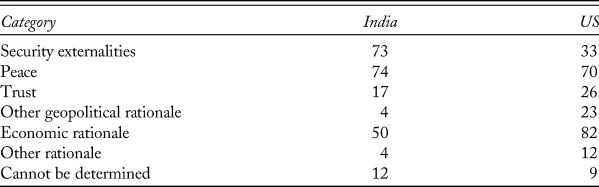
We began by asking respondents whether they support increased trade with Russia (for US respondents) or Pakistan (for Indian respondents), and asked them to write three to five sentences explaining their answer. Because we asked this question at the beginning of the survey, we didn't prime them in any further way. We then hand-coded the responses based on whether the participants justified their position by citing security externalities, a desire for peace, lack of trust, economic rationales, or other geopolitical or nongeopolitical reasons, or whether it was not possible for us to determine the category under which a response fell. Responses that named several factors could fit into multiple categories, so they don't sum to the number of respondents. There were two coders with high levels of agreement; if a disagreement in coding arose, we flagged the observation for further discussion to reach agreement. These results are summarized in Table 1, which presents the raw counts of how many responses fell into each category.
Reasons for Trade with Adversariesa

a Sample size: two hundred American and two hundred Indian adults. Responses can fall within more than one category, so that summing across all responses doesn't give the total number of respondents. The table shows that most responses fit within our theoretically identified geopolitical categories, indicating that geopolitical concerns are most salient in citizens’ minds.
The first thing to note is that the geopolitical concerns cited by our respondents dwarf the economic considerations. In the US sample, citizens cited geopolitical issues 152 times, compared to 82 times for economic factors. In the Indian sample the difference was even more pronounced: people mentioned geopolitical factors 168 times, and only referenced economic concerns in 50 instances.
Also note that the vast majority of responses corresponded to the geopolitical categories identified in our theoretical framework. Within the Indian sample, seventy-three people mentioned security externalities, and seventy-four believed that increased trade would lead to peace. For example, one respondent wrote,Footnote 41 “As the people of India seeing Pakistan as enemy country, I want to support the foreign trade to lessen this enmity. As the trade flourishes, the friendship between the country also flourish.” Another respondent stated, “it would reduce the hostility between the two countries. It would prompt Pakistan businessmen to invest in India too. Once the trade and investment reaches higher levels snapping relations with India will not be easy.”
In contrast, statements regarding security externalities focused on terrorism, as many people feared that boosting trade would allow more terrorist attacks. For example, one respondent wrote, “Pakistan is a worst country in the world. Pakistan support terrorists and working against India. So foreign trade help them to grow their military. That is a threat to India.” These opinions are illuminating, as they suggest that in this context, concerns about absolute versus relative gains appear to be quite salient in the minds of individual voters.
Similarly, in the US sample, thirty-three responses cited security externalities, while seventy mentioned that trade would likely lead to peace. On the security externalities side, one person stated, “I dislike Russia's foreign policy with neighboring countries. I believe that the way to control Russia's ability to expand their empire is to limit them financially. I believe that the US has manipulated oil prices down to this end. We should restrict trade with Russia and isolate them to limit their global power.” Another opined, “They are our enemy. They don't support anything we do. They are hostile in Ukraine. Russia will use the money for its army against us.”
But others thought that peace would grow as a result of trade, and some even mentioned both factors as a trade-off. For instance, one noted, “Trade would be beneficial to both parties involved. While Russia might increase its military powers with the additional funds created through trade, they could enhance the lives of citizens through more programs and funding to help the poor. This would benefit and strengthen our relationship with Russia, leading to less threats of war and violence.”Footnote 42
These opinions suggest that citizens care about the effect of trade on geopolitical outcomes—at least for the highly salient, adversarial partners of the two countries we sampled. But it's not clear whether respondents would change their views if they could be persuaded that trade's effects are either more or less beneficial than they previously thought (we address this question below). Moreover, many respondents drew on “enemy” language, plausibly implying a moral argument about the adversary, while others used security externalities as justification. Even for the latter, it's not clear whether the respondents were offering a post hoc rationalization of judgments they'd already formed.Footnote 43 To help tease out how geopolitical considerations influence respondents’ emotive responses to trade with adversaries and allies, we turn to our survey experiments.
V. Experimental Tests of the Impact of Geopolitics on Trade
Examining our key theoretical conjectures through a series of survey experiments allows us to circumvent common problems of endogeneity, and also to manipulate variables that would otherwise be hard to disentangle from the effects of geopolitical factors. For example, since US allies tend to be democracies, observed predilections for trade with allies could capture individuals’ desire to cooperate with nations that hold free and fair elections rather than those with which they have shared security commitments. Our research design allows us to parse the effect of such correlated factors, and to guard against information equivalence.Footnote 44
Vignette Experiment Design
We first employed a vignette experiment in which we gave respondents information in a manner similar to what they might encounter in a newspaper article, commentary piece, or political speech. Our purpose was to study how individuals respond to theoretically grounded geopolitical triggers of trade preferences that might arise in real-world political discourse.Footnote 45 The experiment let us probe how respondents evaluate the positive and negative geopolitical effects of trading with an adversary when both mechanisms are made salient, as they often are in public debates on the issue.
We ran our vignette experiment in March 2016, on a sample of 1,208 US adults. The experimental treatment was implemented at the start of the survey, directly after participants had provided informed consent. We presented subjects with a version of the following scenario:
An article in a major national newspaper recently stated that the US is considering enacting a free trade agreement with another country. Trade will strengthen the US economy, although some Americans will lose their jobs as a result of free trade.
The other country in the free trade agreement [is/is not] a democracy and has a large military. Importantly, the other country is an [ally/adversary] of the US, meaning that it is considered to be [friendly with/hostile to] the US.
In addition, the article makes two key predictions about how trade with the US will impact the other country. First, trade [will/will not] benefit the other country's military. Second, trade [will/will not] help ensure peace by reducing the possibility of a conflict between the other country and the US.
After presenting this scenario, we immediately asked, “Given the facts described in the article, do you support increasing trade with this country?” As indicated by the brackets in our prompt, our experimental manipulations comprised four sets of treatments. First, we varied whether the country was a democracy to provide direct information about an important characteristic of the country that respondents might plausibly associate with the US's allies and adversaries. If respondents conflated allies with democracies, for example, the effect of the ally treatment might have captured individuals’ preferences for trading with democracies. By establishing the nature of the country's government, we effectively controlled for this correlated threat to inference. Moreover, this treatment permitted us to compare the magnitude of the effect of our primary variable of interest with a well-known benchmark in the trade preferences literature.Footnote 46
Our main experimental manipulation pertained to the country's status as an “ally” or “adversary.” We explained that allies are considered friendly with the US whereas adversaries are considered hostile, because the words ally and adversary might not be familiar to some respondents.Footnote 47 This variable allowed us to test whether geopolitical determinants are broadly important in shaping individual attitudes.
Next, we explicitly tested the role of the security externalities and liberal peace theories in moderating attitudes. The security externalities theory argues that these externalities represent “the most critical aspect of free trade agreements in the anarchic international system”; increased efficiency resulting from trade “itself frees economic resources for military uses” and “enhances the potential military power” of trading partners.Footnote 48 Our third treatment allowed us to test this claim explicitly. We revealed to respondents that trade either will or will not benefit the other country's military. If the security externalities theory operates, respondents should de-emphasize trade with an adversary and elevate trade with an ally.
Following the liberal peace hypothesis,Footnote 49 our fourth treatment tested whether citizens are more likely to prefer trade when it is expected to promote peaceful ties. We informed voters that trade either will or will not decrease the possibility of conflict between the two nations.
A few additional points about our vignette are worth noting. First, we made it clear that the potential trade partner has a large military. This is an important feature of Joanne Gowa and Edward Mansfield's security externalities theory, and we didn't want subjects to differentially attribute military sizes to allies and adversaries based on preexisting associations.Footnote 50 We also highlighted that trade would have economic ramifications. By stating that “trade will strengthen the US economy, although some Americans will lose their jobs as a result of free trade,” we attempted to provide a balanced and holistic picture of the costs and benefits of free trade—a vignette that discussed the impact of trade on the US without referring to economic factors may have appeared incongruous to some respondents. Last, the information in the vignette was sourced to a major national newspaper, conferring an aura of authenticity and suggesting that the deliberation over the free trade agreement was consequential to public discourse.Footnote 51
Vignette Experiment Results
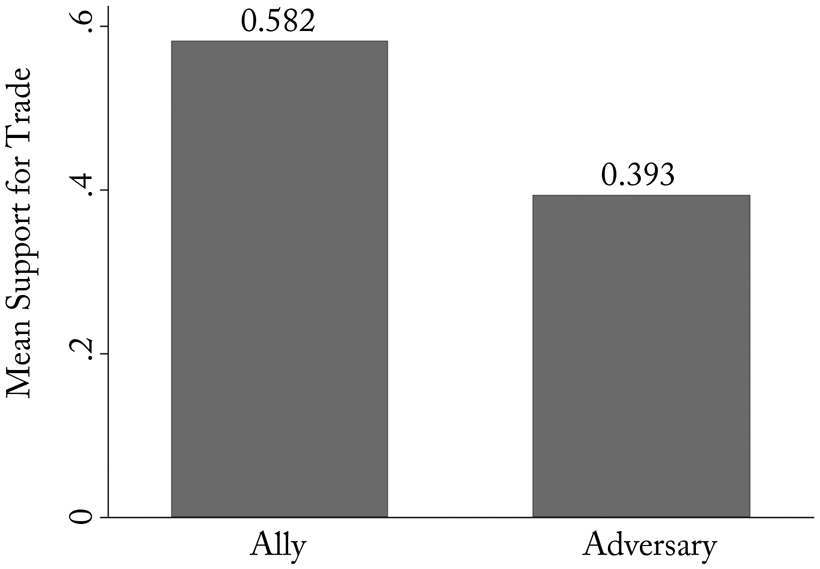
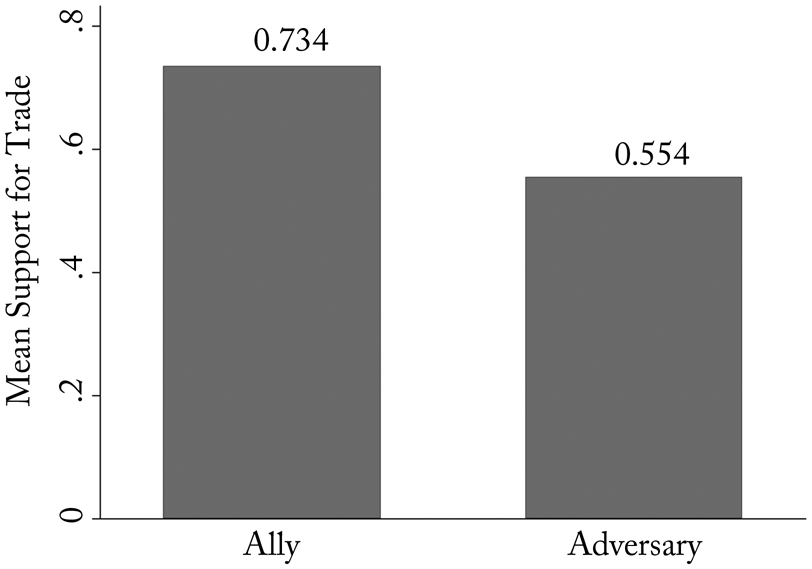
We begin by scrutinizing the effect of the geopolitical profile of the potential US trading partner. Figure 1 presents the results of this analysis, indicating support for increased trade with the country described in the newspaper article. Simply by replacing the word ally with adversary and explaining that this implies that the other country is hostile to the US, support for trade with the country drops by nineteen percentage points.Footnote 52 Notably, while a majority of respondents prefers trade with allies, a similar majority wishes to cut off trade with adversaries. This aversion to economic integration with adversaries relative to allies is consistent with the psychological paths by which geopolitics was theorized to shape trade attitudes. Voters view adversaries in a negative light and appear to automatically oppose granting them trade benefits. Overall, we find compelling evidence that US respondents on average prefer to trade with allies, while simultaneously attaching a trading penalty to geopolitical rivals.
Support for Trade by Partner's Geopolitical Status: US Samplea
a Difference = 0.189 (p = 0.000). Difference and p-value are based on a two-sided t-test; n = 1,208.

What are the effects of the securities externalities, liberal peace, and democracy treatments, and do these effects vary depending on the geopolitical profiles of potential trading partners?
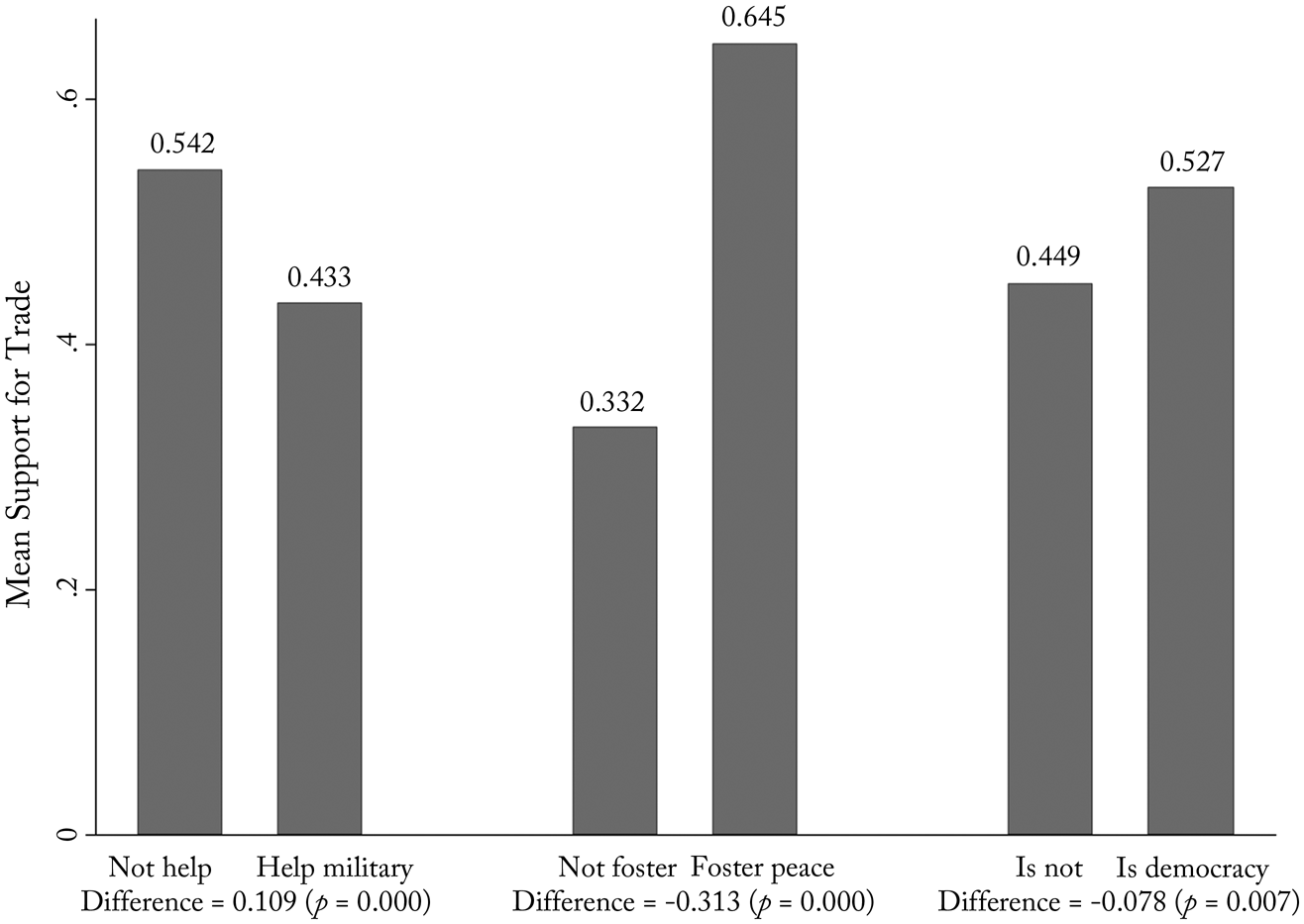
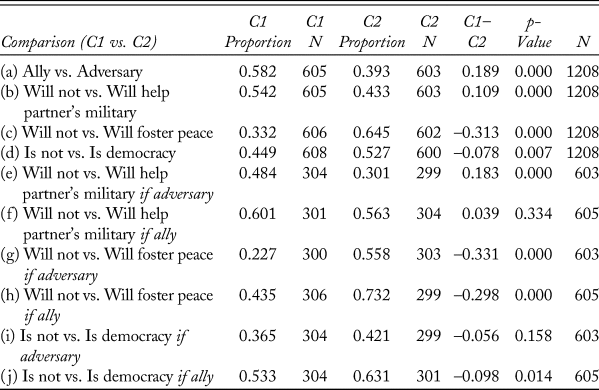
Figure 2 visualizes the findings from these three experimental treatments in the full sample. Table 2 presents the mean levels of support for trade in each treatment cell along with the estimated treatment effects, both for all partners and conditional on the partner being either an ally or an adversary. We analyze these findings to adjudicate between the theoretical mechanisms presented above.
Support for Trade by Randomized Attributes: US Samplea
a Differences and p-values are based on two-sided t-tests; n = 1,208.

Differences in Support for Trade with Partner Country across Pairs of Treatment Conditions in the Vignette Experimenta

a Each row represents one model. Differences and p-values are based on two-sided t-tests.
First, we test whether the mechanism specified by Gowa and Mansfield—namely, that voters privilege trading with allies over adversaries due to the knock-on effects of trade on military size—resonates with respondents in our sample.Footnote 53 To do so, we analyze the effect of the treatment in which we specify that trade will strengthen the other country's military. Table 2, row (b) shows that the security externalities mechanism has a large and statistically significant impact. Respondents are less likely to favor free trade when told that trade will augment the military of a US trading partner. This effect is larger when we restrict our sample to countries that are considered adversaries (row (e)), as in these instances support for free trade falls by eighteen percentage points. Thus, we find support for the prediction that citizens don't wish to promote trade when it will help their adversaries’ military.
That logical concerns about the effect of trade on the partner's military capabilities perceptibly amplifies antipathy toward trade with adversaries is consistent with the theoretical claim that a process of motivated reasoning leads individuals to accept new information that reinforces their prior beliefs. We previously showed that Americans have an affective negative reaction to trading with rivals. Providing rational-strategic information that trade helps the adversary militarily provides more fuel to bolster opposition to economic integration.
Next, we study the effect of this treatment on US allies. A corresponding key prediction of the security externalities theory is that countries are expected to desire more trade with allies to build their coalition's strength and maximize their joint war-fighting capacity. Here, a different pattern emerges. There's no statistically significant effect when respondents consider the effect of trade on an ally's military size (row f). The lack of a similar penalty among allies shows that citizens don't blindly find the association between trade and military size unappealing; instead, they're thoughtful in their answers and they distinguish between partners based on geopolitical characteristics.
Our lopsided finding on allies suggests an important scope condition of the security externalities theory. It's plausible that voters formulate opinions on trade policy differently for high salience and low salience geopolitical issues; we discuss issue salience in the domain of geopolitics and trade in more detail below. A claim that would be consistent with our experimental findings is that citizens consider geopolitical concerns to be much more salient when contemplating trade with adversaries. By contrast, they might view allies as less salient security partners, preferring to evaluate trade with friendly countries in business-as-usual terms. We view this interpretation as speculative, but note that it supports observational evidence that the public tends to have well-formed views on the subject of trading relations between adversaries.Footnote 54 Overall, these findings suggest that the security externalities theory sways the public primarily through its effect on adversaries rather than its effect on allies, implying that public concerns about geopolitical factors are likely more salient and intense for trade with adversaries.Footnote 55
Next, we examine whether voter preferences regarding trade with adversaries shift when trade holds the prospect of fostering peace. Table 2 shows that replacing “trade will” with “trade will not” in the statement about trade reducing the possibility of conflict between the US and its trading partner triggers a sharp effect among respondents. Row (c) shows an increase of thirty-one percentage points in support of free trade in the full sample. Rows (g) and (h) break down these results among respondents who are told that the potential trading partner is an adversary (thirty-three percentage points) and an ally (thirty percentage points), respectively. Although baseline support for free trade is much lower for adversaries than for allies, respondents upgrade their evaluation of free trade agreements when informed that trade will help foster peace not only for allies, but also for adversaries. Evidently, when trade reduces the possibility of conflict, many voters who would be averse to trade with adversaries prefer increased economic integration.
It's noteworthy that information about the peace-inducing aspects of trade attenuates aversion toward trade with adversaries. Individuals’ underlying antipathy toward trade with adversaries may be based on emotive responses. Nevertheless, we find that logical arguments can cause individuals to overcome their hostility toward adversaries, a finding that goes against studies in psychology that illustrate how it's typically difficult to convince people to alter prior beliefs.Footnote 56
Table 2 also reports the results of the democracy treatment. As row (d) shows, the positive effect of the trading partner being a democracy (a treatment effect of eight percentage points) is substantially smaller than the effect of the trading partner being an ally. Also, the treatment effect when the other country is considered an adversary (row (i)) is insignificant, while the treatment effect when it's an ally (row (j)) achieves significance. Along with the evidence presented previously, Table 2 indicates that geopolitical considerations are significant predictors of individuals’ opinions on trade policy and are orthogonal to a trading partner's status as a democracy.
As an illustrative exercise, we can now compare the effect of a trading partner that's an adversary with respondents’ willingness to trade under different treatment conditions. When a trading partner is an adversary, a minority (only 39 percent) of respondents prefer increased trading relations; by contrast, a majority—a full 58 percent—prefer to trade when the partner is an ally. As expected by the security externalities theory, the effect of switching from an ally to an adversary on support for trade is negative and significant, but this gap grows when trade is expected to increase the partner's military capability. In that scenario, only 30 percent of citizens express support for trade with an adversary.
But our results also provide supportive evidence for the liberal peace hypothesis. When respondents are informed that trade with an adversary will both bolster its military and reduce the possibility of conflict, 46 percent (a greater proportion than in the scenario above, but still a minority) support increased trade. This support increases substantially when we look at the best-case scenario for trade with adversaries—that is, when trade doesn't increase the size of the adversary's military and is expected to foster peace. In these instances, average levels of support reach 65 percent, indicating that a potential referendum on such a trade agreement would pass.
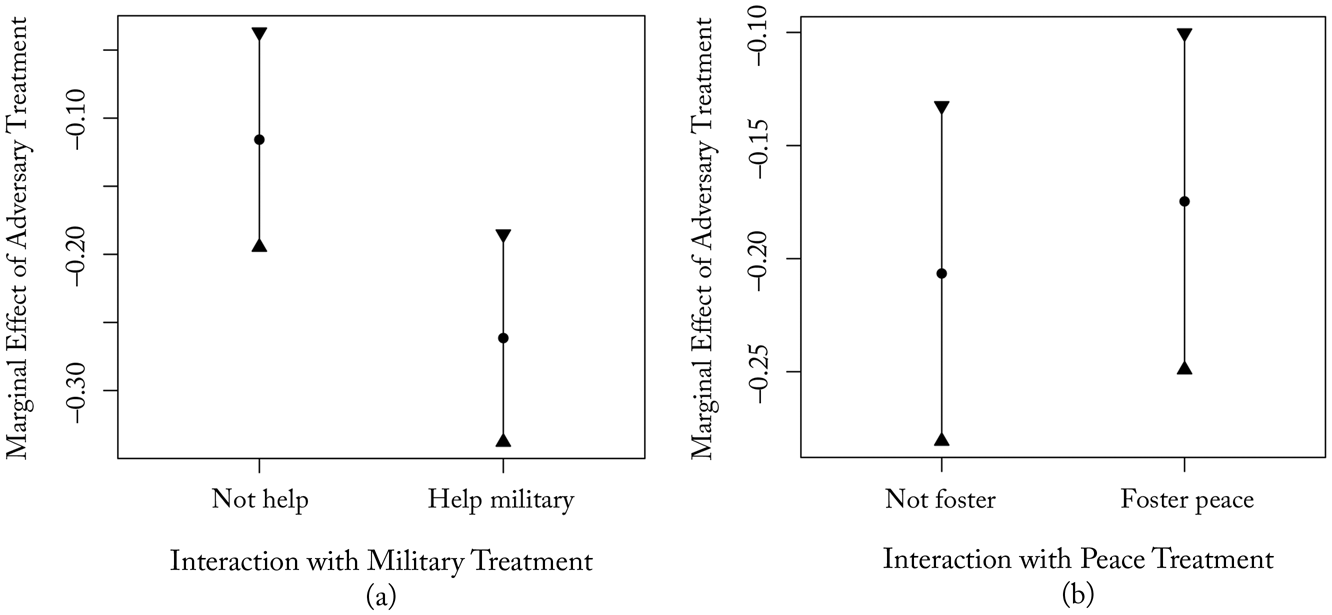
Our results show that it's difficult to shift people's preferences about trading with adversaries relative to allies. This underscores the durability of such psychological factors as morals and values in shaping mass preferences. Even when we consider the best-case scenario discussed above (that is, when trade doesn't increase the size of the partner's military and reduces the chance of a conflict), more respondents prefer trading with allies (74 percent) than with adversaries. The strength of the negative penalty received by adversaries relative to allies can be evaluated in Figure 3, which presents two-way interactions between the adversary treatment and the military treatment (panel (a)) and between the adversary treatment and the peace treatment (panel (b)).Footnote 57
Marginal Effect of Adversary Treatment on Trade Supporta
a In panel (a) treatment varies whether or not trade will benefit the other country's military. In panel (b) treatment varies whether or not trade will help foster peace.

Taken together, these findings indicate that mass preferences on geopolitics and trade are nuanced; public opinion hews to the predictions of the security externalities hypothesis, but is also determined by peaceful inclinations. The vignette analysis allows us to focus exclusively on—and establish—the impact of geopolitical determinants on trade attitudes, as respondents were given a limited set of additional factors to consider. How do these geopolitical determinants fare when geopolitics is only one of a range of theoretical determinants predicted to influence support for trade? To answer this question and explore the role of potential alternative explanations, we turn to our conjoint experiment.
Conjoint Experiment Design
We ran a conjoint survey experiment on a sample of 1,208 US respondents recruited in March 2016. Conjoint methods present respondents with two or more hypothetical options and ask them to choose between the options and rank them according to their preferences. In our survey, we showed subjects the characteristics of two randomly generated hypothetical trading partners and asked them to select the partner with whom they'd rather see the United States trade.
The conjoint design offers several advantages in the context of this study. First, while the order of the treatments was held fixed in the vignette experiment, we randomized the order of attributes in the conjoint study to prevent ordering effects and make it easier to compare the magnitudes of treatment effects with the vignette experiment.Footnote 58 Second, because respondents rated and ranked multiple attributes simultaneously, we could assess a number of causal hypotheses independently and interactively and evaluate the relative explanatory power of each. Third, the conjoint design let us assign different levels to each theoretical attribute and study how individuals’ attitudes varied according to attribute levels.
Unlike the vignette, which presents respondents with a description of a single country, the conjoint experiment presents a pair of countries. After a brief introduction, respondents were shown a screen with profiles of the two countries and asked to choose the one with which they'd prefer to trade.Footnote 59 We coded the responses as a binary variable that indicated whether a particular country was preferred or not. In forcing respondents to choose a trade partner, we explicitly required them to make trade-offs and express a preference. This has the advantage of neutralizing attitudes about trade in general so we can zero in on what makes one country more attractive as a trading partner than the other.Footnote 60 Respondents also rated each country individually in terms of how likely they'd be to support trade with that country. We gave each subject five sets of such comparisons. Therefore, 1,208 subjects rated two countries in five conjoint comparisons, giving us a total of 12,080 rated countries.
We experimentally varied six attributes of the trading partners. We began by indicating whether a partner was an ally or an adversary, but we also specified whether the other country was a democracy or not because the democratic peace literature predicts that democracies seek to forge economic relations with each another. Next, we explained that the other country's military was either much smaller or a little smaller than the US military. According to Gowa and Mansfield, the larger a trading partner's existing military, the greater the security externalities that emerge from trade. The treatment seeks to test this hypothesis in the US context.Footnote 61
Our fourth treatment indicated whether trade would increase the size of the other country's military. Respondents were given the following attributes: no change in size, a little, and a lot. Our goal was to study how variation in the levels of these theoretical attributes would affect respondents’ preferences. We also specified that because of trade, the likelihood that the other country would engage in a conflict with the US would either stay the same, decrease a little, or decrease a lot.Footnote 62
Finally, we varied whether trade would help, hurt, or neither help nor hurt the US economy to compare the magnitudes of potential geopolitical effects with those of sociotropic economic consequences.Footnote 63 This treatment also allowed us to address the concern that some respondents may believe that trade with an ally could provide greater economic benefits than trade with an adversary, an outcome that may occur if alliances are themselves endogenous to economic benefits.
Our research design fully randomized the six theoretical attributes of the free trade agreement under consideration. The values for these six dimensions were randomly assigned for each potential trade partner to make the treatment groups comparable on both observable and unobservable criteria. Thus, even if respondents subjectively interpreted some of the provided information differently, any potentially confounding variables would have been distributed uniformly across treatment groups, and our estimates of treatment effects would remain valid. We use a linear probability model to estimate the marginal effects of each of these features.Footnote 64
Conjoint Experiment Results
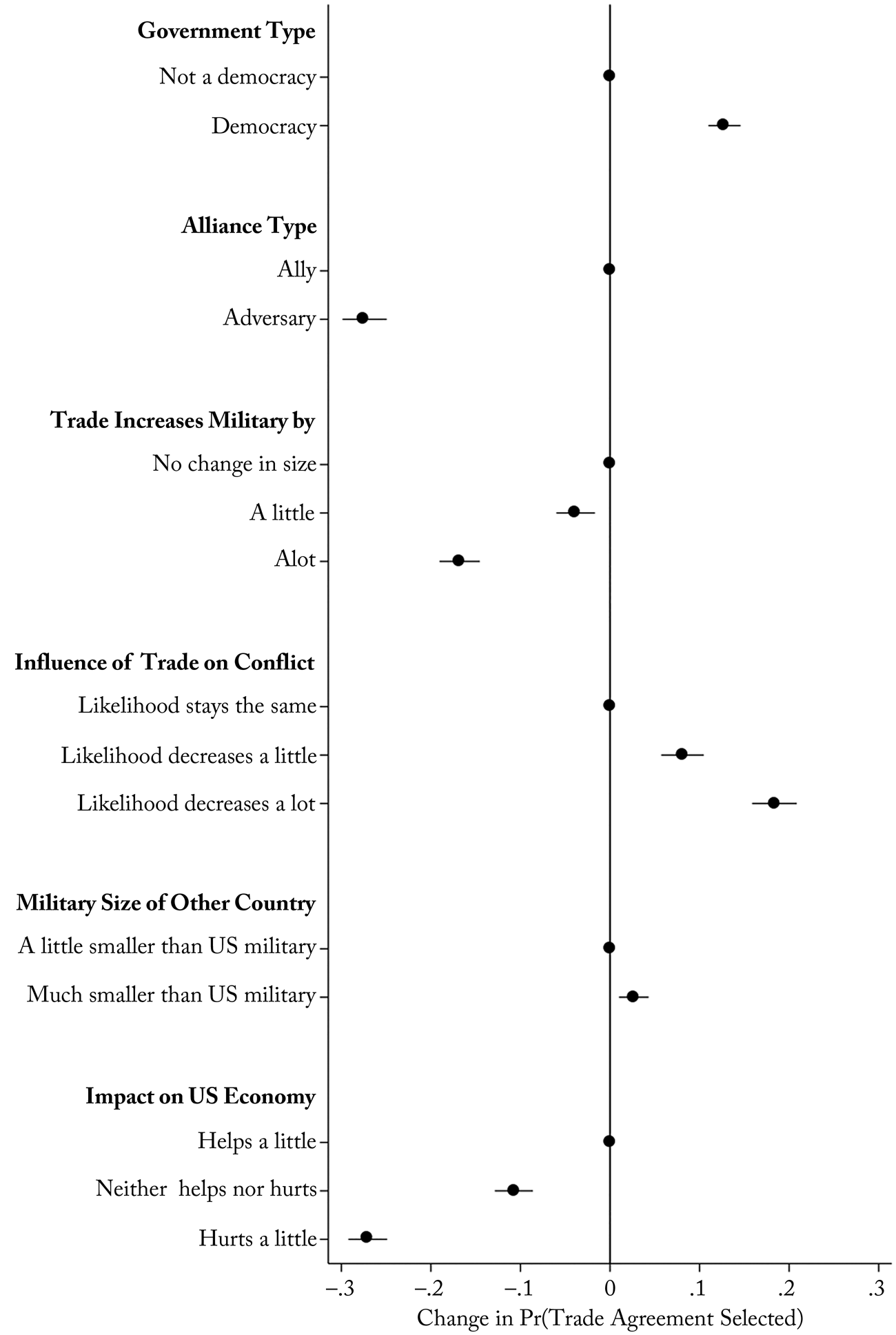
Figure 4 reports our estimates of the influence of the geopolitical and economic determinants of trade preferences on public support for free trade, each of which should be interpreted relative to the attribute's reference category.Footnote 65 We find that geopolitical considerations have a qualitatively large impact on public opinion, as moving from an ally to an adversary decreases public support for an agreement by 27.4 percentage points. The sheer magnitude of this effect is worth acknowledging. Respondents penalize adversaries by more than twice the amount that they reward democracies (12.8 percentage points).
Effect of Trade Partner Attributes on Support for Tradea
a n = 12,080 trade partners.

By way of comparison, the literature on trade preferences has established that trade's perceived impact on the national economy is a key determinant of individual opinions on trade policy.Footnote 66 Indeed, when we shift from telling respondents that trade helps the US economy to telling them that it hurts the US economy, support for the trade agreement falls by twenty-seven percentage points. The effect of security externalities thus appears to be similar to that of sociotropic economic concerns.Footnote 67
Next, we find that on the one hand, when respondents are informed that trade will increase the size of the other country's military by “a lot” compared to the baseline level of inducing no change, they become 16.8 percentage points less likely to support trade. On the other hand, respondents are 18.4 percentage points more likely to support the trade agreement when trade decreases the likelihood of conflict between the other country and the US by “a lot.”Footnote 68 The peace-inducing properties of trade have a nearly equal and opposite impact on preferences toward trade with geopolitical partners when compared to the negative military-related externalities potentially generated by trade. Last, we find that the trade partner's military size has a significant effect on support for trade with the partner: partners whose military is “much smaller” than that of the US are preferred to those whose militaries are “a little smaller,” although the magnitude of this effect is small (2.7 percentage points increase in support for trade).
Note that Figure 4 shows us that the effect of being an adversary is negative, and that this impact is mitigated—but not eliminated—when trade is expected to reduce conflict by “a lot.” This suggests that even in a potential best-case scenario for adversaries, citizens are still likely to prefer to trade with allies. But our respondents’ opposition to adversaries isn't inflexible, as resistance to trade with adversaries diminishes when respondents are informed that trade agreements will foster peace between nations.Footnote 69
Generalizability
We now turn to considering the generalizability of our findings. First, we explore whether the findings vary according to respondent subgroups, including those with various demographic and political characteristics. We reflect on whether our findings could be driven by alternate determinants of preference formation, and then we explore whether our results may carry over to other countries and time periods.
We start by examining whether different types of citizens attach distinct weights to the military and peace-inducing properties of trade. To explore this possibility, we analyze our results by subgroups, distinguishing between respondents classified as hawks versus doves, liberals versus conservatives, and Republicans versus Democrats.Footnote 70 Our findings are reassuring insofar as they document differences in responses to the ally/adversary treatment that conform to conventional wisdom.
Individuals categorized as hawks are much more likely than doves to penalize potential trading partners who are adversaries. While hawks evince a decline of thirty-one percentage points in support for trade with adversaries relative to allies, the corresponding figure for doves is twenty-three percentage points. A congruent pattern emerges when we partition our sample by self-identified liberals and conservatives, with the latter group more likely than the former to eschew trade with adversaries. The adversary treatment results in a thirty-one-percentage-point decline in support among conservatives, but a twenty-four-percentage-point decline in support among liberals. Similarly, the adversary treatment results in a decline of thirty percentage points in support for trade among Republicans, but a twenty-four-percentage-point decline in support for trade among Democrats.
This treatment heterogeneity tends to lean in the direction of what we'd expect from research on values and ideology. The fact that some segments of the population place more emphasis on geopolitics than do others aligns with prior work that shows that us-versus-them attitudes vary according to respondents’ ideological leanings. That said, it's notable that the direction of the treatment effects is identical for each subgroup.
One might question whether the treatment effects registered in our experiments are capturing alternate determinants of attitude formation. For example, people holding more negative feelings toward out-groups might be more likely to oppose trade with adversaries. Anticipating this possibility, we designed our survey to include a battery of attitudinal measures, thus capturing the following behavioral traits that have been shown to influence foreign-policy preferences related to globalization: (a) ethnocentrism, (b) nationalism, (c) isolationism, (d) internationalism, and (e) interest in foreign affairs.
When partitioning our results according to these behavioral traits, a strikingly consistent set of patterns emerges. Across all five classifications, the subgroups have treatment effects that are statistically indistinguishable from one another (as shown in Appendix F of the supplementary material). Individuals who evince greater out-group bias, for instance, are neither more nor less likely than their counterparts to penalize trading partners who are adversaries. Although these analyses aren't causally identified, they provide suggestive evidence that many alternate drivers of policy preferences do not explain our findings.Footnote 71 We're unable to test all possible alternative explanations, but when considered alongside this study's other findings, we consider the evidence in favor of our preferred interpretation to be compelling.
Next, we turn our attention to India, where geopolitical considerations have routinely been invoked by political elites in discussions of foreign economic policy (see Appendix A of the supplementary material for an overview). We replicated our vignette experiment on a sample of Indian respondents recruited in April 2016. The design was identical to that used in the US vignette experiment, save for minor context-specific variations.Footnote 72
Figure 5 presents the results of this experiment, illustrating support for trade with partner nations that are either allies or adversaries. We draw attention to the pronounced similarity of the results to our US vignette experiment. When informed that the other country is an “adversary or opponent” of India, rather than an “ally or partner,” respondents were significantly less likely to want to trade with that country. The treatment effect of eighteen percentage points parallels the treatment effect documented in the US vignette experiment (nineteen percentage points).
Support for Trade by Partner's Geopolitical Status: India Samplea
a Difference = 0.180 (p = 0.000). Difference and p-value are based on a two-sided t-test; n = 480.

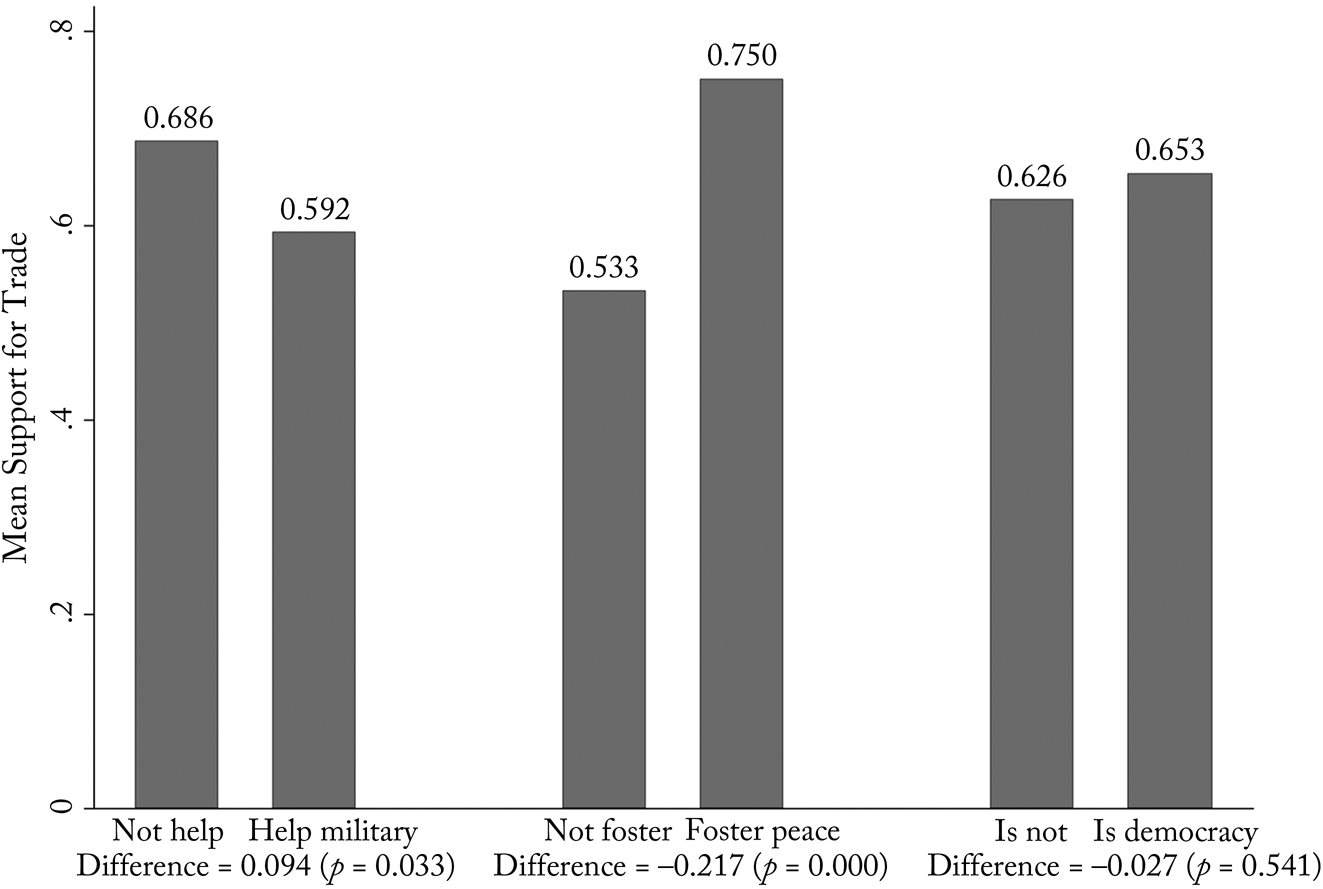
Figure 6 illustrates the effects of the other three treatments. Like their US counterparts, Indian respondents attached a negative penalty to trade—with a treatment effect of 9.4 percentage points—when trade was expected to increase the size of the partner's military. But when trade enhanced the prospects of peace, respondents were 21.7 percentage points more likely to value trade with the other country. It's telling that the geopolitical effects uncovered in our US sample parallel the findings in a democratic setting with markedly different socioeconomic and demographic characteristics. It indicates that country-specific features can't account for the relationship between geopolitics and trade policy support documented in this article. That said, we note that the democracy treatment, which had a significant positive effect in the US sample, is statistically insignificant in the Indian context. This lack of a treatment effect may be evaluated in the context of the democratic erosion in South Asia that has occurred in recent years—a possibility that warrants investigation in future work.
Support for Trade by Randomized Attributes: India Samplea
a Differences and p-values are based on two-sided t-tests; n = 480.

Last, we examine whether the trends identified in our experiments have been salient in other time periods. To do this, we use historical survey data and case study evidence from the India–Pakistan, Taiwan–China, and South Korea–North Korea cases (see Appendix H of the supplementary material). We find support for the claim that citizens routinely consider trade in line with the predictions of our theory, at least when evaluating salient geopolitical rivals. We also find evidence of the generalizability of our effects when we revisit the results of our first survey, in which we asked respondents open-ended questions about whether and why they supported trade with geopolitically salient pairs of countries. We observe that the respondents tend to explain their answers in geopolitical terms, underlining the importance of peace and security externalities in determining their attitudes (see Appendix I of the supplementary material for further details). This suggests that people think about trade with a variety of partners in the manner we highlight in our theory.
VI. Policy Implications
Having empirically examined the determinants of public opinion on trade, we consider the relevance of this line of inquiry for policy outcomes. Indeed, recent research shows that citizens often don't possess detailed knowledge on the subject of trade,Footnote 73 and that trade is frequently an issue of low salience even when they do.Footnote 74 In such cases, individual attitudes may not represent a meaningful determinant of policy outcomes.Footnote 75 Still, there are compelling theoretical reasons to expect that geopolitical factors have strong effects on citizens’ trade attitudes, and that these mass preferences translate into policy outcomes when important security goals are at stake.
Scholars have documented that public opinion has the greatest impact on policy when issue salience is high.Footnote 76 Even if voters consider routine trade policy to be a topic of relatively low salience, they typically view geopolitical factors pertaining to war and peace in highly salient terms. Therefore, linking matters of national security to trade effectively elevates the issue salience of trade policy-making. Daniel Verdier makes this point clearly when he argues:
The security dimension of trade—that is, the fact that trade can be used to reward allied countries and penalize rivals—has made national security the issue most consistently and effectively paired with the trade issue. When security becomes a salient, consensual issue, trade is likely to follow in its wake. Voters are thus rallied as a nation on one side or the other of the trade debate; and either protectionists or free traders are offered a unique opportunity to rout the other side.Footnote 77
Put simply, when voters prioritize geopolitical concerns, they formulate opinions on foreign policy measures that affect national security, including those related to trade and economic statecraft. Moreover, it's precisely during these periods that the public exerts considerable influence over trade policy-making debates. As Michael Bailey notes, the electoral process translates security imperatives into trade policy outcomes because “when the public is deeply concerned about foreign policy, the preferences of the public permeate and dominate the entire system. Under these circumstances, Congress—and, in turn, the nation—can engage in politically difficult policies. This strategic ability is not due to the machinations of bureaucrats or lobbyists but to politicians responding to clear public concerns.”Footnote 78
When geopolitical concerns are ingrained in voters’ minds, political representatives face clear electoral imperatives to formulate trade policies that advance national security interests—even if those policies are unpalatable to special interests or elite factions. In the presence of external threats, “the foreign policy establishment … enjoy[s] the popular support necessary to take trade policy out of its domestic format” and turn it into a national security concern.Footnote 79 Indeed, historical and contemporary examples in which the geopolitical dimensions of trade with allies and adversaries swayed mass attitudes regarding decisions to foster trade with particular partner countries—including whether to grant them most favored nation status, sanction them, sign preferential trade agreements and other preferential agreements with them, or allow them to accede to multilateral organizations—abound.Footnote 80
Notably, even when geopolitical considerations aren't particularly salient, public opinion may still matter. Scholars argue that public opinion routinely influences foreign policy outcomes even when voters have low levels of information about particular international affairs debates. Studies across a diverse range of foreign relations domains show that when voters “lack highly specific knowledge about foreign policy, they can nonetheless be capable of making reasonable judgments about foreign policy.”Footnote 81 Correspondingly, representatives face incentives to respond to diffuse public opinion as a preemptive measure if they anticipate that other actors, such as political competitors, interest groups, or the media, might be able to mobilize uninformed voters in the future,Footnote 82 particularly if electoral competition is high.Footnote 83
This discussion highlights why the mass public has strong opinions and policy influence on trade relations when economic integration is paired with statecraft, underscoring the importance of theoretical and empirical analyses of public opinion on geopolitics and trade.
VII. Conclusion
This article demonstrates that geopolitics constitutes a strong predictor of citizens’ attitudes toward trade policy. Building on the literature in political psychology, we hypothesized that voters’ prior beliefs about a given country influence their views on whether—and to what extent—they wish to forge closer trade relations with it. In particular, we focused on whether voters consider the relationship between trade, security externalities, and peace, and how these connections might influence their opinions regarding potential trading partners.
We tested our hypotheses using novel survey experiments in the United States and India. Our surveys demonstrated that individuals routinely evaluate trade in geopolitical terms and in ways that are consistent with our proposed theoretical framework. We found that respondents prefer trade with allies over adversaries, but that many prefer increasing trade with adversaries when they are informed that trade would serve as a conduit to peace.
Potential scope conditions of our argument are worth explicating. Several factors, including issue salience, territorial size or proximity, the severity of military threats, and the historical nature of the relationship between adversaries, could mediate the salience of geopolitical concerns in voters’ minds. Also, public opinion on trade with adversaries might not be static, since perceptions can be influenced by both the character and the actions of the adversary's regime. We view these as exciting avenues for future research. And our finding that respondents’ opinions about whether to trade with a particular partner can be swayed by learning that trade induces peace warrants further consideration as well. Although it's impossible to know whether trade will foster peace with another country ex ante, and interstate wars have become increasingly uncommon, politicians often invoke themes of peace when promoting closer trade relations with adversaries. For example, such themes are often used in the evolving trade relationships of the US with countries like China, Russia, and Iran.
Our article makes several contributions both to the international relations scholarship on trade and security, and to public policy debates on global economic cooperation. First, we show that the literature on public opinion on trade policy has largely overlooked a key determinant of citizens’ attitudes: geopolitics. It's significant that public opinion on trade is molded by geopolitical considerations previously unacknowledged in the literature; it might help explain why some prior studies have registered findings that appear incongruent with existing political economy models of the determinants of trade preferences. It also indicates that scholars seeking to understand the role of geopolitics in international economic exchange should pay attention both to the security externalities and to the peace-inducing features of trade. Focusing solely on either mechanism can generate misleading inferences about how trade affects statecraft.
Second, our study points to public opinion as an important area of inquiry that can help to explain when and why states are able to cooperate in a global economic order that is characterized by anarchy. Future work can test whether similar dynamics operate in other areas of global cooperation, such as foreign investment and aid; the core propositions of our argument could plausibly apply to a host of additional policy domains related to international economic exchange. Future work should also investigate whether our theory applies differently across industries and across democratic and authoritarian regimes.
Our results speak to many contemporary policy debates about trade agreements and policy negotiations in which geopolitical considerations have weighed heavily in the public eye. The existing scholarship offers few guidelines to help make sense of such mass preferences, but our work proposes a simple yet coherent framework to explain these trends. Voters are skeptical of trade with adversaries due to prior beliefs amplified by concerns that closer economic linkages will strengthen their rivals. At the same time, our findings suggest that a significant portion of the population responds positively to the idea that trade leads to peace. Policymakers seeking to advance trade agreements could thus benefit from clarifying the positive geopolitical consequences of tighter trade links.
Supplementary Material
Supplementary material for this article can be found at https://doi.org/10.1017/S0043887121000265.
Data
Replication files for this article can be found at https://doi.org/10.7910/DVN/4DE06H.
Acknowledgements
We thank Leonardo Baccini, Stephen Chaudoin, Jeff Colgan, Benjamin Fordham, Elitsa Garnizova, Benjamin Graham, Patrick James, Miles Kahler, Judith Kelley, Soo Yeon Kim, Edward Mansfield, James Morrison, Jiyeon Park, Amy Pond, Margaret Peters, Etel Solingen, Erik Wibbels, and Boliang Zhu for helpful comments, as well as workshop participants at Duke University; McGill University; the Harris School of Public Policy; the 2016 International Political Economy Society Annual Conference; the Economics and Security Reconsidered Workshops; the 2017 International Studies Association Annual Conference; the 2017 American Political Science Association Annual Conference; and the 2018 Political Economy of Security Conference. Aura Gonzalez, Hanzhang Liu, Kylan Rutherford, Bryan Schonfeld, Jenny Xiao, and Joon Yang provided exceptional research assistance.
Funding
This research was supported by a Lenfest Development Grant and approved by the institutional review boards of Columbia University and Yale University.