Introduction
The Pacific Northwest region of North America has a high lichen biodiversity. (e.g. Brodo Reference Brodo1973, Reference Brodo1976, Reference Brodo1984, Reference Brodo1988, 1995 Reference Brodoa , Reference Brodob , Reference Brodoc ; Brodo & Vänskä Reference Brodo and Vänskä1984; Brodo & Hertel Reference Brodo and Hertel1987; Brodo et al. Reference Brodo, Noble, Ahti and Clayden1987; Brodo & Tønsberg Reference Brodo and Tønsberg1994; Brodo & Henssen Reference Brodo and Henssen1995; Brodo & Santesson Reference Brodo and Santesson1997; Brodo & Wirth Reference Brodo and Wirth1998). The Queen Charlotte Islands in particular with their cool, oceanic climate host numerous species that are globally rare or endemic. Here, we present a new species from the coast of Alaska, another area of spectacular lichen diversity and abundance, similar in many ways to the Queen Charlotte Islands. Recent explorations of coastal Alaska have added numerous additional species to this region (e.g. Fryday Reference Fryday2008; Fryday & Coppins Reference Fryday and Coppins2008; Spribille et al. Reference Spribille, Pérez-Ortega, Tønsberg and Schirokauer2010; Dillman et al. Reference Dillman, Ahti, Björk, Clerc, Ekman, Goward, Hafellner, Pérez-Ortega, Printzen and Savić2012; Sheard et al. Reference Sheard, McCune and Tønsberg2014). Climatically these areas are similar to coastal British Columbia, but northward along the coast the climate becomes cooler, and tree species diversity gradually diminishes (Viereck & Little Reference Viereck and Little1972). The current contribution resulted from fieldwork in Katmai National Park, in the area where conifers along the coast have their last foothold, moving outwards along the Alaska Peninsula toward the Aleutian Islands.
Despite Rhizocarpon Ramond ex DC. being one of the most widely studied genera of saxicolous lichens (e.g. Runemark 1956 Reference Runemarka , Reference Runemarkb ; Poelt Reference Poelt1988), the large number of species in the genus and their chemical and morphological diversity has resisted a convincing, well-supported taxonomy across the genus. In connection with an ongoing lichen DNA barcoding project and molecular phylogenetic studies of Rhizocarpon by Timdal and co-workers, the present paper makes one small contribution toward that effort by describing a distinctive new species that is so far known only from the Aleutian Range in Alaska. Although the material lacked well-formed apothecia, we initially suspected Rhizocarpon because of the pigmentation pattern in sections of incipient apothecia. We then pursued its identity with secondary chemical and molecular studies. The species is distinguished by apparently being the only known member of Rhizocarpon to produce anthraquinones.
Materials and Methods
We applied standard microscopy and chemical spot test methods. Specimens were subjected to thin-layer chromatography (TLC) using the standard methods of Culberson (Reference Culberson1972), modified by Menlove (Reference Menlove1974) and Culberson & Johnson (Reference Culberson and Johnson1982), and reference tables of Chicita Culberson (1996, unpublished). Fragments of specimens were extracted in acetone at room temperature, spotted on aluminum-backed silica gel plates (Merck 5554/7 Silica gel 60 F254), run in solvent systems A and C of Culberson (Reference Culberson1972) and solvent B’ of Culberson & Johnson (Reference Culberson and Johnson1982), then lightly brushed with 10% H2SO4, and charred in an oven at 100 °C.
We obtained full internal transcribed spacer (ITS) sequences, including the 5.8S region, for both specimens of the putative new species, using the specimens McCune 32999 and 34087 and methods as described in McCune et al. (Reference McCune, Di Meglio and Curtis2014), except that tissue fragments were first eluted for 1 min. in acetone, then extracted for DNA, and PCR product was cleaned with ExoSAP-IT® (Affymetrix, Santa Clara, CA, USA). All other new sequences included here were obtained through a lichen DNA barcoding project at the Natural History Museum (NHM, University of Oslo), a subproject of NorBOL (http://www.norbol.org/en/; the Norwegian node of iBOL). In this project, a thorough sampling and specimen data entry procedure was performed in Norway whereas DNA isolation, amplification and sequencing was undertaken at the Canadian Centre for DNA Barcoding (http://www.ccdb.ca/). Some of the resulting sequences from this project are already available through the BOLD database (http://www.boldsystems.org/). Taxon selection for the present study was based on 1) the least genetic distance from the putative new species (the McCune 32999 and 34087 ITS sequences were blasted against GenBank as well as our own unpublished sequences), 2) the closest phylogenetic relatedness to the putative new species (the McCune 32999 and 34087 ITS sequences were included in a preliminary alignment of all available Rhizocarpon ITS sequences, both GenBank sequences and our own unpublished sequences), and 3) phenotypic similarity to the putative new species (our own and published morphological and TLC studies). When available, at least two accessions of each species were included, using more than that for species closely related to the putative new species. The most divergent (genetic distance) ITS sequence among the ones selected was used as an outgroup to root the resultant phylogenetic hypothesis. Table 2 summarizes voucher information (including author names) for all sequences used in this study.
We made a preliminary alignment of the 35 included ITS sequences using the ClustalW multiple alignment option in BioEdit 7.2.3 (Hall Reference Hall1999) with subsequent manual adjustments. End parts (10–30 bp) of the sequences downloaded from GenBank were difficult to align and replaced with question marks. Due to problems with positional homology in parts of the alignment, we used Gblocks 0.91b (http://phylogeny.lirmm.fr/phylo_cgi/one_task.cgi?task_type=gblocks) with two different stringency levels to create additional datasets with fewer ambiguities. We analyzed three different matrices using parsimony jackknifing: 1) the full alignment with gaps treated as missing data (alignment will be provided upon request); 2) Gblocks treated with default settings; 3) Gblocks treated with all less-stringent options deselected. We analyzed and summarized the full alignment using MrBayes. Both parsimony jackknifing and Bayesian phylogenetic analyses, including model testing, were performed as described in Bendiksby et al. (Reference Bendiksby, Haugan, Spribille and Timdal2015). The ITS1, 5.8S and ITS2 were defined as separate data blocks in the model testing.
Results
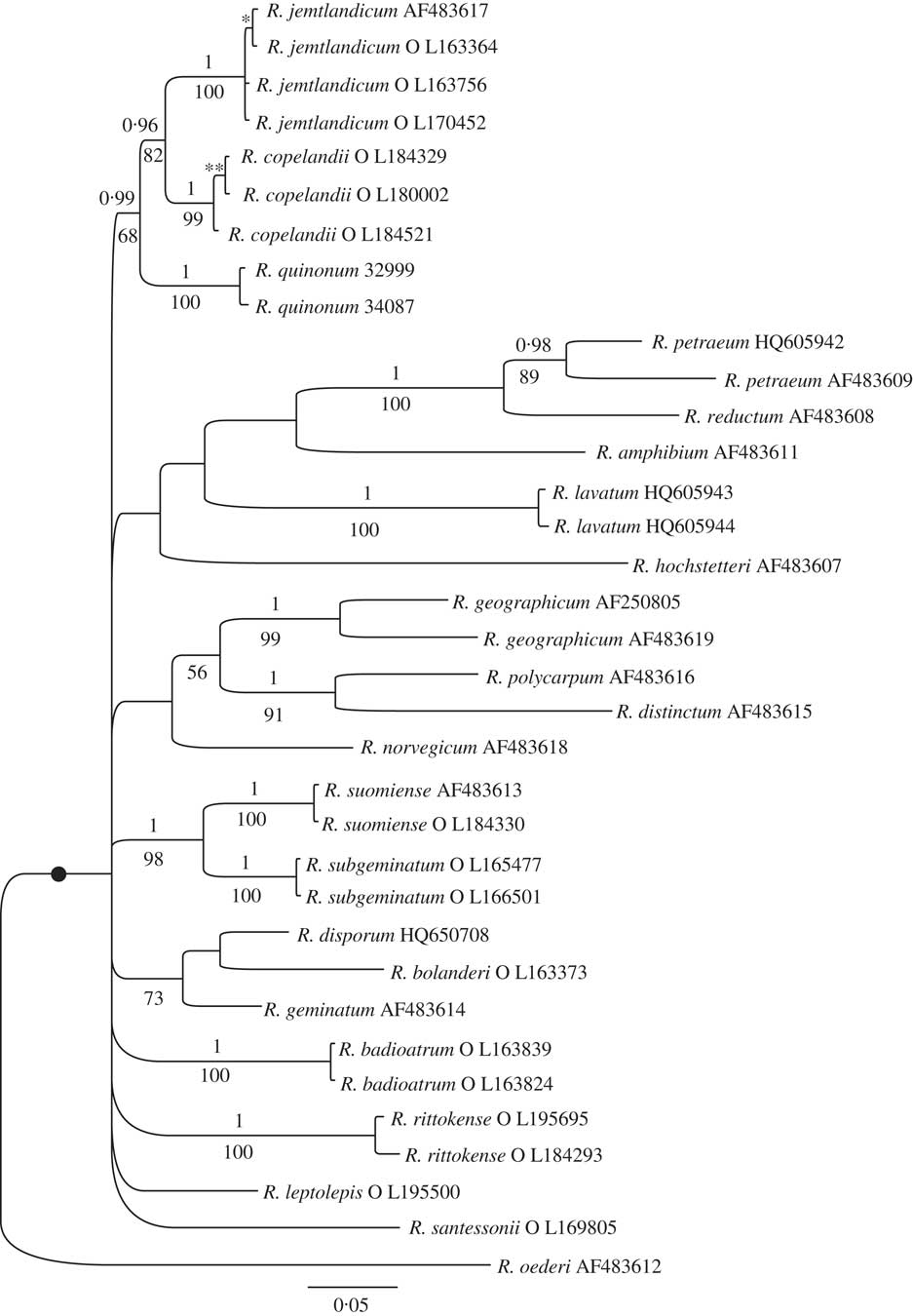
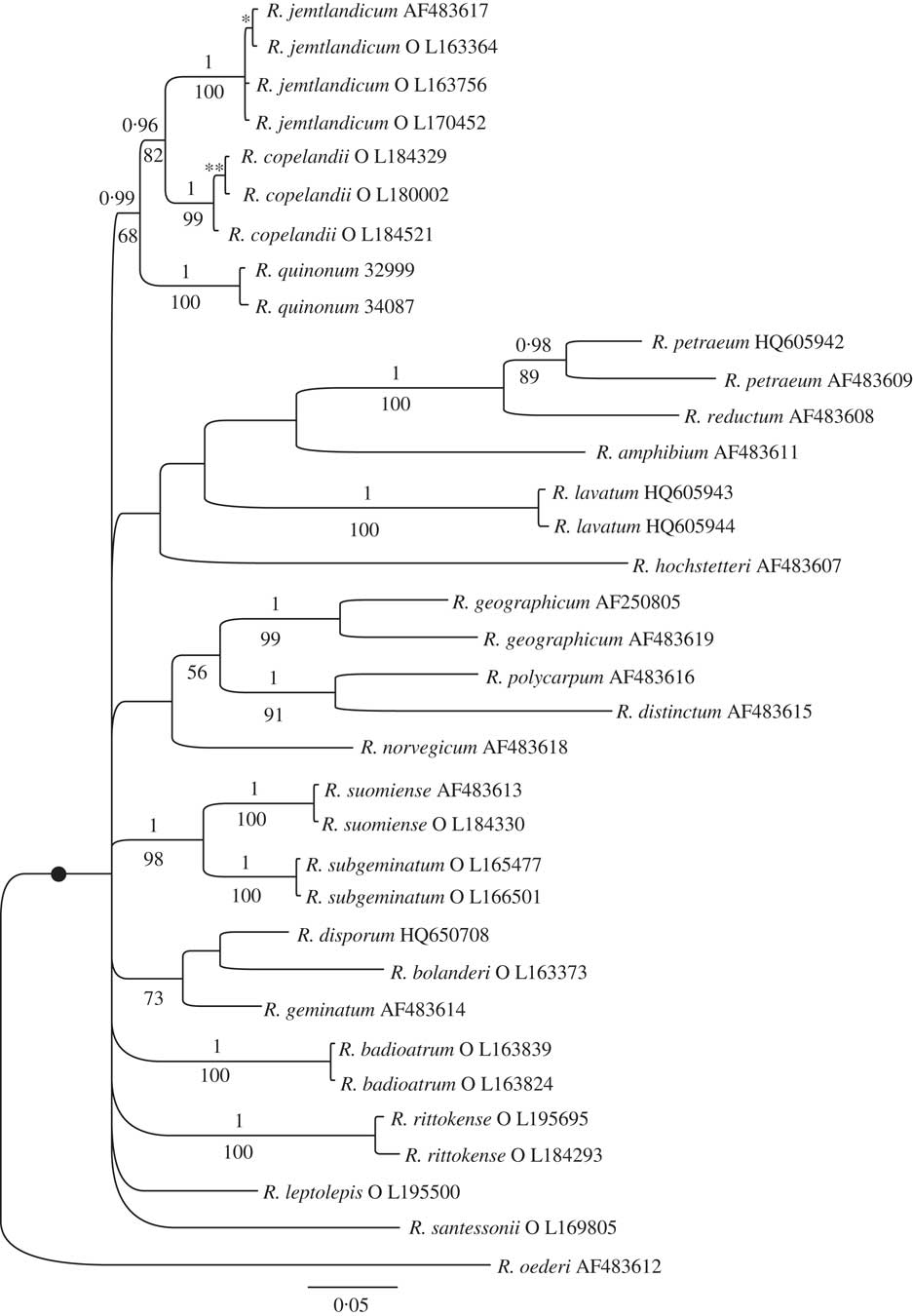
The three analyzed alignments (numbered 1–3 above) were 533, 453, and 323 bp long, and with 229, 188 and 89 parsimony-informative characters, respectively. The ITS sequences of the two accessions of the putative new species, described below as Rhizocarpon quinonum, were identical. Results from parsimony jackknifing of the three datasets were congruent (trees not shown), but the JK tree based on dataset 3 was less resolved, with the only supported inter-species groupings including R. petraeum-R. reductum, R. subgeminatum-R. suomiense, and R. distinctum-R. geographicum-R. polycarpum. Datasets 1 and 2 produced identical topologies and highly similar support values. The best models selected for the Bayesian analysis were HKY + I + G for ITS1 and ITS2, and K80 + I + G for the intervening 5.8S. We terminated the Bayesian phylogenetic analysis of dataset 1 at the point where the average standard deviation of split frequencies had stabilized below 0·01 (at 5 million generations). After discarding the first 1250 saved trees (i.e., 25%) as burn-in, we summarized the trees in a Bayesian 50% majority-rule (MR) consensus tree with posterior probabilities (PP) provided (Fig. 1). The parsimony jackknife topology of the full alignment (dataset 1) was congruent with the Bayesian MR tree, but generally less resolved. The jackknife support values (JK) are superimposed on the Bayesian tree (Fig. 1). The putative new species, R. quinonum, was supported (JK=68; PP=0·99) as sister to a supported (JK=82; PP=0·97) clade of R. copelandii and R. jemtlandicum. All species with multiple accessions formed strongly supported clades in the tree. Support of PP>0·9 and JK>65 for inter-species relationships was restricted to the following five clades: 1) copelandii-jemtlandicum; 2) quinonum-copelandii-jemtlandicum; 3) subgeminatum-suomiense; 4) petraeum-reductum; and 5) distinctum-polycarpum.
The Bayesian 50% majority rule consensus tree based on ITS sequences of 35 accessions of 22 Rhizocarpon species (see Table 2). Parsimony jackknife (JK) support values > 50% are shown below branches and Bayesian posterior probabilities (PP) > 0·95 above branches, except for two branches with space limitations. These are indicated with asterisk(s): * JK=61 and PP=0·97; ** JK=81 and PP=0·99. Branch lengths are the estimated number of substitutions per site (assuming the following models of substitution: HKY+I+G for ITS1 and ITS2, and K80+I+G for the intervening 5.8S) except for the branch indicated with a black dot, which was shortened to reduce the size of a broad figure.
The New Species
Rhizocarpon quinonum McCune, Timdal & Bendiksby sp. nov.
MycoBank No.: MB 816531
Thallus with grey-edged brown areoles, similar to Rhizocarpon arctogenum, R. bolanderi, R. leptolepis, and R. rittokense, but containing anthraquinones and most similar in ITS sequences to R. copelandii and R. jemtlandicum.
Type: USA, Alaska, Lake and Peninsula Borough, Katmai National Park, low rocky ridge north-east of Mirror Lake, 58·26553°N, 155·8839°W, 565 m, coarse talus and boulders in alpine tundra, 28 July 2013, B. McCune 32999 (holotype—ALA).
(Fig. 2)
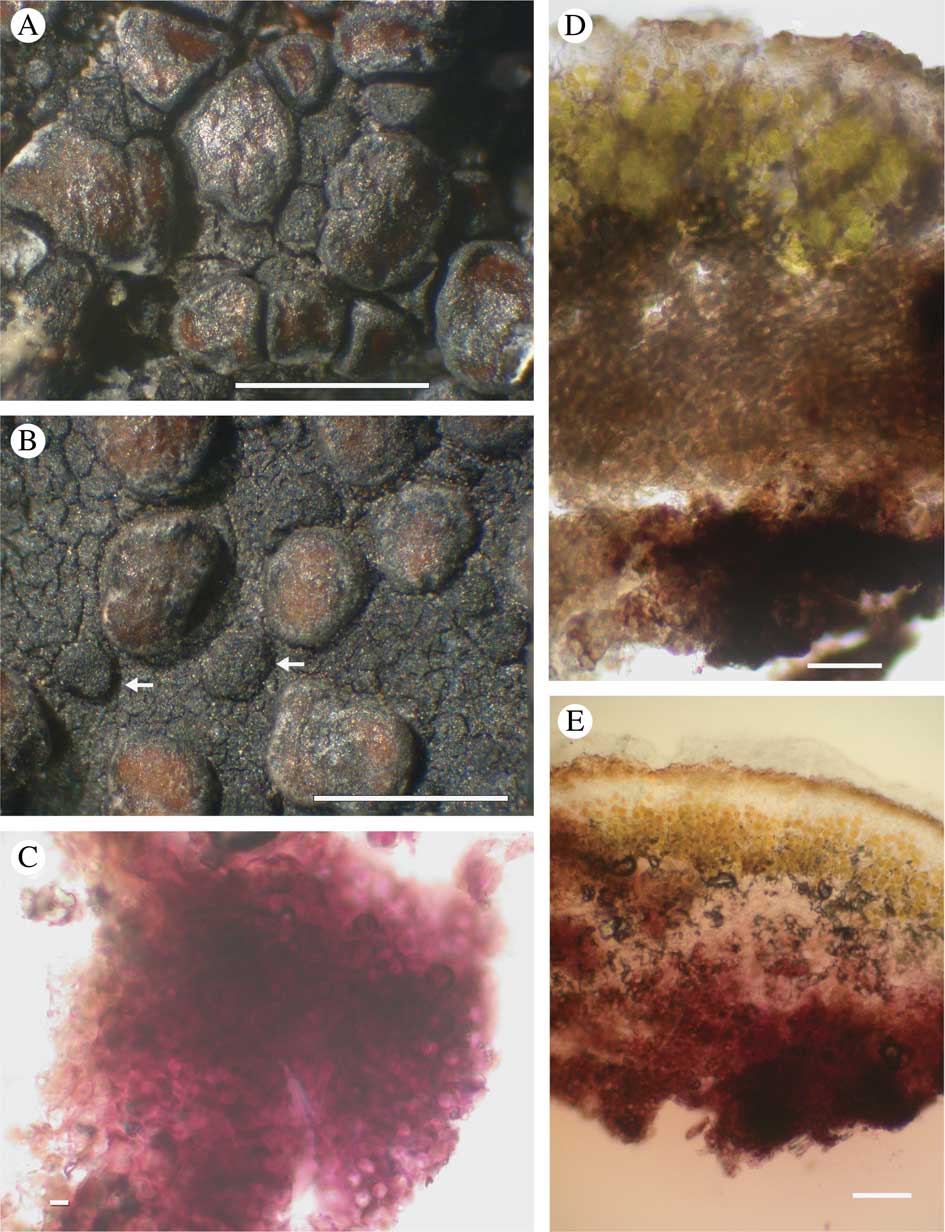
Rhizocarpon quinonum. A, habit (holotype, 32999); B, habit with incipient apothecia (white arrows) (34087); C, basal layer in K (34087); D, thallus section (32999); E, thallus section in K (34087). Scales: A & B=1 mm; C=5 µm; D & E=50 µm. In colour online.
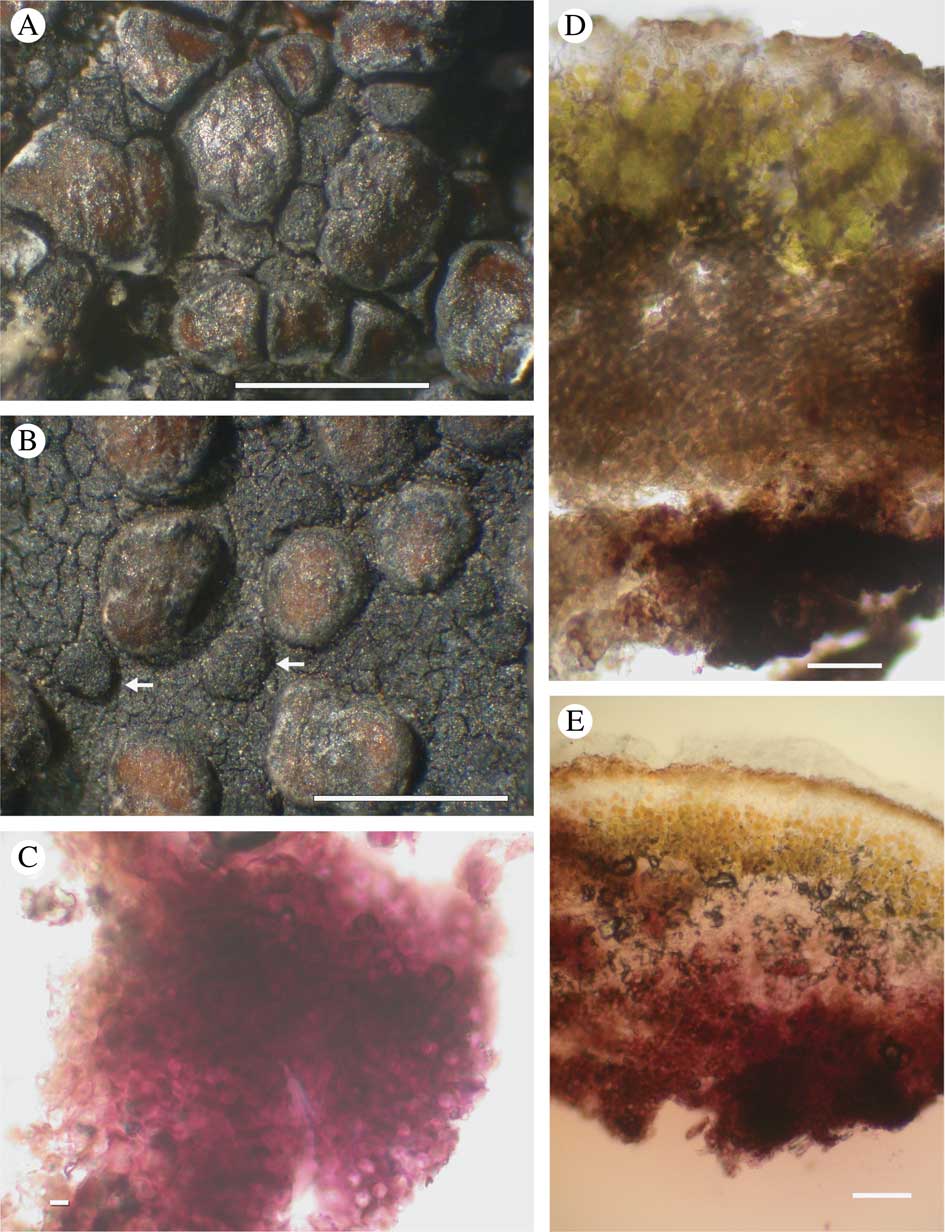
Thallus crustose, areolate, not lobate, to 5 cm or more diam.; areoles scattered to contiguous, commonly 0·3–1·0 mm broad and c. 0·2 mm thick, brown, dark brown, or blackish brown, pale brown where shaded, matt or glossy, the edges pale to dark grey, sometimes black; hypothallus black, grey-black where shaded, conspicuous between the areoles, dark brown under compound microscope, POL− in lower part, POL+ in gradual transition to medulla; epinecral layer thin or thick (mostly 5–10 µm, up to 25 µm), amorphous, POL− or weakly POL+; true upper cortex brown throughout or differentiated into upper brown and lower hyaline layers, paraplectenchymatous, POL+, 15–25 µm thick; cortex at edge of areole differentiated, paraplectenchymatous, dark brown in a thick layer, similar in colour and structure to the hypothallus; algal layer even, 74–100 µm thick, with a few photobiont cells scattered into the lower part of the cortex, with grey-brown POL+ crystals between the algal clumps and K+ yellow diffusion; photobiont chlorococcoid, the cells mostly 5–11 µm diam.; medulla to 75 µm thick, white under dissecting microscope, under compound microscope occluded with grey to brownish grey crystals, POL+, IKI−, all crystals dissolving in K, with K+ yellow diffusion; basal layer (hypothallus) dark brown-black paraplectenchymatous, POL−, K+ magenta to violet, with K+ magenta diffusion; soredia, isidia, and lobules lacking.
Apothecia initials attached to the hypothallus, black; mature apothecia not seen; developing exciple edge dark brown, pale brown to hyaline within, POL+, K+ yellow diffusion, K+ magenta at base; epithecium dark brown, POL−, K−; well-developed hymenium not seen; hypothecium dark brown, K−.
Pycnidia black, hemispherical to subconical, sessile on the hypothallus and between the areoles, the wall dark brown, K− or K+ weakly reddish; spermatia filiform, straight to slightly curved, 14·1–17·3 × 0·6–0·8 µm.
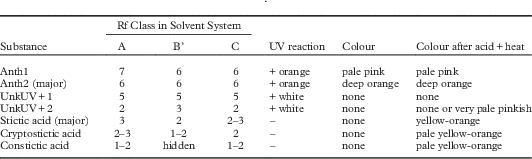
Secondary chemistry. TLC: stictic acid (major), satellites of stictic acid (cryptostictic and constictic acids), unknown anthraquinones Anth1 (minor) and Anth2 (major), minor unknown UV+ substances UnkUV+1 and UnkUV+2 (Rf classes for all substances in Table 1). Cortex K−, CK+ magenta in part, IKI−; medulla K+ yellow, basally K+ magenta to violet with magenta diffusion, C−, KC−, CK+ strong yellow, P+ orange, UV−, IKI−.
Substances found in Rhizocarpon quinonum by TLC, including unidentified anthraquinones (Anth1, Anth2). Rf classes and solvent systems refer to Culberson (Reference Culberson1972) and Culberson & Johnson (Reference Culberson and Johnson1982). Substances are minor except for those indicated as major and given in decreasing Rf order in solvent B’
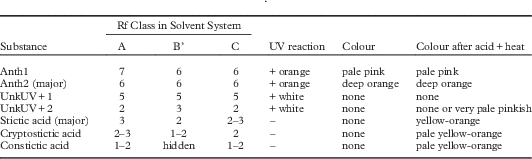
Diagnostic features of the lichen substances found in the two specimens of R. quinonum are given in Table 1. The major pigment (Anth2) is orange, UV+ orange on a TLC plate, and K+ magenta. While the pigment is not visually apparent in the intact thallus, an acetone extract is yellow-orange on a white spot plate, and the extract is K+ magenta and C−. Accessions and TLC results are reported in Table 2.
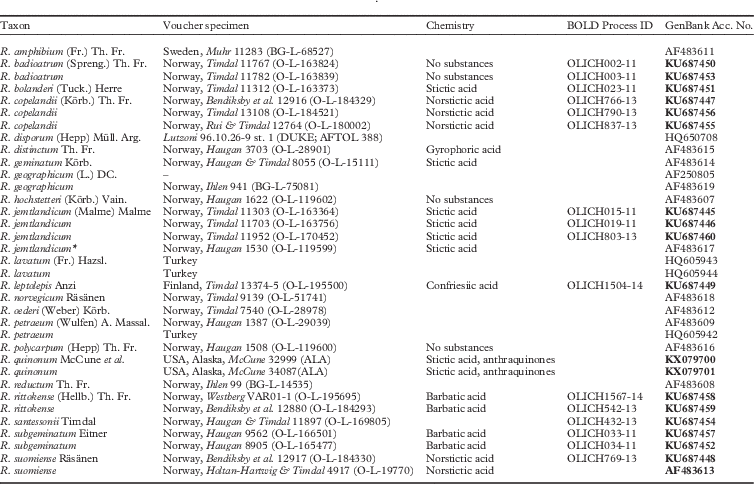
Rhizocarpon specimens used in this study with voucher information, major lichen substances, BOLD process IDs, and GenBank accession numbers. New sequences are indicated by accession numbers in bold
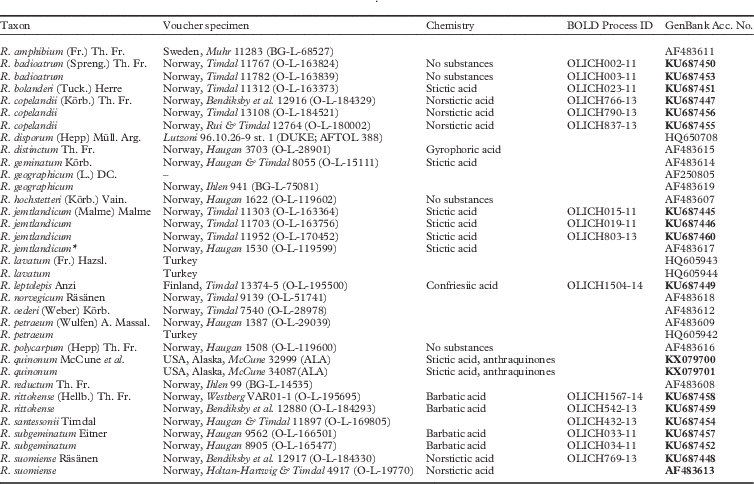
* As R. copelandii in GenBank, but redetermined as R. jemtlandicum in the herbarium by Timdal in 2011.
Ecology and substratum. Rhizocarpon quinonum is so far known from non-calcareous rock in alpine environments at 565–1140 m in the Aleutian Range on the Alaska Peninsula. It occurs in exposed sites with high diversity and cover of saxicolous lichens. The climate of this area is cold suboceanic. Although no climate stations exist at high elevations in this area, nearby low elevations average c. 125 cm of precipitation annually, with mean January and July temperatures of −9 °C and 13 °C, respectively.
Etymology. The epithet ‘quinonum’ refers to the presence of an anthraquinone as a major secondary substance.
Additional specimen examined. USA: Alaska: Lake and Peninsula Borough, Katmai National Park, north end of ridge west of Contact Creek, cliffs and alpine fellfield, 58·26553°N, 155·8839°W (NAD83), 1140 m, 2013, B. McCune 34087 (ALA).
Discussion
Lichen substances
We infer that the two unknown compounds present in R. quinonum are anthraquinones because the major pigment is orange, UV+ orange, and K+ magenta. We know of no reports of anthraquinones in Rhizocarpon. The morphologically somewhat similar genus Orphniospora Körb. (Fuscideaceae) does, however, contain anthraquinones, but in that case they are apparently restricted to the epihymenium. We found no matching substances in Chicita Culberson’s tables (1996, unpublished data); nor did co-chromatography show matches with substances in anthraquinone-containing examples of Phaeophyscia Moberg, Buellia De Not., and Heterodermia Trevis.
Rf values of Anth2 are similar to those for the pulvinic acid derivatives epanorin and rhizocarpic acid (op. cit., which are also UV+ orange, but K−), but co-chromatography showed that epanorin and rhizocarpic acid are both lower than Anth2 in solvent A and higher than Anth2 in solvent C. Furthermore, Anth2 is more orange than rhizocarpic acid and epanorin, and is orange after charring while epanorin and rhizocarpic acid are pale yellow.
Based on our TLC results, Rhizocarpon bolanderi var. sulphurosum (Tuck.) Zahlbr. (=Rhizocarpon sulphurosum (Tuck.) Lendemer) contains stictic and rhizocarpic acid, as does R. geminatum f. citrinum (Körb.) Schade. The yellow pigment of those taxa (rhizocarpic acid) is, however, not evident in R. quinonum, either by inspection of the thallus or by TLC.
An unknown yellow pigment with similar Rf values to Anth2 occurs in R. santessonii, but that pigment is K−, possibly being a pulvinic acid derivative. Rhizocarpon santessonii is an obligate parasite on Tremolecia atrata (Ach.) Hertel that has never been observed as a free-living lichen. Its areoles are faintly yellow without a grey margin (Timdal Reference Timdal1986).
Molecular phylogeny
The ITS region has been used here to infer the closest relatives of the putative new species. For resolution and support for deeper relationships, additional and more conserved genetic markers are needed (M. Bendiksby & E. Timdal, unpublished data). The genetic distinctness of the quinonum-clade (i.e., McCune 32999 and 34087) and its supported sister relationship to the copelandii-jemtlandicum clade (Fig. 1) support its description as a separate species.
Taxonomy
Morphologically the new species is closest to the group of Rhizocarpon species with brown, grey-edged, more or less peltate areolae that were treated by Gelting (Reference Gelting1954), that is, R. arctogenum Gelting, R. bolanderi, R. leptolepis, and R. rittokense. Those species differ mainly in ascospore features and chemistry: R. arctogenum has muriform spores, c. 4 per ascus, and contains the stictic acid complex; R. bolanderi has muriform spores, 2 per ascus, and contains the stictic acid complex, sometimes also rhizocarpic acid; R. leptolepis has muriform spores, 8 per ascus, and contains confriesiic acid (M. Bendiksby & E. Timdal, unpublished data.; Timdal & Holtan-Hartwig Reference Timdal and Holtan-Hartwig1988, as unknown ‘u1’; Elix & Tønsberg Reference Elix and Tønsberg2004, as ‘friesiic acid’); and R. rittokense has 1-septate spores, 8 per ascus, and contains either barbatic acid or the stictic acid complex (Timdal & Holtan-Hartwig Reference Timdal and Holtan-Hartwig1988).
Rhizocarpon arctogenum is, to our knowledge, known only from a few collections made on Disko Island in Greenland, and we do not have sequences for comparison with R. quinonum. We have examined three specimens of this species (C, GZU) by TLC and not found traces of yellow/orange pigments. The phylogenetic sister relationship of R. quinonum to the copelandii-jemtlandicum clade suggests that R. quinonum should have similar, 1-septate ascospores and hence not be closely related to R. arctogenum.
Rhizocarpon bolanderi is fairly common in western North America (pers. obs.) and may be the species most likely to be confused with R. quinonum in the field. Despite morphological similarity and sympatric occurrence, the ITS phylogeny clearly shows that R. bolanderi and R. quinonum are not sister to each other, which would have cast doubt on their distinction as species.
Rhizocarpon rittokense has two chemotypes: barbatic acid (the common one) and stictic acid complex (Novaya Zemlja, Magadan in Far East Russia, Alaska, and Greenland; nine specimens in O). The two sequenced specimens are of the barbatic acid chemotype, which is the only one known in Scandinavia. The species was described from northern Sweden, and we have examined three specimens from the type locality (O). We do not have sequences of the stictic acid chemotype, and it is possible that it is actually distinct from R. rittokense, and even possible that it represents R. quinonum. We find this unlikely, however, as yellow pigments were not observed on the chromatograms from the nine specimens examined.
Rhizocarpon copelandii is a variable species, described under at least five species names (chronologically, R. copelandii, R. cyclodes Th. Fr., R. hyperboreum (Vain.) Vain., R. groenlandicum Lynge, and R. elevatum H. Magn.). Timdal & Holtan-Hartwig (Reference Timdal and Holtan-Hartwig1988) synonymized four of those names after having struggled with the morphology (areoles brown to grey, flattened to bullate, dull to shiny) and chemistry (stictic or norstictic acid as a major compound). Timdal & Holtan-Hartwig’s (Reference Timdal and Holtan-Hartwig1988) conclusions based on morphology are supported by DNA barcoding (M. Bendiksby & E. Timdal, unpublished data). Rhizocarpon jemtlandicum contains the stictic acid complex and differs morphologically from R. copelandii in rather subtle characters. Although the ITS sequences show that R. quinonum is the sister of the copelandii-jemtlandicum clade, it is morphologically distinct in the grey-edged areoles and in the presence of the anthraquinone. Hence, R. quinonum is genetically distinct from the species most similar morphologically, and morphologically distinct from those species most genetically similar to it.
We thank Ernie Brodo for his groundbreaking work on the lichens of the coastal Pacific Northwest of North America, which provided a context for the current study. We have enjoyed following in his footsteps by exploring nearby areas, delighted to find the species that he described. We thank Elisa Di Meglio and Leon Rogers for assistance with TLC and Joe Di Meglio for DNA sequencing; Amy Miller, James Walton and the National Park Service in Anchorage for financial support and facilitating the study; Chris Lauver and the Cooperative Ecosystem Studies Unit in Seattle, for setting up Cooperative Agreement H8W07110001 with Oregon State University; and two anonymous reviewers. MB and ET acknowledge generous financial support (project No. 70184216) from the Norwegian Taxonomy Initiative (Norske Artsprosjektet) administered by the Norwegian Biodiversity Information Centre (ArtsDatabanken).