INTRODUCTION
The fig (Ficus carica L.) is a fruit tree of the Moraceae family and is one of the earliest cultivated fruit trees. Its fruits are of great commercial value (İrget et al., Reference İrget, Aksoy, Okur, Ongun and Tepecik2008) and are an important complement in human nutrition because they provide energetic compounds as starches and sugars such as glucose and fructose (Aljane et al., Reference Aljane, Toumi and Ferchichi2007). They also supply significant amounts of minerals needed for metabolism, being P, K, Ca, Mg, Na, Fe and Zn, those that are found in highest concentrations (Saeed and Sabir, Reference Saeed and Sabir2005) and are an important source of vitamins, amino acids and antioxidants (Solomon et al., Reference Solomon, Golubowicz, Yablowicz, Grossman, Bergma, Gottlieb, Altman, Kerem and Flaishman2006). Additionally, they contain various medicinal compounds: flavonol, quercetin and rutin used to treat cardiovascular diseases and have antimicrobial properties (Aref et al., Reference Aref, Salah, Chaumont, Fekih, Aouni and Said2010; Patil et al., Reference Patil, Bhangale and Patil2010) and even nematicides (Liu et al., Reference Liu, Yang, Zheng, Luo, Zhang and Li2011). On the other hand, it is easy to store them dried and they can be transformed into various products such as canned fruits: jam, juice, wine, dust and some others (Lianju et al., Reference Lianju, Weibin, Kai, Zhifeng and Yelin2003), which are demanded by the worldwide food industry (Gozlekci, Reference Gozlekci2011).
In the Mediterranean region, it is an important component in human diet, being considered one of the healthiest fruits as well as being associated with longevity (Trichopoulou et al., Reference Trichopoulou, Soukara and Vasilopoulou2007). Worldwide, its cultivation is important because of its dry and fresh consumption (Çalişkan and Polat, Reference Çalişkan and Polat2011). Fig trees are abundantly cultivated throughout the Mediterranean region and are well adapted to drought conditions and high temperatures. The fig production area is estimated at 358,494 ha, with a production of 1,117,452 t in 2013. Turkey and Egypt are the countries with the highest production of figs and represent approximately 43% of world production, followed by Algeria, Morocco and Iran. The fig production of these five countries account for 71% of the total production. Turkey is the major exporter of fig followed by the Austria, Spain, Italy and the Netherlands and the main importing countries of fig are France, Germany, Austria and United Kingdom (FAOSTAT, 2013).
The great economic importance of cultivation in countries such as Turkey, Italy, Spain, Japan, Brazil and Argentina has promoted the development of various investigations. Studies have been conducted on pruning, cultivars, fertilization, pest and disease control, harvesting and packing (de Souza, Reference de Souza2003). As a result, production technologies and post-harvest management have been developed to obtain high yielding, vigour and fruit quality (Alvarenga et al., Reference Alvarenga, Fráguas and da Silva2002). For instance, the high interest in the production of fresh and dried fig in Italy and Turkey has led to the implementation of wide programs to meet the needs of farmers in the training of pest and disease control, fertilization, irrigation systems, systems of planting, soil selection and indicators of harvest (Monagheddu and Chessa, Reference Monagheddu and Chessa2002). In addition, other researches have been developed on pruning and re-sprouting (Gerber et al., Reference Gerber, Steyn and Theron2010), plantation density (Yamakura et al., Reference Yamakura, Hosomi and Hirayama2008), the effect of weather conditions (Botti et al., Reference Botti, Franck, Prat, Ionnandis and Morales2003) and the use of macro-tunnels (Macías et al., Reference Macías, Velásquez, Villa, Rivera and Muñoz2014) in relation to their productivity, as a consequence, excellent results have been obtained.
In Mexico the cultivation of this species has been increasing since it is a good economic alternative for the rural sector (Macías et al., Reference Macías, Velásquez, Villa, Rivera and Muñoz2014). Its production in the states of Morelos, Baja California Sur, Puebla and Hidalgo has been emphasized (SAGARPA, 2015). However, production in open field shows some problems in production such as: high incidence of pests and diseases, fruit decay during in rainy season, mishandling of plantations and damage caused by frost. Hence, lower yields are obtained and in some cases – the plantations are abandoned. The search for higher yields in fig has led to implementing fertigation techniques, setting high-planting densities, managing productive branches and macro-tunnels, handling different types of pruning of leaves, buds and stems. Another important aspect to be considered is that the fig requires lots of heat units to achieve good quality of the fruit (Stover et al., Reference Stover, Aradhya, Ferguson and Crisosto2007), which limits the expansion of cultivation in regions with low temperatures are. As a result, production systems in controlled environments or protected agriculture are a good production alternative.
The protected agriculture, in particular the production in greenhouses, is considered a technological system which enables to handle environmental conditions and other risks (pests and diseases) for good crop development; as a result, an increase of the productivity in quantity, quality and commercial opportunity is achieved (Bastida, Reference Bastida2008; Castañeda-Miranda et al., Reference Castañeda-Miranda, Ventura-Ramos, Peniche-Vera and Herrera-Ruiz2007; Moreno et al., Reference Moreno, Aguilar and Luévano2011). Therefore, it is believed that the current goal of achieving and maintaining sustainable agriculture is based on full knowledge of these production systems (Vargas-Canales et al., Reference Vargas-Canales, Castillo-González, Pineda-Pineda, Ramírez-Arias and Avitia-García2014). In this sense, the objective of this research was to evaluate the behaviour of six intensive production systems in hydroponic and greenhouse conditions of fig tree for 11 months.
MATERIALS AND METHODS
Location and plant material used
The research was conducted under greenhouse conditions at the Experimental Field of the Universidad Autónoma Chapingo, located at coordinates 19° 20’ N, 98° 53’ W, and altitude of 2240 m. A native cultivar was used, regionally referred to as “Netzahualcoyotl”, from backyard orchards, with fruits of black – pale pericarp and pale – purple pulp belonging to the unique collection of local varieties of fig trees in Mexico, which consists of six local varieties from different parts of the central region of Mexico (García-Ruiz et al., Reference García-Ruiz, Mendoza-Castillo, Valadez-Moctezuma and Muratalla-Lúa2013). The experiment lasted eleven months (November 2010 to September 2011) at the end of the ripening of fruits. The harvesting period began in July and ended in September 2011.
Designing and conducting the experiment
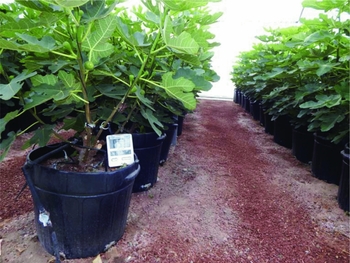
A topological arrangement of 1.6 m between rows and 0.5 m between plants, which corresponds to a planting density of 1.25 plants m2 (Figure 1), was used. It's important to outline that the evaluated plants were under this production system for three years. Flowerpots were used of 40 L black colour as containers. As a substrate, a mixture with 10% of vermicomposting, red volcanic rock 45% and white volcanic rock or tepojal 45%, was used. An irrigation system with self-regulated emitters to 4 L h−1 with four stakes each one, was set with irrigation of 3 minutes per hour from 9:00 am to 6:00 pm.
Intensive production of fig (Ficus carica L.) growing under greenhouse conditions.

A completely randomized experimental design with five replicates for each treatment was used, with a plant in each flowerpot as an experimental unit. Plants were handled with 20 fruits per productive stem, with different number of stems. In all treatments, pruning of lateral and apical buds were carried out. During the growing period, a conduction of the stems in “V” was conducted to avoid competition and to get further penetration of the radiation in inferior strata.
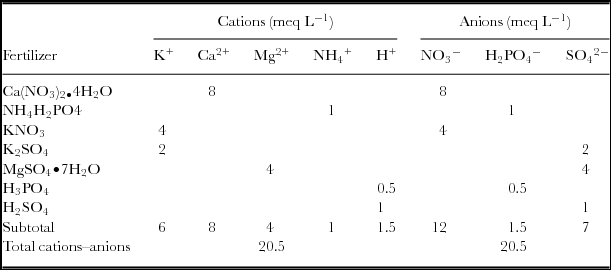
Furthermore, throughout experimental stage, a nutrient solution was applied (Table 1), the proposal for the hydroponic tomato production was used (Vargas-Canales et al., Reference Vargas-Canales, Castillo-González, Pineda-Pineda, Ramírez-Arias and Avitia-García2014) adapted from Urrestarazu (Reference Urrestarazu2004) and Steiner (Reference Steiner1984). This included the addition of micronutrients (mg L−1) throughout the growing season: Fe 3, Mn 0.5, Cu 0.1, Zn 0.1 y B 0.6., in which a pH of 5.6 and an electrical conductivity of 2.61 dS m−1 was kept.
Macronutrient nutrient solution for the production of fig tree (Ficus carica L.) growing under greenhouse conditions.

Finally, the six systems of production or treatments were as follows, 8S: eight productive stems per plant; 7S, seven productive stems per plant; 6S: six productive stems per plant; 5S: five productive stems per plant; 4S, four productive stems per plant and 3S: three productive stems per plant.
Variables evaluated
Biomass production. Dry weight of leaves and dry weight of stems per plant in grams were analysed. For that purpose, at the end of the harvest, the leaves and stems of each plant were separated and placed in a drying, trademark Blue, stove at 80 °C for 72 h for the leaves and 96 h for the stems. The biomass production per plant (kg), was obtained from the sum of the biomass of stems, leaves and fruits (the root was not included). Dry weight of fruits per plant (g), this variable was obtained by placing the fruit into a drying stove at 70 °C for 72 h and was multiplied by the number of fruits per plant. The leaf area index was estimated from on the average foliar area measured in the area leaf integrator. Subsequently, the leaf area plant was divided by 0.8 resulting in the occupied area by each plant. The harvest index was estimated by dividing the fruit yield (economic or agronomic yield) between the total biomass.
Fruit characteristics. The length and diameter of the fruit were determined in centimetres; for that purpose, a Mitutoyo slide gauge was used to get the polar and equatorial diameter of the fruit. To analyse the fresh fruit weight (g), each fruit was harvested and weighed according to the maturation and the weight of each experimental unit was registered. To analyse total soluble solids (ºBrix), a drop of juice from the fruit was added into an HANNA digital refractometer, HI 96801 model.
Fruit yield. This variable was evaluated in tons per hectare, for that purpose, the weight of the fruit fresh was multiplied by the number of fruits per plant and by the density of plantation.
Statistical analysis
Variance analyses and means comparisons were performed for each variable. The test utilized for the means comparisons was the Tukey test (p ≤ 0.05) and the software used was the SAS version 9.1.3. (SAS, 2006).
RESULTS
Biomass production
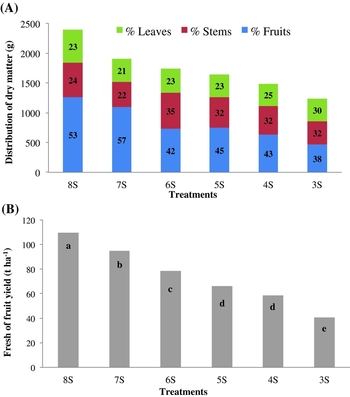
In relation to the production of biomass by the plant and by the organ (Figure 2a), treatments with eight (8S) and seven stems (7S) per plant stand out, in all the cases. Wherein the fruits contributed to the total biomass of the plant a higher proportion, more than 50% (53 and 57%). The three treatments with 5, 4 and 6 stems per plant (5S, 4S and 6S) contributed with 43 and 45% which corresponded to the 11 to 15% less biomass compared with that of highest value. The handled treatment with three productive stems per plant (3S) was the one that contributed with less biomass in the form of fruit (38%).
Relative distribution of dry matter per organ (A) and yield of fresh fruit (B) of the fig tree (Ficus carica L.) growing under greenhouse conditions. Different letters in (B) indicate statistical difference between treatments by the Tukey's test at p ≤ 0.05 (n = 5 replications).

As for the biomass supplied by the stems, the treatment with six productive stems per plant (6S) excelled with 35% of the total biomass, a superior value while comparing with the rest of the other treatments. On the other hand, the variable biomass of leaves showed similar behaviour in all treatments with minimal differences. According to the crop phenology, the accumulation and distribution of dry matter per organ, the six evaluated treatments showed similar tendencies throughout the crop cycle (Figure 2a).
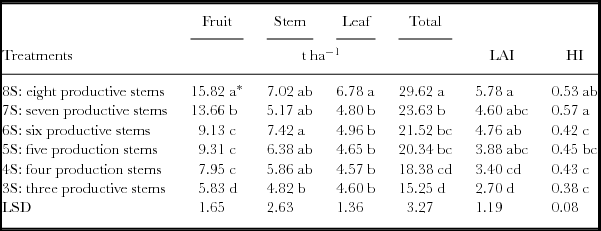
While analysing the total biomass per hectare, some significant differences among treatments were observed (Table 2). The 8S with eight stems per plant was the highest, with 29.62 t ha−1, which was understandable if one considered that the highest values were recorded in terms of fruits (15.82 t ha−1), stem (7.42 t ha−1) and leaf (6.78 t ha−1) in this treatment with a higher leaf area index (5.78), outperforming the rest of the treatments, as well as a harvest index of 0.53. The treatment with seven productive stems generated a statistically lower biomass than that of 8S of 23.63 t ha−1; however, it had a good supply of fruit biomass (13.66 t ha−1) and showed a high harvest index (0.57).
Biomass production (dry weight), leaf area index (LAI) and harvest index (HI) of fig trees (Ficus carica L.) growing in hydroponic conditions.

*Means with the same letters between columns do not differ according to Tukey's test (p ≤ 0.05); LSD: Least Significant Difference; n = 5 replications.
The 6S treatments with 20.34 t ha−1 and 5S with 21.52 t ha−1 did not show statistical differences between them in the biomass produced in fruits, stems and leaves as well as leaf area index and harvest index. The lowest values of total biomass were shown in the 4S treatments with 18.38 t ha−1 and in 3S with 15.25 t ha−1, the latter being the one with the lowest total biomass production of fruits, stem and leaf with the lowest leaf area index and the lowest value of harvest index (Table 2).
It is necessary to clarify that the pest incidence was very low and that diseases, fruit rot and cold injury did not appear in the present investigation.
Fruit characteristics
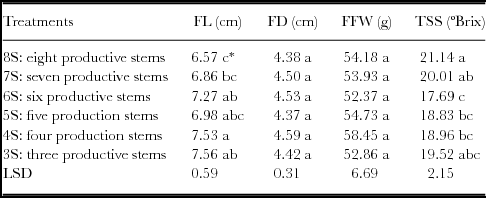
In relation to the length of the fruit, there were significant differences among 6S, 5S, 4S and 3S, and among 8S, 7S and 5S (Table 3) highlighting the one in treatment 4S, followed by the one in 3S and 6S. The shortest length of the fruit was registered in the treatment 8S and 7S. From above, it can be inferred that the higher the number of productive stems, the shorter the fruit. About the variable diameter of the fruit, no significant differences were shown, i.e. there was no effect of the number of productive stems on the fruit diameter.
Fruit length (FL), fruit diameter (FD), fresh fruit weight (FFW), total soluble solids (TSS) of fig trees (Ficus carica L.) growing in hydroponic conditions.

*Means with the same letters between columns do not differ according to Tukey's test (p ≤ 0.05); LSD: Least Significant Difference; n = 5 replications.
Regarding the fresh weight per fruit, the results indicate no significant differences (Table 3). Suggesting that there is no effect of the number of productive stems on the fresh weight of each fruit. The total soluble solids present significant differences among 8S, 7S and 3S, and among 6S, 5S, 4S and 3S, excelling the highest percentage in the handled treatments with eight productive stems per plant (8S), followed by the treatment of seven stems (7S) and three stems (3S). The treatment with the lowest solid soluble levels was the one with six productive stems per plant (6S).
Fresh fruit yield
In the yield of fresh fruit per hectare, there were significant differences in the treatments, except between the treatments 5S and 4S. The demeanour of the yield in descending order was 8S: 109.5 t ha−1 > 7S: 94.8 t ha−1 > 6S: 78.6 t ha−1 > 5S: 66.1 t ha−1 > 4S: 58.5 t ha−1 > 3S: 40.5 t ha−1 (Figure 2b). The highest yield of the fruit responded to highest leaf area index, which was far superior since the beginning of the growth of the plant with the highest number of stems. The highest yield of fresh fruit obtained in this study was 109.5 t ha−1 with a harvest index of 0.57.
DISCUSSION
Biomass production
When analysing biomass production of the fig tree in the greenhouse, it is evident that a greater leaf area index, harvest index and yield are obtained, coinciding with Abdel-Razik and El-Darier (Reference Abdel-Razik and El-Darier1991) who establish that good crop management conditions favour the storage of photo-assimilated for later use in the growth and maturation of fruits. Also, it has to be said that the fig tree, according to the values of produced biomass, can be of a potential use as an energy source since the rapid depletion of the main sources of non-renewable energy such as natural gas, oil and coal resources which will soon be scarce (Hosseini and Wahid, Reference Hosseini and Wahid2013). In this sense, the use of renewable energy, as crop residues (González et al., Reference González, Rosal, Requejo and Rodríguez2011; Hosseini and Wahid, Reference Hosseini and Wahid2013), is an excellent choice and it also reduces the waste of inedible parts of crops and the accumulation of CO2 in the atmosphere (Sorgüven and Özilgen, Reference Sorgüven and Özilgen2012).
Fruit characteristics
The length of the fruits changed according to handling practices; in this research, the length ranged from 6.57 cm to 7.53 cm, compared with those reported by Karadeniz (Reference Karadeniz2008) who found that the genotypes of the Black Sea region, in Turkey, had a length of 3.32 to 6.05 cm. Regarding the diameter of the fruits, the values were constant, about 4.4 cm, compared with the values reported by Darjazi (Reference Darjazi2011), who found fruits with an equatorial diameter of 2.1 to 4.5 cm.
In relation to the weight of the fresh fruit, the results were similar to those obtained by Cuihua et al. (Reference CuiHua, Min, FuKuan, HongYing and ChangGeng2003) of 58 g with a ziguo cultivar in China. In Iran, Darjazi (Reference Darjazi2011) also described the phenotypic diversity of fresh fruit weighing from 8.0 to 43.5 g. and in Turkey, Karadeniz (Reference Karadeniz2008) reported fruits weighing between 22.21 and 77.40 g. However, they were inferior when compared with those obtained by Gaaliche et al. (Reference Gaaliche, Trad and Mars2011), in Tunisia, of 102 and 112 g with Zidi and Bouhouli cultivars, respectively. About the total soluble solids ranging from 17.79 to 21.14%, the results coincided with those found by Gaaliche et al. (Reference Gaaliche, Trad and Mars2011) of 20.3%, and were within the range reported by Karadeniz (Reference Karadeniz2008) from 10.34 to 20.5% and Darjazi (Reference Darjazi2011) from 13.13 to 28.5%. However, they were closer to those by Sánchez et al. (Reference Sánchez, Melgarejo, Hernández and Martínez2003) who reported a range between 19.7 and 24.7% in Spain.
Fresh fruit yield
In this research, the production system was modified. Protected environments, which are increasingly common nowadays, were used and planting densities were increased from 0.5 m × 1.6 m up to eight stems per plant to achieve higher yields, of 100 t ha−1, than the ones reported by Nienow et al. (Reference Nienow, Chaves, Lajús and Calvete2006) in southern Brazil using a Roxo variety of Valinhos spaced at 1.50 m × 1.90 m and handling from 8 to 12 productive stems per plant in which yields of 41 to 43 t ha−1 were obtained.
The differential response of the number stems, from three to eight, per plant on fresh fruit yield with a range from 40.5 to 109.5 t ha−1 is higher, though, comparable to those obtained by Melgarejo et al. (Reference Melgarejo, Martínez, Hernández, Salazar and Martínez2007) of 81 t ha−1 and those by Lifei and Guondong (Reference Lifei and Guondong2003) of 47 t ha−1 under greenhouse conditions. In this sense, they exceeded 20 times the yields of fresh fig obtained in opencast as reported by different authors. In Spain, Puebla et al. (Reference Puebla, Toribio and Montes2001) a yield of 5.84 t ha−1 was reported and in Botucatu, Brazil, yields of 5.13 t ha−1 in 2004/05 and 5.82 t ha−1 in 2005/2006 were found (Leonel and Tecchio, Reference Leonel and Tecchio2010).
These results were related with those found by Yamakura et al. (Reference Yamakura, Hosomi and Hirayama2008), who concluded that the different densities had no negative influence on the amount of fruit harvested, provided that the orchards were fully covered by leaves. In this aspect, Yang and Zhang (Reference Yang and Zhang2010) stated that handling practices were essential to achieve a high rate of harvest. The plants were handled in hydroponics, handling branches and pruning side buds, leaves and terminal buds to favour a maximum incidence of light on the entire plant canopy with which a greater productive efficiency was achieved. About this, Cavatte et al. (Reference Cavatte, Rodríguez-López, Martins, Mattos, Sanglard and DaMatta2012) found that the combined effects of the continuous availability of light on the leaves and the water contributed to the fixation of CO2 for the growth and secondary metabolism, favouring functional relationships and relative growth rate.
The foregoing reflects the benefits of the protected agriculture systems or controlled environments. In addition, the fig tree shows great adaptability and response to nutrition, handling and control of the number of productive stems, pruning and predetermination of the number of fruits per productive stem which allowed to find a greater leaf area index, increased harvest index and increased yield of fresh fruit.
CONCLUSION
The handling of the fig tree in intensive production systems under hydroponic and greenhouse conditions is an excellent alternative production since it allows increasing leaf area index, harvest index and fruit yield in relation to the total biomass of the plant. Suggesting that high densities have no negative influence on the performance of fig fruit if plantations are fully covered by leaves (Yamakura et al., Reference Yamakura, Hosomi and Hirayama2008). With this, up to 20 more times of fresh fruit yield can be obtained, compared with field plantations in the open. In addition, the fig tree shows great adaptability and response to nutrition, handling and controlling the number of productive stems, pruning and predetermination of the number of fruits per productive stem. Also, the problems of pests and diseases, fruit rots and frost damage are reduced. For future research, it is important to evaluate the nutritional requirements of the plant according to their demand and phenology and to analyse the phytochemical and antioxidant properties of the fruit in relation to health as well as the characteristics of plants, fruit quality and genetic markers that are useful to improve the nutritional content of the fig tree. Also, it is necessary to consider that the fig tree, in these environments, generates lots of inedible biomass which can be used as an alternative bioenergy in producing compost, biogas, among others.