1. Introduction
Let
 $(\Omega, \mu )$
be any measure space, and let
 $1\lt p\lt \infty$
and let
 $T\colon L^p(\Omega )\to L^p(\Omega )$
be a positive contraction. Akcoglu’s dilation theorem [Reference Akcoglu1, Reference Akcoglu and Sucheston2] asserts that
 $T$
admits an isometric dilation, that is, there exists a second measure space
 $(\Omega ^{\prime},\mu ^{\prime})$
, an isometry
 $J\colon L^p(\Omega )\to L^p(\Omega ^{\prime})$
, an isometry
 $U\colon L^p(\Omega ^{\prime})\to L^p(\Omega ^{\prime})$
, and a contraction
 $Q\colon L^p(\Omega ^{\prime})\to L^p(\Omega )$
such that
 $T^k=QU^kJ$
for all integers
 $k\geq 0$
. This
 $L^p$
-analog of Nagy’s dilation theorem has been instrumental in various topics concerning
 $L^p$
-operators, such as functional calculus, harmonic analysis, and ergodic theory. We refer to [Reference Arhancet, Fackler and Merdy8, Reference Hytönen, van Neerven, Veraar and Weis28, Reference Kunstmann and Weis34, Reference Merdy and Xu36] and the references therein for specific results.
Turning to noncommutative analysis, we note that Akcoglu’s theorem does not extend to noncommutative
 $L^p$
-spaces [Reference Junge and Merdy29]. This obstacle led to new, interesting difficulties in the development of operator theory and harmonic analysis on noncommutative
 $L^p$
-spaces. Also, it became important to exhibit classes of completely positive contractions on noncommutative
 $L^p$
-spaces which do admit a dilation into an isometry acting on a second noncommutative
 $L^p$
-space. We refer to [Reference Arhancet4– Reference Arhancet6, Reference Duquet16, Reference Duquet and Merdy17, Reference Hong, Ray and Wang27, Reference Junge, Le Merdy and Xu30] for various results of this type. In all these papers (except [Reference Hong, Ray and Wang27]), the construction of an isometric dilation of a map
 $T\colon L^p(A)\to L^p(A)$
relies on the existence of a trace (or weight) preserving dilation of
 $T$
on the underlying von Neumann algebra
 $A$
. This leads us to introduce the following definition, which extends [Reference Duquet and Merdy17, Definition 2.1]. Let
 $\varphi$
be a normal semifinite faithful weight on
 $A$
(we say that
 $(A,\varphi )$
is a weighted von Neumann algebra in this case). Let
 $(\sigma ^\varphi _r)_{r\in {\mathbb R}}$
denote the modular automorphism group of
 $\varphi$
. We say that a linear map
 $T\colon A\to A$
admits an absolute dilation if there exists another weighted von Neumann algebra
 $(M,\psi )$
, a
 $w^*$
-continuous, unital, and weight-preserving
 $*$
-homomorphism
 $J\colon A\to M$
such that
 $\sigma ^\psi \circ J=J\circ \sigma ^\varphi$
, as well as a weight-preserving
 $*$
-automorphism
 $U\colon M\to M$
such that
 $T^k= {\mathbb {E}}_JU^kJ$
for all integers
 $k\geq 0$
, where
 $ {\mathbb {E}}_J\colon M\to A$
is the conditional expectation associated with
 $J$
. This dilation property implies that
 $T$
is unital, completely postive, and weight-preserving, that
 $T$
has a natural extension to
 $L^p(A)$
and that the latter admits a dilation into an isometry acting on another noncommutative
 $L^p$
-space (see Proposition 2.7).
In [Reference Duquet and Merdy17], we gave a characterization of bounded Schur multipliers which admit an absolute dilation. In [Reference Duquet16], the first named author showed that for any unimodular locally compact group
 $G$
, every unital completely positive Fourier multiplier
 $VN(G)\to VN(G)$
(in the sense of [Reference De Cannière and Haagerup14]) whose symbol is real-valued admits an absolute dilation. The case when
 $G$
is discrete had been settled in [Reference Arhancet4]. (The discrete case also follows from [Reference Ricard38, Corollary] and [Reference Haagerup and Musat22, Theorem 4.4]). The objective of this article is to extend the above mentioned result to the non unimodular case. Let
 $G$
be any locally compact group, let
 $u\colon G\to {\mathbb {R}}$
be a continuous function and assume that
 $u$
induces a unital completely positive Fourier multiplier
 $M_u\colon VN(G)\to VN(G)$
. We show that
 $M_u$
admits an absolute dilation, see Theorem4.1.
In the previous paragraph, the group von Neumann algebra
 $A=VN(G)$
is equipped with its Plancherel weight
 $\varphi =\varphi _G$
(see Section 3 for background). This specific weight is a trace if and only if
 $G$
is unimodular. This is the reason why passing from the unimodular case (considered in [Reference Duquet16]) to the nonunimodular case (considered in the present paper) requires new arguments. When
 $\varphi _G$
is a nontracial weight, we need to consider the Haagerup noncommutative
 $L^p$
-spaces associated with
 $(VN(G),\varphi _G)$
(see Subsection 2.2 for background). In particular, the space
 $L^1(VN(G),\varphi _G)$
plays a key role in the proof of Theorem4.1.
We note that a dilation theorem for semigroups of unital completely positive Fourier multiplier with real symbols was established in [Reference Arhancet6]. However, it cannot be applied to our case. Indeed there is no known way to pass from a dilation result for semigroups to a dilation result for single operators. We also note that if we restrict to the case when
 $G$
is unimodular, the proof of Theorem4.1 is partly different and somewhat simpler than the one in [Reference Duquet16] or [Reference Arhancet4].
In the last part of the paper (Section 5), we give an application of our dilation result to functional calculus. We consider a unital completely positive Fourier multiplier
 $M_u\colon VN(G)\to VN(G)$
, and we assume that
 $u$
is valued in
 $[0,1]$
. Then, we show that for any
 $1\lt p\lt \infty$
, the
 $L^p$
-realization of
 $T$
on
 $L^p(VN(G),\varphi _G)$
is a Ritt operator which admits a bounded
 $H^\infty$
-functional calculus in the sense of [Reference Arhancet and Merdy7, Reference Merdy35].
2. Absolute dilations and isometric
 $p$
-dilations in the weighted case

We refer the reader to [Reference Takesaki41] for general information on von Neumann algebras. Given any von Neumann algebra
 $A$
, we let
 $A_*$
denote its predual. We let
 $A^+$
and
 $A_{*}^+$
denote the positive cones of
 $A$
and
 $A_*$
, respectively. A map
 $V\colon A\to A^{\prime}$
between two von Neumann algebras is called positive if
 $V(A^+)\subset A^{\prime+}$
. We will use the stronger notion of completely positive map, for which we refer to [Reference Takesaki41, Section IV.3].
2.1. Absolute dilations
We refer to [Reference Sratila39, Reference Takesaki42] for general information on weights. Let
 $A$
be a von Neumann algebra equipped with a normal semifinite faithful weight
 $\varphi$
. In this situation, we say that
 $(A,\varphi )$
is a weighted von Neumann algebra. We let
 $(\sigma ^\varphi _r)_{r\in {\mathbb R}}$
denote the modular automorphism group of
 $\varphi$
. Then, we set
 \begin{equation*} \mathcal {N}_\varphi =\bigl \{x\in A\, :\, \varphi (x^*x)\lt \infty \bigr \} \end{equation*}
and
 \begin{equation*} \mathcal {M}_\varphi =\textrm {Span}\bigl \{y^*x\, :\, x,y\in \mathcal {N}_\varphi \bigr \}. \end{equation*}
We recall that
 $\mathcal {N}_\varphi$
is a
 $w^*$
-dense left ideal of
 $A$
and that
 $\mathcal {M}_\varphi$
is a
 $w^*$
-dense
 $*$
-subalgebra of
 $A$
. Further
 $\mathcal {M}_\varphi =\textrm {Span}\{x^*x\, :\, x\in \mathcal {N}_\varphi \}$
and the restriction of
 $\varphi$
to the set
 $\{x^*x\, :\, x\in \mathcal {N}_\varphi \}$
uniquely extends to a functional (still denoted by)
 \begin{equation*} \varphi \colon \mathcal {M}_\varphi \longrightarrow {\mathbb {C}}. \end{equation*}
Let
 $(M,\psi )$
be a second weighted von Neumann algebra and let
 $T\colon A\to M$
be any positive map. We say that
 $T$
is weight-preserving provided that
 \begin{equation*} \psi \circ T=\varphi \quad \hbox {on}\ A^+. \end{equation*}
Let
 $J\colon A\to M$
be a
 $w^*$
-continuous, unital and weight-preserving
 $*$
-homomorphism such that
 \begin{equation*} \sigma ^\psi \circ J=J\circ \sigma ^\varphi . \end{equation*}
Here and thereafter, this identity means that
 $\sigma ^\psi _r\circ J=J\circ \sigma ^\varphi _r$
on
 $A$
for all
 $r\in {\mathbb {R}}$
. According to either [Reference Sratila39, Theorem 10.1] or [Reference Takesaki42, Theorem IX.4.2], there exists a unique weight-preserving conditional expectation
 \begin{equation} {\mathbb {E}}_J\colon M\longrightarrow A. \end{equation}
That is,
 $ {\mathbb {E}}_J\colon M\to A$
is the unique linear map satisfying
 $ {\mathbb {E}}_J\circ J=I_A$
,
 $\Vert {\mathbb {E}}_J\Vert =1$
and
 $\varphi \circ {\mathbb {E}}_J= {\mathbb {E}}_J\circ \psi$
. We note that we further have
 $\sigma ^\varphi \circ {\mathbb {E}}_J= {\mathbb {E}}_J\circ \sigma ^\psi$
, see [Reference Sratila39, Corollary 10.5], and that
 $ {\mathbb {E}}_J$
is
 $w^*$
-continuous (see also Lemma 2.12).
Definition 2.1. Let
 $(A,\varphi )$
be a weighted von Neumann algebra and let
 $T\colon A\to A$
be a bounded map. We say that
 $T$
admits an absolute dilation if there exists another weighted von Neumann algebra
 $(M,\psi )$
, a
 $w^*$
-continuous, unital, and weight-preserving
 $*$
-homomorphism
 $J\colon A\to M$
such that
 $\sigma ^\psi \circ J=J\circ \sigma ^\varphi$
, as well as a weight-preserving
 $*$
-automorphism
 $U\colon M\to M$
such that
 \begin{equation} \forall \, k\geq 0,\qquad T^k = {\mathbb {E}}_JU^k J. \end{equation}
Remark 2.2.
-
(1) Assume that
$T\colon (A,\varphi )\to (A,\varphi )$
admits an absolute dilation and consider
$(M,\psi )$
,
$J$
and
$U$
as in Definition 2.1. In particular, we have
$T= {\mathbb {E}}_JU J$
. We observe that
$J,U$
, and
$ {\mathbb {E}}_J$
are both unital, completely positive, and weight-preserving. Further
$\sigma ^\psi \circ U =U\circ \sigma ^\psi$
, by [Reference Takesaki42, Corollary VIII.1.4]. Since
$\sigma ^\psi \circ J=J\circ \sigma ^\varphi$
and
$\sigma ^\varphi \circ {\mathbb {E}}_J= {\mathbb {E}}_J\circ \sigma ^\psi$
, we deduce that
$T$
is unital, completely positive, weight-preserving and that
$\sigma ^\varphi \circ T=T\circ \sigma ^\varphi$
. -
(2) Assume that
$\varphi$
is a state and consider
$T\colon (A,\varphi )\to (A,\varphi )$
. If
$T$
admits an absolute dilation and if
$(M,\psi )$
and
$J\colon A\to M$
are given by Definition 2.1, then
$\psi (1)=\psi (J(1))=\varphi (1)=1$
, hence
$\psi$
is a state. It therefore follows from [Reference Haagerup and Musat22, Theorem 4.4], that
$T$
admits an absolute dilation if and only if
$T$
is factorizable in the sense of [Reference Anantharaman-Delaroche3,Reference Ricard38]. Absolute dilations in the state case go back to [Reference Kümmerer33]. We refer to [Reference Arhancet5] for various examples. -
(3) Assume that
$\varphi$
is a trace and that
$T\colon (A,\varphi )\to (A,\varphi )$
admits an absolute dilation. Then, the weighted von Neumann algebra
$(M,\psi )$
from Definition 2.1 can be chosen in such a way that
$\psi$
is a trace. Indeed, assume that
$T$
satisfies Definition 2.1 and let
$M_0$
be the centralizer of
$\psi$
, that is,
$M_0=\{m\in M\, :\, \sigma ^\psi _r(x)=x\ \hbox {for all}\ r\in {\mathbb {R}}\}$
. Letand let
\begin{equation*} \mathcal {B}=\textrm {Span}\Bigl \{\sum _{k=1}^m U^{k_1}J(x_1)U^{k_2}J(x_2)\cdots U^{k_m}J(x_m)\, :\, m\geq 1,\, k_1,\ldots, k_m\in {\mathbb {Z}},\, x_1,\ldots x_m\in A\Bigr \}, \end{equation*}
$B=\overline {\mathcal {B}}^{w^*}$
. Since
$\sigma ^\varphi$
is trivial,
$U^kJ(x)\in M_0$
for all
$x\in A$
and
$k\in {\mathbb {Z}}$
. Hence,
$B$
is a sub-von Neumann algebra of
$M_0$
. Therefore, the restriction
$\psi _B$
of
$\psi$
to
$B^+$
is a normal faithful trace. Let us show its semi-finiteness. For any
$x\in \mathcal {N}_\varphi$
and any
$k\in {\mathbb {Z}}$
, we havethat is,
\begin{equation*} \psi \bigl ((U^kJ(x))^*(U^kJ(x))\bigr )= \psi \bigl (U^kJ(x^*x)\bigr )=\varphi (x^*x)\,\lt \infty, \end{equation*}
$U^kJ(x)\in \mathcal {N}_\psi$
. Since
$\mathcal {N}_\varphi$
is
$w^*$
-dense in
$A$
and
$J,U$
are
$w^*$
-continuous,
$U^kJ(\mathcal {N}_\varphi )$
is
$w^*$
-dense in
$U^kJ(A)$
. Since
$\mathcal {N}_\psi$
is a left ideal, we deduce that
$\mathcal {N}_\psi \cap \mathcal {B}$
is
$w^*$
-dense in
$\mathcal {B}$
. Consequently,
$\mathcal {N}_\psi \cap B$
is
$w^*$
-dense in
$B$
. Thus,
$\psi _B$
is semi-finite. Consequently,
$(M,\psi )$
can be replaced by
$(B,\psi _B)$
in the dilation of
$T$
. In the article [Reference Duquet and Merdy17], we considered absolute dilations in the tracial case. The above paragraph shows that in the case when
$\varphi$
is a trace,
$T\colon (A,\varphi )\to (A,\varphi )$
admits an absolute dilation in the sense of Definition 2.1 if and only if it admits an absolute dilation in the sense of [Reference Duquet and Merdy17].
-
(4) Combining [Reference Haagerup and Musat22, Section 3] with (3) above, we obtain examples of unital, completely positive, weight-preserving maps
$T\colon (A,\varphi )\to (A,\varphi )$
such that
$\sigma ^\varphi \circ T=T\circ \sigma ^\varphi$
, without any absolute dilation (see [Reference Duquet and Merdy17, Remark 7.3] for details).


We record for further use the so-called Pedersen–Takesaki theorem (see [Reference Sratila39, Theorem 6.2]).
Lemma 2.3.
Let
 $(A,\varphi )$
be a weighted von Neumann algebra and let
 $B\subset \mathcal {N}_\varphi$
be a
 $w^*$
-dense
 $*$
-algebra such that
 $\sigma ^\varphi _r(B)\subset B$
for all
 $r\in {\mathbb {R}}$
. Let
 $\gamma$
be a normal semi-finite weight on
 $A$
such that
 $\gamma \circ \sigma ^\varphi = \gamma$
and
 $\gamma (x^*x)=\varphi (x^*x)$
for all
 $x\in B$
. Then
 $\gamma =\varphi$
.
2.2. Haagerup noncommutative
$L^p$
-spaces

Let
 $(A,\varphi )$
be a weighted von Neumann algebra. We recall the definition of the Haagerup non-commutative
 $L^p$
-spaces
 $L^p(A,\varphi )$
, as well as some of their properties. We refer the reader to [Reference Haagerup20], [Reference Haagerup, Junge and Xu23, Section 1], [Reference Hiai26, Chapter 9], [Reference Pisier and Xu37] and [Reference Terp44] for details and complements. Assume that
 $A$
acts on some Hilbert space
 $H$
and let
 \begin{equation*} \mathcal R = A \rtimes _{\sigma ^\varphi } {\mathbb {R}}\subset B(L^2( {\mathbb {R}}))\overline {\otimes } A\subset B\bigl (L^2( {\mathbb {R}};H)\bigr ) \end{equation*}
be the crossed product associated with
 $\sigma ^\varphi \colon {\mathbb {R}}\to \textrm {Aut}(A)$
, see e.g. [Reference Sratila39, Chapter IV] or [Reference Takesaki42, Chapter X]. We regard
 $A$
as a sub-von Neumann algebra of
 $\mathcal {R}$
in the natural way. Let
 $\widehat {\sigma }^\varphi \colon {\mathbb {R}}\simeq \widehat { {\mathbb {R}}} \to \textrm {Aut}(\mathcal {R})$
be the dual action of
 $\sigma ^\varphi$
and note that
 $\widehat {\sigma }^\varphi _r(x)=x$
for all
 $r\in {\mathbb {R}}$
if and only if
 $x\in A$
.
There exists a unique normal semifinite faithful trace
 $\tau _0$
on
 $\mathcal {R}$
such that
 \begin{equation*} \tau _0\circ \widehat {\sigma }^\varphi _r =e^{-r}\tau _0,\qquad r\in {\mathbb {R}}. \end{equation*}
This trace gives rise to the
 $*$
-algebra
 $L^{0}(\mathcal {R},\tau _0)$
of
 $\tau _0$
-measurable operators [Reference Hiai26, Chapter 4]. Then, for any
 $1\leq p\leq \infty$
, the Haagerup
 $L^p$
-space
 $L^p(A,\varphi )$
is defined as
 \begin{equation*} L^p(A,\varphi ) = \bigl \{ y\in L^0(\mathcal {R},\tau _0)\, :\, \widehat {\sigma }^\varphi _r(y) =e^{-\frac {r}{p}}y\ \hbox {for all}\ r\in {\mathbb {R}}\bigr \}. \end{equation*}
In particular,
 $L^\infty (A,\varphi )=A\subset \mathcal {R}$
.
For all
 $1\leq p\lt \infty$
,
 $L^p(A,\varphi )^+= L^p(A,\varphi )\cap L^0(\mathcal {R},\tau _0)^+$
is a positive cone on
 $L^p(A,\varphi )$
.
For any normal semifinite weight
 $\gamma$
on
 $A$
, let
 $\widehat {\gamma }$
denote the dual weight on
 $\mathcal {R}$
, see for example [Reference Sratila39, Section 19] or [Reference Takesaki42, Section 10.1]. Let
 $h_\gamma$
denote the Radon–Nikodym derivative of
 $\gamma$
with respect to
 $\tau _0$
. This is the unique positive operator on
 $L^2( {\mathbb {R}};H)$
affiliated with
 $\mathcal {R}$
, such that
 $\widehat {\gamma }(y)= \tau _0(h_\gamma ^{\frac 12} yh_\gamma ^{\frac 12}),$
for all
 $y\in \mathcal {R}^+$
. It turns out that
 $h_\gamma$
belongs to
 $L^1(A,\varphi )^+$
if and only if
 $\gamma \in A_{*}^+$
. Further the mapping
 $\gamma \mapsto h_\gamma$
on
 $A_{*}^+$
extends to a linear isomorphism from
 $A_*$
onto
 $L^1(A,\varphi )$
, still denoted by
 $\gamma \mapsto h_\gamma$
. With this isomorphism in hands, we equip
 $L^1(A,\varphi )$
with the norm
 $\Vert \,\cdotp \Vert _1$
inherited from
 $A_*$
, that is,
 $\Vert h_\gamma \Vert _{1}=\Vert \gamma \Vert _{A_*}$
for all
 $\gamma \in A_*$
. Next, for any
 $1\leq p\lt \infty$
and any
 $y\in L^p(A,\varphi )$
, the positive operator
 $\vert y\vert$
belongs to
 $L^p(A,\varphi )$
as well and hence
 $\vert y\vert ^p$
belongs to
 $L^1(A,\varphi )$
. This allows to define
 $\Vert y\Vert _p=\Vert \vert y\vert ^p\Vert ^{\frac {1}{p}}$
for all
 $y\in L^p(A,\varphi )$
. Then,
 $\Vert \,\cdotp \Vert _p$
is a complete norm on
 $L^p(A,\varphi )$
.
The Banach spaces
 $L^p(A,\varphi )$
satisfy the following version of Hölder’s inequality(see e.g. [Reference Hiai26, Proposition 9.17]). For any
 $1\leq p,p^{\prime}\leq \infty$
such that
 $p^{-1}+p^{\prime-1}=1$
and for any
 $x\in L^{p}(A,\varphi )$
and
 $y\in L^{p^{\prime}}(A,\varphi )$
, the product
 $xy$
belongs to
 $L^1(A,\varphi )$
and we have
 \begin{equation*} \Vert xy\Vert _1\leq \Vert x\Vert _{p}\Vert y\Vert _{p^{\prime}}. \end{equation*}
We let
 $\textrm {Tr}_\varphi \colon L^1(A,\varphi )\to {\mathbb {C}}$
be defined by
 $\textrm {Tr}_\varphi (h_\gamma )=\gamma (1)$
for all
 $\gamma \in A_*$
. This functional has two remarkable properties. First, for any
 $x\in L^{p}(A,\varphi )$
and
 $y\in L^{p^{\prime}}(A,\varphi )$
with
 $p^{-1}+p^{\prime-1}=1$
, we have
 $\textrm {Tr}_\varphi (xy) = \textrm {Tr}_\varphi (yx).$
Second,
 \begin{equation*} \textrm {Tr}_\varphi (h_\gamma x) = \gamma (x), \end{equation*}
for all
 $\gamma \in A_*$
and
 $x\in A$
. It follows from this identity and the definition of
 $\Vert \,\cdotp \Vert _1$
that the duality pairing
 $\langle x,y\rangle =\textrm {Tr}_\varphi (xy)$
for
 $x\in A$
and
 $y\in L^1(A,\varphi )$
yields an isometric isomorphism
 \begin{equation} L^1(A,\varphi )^*\simeq A. \end{equation}
We also note that
 $L^2(A,\varphi )$
is a Hilbert space for the inner product
 \begin{equation} (x\vert y)_{L^2(A)}=\textrm {Tr}_\varphi (y^*x),\qquad x,y\in L^2(A,\varphi ). \end{equation}
We let
 $D_\varphi =h_\varphi$
be the Radon–Nikodym derivative of
 $\varphi$
with respect to
 $\tau _0$
. This operator is called the density of
 $\varphi$
. Note that it belongs to
 $L^1(A,\varphi )$
if and only if
 $\varphi$
is finite. It was shown in [Reference Goldstein and Lindsay18, Section 2] that for any
 $1\leq p\lt \infty$
,
 $D_\varphi ^{\frac {1}{2p}} x D_\varphi ^{\frac {1}{2p}}$
belongs to
 $L^p(A,\varphi )$
for all
 $x\in \mathcal {M}_\varphi$
, and that
 $D_\varphi ^{\frac {1}{2p}} \mathcal {M}_\varphi D_\varphi ^{\frac {1}{2p}}$
is dense in
 $L^p(A,\varphi )$
. In the case
 $p=1$
, we further have
 \begin{equation} \varphi (x)=\textrm {Tr}_\varphi \bigl (D_\varphi ^{\frac 12} x D_\varphi ^{\frac 12}\bigr ), \qquad x\in \mathcal {M}_\varphi, \end{equation}
see [Reference Goldstein and Lindsay18, Proposition 2.13]. We refer to [Reference Goldstein and Lindsay18, Section 1] for the precise meaning of the above products.
2.3. The Haagerup–Junge–Xu extension property and
$p$
-dilations

Consider two weighted von Neumann algebras
 $(A,\varphi )$
and
 $(A^{\prime},\varphi ^{\prime})$
, and let
 $V\colon A\to A^{\prime}$
be any weight-preserving positive operator. If
 $x\in \mathcal {N}_\varphi$
, then
 $\varphi ^{\prime}(V(x^*x))=\varphi (x^*x)\lt \infty$
, hence
 $V(x^*x)\in \mathcal {M}_{\varphi ^{\prime}}$
. Consequently,
 $V$
maps
 $\mathcal {M}_\varphi$
into
 $\mathcal {M}_{\varphi ^{\prime}}$
. Hence, for any
 $1\leq p\lt \infty$
, one may define
 \begin{equation*} V_p\colon D_\varphi ^{\frac {1}{2p}} \mathcal {M}_\varphi D_\varphi ^{\frac {1}{2p}}\longrightarrow L^p(A^{\prime},\varphi ^{\prime}), \qquad V_p\bigl (D_\varphi ^{\frac {1}{2p}} x D_\varphi ^{\frac {1}{2p}}\bigr ) =D_\psi ^{\frac {1}{2p}} V(x) D_\psi ^{\frac {1}{2p}},\quad \hbox {for all}\ x\in \mathcal {M}_\varphi . \end{equation*}
The following extension result is due to Haageup–Junge–Xu.
Proposition 2.4. [Reference Haagerup, Junge and Xu23, Proposition 5.4
 $\&$
Remark 5.6] For any weight-preserving positive map
 $V\colon (A,\varphi )\to (A^{\prime},\varphi ^{\prime})$
and any
 $1\leq p\lt \infty$
,
 $V_p$
extends to a (necessarily unique) bounded map from
 $L^p(A,\varphi )$
into
 $L^p(A^{\prime},\varphi ^{\prime})$
. If further
 $\Vert V\Vert \leq 1$
, then we have
 \begin{equation*} \bigl \Vert V_p\colon L^p(A,\varphi ) \longrightarrow L^p(A^{\prime},\varphi ^{\prime})\bigr \Vert \leq 1,\qquad 1\leq p\lt \infty . \end{equation*}
Remark 2.5. Consider
 $V\colon (A,\varphi )\to (A^{\prime},\varphi ^{\prime})$
as in Proposition 2.4 and assume that
 $V$
is an isometric isomorphism. Then, for all
 $1\leq p\lt \infty$
,
 $V_p\colon L^p(A,\varphi ) \to L^p(A^{\prime},\varphi ^{\prime})$
is an isometric isomorphism as well. To prove this, it suffices to apply Proposition 2.4 to
 $V$
and to
 $V^{-1}$
, and to observe that
 $\{V^{-1}\}_p=\{V_p\}^{-1}$
.
Definition 2.6. Let
 $(A,\varphi )$
be a weighted von Neumann algebra and let
 $T\colon L^p(A,\varphi ) \to L^p(A,\varphi )$
be a contraction. We say that
 $T$
admits an isometric
 $p$
-dilation if there exists another weighted von Neumann algebra
 $(M,\psi )$
, an isometric isomorphism
 $U\colon L^p(M,\psi )\to L^p(M,\psi )$
and two contractions
 $J\colon L^p(A,\varphi )\to L^p(M,\psi )$
and
 $Q\colon L^p(M,\psi )\to L^p(A,\varphi )$
such that
 \begin{equation*} \forall \, k\geq 0,\qquad T^k = QU^kJ. \end{equation*}
The following is a straightforward application of Proposition 2.4 and Remark 2.5. It extends [Reference Duquet and Merdy17, Proposition 2.3] which was concerned by the tracial case only (see also [Reference Arhancet5, p. 2281] for the state case).
Proposition 2.7.
Let
 $T\colon (A,\varphi )\to (A,\varphi )$
be a positive weight-preserving contraction. For any
 $1\leq p\lt \infty$
, let
 $T_p\colon L^p(A,\varphi )\to L^p(A,\varphi )$
be the contraction provided by Proposition 2.4
. If
 $T$
admits an absolute dilation, then
 $T_p$
admits an isometric
 $p$
-dilation.
2.4. The use of analytic elements
Let
 $(A,\varphi )$
be a weighted von Neumann algebra. We let
 $A_a\subset A$
be the subset of all
 $x\in A$
such that
 $r\mapsto \sigma ^\varphi _r(x)$
extends to an entire function
 $z\in {\mathbb {C}}\mapsto \sigma _z^\varphi (x) \in A$
. Such elements are called analytic. They play a key role in the study of absolute dilations. Following [Reference Goldstein and Lindsay18, p.46], we introduce
 \begin{equation*} \mathcal {N}_\varphi ^\infty = \bigl \{x\in A_a\, :\, \sigma _z^\varphi (x)\in \mathcal {N}_\varphi \cap \mathcal {N}_\varphi ^*\ \, \hbox {for all}\ z\in {\mathbb {C}}\bigr \} \end{equation*}
and
 \begin{equation*} \mathcal {M}_\varphi ^\infty =\textrm {Span}\bigl \{y^*x\, :\, x,y\in \mathcal {N}_\varphi ^\infty \bigr \}. \end{equation*}
It is easy to check that
 $\mathcal {M}^\infty _\varphi \subset \mathcal {N}^\infty _\varphi$
. According to [Reference Goldstein and Lindsay18, Theorem 2.4,(a)],
 $\mathcal {M}_\varphi ^\infty$
is a
 $w^*$
-dense
 $*$
-subalgebra of
 $A$
and by [Reference Goldstein and Lindsay18, Theorem 2.4,(b)], we have the following.
Lemma 2.8.
The space
 $D_\varphi ^{\frac 12}\mathcal {M}^\infty _\varphi D_\varphi ^{\frac 12} \subset L^1(A,\varphi )$
is dense in
 $L^1(A,\varphi )$
.
The following commutation property is given by [Reference Goldstein and Lindsay18, Lemma 2.5].
Lemma 2.9.
For all
 $x\in \mathcal {M}_\varphi ^\infty$
, we have
 $x D_\varphi ^{\frac 14} = D_\varphi ^{\frac 14}\sigma _{\frac {i}{4}}^{\varphi }(x).$
Next we record a variant of (2.5), based on Lemma 2.9, for which we refer to [Reference Goldstein and Lindsay18, Proposition 2.13].
Lemma 2.10.
For any
 $x\in \mathcal {N}_\varphi ^*$
and any
 $y\in \mathcal {M}^\infty _\varphi$
,
 $x\sigma _{-\frac {i}{2}}^{\varphi }(y)$
belongs to
 $\mathcal {M}_\varphi$
and we have
 \begin{equation*} \textrm {Tr}_\varphi \bigl (xD_\varphi ^{\frac 12} y D_\varphi ^{\frac 12}\bigr )=\varphi \bigl (x \sigma _{-\frac {i}{2}}^{\varphi }(y)\bigr ). \end{equation*}
Remark 2.11. Consider
 $V\colon (A,\varphi )\to (A^{\prime},\varphi ^{\prime})$
as in Proposition2.4. Using (2.3) both for
 $A$
and for
 $A^{\prime}$
, we may consider
 $V_1^*\colon A^{\prime}\to A$
. Then
 $V_1^*$
is a weight-preserving positive map. This is proved in [Reference Haagerup, Junge and Xu23, Proposition 5.4] in the case when the weights
 $\varphi$
and
 $\varphi ^{\prime}$
are finite. This actually extends to the general case [Reference Xu47]. The proof uses the space
 $\mathcal {N}_\varphi ^\infty$
.
Lemma 2.12.
Let
 $J\colon (A,\varphi )\to (M,\psi )$
be a
 $w^*$
-continuous, unital and weight-preserving
 $*$
-homomorphism such that
 $\sigma ^\psi \circ J=J\circ \sigma ^\varphi .$
Let
 $ {\mathbb {E}}_J$
be the conditional expectation associated with
 $J$
, see (
2.1
). Then
 \begin{equation*} {\mathbb {E}}_J=J_1^*. \end{equation*}
Proof.
We know that
 $J_1^*$
is a contraction. Furthermore,
 $J_1^*$
is a weight-preserving positive map, by Remark 2.11. Hence, it remains to prove that
 $J_1^*\circ J=I_{A}$
.
Let
 $x\in \mathcal {M}_\varphi$
and let
 $y\in \mathcal {M}_{\varphi }^\infty$
. Then,
 \begin{equation*} \bigl \langle J_1^*\circ J(x), D^{\frac 12}_\varphi y D^{\frac 12}_\varphi \bigr \rangle _{A,L^1(A)} =\bigl \langle J(x), J_1\bigl (D^{\frac 12}_\varphi y D^{\frac 12}_\varphi \bigr ) \bigr \rangle _{M,L^1(M)} =\bigl \langle J(x), D^{\frac 12}_\psi J(y) D^{\frac 12}_\psi \bigr \rangle _{M,L^1(M)}. \end{equation*}
Since
 $J$
is a
 $*$
-homomorphism, we have
 $J(\mathcal {N}_\varphi )\subset \mathcal {N}_\psi$
. Using the commutation property
 $\sigma ^\psi \circ J=J\circ \sigma ^\varphi$
, we deduce that
 $J(\mathcal {N}_\varphi ^\infty )\subset \mathcal {N}_\psi ^\infty$
. Using again that
 $J$
is a
 $*$
-homomorphism, we deduce that
 \begin{equation*} J\bigl (\mathcal {M}_\varphi ^\infty \bigr )\subset \mathcal {M}_\psi ^\infty . \end{equation*}
Likewise,
 \begin{equation*} J\bigl (\mathcal {M}_\varphi \bigr )\subset \mathcal {M}_\psi . \end{equation*}
Hence
 $J(y)\in \mathcal {M}_\psi ^\infty$
and
 $J(x)\in \mathcal {M}_\psi \subset \mathcal {N}_\psi ^*$
. By Lemma 2.10 (applied to
 $\psi$
), we deduce that
 \begin{equation*} \bigl \langle J_1^*\circ J(x), D^{\frac 12}_\varphi y D^{\frac 12}_\varphi \bigr \rangle _{A,L^1(A)} =\textrm {Tr}_\psi \bigl (J(x)D^{\frac 12}_\psi J(y)D^{\frac 12}_\psi \bigr )= \psi \bigl (J(x)\sigma ^\psi _{-\frac {i}{2}}\bigl (J(y)\bigr )\bigr ). \end{equation*}
Moreover,
 $J(x)\sigma ^\psi _{-\frac {i}{2}}\bigl (J(y)\bigr ) = J\bigl (x\sigma ^\varphi _{-\frac {i}{2}}(y)\bigr )$
and
 $\psi \circ J=\varphi$
, hence
 \begin{equation*} \bigl \langle J_1^*\circ J(x), D^{\frac 12}_\varphi y D^{\frac 12}_\varphi \bigr \rangle _{A,L^1(A)} =\varphi \bigl (x\sigma ^\varphi _{-\frac {i}{2}}(y)\bigr ). \end{equation*}
Thus, by Lemma 2.10 again, we obtain that
 \begin{equation*} \bigl \langle J_1^*\circ J(x), D^{\frac 12}_\varphi y D^{\frac 12}_\varphi \bigr \rangle _{A,L^1(A)} =\langle x, D^{\frac 12}_\varphi y D^{\frac 12}_\varphi \rangle _{A,L^1(A)}. \end{equation*}
Since
 $J,J_1^*$
are
 $w^*$
-continuous and
 $\mathcal {M}_\varphi$
is
 $w^*$
-dense, the result follows from Lemma 2.8.
3. Background on Fourier multipliers
Let
 $G$
be a locally compact group equipped with a fixed left Haar measure
 $dg$
. We let
 $\epsilon$
denote the unit of
 $G$
. Let
 $\lambda \colon G\to B(L^2(G))$
be the left regular representation of
 $G$
, that is
 \begin{equation*} [\lambda (g)h](t)= h(g^{-1}t),\qquad h\in L^2(G),\ g,t\in G. \end{equation*}
Let
 $VN(G)\subset B(L^2(G))$
be the von Neumann algebra generated by
 $\{\lambda (g)\, :\, g\in G\}$
. For any
 $f\in L^1(G)$
, we set
 \begin{equation*} \lambda (f)=\int _G f(g)\lambda (g)\, dg, \end{equation*}
where the integral is defined in the strong sense. The operators
 $\lambda (f)$
belong to
 $VN(G)$
and
 $\lambda (L^1(G))$
is actually a
 $w^*$
-dense
 $*$
-subalgebra of
 $VN(G)$
. Further for all
 $f_1,f_2\in L^1(G)$
, we have
 $\lambda (f_1\ast f_2)=\lambda (f_1)\lambda (f_2)$
.
Let
 $\Delta _G\colon G\to (0,\infty )$
be the modular function of
 $G$
and recall that it is characterized by the identity
 \begin{equation*} \int _G f(g^{-1})\, dg\,= \int _G f(g)\Delta _G(g)^{-1}\,dg. \end{equation*}
For any
 $f\in L^1(G)$
, let
 $f^*\in L^1(G)$
be defined by
 \begin{equation*} f^*(g) = \Delta _G(g)^{-1}\overline {f(g^{-1})}, \qquad g\in G. \end{equation*}
Then, it is easy to check that
 $\lambda (f)^*=\lambda (f^*)$
.
Let
 $K(G)$
be the space of all continuous functions
 $G\to {\mathbb {C}}$
with compact support. It follows from above that
 $\lambda (K(G))$
is a
 $*$
-subalgebra of
 $VN(G)$
. Since
 $K(G)$
is dense in
 $L^1(G)$
, the latter is
 $w^*$
-dense.
We equip
 $VN(G)$
with the so-called Plancherel weight
 \begin{equation*} \varphi _G\colon VN(G)^+\longrightarrow [0,\infty ], \end{equation*}
for which we refer to [Reference Haagerup21, Section 2] (see also [Reference Takesaki42, Section VII.3]). For simplicity, we let
 \begin{equation*} \sigma ^G:=\sigma ^{\varphi _G}\qquad \hbox {and}\qquad D_G:=D_{\varphi _G} \end{equation*}
denote the modular automorphism group and the density of
 $\varphi _G$
, respectively.
We record for later use that for any
 $f\in L^1(G)\cap L^2(G)$
,
 $\lambda (f)\in \mathcal {N}_{\varphi _G}$
and
 \begin{equation} \varphi _G\bigl (\lambda (f)^*\lambda (f) \bigr ) = \Vert f\Vert _{L^2(G)}^2, \qquad f\in L^1(G)\cap L^2(G). \end{equation}
Moreover if
 $f\in K(G)$
is such that
 $\lambda (f)\geq 0$
, then
 $\lambda (f)\in \mathcal {M}_{\varphi _G}$
and
 \begin{equation} \varphi _G\bigl (\lambda (f)\bigr )= f(\epsilon ). \end{equation}
We also note that by the last but one line of [Reference Haagerup21, p. 125], we have
 \begin{equation} \sigma _r^{G}(\lambda (g))= \Delta _G(g)^{ir}\lambda (g), \qquad g\in G, \ r\in {\mathbb {R}}. \end{equation}
This readily implies
 \begin{equation} \sigma _r^G(\lambda (f)) = \lambda \bigl (\Delta _G^{ir}f\bigr ), \qquad f\in L^1(G),\ r\in {\mathbb {R}}. \end{equation}
Consequently,
 $\lambda (K(G))$
is
 $\sigma ^G$
-invariant.
Let
 $C_b(G)$
be the space of all bounded continuous functions
 $u\colon G\to {\mathbb {C}}$
. Following [Reference De Cannière and Haagerup14], we say that
 $u\in C_b(G)$
is a bounded Fourier multiplier on
 $VN(G)$
if there exists a
 $w^*$
-continuous operator
 $M_u\colon VN(G)\to VN(G)$
such that
 \begin{equation*} M_u(\lambda (g))=u(g)\lambda (g),\qquad g\in G. \end{equation*}
In this case, the operator
 $M_u$
is necessarily unique. Furthermore, we have
 \begin{equation*} M_u(\lambda (f))=\lambda (uf),\qquad f\in L^1(G), \end{equation*}
see [Reference De Cannière and Haagerup14, Proposition 1.2] and its proof.
Lemma 3.1.
Assume that
 $u$
is a bounded Fourier multiplier on
 $VN(G)$
.
-
(1) For all
$r\in {\mathbb {R}}$
, we have
$\sigma _{r}^{G} \circ M_u = M_u\circ \sigma _{r}^{G}$
. -
(2) The operator
$M_u$
is unital if and only if
$u(\epsilon )=1$
. -
(3) If
$M_u$
is both unital and positive, then
$\varphi _G\circ M_u = \varphi _G$
.


Proof. According to (3.3), we have
 \begin{equation*} \bigl (\sigma _{r}^{G} \circ M_u\bigr )(\lambda (g))= \Delta _G(g)^{ir}u(g) \lambda (g)=\bigl (M_u\circ \sigma _{r}^{G} \bigr )(\lambda (g)), \end{equation*}
for all
 $g\in G$
and all
 $r\in {\mathbb {R}}$
. Since
 $M_u$
is
 $w^*$
-continuous, (1) follows at once.
Part (2) is clear, since
 $\lambda (\epsilon )$
is the unit of
 $VN(G)$
.
To prove (3), assume that
 $M_u$
is both unital and positive. Let
 $f\in K(G)$
such that
 $\lambda (f)\geq 0$
. Then
 $uf\in K(G)$
and
 $\lambda (uf)=M_u(\lambda (f))\geq 0$
. Hence, by (3.2),
 \begin{equation*} \varphi _G\bigl (M_u(\lambda (f)))= (uf)(\epsilon ) = f(\epsilon ) =\varphi _G\bigl (\lambda (f)). \end{equation*}
This implies that for all
 $f_1\in K(G)$
, we have
 $(\varphi _G \circ M_u)\bigl (\lambda (f_1)^*\lambda (f_1)\bigr )= \varphi _G\bigl (\lambda (f_1)^*\lambda (f_1)\bigr )$
. Using part (1), the
 $\sigma ^G$
-invariance of
 $\lambda (K(G))$
, the
 $w^*$
-density of
 $\lambda (K(G))$
and Lemma 2.3, we deduce that
 $\varphi _G\circ M_u = \varphi _G$
.
It follows from (3.4) that
 \begin{equation*} \lambda (K(G))\subset VN(G)_a, \quad \hbox {with}\ \sigma _z^G(\lambda (f)) = \lambda \bigl (\Delta _G^{iz}f\bigr ) \end{equation*}
for all
 $f\in K(G)$
and all
 $z\in {\mathbb {C}}$
. This identity further implies that
 $\lambda (f)\in \mathcal {N}_{\varphi _G}^\infty$
. Let
 $K(G)\ast K(G)$
denote the linear span of all functions
 $f_1\ast f_2$
, with
 $f_1,f_2\in K(G)$
. We deduce from above that
 \begin{equation} \lambda \bigl (K(G)\ast K(G)\bigr )\subset \mathcal {M}_{\varphi _G}^\infty . \end{equation}
We will use the Haagerup non-commutative
 $L^p$
-spaces
 $L^p(VN(G),\varphi _G)$
associated with the Plancherel weight of
 $G$
. If
 $u$
is a bounded Fourier multiplier on
 $VN(G)$
and
 $M_u$
is both unital and positive, then
 $\Vert M_u\Vert \leq 1$
, and hence
 \begin{equation} \vert u(g)\vert \leq 1,\qquad g\in G. \end{equation}
It further follows from Lemma 3.1, (3) and Proposition 2.4 that for any
 $1\leq p\lt \infty$
,
 $M_u$
gives rise to a contraction
 $M_{u,p}\colon L^p(VN(G),\varphi _G) \to L^p(VN(G),\varphi _G)$
taking
 $D_G^{\frac {1}{2p}}xD_G^{\frac {1}{2p}}$
to
 $D_G^{\frac {1}{2p}} M_u(x) D_G^{\frac {1}{2p}}$
for all
 $x\in \mathcal {M}_{\varphi _G}$
.
Lemma 3.2.
Assume that
 $u$
is a bounded Fourier multiplier on
 $VN(G)$
such that
 $M_u$
is both unital and positive. The following assertions are equivalent.
-
(i) The function
$u$
is real-valued.
-
(ii) The operator
$M_{u,2}\colon L^2(VN(G),\varphi _G)\to L^2(VN(G),\varphi _G)$
is self-adjoint.


In this case,
 $M_{u,2}$
is positive in the Hilbertian sense, that is,
 $(M_{u,2}(h)\vert h)_{L^2(VN(G))}\geq 0$
for all
 $h\in L^2(VN(G),\varphi _G)$
, if and only if
 $u$
is valued in
 $[0,1]$
.
Proof.
We first note that
 $\varphi _G(\lambda (f^{\prime})^*\lambda (f))= (f\vert f^{\prime})_{L^2(VN(G))}$
for all
 $f,f^{\prime}\in L^1(G)\cap L^2(G)$
, by polarization of the identity (3.1). We use this identity twice below.
Let
 $f,f^{\prime}\in K(G)\ast K(G)$
and recall (3.5). By Lemma 2.9 and the fact that
 $M_u$
commutes with
 $\sigma ^G$
, see Lemma 3.1, (1), we have
 \begin{align*} M_{u,2}\bigl (\lambda (f)D_G^{\frac 12}\bigr ) & = M_{u,2}\Bigl (D_G^{\frac 14}\,\sigma ^G_{\frac {i}{4}}\bigl (\lambda (f)\bigr ) D_G^{\frac 14}\Bigr )\\ & = D_G^{\frac 14} M_u\Bigl (\sigma ^G_{\frac {i}{4}}\bigl (\lambda (f)\bigr )\Bigr )D_G^{\frac 14}\\ & = D_G^{\frac 14} \,\sigma ^G_{\frac {i}{4}}\bigl (\lambda (uf)\bigr )D_G^{\frac 14}\\ & = \lambda (uf)\,D_G^{\frac 12}. \end{align*}
Hence by (2.5), we have
 \begin{equation*} \Bigl (M_{u,2}\bigl (\lambda (f)D_G^{\frac 12}\bigr ) \big \vert \lambda (f^{\prime})D_G^{\frac 12}\Bigr )_{L^2(VN(G))} = \textrm {Tr}_{\varphi _G}\Bigl (D_G^{\frac 12} \lambda (f^{\prime})^*\lambda (uf) D_G^{\frac 12}\Bigr ) = \varphi _G\bigl (\lambda (f^{\prime})^*\lambda (uf)\bigr ). \end{equation*}
Therefore,
 \begin{equation} \Bigl (M_{u,2}\bigl (\lambda (f)D_G^{\frac 12}\bigr ) \big \vert \lambda (f^{\prime})D_G^{\frac 12}\Bigr )_{L^2(VN(G))} =\int _G \overline {f^{\prime}}\, uf. \end{equation}
Likewise,
 \begin{equation*} \Bigl (\lambda (f)D_G^{\frac 12} \big \vert M_{u,2} \bigl ( \lambda (f^{\prime})D_G^{\frac 12}\bigr )\Bigr )_{L^2(VN(G))} =\int _G \overline {uf^{\prime}}\, f. \end{equation*}
We deduce that
 $u$
is real-valued if and only if
 \begin{equation*} \Bigl (M_{u,2}\bigl ( \lambda (f)D_G^{\frac 12}\bigr )\big \vert \lambda (f^{\prime})D_G^{\frac 12}\Bigr )_{L^2(VN(G))} = \Bigl (\lambda (f)D_G^{\frac 12} \big \vert M_{u,2} \bigl ( \lambda (f^{\prime})D_G^{\frac 12}\bigr )\Bigr )_{L^2(VN(G))} \end{equation*}
for all
 $f,f^{\prime}\in K(G)\ast K(G)$
.
It follows from [Reference Goldstein and Lindsay18, Theorem 2.4,(b)] that
 $\mathcal {N}_{\varphi _G}^\infty D_G^{\frac 12}$
is dense in
 $L^2(VN(G),\varphi _G)$
. The proof of this theorem shows as well that
 $\lambda (K(G)\ast K(G)) D_G^{\frac 12}$
is dense in
 $L^2(VN(G),\varphi _G)$
. We therefore deduce the equivalence “
 $(i)\Leftrightarrow (ii)$
” from above.
By (3.6), the function
 $u$
is valued in
 $[\!-1,1]$
. Hence, the last assertion is obtained by applying (3.7) with
 $f^{\prime}=f$
.
4. Dilation result
The main result of this article is the following theorem. In the case when
 $G$
is discrete, this result was established in [Reference Arhancet4, Theorem 4.6], see also [Reference Ricard38]. Next, it was proved in [Reference Duquet16, Theorem (B)] for any unimodular group
 $G$
. The approach for the nonunimodular case is similar; however, significant difficulties arise from the fact that the Plancherel weight may be non tracial.
Theorem 4.1.
Let
 $G$
be a locally compact group and let
 $u\in C_b(G)$
such that
 $M_u\colon VN(G)\to VN(G)$
is unital and completely positive. If
 $u$
is real valued, then
 $M_u$
admits an absolute dilation.
Proof.
We let
 $\ell ^{1,{\mathbb R}}_G$
be the real
 $\ell ^1$
-space over
 $G$
, with standard basis
 $(e_t)_{t\in G}$
. Define a bilinear form
 $[\,\cdotp, \,\cdotp ]_u\colon \ell ^{1,{\mathbb R}}_G\times \ell ^{1,{\mathbb R}}_G\to {\mathbb {R}}$
by
 \begin{equation*} [\alpha, \beta ]_u=\sum _{s,t\in G} u(t^{-1}s)\alpha _t\beta _s, \qquad \alpha =(\alpha _t)_{t\in G},\, \beta =(\beta _s)_{s\in G}\in \ell ^{1,{\mathbb R}}_G. \end{equation*}
According to [Reference De Cannière and Haagerup14, Proposition 4.2], the complete positivity of
 $M_u\colon VN(G)\to VN(G)$
implies that the function
 $u$
is positive definite. Hence,
 $[\,\cdotp, \,\cdotp ]_u$
is positive semidefinite. Let
 $E_u=\{\alpha \in \ell ^{1,{\mathbb R}}_G\, :\, [\alpha, \alpha ]_u=0\}$
and let
 $H_u$
be the real Hilbert space obtained by completing the space
 $\ell ^{1,{\mathbb R}}_G/E_u$
equipped with the norm induced by
 $[\alpha, \alpha ]_u(\alpha, \alpha )^{\frac 12}$
. In the sequel, we let
 $h_t\in H_u$
denote the class of
 $e_t\in \ell ^1_G( {\mathbb {R}})$
, for all
 $t\in G$
. We let
 $(\,\cdotp \vert \,\cdotp )_{H_u}$
denote the inner product on
 $H_u$
.
Let
 $N$
be the Clifford von Neumann algebra over
 $H_u$
and let
 $\tau$
denote its standard trace. Let
 $N_{sa}$
be the self-adjoint part of
 $N$
. We recall that there exists an
 $ {\mathbb {R}}$
-linear map
 \begin{equation*} w\colon H_u \longrightarrow N_{sa} \end{equation*}
such that
 $w(\xi )$
is a unitary for all
 $\xi \in H_u$
with
 $\Vert \xi \Vert _{H_u}=1$
,
 \begin{equation} \tau \bigl (w(h)w(h^{\prime})\bigr ) = (h\vert h^{\prime})_{H_u},\qquad h,h^{\prime}\in H_u, \end{equation}
and
 $N$
is generated (as a von Neumann algebra) by the range of
 $w$
. We refer to [Reference Bozejko, Kümmerer and Speicher11, Reference Bratelli and Robinson12, Reference Ricard38] for the construction of the Clifford von Neumann algebra and more information.
Fix some
 $g\in G$
. For any
 $(\alpha _t)_{t\in G}\in \ell ^{1,{\mathbb R}}_G$
, we have
 \begin{align*} \Bigl \Vert \sum _t \alpha _{g^{-1}t}h_t\Bigr \Vert _{H_u}^2 & = \sum _{s,t\in G} u(t^{-1}s) \alpha _{g^{-1}t}\alpha _{g^{-1}s} = \sum _{s,t\in G} u\bigl ((gt)^{-1}(gs)\bigr ) \alpha _{t}\alpha _{s} \\ & =\sum _{s,t\in G} u(t^{-1}s)\alpha _t\alpha _{s} =\Bigl \Vert \sum _t \alpha _{t}h_t\Bigr \Vert _{H_u}^2. \end{align*}
Hence there exists a (necessarily unique) orthogonal map
 $\theta _g\in B(H_u)$
such that
 \begin{equation*} \theta _g(h_t)=h_{gt},\qquad t\in G. \end{equation*}
Let
 $\widetilde {\theta _g}\colon N\to N$
be the second quantization of
 $\theta _g$
. By [Reference Bozejko, Kümmerer and Speicher11, Theorem 2.11],
 $\widetilde {\theta _g}$
is a trace-preserving
 $*$
-automorphism and we have
 \begin{equation} \widetilde {\theta _g}\bigl (w(h)\bigr )= w\bigl (\theta _g(h)\bigr ),\qquad h\in H_u. \end{equation}
Recall that
 $\tau$
is normalized. Let
 \begin{equation*} N^{\otimes } = \mathop {\overline {\otimes }}_{\mathbb Z} N, \end{equation*}
be the infinite tensor product of
 $(N,\tau )$
over the index set
 $ {\mathbb {Z}}$
, as considered in [Reference Takesaki43, Definition XIV.1.6]. Note that the associated state
 $\tau _\otimes := \mathop {\overline {\otimes }}_{\mathbb Z}\tau _N$
on
 $N^\otimes$
is a normal faithful tracial state. In the sequel, we let
 $1$
denote the unit of
 $N$
and we let
 $1_\otimes$
denote the unit of
 $N^\otimes$
.
For any integer
 $m\geq 1$
and for any finite family
 $(x_k)_{k=-m}^{m}$
in
 $N$
, set
 \begin{equation*} \mathop {\otimes }_{k} x_k = \cdots 1\otimes 1\otimes x_{-m}\otimes \cdots \otimes x_0\otimes x_1\otimes \ldots \otimes x_m\otimes 1\otimes 1 \cdots, \end{equation*}
where each
 $x_k$
is in position
 $k$
. For any
 $g\in G$
, we let
 $\rho (g)\colon N^\otimes \to N^\otimes$
be the
 $*$
-automorphism such that
 \begin{equation*} [\rho (g)]\bigl (\mathop {\otimes }_{k} x_k \bigr )=\mathop {\otimes }_{k} \widetilde {\theta _g}(x_{k}) \end{equation*}
for all finite families
 $(x_k)_{k}$
in
 $N$
. Since
 $\widetilde {\theta _g}$
is trace-preserving,
 $\rho (g)$
is trace-preserving. The mapping
 $G\to \textrm {Aut}(N)$
taking any
 $g\in G$
to
 $\widetilde {\theta _g}$
is a group homomorphism and it follows from [Reference Duquet16, Lemma 5.4] that it is continuous in the sense of [Reference Takesaki42, Proposition X.1.2]. We easily deduce that
 $\rho \colon G\to \textrm {Aut}(N^\otimes )$
is a continuous group homomorphism as well.
We are going to use crossed products, for which we refer again to either [Reference Sratila39, Chapter IV] or [Reference Takesaki42, Chapter X]. We let
 \begin{equation*} M = N^\otimes \rtimes _{\rho } G\,\subset B(L^2(G))\overline {\otimes }N^\otimes \end{equation*}
be the crossed product associated with
 $\rho$
. We regard
 $N^\otimes \subset M$
in the usual way. We recall that
 $VN(G)\otimes 1_\otimes \subset M$
and that
 $M$
is generated (as a von Neumann algebra) by
 $N^\otimes$
and
 $VN(G)\otimes 1_\otimes$
. We also recall (see e.g. [Reference Sratila39, 19.1.(2)]) that
 \begin{equation} \rho (g)x=\bigl (\lambda (g)\otimes 1_\otimes \bigr )x\bigl (\lambda (g^{-1})\otimes 1_\otimes \bigr ), \qquad x\in N^\otimes, \, g\in G. \end{equation}
This implies that the linear span of
 $\{x (y\otimes 1_\otimes )\, :\, x\in N^\otimes, \, y\in VN(G)\}$
is
 $w^*$
-dense in
 $M$
. We will use it in the sequel without any further reference.
Let
 $K(G, N^\otimes )$
be the space of all
 $\sigma$
-strong
 $^*$
-continuous functions
 $G\to N^\otimes$
with compact support. For any
 $F\in K(G, N^\otimes )$
, we define
 $T_F\in M$
by
 \begin{equation*} T_F= \int _G F(g) (\lambda (g)\otimes 1_\otimes )\, dg, \end{equation*}
where the integral is defined in the
 $w^*$
-sense. Following [Reference Takesaki42, pp. 242–243], given any
 $F_1,F_2\in K(G, N^\otimes )$
, we may define
 $F_1\ast F_2\in K(G, N^\otimes )$
by
 \begin{equation*} (F_1\ast F_2)(g) = \int _{G} F_1(t) \rho (t)\bigl (F_2(t^{-1}g)\bigr )\, dt,\qquad g\in G, \end{equation*}
and we have
 \begin{equation*} T_{F_1} \ast T_{F_2} = T_{F_1\ast F_2}. \end{equation*}
Similarly, given any
 $F\in K(G, N^\otimes )$
, we may define
 $F^*\in K(G, N^\otimes )$
by
 \begin{equation*} F^*(g) =\Delta _G(g)^{-1} \rho (g)\bigl (F(g^{-1})^*\bigr ),\qquad g\in G, \end{equation*}
and we have
 \begin{equation*} T_F^*=T_{F^*}. \end{equation*}
Using these definitions, we see that
 \begin{equation} (F^*\ast F)(g) = \int _G \Delta _G(t)^{-1}\rho (t)\bigl (F(t^{-1})^*F(t^{-1}g)\bigr )\, dt,\qquad g\in G. \end{equation}
It actually follows from [Reference Takesaki42, Lemma X.1.8] that
 \begin{equation*} \mathcal {B} : =\bigl \{T_F\, :\, F\in K(G,N^\otimes )\bigr \} \end{equation*}
is a
 $w^*$
-dense
 $*$
-subalgebra of
 $M$
.
We let
 $\psi$
be the dual weight of
 $\tau _\otimes$
on
 $M$
. This weight is normal, semifinite, and faithful [Reference Takesaki42, Lemma X.1.18], so that
 $(M,\psi )$
is a weighted von Neumann algebra. Moreover
 \begin{equation*} \mathcal {B}\subset \mathcal {N}_\psi \end{equation*}
and for any
 $F\in K(G, N^\otimes )$
, we have
 \begin{equation*} \psi \bigl (T_F^* T_F\bigr ) = \tau _\otimes \bigl ((F^*\ast F)(\epsilon )\bigr ), \end{equation*}
see [Reference Takesaki42, Theorem X.1.17,(i)]. This is an analog of (3.2). According to [Reference Takesaki42, Theorem X.1.17, (ii)] and (3.3), the modular automorphism group
 $\sigma ^\psi$
satisfies:
 \begin{equation} \forall \, x\in N^\otimes, \quad \sigma ^\psi _r(x)=x \qquad \hbox {and}\qquad \forall \, y\in VN(G), \quad \sigma ^\psi _r(y\otimes 1_\otimes ) =\sigma ^G_r(y)\otimes 1_\otimes, \end{equation}
for all
 $r\in {\mathbb {R}}$
.
We define a
 $w^*$
-continuous unital
 $*$
-homomorphism
 \begin{equation*} J\colon VN(G)\longrightarrow M,\qquad J(y)=y\otimes 1_\otimes \quad \hbox {for all}\ y\in VN(G). \end{equation*}
It follows from the second part of (4.5) that
 \begin{equation} \sigma ^\psi \circ J=J\circ \sigma ^G. \end{equation}
Let
 $f\in K(G)$
and let
 $F=f\otimes 1_\otimes \in K(G,N^\otimes )$
. Then,
 $J(\lambda (f))=T_F$
and we both have
 $F^*\ast F=(f^*\ast f)\otimes 1_\otimes$
and
 $J(\lambda (f)^*\lambda (f))=T_{F^*\ast F}$
. Therefore,
 \begin{equation*} \psi \bigl (J(\lambda (f)^*\lambda (f))\bigr ) = \tau _\otimes \bigl ((F^*\ast F)(\epsilon )\bigr ) = (f^*\ast f)(\epsilon ) = \varphi _G \bigl (\lambda (f)^*\lambda (f)\bigr ), \end{equation*}
by (3.2). We deduce, using (4.6) and Lemma 2.3, that
 $J$
is weight-preserving.
Let us record two remarkable properties of
 $J$
. First, we have
 \begin{equation} \psi \bigl (xJ(y)\bigr )=\tau _\otimes (x) \varphi _G(y),\qquad x\in N^\otimes, \ y\in \mathcal {M}_{\varphi _G}. \end{equation}
To prove this, consider
 $x\in N^\otimes \setminus \{0\}$
and define
 \begin{equation*} \gamma \colon VN(G)^+\longrightarrow [0,\infty ],\qquad \gamma (y)=\tau _\otimes (x^*x)^{-1} \psi \bigl (xJ(y)x^*\bigr ). \end{equation*}
This is a normal semifinite weight.
Given any
 $f\in K(G)$
, let
 $F\in K(G,N^\otimes )$
be defined by
 \begin{equation*} F(g) = \Delta _{G}(g)^{-1}\overline {f(g^{-1})}\rho (g)(x^*),\qquad g\in G. \end{equation*}
This function is chosen in such a way that
 $F^*=f\otimes x$
. Thus, we have
 $T_F^*=T_{F^*} = xJ(\lambda (f))$
. Consequently,
 \begin{equation*} \gamma \bigl (\lambda (f)\lambda (f)^*\bigr )=\tau _\otimes (x^*x)^{-1} \psi \bigl (T_{F}^*T_F\bigr ) = \tau _\otimes (x^*x)^{-1} \tau _\otimes \bigl ((F^*\ast F)(\epsilon )\bigr ). \end{equation*}
Using (4.4), we compute
 \begin{equation*} (F^*\ast F)(\epsilon ) = \Vert f\Vert _2 \,xx^*. \end{equation*}
We deduce that
 \begin{equation*} \gamma \bigl (\lambda (f)\lambda (f)^*\bigr ) = \varphi _G\bigl (\lambda (f)\lambda (f)^*\bigr ). \end{equation*}
By the first part of (4.5),
 $x$
belongs to the centralizer of
 $\psi$
, hence
 \begin{equation*} \gamma (\,\cdotp )=\tau _\otimes (x^*x)^{-1} \psi \bigl (J(\,\cdotp )x^*x\bigr ), \end{equation*}
by [Reference Takesaki42, Theorem VIII.2.6]. Applying (4.6), we deduce that
 $\gamma \circ \sigma ^G=\gamma$
. Then, arguing as in the proof of Lemma 3.1, (3), we infer that
 $\gamma =\varphi _G$
. Using the fact that
 $x^*$
belongs to the centralizer of
 $\psi$
, this yields
 $\psi \bigl (x^*x J(y)\bigr )=\tau _\otimes (x^*x) \varphi _G(y)$
for all
 $y\in \mathcal {M}_{\varphi _G}$
. The identity (4.7) follows at once.
Let us now show that
 \begin{equation} {\mathbb {E}}_J\bigl (xJ(y))= \tau _\otimes (x)y,\qquad x\in N^\otimes, \ y\in VN(G). \end{equation}
Since
 $J$
and
 $ {\mathbb {E}}_J$
are
 $w^*$
-continuous, we may assume in the proof of (4.8) that
 $y\in \mathcal {M}_{\varphi _G}$
. Let
 $m\in \mathcal {M}_{\varphi _G}^\infty$
. Since
 $J$
is a weight-preserving
 $*$
-homomorphism and
 $J$
satisfies (4.6), we easily obtain, as in the proof of Lemma 2.12, that
 \begin{equation*} J(y)\in \mathcal {M}_{\psi } \qquad \hbox {and}\qquad J(m)\in \mathcal {M}_{\psi }^\infty . \end{equation*}
Since
 $x$
belongs to the centralizer of
 $\psi$
, the product
 $xJ(y)$
belongs to
 $\mathcal {M}_{\psi }$
, by [Reference Takesaki42, Theorem VIII.2.6]. Using Lemmas 2.12 and 2.10, we deduce that
 \begin{align*} {\bigl \langle {\mathbb {E}}_J(xJ(y)), D_G^{\frac 12} m D_G^{\frac 12}\bigr \rangle }_{VN(G), L^1(VN(G))} & = {\bigl \langle xJ(y), J_1\bigl (D_G^{\frac 12} m D_G^{\frac 12}\bigr )\bigr \rangle }_{M, L^1(M)}\\ & = {\bigl \langle xJ(y), D_\psi ^{\frac 12} J(m) D_\psi ^{\frac 12})\bigr \rangle }_{M, L^1(M)}\\ & = \textrm {Tr}_\psi \bigl (xJ(y)D_\psi ^{\frac 12} J(m) D_\psi ^{\frac 12}\bigr )\\ &=\psi \bigl (xJ(y)\sigma ^\psi _{-\frac {i}{2}}(J(m))\bigr ). \end{align*}
Using (4.6) again and (4.7), we have
 \begin{equation*} \psi \bigl (xJ(y)\sigma ^\psi _{-\frac {i}{2}}(J(m))\bigr ) =\psi \bigl (xJ \bigl (y\sigma ^G_{-\frac {i}{2}}(m)\bigr )\bigr ) = \tau _\otimes (x) \varphi _G\bigl ( y\sigma ^G_{-\frac {i}{2}}(m)\bigr ). \end{equation*}
By Lemmas 2.12 and 2.10 again,
 \begin{equation*} \varphi _G\bigl (y\sigma ^\psi _{-\frac {i}{2}}(m)\bigr )= \textrm {Tr}_{\varphi _G}\bigl (yD_G^{\frac 12} mD_G^{\frac 12}\bigr ) =\bigl \langle {\mathbb {E}}_J(y), D_G^{\frac 12} m D_G^{\frac 12}\bigr \rangle _{VN(G), L^1(VN(G))}. \end{equation*}
Altogether, we obtain that
 \begin{equation*} \bigl \langle {\mathbb {E}}_J\bigl (xJ(y)), D_G^{\frac 12} m D_G^{\frac 12}\bigr \rangle _{VN(G), L^1(VN(G))} = \tau _\otimes (x) \bigl \langle {\mathbb {E}}_J(y), D_G^{\frac 12} m D_G^{\frac 12}\bigr \rangle _{VN(G), L^1(VN(G))}. \end{equation*}
Since
 $D_G^{\frac 12} \mathcal {M}_{\varphi _G}^\infty D_G^{\frac 12}$
is dense in
 $L^1(VN(G))$
, see Lemma 2.8, we deduce (4.8).
We now aim at constructing a suitable
 $U\colon M\to M$
. We proceed in two steps.
We let
 ${\mathfrak s}\colon N^\otimes \to N^\otimes$
be the
 $*$
-automorphism such that
 \begin{equation*} {\mathfrak s}\bigl (\mathop {\otimes }_{k} x_k \bigr )=\mathop {\otimes }_{k} x_{k-1} \end{equation*}
for all finite families
 $(x_k)_{k}$
in
 $N$
. Clearly
 $\mathfrak s$
is trace-preserving, i.e.
 \begin{equation} \tau _\otimes \circ {\mathfrak s} = \tau _\otimes . \end{equation}
Moreover
 $\rho (g)\circ {\mathfrak s}={\mathfrak s}\circ \rho (g)$
for all
 $g\in G$
. This commutation property ensures, by [Reference Sunder40, Theorem 4.4.4], that there exists a (necessarily unique)
 $*$
-automorphism
 $\widetilde {\mathfrak s}\colon M\to M$
such that
 \begin{equation*} \forall \, x\in N^\otimes, \quad \widetilde {\mathfrak s}(x) = {\mathfrak s}(x) \qquad \hbox {and}\qquad \forall \, y\in VN(G), \quad \widetilde {\mathfrak s}(y\otimes 1_\otimes ) =y\otimes 1_\otimes . \end{equation*}
It follows from these identities and (4.5) that
 \begin{equation} \sigma ^\psi \circ \widetilde {\mathfrak s}=\widetilde {\mathfrak s}\circ \sigma ^\psi . \end{equation}
Let us show that
 $\widetilde {\mathfrak s}$
is weight-preserving. Let
 $F\in K(G,N^\otimes )$
and let
 $r\in {\mathbb {R}}$
. Then
 \begin{equation*} \sigma ^\psi _r(T_F)= \int _G \sigma ^\psi _r(F(g)) \sigma ^\psi _r(\lambda (g)\otimes 1_\otimes )\, dg\, = \int _G F(g) \Delta _G(g)^{ir}(\lambda (g)\otimes 1_\otimes )\, dg\, =T_{ \Delta _G^{ir}F}. \end{equation*}
Hence
 $\mathcal {B}$
is
 $\sigma ^\psi$
-invariant. Using Lemma 2.3, (4.10), and the fact that
 $\mathcal {B}$
is a
 $w^*$
-dense
 $*$
-subalgebra of
 $M$
, it therefore suffices to show that
 \begin{equation} (\psi \circ \widetilde {\mathfrak s})\bigl (T_F^*T_F\bigr ) = \psi \bigl (T_F^*T_F\bigr ),\qquad F\in K(G,N^\otimes ), \end{equation}
to obtain that
 $\psi \circ \widetilde {\mathfrak s}=\psi$
. To prove this, consider
 $F\in K(G,N^\otimes )$
and write
 \begin{equation*} \widetilde {\mathfrak s}\bigl (T_F^*T_F\bigr ) =\widetilde {\mathfrak s}\Bigl (\int _G (F^*\ast F)(g)(\lambda (g)\otimes 1_\otimes )\, dg\Bigr )\ =\int _G {\mathfrak s}\bigl ((F^*\ast F)(g)\bigr )(\lambda (g)\otimes 1_\otimes )\, dg. \end{equation*}
Since
 ${\mathfrak s}\circ \rho (t) = \rho (t)\circ {\mathfrak s}$
, we deduce, using (4.4), that
 \begin{align*} {\mathfrak s}\bigl ((F^*\ast F)(g)\bigr ) &= \int _G \Delta _G(t)^{-1}\rho (t)\bigl ({\mathfrak s}\bigl (F(t^{-1})^*\bigr ) {\mathfrak s}\bigl (F(t^{-1}g)\bigr )\bigr )\, dt\\ & = \bigl [({\mathfrak s}\circ F)^*\ast ({\mathfrak s}\circ F)\bigr ](g),\qquad g\in G. \end{align*}
Consequently,
 \begin{equation} \widetilde {\mathfrak s}\bigl (T_F^*T_F\bigr ) =T_{{\mathfrak s}\circ F}^* T_{{\mathfrak s}\circ F}. \end{equation}
We deduce, using (4.9), that
 \begin{align*} (\psi \circ \widetilde {\mathfrak s})\bigl (T_F^*T_F\bigr ) & = \tau _\otimes \bigl ( [{\mathfrak s}\circ F)^*\ast ({\mathfrak s}\circ F)](\epsilon )\bigr )\\ & = \tau _\otimes \bigl ({\mathfrak s}\bigl ((F^*\ast F)(\epsilon )\bigr )\bigr )\\ & = \tau _\otimes \bigl ((F^*\ast F)(\epsilon )\bigr )\\ & = \psi \bigl (T_F^*T_F\bigr ), \end{align*}
which proves (4.11).
For any
 $g\in G$
, let
 $\delta _g\in N^\otimes$
be defined by
 \begin{equation*} \delta _g= \cdots 1\otimes \cdots \otimes 1\otimes w(h_g)\otimes 1\otimes \cdots \otimes 1\otimes \cdots, \end{equation*}
where
 $w(h_g)$
is in position
 $0$
. By assumption,
 $M_u$
is unital hence
 $\Vert h_\epsilon \Vert _{H_u}= u(\epsilon )=1$
, see Lemma 3.1, (2). Consequently,
 $w(h_\epsilon )$
is a unitary of
 $N$
hence
 $\delta _\epsilon$
is a self-adjoint unitary of
 $N^\otimes \subset M$
. Let
 $U\colon M\to M$
be defined by
 \begin{equation*} U(z) = \delta _\epsilon \,\widetilde {\mathfrak s}(z) \delta _\epsilon, \qquad z\in M. \end{equation*}
Then
 $U$
is a
 $*$
-automorphism. By the first part of (4.5),
 $\delta _\epsilon$
belongs to the centralizer of
 $\psi$
, hence we may write
 $\psi (U(y)) = \psi (\widetilde {\mathfrak s}(y)\delta _\epsilon ^2) =\psi (\widetilde {\mathfrak s}(y)) = \psi (y)$
. Thus we have
 \begin{equation*} \psi \circ U = \psi . \end{equation*}
Let us now check that
 $T=M_u$
satisfies (2.2). We observe that by (4.2), we have
 \begin{equation*} \rho (g)(\delta _t)= \delta _{gt},\qquad g,t\in G. \end{equation*}
Applying (4.3), we deduce that
 \begin{equation} (\lambda (g)\otimes 1_\otimes ) \delta _\epsilon = \delta _g (\lambda (g)\otimes 1_\otimes ),\qquad g\in G. \end{equation}
Let
 $g\in G$
. Then
 $\widetilde {\mathfrak s}(\lambda (g)\otimes 1_\otimes )= \lambda (g)\otimes 1_\otimes, $
hence by (4.13), we have
 \begin{equation*} UJ(\lambda (g)) = \delta _\epsilon \delta _g (\lambda (g)\otimes 1_\otimes ). \end{equation*}
Next,
 \begin{equation*} \widetilde {\mathfrak s}(\delta _\epsilon \delta _g) = \cdots 1\otimes \cdots \otimes 1\otimes w(h_\epsilon )w(h_g)\otimes 1\otimes \cdots \otimes 1\otimes \cdots, \end{equation*}
where
 $w(h_\epsilon )w(h_g)$
is in position
 $1$
. Hence
 $\delta _\epsilon$
commutes with
 $\widetilde {\mathfrak s}(\delta _\epsilon \delta _g)$
and using (4.13) again, we obtain
 \begin{equation*} U^2J(\lambda (g)) = \delta _\epsilon \widetilde {\mathfrak s}(\delta _\epsilon \delta _g) ( \lambda (g)\otimes 1_\otimes )\delta _\epsilon = \widetilde {\mathfrak s}(\delta _\epsilon \delta _g)\delta _\epsilon \delta _g (\lambda (g)\otimes 1_\otimes ). \end{equation*}
More explicitly,
 \begin{equation*} U^2J(\lambda (g)) = \bigl (\cdots \otimes 1\otimes w(h_\epsilon )w(h_g)\otimes w(h_\epsilon )w(h_g)\otimes 1\otimes \cdots \bigr )(\lambda (g)\otimes 1_\otimes ), \end{equation*}
with
 $w(h_\epsilon )w(e_g)$
in positions
 $0$
and
 $1$
. Then we obtain by induction that for all integer
 $k\geq 0$
, we have
 \begin{equation*} U^kJ(\lambda (g)) = \bigl (\cdots \otimes 1\otimes w(h_\epsilon )w(e_g)\otimes \cdots \otimes w(h_\epsilon )w(e_g)\otimes 1\otimes \cdots \bigr )(\lambda (g)\otimes 1_\otimes ), \end{equation*}
with
 $w(h_\epsilon )w(e_g)$
in positions
 $0,\ldots, k-1$
. According to (4.8) and (4.1), this implies that
 \begin{align*} {\mathbb {E}}_J U^k J(\lambda (g)) & = \tau _\otimes \bigl (\cdots \otimes 1\otimes w(h_\epsilon )w(e_g)\otimes \cdots \otimes w(h_\epsilon )w(e_g)\otimes 1\otimes \cdots \bigr )\lambda (g)\\ & = \tau \bigl (w(h_\epsilon )w(h_g)\bigr )^k \lambda (g)\\ & = (h_\epsilon \vert h_g)_{H_u}^k \lambda (g)\\ & = u(g)^k\lambda (g). \end{align*}
Thus,
 $ {\mathbb {E}}_J U^k J(\lambda (g))=M_u^k(\lambda (g))$
for all
 $k\geq 0$
and all
 $g\in G$
. Since the operators
 $M_u, J, U$
and
 $ {\mathbb {E}}_J$
are all
 $w^*$
-continuous and
 $\textrm {Span}\{\lambda (g)\, :\, g\in G\}$
is
 $w^*$
-dense in
 $VN(G)$
, we deduce (2.2) for all
 $k\geq 0.$
If we restrict to the case when
 $G$
is unimodular, the above proof is different and somewhat simpler than the one in [Reference Duquet16] or [Reference Arhancet4]. Indeed, we do not use [Reference Duquet16, Lemma 2.7].
Remark 4.2. We observe (as in [Reference Duquet16, Theorem 6.3]) that we can simulteously dilate any finite family of Fourier multipliers satisfying the assumptions of Theorem 4.1. More explicitly, let
 $u_1,\ldots, u_n\in C_b(G)$
such that
 $M_{u_j}\colon VN(G)\to VN(G)$
is unital and completely positive and
 $u_j$
is real valued, for all
 $j=1,\ldots, n$
. Then, there exists a weighted von Neumann algebra
 $(M,\psi )$
, a
 $w^*$
-continuous, unital and weight-preserving
 $*$
-homomorphism
 $J\colon VN(G)\to M$
such that
 $\sigma ^\psi \circ J=J\circ \sigma ^\varphi$
, as well as a commuting family
 $(U_1,\ldots, U_n)$
of weight-preserving
 $*$
-automorphisms on
 $M$
, such that
 \begin{equation*} \forall \, k_1,\ldots, k_n\geq 0,\qquad M_{u_1}^{k_1}\cdots M_{u_n}^{k_n}= {\mathbb {E}}_J\, U_1^{k_1}\cdots U_n^{k_n} J. \end{equation*}
5. An application to functional calculus
The aim of this section is to establish a functional calculus property of the
 $L^p$
-realization of certain Fourier multipliers
 $M_u\colon VN(G)\to VN(G)$
.
Let
 $ {\mathbb {D}}=\{z\in {\mathbb {C}}\, :\, \vert z \vert \lt 1\}$
be the open unit disc. Let
 $X$
be a Banach space and let
 $T\in B(X)$
. We say that
 $T$
is power bounded if there exists a constant
 $C_0\geq 1$
such that
 $\Vert T^k\Vert \leq C_0$
for all integer
 $k\geq 0$
. Let
 $\sigma (T)$
denote the spectrum of
 $T$
. We say that
 $T$
is a Ritt operator if
 $\sigma (T)\subset \overline { {\mathbb {D}}}$
and there exists a constant
 $C\gt 0$
such that
 \begin{equation*} \bigl \Vert (z-T)^{-1}\bigr \Vert \leq \,\frac {C}{\vert z-1\vert }\,,\qquad z\in {\mathbb {C}}\setminus \overline { {\mathbb {D}}}. \end{equation*}
A classical result (see e.g. [Reference Vitse46]) asserts that
 $T$
is a Ritt operator if and only if
 $T$
is power bounded and there exists a constant
 $C_1\geq 1$
such that
 \begin{equation*} n \bigl \Vert T^{n}- T^{n-1}\bigr \Vert \leq C_1,\qquad n\geq 1. \end{equation*}
For any
 $\gamma \in \bigl (0,\frac {\pi }{2}\bigr )$
, let
 $B_\gamma$
be the interior of the convex hull of
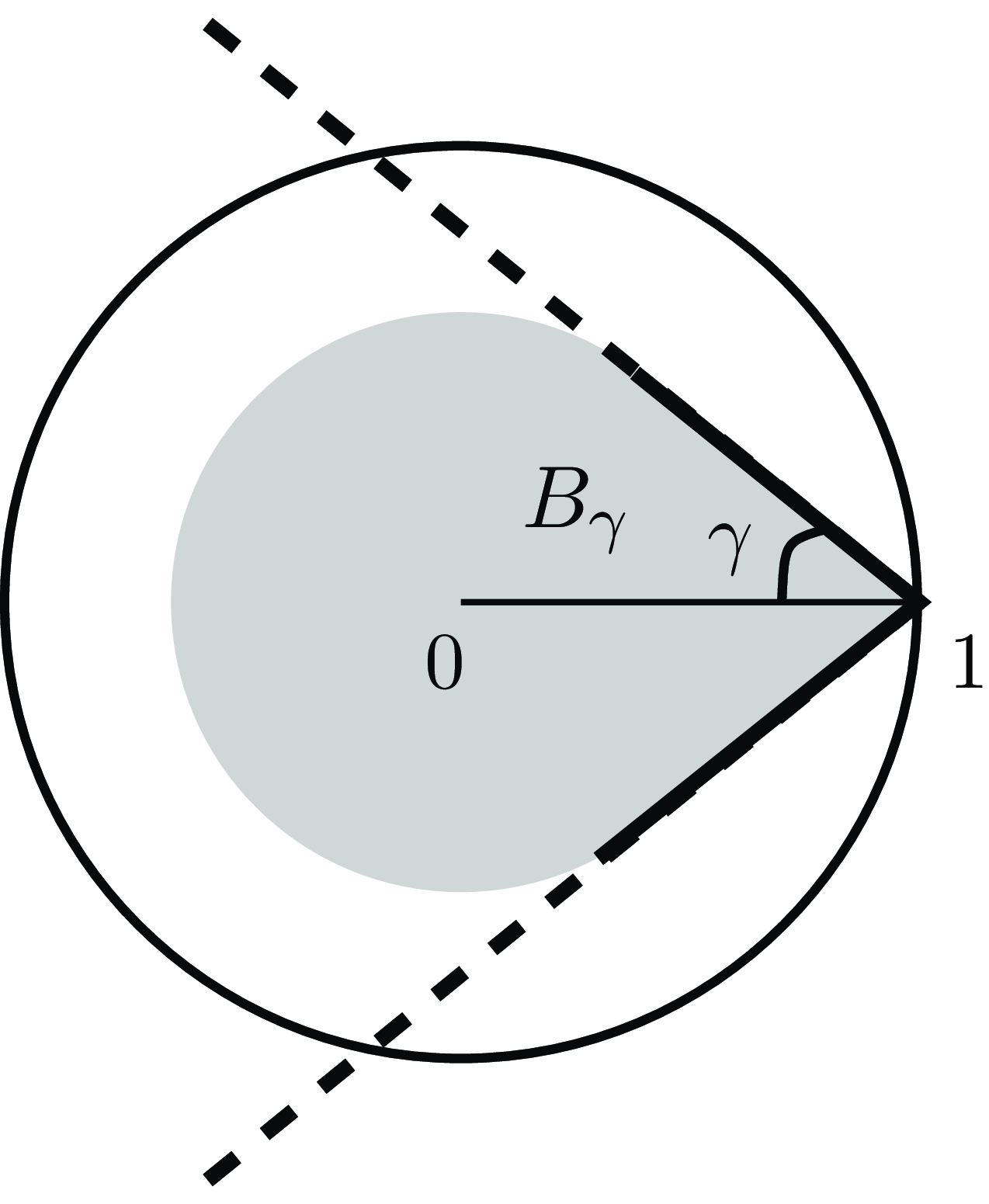
 $1$
and the disc
 $\{\vert z\vert \lt \sin \gamma \}$
, see Figure 1 below. It is well-known that the spectrum of any Ritt operator
 $T$
is included in the closure of one of the
 $B_\gamma$
.
Stolz domain.

Let
 $\mathcal {P}$
be the algebra of complex polynomials and let
 $T\in B(X)$
be a Ritt operator. For any
 $\gamma \in \bigl (0,\frac {\pi }{2}\bigr )$
, we say that
 $T$
admits a bounded
 $H^\infty (B_\gamma )$
-functional calculus if there exists a constant
 $K\geq 1$
such that
 \begin{equation*} \Vert F(T)\Vert \leq K\sup \bigl \{\vert F(z)\vert \, :\, z\in B_\gamma \bigr \},\qquad F\in \mathcal {P}. \end{equation*}
Then, we simply say that
 $T$
admits a bounded
 $H^\infty$
-functional calculus if it admits a bounded
 $H^\infty (B_\gamma )$
-functional calculus for some
 $\gamma \in \bigl (0,\frac {\pi }{2}\bigr )$
. This implies that
 $T$
is polynomially bounded, that is,
 $T$
satisfies an estimate
 $\Vert F(T)\Vert \leq K\sup \bigl \{\vert F(z)\vert \, :\, z\in {\mathbb {D}}\bigr \}$
for all
 $F\in \mathcal {P}$
.
Ritt operators and their
 $H^\infty$
-functional calculus have attracted a lot of attention in the last twenty years. We refer the reader to [Reference Arhancet and Merdy7, Reference Arhancet, Fackler and Merdy8, Reference Blunck10, Reference Dungey15, Reference Gomilko and Tomilov19, Reference Haak24, Reference Haak and Haase25, Reference Merdy35, Reference Vitse46] and the reference therein for more information.
The main result of this section is the following theorem. Note that in this statement, the multiplier
 $u$
is not only a real valued function but a nonnegative one.
Theorem 5.1.
Let
 $G$
be a locally compact group, let
 $u\colon G\to [0,1]$
be a continuous function, and assume that
 $M_u\colon VN(G)\to VN(G)$
is unital and completely positive. Then for all
 $1\lt p\lt \infty$
,
 $M_{u,p}\colon L^p(VN(G),\varphi _G)\to L^p(VN(G),\varphi _G)$
is a Ritt operator which admits a bounded
 $H^\infty$
-functional calculus.
We need sectorial operators and their
 $H^\infty$
functional calculus. We refer to [Reference Hytönen, van Neerven, Veraar and Weis28, Chapter 10] for background and undefined terminology on this topic. As in this reference, we set
 \begin{equation*} \Sigma _\theta =\bigl \{z\in {\mathbb {C}}\setminus \{0\}\, :\, \vert \textrm {Arg}(z)\vert \lt \theta \}, \end{equation*}
for any
 $\theta \in (0,\pi )$
. The following was proved in [Reference Merdy35, Proposition 4.1].
Proposition 5.2.
Let
 $T\in B(X)$
be a Ritt operator. Then
 $I_X-T$
is a sectorial operator. If there exists
 $\theta \in \bigl (0,\frac {\pi }{2}\bigr )$
such that
 $I_X-T$
admits a bounded
 $H^\infty (\Sigma _\theta )$
functional calculus, then
 $T$
admits a bounded
 $H^\infty$
-functional calculus.
The proof of Theorem5.1 will also rely on interpolation. Given any interpolation couple
 $(X_0,X_1)$
of Banach spaces and
 $\alpha \in [0,1]$
, we let
 $[X_0,X_1]_\alpha$
denote the Banach space obtained by the complex interpolation method. We refer to [Reference Bergh and Löfström9, Chapter 4] for background.
Proposition 5.3.
Let
 $(X_0,X_1)$
be an interpolation couple of Banach spaces and consider an operator
 $T\colon X_0+X_1\to X_0+X_1$
such that
 \begin{equation*} T\colon X_0\longrightarrow X_0 \qquad \hbox {and}\qquad T\colon X_1\longrightarrow X_1 \end{equation*}
are bounded. If
 $T\colon X_0\to X_0$
is a Ritt operator and
 $T\colon X_1\to X_1$
is power bounded, then for all
 $\alpha \in [0,1)$
,
 $T\colon [X_0,X_1]_\alpha \to [X_0,X_1]_\alpha$
is a Ritt operator.
Proof.
This result was proved by Blunck in the case when
 $X_0=L^p(\Omega )$
and
 $X_1=L^q(\Omega )$
for a measure space
 $(\Omega, \mu )$
and
 $1\leq p,q\leq \infty$
, see [Reference Blunck10, Theorem 1.1]. His arguments apply as well in this abstract setting.
Proof of Theorem 5.1. We set
 $A=VN(G)$
,
 $\varphi =\varphi _G$
and
 $D=D_G$
for simplcity. We use complex interpolation for the spaces
 $L^p(A,\varphi )$
. Following [Reference Terp45] (see also [Reference Caspers and de la Salle13, Section 6], [Reference Kosaki32] and [Reference Hiai26, Chapter 9]), we regard
 $(A, L^1(A,\varphi ))$
as an interpolation couple of Banach spaces, using the embedding
 $\mathcal {M}_\varphi \to L^1(A,\varphi )$
which takes
 $x$
to
 $D^{\frac 12} x D^{\frac 12}$
for any
 $x\in \mathcal {M}_\varphi$
. Then for any
 $1\leq p\leq \infty$
, the mapping
 $D^{\frac {1}{2p}}\mathcal {M}_\varphi D^{\frac {1}{2p}} \to L^1(A,\varphi )$
which takes
 $D^{\frac {1}{2p}}xD^{\frac {1}{2p}}$
to
 $D^{\frac 12} x D^{\frac 12}$
for any
 $x\in \mathcal {M}_\varphi$
extends to an isometric isomorphism
 \begin{equation} L^p(A,\varphi )\simeq \bigl [A, L^1(A,\varphi )\bigr ]_{\frac {1}{p}}. \end{equation}
Furthermore, if
 $V\colon A\to A$
is a weight-preserving positive map, we can define
 $T\colon A+L^1(A,\varphi )\to A+L^1(A,\varphi )$
by
 $T(x+y)=V(x)+V_1(y)$
for all
 $(x,y)\in A\times L^1(A,\varphi )$
and the interpolation operator on
 $[A, L^1(A,\varphi )]_{\frac {1}{p}}$
induced by
 $T$
coincides with
 $V_p$
though the identification (5.1).
Let
 $u\colon G\to [0,1]$
be a continuous function such that
 $M_u\colon VN(G)\to VN(G)$
is unital and completely positive and let us apply the above properties with
 $V=M_u$
. We fix some
 $p\in [2,\infty )$
, the case when
 $p\in (1,2)$
being similar.
According to Lemma 3.2,
 $M_{u,2}$
is positive in the Hilbertian sense. Hence,
 $\sigma (M_{u,2})\subset [0,1]$
. Then, by the functional calculus of self-adjoint operators,
 $M_{u,2}$
is a Ritt operator. Indeed, for any
 $z\in {\mathbb {C}}\setminus \overline { {\mathbb {D}}}$
, we have an estimate
 \begin{equation*} \bigl \Vert (z-M_{u,2})^{-1}\bigr \Vert \leq \sup \bigl \{\vert z-t\vert ^{-1}\, :\, t\in [0,1]\bigr \}\lesssim \vert z-1\vert ^{-1}. \end{equation*}
By (5.1) and the reiteration theorem for complex interpolation (see [Reference Bergh and Löfström9, Theorem 4.6.1]), we have
 \begin{equation*} L^p(A,\varphi ) \simeq \bigl [A, L^2(A,\varphi )\bigr ]_{\frac {2}{p}}. \end{equation*}
Hence by Proposition 5.3,
 $M_{u,p}$
is a Ritt operator.
The rest of the proof is similar to the one of [Reference Arhancet5, Theorem 7.1]. Let
 $q\in (p,\infty )$
and let
 $\theta _0\in \bigl (\frac {\pi }{2},\pi \bigr )$
. By Theorem4.1 and Proposition 2.7, the operator
 $M_{u,q}$
admits an isometric
 $q$
-dilation. Hence by [Reference Arhancet and Merdy7, Proposition 6.2], the sectorial operator
 $I_{L^q} -M_{u,q}$
admits a bounded
 $H^\infty (\Sigma _{\theta _0})$
functional calculus. (The noncommutative
 $L^q$
-spaces considered in [Reference Arhancet and Merdy7, Section 6] are the tracial ones. However, the results contained therein extend verbatim to the framework of Haagerup noncommutative
 $L^q$
-spaces, using the fact that for
 $1\lt q\lt \infty$
, these spaces satisfy the UMD property, see [Reference Pisier and Xu37, Corollary 7.7].)
Let
 $\theta _1\in \bigl (0,\frac {\pi }{2}\bigr )$
. The operator
 $I_{L^2} - M_{u,2}$
is self-adjoint and
 $\sigma (I_{L^2} - M_{u,2})\subset [0,1]$
. Hence, using again the functional calculus of self-adjoint operators, we see that
 $I_{L^2} -M_{u,2}$
admits a bounded
 $H^\infty (\Sigma _{\theta _0})$
functional calculus. Applying again the reiteration theorem for complex interpolation, we obtain that
 \begin{equation*} L^p(A,\varphi ) \simeq \bigl [L^q(A,\varphi ), L^2(A,\varphi )\bigr ]_{\alpha }, \qquad \hbox {with}\ \frac {1-\alpha }{q} \, +\, \frac {\alpha }{2}\,=\,\frac {1}{p}. \end{equation*}
Now applying the interpolation theorem for the
 $H^\infty$
-functional calculus of sectorial operators [Reference Kalton, Kunstmann and Weis31, Proposition 4.9] (see also [Reference Junge, Le Merdy and Xu30, Proposition 5.8]), we deduce that
 $I_{L^p} -M_{u,p}$
admits a bounded
 $H^\infty (\Sigma _{\theta })$
functional calculus, with
 $\theta = (1-\alpha )\theta _0+\alpha \theta _1.$
We can choose
 $q,\theta _0,\theta _1$
so that
 $\theta \in \bigl (0,\frac {\pi }{2})$
. (We can actually obtain bounded
 $H^\infty (\Sigma _{\theta })$
functional calculus for any
 $\theta \gt \bigl (\frac 12 -\frac {1}{p}\bigr )\pi$
.) By Proposition 5.2, this implies that
 $M_{u,p}$
admits a bounded
 $H^\infty$
-functional calculus.
Acknowledgements
The two authors were supported by the ANR project Noncommutative analysis on groups and quantum groups (No./ANR-19-CE40-0002).
Competing interests
The authors declare that they have no known competing financial interests or personal relationships that could have appeared to influence the work reported in this article.