


As from the second half of the nineteenth century, major changes in retailing and in consumer patterns and practices have usually been associated with the introduction of new formats such as shopping arcades, department stores and retail chains. The renovation of traditional markets formed part of this same process but it has aroused much less interest so far. Nevertheless, we believe that municipal markets form an exceptional vantage point from which to consider retailing in the long term. Though their initial renewal occurred in parallel to the expansion of the new formats, they offer a view that is much less selective and less closely focused on the practices of the middle classes than the more novel forms of retailing. This is because they never ceased to reflect changes in the distribution systems and in consumer patterns in the period under consideration, and because food generally and particularly cheap food was a critical issue in popular consumption patterns. Moreover, markets were public spaces where women and especially those of the working class played a highly significant role and were more prominent than in the new commercial formats.
The renewal of the covered markets in Europe went through different cycles and followed different paths, with widely differing features and outcomes in the various countries, regions and cities.Footnote 1 Already in the early stages, one may observe two clearly distinct models, one or the other of which would be adopted by the European cities: the English pattern of single-market cities, requiring long trips to the city centre, and the Parisian polycentric model of evenly distributed neighbourhood markets, which is governed by criteria of proximity.
Barcelona's network of public covered markets, created between the opening of the first wrought-iron market hall in 1876 and the outbreak of the Spanish Civil War in 1936, is a notable example of a polycentric system. This article shows the important place held by the Barcelona food markets in the city's structural organization. After explaining the decisive role played by the municipal markets in the city's food supply, their key role as neighbourhood socializing centres is presented. Covered markets were also important food retailing hubs for working-class neighbourhoods as the map of the retail food shop locations in 1932 will show. This essential role of the market halls shaped defining structural and long-lasting features of the city. In Barcelona, these features have shown a great resilience and have become an urban asset that remains valuable today, as is highlighted in this article's epilogue.
The Barcelona polycentric market system formation: proximity versus centrality
The formation of two big new markets in Barcelona, respectively on the plots of two convents confiscated in 1836, was aimed to confine and regulate the vendors who invaded and congested very central public spaces.Footnote 2 The traditional Boqueria market, which encroached on the Rambla, was transferred to a monumental porticoed square built on the plot of Sant Josep convent, standing right by the Rambla itself, which had become the foremost place of socialization and consumer activity of the new privileged classes. The new Santa Caterina market, on the other hand, in a central but much more working-class neighbourhood, adopted the model of Paris's Saint-Germain market, by J.B. Blondel (1813–17), but in a more modest version. These markets were built over an extended period.Footnote 3 When they were finished around the middle of the century, they already looked completely anachronistic. England had earlier built numerous markets with a wrought-iron structure and in Paris the immense market of Les Halles was in the process of being constructed.Footnote 4 For two decades, it proved impossible to update Barcelona's market system but, as from the 1870s, a process began that would lead to a second generation of markets. The first two wrought-iron market halls, those of Born and Sant Antoni, were conceived as a response to the outdated style of the Sant Josep (Boqueria) and Santa Caterina markets and as two genuine symbols of the new urban trends. They followed the European models of new wrought-iron and glass architecture, creating clear spaces that were sheltered from the elements and ideal for looking at goods in an orderly way. These markets took shape as surprising urban ‘monuments of transitoriness’.Footnote 5
Born market opened in 1876 and Sant Antoni market in 1882. It was hoped that their drawing power would decongest the more central markets of Santa Caterina and Sant Josep (Boqueria), which were dramatically overloaded, but this did not occur and their size eventually proved excessive. The high cost and scant yield of these first two markets reoriented municipal policy towards the building of smaller ones for the various neighbourhoods. Before the aggregation of municipalities in 1897, five wrought-iron markets had already been built in the city of Barcelona and five more in neighbouring towns. A concise initial account of the situation was drawn up in 1900. Of the total of 16 markets in the whole new aggregated municipality, only a few of the smaller ones were held in the open air. The greatest paradox was that La Boqueria market, an unfinished porticoed square with simple huts for stalls, was by far the city's largest, accounting for 40 per cent of the market system's total revenues. Santa Caterina market, which was also in very poor condition, brought in 12 per cent of the revenues. The big wrought-iron markets of Born and Sant Antoni, on the other hand, despite their large size and cost, hardly reached the figure of 10 per cent.Footnote 6
At the end of the nineteenth century, British cities – and French ones in a lesser degree – showed undeniable signs of a preliminary stagnation. However, in Barcelona – as in many Latin and central Europe big cities – the building cycle of neighbourhood market halls went on until the 1930s, adopting the forms characteristic of the nineteenth century and a notably homogeneous layout destined to endure. Indeed, the 1930s provide an insight into the legacy of the long-drawn-out nineteenth century. The guidebooks for visitors to the city published for the Barcelona Universal Exhibition of 1888 mentioned the new wrought-iron market halls of Born and Sant Antoni among the city's foremost attractions. They were a novelty that set Barcelona on a footing with other major European cities. On the other hand, market halls were conspicuously absent from the guidebooks published for the Barcelona International Exhibition of 1929. The system had grown and been restructured with the designation of Born market as a facility for fruit and vegetable wholesalers, but even so the market halls had lost all their allure of modernity and the new neighbourhood markets, based on nineteenth-century models, were considered irrelevant for visitors. Highlighted in this way was the latent divorce between consumer activity turned leisure – practised in department stores and the most attractive commercial establishments – and the other face of the city, that of the neighbourhood market halls and retailing fabrics. The location of the shopping arcades and department stores doubtless reflected a centrality-based reasoning, while the daily sale of food tended necessarily to be influenced by local proximity factors.
In this respect, not all European cities followed the same principles on the number, conditions and location of market halls. There were marketless cities, cities with a single big market in the centre and cities with an entire polycentric system of markets, which were evenly distributed throughout all their districts. In British towns, once market halls had been opened in central locations, the opening of further covered markets proved a failure. Exeter, which had two district markets in two different parts of the city, had to close them down, after a short time, and the same happened in Manchester and Liverpool. The vast majority of new market halls were located in almost the same place where traditional central markets had stood. Moreover, new urban growth was becoming increasingly dispersed and therefore markets struggled to be profitable. These low-density urban sprawl areas were much more apt for the popular grocery shops or the small shopping parades, a process identical to that which had previously unfolded in many US cities since the mid-nineteenth century. Nor can we forget the importance of street markets, as in the case of London, addressed by Victoria Kelley in this issue. Numerous central European cities, in Germany, Austria, Hungary, the former Czechoslovakia and the Scandinavian area, showed hardly any interest in the neighbourhood market system and the English pattern of single-market cities was replicated there.Footnote 7
As opposed to a model like the English one, in which market halls were only very exceptionally installed in non-central areas and in which, consequently, shopping entailed an increasingly long trip to the centre, the more decentralized Parisian model led to an urban market experience that was much more closely based on local proximity factors. The Parisian polycentric model was subsequently adopted at the end of the nineteenth century by Berlin and Budapest in a programmed way and by Barcelona, Turin, Madrid and cities of eastern Europe in a less systematic manner. The key to the success of the district market halls was that they were built in medium- and high-density areas, which meant that a sufficiently large population pivoted around them to make the market hall itself a building that was not only financially profitable but also extraordinarily lively from the social standpoint. Towards 1914, for example, almost all the large popular and working-class neighbourhoods of Barcelona, both in the centre and in the industrial suburbs, had a wrought-iron market, and some large suburbs even had more than one. It is not by chance that market hall literature of those countries with dense cities, accustomed by then to the service provided by the new neighbourhood markets, would recall that ‘a market hall is required for every 20,000 or 30,000 inhabitants so when a city's population increases beyond a certain limit, the need arises for new markets’. The reasoning behind the market hall as a public amenity cannot be more clearly expressed.Footnote 8
Market halls and food supply
The consolidation of a wide-ranging market hall system is closely related to the impact of markets on the supply and demand of food. In Great Britain, just as occurred earlier in the United States and Canada, numerous studies have been published on the vitality of grocery shops, butchers’ shops and fishmongers in the area outside the market halls. It would appear that the same type of growth process took place in Germany but perhaps somewhat later.Footnote 9 In any case, the scope of this form of distribution connected with the market halls in both countries appears to vary considerably. While in English cities such as Manchester, public market halls held a notable importance until the middle of the century, subsequently undergoing a dramatic decline to the point that, by around 1870 only 3.6 per cent of the meat, 11.9 per cent of the fish and 16.6 per cent of the fruit and vegetables were distributed there, in other areas of Lancashire the figures for 1920 and 1970 show, according to Deborah Hodson, that ‘selling in the market halls was still firmly established’. In other industrial cities such as Sheffield, it appears that in 1888 one half of the population shopped in market halls.Footnote 10 This explains why, in contrast to authors who have defended the thrust and positive balance of grocery stores as opposed to the inefficiency of the market halls, such as Scola in the case of Manchester, there are other authors, such as Schmiechen and Carls, who are inclined to postulate examples of cities whose balance is more favourable to the municipal markets. So, not even in the countries which have been studying the history of retailing for years can a final balance be drawn up owing to the continued lack of conclusive studies.
In any case, as far as we know, the situation in some cities of southern Europe contrasted sharply with the impact of retail food shops observed in Anglo-Saxon countries. In cities like Barcelona, the municipal market halls played a dominant role. If a comparison is made between the points of sale within the market halls in 1921 and the shops outside them, according to the Industrial and Commercial Tax Register of 1932, it may be observed that the market halls comprised about 79 per cent of the city's overall points of sale in the case of meat, 74 per cent in the case of fish, 60 per cent in the case of fruit and vegetables and 58 per cent of the total number of establishments devoted to the sale of foods in general. The favourable balance of the market halls in Barcelona compared to the case of Manchester, two cities similar in size, is eloquent and even more significant if it is considered that the British markets began to lose importance in the opening decades of the twentieth century.Footnote 11 That was also the case in some northern countries, like the Danish cities addressed by Jens Toftgaard in this issue, where only few market halls materialized and the very idea was abandoned at the end of the nineteenth century.
On the other hand, this discussion cannot be reduced in its entirety to a comparison of the market halls’ sales with those of the retailers located outside their walls. Numerous forms of pre-industrial markets, which were more unstable and very difficult to quantify, also held their ground, as was the case of street vending. Even in big US cities like New York, street vending was unshakable and continued to function. Substantial percentages of the food supply, especially among immigrants, were channelled through the street market. In London, it would appear that the open-air retail markets did not always prevent the proliferation of street vendors in their surroundings, and numerous enclaves in the city were foci of peddlers in the decades around the mid-nineteenth century. Schmiechen recalls that in London towards the end of the century, for every three vendors in shops there were two street vendors, the latter totalling about 24,000. Street vending was common in Germany, at least until World War I. Even in cities with well-developed market systems like Berlin, the sales in the old open-air markets on streets and squares did not disappear completely, as shown in the beautiful photographs by Heinrich Zille. As recalled by Allan Siegel, on opening its six new market halls at the turn of the century, Budapest had 44 open-air markets where a total of 4,500 to 8,000 vendors did business.Footnote 12 In big southern European cities like Barcelona and Madrid, street vending, which sometimes surrounded the new market halls, survived throughout the nineteenth century, flaring up again in times of crisis, as in the 1930s.Footnote 13
Gender as a strengthening factor of the neighbourhoods around market halls
The presence of women from the flourishing middle and bourgeois classes in the new leisure-consumer spaces and, in particular, in department stores, has given rise to a notable literature.Footnote 14 Nevertheless, we know practically nothing about their role in the market halls, where there was a predominant presence of women and their visibility was undeniable. Converging at the market halls were women of all social backgrounds, from the servants who were entrusted with shopping to the modest housewives who shopped every day, carefully considering how much each item cost or waiting until the last minute to purchase foods at bargain prices. Montserrat Miller recalls the essential role of Barcelonan women as vendors and owners of market stalls. In the mid-nineteenth century, when there was only one market hall and almost all the vendors worked in the open air, 90 per cent of the stalls were run by women. After the extensive network of market halls was built, on the eve of the Spanish Civil War, despite the unquestionable increase in the presence of men (above all in the stalls that required greater capital, such as meat stalls), about 58.4 per cent of the business permits for stalls in 15 of the municipal market halls were issued to women. As opposed to what happened in other economic activities, municipal laws on market halls allowed women to be the owners of their business and to transfer it under the same rights as men. Women also tended to establish especially close ties with a preponderantly female clientèle, relationships that were in essence an extension of everyday life in the community. On the basis of neighbourhood and family relations, close-knit social networks were established around the market halls. A number of festival elements, created by vendor associations, celebrated the role women played in the social life of the market hall and presented them as the ‘queens of the market’.Footnote 15
Born market records relating to the period when it operated as a retail market hall (1876–1921) show that the majority (about 62 per cent) of the people to whom sales permits were granted were women.Footnote 16 This situation should apply to the rest of the city's market halls if one considers the extraordinary visibility of women, as both shoppers and vendors, in the abundant photographic documentation on this period. Nevertheless, men usually ran businesses that were more highly capitalized. The situation was indeed quite balanced in the stalls for which the highest prices were paid in auctions and for permits (meat stalls and fish stalls, and some grocery stalls and cafés), but in the rest of the businesses – the more modest stalls mainly dealing in fruit and vegetables (about 42 per cent of the total market stalls, where there were twice as many women than men) – women were clearly in the majority. These women gave the neighbourhood its character. About 60 per cent of all the fruit and vegetable vendors lived in the Ribera and Santa Caterina area. Indeed, three times as many women as men with this same occupation lived within local area and travelled to work on foot. On the other hand, male fruit and vegetable vendors usually came to work from greater distances, the average length of the home-to-work trip being 2.7 kilometres, about 50 per cent farther than the average for female vendors and even farther than the average for workers of the similarly located large Barcelona factories, which leads one to think that male vendors used some form of mechanized transport.Footnote 17
When Born market turned into a central wholesale fruit and vegetable market in 1921 and its stalls became much more highly capitalized businesses, a radical change took place in its gender composition. Over three-quarters of the 150 market stalls came to be run by men, with women being left clearly in the minority.Footnote 18 Moreover, if one adds the total absence of women in the field of loading, unloading and transport, the difference with respect to the retail market halls becomes even greater. About 30 per cent of all the male and female vendors at the stalls in Born market during its period as a retail market hall were directly related by kin and women were mainly responsible for bringing these family members together around the market hall (see Figure 1). These relationships not only existed inside the market hall but also with respect to the food establishments on the streets around the market. As suggested by Miller in the case of the Revolució market hall in Barcelona, many of the vendors around the market had a complementary rather than competitive relationship with the market, and acquiring a stall was ‘a way of horizontally extending the family's retail business’.Footnote 19 This made the market hall a veritable centre of financial interrelationships, reproducing on a small scale in its surroundings the blend of activities that had previously characterized the old open-air markets. Indeed, this drawing power of retail commerce sometimes resulted in an infringement of ordinances that restricted the sale of certain products within a set radius.Footnote 20
Kinship relations inside Born market (1876–1921) (IMMB: Stalls registration record, 1876–1921).

Accordingly, the neighbourhood market halls were true socializing centres. Since each neighbourhood of a certain size had a market hall, most of the male and female manual workers in Barcelona in the inter-war period had a very close relationship with the market hall:
We have always been neighbourhood people – said a regular female shopper at the market hall in Sants, a working-class suburb of Barcelona – people of a bustling neighbourhood where everyone says hello to you when you walk down the street, where everyone knows about everybody else, and where people socialize at the market hall and strike up conversations in the grocery shops.Footnote 21
The area around the market halls was also a common place of residence for vendors. Over half the stall-holders of the Santa Caterina market hall in Barcelona lived in the city's Old Town and almost one third of them lived within a one-block radius of the market. More than two-thirds of the male and female vendors of the Llibertat market hall lived in the surrounding Gràcia neighbourhood, and about 25 per cent within a one-block radius of the market. The map showing the distribution of male and female vendors of the Born market in the period 1876–1921 illustrates the dominance of local proximity factors in Barcelona's market halls (see Figure 2).
Homes of Born market male and female vendors in the central area of Barcelona, 1876–1921 (IMMB: Stalls registration record, 1876–1921).

Food retail geography: the market halls as functional poles
Besides their role as socializing centres, early twentieth-century Barcelona market halls also played an important role as retailing cores of neighbourhoods. The concentration of food stalls in many market halls in city centres, and above all in English markets (where they were open for business even on Saturday nights to cater for many working-class families), did not mean that only food items were on offer. Indeed, a great diversity of domestic articles such as cheap ready-made clothing, crockery, cutlery and toys were available.Footnote 22 The market's power to draw shoppers on a daily basis was in no way negligible if one also considers the shops that were located around them. In many cities on the Continent, such as Barcelona, with its particular system of markets distributed throughout the city, this influence could also be noted in the outlying neighbourhoods (see Figure 3). The interior of these market halls was more strictly devoted to fresh foods, but in their immediate surroundings there were numerous shops dealing in fresh and non-fresh products (salted fish, dried fruit and nuts or pasta), cheap taverns and cafés and shops for domestic consumer activity in the broad sense of the term. As will be seen, in Barcelona the markets played an important role in attracting food shops.Footnote 23
Food retailing shops in Barcelona, with the influence areas of the market halls, 1932 (ACA: Industrial and Commercial Tax Register).

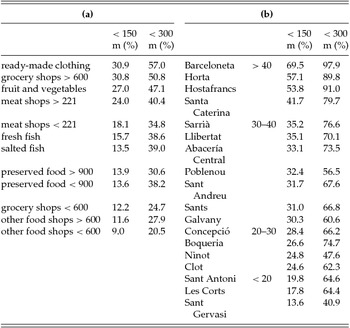
Table 1a and the graphs accompanying it are a result of a laborious data processing of the Barcelona Industrial and Commercial Tax Register of 1932. They show about 5,000 retail food vending businesses in two spheres of 150 and 300 metres, respectively, centred around the 18 market halls (see Figure 3). The number of points of sale encompassed by the two spheres represents about 32 per cent of the city's total food establishments. By adding these figures to the total number of food stalls inside the market halls (the 58 per cent mentioned above), the figure of 71 per cent of the total of nearly 11,900 commercial food supply points in the city is obtained.
Distribution of the food shops in the radii around the Barcelona market halls by type of product and by neighbourhood, 1932 (ACA: Industrial and Commercial Tax Register).

Marked in each column are the percentage proportions in both spheres of the different kind of food shops (and some other domestic articles, such as ready-made clothing) with respect to the total number of shops of the same type in the whole city. As may be seen, the markets had a notable drawing power in the case of some products. Between 24 per cent and 31 per cent of all the establishments selling meat and general food products (grocery shops) which paid a higher tax rate, and those selling fruit and vegetables or ready-made clothing, were concentrated within the radius of 150 metres around the 18 market halls distributed throughout the city. If one analyses the radius of up to 300 metres, it is found that the aforementioned percentage rises to considerably higher levels of between 40 per cent and 57 per cent. Although it is not so evident, the drawing power of the market halls also stands out with respect to a second group of establishments (between 13 per cent and 18 per cent in the closest radius and between 30 per cent and 39 per cent in the radius of 300 metres), including the meat shops paying lower tax rates, the establishments selling fresh or salted fish and those selling preserved foods. On the other hand, in a third group of food shops, the drawing power does not appear to be so strong (9–12 per cent in the closest radius and 20–5 per cent in the more distant one).
Table 1a does not give any evidence of a correlation between retail shop concentration and tax rates hierarchy, which is to say the price of the foods sold. On studying the maps of the distribution of food shops by product, however, a motive based on this aspect may be intuited. In a layer analysis by product absolutely no clouds of dots appear around the market halls of the working-class neighbourhoods when considering the distribution of the most expensive grocery shops and meat and fresh fish shops. However, the polarizing power is quite strong in the case of products for which a low tax rate was paid: the lower-range grocery shops, the establishments selling fruit and vegetables and, although less clearly, the establishments which sold the popular salted fish. Actually, the relation between social class neighbourhood and polarizing power is clear, as is shown in Table 1b. The first group, that of the neighbourhoods with a high food retail concentration around the market hall, encompasses the neighbourhoods of Barceloneta, Horta, Hostafrancs and Santa Caterina-Sant Pere. Between 40 per cent and 70 per cent of all the shops of the surrounding neighbourhood in the radius of 150 metres and between 80 per cent and 100 per cent in the radius of 300 metres were situated around the market hall. All these cases were working-class neighbourhoods in the dense Old Town, one working-class suburb (Hostafrancs) and one socially mixed suburb (Horta). Barceloneta was by far the neighbourhood where the drawing power of the market hall was the strongest. Almost 70 per cent of all the food shops in the neighbourhood were grouped around the market hall and nearly 100 per cent of the 95 shops that have been pinpointed were situated in the radius of 300 metres around the market hall. Its special circumstances as a neighbourhood in a peninsular position, isolated from the rest of the city's historic centre, doubtless accentuated this drawing power (see Figure 4). In a second group, with a 30 to 40 per cent of neighbourhood´s shops concentrated in the 150 metres radius, popular and working-class suburbs were predominant, with the two market halls of Gràcia in the lead followed by the more working-class neighbourhood markets of Poblenou, Sant Andreu and Sants. The last one was the well-to-do suburb of Galvany. In contrast to the foregoing groups, the third one includes a set of neighbourhoods characterized by their higher level of wealth or at least by their much more mixed character from the social standpoint. This group comprised two sub-districts of the city's wealthy Eixample district (Ninot and Concepció markets), the well-to-do suburb of Galvany and the socially highly mixed neighbourhood around the big market hall of Boqueria. Only one properly speaking working-class suburb, Clot, is on this list. Finally, in a fourth group which reflects the weakest market hall drawing power, there was no presence of working-class neighbourhoods at all. Actually, the overall picture is that wealthy areas of the city showed the weakest market hall drawing power. The food retailing fabric of these areas did not appear to be so strongly conditioned by the presence of the market hall as is the case in the more popular and working-class areas.Footnote 24 Along this same line, the absence of this type of commerce in the residential areas of highest status, like the area around Passeig de Gràcia, is especially significant.
Food retailing shops around Barceloneta market hall, 1932 (ACA: Industrial and Commercial Tax Register).

In conclusion, many of the big and dense popular and working-class neighbourhoods were not only served by a municipal market hall but, besides, attracted abundant food commerce around it. The small-scale food retailing fabric appears to be inextricably linked to meeting the demand of the working class, just as was affirmed by John Benson and Gareth Shaw. In the case of early twentieth-century Barcelona, market halls were a relevant polarizing factor of food retail distribution. This was also the picture of early nineteenth-century New York markets, as Gergely Baics has pointed out.Footnote 25
Local food stores: the backbone of neighbourhoods
Besides the concentration around public market halls, food business distribution showed an alternative and more sprawling layout driven by local proximity factors. It should not be forgotten that only one third of the food business recorded in tax records was concentrated within a radius of 300 metres around the market halls: there were entire neighbourhoods that stood outside the market halls’ spheres of influence.
First, a substantial number of food vending establishments were concentrated in some shopping streets.Footnote 26 On the one hand, the old roads leading out of Barcelona became axes for shops, as was the case with the old Madrid road, which acted as a high street connecting the neighbourhoods of Hostafrancs, Sants and Collblanc (see Figure 5); the road leading to France, which became the high street of Sant Andreu, and the Mataró road between the nuclei of Poblenou and El Clot. Other streets of more recent origin have a similar formation, as in the case of Bordeta Road, Taulat Street in Poblenou, or Saragossa Street in Sant Gervasi. The building of tram lines there strengthened their drawing power. In Eixample, the tram exerted the same attraction on streets that were built ex novo, such as Aribau Street or the eastern stretches of València and Majorca Streets. In some cases, these streets crossed market hall areas and the commercial establishments extended all along them in a quite linear arrangement (see Figure 5). In contrast to these dense shopping streets, the city's most central thoroughfares (and their immediate surroundings) had no food shops owing to high rents that only a few establishments could afford. This is the case with the most important Eixample axes as Passeig de Gràcia. The very rich residential areas in the affluent suburbs of Bonanova and Tres Torres tell the same story.
Food retailing shops along the Madrid road, crossing the Hostafrancs and Sants market hall areas, 1932 (ACA: Industrial and Commercial Tax Register).

Secondly, there were some very notable commercial concentrations in dense popular and working-class areas not served by market halls – a very common situation in many European cities but relatively uncommon in Barcelona. This is the case, for example, of the important popular suburbs of Poble Sec and Camp de l'Arpa, the Raval district and the large residential area between Gràcia, El Clot and the Hospital de Sant Pau which, not having any market hall, possessed a very dense network of food shops (see Figure 6). In the Raval de Santa Mónica and the Sagrada Familia areas, respectively, there were two extremely lively street-peddler markets which, after long and unresolved conflicts with the stall-keepers of the market halls and with the municipal authority, finally became open-air markets – the so called Mercadet (little market) of the Raval de Santa Mònica and the Sagrada Familia market.Footnote 27
Food retailing shops in the Old Town and Poble Sec areas, 1932 (ACA: Industrial and Commercial Tax Register).

Lastly, the most recently formed working-class areas of the city, the booming suburbs which arose in the inter-war period, were not only bereft of any type of covered market but moreover had a deficient commercial fabric of food outlets. In these young neighbourhoods – that grew to accommodate the most recent unskilled immigration, which was spatially more segregated and of a more homogeneous working-class character – the maps describing the distribution of food shops provide only a very vague profile. Only the maps of the most modest businesses, those of the grocery shops paying the lowest tax rate, of the most simple meat shops, of the fruit and vegetable shops likewise on the lowest tax-rate level or the salted fish shops, give a slight idea of their contours. Except for neighbourhoods like the Hospital de Sant Pau suburb, where a certain fabric appears to have been generated, the food business was limited to what was strictly necessary.
Epilogue: a long-term urban asset
The most notable feature of Barcelona food retailing provision is the enduring vitality of the municipal market system, which continues to be a fundamental asset. In contrast to what was common in the other European cities, when a progressive erosion of the markets was being observed in the more dynamic countries, an active policy was unfolding in this area in Spain.
Between 1930 and 1980, the number of market halls rose sharply from 18 to 41 in Barcelona, forming a system of evenly distributed facilities open six days a week, which also served the new popular neighbourhoods that had developed in the peripheries. In the so-called Autarchy period, between 1939 and 1959, which was the most depressive and interventionist phase of the Francoist dictatorship, a decided impetus was lent to the building of markets. The gradual liberalization of the economy and the economic development of the 1960s did not halt the expansion of the market system, which grew significantly in both Barcelona and Madrid to serve the districts which had arisen with immigration. In contrast to post-war Europe, which incorporated more advanced commercial formulas in unequal competition with the markets, in Spain the selfsame backwardness of the food retail economy allowed an amazing expansion and consolidation of the public market system especially in the case of Barcelona.
In 1955, the requirements and conditions for the possible installation of private markets were being studied. Indeed, the new regulations approved at the beginning of 1956 simplified the introduction of markets of private construction and operation with reversion to the city council. This whole process laid the foundations for the most active stage in the construction of markets.Footnote 28 Between 1957 and 1977, 18 neighbourhood market halls were built in the areas with the least service. The idea was that all the people of Barcelona should have a market hall at a distance of less than one kilometre from their home.Footnote 29 Moreover, as from 1966, the possibility of constructing neighbourhood market halls providing car parking space was systematically considered. This circumstance affected both the new constructions of the expanded network of retailer markets and the renewal of the previously existing ones.Footnote 30
In the 1980s, market halls recovered their prominent role from a very different standpoint. At that time, the market halls and their areas of influence still attracted the majority of food purchases. The Barcelona Food Facilities Plan (PECAB) adopted the commercial polarities of the market halls as foci to restructure a commercial fabric that had entered a serious crisis (see Figure 7). The plan also sought to limit the effects of the megastores that were beginning to acquire great importance in Spain. A sustained policy of modernization of the market halls and their surroundings has been promoted since then. Their purpose is no longer to contain prices but rather to revitalize the local commercial fabric and, consequently, to bring renewed activity to the neighbourhoods. After a sustained decline since the 1980s, recent information from the Board of Commerce and Consumption of the City Council says that municipal markets retain a share of more than 40 per cent of the total amount of fresh food purchases, and that more than 90 per cent of total food purchases take place in the same neighbourhood of residence.Footnote 31 In this way, in Barcelona the market halls are still today a very active and enduring legacy from the nineteenth century.
Markets catchment areas (25 per cent, 50 per cent and 75 per cent of customers), 1985 (PECAB).