Introduction
Biological nitrogen (N) fixation is the least expensive source of N, and also a sustainable and environmentally friendly alternative to chemical fertilization. All leguminous crops can fix N, including soybean (Glycine max (L.) Merr.). Worldwide, soybean seeds are routinely inoculated with N-fixing soil bacteria. Several bacterial species, the majority of which belong to Bradyrhizobium spp., are used to produce different types of commercial inoculants (Stephens and Rask, Reference Stephens and Rask2000). In regions where soybean rhizobia are not naturally present, inoculation with rhizobia improves yield and protein content (Ulzen et al., Reference Ulzen, Abaidoo, Mensah, Masso and AbdelGadir2016; Zimmer et al., Reference Zimmer, Messmer, Haase, Piepho, Mindermann, Schulz, Habekuß, Ordon, Wilbois and Heß2016).
The European Union (EU) imports over 19 million tons of soybean meal per year, creating a heavy dependency on imported soy (IndexMundi, 2017). To reduce soy imports in the EU, the demand for locally produced soybean is growing. Profitable seed and protein yields of soybean cultivation in Belgium will depend on efficient bacteria–soybean symbiosis. The major constraints for soybean production in north-western Europe are the cool growing conditions and sub-optimal root zone temperatures, which hinder the symbiosis process between Bradyrhizobium spp. and soybean roots (Zhang et al., Reference Zhang, Daoust, Charles, Driscoll, Prithiviraj and Smith2002; Schmidt et al., Reference Schmidt, Messmer and Wilbois2015). The optimum root temperature for this symbiosis ranges between 25 and 30 °C (Miransari et al., Reference Miransari, Riahi, Eftekhar, Minaie and Smith2013). All stages of nodule development may strongly be affected by low root zone temperatures, but the early stages are considered to be most sensitive (Miransari and Smith, Reference Miransari and Smith2007). Temperatures below 10 °C have previously been reported as completely inhibitory for nodulation (Broughton et al., Reference Broughton, Zhang, Perret and Staehelin2003). In Belgium, the soil temperature regimes are categorized as mesic, with mean annual soil temperature ranging between 8 and 15 °C (USDA-NRCS Soil Science Division, 2003). Notwithstanding difficulties experienced with inoculation, several studies of successful soybean–rhizobia symbiosis under cool growing conditions have been reported in Austria, Canada and Germany (Vollmann et al., Reference Vollmann, Fritz, Wagentristl and Ruckenbauer2000; Zhang et al., Reference Zhang, Prithiviraj, Charles, Driscoll and Smith2003; Zimmer et al., Reference Zimmer, Messmer, Haase, Piepho, Mindermann, Schulz, Habekuß, Ordon, Wilbois and Heß2016). Success of soybean cultivation in Belgium will rely on good symbiosis between soybean roots and rhizobia under low root zone temperatures, together with early sowing in spring (Aper et al., Reference Aper, De Clercq and Baert2016). Bacterial growth and biological N fixation under sub-optimal temperatures are reported to be strain-dependent (Zhang et al., Reference Zhang, Prithiviraj, Charles, Driscoll and Smith2003; Duzan et al., Reference Duzan, Mabood, Souleimanov and Smith2006). Companies investing in the technology to prepare inoculants have selected rhizobial strains that are able to form highly effective nodules with the host plant under a wide range of crop conditions (Rodriguez-Navarro et al., Reference Rodriguez-Navarro, Oliver, Contreras and Ruiz-Sainz2011). However, these products must be tested under specific growing conditions, as some products have been known to fail (Zimmer et al., Reference Zimmer, Messmer, Haase, Piepho, Mindermann, Schulz, Habekuß, Ordon, Wilbois and Heß2016).
The rhizobial inoculants currently available in north-west Europe are either liquid or peat-based. The peat-based inoculants generate higher bacterial survival rates on inoculated seeds (bacteria benefit from carrier protection as compared with liquid inoculants), but liquid inoculants provide better seed adhesion (Schulz and Thelen, Reference Schulz and Thelen2008) and are easier to apply to seeds (Albareda et al., Reference Albareda, Rodriguez-Navarro, Camacho and Temprano2008). However, liquid and peat-based carriers provide similar yield effects (Schulz and Thelen, Reference Schulz and Thelen2008).
Besides the formulation of inoculant, the cell density of rhizobia per gram of product is important to guarantee fast colonization of the rhizosphere, which helps ensure nodulation and higher seed yields. Increments in nodule dry weight, seed yield and seed N content have been observed when the number of rhizobia applied to seeds increased from 104 up to 107 cells per seed (Albareda et al., Reference Albareda, Rodriguez-Navarro and Temprano2009).
Upon application of inoculant to the seeds, rhizobial survival might decrease due to unfavourable conditions for the bacteria during storage, such as high temperatures, desiccation or the toxic nature of soluble seed coat exudates (Deaker et al., Reference Deaker, Roughley and Kennedy2004). Seed may either be inoculated by farmers immediately prior to sowing or commercially inoculated and stored prior to seed sale (commonly referred to as pre-inoculated seed) (Deaker et al., Reference Deaker, Roughley and Kennedy2004). However, the effect of pre-inoculation on symbiosis is uncertain (Schmidt et al., Reference Schmidt, Messmer and Wilbois2015).
Most commercial inoculants are developed under US environmental conditions; thus, additional tests are required to determine their efficacy under the cool growing conditions in north-west Europe. Under German conditions, Zimmer et al. (Reference Zimmer, Messmer, Haase, Piepho, Mindermann, Schulz, Habekuß, Ordon, Wilbois and Heß2016) showed the complete failure of commercial inoculant Radicin, but other products (Biodoz, HiStick and Force 48) resulted in effective nodulation.
The objective of the present study was to determine the most suitable inoculation strategy for soybean cultivation under cool Belgian growing conditions in order to maximize soybean grain yield, protein content and protein yield. Four rhizobial inoculants were evaluated in field trials over 2 years at two locations in Belgium: one was also tested at three doses and another at two times of application. In addition, the strain of three inoculants was identified and the effects of sub-optimal temperatures on bacterial growth of these strains were evaluated in vitro.
Materials and methods
Trial description
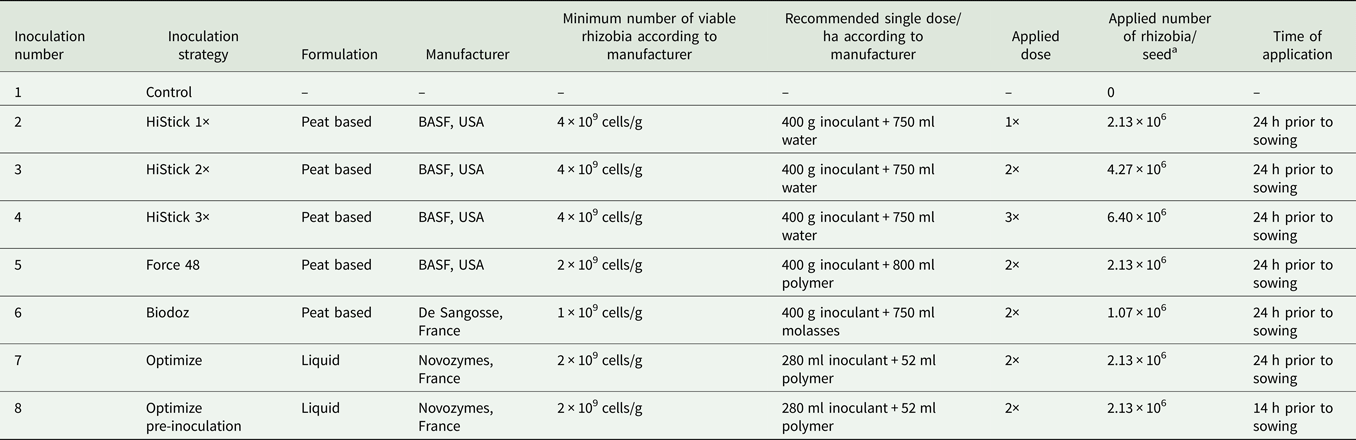
Experiments were conducted during two consecutive years (2014 and 2015) in two agricultural zones in Flanders (the northern region of Belgium): on sandy soil (Geel: 51°10′N, 4°48′E, 22 m a.s.l.) and sandy-loam soil (Merelbeke: 50°59′N, 3°46′E, 29 m a.s.l.). None of the trial fields had been cultivated previously with soybean. Two early-maturing soybean varieties (Primus (maturity group 00), and Adsoy (maturity group 000)) were tested in combination with eight inoculation strategies, including a non-inoculated control (no application of bacteria) and four Bradyrhizobium inoculants (HiStick, Force 48, Biodoz and Optimize). Of these inoculants, HiStick was applied at three different doses (recommended dose by manufacturer, double and triple recommended dose) and Optimize was applied at two inoculation times (1 day before sowing and 2 weeks before sowing) (Table 1). Inoculation was done according to the manufacturer's recommendations. Peat-based inoculants (HiStick, Force 48 and Biodoz) were applied as slurry to the seeds (HiStick was mixed with water; Force 48 was delivered with a polymeric adhesive; Biodoz was suspended in molasses as a sticking agent). Liquid inoculant Optimize was also delivered with a polymeric adhesive. A double dose was applied as this was the first cultivation of soybean, except for HiStick which was applied in three doses (Table 1). After inoculation, all seeds were stored in closed paper bags at 18 °C under dark conditions until sowing.
Overview of inoculation strategies tested in the field experiments

a Calculation of applied number of rhizobia/seed is based on the minimum number of viable rhizobia according to manufacturer, applied dose and a sowing density of 7 50 000 seeds/ha.
A factorial treatment was arranged in a split-plot design with inoculation strategy (I) as main plots and soybean variety (V) as sub-plots. The main plot factor was laid out according to a randomized complete block design with four replicates (each with a surface of 20.9 m2). The dimensions of the plots were 1.25 × 16.7 m with 0.25 m between rows. Soybean was sown at a density of 75 seeds/m2. Detailed descriptions of soil characteristics, fertilizer, plant protection, sowing and harvesting are listed in Table 2. Methods for the chemical characterization of soil are based on standards developed by the International Organization for Standardization (ISO), where ISO numbers refer to the specific standards (available from https://www.iso.org/home.html). Soil was sampled at the end of the winter around 2 months before the sowing of each trial. Prior to chemical analysis, the soil samples were mixed thoroughly and divided into three sub-samples. The first sub-sample was used immediately for pH-potassium chloride (KCl) and soil mineral N (nitrate-N (NO3–-N) + ammonium-N (NH4+-N)) determination. Soil dry matter (DM) content was determined by oven drying at 105 °C. The pH was measured potentiometrically in a 1 : 5 soil : KCl (1 M) extract according to ISO 10390. Soil mineral N was determined in a 1 M KCl extract according to ISO 14256-2 with a Skalar San++ mineral N analyser. The second and third sub-samples were oven-dried at 45 and 70 °C, respectively. The samples were ground in a mortar and passed through a 2 mm and 250 µm sieve, respectively, prior to analysis of chemical properties. Ammonium lactate-extractable elements were assessed on the second sub-sample by extracting plant-available concentrations of Fe, K, Mg, Ca, Mn, Na and P with ammonium lactate (extraction ratio 1 : 20) in dark polyethylene bottles, shaken for 4 h (Egnér et al., Reference Egnér, Riehm and Domingo1960). The suspension was filtered in dark polyethylene bottles that were stored at 4 °C until analysis. Elements were analysed using Inductively Coupled Plasma Optical Emission Spectrometry (ICP-OES, Varian Vista-Pro) with an axial torch. Total organic carbon was measured on the third sub-sample by dry combustion at 1050 °C using a Skalar Primacs SLC TOC analyser (ISO 10694).
Description of the field trials conducted on two soil types: sandy soil (Geel) and sandy-loam soil (Merelbeke) during 2 years (2014 and 2015) including soil fertility, fertilization, sowing date, herbicides, harvesting time and soil parameters

Fe, iron; K, potassium; Mg, magnesium; Ca, calcium; Mn, manganese; Na, sodium; P, phosphorus; Nmin, mineral nitrogen; KCl, potassium chloride; CaO, calcium oxide.
a Extraction in ammonium lactate and acetic acid (Egnér et al., Reference Egnér, Riehm and Domingo1960).
b n.a. Data not available.
Plant measurements
Field measurements
At the beginning of flowering, nodulation parameters were determined. Sampling was performed by manually removing entire plants located outside the harvest area. A spade was used to minimize damage to roots and nodules. From the middle three rows of each plot, ten plants were dug out using a spade and nodules counted. Dry weight of the nodules was determined by drying the nodules at 70 °C for 48 h.
At physiological maturity, soybean plants of each plot with a net surface of 18.8 m2 were harvested. Moisture content was determined by weighing the seeds before and after drying for 74 h at 70 °C. Seed yield was measured in kg/ha and adjusted to 100% DM. The thousand-grain weight (TGW) was determined.
Chemical analysis
Analyses of protein and oil content were done on dry seed material milled over a 1 mm screen using a cutting mill (Peppink Type 200AN). Protein and oil content were estimated using near-infrared reflectance spectroscopy (NIRS). Calibration was based on soybean samples from 2014 and 2015 from different soybean trials in Belgium, including the four trials described in the current study. A total of 616 samples from different soybean trials in Belgium were scanned with a FOSS XDS monochromator instrument with ISIscan v2.85.1 software. The inverse reflectance (log(1/R)) was collected from 400 to 2500 nm in steps of 2 nm. Principal component analysis was used to select a reduced number of samples covering the spectral variation of the sample set (Shenk and Westerhaus, Reference Shenk and Westerhaus1991a). Within the 616 scanned samples, samples from 2 years (110 from 2014 and 100 from 2015) were selected for the chemical reference analyses of crude protein (ISO 5983-2:2009) and oil content (ISO 659:2009). The calibration development was executed with WINSI v4.9.0. software using modified partial least-squares regression (Shenk and Westerhaus, Reference Shenk and Westerhaus1991b). Cross-validation was used to select the optimum number of partial least-squares terms. The standard error of calibration and cross-validation were 2.5 and 3.0 g/kg for crude protein, respectively, and 6.8 and 7.3 g/kg for oil content, respectively. The determination coefficient (R 2) of the simple linear regression between reference values and NIRS predicted values of the calibration set was 0.99 for crude protein and 0.81 for oil content. Finally, all 256 samples of the current study (= 8 treatments × 2 varieties × 4 blocks × 2 locations × 2 years) were predicted for crude protein and oil content on the basis of the developed calibrations.
In vitro experiments
Bacterial strain identification
The active strains in the commercial products HiStick, Force 48 and Biodoz were isolated by plating serial dilutions of the product suspensions on yeast mannitol agar (YMA). Per litre, YMA consists of 10 g mannitol, 0.5 g dipotassium phosphate, 0.5 g sodium glutamate, 0.05 g sodium chloride (NaCl), 10 ml of solution 10 g/l magnesium sulphate heptahydrate, 1 ml of solution 40 g/l calcium chloride, 1 ml of solution 4 g/l ferric chloride, 1 g yeast and 20 g agar, and adjusted to pH 6.8. Optimize was not included in this experiment because it was no longer provided by the manufacturer. The plates were incubated at 28 °C for 3 days and one single-cell colony per product was used for further growth on YMA and for DNA extraction. All colonies per product were morphologically equal, indicating products consist of only one bacterial strain and characterization of one single-cell colony was representative for each product. The type strain Bradyrhizobium japonicum LMG 61-38T was obtained from the Belgian Coordinated Collections of Microorganisms/bacteria from the Laboratory of Microbiology (BCCM/LMG), Ghent University (Belgium) and was included as a reference strain. All isolates were characterized by partial sequence analyses of the 16S rRNA gene and the atpD gene. The gene atpD encodes for the β-subunit of the adenosine triphosphate synthase and is frequently used in phylogenetic studies to identify Bradyrhizobium spp. (Vinuesa et al., Reference Vinuesa, Silva, Werner and Martínez-Romero2005; Rivas et al., Reference Rivas, Martens, De Lajudie and Willems2009; Tang et al., Reference Tang, Bromfield, Rodrigue, Cloutier and Tambong2012). For deoxyribonucleic acid (DNA) extraction, a cetyl trimethylammonium bromide (CTAB)-DNA extraction method modified from Murray and Thompson (Reference Murray and Thompson1980) was used. Briefly, the cell pellet was suspended in 600 µl CTAB-extraction buffer (0.7 m NaCl, 1% CTAB, 50 mm Tris-HCl, 10 mm ethylenediaminetetraacetic acid) amended with 1.6 µl RNase A (100 mg/ml) and 4 µl Proteinase K (2.5 U/mg). The mixture was incubated for 30 min at 65 °C. Subsequently, 600 µl chloroform/isoamylalcohol (24 : 1 v : v) was added and mixed well. After centrifugation (13 000g for 10 min), the aqueous phase was removed and mixed with 280 µl ice-cold isopropanol. After centrifugation (13 000g for 10 min), the supernatant was removed, the pellet washed with 70% ethanol, air-dried and dissolved in 100 µl distilled water by incubating the mixture for 30 min at 65 °C.
To identify the bacterial genus of the isolates, 16S rRNA gene sequence analysis was done as described in Q-bank (Q-bank Bacteria, 2017). In short, approximately 1500 bp of the 16S rRNA gene was amplified using primers pA (AGAGTTTGATCCTGGCTCAG) and pH (AAGGAGGTGATCCAGCCGCA) (Edwards et al., Reference Edwards, Rogall, Blöcker, Emde and Böttger1989) and only a partial fragment of 309–350 bp (Coenye et al., Reference Coenye, Falsen, Vancanneyt, Hoste, Govan, Kersters and Vandamme1999) was sequenced.
For the Bradyrhizobium species-level identification, sequence analysis was done on an atpD gene fragment amplified with primers atpD294F/atpD782R (ATCGGCGAGCCGGTCGACGA)/(GCCGACACTTCMGAACCNGCCTG) and polymerase chain reaction (PCR) conditions according to Tang et al. (Reference Tang, Bromfield, Rodrigue, Cloutier and Tambong2012).
Polymerase chain reaction products were visualized with the QIAxcel system and purified with the SmartPure PCR kit (Eurogentec S.A., Seraing, Belgium). The DNA concentration and quality were assessed in a ND-1000 spectrophotometer. Purified PCR products were sequenced in both directions by Macrogen (Korea). Sequences were assembled with BioNumerics v. 7.0 software (Applied Maths), trimmed and identified using BLAST searching the National Center for Biotechnology Information (NCBI) database.
Growth temperature
In vitro growth in YM broth of the isolated strains from the commercial products HiStick, Force 48 and Biodoz plus the B. japonicum type strain LMG 61-38T was tested at five temperatures (4, 8, 16, 20 and 28 °C). The treatments consisted of factorial combinations of four strains and five temperatures, with four replicates for each treatment. The experiment was done twice. Equal starter cultures (optical density, measured at wavelength of 600 nm, of starter cultures was 0.01) were subjected to the five different growth temperatures and shaken at 150 rpm for 5 days.
Serial dilution and spread-plate methods were done to determine the number of viable cells in the cultures. Two sub-replicates of 0.1 ml per replicate per treatment, for a total of 5 × 4 × 4 × 2 = 160, were plated on YMA and incubated at 28 °C. The number of colonies were counted after 5–6 days of incubation and number of colony-forming units per millilitre (CFU/ml) was calculated using the following formula:
 $$\eqalign{ \displaystyle{{{\rm CFU}} \over {{\rm ml}}} & = \displaystyle{{\mathop \sum \limits {\rm No}{\rm.} \,{\rm of}\,{\rm colonies}\,{\rm per}\,{\rm plate}} \over {{\rm No}{\rm.} \,{\rm of}\,{\rm plates}\,{\rm counted}}}{\rm \;} \cr & \quad \times \displaystyle{1 \over {{\rm ml}\,{\rm of}\,{\rm aliquot}}}{\rm \;} \times {\rm \;} \displaystyle{1 \over {{\rm Decimal}\,{\rm dilution}}}} $$
Statistical analysis
Statistical analysis of field trials was implemented using the lme4 procedure in the statistical software package R (Bates et al., Reference Bates, Mächler, Bolker and Walker2015; R Core Team, 2016). Normality and equal variances were checked with a quantile–quantile–plot and a residuals plot, respectively. Trials were located in two soil types (sandy soil and sandy-loam soil). Due to differences in pedoclimatic conditions, statistical analyses were performed per soil type. The model used for statistical analysis included inoculation strategy (I), soybean variety (V) and year (Y) as fixed factors, and replication (REP) as a random factor. The model was built according to Piepho et al. (Reference Piepho, Bu and Emrich2003):
 $$\eqalign{ {\rm Response} & = I + V + Y + I{\rm \;} \times V + I{\rm \;} \times Y \cr & \quad + V{\rm \;} \times Y + I{\rm \;} \times V \times Y:Y \times {\rm REP} \cr & \quad + I{\rm \;} \times Y \times {\rm REP} + I \times V \times Y \times {\rm REP}} $$
where I × Y × REP is the main-plot error and I × V × Y × REP is the sub-plot error. The effects of I, V, Y, I × V, I × Y and I × V × Y were considered fixed and all terms after the colon were modelled as random. This model was applied for all traits. No nodules were observed in any of the replicates of the non-inoculated control, resulting in zero nodules and zero variance. Hence the nodulation data of the non-inoculated control were excluded from analysis of variance, because with no nodules and no variance, the data do not follow the model's assumptions.
Statistical analysis of in vitro experiments was carried out using non-parametric tests as ratios were not normally distributed. For each temperature, the effect of inoculant on the increased population density of Bradyrhizobium spp. relative to the start population density was studied using the Kruskal–Wallis test at P < 0.05. Multiple comparisons of treatment means were performed by using a Wilcoxon rank-sum test at P < 0.05.
All statistical analyses were performed using R (R Core Team, 2016).
Results
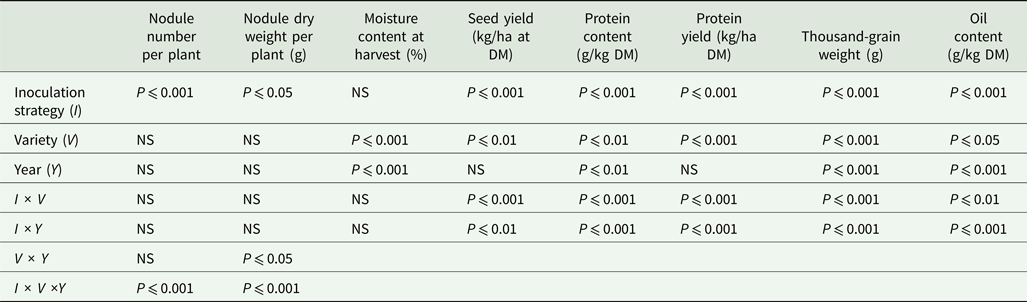
For trials in the sandy soil (Geel), results are presented for 2 years (2014 and 2015) and two varieties (Adsoy and Primus) (Tables 3 and 4). For trials in the sandy-loam soil (Merelbeke), heavy rain caused severe plant lodging and subsequent damage by Sclerotinia on the variety Adsoy in 2014. Therefore, results of moisture content, seed yield, protein content, protein yield, TWG and oil content of Adsoy in 2014 at the sandy-loam site Merelbeke were excluded from the data set (Tables 5 and 6).
Main effects and interactions for nodule number per plant, nodule dry weight per plant (g), moisture content at harvest (%), seed yield (kg/ha dry matter (DM)), dry matter protein content (g/kg DM), protein yield (kg/ha DM), thousand-grain weight (g) and dry matter oil content (g/kg DM) at the sandy soil site in Geel (2014–2015)

NS, not significant.
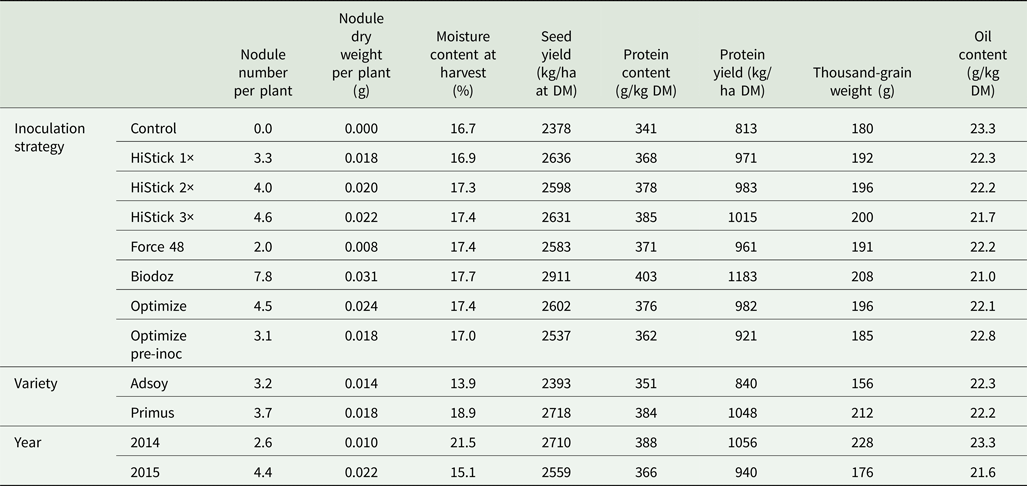
Mean values for nodule number per plant, nodule dry weight per plant (g), moisture content at harvest (%), seed yield (kg/ha dry mater (DM)), dry matter protein content (g/kg DM), protein yield (kg/ha DM), thousand-grain weight (g) and dry matter oil content (g/kg DM) at the sandy soil site in Geel (2014–2015) as influenced by inoculation strategy (I), variety (V) and year (Y)

Main effects and interactions for nodule number per plant, nodule dry weight per plant (g), moisture content at harvest (%), seed yield (kg/ha dry matter (DM)), dry matter protein content (g/kg DM), protein yield (kg/ha DM), thousand-grain weight (g) and dry matter oil content (g/kg DM) at the sandy-loam soil site in Merelbeke (2014–2015)

NS, not significant.
Due to severe plant lodging and subsequent damage by Sclerotinia, results of moisture content, seed yield, protein content, protein yield, thousand-grain weight and oil content of Adsoy in 2014 at the sandy-loam site Merelbeke were excluded from the data set.
Mean values for nodule number per plant, nodule dry weight per plant (g), moisture content at harvest (%), seed yield (kg/ha DM), dry matter protein content (g/kg DM), protein yield (kg/ha DM), thousand-grain weight (g) and dry matter oil content (g/kg DM) at the sandy-loam soil site in Merelbeke (2014–2015) as influenced by inoculation strategy (I), variety (V) and year (Y)

Nodulation
In all trials, inoculation of soybean seeds resulted in the development of nodules, while no nodules were found on the non-inoculated soybean roots. Cross-contamination due to sowing technique can be excluded. In both soil types, the highest nodule numbers were counted on inoculation with Biodoz, while inoculation with Force 48 and pre-inoculation with Optimize resulted in the lowest nodule numbers. At the sandy soil site in Geel, more nodules per plant were counted compared with the sandy-loam soil site, with a maximum of 14.2 (Table 4) and 7.8 (Table 6) nodules per plant upon Biodoz inoculation, respectively.
Nodule dry weight per plant showed similar trends to nodule numbers, with both soil types yielding a maximum weight upon inoculation with Biodoz of 0.075 g of nodules per plant in the sandy soil of Geel (Table 4) and 0.031 g of nodules per plant in the sandy-loam soil of Merelbeke (Table 6). For both soil types, doubling the dose of HiStick resulted in higher nodulation values. A triple dose of HiStick led to a higher mean number of nodules per plant (4.6 nodules per plant) and a higher mean nodule dry weight per plant (0.022 g nodule dry weight per plant) at the sandy-loam site in Merelbeke (Table 6); however, no increases compared with the double dose were seen at the sandy soil site in Geel. In both soil types, pre-inoculation with Optimize 2 weeks before sowing resulted in lower nodulation values compared with inoculation with Optimize 24 h prior to sowing.
Moisture content and seed yield at harvest
Visual observations in the field suggested earlier ripening of non-inoculated soybeans, since plants in these plots showed earlier yellow discoloration of the leaves. However, moisture content at harvest was not significantly influenced by inoculation strategy (Tables 3 and 5). In all trials, seed yields of inoculated soybeans were consistently higher compared with those of non-inoculated soybeans. On average, seed yield on sandy soil increased by 21% across all inoculation strategies. At the sandy-loam soil site, a similar trend was observed and on average across all inoculation products seed yields increased by 11% resulting in a maximum of 2911 kg dry soybean per ha upon Biodoz inoculation (Table 6).
Protein content, protein yield, thousand-grain weight and oil content
At both locations, protein content was influenced by inoculation strategy, variety and year (Tables 3 and 5). Also, significant interaction terms were observed (in Geel P ⩽ 0.01 for I × V and P ⩽ 0.001 for V × Y and I × V × Y; in Merelbeke P ⩽ 0.001 for I × V and I × Y). At the sandy soil site, the highest protein content of 426 g/kg DM was measured after inoculation with Biodoz and the lowest (346 g/kg DM) was measured for the non-inoculated control treatment (Table 4). At the sandy-loam soil site, a similar trend was observed with a maximum protein content of 403 g/kg DM upon inoculation with Biodoz and a minimum protein content of 341 g/kg DM for the non-inoculated control treatment (Table 6). The average increase in protein content for inoculated plants across all treatments was 18% at the sandy soil site and 11% at the sandy-loam soil site. At both soil types, doubling the dose of HiStick resulted in higher protein contents. The triple dose of HiStick only resulted in a higher protein content compared with a single and double dose of HiStick at the sandy-loam soil site in Merelbeke. At both sites, pre-inoculation with Optimize resulted in lower protein contents compared with Optimize inoculation 24 h prior to seeding. At both sites, variety Primus had a higher protein content than variety Adsoy.
At both soil types, maximal protein yields were detected upon inoculation with Biodoz (1051 kg/ha in sandy soil in Geel (Table 4), 1183 kg/ha in sandy-loam soil in Merelbeke (Table 6)).
In all trials, lowest TGW were measured for the non-inoculated control treatment. On average across all inoculation strategies, inoculation of soybeans increased TGW over the non-inoculated control in Geel by 16% and in Merelbeke by 9%.
Considering the inverse relationship between protein and oil content, inoculated soybeans contained lower oil contents compared with non-inoculated soybeans. On average across all inoculation strategies, inoculation of soybeans reduced oil content up to 9% in Geel and up to 5% in Merelbeke compared with non-inoculated soybeans.
Identification of Bradyrhizobium bacteria in commercial inoculants
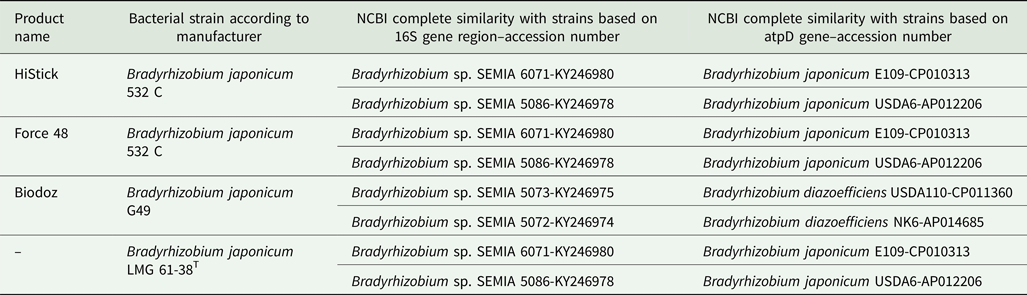
Results of the 16S rRNA gene sequence analysis showed that all strains belonged to the genus Bradyrhizobium, as the amplified 16S region of all strains showed a complete match with this genus. However, the strain of Biodoz has 5 bp differences on 350 bp compared with the three other strains. The atpD gene sequence analysis revealed that the atpD sequence of the strain of Biodoz was only 0.96 equal to the other strains, while the atpD sequences of the other strains were all completely identical. Table 7 presents the bacterial strains according to the manufacturer and the taxonomic nomenclature by performing a BLAST search for bacterial strains of inoculants HiStick, Force 48 and Biodoz and reference strain LMG 61-38T. Remarkably, the atpD sequence of the strain of Biodoz has a total match with B. diazoefficiens, another species than the expected B. japonicum.
Taxonomic nomenclature for the bacterial strains of each inoculant and reference strain LMG 61-38T by performing a BLAST search for the 16S gene region and the atpD gene sequence; the first two BLAST hits with complete query cover and complete identity cover are shown

Effect of temperature on bacterial growth
Growth temperature was correlated with the rate of cell growth for all strains. Bacterial growth was zero at 4 °C for all strains but was activated at 8 °C with a CFU/ml in the range of 107. From 15 to 28 °C, bacterial growth increased steadily to a range of 109 CFU/ml.
The increase of CFU/ml relative to the start CFU/ml was significantly different among strains at 8 and 15 °C. At 8 °C, the increase of CFU/ml relative to the start CFU/ml of the strain of Biodoz was 1.7 times higher compared with the other strains. In contrast, bacterial growth of the strain of Biodoz was lowest at 15 °C, where the increase in CFU/ml relative to the start CFU/ml of Biodoz was 1.7 times lower than the other strains. No significant differences in bacterial growth were detected at 20 and 28 °C. No significant differences were found at any temperature level between the strains of Force 48, HiStick and LMG 61-38T (Fig. 1).
The increased population density of Bradyrhizobium spp. relative to the start population density from the strains of three inoculant products and reference strain LMG 61-38T at five growth temperatures. Values are means (n = 8) ± s.e. Bars with the same letters are not significantly different as determined by Tukey's HSD test at P < 0.05.

Discussion
The absence of N-fixing bacteria in Belgian soils was confirmed by the lack of nodule development on non-inoculated soybean plants. Non-inoculation resulted in lower seed yields and protein contents in the two soil types tested in the current study. Decreases in seed yield up to 533 kg/ha DM and decreases in protein content up to 79.1 g/kg DM clearly show the importance of inoculating soybeans in Belgium to achieve high seed and protein yield.
Inoculation treatments performed in the present study included different formulation types (peat-based v. liquid), different doses and different times of application. Peat is the most frequently used carrier for rhizobia inoculants as it guarantees good bacterial survival during storage of the inoculant (Albareda et al., Reference Albareda, Rodriguez-Navarro, Camacho and Temprano2008). Liquid inoculants are easier to apply and adhere better to the seeds, although some authors have reported inferior results obtained with liquid formulations compared with solid formulations (Zimmer et al., Reference Zimmer, Messmer, Haase, Piepho, Mindermann, Schulz, Habekuß, Ordon, Wilbois and Heß2016). In the current study, three peat-based products (HiStick, Force 48 and Biodoz) and one liquid formulation (Optimize) were compared. All four types of inoculants were effective in initiating symbiosis, which is in agreement with the results of Albareda et al. (Reference Albareda, Rodriguez-Navarro, Camacho and Temprano2008) and Stephens and Rask (Reference Stephens and Rask2000), who reported similar performances for liquid and peat-based products.
When introducing soybeans into new geographical areas, manufacturers often recommend applying double or even triple doses of inoculant. The cost of inoculant and the added value of higher seed and protein yield indicate a need for knowledge about the impact of inoculant dose. In general, a higher inoculation dose improves nodulation and yield (Catroux et al., Reference Catroux, Hartmann and Revellin2001). Albareda et al. (Reference Albareda, Rodriguez-Navarro and Temprano2009) found an increase in nodule dry weight, seed yield and seed N content when the number of rhizobia applied to the seed increased from 104 to 107 rhizobia per seed. According to the manufacturer's specification, HiStick contains 4 × 10⁹ viable cells of Bradyrhizobium per g product. Application of the recommended dose, double recommended or triple recommended dose for new soybean fields corresponds with the application of 2 × 10⁶, 4 × 10⁶ and 6 × 10⁶ rhizobia per seed, respectively. In the current study, the number of bacteria in the inoculants was not enumerated at the start of the experiments. During storage of the inoculants, rhizobial numbers may decline and the rate at which this happens can be substantially different among types of inoculant groups (Herridge et al., Reference Herridge, Hartley and Gemell2014). In the current study, dose effects of only one type of inoculant are reported. The current study showed that applying a single dose of inoculant in soils lacking natural presence of soybean rhizobia was sufficient to establish a good symbiosis and to increase seed yield, protein content, protein yield, TGW or oil content in comparison with the non-inoculated control treatment. A double inoculation dose of HiStick further increased the studied parameters at both locations. Tripling the recommended dose of HiStick did not increase the parameters studied in the current research at the sandy soil site. This is probably due to the high magnitude of 106 rhizobia per seed added and the rather small differences in bacterial concentration among the applied doses. Therefore, it can be concluded that there is no added value to account for the extra costs of a double or triple dose and that inoculation of a single dose of a high-quality inoculant is sufficient to achieve all benefits of rhizobial symbiosis.
To maximize efficacy, an inoculant must be easy to apply as well as compatible with farmer practices (Thilakarathna and Raizada, Reference Thilakarathna and Raizada2017). Pre-inoculation of seeds at the premises of seed companies is the easiest solution for the farmer, but only if the rhizobia are guaranteed to survive on the seeds during storage (Albareda et al., Reference Albareda, Rodriguez-Navarro, Camacho and Temprano2008). In the present study, the product Optimize was evaluated, which according to the manufacturer, is suitable for the application up to 120 days before sowing (Monsanto, 2015). When comparing Optimize pre-inoculation at 14 days before sowing and inoculation 1 day before sowing, no significant differences were found in number of nodules per plant, nodule dry weight, protein yield and TGW. Nevertheless, for all parameters, pre-inoculation with Optimize resulted in lower values, including several at the same level of the non-inoculated control. This indicates that the survival rate of the rhizobia might decrease during storage to a concentration which jeopardizes optimal symbiosis. This observation is in accordance with the observations of Herridge et al. (Reference Herridge, Gemell, Hartley and Herridge2002). Therefore, pre-inoculation with the product Optimize cannot be recommended. Future studies determining the survival rate during storage of rhizobia after pre-inoculation with Optimize are necessary.
Among inoculated treatments, the mean number of nodules per plant varied from 4.2 to 14.2 on sandy soil and from 2.0 to 7.8 on sandy-loam soil, indicating the importance of inoculation strategy. The highest nodule development, yield, protein content, protein yield and TGW were achieved with inoculant Biodoz, which is consistent with the results of field trials in Germany reported by Zimmer et al. (Reference Zimmer, Messmer, Haase, Piepho, Mindermann, Schulz, Habekuß, Ordon, Wilbois and Heß2016). It was suggested that the higher number of nodules observed in the German study could be a result of better adapted strains (Zimmer et al., Reference Zimmer, Messmer, Haase, Piepho, Mindermann, Schulz, Habekuß, Ordon, Wilbois and Heß2016). Identification of bacterial strains used in the current study classified the bacterial strain of Biodoz as Bradyrhizobium diazoefficiens, while the strains of HiStick and Force 48 showed complete similarity to B. japonicum. Bradyrhizobium diazoefficiens is a recently reclassified species and consists of strains clustering within the former Ia group of B. japonicum (Schulz and Thelen, Reference Schulz and Thelen2008; Delamuta et al., Reference Delamuta, Ribeiro, Ormeño-Orrillo, Melo, Martinez-Romero and Hungria2013).
The short growing season in Belgium requires an early sowing date to obtain sufficiently dry soybeans in autumn. The mean temperatures in Belgium in April and May are 9.8 and 13.6 °C, respectively, with mean minimum values of 5.3 and 9.2 °C, respectively (KMI, 2017). Soil temperatures in the spring of 2015 dropped to 8 °C. Several other authors have reported temperature as a key factor that influences rhizobial growth under cool growing conditions (Zhang et al., Reference Zhang, Prithiviraj, Charles, Driscoll and Smith2003; Duzan et al., Reference Duzan, Mabood, Souleimanov and Smith2006; Schmidt et al., Reference Schmidt, Messmer and Wilbois2015). Low temperature after sowing hinders the development of symbiosis (Duzan et al., Reference Duzan, Mabood, Souleimanov and Smith2006). The good performance of Biodoz, observed in the present study, might suggest a better adaptation of Biodoz bacteria to low root zone temperatures. Interest in cold-adapted rhizobial inoculants is increasing due to the expansion of soybean cultivation in colder climates (Schmidt et al., Reference Schmidt, Messmer and Wilbois2015). The in vitro experiments revealed that the strain of Biodoz grew significantly better at 8 °C. The better growing capacity of the Biodoz strain at 8 °C might contribute to the good performance of Biodoz under cool growing conditions in Belgium, as observed in the field trials of the current study. However, discrepancies between performance under in vitro conditions and field conditions have been reported. According to Chueire and Hungria (Reference Chueire and Hungria1997), rhizobial growth in vitro is not related to nodulation or N-fixation ability, because the competitive capacity with other native rhizobia is neglected during in vitro experiments. The current study confirmed the absence of native soybean rhizobia in Belgian soils, which might reduce the importance of competition for a successful nodulation. In contrast, Zhang et al. (Reference Zhang, Prithiviraj, Charles, Driscoll and Smith2003) have reported a good correlation between bacterial growth in vitro and nodulation in field trials.
In summary, inoculation with Bradyrhizobium spp. is a common practice to achieve higher seed and protein yields, but the inoculation strategy plays a crucial role to reach the full potential of symbiosis with soybeans. This inoculation strategy is strongly dependent on the region and is very important for the introduction of soybean cultivation under cool growing conditions. The commercial inoculants HiStick, Force 48, Biodoz and Optimize were effective in establishing a rhizobial symbiosis. Both peat-based and liquid inoculants could establish a successful symbiosis. A single dose of HiStick was sufficient to efficiently fix biological N. Under conditions tested in the current study, a double inoculation dose with HiStick was beneficial at both locations; whereas a triple inoculation dose with HiStick only gave better results in the sandy-loam soil in Merelbeke. Pre-inoculation with Optimize is not recommended, as results for most parameters were intermediate between Optimize inoculation 24 h prior to sowing and the non-inoculated treatment, which suggests a decreasing survival rate of rhizobia during storage. Among the four products tested, Biodoz seemed the best product for inoculation under cool growing conditions due to a higher nodulation, seed yield, protein content and a higher bacterial growth capacity of the Biodoz strain at 8 °C.
Acknowledgements
The authors thank Cinzia Van Malderghem for assistance and Dr Bart Cottyn for advice during in vitro experiments, and Professor Anne Willems of Ghent University for providing the type strains LMG 61-38T. Special thanks to Stefan Dubois and Kim Vekemans for their dedicated work in the field trials and to Miriam Levenson for English-language editing.
Financial support
Funding support for this project (number 120765) was provided by Flanders Innovation & Entrepreneurship (VLAIO).
Conflict of interest
None.
Ethical standards
Not applicable.