Introduction
Declining fertility, along with increased life expectancy and decreasing mortality, are changing the age structure of populations in many societies, and this has resulted in an increase in the proportion of elderly in these populations. The process has mostly occurred in the developed countries of the world, but also in some developing countries. Globally, the size of the elderly population and the speed of population ageing vary across regions. Europe has the highest proportion of people aged 65 and older (16%), but the older population is growing fastest in several countries in East and South-east Asia (PRB, 2006). The developing countries of the world have seen a steady growth in the proportion of elderly population. About 60% of the elderly live in the developing world, and this will rise to 70% by 2010 (BOLD, 2001). More than half of the growth of elderly population in developing countries will be in Asia (Rajan et al., Reference Rajan, Mishra and Sarma1999). The Indian population is undergoing a process of advanced demographic transition, and in this context the ageing problem will become very severe. According to the 2001 census, the proportion of elderly population (age 60+ years) in India was 7.5%. More than the proportion of aged, the absolute number of aged persons in India is of concern.
The different states in India are at different stages of population ageing. The southern-most state, Kerala, has already achieved below replacement level fertility and its mortality rate is the lowest in the country. Kerala has the largest proportion of aged persons among its population compared with any other states in India (Registrar General of India, 2001). The old age dependency ratio is also the highest in Kerala (Registrar General of India, 2001). The state is the most advanced in terms of demographic and epidemiological transition (Kutty, Reference Kutty2000). The most significant status of demographic transition is seen in the case of population ageing observed in the state, and that of epidemiological transition is seen in the state's morbidity status, especially the health status of the aged as transition from communicable disease to non-communicable diseases. Around 10% of Kerala's population is in the 60+ age category (Registrar General of India, 2001). The prevalence of chronic diseases such as cardiovascular diseases, cancer, diabetes and chronic lung diseases is also reported to be highest in this state.
The prevailing health situation in Kerala is comparable to that in developed countries. The state's health status history is indicative of the high morbidity level experienced when mortality rates are low and life expectancy high (Riley, Reference Riley1990). Earlier research has shown this to be due to the contribution of health care programmes and the state's policies in the field of land relations, education and public distribution of food grains, which have contributed directly or indirectly to the improvement in health status and also accounted for the high morbidity rates to poverty level (Panicker & Soman, Reference Panikar and Soman1984). However, the state has the best access to health care and the highest proportion of private as well as public utilization of health facilities (NSSO, 2006).
A higher level of burden related to the demographic and epidemiological transition, along with a double burden of disease, are shared by the elderly in the state. The health status of the aged is central to the study of the elderly population (Rajan, Reference Rajan2006), since the majority of the elderly suffer from disease (Nandal et al., Reference Nandal, Khatri, Kadian, Sharma and Dak1987). Much of the debate has been resolved with comparative analysis wherein it has been observed that morbidity does become high with increase in life expectancy. But given this high life expectancy, morbidity is also unduly concentrated among the elderly. The present study attempts to identify the nature of this burden in a state that has the most advanced demographic indicators in India. It examines the demographic and socioeconomic correlates of the health status of the elderly population in Kerala in order to understand which kinds of elderly are more likely to experience an adverse health situation. Health status is assessed mainly by perceived health status, physical mobility and the morbidity profile of the elderly. The combined effect of these three components is taken as a measure of the overall health status of elderly persons. Such an analysis of health status in Kerala will be indicative of the nature of the health burden the country will experience as this transitional process progresses into other states.
Methods
The study is based on data collected by the National Sample Survey Organization (NSSO) during its 60th round survey on ‘Morbidity, Health Care and the Conditions of the Aged’ conducted between January and June 2004 (NSSO, 2006). The sample design adopted for the survey was a two-stage stratified design. The data were collected from a sample of households by the interview method. As far as possible, efforts were made to collect information relating to ailments of each household member from the member themselves. However, in spite of the best efforts, some other person of the household might have provided this information for the aged. The fieldwork for the survey was handled by the Field Operations Division of NSSO.
The state representative sample consisted of 1766 (males, 44·3%, rural, 75·5%) elderly persons aged 60 years and above. Ailments reported during the survey were classified as acute (short duration ailments, less than 30 days) or chronic (long duration ailments, 30 days or more) based on the standard classification of illness followed in NSSO surveys. In addition to this, the current disease pattern of the elderly was taken to represent the disease-specific morbidity level of the sample population. Health status was measured by perceived health status, physical mobility and disease condition. The criterion applied for inclusion of perceived health is that it reflects the physical as well as mental health of a person. The criterion followed by NSSO is that a person is considered as being in good health if he feels so. It was assessed by asking the question ‘What is your own perception about current state of health?’ The options given were ‘excellent/very good’, ‘good/fair’ and ‘poor’. Here the first two options were combined as ‘good’ and the others as ‘poor’. Physical mobility for aged persons is the ability to move, which is an important indicator of their physical condition of health and also indicated the degree of their dependence on others for movement and performing their daily routine. It was assessed by giving options as: physically immobile; confined to bed; or confined to home and physically mobile. The disease condition was assessed by asking whether they were suffering from any ailment at the date of enquiry. The overall health status was measured by combining the above three components. Thus the health status of a person was considered as ‘poor’ if he perceived his own health as poor, was immobile and had experienced any illness, otherwise heath status was considered as ‘good’.
Data were analysed using SPSS version 11·5 (SPSS Inc., Chicago, Illinois 60606). The differences in health status components by socio-demographic variables were examined through bivariate analysis using the chi-squared test of significance. Logistic regression analysis was performed to study the independent effect of each of the socio-demographic variables on the overall health status of the elderly population. For all the statistical tests, p values of <0·05 were considered for statistical significance.
Results
More than half of the elderly sample in the study were in the age group 60–69 years, and a higher proportion of the sample were females (55%). Around 57% of the elderly persons were living with their spouse and 32% were illiterate. Twenty-three per cent of the sample population were working at the time of the survey. Rural predominance in the sample population was also observed (65%). The major religious group was Hindus (64%), followed by Christians (18·6%) and Muslims (17·9%). Compared with women, a higher proportion of men were living with their partner, more educated and highly employed and economically independent.
Poor perceived health status was reported by 37% of the elderly. A significant gender difference was observed with a higher percentage of women reporting poor health status than men (36% men, 39% women). The physical mobility of a person represents their physical condition of health and the extent of their dependence on others. About 12·8% of the elderly were either confined to their home or bed at the time of the survey. Together with the changes in biological and behavioural factors, illness is a part of the process of ageing. In Kerala more than half of the respondents (58%) were experiencing any illness at the time of the survey.
Poor perceived health status (having any disease) was reported by 49·3% of the elderly, against 18·7% of those having no disease at the time of the survey (p<0·001). Among the physically immobile elderly 80·1% perceived their health status as ‘poor’, whereas the corresponding percentage for physically mobile elderly was 30·4% (p<0·001). Overall health status is significantly different among males and females: women showed significantly lower poor overall health status than men.
Health status and socio-demographic characteristics
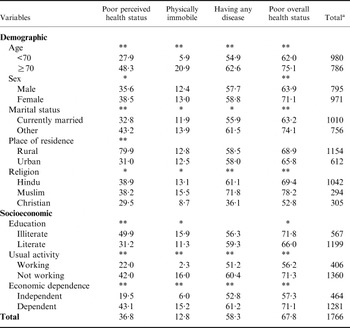
Table 1 presents the bivariate results of health status by perceived health status, physical mobility and morbidity level and poor overall health with demographic and socioeconomic variables such as age, sex, marital status, living arrangement, education, usual activity, place of residence, religion and economic independence.
Socio-demographic determinants of perceived status of health, physical mobility, morbidity level and combined health status of the elderly population in Kerala, 2004

Note: the figures represent percentages.
a These do not add up to the total (N=1766) since information related to some of the variables is missing.
** p≤0·001;
* p<0·05.
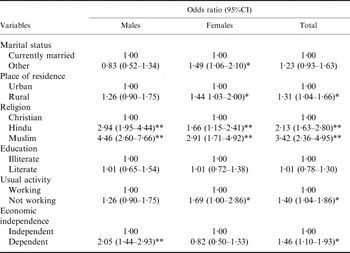
Multivariate analysis using logistic regression for the dependent variable as overall health status was performed (1 for overall health status as ‘poor’ and 0 for ‘good’ overall health status). The results of age-adjusted multivariate logistic regression analysis performed separately for male and female elderly are presented in Table 2. Among male elderly, religion and economic independence showed a significant relationship and among female elderly marital status, place of residence, religion and working status showed a significant relationship with health status. The odds ratios of the results are shown in Table 2. Poor overall health status was reported more by economically dependent (OR 1·46; CI 1·10–1·93), unemployed (OR 1·40; CI 1·04–1·86) and rural (OR 1·31; CI 1·04–1·66) elderly compared with their counterparts. Hindus are two times and Muslims are three times more likely to be in poor health status compared with Christians.
Age-adjusted logistic regression results for ‘poor overall health status’ with background characteristics
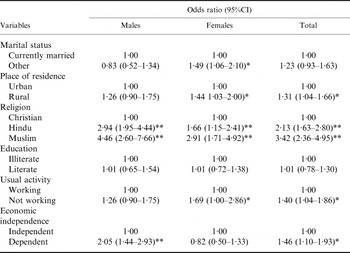
CI, confidence interval.
** p≤0·001;
* p<0·05.
Morbidity profile
Regarding level of morbidity, about 16% of elderly persons were suffering from at least one acute disease (males, 15·9%; females, 17·2%) and 47·3% were suffering from at least one chronic disease (males, 47·6%; females, 47·0%) at the time of the survey.
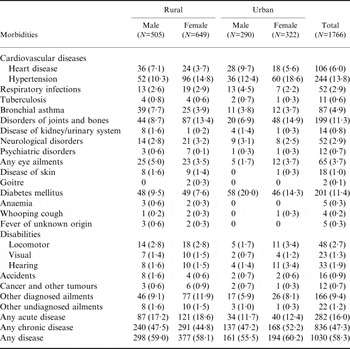
The self-reported disease-specific morbidity profile of the elderly people according to sex and locality is shown in Table 3. The disease-specific prevalence of morbidity among the elderly indicates the most prevalent disease as hypertension, both among males and females, followed by disorders of the joints and bones, diabetes mellitus and asthma.
Morbidity profile (self-reported) of elderly people in Kerala according to sex and place of residence
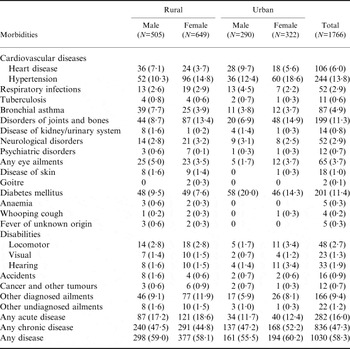
In rural areas the most prevalent disease among men and women was hypertension, whereas in urban areas among men diabetes mellitus was the most prevalent disease and among women hypertension was the most prevalent one. Heart disease was found to be more prevalent among males than females in both rural and urban areas. Among the other major prevalent diseases, bronchial asthma was more prevalent among males than females in rural areas and slightly higher among males in urban area. Irrespective of the locality difference, disease of joints and bones was more prevalent among women compared with men.
Eye ailments were found to be higher among rural males and urban females compared with their counterparts. Sex-wise variation in disability was less in rural area but higher disability was observed among women compared with men in urban area.
Anaemia and whooping cough were highly reported in rural areas, and neurological disorders were highly prevalent among females in rural areas and males in urban areas compared with their counterparts.
Discussion
Based on the state representative data set collected in 2004 by the National Sample Survey Organization (NSSO), India, during its 60th round survey on ‘Morbidity Health Care and Conditions of the Aged’, the present study provides demographic and socioeconomic variations in the health status of the elderly population in Kerala, the state with the highest life expectancy and with the best demographic indicators among the Indian states.
The demographic and epidemiological transformation that occurred in Kerala has resulted in a high proportion of aged and the paradoxical health situation of the state. The inequities in terms of social and economic structure of Kerala State were more abundant in the past and are reflected in the socio-demographic characteristics of the elderly at present.
In the present study, a higher proportion of the sample were females, in the age group 60–69 years, literate, unemployed, currently married, Hindus and living in rural areas compared with their counterparts. The proportion married decreased with older age, and thus conversely, the proportion of widowed increased both among men and women elderly. Gender difference in marital status was also observed. This may be a reflection of several underlying factors such as women living longer than men, women tending to marry men older than themselves and the higher chance of remarriage among men. Risky behavioural characteristics such as tobacco use and alcohol consumption (IIPS & Macro, 2007) and the accident rate (National Crime Records Bureau, 2006) are also higher for men compared with women. There is less variation in literacy level of male and female elderly. As seen in the general population (Registrar General of India, 2001), unemployment is significantly greater among elderly women than elderly men (60·5%, men; 90·5%, women).
Several earlier studies (Fillenbaum, Reference Fillenbaum1979; Ferraro, Reference Ferraro1980) have shown that self-reported health among elderly adults is a valid measure of the respondent's objective health status, an important predictor of survival in old age (McCallum et al., Reference McCallum, Shadbolt and Wang1994) and a strong independent predictor of healthy longevity, even after the major factors for mortality and disability are statistically controlled (Liang, Reference Liang1986; Marton, Reference Marton1988; Indler & Kasl, Reference Indler and Kasl1991; Jagger et al., Reference Jagger, Spiers and Clarke1993; Lee, Reference Lee2000). Here we make use of self-reported health status indicators. Poor perceived health status was more reported by diseased, physically immobile elderly compared with their counterparts. Illiterate, unemployed persons living without a spouse, living in rural area, and mostly Hindus and Muslims were more likely to report poor perceived health status compared with their counterparts. The immobility status was found to increase with increase in age, being slightly higher for females, rural persons, illiterates, unemployed, persons living without a spouse and Muslims.
The prevalence of morbidity in the study is lower than that reported from India (Shah & Prabhakar, Reference Shah and Prabhakar1997; Joshi et al., Reference Joshi, Kumar and Avasthi2003) and for other countries (Fuchs et al., Reference Fuchs, Blumstein, Novikov, Walter-Ginzburg, Lyanders, Gindin, Habot and Modan1998; Valderrama et al., Reference Valderrama-Gama, Damain, Ruigomez and Martin-Moreno2002, Woo et al., Reference Woo, Han, Jo, Park, Kim, Kim, Park, Lee and Jo2007). The diseased condition, as having any illness, is significantly higher among older persons, those living without spouse, the unemployed and the Muslim elderly compared with their counterparts.
The age-adjusted multivariate logistic regression analysis results show that for men, the odds of reporting their overall health status as ‘poor’ was higher for Muslims and Hindus and economically dependent people compared with their counterparts. And in the case of women, the unemployed, those living without a spouse and rural residents were more likely to report poor health status compared with their counterparts. The religious difference showed a favourable health status for Christian elderly. Along with these physical ailments, metal illness is also prevalent among the elderly (Gupta & Vohra, Reference Gupta, Vohra, Sharma and Dak1987). The results call for urgent health care strategies specific to elderly persons in different socio-demographic sections. Moreover, change is needed in the present elderly policy situation of the country, which is currently based on age, regardless of their health conditions.
The age-wise distribution of overall health status is in the expected direction, with older people (aged 70 and above) appearing to be in poor health compared with their counterparts in the age group 60–69 years. The high level of illiteracy among the elderly will change in the future and this will change their socioeconomic situation. Marital status seems to be an important factor in the health status of the elderly. However, the health effects of this status are often difficult to quantify, but can include lack of resources for health services, depression, lack of mobility and poverty (Bonita, Reference Bonita1998). In corroboration with the results of Jun (Reference Jun2002), our study also showed that the likelihood of being in poor health is higher for those who live without a spouse both among male and female elderly.
The association between poor health status and socio-demographic variables can explain the group-wise variation in overall health of the elderly and the study results stress the need to develop new plans by considering these variations. Even though Kannan et al. in Reference Kannan, Thankappan, Kutty and Aravindan1991 reported that the high rate of morbidity in Kerala is a manifestation of its continued backwardness and the poverty of the masses, the health status of the elderly is of concern in the emerging steep increase in non-communicable disease prevalence. The disease pattern in Kerala is different from that of India as a whole (NSSO, 2006). The disease-specific morbidity in the present study indicates higher prevalence of some non-communicable diseases such as hypertension, joint diseases, diabetes and asthma. Earlier study results identified that problems such as chronic obstructive pulmonary disease, osteoarthritis, cataracts, neurological disorders and dental problems were important determinants of health status in elderly Indians (Joshi et al., Reference Joshi, Kumar and Avasthi2003). The assessment of health status and its determinates among elderly people will help policymakers formulate interventions for the elderly and identify the areas to concentrate on in order to improve their quality of life.
Kerala has already achieved replacement level of fertility and has the lowest rate of growth of the population among the states in India. With this situation, the high proportion of aged population in the state has become a significant problem. Apart from the fact of population ageing in Kerala, the older population of the state itself is ageing. With the widening gender gap in mortality and the higher proportion of elderly population in the state, health care providers and policymakers should emphasize the gender-perspective elderly policies in the state. Old-age packages should not be the same for all elderly since their health status varies with different socio-demographic conditions, as distinguished by chronic ailment, immobility and so on. The Government of Kerala announced a policy for health care of the elderly in 1997. Socioeconomic variations were given importance in the policy. However, efforts should be made towards more quality-oriented policies for the elderly in the state. Also, more specific studies to measure the health of the elderly are warranted in Kerala State. The study results are significant as results obtained from Kerala are indicative of future trends in the rest of India. The study also has significance in the light of the current cultural transition observed in the state, where filial piety is loosening and a high level of out-migration is resulting in many of the elderly living alone without their children.
Acknowledgments
The author is thankful to Dr Mala Ramanadhan, Additional Professor, Sree Chitra Tirunal Institute for Medical Sciences, Trivandrum for her comments on the draft paper. Thanks also go to the National Sample Survey Organization, Ministry of Statistics and Programme Implementation, Government of India, for providing the data set for this research.