


Introduction
The clinical letter sent to the primary care provider after a specialist appointment is often the sole means of communication for the care provided. It provides information to the referring practitioner on specific clinical findings, diagnoses and proposed management.Reference Francois1, Reference Newton, Hutchinson, Hayes, McColl, Mackee and Holland2 Good communication and timely exchange of information between referring providers and specialists is essential to providing safe and high-quality patient care. It also improves patient outcomes and physician satisfaction.Reference O’Malley and Reschovsky3 Ensuring that these letters meet the needs of the letter recipients is important as it reduces unnecessary repetition of diagnostic investigations and ensures efficiency of care.Reference Tattersall, Butow, Brown and Thompson4 Poor communication can conversely have negative effects on patient care such as delaying diagnoses, increasing healthcare costs and increasing polypharmacy.Reference Francois1 Often, there is little feedback from referring practitioners to specialists about their letter content. Previous studies have indicated preferences from referring physicians including use of a structured letter containing a problem list and list of management proposals.Reference Tattersall, Butow, Brown and Thompson4
In otolaryngology, previous research on clinical correspondence has evaluated readability scores as a measure of ease of extraction of information.Reference Peridis, Roberts and Hopkins5 The authors note the preference of structured letters due to benefits such as concise statement of diagnosis and management, ease of extracting key information, decreased length and ease of transferring to computer-based records. We sought to expand on this research, specifically elucidating what level of detail is preferred by referring providers based on their previous experience and in comparing sample letters as well as if there are differences depending on professional background and frequency of referral. This study seeks to examine the perspective of referring healthcare providers regarding content and degree of detail preferred in clinic letters from otolaryngologists.
Materials and methods
This study was approved by a Research Ethics Board (H2024:059/ HS26332). A survey (Appendix 1) was distributed to family physicians, nurse practitioners and physician assistants throughout the province of Manitoba via Qualtrics, a free online survey distribution platform. All three of these professional groups have the ability to refer patients to see specialists in Canada, depending on the clinical context in which they work. The survey was disseminated via email through the professional bodies of each respective group: the Manitoba College of Family Physicians, Physician and Clinical Assistants of Manitoba and the College of Registered Nurses of Manitoba. The survey remained open for responses from March to June 2024.
Participants were provided with two sample letters: one that provides a concise summary of the findings (Appendix 2), followed by one containing detailed clinical findings from the otolaryngologist’s exam and assessment (Appendix 3).
A series of questions was designed to assess referring practitioners’ preferences between the two letters. These included Likert scale and open-ended questions aimed at understanding participants’ past experiences with clinical correspondence. Participants were asked to evaluate both letters in terms of accessibility of information, satisfaction with the level of detail in individual sections and overall quality of each letter. Finally, participants were asked to indicate which letter they preferred and to explain the rationale for their choice.
Quantitative data were analysed using Wilcoxon matched-pairs signed-rank tests and chi-squared tests. Chi-squared tests were used to analyse historical satisfaction with amount of information received in clinical letters, compared across professions as well as comparing preference of concise vs. detailed sample letter compared against frequency of referral.
As each participant evaluated both letter formats, responses were treated as paired data. Comparisons between concise and detailed letters were performed using the Wilcoxon matched-pairs signed-rank test. Qualitative responses were coded and thematically analysed to identify recurring themes and patterns.
Results and analysis
Survey results were collected between 1 March and 3 May 2024. The survey received 39 complete responses: 13 per cent from physician assistants (n = 5), 49 per cent from nurse practitioners (n = 19) and 38 per cent from physicians (n = 15) (Fig. 1). There were 57 incomplete responses received (68.4 per cent completion rate). Participants who did not complete the survey did complete the first section regarding demographics and previous experience with clinical letters. Demographics of incomplete responses were similar: 14 per cent from physician assistants(n = 8), 46 per cent from nurse practitioners (n = 26) and 40 per cent from physicians (n = 23). Regarding frequencies of referrals, just over half of the participants indicated that they “sometimes” referred to otolaryngology–head and neck surgery (OHNS) (52.6 per cent). Within the province of Manitoba, there are approximately 1600 registered family physicians, 300 nurse practitioners and 155 physician assistants.6 However, this represents total numbers, not exclusively those who work within a capacity where they refer to specialist care.
Demographics of participants who partially completed (n = 57) and fully completed the survey (n = 39). The majority are physicians or nurse practitioners.

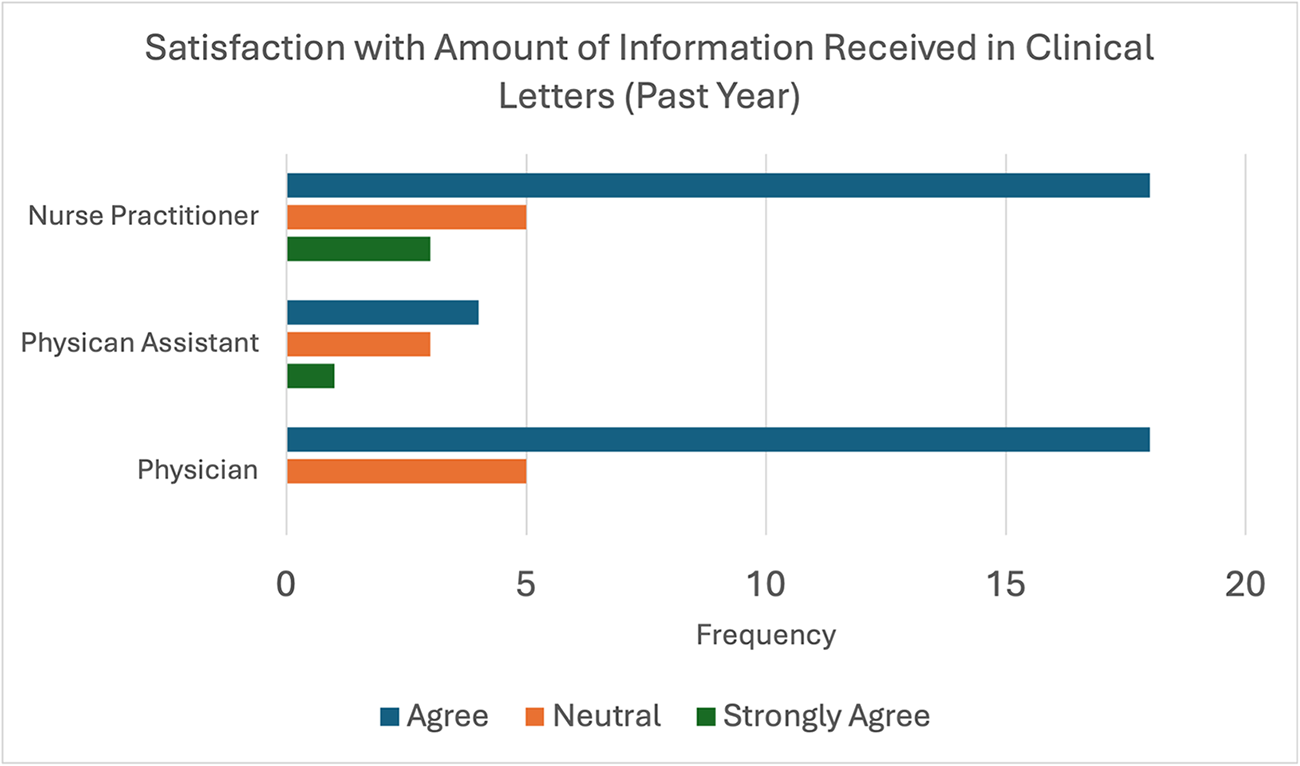
When participants were asked to reflect on clinical correspondence that they received in the past year, 40/57 (70.2 per cent) respondents to that question indicated agreement with the amount of information received (defined as responses of “agree” or “strongly agree” on a five-point Likert scale). Between professional groups, there was no significant difference between satisfaction for p less than 0.05 (Fig. 2).
Satisfaction with letters received in the past year among the referring practitioners. Majority of participants were satisfied with the amount of detail received. There is no significant difference between groups.

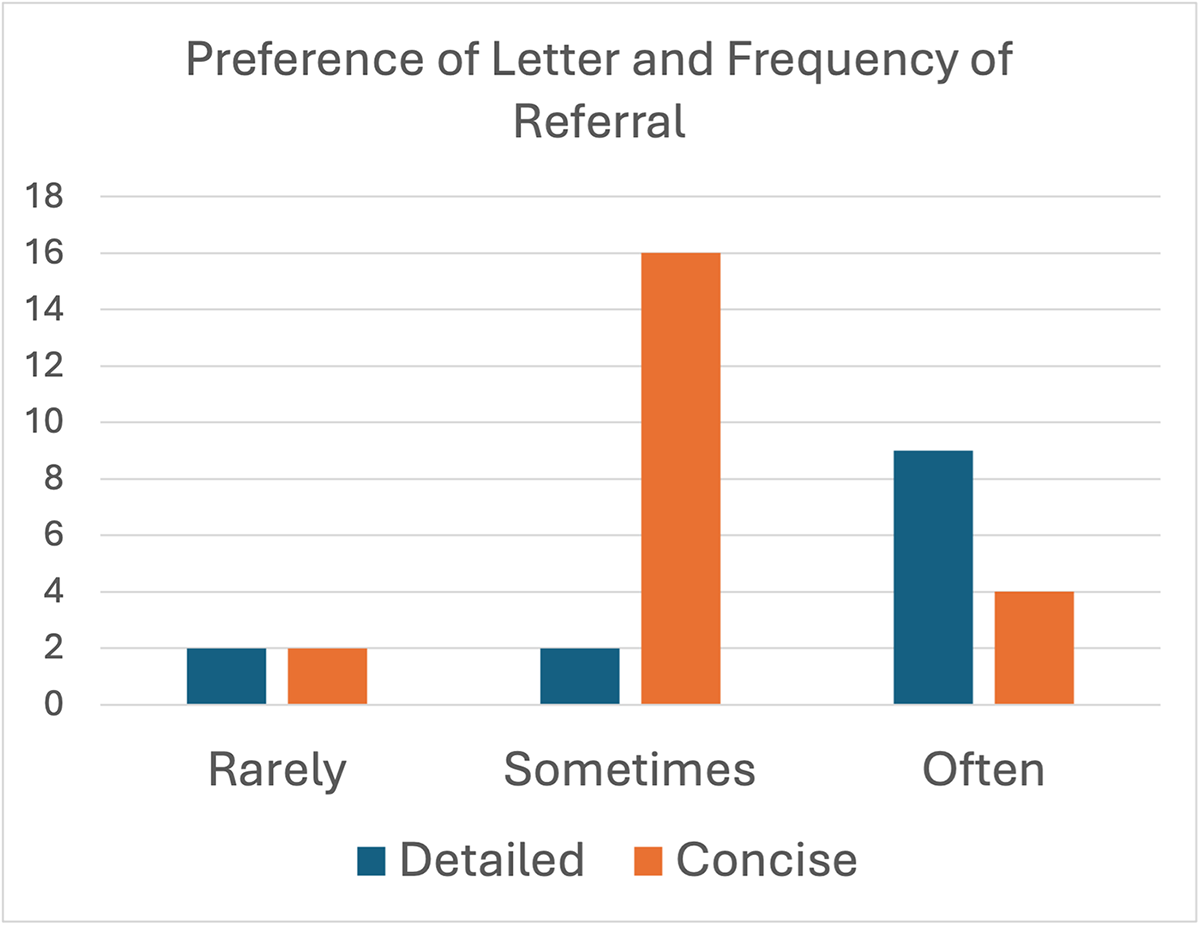
In comparing the sample concise vs. detailed letter, 75 per cent of total participants preferred the concise letter, and 25 per cent of participants preferred the detail letters. There was no statistically significant difference comparing average scores across letter components. Comparing letter preference and frequency of referral, there is a statistical significance via chi-squared analysis between groups (p = 0.004). Providers that “sometimes” refer to OHNS prefer concise letters (Fig. 3).
Comparison of frequency referral and preference of concise vs. detailed sample letter. Participants that “sometimes” referred to OHNS were more likely to prefer the concise letter.

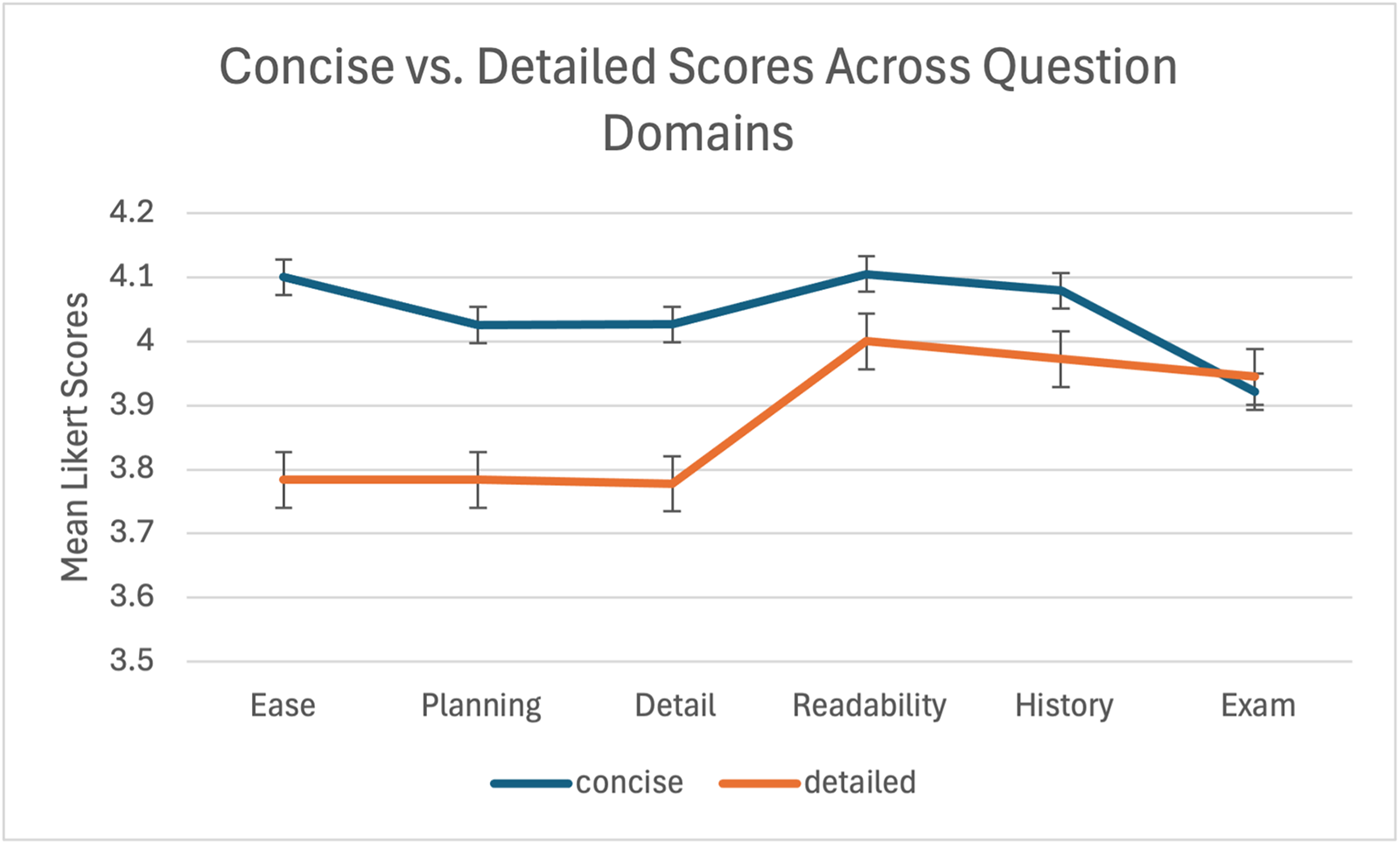
The Likert scores for assessment of the individual letter components were converted into numerical values. These questions included ease of extraction of information, helpfulness in informing treatment plans, detail level, readability and adequate history and physical exam information. Comparison of Likert scores between concise and detailed letters using paired analysis demonstrated no statistically significant difference across domains (Wilcoxon signed-rank test, p > 0.05 for all comparisons). Similarly, when scores were averaged per participant, there was no significant difference between letter formats (p = 0.78) (Fig. 4).
Comparison of average Likert scores between concise and detailed letters. While concise letters demonstrated numerically higher scores across several domains, no statistically significant difference was observed on paired analysis (Wilcoxon matched-pairs signed-rank test, p > 0.05).

Free-form answers were analysed qualitatively, and common themes were extracted. The sample concise letter was noted to be preferred for its brevity (10 responses), readability (10 responses), inclusion of pertinent positives and negatives (nine responses) and clarity on planned treatments (eight responses). Negatives include a desire for more detail (10 responses), not enough detail on physical exam findings (five responses), a lack of recommendations for interim management (four responses) and no information on past interventions (two responses).
The sample detailed letter was preferred for its comprehensiveness, thorough summary of history and physical exam (eight responses), informative and comprehensive assessment and plan (six responses) and provision of learning opportunities for the provider (six responses). Negatives include the excessive length (16 responses), redundancy of information (14 responses), unnecessary inclusion of information already known to the referring physician (eight responses) and length of time required to read letter (seven responses).
Discussion
Effective communication is essential to a safe and high-quality consultation and referral process.Reference Francois1 This study provides insight into primary care providers’ perspectives on the quality of clinical letters from OHNS specialists. Overall, most participants expressed satisfaction with the amount of information included in clinical letters, with 70.2 per cent indicating satisfaction. Participants were generally satisfied with the quality of letters. No participants indicated that they disagreed or strongly disagreed with the amount of information they received.
The preference for concise letters was associated with practitioners who “sometimes” referred to OHNS (Fig. 3). Those with less frequent interaction may rely on a concise and clear letter to guide further care. While concise letters demonstrated numerically higher mean scores across several domains, these differences were not statistically significant on paired analysis. This suggests that, although there may be a trend toward preference for concise formats, the effect size is modest and may not be clinically meaningful. These aspects were highlighted in free-form responses where brevity and readability were frequently extracted from responses.
Qualitative data highlights that, with concise letters, there is a trade-off: overly concise letters may omit clinical reasoning or recommendations for the referring practitioner to complete prior to follow-up visits. While many participants praised concise letters for being time-saving and straightforward, some participants were concerned about the lack of interim treatment plans, as well as not having a rationale for clinical decisions. Some also expressed desire for a more explicit follow-up plan. Overall, brevity should not come at the expense of essential clinical details. Similar studies that have investigated OHNS letters compared to another specialty noted that most letters contain adequate clinical or administrative information but omitted information that a patient had been told, or what their expectations of the encounter were.Reference Newton, Hutchinson, Hayes, McColl, Mackee and Holland2
Exploration of the optimal degree of detail in clinical letters has been assessed in other specialties. Previous Canadian studies investigated communication between oncologists and family physicians. A template letter was investigated providing communication in a 10-heading concise format. This was noted to improve family physician satisfaction regarding relevance, timeliness, format and amount of information received.Reference Braun, Hagen, Smith and Summers7 This has been corroborated in other studies as well.Reference Tattersall, Butow, Brown and Thompson4, Reference Peridis, Roberts and Hopkins5 Other studies have examined modifiable practice aspects that influenced letters include adequate visit times with patients, receipt of quality report and allied health support.Reference O’Malley and Reschovsky3
Recent studies have explored the use of natural language processing (NLP) and artificial intelligence (AI) such as Open AI’s ChatGPT chatbot which uses NLP technology to generate human-like text. In a pilot study, Chat GPT was able to generate clinical letters with high overall correctness and “humanness” scores and at a readability level comparable to human-generated letters. There were noted to be potential risks such as omissions or errors in clinical information which may have significant consequences for patient care and should be further evaluated.Reference Ali, Dobbs, Hutchings and Whitaker8 Other studies have assessed utilising ChatGPT not to write letters, but as an aid to improve readability. Modified letters were shown to improve patient understanding and satisfaction and reduce the need for patients to seek additional assistance to understand letter contents.Reference Cork and Hopcroft9 These studies highlight promising opportunities for integrating AI-assisted tools into clinical communication, provided that accuracy and safety can be maintained.
This study has several limitations, including a small sample size, rate of incomplete responses and uneven representation across professional groups. Additionally, the study is also geographically restricted to a single Canadian province. Of note, this study also utilised a rhinology-related consultation letter; however, it did include a comprehensive otolaryngological examination that can be generalised to other subspecialties. Finally, survey questions included in this study are not subspecialty-specific and were designed to assess general perspectives regarding satisfaction with level of detail, readability and ease of information extraction.
Further research could explore whether similar preferences are found across other specialties and jurisdictions.
Conclusion
Most referring healthcare practitioners to OHNS prefer concise clinical letters valuing readability and efficiency while recognising the trade-off of clinical details and interim treatment plans. The ideal clinical letter balances brevity with comprehensiveness. Options can include the use of standardised templates or structured formats that clearly outline key components without excessive narrative details. Further research across specialities and the use of structured templates or emerging tools such as AI may further improve clinical communication.
Financial support
None.
Competing interests
None.
Ethical standards
The authors assert that all procedures contributing to this work comply with the ethical standards of the relevant national and approved by the University of Manitoba Human Research Ethics Board (H2024:059/ HS26332) and with the Helsinki Declaration of 1975, as revised in 2008.
Acknowledgements
None.
Appendix 1. OHNS clinical letters survey
The submission of this anonymous survey indicates that you consent to your answers being used for research purposes. Do you agree to this?
o Yes, I agree
o No, I do not agree
1. How frequently do you refer to OHNS in your practice?

2. Please indicate your profession:


With regard to OHNS clinic letters you have received in the past year, please indicate your agreement with the following phrases:
3. On average, the level of detail regarding the specialist assessment was informative.
4. On average, the level of detail in clinical letters were helpful in informing further treatment plans.
5. On average, I was satisfied with the level of detail contained in the letter.
6. On average, details in the clinical letters are readable (i.e. specialty-specific jargon was explained).


Regarding the ‘Concise’ clinic letter, please indicate your agreement with the following phrases:
1. I was easily able to extract relevant clinical information from this letter.
2. The level of detail in this letter is helpful in informing further treatment plans.
3. I was satisfied with the level of detail contained in the letter.
4. Details in this letter is readable (i.e. specialty-specific jargon was explained).
5. Details regarding the patient’s history of presenting illness was adequate.
6. Details regarding the clinical exam was adequate.
7. What were some qualities you liked about this letter? (free form response)
8. What were some qualities you did not like about this letter? (free form response)


Regarding the “detailed” clinic letter, please indicate your agreement with the following phrases:
9. I was easily able to extract relevant clinical information from this letter.
10. The level of detail in this letter is helpful in informing further treatment plans.
11. I was satisfied with the level of detail contained in the letter.
12. Details in this letter is readable (i.e. specialty-specific jargon was explained).
13. Details regarding the patient’s history of presenting illness was adequate.
14. Details regarding the clinical exam was adequate.
15. What were some qualities you liked about this letter? (free form response)
16. What were some qualities you did not like about this letter? (free form response)


In comparing the detailed and concise clinic letter:
17. Which letter would you prefer to receive regarding the sample patient?
18. What are some reasons for your choice? (free form response)?

Appendix 2. Concise clinical letter
Thank you for the referral of John Smith, a pleasant 38-year-old male for symptoms of chronic rhinosinusitis as well as nasal obstruction.
John describes recurrent facial pain and pressure behind his eyes. He also notes worsening hyposmia and periodic nasal congestion. He has trialed several over-the-counter sinus medications and nasal steroid spray with no affect. He experiences some degree of nasal obstruction and hyposmia constantly, with worsening symptoms of facial pain and pressure 3–4 times per year.
His past medical, allergic and social history is non-contributory. Past antibiotic trials have not resulted in significant symptom reduction.
CT Sinuses (April, 2022): Extensive pan-sinus disease and a deviated septum.
On exam, nasoendoscopy reveals nasal polyps bilaterally. There is a posterior septal deviation to the right.
In summary, John Smith is a 38-year old male with chronic sinusitis with nasal polyps, with recent CT scan demonstrating diffuse sinus disease. He has been treated with maximal medical management with no significant reduction to his symptoms. We have therefore recommended functional endoscopic sinus surgery with John today and he consented to and acknowledged the risks of a CSF leak and permanent or temporary eye injury. Thank you for involving us in the care of this patient.
Sincerely,
Dr. ENT
Appendix 3. Detailed clinical letter
Thank you for the referral of John Smith is a pleasant 38-year-old male who was referred for symptoms of chronic rhinosinusitis, as well as nasal obstruction. He is primarily bothered by nasal obstruction/congestion, hyposmia, facial pain and pressure behind his eyes which has significantly worsened since 2019. He experiences some degree of nasal obstruction and hyposmia constantly, with worsening symptoms of facial pain and pressure 3-4 times per year.
He denies any nasal trauma, he denies a history of eczema or asthma, he denies a history of migraines or headaches. He also denies dental concerns and has frequent dental assessments.
He has trialed several over-the-counter sinonasal and allergy medications which have included: nasal saline sprays, antihistamines and Tylenol Sinus, all of which have not decreased his symptoms. When he has an exacerbation of symptoms, he has been prescribed antibiotics including amoxicillin and amox-clav which have not significantly reduced his symptoms. He has also trialed a nasal steroid spray for the past 6 months which has not resulted in significant reduction of symptoms.
CT Sinuses (April, 2022): near complete opacification of the left and right frontal sinuses, partial opacification of the ethmoid air cells and maxillary sinuses bilaterally. Overall impression of extensive pan-sinus disease.
His past medical history is relevant for hypertension. He takes no medications. He had an appendectomy in 2003. He has not had any previous sinonasal surgeries. Regarding his social history, he has no history of cigarette use, nor exposure to occupational inhalants or intranasal substances. He has 1–2 alcoholic beverages per week. His family history is relevant for environmental allergies in both his parents. He is allergic to pollen.
Physical Examination:
General: pleasant, appears stated age, well-nourished, in no apparent distress, comfortably answering questions, no stridor or wheezing.
Ears: normal external ears, normal external auditory canal, normal tympanic membranes.
Anterior Rhinoscopy: posterior septal deviation to the right, inferior turbinate hypertrophy bilaterally, clear rhinorrhea.
Oral Cavity: normal dentition and no lesions or masses on oral cavity mucosa.
Oropharynx: oropharyngeal mucosa normal and no lesions or masses.
Neck: no lymphadenopathy or masses.
Cranial Nerves: CN II–IX within normal limits.
Nasal Endoscopy:
Nasal endoscopy was indicated to better evaluate the nasal passages. Following topical administration of lidocaine and xylometazoline, a diagnostic nasal endoscopy was performed using a 3.5-mm flexible nasopharyngoscope. The nasal cavity, middle meatus and nasopharynx were examined. The patient tolerated the procedure well. Notable findings were:
Left: grade 3 polyp in middle meatus, evidence of thick and purulent discharge, severe edema.
Right: grade 3 polyp in middle meatus, evidence of thick and purulent discharge, severe edema. There was also evidence of a posterior septal deviation.
Assessment/Plan:
John Smith is a 38-year-old male with extensive sinus disease radiologically and bilateral polyps on direct visualisation. He has been treated with maximal medical management with no significant reduction to his symptoms. We have therefore recommended functional endoscopic sinus surgery with John today and he consented to and acknowledged the risks of a CSF leak and permanent or temporary eye injury. We will see him again at the time of his surgery. Thank you for involving us in the care of this patient.
Sincerely,
Dr. ENT


 Open access

