




No CrossRef data available.
Article contents
The neuropsychological impact of sports-related concussion: A meta-analysis
Published online by Cambridge University Press: 01 July 2005
Abstract
There is increasing interest in the potential neuropsychological impact of sports-related concussion. A meta-analysis of the relevant literature was conducted to determine the impact of sports-related concussion across six cognitive domains. The analysis was based on 21 studies involving 790 cases of concussion and 2014 control cases. The overall effect of concussion (d = 0.49) was comparable to the effect found in the non-sports-related mild traumatic brain injury population (d = 0.54; Belanger et al., 2005). Using sports-concussed participants with a history of prior head injury appears to inflate the effect sizes associated with the current sports-related concussion. Acute effects (within 24 hr of injury) of concussion were greatest for delayed memory, memory acquisition, and global cognitive functioning (d = 1.00, 1.03, and 1.42, respectively). However, no residual neuropsychological impairments were found when testing was completed beyond 7 days postinjury. These findings were moderated by cognitive domain and comparison group (control group versus preconcussion self-control). Specifically, delayed memory in studies utilizing a control group remained problematic at 7 days. The implications and limitations of these findings are discussed. (JINS, 2005, 11, 345–357.)
Information
- Type
- Research Article
- Information
- Journal of the International Neuropsychological Society , Volume 11 , Issue 4 , July 2005 , pp. 345 - 357
- Copyright
- © 2005 The International Neuropsychological Society
INTRODUCTION
Sports-related concussion occurs with some frequency. Among high school athletes, for instance, 5.5% of all injuries are concussions with an estimated 62,816 new cases of concussion annually (Powell & Barber-Foss, 1999). Football accounts for 63% of these injuries. The rate of concussion is similarly high in professional sports with an estimated .41 concussions per National Football League game (Pellman et al., 2004).
Sports-related concussion has gained increasing attention in the neuropsychology literature. Early work by Barth and colleagues (Barth et al., 1983; Rimel et al., 1981) in the 1980s set the stage for a plethora of empirical investigation into the neuropsychological impact of concussion in sports and the resolution of cognitive sequelae over time. In addition, other researchers have suggested the possibility that repeated exposure to sports-related activities such as heading a soccer ball may cause a more subtle concussion (e.g., headaches, dizziness, feeling “dazed,” etc.) with an associated dose–response effect (Webbe & Ochs, 2003; Witol & Webbe, 2003).
Although it is clear that most patients suffer at least some acute cognitive difficulties associated with concussion or mild traumatic brain injury (MTBI) more generally, the nature and course of postacute cognitive recovery remains an area of intense controversy. In non-sports-related MTBI, most cases recover completely within the first 3 months (Dikmen et al., 1986, 1995; Gentilini et al., 1985; Gronwall & Wrightson, 1974; Levin et al., 1987), however, a significant minority continue to manifest cognitive deficits beyond that point, with prevalence estimates varying across study from 7–8% (Binder et al., 1997) to 33% (Rimel et al., 1981). In addition, a number of individuals continue to report distressing symptoms for months (Alves et al., 1993; Dikmen et al., 1986; Hartlage et al., 2001; Powell et al., 1996) or years postinjury (Alexander, 1992; Deb et al., 1999; Hartlage et al., 2001). Frequently these complaints involve a constellation of physical, emotional, and cognitive symptoms collectively known as postconcussion syndrome (PCS).
Four meta-analytic reviews have been conducted on neuropsychological outcomes in MTBI (Belanger et al., 2005; Binder et al., 1997; Schretlen & Shapiro, 2003; Zakzanis et al., 1999) which together suggest (1) small overall effects, (2) somewhat larger effects in certain domains (i.e., attention largest), (3) a decrease in effect size with time since injury, and (4) effect size differences by sample selection criteria (i.e., larger effects associated with clinic-based or litigation samples as opposed to population-based samples). Quantitative summaries of sports-related concussion have not yet been conducted.
Investigation of concussion in an athletic context affords the researcher many advantages over studying concussion in a hospital setting, including access to a large at-risk population sometimes willing to undergo baseline testing, the ability to test injured parties immediately after injury, and the ability to follow them up at subsequent time points. On the other hand, many argue that this population differs substantially from other MTBI patients (e.g., higher motivation levels, less secondary gain issues) and can therefore not be meaningfully compared with them. Concussion in the sports arena is often diagnosed by a variety of different personnel (i.e., athletic trainers, team physicians, etc.) rather than emergency room physicians or neurologists, perhaps creating more liberal inclusion criteria. In addition, some would argue that athletes represent a group that differs greatly in terms of motivation to resume normal activities (“get back into the game”) and are typically more physically fit than the general population. These constitutional variables may impact neurocognitive status and recovery rates. Finally, effort testing is not used systematically in the sports arena to “throw out” data associated with questionable effort as is done in some research studies of concussion in the general population.
Given these factors, it seems necessary to consider athletes separately when trying to elucidate the neuropsychological impact of concussion and associated recovery rate. In addition to the differences in participants and injuries noted above, sports-related studies of concussion typically utilize more assessment episodes closer together in time, therefore likely increasing practice effects. As we recently conducted a meta-analysis of the general MTBI literature (Belanger et al., 2005), we felt it was important to examine the neuropsychological impact of sports-related MTBI separately. The purpose of this study is therefore to determine the magnitude of impairment in sports-related concussion across multiple cognitive domains. Of primary interest was whether there are differences in effect sizes based on several dimensions: cognitive domain (e.g., attention, memory, etc.), time since injury, computer versus traditional assessment techniques, and the method of assessment across time (comparisons made within or between subjects). A secondary analysis was conducted to examine those studies reporting correlations between exposure (e.g., number of soccer headings or bouts in boxing) and neuropsychological functioning.
METHOD
Search Strategy
Articles published between 1970 to August 2004 were identified through a literature search of online databases (PUBMED and PsychINFO). The search was limited to articles published in the English language using human participants. The key words were “sport(s),” “athlete(s),” “football,” “soccer,” “hockey,” “ice hockey,” “boxing,” “cognition,” “neuropsychological,” “minor,” “head injury,” “brain injury,” “mild,” “traumatic brain injury,” and “concussion.” In addition, we examined the reference sections of retrieved empirical studies to locate additional studies. This was done to minimize the possibility of overlooking any studies missed in the computerized database searches.
Selection Criteria
Concussion meta-analysis
To be included in the analysis, studies had to meet several criteria which were implemented to ensure a reasonably homogeneous set of studies and to allow for the calculation of effect sizes pertaining to the potential cognitive sequelae of concussion. First, participants were diagnosed with concussion in the context of a sporting event. Diagnosis was made using standard criteria, such as the American Academy of Neurology Practice Parameter (Kelly & Rosenberg, 1997), and/or by medical personnel. Liberal inclusion was deemed appropriate given the variety of different personnel asked to determine the presence of concussion in the sports arena. Second, participants with mild head injury had to be compared to some control group or to preinjury baseline performance. Case studies were excluded. Third, participants had to be compared on cognitive measures, either clinically validated tests or experimental measures. Fourth, the studies had to include sufficient statistical information to allow for calculation of effect sizes. Given the cautionary findings reported by Dunlap et al. (1996) with regard to inflated effect sizes associated with statistics reported in correlated designs (i.e., those reporting only correlational statistics), only studies reporting means and standard deviations were included. Fifth, participants had to be adults or adolescents, as children may have different cognitive sequelae following concussion (Borg et al., 2004; Capruso & Levin, 1992). As many studies did not report specific ages, only studies using high school athletes and beyond were included. Finally, as we are interested in changes in cognitive functioning over time following concussion, we only included studies that reported time since injury.
We examined a total of 69 studies of which 21 met inclusion criteria (see asterisked studies in the Reference section) for a total of 23 effect size estimates. Two studies (Cremona-Meteyard & Geffen, 1994; Lavoie et al., 2004) contributed two separate effect sizes, as results for these studies were presented by separate participant groups (labeled ‘a’ and ‘b’). The 21 studies contributed a total of 790 cases of concussion and 2014 control cases. Of the total effect sizes, 16 (or 70%) involved multiple assessments. Of those 16 studies with multiple assessments, all but two involved pre–post within-subjects comparisons and 12 of them involved some form of control group comparison. Of the 12 control group comparisons, eight (or 67%) retested the control participants at the same time intervals as the concussed athletes. Studies with an overall effect size that were two standard deviations away from the overall mean effect size estimate (d) were flagged as potential outliers. Funnel plots (Egger et al., 1997) were then used to further verify the presence of extreme values. Funnel plots are graphical representations of effect size plotted as a function of sample size. Using this approach, no outliers were removed (see Figure 1). The basic characteristics of each of the included studies are displayed in Table 1.
Characteristics of the 21 studies included in the concussion meta-analysis %Comparions Group: S—scores of injured group compared to self or preinjury baseline, C—scores of injured group compared to control group, B—both. Age: H—high school, C—college, P—professional.


Funnel plot showing effect sizes for concussion meta-analysis delineated by sample size.
Exposure meta-analysis
To be included in this analysis, studies had to include participants in sports typically associated with head injury risk (i.e., boxing or soccer). Again, cognitive measures included either clinically validated tests or experimental measures. Studies that investigated the correlation between “exposure” (as defined by heading frequency in soccer or number of bouts in boxing) and cognitive functioning were considered separately from those that compared participants of these sports with control participants.
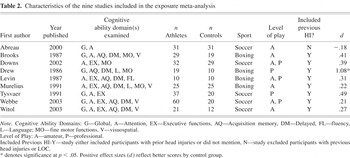
We examined a total of ten studies that compared “exposed athletes” to controls (see studies marked with the # sign in the Reference section). One study represented an extreme outlier using the aforementioned procedures and was deleted. The nine remaining studies contributed a total of 264 cases of “exposed” athletes and 176 control cases. The basic characteristics of each of the included studies and their effect sizes are displayed in Table 2. In addition, four of these studies reported correlations between length of “exposure” and cognitive functioning which were analyzed separately. When studies presented both current and cumulative exposure, data based on cumulative exposure was utilized.
Characteristics of the nine studies included in the exposure meta-analysis %Level of Play: A—amateur, P—professional. %Included Previous HI-Y—study either included participants with prior head injuries or did not mention, N—study excluded participants with previous head injuries or LOC. %* denotes significance at p < .05. Positive effect sizes (d) reflect better scores by control group.

Cognitive Outcome Measures
The outcome measures for both meta-analyses were tests of cognitive performance for concussion cases and controls. These tests were grouped into nine broad domains of functioning, based upon the typical grouping seen in the neurological and neuropsychological literature (Lezak, 1995; Spreen & Strauss, 1998). For experimental tasks (i.e., tasks not validated for clinical use), we relied upon the authors' domain assignment. Measures included within the nine domains are: orientation—Orientation subtest from the Standardized Assessment of Concussion (SAC; McCrea et al., 2000); global cognitive ability—Wechsler Adult Intelligence Scales full scale IQ scores (Wechsler, 1987a, 1997a), SAC total score (McCrea et al., 2000), the Repeatable Battery for the Assessment of Neuropsychological Status total score (Randolph, 1998), the General Neuropsychological Deficit Scale from the Halstead-Reitan Neuropsychological Test Battery (Reitan & Wolfson, 1993), Raven's Progressive Matrices (Raven, 1960), the Shipley Institute of Living Scale (Shipley, 1940); attention—Trail Making Test-Part A (Reitan & Wolfson, 1985), Digit Span and Visual Span subtests from the Wechsler Memory Scales (Wechsler, 1987b, 1997b), the Perceptual Speed Test (Moran & Mefferd, 1959), concentration subtest from SAC (McCrea et al., 2000), Stroop Color and Word Test color and word scores (Golden, 1978), the Speed of Comprehension Test (Baddeley et al., 1992), Vigil Continuous Performance Test (The Psychological Corporation, 1994), subtests (reaction time, continuous performance test, mathematical processing, matching to sample, Sternberg procedure) from the Automated Neuropsychological Assessment Metrics (Bleiberg et al., 2000), reaction time from the CogState (Westerman et al., 2001), subtests (processing speed, complex reaction time and simple reaction time) from the Concussion Resolution Index (Erlanger et al., 1999), Paced Auditory Serial Addition Task (Gronwall, 1977; Levin, 1983), subtests (Digit Span and Digit Symbol) from the Wechsler Intelligence Scales (Wechsler, 1974, 1987a), subtests (reaction time and processing speed) from the Immediate Postconcussion Assessment and Cognitive Testing (Maroon et al., 2000), Continuous Performance Test (Conners, 1995), experimental simple and choice reaction time tasks; executive functioning—Trail Making Test-Part B (Reitan & Wolfson, 1985), Stroop Color and Word Test interference score (Golden, 1978), number of perseverations on the California Verbal Learning Test (CVLT; Delis et al., 1987), semantic clustering from the Hopkins Verbal Learning Test–Revised (HVLT–R) (Benedict et al., 1998), Controlled Oral Word Association Test (Benton & Hamsher, 1976), Design Fluency (Jones-Gotman & Milner, 1977), and the Wisconsin Card Sorting Test (Heaton, 1981; Heaton et al., 1993); memory acquisition—learning trials or immediate recall trials from the following tests: CVLT (Delis et al., 1987), Benton Visual Retention Test (Benton, 1974), Verbal Learning (Claeson et al., 1971), Hopkins Verbal Learning Test (HVLT) (Brandt, 1991) and HVLT–R (Benedict et al., 1998), Memory for Designs (Graham & Kendall, 1960), Wechsler Memory Scale (Wechsler, 1987b, 1997b), Randt Memory Test (Randt & Brown, 1983), Selective Reminding Test (Buschke, 1973; Mattis & Kovner, 1978), Rey-Osterrieth Complex Figure (Osterrieth, 1944), Rey Auditory Verbal Learning Test (Schmidt, 1996), SAC (McCrea et al., 1997); delayed memory—delayed recall portions from the following tests: CVLT (Delis et al., 1987), Wechsler Memory Scales (Wechsler, 1987b, 1997b), Rey-Osterrieth Complex Figure (Osterrieth, 1944), Automated Neuropsychological Assessment Metrics (Bleiberg et al., 2000), Verbal Learning (Claeson et al., 1971), Randt Memory Test (Randt & Brown, 1983), HVLT (Brandt, 1991) and HVLT–R (Benedict et al., 1998), Rey Auditory Verbal Learning Test (Schmidt, 1996), Immediate Postconcussion Assessment and Cognitive Testing (Maroon et al., 2000), SAC (McCrea et al., 1997); language—aphasia screening errors from the Halstead-Reitan Neuropsychological Test Battery (Reitan & Wolfson, 1993) and an experimental synonyms test; visuospatial ability—the Block Design subtest from Wechsler Scales (Wechsler, 1987a, 1997a), the Facial Recognition Test (Benton & Van Allen, 1968), the copy portion of the Benton Visual Retention Test (Benton, 1974), and the Rey-Osterrieth Complex Figure (Osterrieth, 1944); and motor abilities—finger tapping (Reitan & Wolfson, 1993) and the grooved pegboard test (Lafayette Instrument Company, Undated).
Data Extraction and Statistical Analysis
Effect sizes were calculated using techniques espoused by Hunter and Schmidt (Hunter & Schmidt, 1990; Hunter et al., 1982). Calculated from the data reported in each study was the effect-size estimate, d (i.e., the control group mean minus the TBI group mean, divided by the pooled standard deviation). Thus, d represents the standardized difference between the two groups within each study, with a positive effect size indicative of better performance by the control group. In studies where more than one dependent measure was present for a cognitive domain (e.g., multiple tests of memory), an averaged effect size was calculated to avoid one study dominating the results. For example, if a study had tests with both nonverbal and verbal memory, these effect sizes were averaged to generate the overall effect size for memory. For studies with multiple time points, an average effect size was calculated across time. For the summary effect sizes reported in this study, the averaged d values are weighted by each study's sample size.
Moderator Variables
We also calculated the Q statistic to examine homogeneity of effect sizes across studies. If a significant Q value is observed, this indicates heterogeneity of results and potential moderator effects. We examined the influence of potential categorical moderating variables including study design (serial vs. single assessment), administration method (computerized vs. traditional), cognitive domain, time since injury (within 1 day, 1–7 days, and beyond 7 days), participant selection criteria (excluding vs. including those with prior head injuries), and comparison group (self vs. control group). If a time range was given rather than the exact time since injury, the midpoint of the time range was utilized (e.g., 0–24 days was coded as 11.5 days). These time ranges, utilized for moderator analysis, were chosen to mimic the majority of studies in this literature and to ensure adequate numbers within each cell.
RESULTS
Concussion Meta-Analysis
Overall effect size
The overall effect (d) of sports concussion on neuropsychological performance was .49 (p < .05) based on 23 effect-size estimates, Q (22) = 3965, p < .05. The overall effect (d) associated with single assessment was .98 (p < .05) based on 11 effect-size estimates, Q (10) = 304, p < .05, whereas the overall effect (d) associated with serial assessment was .44 (p < .05) based on 16 effect-size estimates averaged across assessments, Q (15) = 2452, p < .05.
Overall effect size by administration method
The overall effect size (d) associated with computerized measures was .61 (p < .05) based on 12 effect-size estimates, Q (11) = 297, p < .05. A comparable effect size (d = .51) was associated with more traditional, paper-and-pencil measures based on 16 studies, Q (15) = 2412, p < .05. Unfortunately, given that most of the studies employing computerized measures primarily examined the attention domain and did not vary greatly in terms of time-since-injury, it was not possible to further break these effects down, as would be necessary given the apparent heterogeneity inherent in these effects as indicated by the large Q value.
Overall effect size by participant selection criteria
In an attempt to examine the influence of participant selection criteria, an analysis was conducted to compare those studies that excluded participants who had sustained head injuries within the last year with those studies which included such participants. If an article did not mention this variable, it was assumed that they did not exclude participants with prior head injuries. The overall effect size (d) for studies excluding patients with a history of prior head injury was not significant at .11 (p > .05) based on seven effect-size estimates, Q (6) = 325, p < .05. In contrast, the overall effect (d) for studies which did not exclude such participants was significant at .65 (p < .05) based on 16 effect-size estimates, Q (15) = 1408, p < .05. The average time since current injury for those studies which excluded prior head injuries was 1 day, which was substantially less than the average time for studies not excluding prior head injuries (68 days), suggesting that the difference is not due to time since injury. However, given the small number of studies excluding patients with prior head injury, it was not possible to further break these effects down, despite significant heterogeneity.
Overall effect size by comparison group
The overall effect (d) of sports concussion for those studies relying on control group comparisons was .89 (p < .05) based on 19 effect-size estimates, Q (18) = 2514, p < .05. Of these 19 effect sizes, 12 represented a combined effect across time. In these 12 studies with multiple time points, eight (or 67%) involved retesting the controls at the same time points as concussed athletes. The overall effect (d) of sports concussion for those studies relying on pre–post comparisons within subjects was .19 (p < .05) based on 14 effect-size estimates, Q (13) = 2353, p < .05. Of these 14 effect sizes, eight (or 57%) involved a pre–post design with a single assessment postinjury while the remaining six studies involved more than one measurement postinjury. Thus, the smaller effect size for the pre–post comparison studies likely reflects practice effects.
Effect sizes by cognitive domain
Average effect sizes for the nine cognitive domains are displayed in Table 3. The sports concussion group exhibited statistically significant deficits in all domains except attention and executive functions. Most effect sizes were moderate to large (Cohen, 1988) with memory acquisition and global cognitive ability having the largest overall effect sizes. Smallest overall effects were found in attention.
Effect sizes for the six cognitive domains for the concussion studies %Positive effect sizes (d) reflect better scores by control group.

As can be seen in Table 3, significant heterogeneity was apparent in all domains. We therefore examined the influence of two additional potential moderating variables: time since injury and comparison group (control group vs. pre–post self-comparison). These variables were selected for further investigation based on the concussion literature and because the number of studies including these variables was generally sufficient to permit these additional analyses.
Effect sizes by cognitive domain, time since injury, and comparison group
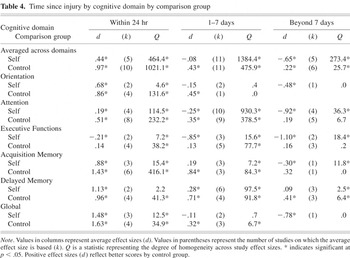
As can be seen in Table 4, cognitive domain, time since injury, and comparison group all clearly affected effect sizes. In all cognitive domains examined, the effect of sports concussion on neuropsychological functions steadily declined over time. Studies conducted using control group comparisons had larger effect sizes overall than those studies conducted using pre–post self or within-subject comparisons. Most (67%) of the control group studies included comparable multiple evaluations for both sport-concussion and control groups, whereas the pre–post self-studies confound practice effects with recovery effects. Consistent with larger practice effects, across cognitive domains, the “resolution” of cognitive symptoms was more dramatic when self or within-subjects comparisons were made. However, despite these discrepancies, the largest acute adverse cognitive effects of sports concussion were found within the domains of acquisition memory, delayed memory, and global cognitive functioning, regardless of which comparison group was utilized.
Time since injury by cognitive domain by comparison group

With the exception of delayed memory, the neuropsychological effects of concussion were not apparent when testing was conducted beyond 7 days, regardless of comparison group. In all domains but delayed memory, self comparisons actually resulted in better performance by this time period compared to baseline, likely because of the practice effects combined with the recovery effects. This was not the case with control group comparisons, although generally there were small and insignificant effects apparent beyond 7 days postconcussion. Once again, the one exception was delayed memory with a significant effect (d = .41). That one significant delayed memory effect is based on three effect sizes: .61 at 7.6 days, .11 at 10 days, and .11 at 51 days postconcussion. Thus, even within the delayed memory domain, by 10 days postinjury sports-concussed individuals did not differ significantly from noninjured controls.
Exposure Meta-Analysis
Overall effect size
The overall effect (d) of “exposure” to head injury as measured by comparing participants in risky sports (i.e., soccer and boxing) to control participants of less risky sports (e.g., track and field) was .31 (p < .05) based on nine effect-size estimates, Q (8) = 79, p < .05. The overall effect (d) of “exposure” as measured by examining the correlation between length of participation and neuropsychological functioning was .71 (p < .05) based on four effect-size estimates, Q (3) = 32, p < .05. In these studies, exposure was determined by number of boxing bouts and/or length of career (Drew et al., 1986; Murelius & Haglund, 1991), or frequency of heading in soccer (Abreau et al., 2000; Downs & Abwender, 2002). As there were so few of these correlational studies, they were not examined any further.
Effect size by cognitive domain
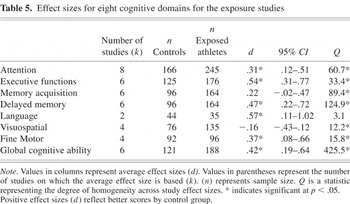
For those studies comparing “exposed” athletes to control athletes, the overall effects (d) by domain are presented in Table 5. These effects are generally small to moderate with nonsignificant effects for memory acquisition and visuospatial skills. The largest effects were noted in the domains of delayed memory, executive functions, and language, with d values of .47, .54 and .57, respectively. Three of the five domains represent smaller effects than those found acutely following a concussion, as per the sports-concussion analysis.
Effect sizes for eight cognitive domains for the exposure studies %Positive effect sizes (d) reflect better scores by control group.

DISCUSSION
Our meta-analysis provides an up-to-date and comprehensive review of the concussion literature in athletics. Results from studies of sports-related concussion suggest that there is an effect of concussion within the first 24 hr with mild-to-moderate neuropsychological impairments across domains, but with relatively large deficits in global functioning (d = 1.42), memory acquisition (d = 1.03), and delayed memory (d = 1.00). However, this acute effect is essentially zero beyond 7 days postinjury (10 days for delayed memory). It is interesting to note that the overall effect size of sports-related concussion (d = .49) is similar to the effect size associated with non-sports concussion in the general population (d = .54) (Belanger et al., 2005). Beyond the overall effect sizes, however, it is difficult to compare these literatures. As athletes are generally tested more acutely, initial effect sizes are larger in this literature. So, for example, the largest effect sizes within 24 hr ranged from 1.03 for memory acquisition to 1.42 for global cognitive functioning whereas in the general population of MTBI, memory acquisition effects measured within 90 days were only .37 with the largest effect at .96 for delayed memory (Belanger et al., in press). Again, different evaluation time frames make comparisons difficult.
Overall, the results of this meta-analysis suggest that for the athlete population at large, there is full neuropsychological recovery following a sports-related concussion at 7–10 days postinjury. This is consistent with literature suggesting that most cognitive deficits associated with sports-related concussion resolve in the first several days (Bleiberg et al., 2004; Bruce & Echemendia, 2003; Macciocchi et al., 1996; McCrea et al., 2003), as well as with metabolic studies in animals suggesting resolution of the chemical cascade that occurs following mild concussion within 6–10 days (Giza & Hovda, 2001). Moderator analyses demonstrated the importance of considering comparison group when examining the cognitive sequelae of sports-related concussion. In general, studies relying on pre–post comparisons demonstrated markedly smaller effects, likely due to practice effects with repeated administration. Indeed, an analysis conducted comparing single assessment with serial assessment revealed effect sizes more than double associated with the former. While comparing a player to his or her own baseline performance is preferable to reduce extraneous variability not attributable to the concussion, effect-size estimates based on repeated administrations likely represent an underestimate of sports-concussion effects due to practice effects. Practice effects in between-subjects designs obviously occur for both concussed participants and control subjects across time. The effect sizes determined in these studies cannot be attributed to practice effects but rather to group differences. Obviously the same practice effect confound exists for those 33% of studies that utilized control groups at baseline but did not retest them despite retesting concussed athletes. The effects of practice on neuropsychological outcome tend to vary by cognitive domain and the use of alternative forms (Wilson et al., 2000) but these issues were not investigated here due to limited sample size.
Beyond practice effects, it is also possible that test–retest studies generally had smaller effect sizes because injured athletes were somehow different than control participants premorbidly. Indeed, McCrea et al. (2003) reported lower scores on Trails B among concussed athletes prior to the incident concussion. In addition, the likelihood of sustaining a concussion is increased in those athletes who have previously sustained a concussion (Guskiewicz et al., 2003) and a history of previous concussion is related to poorer performance on baseline neuropsychological testing (Collins et al., 1999). Again, these findings suggest that studies making comparisons between concussed and nonconcussed groups should match participants on baseline performance and prior head injury.
Despite reports in the literature that computerized measures may be superior to or more sensitive than more traditional paper-and-pencil measures (e.g., for the measurement of reaction time) (Schatz & Zillmer, 2003), the overall effect size associated with computer assessment was comparable to the overall effect size associated with more traditional measures. This finding suggests that at present there is no evidence that computerized assessment is more sensitive than traditional measures, at least with regard to overall effects across time. As there were so few studies examining this issue at varied time points, further analysis was not possible.
Prior head injury appears to be associated with greater cognitive sequelae. Studies that specifically mentioned the exclusion of such athletes, either in terms of recent or remote prior head injuries, had a much smaller effect size (d = .11) than those that did not exclude such athletes (d = .74). As only seven studies mentioned such exclusionary criteria, it is likely that most studies in this area of research represent an overestimate of the effects of acute concussion. Based on seven studies, it would seem that prior head injury is significantly associated with much poorer outcome, at least for the postacute time frames represented in the included studies. It is not known whether these differences are enduring.
Indeed, results of the exposure studies corroborate this finding in that participation in sports which involve contact with the head (i.e., soccer heading and boxing) has a small but significant adverse impact on neuropsychological functioning (d = .31) overall. However, as these studies were quite variable in terms of participant selection (e.g., length of sport participation, number of previous head injuries, etc.), further research is necessary to clarify these findings. Correlational studies suggested a dose–response relationship (d = .71) such that longer participation in boxing and soccer is associated with poorer neuropsychological status. Caution is required here, however, as only four such studies were included in the analysis and their effects should not be directly compared with other effect sizes reported in this paper, as there is an inflation of effect size associated with correlational designs (Dunlap et al., 1996). Finally, while it may be questionable to combine soccer and boxing, studies were too few to break these effects down further. Interestingly, the effect sizes associated with soccer were generally greater than those associated with boxing. Again, however, the heterogeneity of these studies precludes further analysis or interpretation.
As expected, inspection of Tables 3 and 5 demonstrates that the effect sizes associated with exposure relative to acute concussion are generally smaller. Notable exceptions are the attention domain and particularly the executive functions domain. It is noteworthy that executive functions were not impaired in those studies examining acute concussion but represented one of the largest effect sizes in the exposure analyses. One possible explanation is that a different set of tests were utilized. Specifically, the exposure studies relied more heavily upon fluency measures (both verbal and nonverbal) and novel problem-solving measures, whereas only one concussion study used a single measure of verbal fluency. Indeed, in a meta-analysis conducted in the MTBI population at large (Belanger et al., 2005), fluency measures represented the largest overall effect size collapsed across time-since-injury. Another potential explanation is that athletes who head the ball more frequently are premorbidly less inhibited and therefore premorbidly at a disadvantage on measures of executive function.
There are several limitations to this study, some of which are inherent to conducting a meta-analysis. Severity of injury was inconsistently reported and defined in the examined studies. Differential criteria for establishing concussion were averaged in this analysis. Previous research has demonstrated the importance of stringency in defining concussion, as well as the importance of demographic variables (Dikmen et al., 2001), neither of which was investigated in this meta-analysis due to the small number of studies. Examining the effect of concussion across many cognitive domains and across potential moderators necessarily entailed a small number of studies in some cells. So, for example, the effect sizes of concussion on delayed memory using self-comparisons (d = .09) or control group comparisons (d = .41) beyond 7 days comes from three studies in each case. Clearly, more studies in these domains are necessary. Other, more frequently investigated domains (e.g., attention) probably reflect more stable findings. In addition, the ubiquitous nature of practice effects in this literature, even to a small extent in studies using control groups, renders the effect sizes estimated in these analyses likely to be an underestimate of the true overall effect size associated with sports-related concussion. Furthermore, among the studies included in the analysis, few had information on all of the ability domains targeted. Domains themselves were created according to the typical grouping seen in the neuropsychological literature rather than empirically. Finally, many Q values were still significant even after moderator analyses. Those that were not significant were based on only 1–3 studies. As Q is susceptible to artificial variance inflation when the number of studies is large (Schmidt & Hunter, 2003), it is difficult to know whether nonsignificant Q values were due to few studies, and in turn if the significant Q values were due to a larger number of studies. Also, as we were unable to control for potential artifacts (e.g., reliability of the neuropsychological measures), an inflation of Type I error is likely (Schmidt & Hunter, 2003). Therefore, there remain important as-yet-unidentified moderators.
Despite these limitations, this meta-analysis provides compelling evidence that sports-related concussion has no significant effect on neuropsychological function by 7–10 days days postinjury in the athletic population at large. Nonetheless, long-term participation in sports involving head contact (i.e., boxing and soccer) may be associated with small, adverse sequelae. Further research is necessary to clarify these findings in certain, less-studied cognitive domains (e.g., motor functioning, language, etc.), to ascertain the extent to which neuropsychological evaluation contributes above and beyond symptom complaints to clinical outcomes and decision making, and to determine the testing battery and schedule that optimizes clinical information while simultaneously minimizing practice effect confounds.
ACKNOWLEDGMENTS
The authors would like to thank Dr. John Schinka for his assistance with this project. The research reported here was supported by the Department of Veterans Affairs, Veterans Health Administration (VHA), the Defense and Veterans Brain Injury Center, and the James A. Haley Veterans' Hospital. Further support was provided by a grant (#MDA 905-03-2-0003) through the Henry M. Jackson Foundation. The views expressed herein are those of the authors and do not necessarily reflect the views of the Department of Veterans Affairs.
Reference notation
*References marked with an asterisk indicate studies included in the concussion meta-analysis.
#References marked with an a # indicate studies included in the exposure meta-analysis.
References
REFERENCES
#Abreau, F.,
Templer, D.I.,
Schuyler, B.A., &
Hutchison, H.T.
(2000).
Neuropsychological assessment of soccer players.
Neuropsychology,
4,
175–181.Google Scholar
Alexander, M.P.
(1992).
Neuropsychiatric correlates of persistant postconcussive
syndrome.
Journal of Head Trauma Rehabilitation,
8,
60–69.CrossRefGoogle Scholar
Alves, W.,
Macciocchi, S.N., &
Barth, J.T.
(1993).
Postconcussive symptoms after uncomplicated mild head injury.
Journal of Head Trauma Rehabilitation,
8,
48–59.Google Scholar
American Congress of Rehabilitation Medicine
(1993).
Report of the Mild Traumatic Brain Injury Committee of the Head
Injury Interdisciplinary Special Interest Group.
Journal of Head Trauma Rehabilitation,
8,
86–87.Google Scholar
Baddeley, A.,
Emslie, H., &
Nimmo-Smith, I.
(1992).
The Speed and Capacity of Language Processing Test: Manual.
Bury St. Edmunds:
Thames Valley Test Company.
*Barr, W.B. &
McCrea, M.
(2001).
Sensitivity and specificity of standardized neurocognitive testing
immediately following sports concussion.
Journal of the International Neuropsychological Society,
7,
693–702.Google Scholar
Barth, J.T.,
Macciocchi, S.N.,
Giordani, B.,
Rimel, R.,
Jane, J.A., &
Boll, T.J.
(1983).
Neuropsychological sequelae of minor head injury.
Neurosurgery,
13,
529–533.CrossRefGoogle Scholar
Belanger, H.G.,
Curtiss, G.,
Demery, J.A.,
Lebowitz, B.K., &
Vanderploeg, R.D.
(2005).
Factors moderating neuropsychological outcome following mild
traumatic brain injury: A meta-analysis.
Journal of the International Neuropsychological Society,
11,
215–227.Google Scholar
Benedict, R.H.,
Schretlen, D.J.,
Groninger, L., &
Brandt, J.
(1998).
Hopkins Verbal Learning Test–Revised: Normative data and
analysis of inter-form and test–retest reliability.
Clinical Neuropsychologist,
12,
43–55.CrossRefGoogle Scholar
Benton, A.L.
(1974).
The Revised Visual Retention Test: Clinical and experimental
applications
(4th ed.).
New York:
The Psychological Corporation.
Benton, A.L. &
Hamsher, K.D.
(1976).
Multilingual Aphasia Examination.
Iowa City, Iowa:
University of Iowa.
Benton, A.L. &
Van Allen, M.W.
(1968).
Impairment in facial recognition in patients with cerebral
disease.
Cortex,
4,
344–358.Google Scholar
Binder, L.M.,
Rohling, M.L., &
Larrabee, J.
(1997).
A review of mild head trauma. Part I: Meta-analytic review of
neuropsychological studies.
Journal of Clinical and Experimental Neuropsychology,
19,
421–431.Google Scholar
Bleiberg, J.,
Cernich, A.N.,
Cameron, K.,
Sun, W.,
Peck, K.,
Ecklund, L.P.,
Reeves, C.D.,
Uhorchak, C.J.,
Sparling, M.B., &
Warden, D.L.
(2004).
Duration of cognitive impairment after sports concussion.
Neurosurgery,
54,
1073–1080.Google Scholar
Bleiberg, J.,
Kane, R.L.,
Reeves, D.L.,
Garmoe, W.S., &
Halpern, E.
(2000).
Factor analysis of computerized and traditional tests used in mild
brain injury research.
Clinical Neuropsychologist,
14,
287–294.CrossRefGoogle Scholar
Borg, J.,
Holm, L.,
Cassidy, J.D.,
Peloso, P.M.,
Carroll, L.J.,
von Holst, H., &
Ericson, K.
(2004).
Diagnostic procedures in mild traumatic brain injury: Results of the
WHO Collaborating Centre Task Force on Mild Traumatic Brain Injury.
Journal of Rehabilitation Medicine,
43
(Suppl.),
61–75.CrossRefGoogle Scholar
Brandt, J.
(1991).
The Hopkins Verbal Learning Test: Development of a new verbal memory
test with six equivalent forms.
Clinical Neuropsychologist,
5,
125–142.CrossRefGoogle Scholar
#Brooks, N.,
Kupshik, G.,
Wilson, L.,
Galbraith, S., &
Ward, R.
(1987).
A neuropsychological study of active amateur boxers.
Journal of Neurology, Neurosurgery and Psychiatry,
50,
997–1000.Google Scholar
*Bruce, J.M. &
Echemendia, R.J.
(2003).
Delayed-onset deficits in verbal encoding strategies among patients
with mild traumatic brain injury.
Neuropsychology,
17,
622–629.Google Scholar
Buschke, H.
(1973).
Selective reminding for analysis of memory and learning.
Journal of Verbal Learning and Verbal Behavior,
12,
543–550.CrossRefGoogle Scholar
Cantu, R.C.
(1991).
Minor head injuries in sports. In
P.G. Dyment (Ed.),
Adolescent medicine: State of the art reviews (pp.
17–30).
Philadelphia, Pennsylvania:
Hanley & Belfus.
Capruso, D.X. &
Levin, H.S.
(1992).
Cognitive impairment following closed head injury.
Neurologic Clinics,
10,
879–893.Google Scholar
Claeson, L.E.,
Esbjörnsson, E.,
Carté, B.M., &
Wahlbin, M.
(1971).
Manual to Claeson-Dahls learning test for clinical use.
Stockholm:
Psykologiförlaget ab.
Cohen, J.
(1988).
Statistical power analysis for the behavioral sciences
(2nd ed.).
New Jersey:
Lawrence Erlbaum.
Collins, M.W.,
Grindel, S.H.,
Lovell, M.R.,
Dede, D.E.,
Moser, D.J.,
Phalin, B.R.,
Nogle, S.,
Wasik, M.,
Cordry, D.,
Daugherty, K.M.,
Sears, S.F.,
Nicolette, G.,
Indelicato, P., &
McKeag, D.B.
(1999).
Relationship between concussion and neuropsychological performance
in college football players.
Journal of the American Medical Association,
282,
964–970.CrossRefGoogle Scholar
Colorado Medical Society
(1991).
Report of the Sports Medicine Committee: Guidelines for the
management of concussion in sports (revised).
Denver, Colorado:
Colorado Medical Society.
Congress of Neurological Surgeons
(1966).
Committee on head injury nomenclature: Glossary of head
injury.
Clinical Neurosurgery,
12,
386–394.Google Scholar
Conners, C.K.
(1995).
Conners' Continuous Performance Test.
Toronto, Canada:
Multi-Health Systems.
*Cremona-Meteyard, S.L. &
Geffen, G.M.
(1994).
Persistent visuospatial attention deficits following mild head
injury in Australian Rules football players.
Neuropsychologia,
32,
649–662.CrossRefGoogle Scholar
Deb, S.,
Lyons, I., &
Koutzoukis, C.
(1999).
Neurobehavioural symptoms one year after a head injury.
British Journal of Psychiatry,
174,
360–365.CrossRefGoogle Scholar
Delis, D.C.,
Kramer, J.H.,
Kaplan, E., &
Ober, B.A.
(1987).
California Verbal Learning Test: Adult Version.
San Antonio, TX:
The Psychological Corporation.
Dikmen, S.,
Machamer, J., &
Temkin, N.
(2001).
Mild head injury: Facts and artifacts.
Journal of Clinical and Experimental Neuropsychology,
23,
729–738.Google Scholar
Dikmen, S.,
Machamer, J.E.,
Winn, H.R., &
Temkin, N.R.
(1995).
Neuropsychological outcome at 1-year post head injury.
Neuropsychology,
9,
80–90.CrossRefGoogle Scholar
Dikmen, S.,
McLean, A., &
Temkin, N.
(1986).
Neuropsychological and psychosocial consequences of minor head
injury.
Journal of Neurology, Neurosurgery and Psychiatry,
49,
1227–1232.CrossRefGoogle Scholar
#Downs, D.S. &
Abwender, D.
(2002).
Neuropsychological impairment in soccer athletes.
Journal of Sports Medicine and Physical Fitness,
42,
103–107.Google Scholar
#Drew, R.H.,
Templer, D.I.,
Schuyler, B.A.,
Newell, T.G., &
Cannon, W.G.
(1986).
Neuropsychological deficits in active licensed professional
boxers.
Journal of Clinical Psychology,
42,
520–525.Google Scholar
Dunlap, W.P.,
Cortina, J.M.,
Vaslow, J.B., &
Burke, M.J.
(1996).
Meta-analysis of experiments with matched groups or repeated
measures designs.
Psychological Methods,
1,
170–177.CrossRefGoogle Scholar
*Echemendia, R.J.,
Putukian, M.,
Mackin, R.S.,
Julian, L., &
Shoss, N.
(2001).
Neuropsychological test performance prior to and following
sports-related mild traumatic brain injury.
Clinical Journal of Sport Medicine,
11,
23–31.CrossRefGoogle Scholar
Egger, M.,
Davey Smith, G.,
Schneider, M., &
Minder, C.
(1997).
Bias in meta-analysis detected by a simple, graphical test.
British Medical Journal,
315,
629–634.Google Scholar
*Erlanger, D.,
Saliba, E.,
Barth, J.,
Almquist, J.,
Webright, W., &
Freeman, J.
(2001).
Monitoring resolution of postconcussion symptoms in athletes:
Preliminary results of a web-based neuropsychological test
protocol.
Journal of Athletic Training,
36,
280–287.Google Scholar
Erlanger, D.M.,
Feldman, D.J., &
Kutner, K.
(1999).
Concussion Resolution Index.
New York:
Headminder, Inc.
Gentilini, M.,
Nichelli, P.,
Schoenhuber, R.,
Bortolotti, P.,
Tonelli, L.,
Falasca, A., &
Merli, G.A.
(1985).
Neuropsychological evaluation of mild head injury.
Journal of Neurology, Neurosurgery and Psychiatry,
48,
137–140.Google Scholar
Giza, C.C. &
Hovda, D.A.
(2001).
The neurometabolic cascade of concussion.
Journal of Athletic Training,
36,
228–235.Google Scholar
Golden, C.
(1978).
Stroop Color and Word Test: A manual for clinical and experimental
use.
Chicago, Illinois:
Stoelting.
Graham, F.K. &
Kendall, B.S.
(1960).
Memory-for-Designs Test: Revised general manual.
Perceptual and Motor Skills,
11 (Monograph Suppl. No. 2-VII),
147–188.CrossRefGoogle Scholar
Gronwall, D. &
Wrightson, P.
(1974).
Delayed recovery of intellectual function after minor head
injury.
Lancet,
2,
605–609.CrossRefGoogle Scholar
Gronwall, D.A.
(1977).
Paced Auditory Serial Addition Task: A measure of recovery from
concussion.
Perceptual and Motor Skills,
44,
367–373.CrossRefGoogle Scholar
Guskiewicz, K.M.,
McCrea, M.,
Marshall, S.W.,
Cantu, R.C.,
Randolph, C.,
Barr, W.,
Onate, J.A., &
Kelly, J.P.
(2003).
Cumulative effects associated with recurrent concussion in
collegiate football players: The NCAA Concussion Study.
Journal of the American Medical Association,
290,
2549–2555.CrossRefGoogle Scholar
*Guskiewicz, K.M.,
Riemann, B.L.,
Perrin, D.H., &
Nashner, L.M.
(1997).
Alternative approaches to the assessment of mild head injury in
athletes.
Medicine and Science in Sports and Exercise,
29,
S213–S221.CrossRefGoogle Scholar
*Guskiewicz, K.M.,
Ross, S.E., &
Marshall, S.W.
(2001).
Postural stability and neuropsychological deficits after concussion
in collegiate athletes.
Journal of Athletic Training,
36,
263–273.Google Scholar
Hartlage, L.C.,
Durant-Wilson, D., &
Patch, P.C.
(2001).
Persistent neurobehavioral problems following mild traumatic brain
injury.
Archives of Clinical Neuropsychology,
16,
561–570.CrossRefGoogle Scholar
Heaton, R.K.
(1981).
Wisconsin Card Sorting Test Manual.
Odessa, Florida:
Psychological Assessment Resources.
Heaton, R.K.,
Chelune, G.J.,
Talley, J.L.,
Kay, G.G., &
Curtiss, G.
(1993).
Wisconsin Card Sorting Test Manual: Revised and Expanded.
Odessa, Florida:
Psychological Assessment Resources.
*Hinton-Bayre, A.D.,
Geffen, G., &
McFarland, K.
(1997).
Mild head injury and speed of information processing: A prospective
study of professional rugby league players.
Journal of Clinical and Experimental Neuropsychology,
19,
275–289.CrossRefGoogle Scholar
*Hinton-Bayre, A.D.,
Geffen, G.M.,
Geffen, L.B.,
McFarland, K.A., &
Friis, P.
(1999).
Concussion in contact sports: Reliable change indices of impairment
and recovery.
Journal of Clinical and Experimental Neuropsychology,
21,
70–86.CrossRefGoogle Scholar
Hunter, J.E. &
Schmidt, F.L.
(1990).
Methods of meta-analysis: Correcting error and bias in research
findings.
Newbury Park, California:
Sage.
Hunter, J.E.,
Schmidt, F.L., &
Jackson, G.B.
(1982).
Meta-analysis: Cumulating research findings across studies.
Beverly Hills, California:
Sage.
*Iverson, G.L.,
Lovell, M.R., &
Collins, M.W.
(2003).
Interpreting change on ImPACT following sport concussion.
Clinical Neuropsychologist,
17,
460–467.CrossRefGoogle Scholar
Jones-Gotman, M. &
Milner, B.
(1977).
Design fluency: The invention of nonsense drawings after focal
cortical lesions.
Neuropsychologia,
15,
653–674.Google Scholar
Kelly, J.P. &
Rosenberg, J.
(1997).
Practice parameter. The management of concussion in sports. Report
of the Quality Standards Subcommittee.
Neurology,
48,
581–585.Google Scholar
Lafayette Instrument Company
(Undated).
Instructions for the Grooved Pegboard.
Lafayette, Indiana.
*Lavoie, M.E.,
Dupuis, F.,
Johnston, K.M.,
Leclerc, S., &
Lassonde, M.
(2004).
Visual p300 effects beyond symptoms in concussed college
athletes.
Journal of Clinical and Experimental Neuropsychology,
26,
55–73.Google Scholar
Levin, H.S.
(1983).
The Paced Auditory Serial Addition Task–Revised:
University of Texas at Galveston
(unpublished).
#Levin, H.S.,
Lippold, S.C.,
Goldman, A.,
Handel, S.,
High, W.M., Jr.,
Eisenberg, H.M., &
Zelitt, D.
(1987).
Neurobehavioral functioning and magnetic resonance imaging findings
in young boxers.
Journal of Neurosurgery,
67,
657–667.Google Scholar
Levin, H.S.,
Mattis, S.,
Ruff, R.M.,
Eisenberg, H.M.,
Marshall, L.F.,
Tabaddor, K.,
High, W.M., Jr., &
Frankowski, R.F.
(1987).
Neurobehavioral outcome following minor head injury: A three-center
study.
Journal of Neurosurgy,
66,
234–243.CrossRefGoogle Scholar
Lezak, M.D.
(1995).
Neuropsychological assessment
(3rd ed.).
Oxford, UK:
Oxford University Press.
*Lovell, M.R.,
Collins, M.W.,
Iverson, G.L.,
Field, M.,
Maroon, J.C.,
Cantu, R.,
Podell, K.,
Powell, J.W.,
Belza, M., &
Fu, F.H.
(2003).
Recovery from mild concussion in high school athletes.
Journal of Neurosurgery,
98,
296–301.CrossRefGoogle Scholar
*Lovell, M.R.,
Collins, M.W.,
Iverson, G.L.,
Johnston, K.M., &
Bradley, J.P.
(2004).
Grade 1 or “ding” concussions in high school
athletes.
American Journal of Sports Medicine,
32,
47–54.CrossRefGoogle Scholar
*Macciocchi, S.N.,
Barth, J.T.,
Alves, W.,
Rimel, R.W., &
Jane, J.A.
(1996).
Neuropsychological functioning and recovery after mild head injury
in collegiate athletes.
Neurosurgery,
39,
510–514.Google Scholar
*Maddocks, D.L.,
Dicker, G.D., &
Saling, M.M.
(1995).
The assessment of orientation following concussion in
athletes.
Clinical Journal of Sport Medicine,
5,
32–35.CrossRefGoogle Scholar
*Makdissi, M.,
Collie, A.,
Maruff, P.,
Darby, D.G.,
Bush, A.,
McCrory, P., &
Bennell, K.
(2001).
Computerised cognitive assessment of concussed Australian Rules
footballers.
British Journal of Sports Medicine,
35,
354–360.CrossRefGoogle Scholar
Maroon, J.C.,
Lovell, M.R.,
Norwig, J.,
Podell, K.,
Powell, J.W., &
Hartl, R.
(2000).
Cerebral concussion in athletes: Evaluation and neuropsychological
testing.
Neurosurgery,
47,
659–669;
discussion 669–672.Google Scholar
Mattis, S. &
Kovner, R.
(1978).
Different patterns of mnemonic deficits in two organic amnestic
syndromes.
Brain and Language,
6,
179–191.CrossRefGoogle Scholar
*McCrea, M.
(2001).
Standardized mental status testing on the sideline after
sport-related concussion.
Journal of Athletic Training,
36,
274–279.Google Scholar
McCrea, M.,
Guskiewicz, K.M.,
Marshall, S.W.,
Barr, W.,
Randolph, C.,
Cantu, R.C.,
Onate, J.A.,
Yang, J., &
Kelly, J.P.
(2003).
Acute effects and recovery time following concussion in collegiate
football players: The NCAA Concussion Study.
Journal of the American Medical Association,
290,
2556–2563.Google Scholar
*McCrea, M.,
Kelly, J.P.,
Kluge, J.,
Ackley, B., &
Randolph, C.
(1997).
Standardized assessment of concussion in football players.
Neurology,
48,
586–588.Google Scholar
*McCrea, M.,
Kelly, J.P.,
Randolph, C.,
Cisler, R., &
Berger, L.
(2002).
Immediate neurocognitive effects of concussion.
Neurosurgery,
50, 1032–1040;
discussion 1040–1032.Google Scholar
McCrea, M.,
Randolph, C., &
Kelly, J.P.
(2000).
The Standardized Assessment of Concussion (SAC): Manual for
administration, scoring and interpretation.
Waukesha:
CNS, Inc.
Moran, L.J. &
Mefferd, P.B.
(1959).
Repetitive psychometric measures.
Psychological Reports,
5,
269–275.Google Scholar
*Moser, R.S. &
Schatz, P.
(2002).
Enduring effects of concussion in youth athletes.
Archives of Clinical Neuropsychology,
17,
91–100.Google Scholar
#Murelius, O. &
Haglund, Y.
(1991).
Does Swedish amateur boxing lead to chronic brain damage? 4. A
retrospective neuropsychological study.
Acta Neurologica Scandinavica,
83,
9–13.Google Scholar
National Health and Medical Research Council
(1994).
Football injuries of the head and neck.
Canberra:
Sports Medicine Australia.
Osterrieth, P.A.
(1944).
Le test de copie d'une figure complex: Contribution a
l'etude de la perception et de la memoire.
Archives de Psychologie,
30,
286–356.Google Scholar
Pellman, E.J.,
Powell, J.W.,
Viano, D.C.,
Casson, I.R.,
Tucker, A.M.,
Feuer, H.,
Lovell, M.,
Waeckerle, J.F., &
Robertson, D.W.
(2004).
Concussion in professional football: epidemiological features of
game injuries and review of the literature—part 3.
Neurosurgery,
54,
81–94;
discussion 94–86.Google Scholar
Powell, J.W. &
Barber-Foss, K.D.
(1999).
Traumatic brain injury in high school athletes.
Journal of the American Medical Association,
282,
958–963.CrossRefGoogle Scholar
Powell, T.J.,
Collin, C., &
Sutton, K.
(1996).
A follow-up study of patients hospitalized after minor head
injury.
Disability and Rehabilitation,
18,
231–237.CrossRefGoogle Scholar
Randolph, C.
(1998).
Repeatable battery for the assessment of neuropsychological
status.
San Antonio, TX:
The Psychological Corporation.
Randt, C.T. &
Brown, E.R.
(1983).
Randt Memory Test.
Bayport, New York:
Life Science Associates.
Raven, J.E.
(1960).
Guide to the standard progressive matrices.
London, UK:
Lewis.
Reitan, R.M. &
Wolfson, D.
(1985).
The Halstead-Reitan Neuropsychological Test Battery.
Tucson, AZ:
Neuropsychology Press.
Reitan, R.M. &
Wolfson, D.
(1993).
The Halstead-Reitan Neuropsychological Test Battery: Theory and
clinical interpretation
(2nd ed.).
Tucson, AZ:
Neuropsychology Press.
Rimel, R.W.,
Giordani, B.,
Barth, J.T.,
Boll, T.J., &
Jane, J.A.
(1981).
Disability caused by minor head injury.
Neurosurgery,
9,
221–228.Google Scholar
Schatz, P. &
Zillmer, E.A.
(2003).
Computer-based assessment of sports-related concussion.
Applied Neuropsychology,
10,
42–47.Google Scholar
Schmidt, F.L. &
Hunter, J.E.
(2003).
Meta-analysis. In
J.S. Schinka &
W.F. Velicer (Eds.),
Handbook of psychology (pp.
533–554).
Hoboken, New Jersey:
John Wiley & Sons.
Schmidt, M.
(1996).
Rey Auditory Verbal Learning Test: A Handbook.
Los Angeles, California:
Western Psychological Services.
Schretlen, D.J. &
Shapiro, A.M.
(2003).
A quantitative review of the effects of traumatic brain injury on
cognitive functioning.
International Review of Psychiatry,
15,
341–349.CrossRefGoogle Scholar
Shipley, W.C.
(1940).
A self-administered scale for measuring intellectual impairment and
deterioration.
Journal of Psychology,
9,
371–377.CrossRefGoogle Scholar
Spreen, O. &
Strauss, E.
(1998).
A compendium of neuropsychological tests
(2nd ed.).
London, UK:
Oxford University Press.
The Psychological Corporation
(1994).
Vigil/W Continuous Performance Test.
San Antonio, TX:
The Psychological Corporation.
#Tysvaer, A.T. &
Lochen, E.A.
(1991).
Soccer injuries to the brain. A neuropsychologic study of former
soccer players.
American Journal of Sports Medicine,
19,
56–60.Google Scholar
*Warden, D.L.,
Bleiberg, J.,
Cameron, K.L.,
Ecklund, J.,
Walter, J.,
Sparling, M.B.,
Reeves, D.,
Reynolds, K.Y., &
Arciero, R.
(2001).
Persistent prolongation of simple reaction time in sports
concussion.
Neurology,
57,
524–526.Google Scholar
#Webbe, F.M. &
Ochs, S.R.
(2003).
Recency and frequency of soccer heading interact to decrease
neurocognitive performance.
Applied Neuropsychology,
10,
31–41.Google Scholar
Wechsler, D.
(1974).
WISC–R manual, Wechsler Intelligence Scale for
Children–Revised.
New York:
The Psychological Corporation.
Wechsler, D.
(1987a).
Wechsler Adult Intelligence Scale–Revised.
New York:
The Psychological Corporation.
Wechsler, D.
(1987b).
Wechsler Memory Scale–Revised.
San Antonio, TX:
Psychological Corporation.
Wechsler, D.
(1997a).
Wechsler Adult Intelligence Scale–Third Edition:
Administration and Scoring Manual.
San Antonio, TX:
Harcourt Brace.
Wechsler, D.
(1997b).
Wechsler Memory Scale–III Administration and Scoring
Manual.
San Antonio, TX:
The Psychological Corporation.
Westerman, R.,
Darby, D.G.,
Maruff, P., &
Collie, A.
(2001).
Computerised cognitive function testing of pilots.
Australian Defense Forces Health Services Journal,
2,
29–36.Google Scholar
Wilson, B.A.,
Watson, P.C.,
Baddeley, A.D.,
Emslie, H., &
Evans, J.J.
(2000).
Improvement or simply practice? The effects of twenty repeated
assessments on people with and without brain injury.
Journal of the International Neuropsychological Society,
6,
469–479.Google Scholar
#Witol, A.D. &
Webbe, F.M.
(2003).
Soccer heading frequency predicts neuropsychological
deficits.
Archives of Clinical Neuropsychology,
18,
397–417.Google Scholar
Zakzanis, K.K.,
Leach, L., &
Kaplan, E.
(1999).
Mild traumatic brain injury. In
L.A. Bieliauskas (series Ed.),
Neuropsychological differential diagnosis: Studies on
Neuropsychology, Development, and Cognition (pp.
163–171).
Exton, Pennsylvania:
Swets & Zeitlinger.

Characteristics of the 21 studies included in the concussion meta-analysis %Comparions Group: S—scores of injured group compared to self or preinjury baseline, C—scores of injured group compared to control group, B—both. Age: H—high school, C—college, P—professional.

Funnel plot showing effect sizes for concussion meta-analysis delineated by sample size.
Characteristics of the nine studies included in the exposure meta-analysis %Level of Play: A—amateur, P—professional. %Included Previous HI-Y—study either included participants with prior head injuries or did not mention, N—study excluded participants with previous head injuries or LOC. %* denotes significance at p < .05. Positive effect sizes (d) reflect better scores by control group.

Effect sizes for the six cognitive domains for the concussion studies %Positive effect sizes (d) reflect better scores by control group.
Time since injury by cognitive domain by comparison group
Effect sizes for eight cognitive domains for the exposure studies %Positive effect sizes (d) reflect better scores by control group.
 You have
Access
- 391
- Cited by