As in most instances of imperial conquest, the question of how to rule indigenous populations and how to treat their elites was a paramount preoccupation of European colonial officials in Africa. Debates about the benefits and disadvantages of direct and indirect rule dominated much of the general discussion on colonialism after the “Scramble for Africa” in the late nineteenth century. This did not change much after the establishment of colonial rule, and the topic marks scholarly debates and research to this day. It is thus remarkable that we lack systematic data and evidence on where and to what extent indirect colonial rule was actually applied.
I confront this issue head-on and study the indirectness of local British and French rule in nonsettler colonies in Africa. I first test the argument that the French empire was comparatively hostile toward precolonial polities while the British often chose a path of cooptation. Data on the (dis-)continuation of the lines of succession of precolonial polities in the two empires support this argument. Second, I test the claim that indirect rule worked best where it could build on centralized precolonial institutions. Data on local administrations in British colonies conform to this hypothesis.
Strategies of direct and indirect rule shaped the nature of colonial conquest and governance in Africa. Arguments about the application of direct and indirect rule in colonial Africa roughly follow two lines. The first is concerned with differences between, in particular the French and British, empires. Some argue that both relied on local intermediaries to the same extent.Footnote 1 Others, however, claim to see marked differences in their treatment of pre-existing institutions and provide evidence that French rule was more direct than its British counterpart.Footnote 2 This difference is related to the centralized French administrative blueprint and republican ideology, as well as the stronger resource constraints of British colonial government. A second literature has explored within-colony variation of indirect rule and stresses the role of precolonial institutions. These were either sufficiently centralized or too fragmented for integration into schemes of indirect rule.Footnote 3 Despite focusing on one of the most important features of colonial domination, the debate on indirect rule so far lacks comprehensive evidence on variation in its application within and between French and British colonies.
Far from being an issue specific to the European colonies in Africa, the question of direct versus indirect rule defines the hierarchical relation between political entities and points to contrasting ways of creating political order in empires, states, and areas under military occupation.Footnote 4 Across world history, “composite states”Footnote 5 such as China, Rome, the European contiguous and overseas empires, as well as the Soviet Union featured diverse power arrangements between their core and subordinate units.Footnote 6 Moreover, similar variation in vertical relations between dominant and subordinate entities structures intrastate and interstate hierarchies.Footnote 7 Focusing on how colonial domination was translated into empirically observable power relations within British and French colonies in Africa, my study lies at the intersection between the intra- and interstate realm. My results draw attention to the crucial interaction between characteristics of the dominant and subordinate entities in structuring political hierarchy.
Explaining the determinants of indirect colonial rule also sheds light on the origins of current political order and socioeconomic development in Africa. Because indirect rule has a strong ethnic basis, it has been linked to the historical (trans)formation of ethnic inequalities,Footnote 8 identities,Footnote 9 customary institutions,Footnote 10 and land rights.Footnote 11 Similarly, local variation in the character of colonial rule likely determines the effect of colonialism as a whole.Footnote 12 Finally, indirect rule is considered one of the prime historical pathways through which precolonial factors persistently affect economic development.Footnote 13
For the empirical analysis, I draw on a variety of systematic historical data sources. To examine differences in the indirectness of rule in the French and British empires, I analyze encyclopedic data on the lines of succession of 124 colonized polities in Africa.Footnote 14 Taking the end of a polity's line of succession as a proxy for its demise, the data show that only 30 percent of the polities colonized by the French but 70 percent of those colonized by the British survived colonial rule. This large difference holds across plausibly exogenous French-British borders that run perpendicular to the West African coastline.
I then assess the effect of precolonial institutions on the indirectness of rule by analyzing newly collected data on local administrations in eight British colonies. These archival data from official reports shed light on the colonial and indigenous dimensions of local governance under direct and indirect rule. The colonial dimension concerns the administrative effort that the British exerted. Where they could rule indirectly through precolonially centralized institutions, the British exerted less effort as indicated by larger districts and fewer European administrators. In the same vein, chiefs in centralized areas presided over larger budgets and enjoyed higher status. These patterns are absent or even reversed in comparable data from French West Africa.
Literature
A crucial dimension of local governance arrangements in territories under alien dominance is the degree to which the imperial power cedes authority to the subordinate units it rules.Footnote 15 While direct rule comes with high implementation costs for rulers, they can reap long-run benefits by circumventing independent intermediaries who can otherwise pocket parts of the state's revenues and block policy implementation. Conversely, indirect rule is cheap to implement but necessitates sharing revenues with subordinate actors.Footnote 16 The search for effective local rule was thus no less a constant issue for rulers of “composite states”Footnote 17 in Europe and AsiaFootnote 18 than for the European imperialists in Africa.Footnote 19 After the “Scramble for Africa,” the new rulers had to devise ways to secure their hegemony over the conquered populations while being constrained by the few European officers available to administer their vast territories.Footnote 20
All colonial powers relied to a significant degree on local intermediariesFootnote 21 to bridge the social, organizational, and geographical distance between the colonial centers and local populations. Noting the precolonial basis on which these intermediaries were at times appointed, Herbst claims that colonial empires relied on the great variety of existing institutions to keep the costs of occupation at a minimum. For Herbst, “the Africans were unimpressed with the extent of the administrative reforms made by the white man.”Footnote 22 This perspective contrasts with descriptions of disrupted local governance, apparent in Young's “Crusher of Rocks” in the Belgian Congo, or Achebe's fictional depiction of British colonialism in Southeastern Nigeria where “things fell apart.”Footnote 23
A focus on the nature of local institutions helps to reconcile the divergent views on the continuity and change in local governance arrangements. In the most general terms, we can distinguish between traditional, precolonial institutions integrated into the colonial state, and new institutions created by the colonial state (Figure 1). Full indirect rule defines a case in which the state integrates pre-existing institutions at all administrative levels below the central government. The more levels of hierarchy between the state center and its subjects consist of institutions created by the state itself, the more direct the mode of rule becomes.Footnote 24 Full direct rule is a scheme of governance in which the colonial government creates all institutions that reach down to its subjects. With this perspective, we can distinguish intermediaries embedded in precolonial institutions from those that were not.
Conceptualization of indirect rule

The literature on local colonial governance has explored two main axes of variation in the degree to which it integrated pre-existing institutions. The first concerns the colonizer's identity and discusses the difference between French and British styles of local rule. Deschamps, governor of the Côte d'Ivoire, famously claimed that “one can scarcely detect the French administrative policy previous to 1945; it differed from [Britain's] … only in its more familiar style and less clearly defined goals.”Footnote 25 Many have followed Deschamps's claim and argued that all colonial states ruled through local intermediaries and thus indirectly.Footnote 26 However, others maintain that, although both empires relied on local intermediaries, the French approached local rule in a more direct fashion than the British.Footnote 27 In this dichotomy, the British are described as co-opting pre-existing institutions where they existed. The French in turn were comparatively hostile toward them, often replacing them with their own institutions.
The second body of literature argues that traditional, precolonial institutions could best be used as tools for indirect rule where they were sufficiently centralized to be integrated into the colonial administration.Footnote 28 In acephalous, stateless societies, colonizers had to make up for the absence of readily available hierarchical political structures and establish institutions foreign to the local population.Footnote 29
Despite the importance of these two debates for understanding the creation of political order in African colonies, no systematic and disaggregated evidence exists on where colonizers ruled indirectly. The most valuable within-empire measure uses the proportion of court cases handled by native courts as a proxy for differences in indirect rule between British colonies.Footnote 30 Earlier, Herbst proxied the directness of colonial rule via the density of colonial road networks which might misleadingly relate to investments for economic development rather than direct rule.Footnote 31 The best cross-empire proxy draws on the number of European administrators employed by the empires. In 1938, French colonial governance employed 250 administrators per million inhabitants in French West and Equatorial Africa. They compared to a mere twenty-nine administrators per million employed in 1939 in British colonies in Africa.Footnote 32 Despite their value, these data do not capture within-colony as well as cross-empire variation in indirect rule. Such an endeavor requires subcolony information that spans colonial empires.Footnote 33
In sum, existing evidence on indirect colonial rule is limited in two important ways. First, no systematic evidence on the difference between the indirectness of rule in French and British colonies exists. Second, no systematic and spatially disaggregated evidence sheds light on the effect of precolonial institutions on indirect rule. This limits our understanding of how colonial rulers built their states in collaboration with or at the expense of their predecessors. After laying out the respective theoretical and historical arguments, I provide both types of evidence.
Local Colonial Rule: French and British Style
Institutions and methods, in order to command success and promote the happiness and welfare of the people, must be deep-rooted in their traditions and prejudices.
—Lord Lugard, governor-general of NigeriaFootnote 34Suppress the great native polities which are nearly always a barrier between us and our subject.
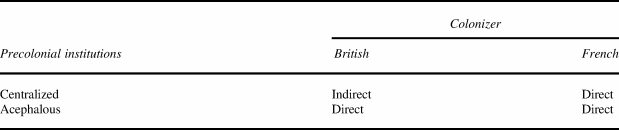
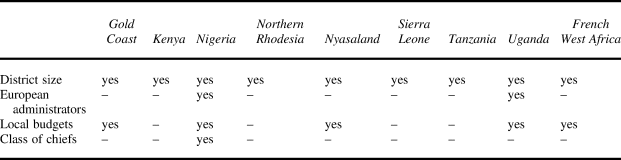
—William Ponty, governor-general of French West AfricaFootnote 35As these two quotes of French and British governor-generals in West Africa illustrate, the official stance toward indigenous authorities differed substantially between the two colonizing powers. In particular in the formative years of nonsettler colonies,Footnote 36 the French strove to establish a rather uniform system of direct rule, a system based on French, rather than pre-existing institutions.Footnote 37 In comparison, the British approach to colonial rule followed the ideal of regional and local self-government but was constrained where centralized institutions were absent.Footnote 38 Summarized in Table 1, I trace these differences back to diverging French and British administrative blueprints and ideologies, as well as to fewer administrative resources available to British colonial governments.
Expected type of colonial rule

Historical Evidence
The historiography of French colonial governance suggests that, wherever possible, the power of precolonial elites was crushed.Footnote 39 Naturally, this lead to widespread armed resistance from the most powerful polities.Footnote 40 Despite this hostility, the French colonial administration depended on native intermediaries to collect taxes, enlist forced labor, recruit soldiers, and maintain the local infrastructure. The responsible local chiefs were frequently appointed based on their loyalty to the French empire rather than their precolonial status.Footnote 41 They were stripped of their traditional authority and converted into colonial agents under the supervision of the commandants de cercle.Footnote 42 These French administrators were shuffled around often enough to remain ignorant of local languages and customs.Footnote 43 Instead, chiefs had to speak French, inhibiting the continuous functioning of indigenous institutionsFootnote 44 and furthering the standardization of local governance.
The British choice of local governance institutions was different and aimed to use local rulers’ legitimacy. The British thus collaborated with indigenous institutions, left them with much of their accustomed executive, legislative, and judiciary powers, and integrated their structure and personnel into the colonial state.Footnote 45 British district officers had a primarily consultative role vis-à-vis indigenous rulers—they encouraged self-government and provided technical assistance.Footnote 46
However, not all precolonial polities could be ruled indirectly. The degree to which British administrations could integrate traditional institutions crucially depended on their degree of precolonial centralization and pre-existing hierarchies.Footnote 47 The idea of local self-government proved practicable where the British could co-opt centralized political institutions. But where political power was decentralized and in the hands of fragmented institutions foreign to the British, they pragmatically set up new governance schemes under the direct control of the administration that connected precolonial village-level elites to the center.Footnote 48
Centralized precolonial institutions with multiple layers of hierarchies characterized the Kingdom of Buganda in Uganda,Footnote 49 the Fulani Emirates in northern Nigeria,Footnote 50 or the Ashanti confederation in the Gold Coast.Footnote 51 The colonial administration made cheap use of these institutions by letting their rulers choose between collaboration and death or exile.Footnote 52 Under this threat of violence, prior elites often cooperated and shared their rents from ruling with the British. In exchange, they were able to preserve much of their previous power and autonomy. The resulting indirect rule featured two main characteristics. First, the British deployed only a minimal amount of administrative resources—just enough to monitor the actions of local elites and collect the rents of the colonial state. Second, local elites continued to enjoy many of their accustomed powers and presided over local governance entities that encompassed much of the institutions, hierarchies, and the territory of “their” pre-existing polity.Footnote 53
Other regions lacked centralized precolonial structures but were instead ruled in a decentralized manner, for example, by village councils prevalent in the acephalous parts of southeastern Nigeria or the northern parts of Kenya and Uganda.Footnote 54 Administering such areas posed substantial problems to British administrators who tried to implement a system of indirect rule. Without institutions above the village level, it was impossible to coerce one powerful ruler to gain control over a large population and territory. To rule efficiently, the colonial state thus had to build its own administrative system to link the colonial capital via the region and district level with each village.Footnote 55
Whether staffed with colonial administrators or neo-”traditional” authorities such as the “warrant chiefs” lifted to power in southeastern Nigeria,Footnote 56 the new system amounted to direct rule. The newly installed state agents were largely independent and partly ignorant about their subjects. They came to power at the whims of the British colonial governments and did not depend on institutionalized ties to the population they ruled.Footnote 57 In effect, this led to governance constellations that were similar to those observed in the French colonies.
Two main characteristics describe the resulting mode of direct local rule. First, the British colonial government employed a substantial amount of personnel and resources to run the administrative infrastructure that linked the colonial center with local populations. Second, the low-level indigenous elites presided over native governance entities that were much smaller in territorial and substantive scope than the indigenous governance units under indirect rule.
Of course, exceptions to the French and the British approach to local colonial rule exist. The French, for example, were never successful in fully overcoming the resistance of the Mossi Empire in Upper Volta, today's Burkina Faso. They finally settled on a cooperative relationship but reserved substantive administrative and judicial powers for themselves.Footnote 58 Similar deviations from the “pure” British model marked the colonization of the Ashanti kingdom in Ghana. The kingdom was, after its violent submission in 1896 and the exile of the Asantehene, first put under direct rule. However, continuous nationalist mobilization of the Ashanti population convinced the British to allow traditional authorities to gradually resume their positions after 1919,Footnote 59 thus establishing indirect rule over the Ashanti.
Determinants of French and British Styles of Colonial Rule
Why is it then that the French chose the expensive paths of crushing precolonial polities and establishing a more direct form of rule? Or conversely, why did the British not follow a path of direct rule offering them greater powers to implement extractive colonial rule? I argue that three differences between the French and the British empires affected their relative costs and benefits of direct and indirect rule: the comparatively centralized style of metropolitan governance of the French, their transformative ideological agenda, and their greater access to administrative resources.Footnote 60
First and prominent in the literature, the administrative architecture of colonizing powers shaped the one implemented in their colonies. Here, the centralized governance characterizing the French Third Republic greatly influenced its official policies.Footnote 61 Already the military officers who conquered the French colonies established a strictly hierarchical system of administration. Assuming their role, the later civil administrators brought with them the centralizing tendencies of the French government.Footnote 62 Contradicting the French administrative blueprint, the adaptation of indirect rule would have been relatively costly to implement and might have even raised demands for local autonomy elsewhere. By contrast, Great Britain's approach to governance at the turn of the nineteenth century was more diverse, including self-rule in the settler colonies of Canada and South Africa, and solving the nineteenth-century conflict over Irish “home rule” through Southern Irish autonomy and the Northern Irish Parliament.Footnote 63 Most closely connected to the African colonies was the British use of indirect rule in India.Footnote 64 This experience of “heterogeneous contracting” between the center and peripheral unitsFootnote 65 lowered the comparative costs of British indirect rule in Africa.
The administrative blueprints transferred to the colonies also came with differing ideologies that shaped colonial rule. French officials, as committed republicans,Footnote 66 despised the existence of hereditary aristocrats whom Governor-General William Ponty scorned as “mostly nothing but parasites living on the population and existing without profit to the treasury.”Footnote 67 Based on a fundamental premise of actual or potential equality of all people,Footnote 68 the French aimed at assimilating their colonial subjects into a body of “100 million Frenchmen.”Footnote 69 This necessarily entailed the replacement of precolonial elites and institutions through methods of direct rule. The British ideological backbone of local rule placed much more emphasis on the need for preservation of cultural differences between conquerors and colonial subjects.Footnote 70 Combined with a lower aversion to traditional aristocrats, this reduced their ambitions at transforming colonial societies. Instead of being official policy, cultural transformation was “outsourced” to missionaries under the government's relatively weak control. As Gerring and colleagues note, realizing the transformative agenda of the French kind requires direct rule, whereas indirect rule empowers traditional leaders and inhibits radical change.Footnote 71
The third difference between the empires concerns the administrative resources at their disposal. We have already seen that French governments employed nine times as many European officers as their British counterparts.Footnote 72 One important reason for this divergence involves the overall size of the British colonial empire, which exceeded that of the French by an order of magnitude. In 1921, France with its 40 million inhabitants ruled over 55 million colonial subjects across the globe, while 44 million British citizens ruled over approximately 400 million colonized subjects.Footnote 73 If both empires could draw on a similarly big pool of well-educated potential colonial administrators in their metropolitan population, it comes as no surprise that French colonial administrations employed nine times more administrators per African subject than British colonial governments. This made indirect rule a pragmatic response to the lack of resources needed to establish and maintain direct control everywhere.Footnote 74
The discussion of the mode of local rule in British and French nonsettler colonies in Africa suggests two main axes of variation in the indirectness of colonial rule. First, French colonial governments were comparatively hostile toward precolonial institutions and aimed to replace them with institutions that resembled the French administrative blueprint. The less republican and more resource-constrained British colonialists in turn championed local self-governance through pre-existing institutions to complement the central colonial government in a Lugardian scheme of “dual rule.” As a result, more precolonial political institutions survived under British than French rule—the subject of this article's first empirical section. The British were not able to rule indirectly where they confronted decentralized and fragmented precolonial institutions. In such regions, they set up more direct forms of colonial rule, employing more administrative effort and devolving less power to local indigenous authorities. I analyze this dynamic in the second empirical section.
The Survival of Precolonial Institutions
To test whether French colonial rulers crushed and replaced more precolonial political institutions than British colonial governments, I exploit data on the continuation of the lines of succession in 124 colonized African polities in the nineteenth and twentieth centuries. A survival analysis of the lines of succession shows that in each year, precolonial polities’ lines of succession under French rule had a four-times higher risk of being terminated than those of polities under British rule. This difference persists in comparisons of polities across arguably arbitrary colonial borders.
Panel Data on Precolonial Polities
To analyze the survival of precolonial institutions under colonial rule, we need panel data on colonized polities. Currently used data on precolonial institutions in Africa, most prominently Murdock's Ethnographic Atlas,Footnote 75 are valuable for their detailed cross-sectional and geographical information, but lack the dimension of time. To fill this void, I digitize historical data on 124 African states before and during French and British colonial rule, collected by Stewart in his encyclopedia of African States and Rulers.Footnote 76 First published in 1989 and updated since then, the encyclopedia enlists indigenous, colonial, and postcolonial states in Africa. Each entry comes with a short account of a state's history and a detailed enumeration of its rulers and capitals.Footnote 77 In addition, Stewart lists the year of each polity's colonization, thus capturing the variation in the onset of colonial rule that resulted from colonizers’ military advances into the interior of the African continent. These data originate from a comprehensive list of sources, among them historical case studies, the Journal of African History, and encyclopediae such as the Cambridge History of Africa.
The main information used in the empirical analysis is the continuation of a polity's line of succession in each year of the colonial occupation by either the British or the French empire. These data are available because Stewart continues to enlist polities’ rulers—so they existed—throughout the colonial and postcolonial period (Figure 2). I take advantage of this coding and take the continuing line of succession in a precolonial state as a proxy for its institutional survival under colonial rule. In particular, I code the end of the line of succession in the year after which Stewart enlists no further rulers for the respective polity.Footnote 78 While the survival of institutions is not always equivalent to the survival of its personnel, the dissolution of a political dynasty is a prominent indicator for the dismantling of the institutions they presided over. This is particularly relevant for precolonial polities in Africa, most of which were traditional regimes that derived authority and legitimacy from hereditary rule and the line of succession.Footnote 79
Lines of succession in six precolonial states 1800–2000.

The states covered by StewartFootnote 80 overwhelmingly belong to the class of centralized precolonial polities. As Appendix A1.1 demonstrates, settlement areas of ethnic groups that were coded as precolonial states (acephalous societies) by Murdock,Footnote 81 feature a polity in Stewart's data in 60 percent (4%) of all cases. This is not surprising, given that Stewart was primarily interested in collecting polities’ rulers, which are hardly identifiable in acephalous societies. Furthermore, acephalous societies lack the institutions to produce traces uncovered by Stewart's sources.Footnote 82
This type of bias makes the data unsuitable for providing a representative description of all precolonial polities in Africa. However, valid inferences about differences in polities’ survival rates under British and French colonial rule are possible if the coding is not biased by the type of colonial rule. Stewart's data show few signs of such bias. A set of analyses in Appendix A1.1 suggests that Stewart did not record fewer states or much different state histories in areas and ethnic groups colonized by the British. If anything, less information on precolonial polities seems to be available from French colonies. Information likely got lost from those polities that did not survive colonization. If at all, this biases the analysis against the hypothesis, that is, toward a higher probability of survival under French rule.
Analysis
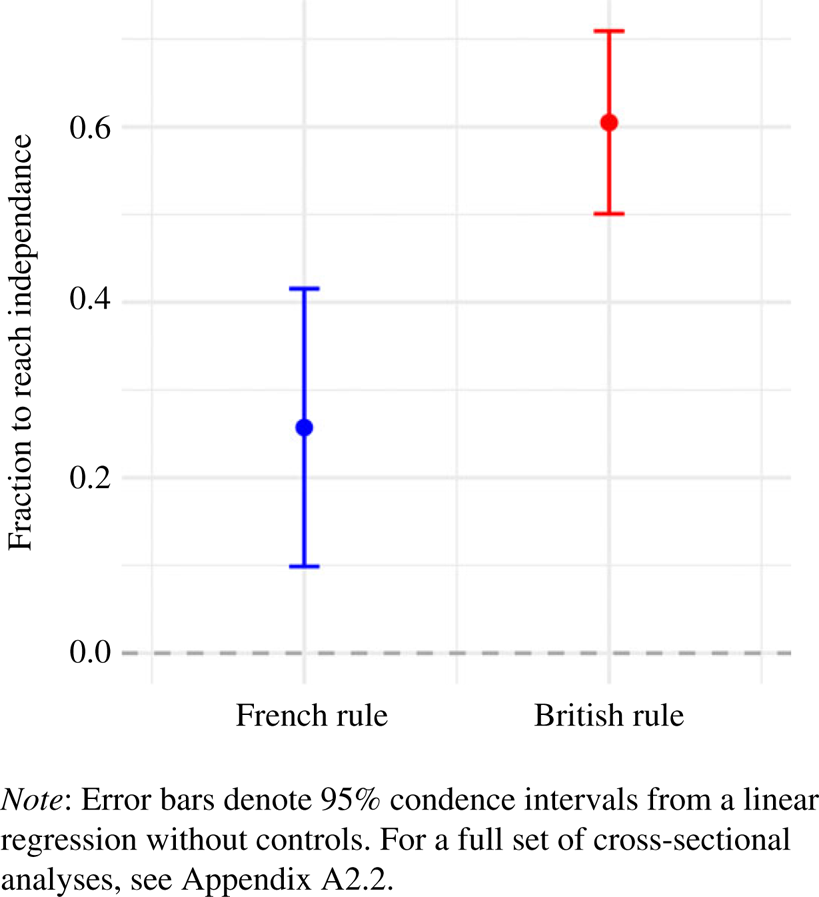
Figures 3 and 4 provide descriptive evidence for a large difference in the survival rates of polities under French and British rule. Zooming in on West Africa, we see the map in Figure 3 suggests that in French West Africa only a few polities reached independence with their local leadership intact. Those that did were mostly located in the far-away regions of Niger (Zinder) and Chad (e.g., Wadai), or were too strong to be made submissive, like the Mossi kingdoms mentioned earlier. The picture looks different for the British colonies in the same area. In the Gold Coast, all coded polities survived, though not always unscathed as the Ashanti kingdom illustrates. In Nigeria, where the nineteenth-century Fulani Jihad created a large number of emirates, fewer polities withstood colonial conquest and rule, but proportionally many more than under French rule. A simple comparison of the proportions of colonized polities that reached independence supports this impression: 26 percent of polities colonized by the French and 60 percent colonized by the British survived colonial rule, the difference being highly statistically significant (see Figure 4).
Map of all colonized polities in West Africa

Fraction of colonized lines of succession to survive until the year of independence from colonial rule

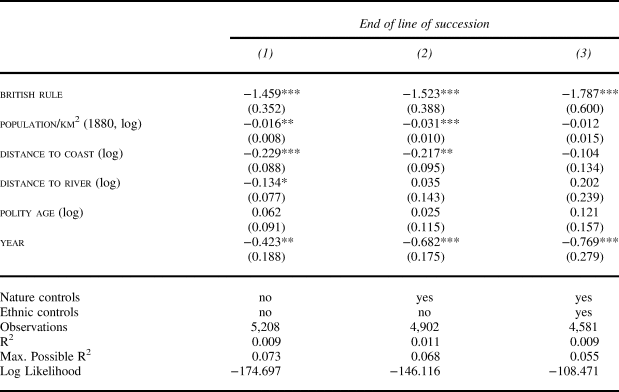
This difference remains stable once I model the end of lines of succession of all colonized polities during the colonial period in a Cox Proportional Hazard Model. Each polity enters the data set at the point of colonization by either the British or the French and leaves the data set either with the end of its line of succession or with its colony's independence. All polities included in the model are listed in Appendix Table A5 with the respective start and end years in the sample.
The Cox model includes a set of covariates geographically attributed to polities via the location of their capital. In particular, I first include a vector of (1) baseline controls comprising the local population density, the polity's age, its distance to the coast and nearest navigable river,Footnote 83 and a simple linear time trend. To control for observable differences between the regions colonized by the French and the British, I add a vector of natural characteristics around the area of a polity's capital,Footnote 84 and finally a vector of characteristics of the ethnic groupFootnote 85 in the settlement area a polity's capital is located in.
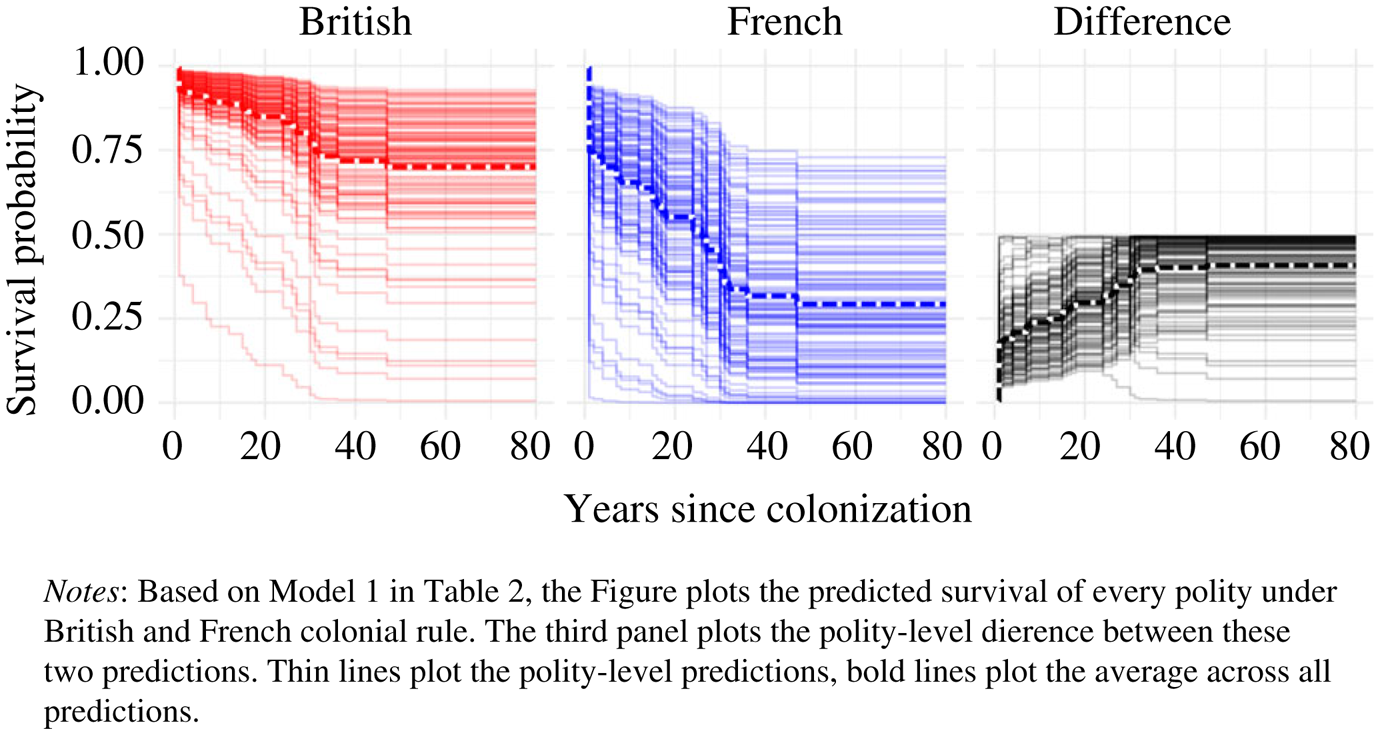
Table 2 reports the results. The transformation of the coefficients of british rule into hazard ratios shows that the lines of succession under British rule had, in every year, a probability of ending that was about a quarter of that of a polity under French rule. The gap between the empires increases in models 2 and 3 with additional controls. This suggests that, if at all, the British settled in areas with a disposition for more frequent extinctions of precolonial polities. The differential yearly hazard rate between the two empires translates into a large and increasing toll that precolonial polities took from French colonization, visualized by the survival curves in Figure 5. Because the imperial domination of the continent ended after approximately eighty years, the model predicts only one out of three polities under French rule to have survived. Under British rule the toll is also substantive but much lower with a 70 percent chance of survival, largely equivalent to the raw comparison discussed initially.
British vs. French rule and the demise of precolonial polities: Cox Proportional Hazards

Notes: Cox Proportional Hazard models. Standard errors are clustered on the polity level. Nature controls consist of median altitude and slope, mean annual temperature, precipitation and evapotranspiration, the ratio of the two, agricultural suitability, and soils’ suitability for cash crop production. Ethnic controls consist of the reliance on agriculture and pastoralism, as well as the intensity of agricultural activities. *p < .10; **p < .05; ***p < .01.
Survival curves as predicted for all polities under either British or French rule

To test the robustness of these findings, I conduct a series of sensitivity analyses in Appendix A2.1. In particular, I show that the results are not driven by (1) a potentially overwhelming weight of some colonies (e.g., Nigeria with its many Fulani emirates) by giving each colony equal weight; (2) differential temporal dynamics of the French and British colonization by stratifying the regressions by year; (3) the local disease environment; (4) miss-specified clustering of standard errors, clustering instead not at all, on the colony, and ethnic group level; or (5) the chosen functional form of the models, instead using a simple linear hazard model. (6) The results are mostly robust to dropping observations of single colonies with the exception of dropping Nigeria in the fully specified model, where point estimates remain stable but standard errors increase. A final analysis (7) focuses on the effect of British and French colonial rule on the average tenure time of rulers compared to tenure times before colonization in the same polity. The effect associated with French colonization on the yearly risk of a ruler's deposition or death is 1.5 times the effect associated with British colonization (see Appendix A2.4).
Polities’ survival in (coastal) West Africa
So far, the main identifying assumption of the model is that colonization by either the French or the British was, conditional on covariates, as if random. This assumption may be difficult to uphold in the face of colonies’ diversity in East and West Africa. A series of further analyses in Appendix A2.5 therefore successively limits the sample of compared polities to ever-smaller and homogeneous regions, first polities in West Africa and second to those in the coastal colonies in West Africa only. Figure 6 shows the results which are well in line with the baseline estimates plotted to the left.
Marginal effect of British rule on the end of polities’ line of succession in West Africa

Finally, I follow recent studies that use colonial borders for identification purposesFootnote 86 and estimate the effect of British rule across arguably arbitrary borders in West Africa that run perpendicular to the coastline.Footnote 87 These borders were drawn in the aftermath of the quick scrambling for territory after 1885 when colonial armies moved from the coast to the interior parts of the continent, which explains their location and their approximate ninety-degree angle to the coast.Footnote 88 Like many other colonial borders in Africa, the respective borders followed no historical precedentFootnote 89 and cut through ethnic groups and political entities.Footnote 90 While they were in some places adjusted by a few kilometers,Footnote 91 there is no historical evidence that precolonial capitals selected into or out of British rule.
Because the spatial sparseness and clustering of precolonial capitals (see Figure 3) inhibits the estimation of a regression discontinuity at the border, I use the full sample of polities from the coastal West African colonies and estimate a Cox Proportional Hazard Model that is stratified by each polity's closest perpendicular empire border. Similar to border fixed effects, this ensures that we compare only polities across these borders. This last analysis yields estimates of the effect of British rule that are larger than the one reported at baseline. With the smaller sample and border strata reducing the degrees of freedom, p-values of the estimate of British rule drop to p < .1 and the size of the coefficient increases substantively as I add the vectors of control variables. These patterns support the baseline results.
The unique data from Stewart's encyclopedia of African states and rulersFootnote 92 show that precolonial polities’ demise was much more frequent under French than under British colonial rule. This result supports the argument that the French ruled more directly and against pre-existing institutions than the British, who favored local self-government through traditional institutions. However, the focus on the survival of centralized polities masks variation in the schemes of colonial governance set up in regions with and those without such pre-existing institutions.
Precolonial Institutions and Indirect Rule
As the theoretical discussion outlined, there are two observable facets to indirect rule: the colonial power's administrative effort and local traditional institutions’ power. The more local indirect rule is, the less administrative effort the central government employs to an area and the more power remains in the hands of local governments that are built upon pre-existing institutions. To provide evidence on indirect rule as complete and systematic as the available data allow, I shed light on both dimensions. All data (see Table 3) come from archival administrative reports from eight British colonies, chosen as a function of the respective data's availability and excluding the settler colonies in Southern Africa and from Huillery for French West Africa.Footnote 93 Appendix A1.2 lists additional details on the sources and coverage of the data.
Data on the indirectness of colonial rule: Overview

The first dimension of indirect rule concerns the local administrative effort employed by the colonizing government. More indirect rule comes with less administrative effort, measured in two ways:
1. Size of districts. This is the simple area of districts, net of water surface (N GB = 294; N F = 114). Each district needs a minimal level of administrative resources, most importantly a district officer or commandant de cercle. Thus, dividing a region into more and thus smaller districts requires more administrative resources. Furthermore, smaller districts come with a lower distance between headquarters and the population.Footnote 94 Given the importance of administrative tours,Footnote 95 this implies more frequent visits to any village and more direct rule.
2. European administrators. This measure draws on data on the number of British administrators employed at the local level. Unfortunately, such district-level officer lists are scarce, so the sample is reduced to Nigerian provinces and districts in Uganda (N = 35). More immediately capturing the previous point, more indirect rule comes with fewer colonial officers posted to an area.
Two measures cover the flipside of indirect rule, the power of the traditional institutions through which schemes of indirect rule were carried out: native treasury budgets and Nigerian chiefs’ power.
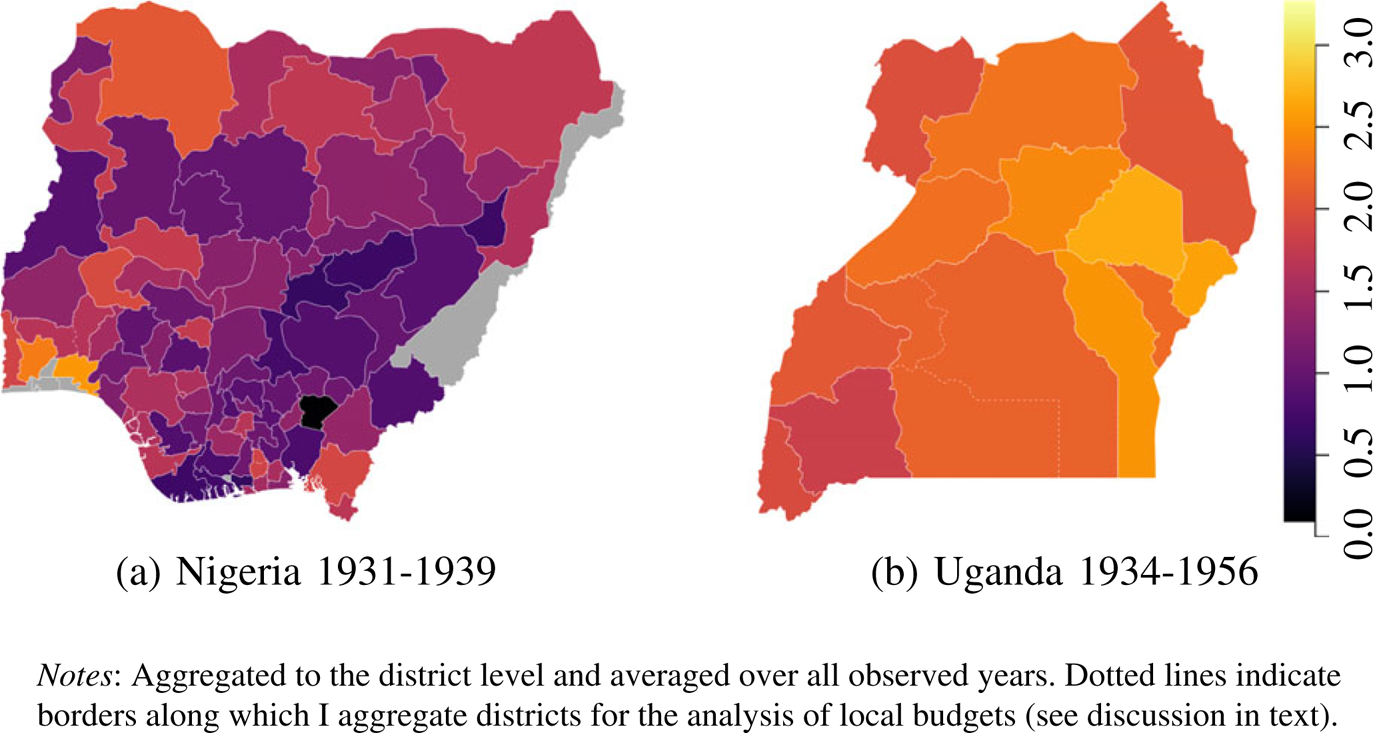
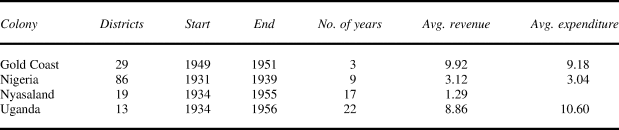
1. Native treasury budgets. As I argued ealier, British colonial governments co-opted strong and hierarchical institutions because they generated rents in a centralized manner and allowed for relatively cheap top-down policy implementation. Thus, indirectly ruled areas should feature native treasuries with larger budgets, both on the revenue and expenditure side. The respective data come from the British “Annual Departmental Reports” for the Gold Coast (Ghana), Nigeria, Nyasaland (Malawi), and Uganda (1931–1956).Footnote 96 The reports include budget totals as well as detailed breakdowns of revenues and expenditures into subcategories (see Appendix A4.1).
In total, the collected data cover native treasuries in 148 districts across the four colonies and a varying number of years.Footnote 97 To avoid biases emerging from an unbalanced panel,Footnote 98 I link native treasuries to the colonial districts introduced earlier and average the budget data for each district across all years (see Figure 7).Footnote 99 If a budget in one year covers more than one district (e.g., the budget of the Kabaka of Buganda, which covered an entire region), I aggregate the data to the highest spatial “denominator” in all years, again for reasons of spatio-temporal consistency.
2. The power of Nigerian chiefs. The second indicator of the power in the hands of local authorities consists of the rights and recognition chiefs received in Nigeria, measured through their official “class.” “First class” chiefs possessed the greatest powers and authority over subsidiary chiefs. “Third class” chiefs had a limited realm in terms of the population they ruled and the rights they enjoyed.Footnote 100 Based on a list compiled by the British War Office in 1929,Footnote 101 the class of the highest-ranking chief in each district serves as an indicator for indigenous institutions’ power and thus local indirect rule.
While the data encode diverse aspects of local colonial governance, the four outcomes correlate with each other (correlation coefficient of between .38 and .65; see Appendix A1.4). For example, larger districts feature fewer European administrators per capita, more revenues by native treasuries, and their chiefs have more power. This suggests that the ensemble of all four indicators comprehensively measures the indirectness of local colonial rule.
Per-capita revenues of native treasuries (logged; 2016 £)

Summary of native treasury data

Note: The number of observations in the data might be smaller than the number of existing districts because some budget reports report numbers above the district level (e.g., Buganda, Uganda).
Precolonial institutions
To test the argument that the local level of precolonial political centralization determined the degree of indirect colonial rule, detailed cross-sectional data of the degree of centralization of local institutions at the time of the colonial conquest are needed. The best source for such data is the Ethnographic Atlas compiled by Murdock.Footnote 102 Based on early ethnographic research, the atlas classifies the levels of administrative hierarchies of ethnic groups’ precolonial political institutions. The coding ranges from 0 to 4 levels, from no political authority beyond the community, via petty chiefdoms and larger chiefdoms, to states and large states. Using the spatial information from Murdock's ethnic map,Footnote 103 the average precolonial centralization of each district's area measures the number of administrative levels that could be used for indirect rule by the colonial power.
With this coding of hierarchical levels, the data are better able to capture the ease with which different political systems could be ruled indirectly than other data sets, such as maps of state historiesFootnote 104 or Stewart's encyclopedic data of precolonial polities and their rulers.Footnote 105 Stewart's data come with the additional disadvantage that only the coordinates of polities’ capitals but not their borders are known. This makes their attribution to relatively small spatial units such as districts subject to large errors where precolonial states were carved up into multiple districts subject to an overarching native authority. Furthermore, his data are likely incomplete—only 60 percent of groups coded by Murdock as a large precolonial state feature a polity in Stewart's data in 1885. However, I check the consistency of the results with Steward's data later.
Empirical Strategy
With this data on district-level colonial and traditional rule at hand, I estimate the effect of precolonial centralization on the various indicators of indirect rule in a simple linear modeling framework:
 $${\rm y}_{i\comma p\comma c} = \alpha _c + \beta _1 { \smallcaps precol}{\smallcaps .centralization}_i + {\rm X}_1{\rm \Lambda }_i + {\rm X}_2{\rm \Omega }_i + {\rm X}_3{\rm \Psi }_i + {\rm \epsilon }_{i\comma p}$$
In particular, I reduce the variation in precol.centralizationi exploited by each model to within-colony variation by using colony-fixed effects α c. In specifications that compare patterns of indirect rule in British and French colonies, the models include the interaction term precol.centralizationi × frenchc. In these cases, I do not add the constitutive term frenchc, which is redundant given the colony fixed effects α c. Since precolonial centralization is not randomly assigned to districts i, I successively include three vectors of control. First, vector Λi captures only the baseline characteristics of a district: the average spatial density of the population of the district and the ethnic groups that inhabit it,Footnote 106 as well as a district's’ distance from the coast and closest navigable river, all logged.Footnote 107 Second, Ωi controls for what I call the “natural” attributes of a district: its altitude, ruggedness, temperature, average precipitation, evapotranspiration, the ratio of its evapotranspiration and its precipitation, as well as its suitability for cash-crop productionFootnote 108 and agriculture in general.Footnote 109 Third, I add an “ethnic” vector of controls Ψi for the socioeconomic characteristics of districts that might cause strong local governments and precolonial centralization. These are local ethnic groups’ reliance on agriculture and pastoralism as well as the intensity of their agricultural activities.Footnote 110 I aggregate these variables to the district level by taking their area-weighted means. French-British models include interactions of all controls with a French dummy. Last, standard errors are clustered on the provincial, thus first-level administrative unit level p to account for potential dependencies among districts in the same region.
Results
The presentation of the results follows the structure of the data. A first set of analyses finds that administrative effort, measured through the size of districts and the local number of British administrators, decreases in the centralization of precolonial institutions. A second set of analyses completes the picture and shows that the power of indigenous or “native” administrations increases in the level of precolonial centralization. While these relationships are overall robust for British colonies, the data from French colonies exhibit no significant or even opposite associations. Together, the results support the argument that precolonial centralization was a strong determinant of indirect rule in the British, but not French colonies.
Evidence on Administrative Effort
The size of districts
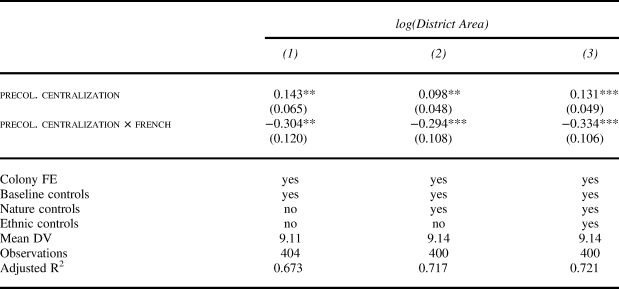
Districts were larger in areas with strong precolonial institutions in British but not in French colonies. The estimated effect of precolonial centralization on the size of British districts is substantial: a move from an acephalous society to a precolonial state, that is, an increase in the value of precol. centralization by 3, is associated with an increase in the size of districts by between 35 and 54 percent (Table 5). The reverse relationship appears in French West Africa, where the data suggest that an increase in the level of precolonial centralization by the same three levels decreased districts’ size by about 45 percent (Figure 8).Footnote 111 Because larger districts correspond to lower levels of administrative effort that the colonizers exerted, this is evidence that centralized pre-existing institutions facilitated British indirect rule.
Precolonial centralization and the size of districts

Notes: OLS models. Standard errors are clustered on the province level. Baseline controls include the local population density, ethnic groups’ population density, and the distance to the coast as well as the closest navigable river. Nature controls consist of the local altitude and slope, mean annual temperature, precipitation and evapotranspiration, the ratio of the two, agricultural suitability, and soils’ suitability for cash crop production. Ethnic controls are the reliance on agriculture and pastoralism, as well as the intensity of agricultural activities. Additionally, all covariates are interacted with “French rule.”
*p < .10; **p < .05; ***p < .01.
Marginal effect of precolonial centralization on district size

This relationship between indirect colonial rule and the size of local governance units remains robust to a number of permutations of the model. A set of sensitivity analyses yields that the results are (1) not driven by very big or very small districts, (2) not due to a potential overweighting of colonies with many districts such as Nigeria, and (3) robust to including a vector of co-variates that control for the disease environment of a district, which might relate to precolonial statehood and colonial administrative difficulties. The results are robust to a colony-level jackknife, and consistent if I use the slightly different coding of precolonial centralizationFootnote 112 or the newly collected data on precolonial polities as a measure of precolonial centralization. Districts that featured a capital city in 1885 were approximately 65 percent bigger in British colonies, but of average size in French colonies.
Imbalances in observables suggest that the divergence of precolonial centralization's effects in British and French colonies might be driven by endogenous colonization choices of both empires. To address this caveat, I exploit borders between Nigeria and Dahomey (Benin) as well as between Côte d'Ivoire and the Gold Coast (Ghana) that run perpendicular to the West African coastline. The borders’ location was determined by the post-1885 race toward the interior of the continent and can therefore be regarded as drawn in a quasi-random manner.Footnote 113
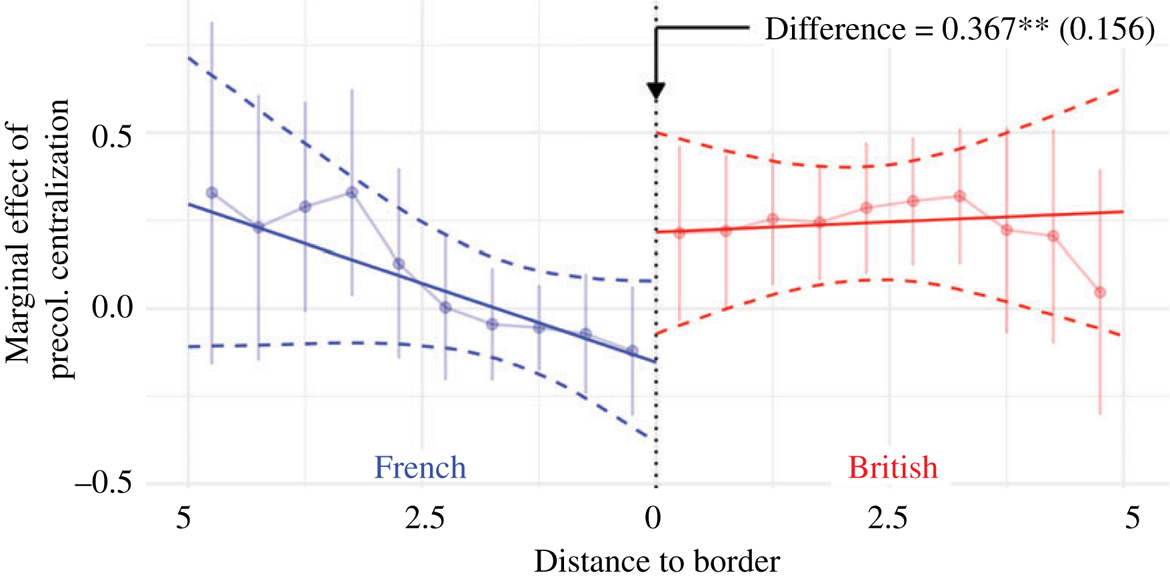
Fully presented in Appendix A3.3, the regression discontinuity design identifies the difference in the effect of pre-existing institutions on districts’ sizes at the French-British borders. Using grid cells within a bandwidth of five decimal degrees as the unit of analysisFootnote 114 and improving but not fully securing balance on pre-treatment covariates (see Table A18),Footnote 115 the analysis supports the conclusion drawn from the baseline model. As Figure 9 illustrates, the estimated difference is statistically significant (p < .05) and shows that precolonial centralization had an effect on district sizes .37 log-points smaller in French than in British colonies.Footnote 116
Regression discontinuity plot of the effect of precolonial centralization on districts’ size at French-British borders perpendicular to the West African coastline

I test this result's robustness with additional control variables to counter the remaining imbalances in the data, using various grid-cell sizes, and dropping cells close to the border to account for potentially endogenous local border adjustments mentioned by Griffiths.Footnote 117 These variations do not significantly affect the results. Varying the bandwidth, the baseline results are statistically insignificant below a cutoff of 1.5 decimal degrees to the border and are stable at larger cutoffs. In sum, the analysis shows that potentially endogenous spatial sorting of colonizers does not explain the patterns of indirect rule observed in the French and British colonies.
European administrators
In addition to district sizes, I draw on data on British administrators’ spatial distribution to measure the extent of indirect rule. Because such data are less abundant, I have access to the number of British administrators in only the twenty-two Nigerian provinces and twelve Ugandan districts. The data support the argument. For example, the large Kano Province in northern Nigeria, a well-institutionalized precolonial emirate with 2.3 million inhabitants, was ruled by only fourteen British administrators in 1927. In comparison, Ogoja's .6 million inhabitants in the acephalous southeastern part of the colony were governed by twenty-one administrators. A simple linear model yields a very similar association (Appendix A3.4, Table A21). An increase in the political centralization of a province/district by one level is associated with a decrease of about three British administrators per million inhabitants (p < .05). While adding only the vector of ethnic co-variates does not change this result, adding the vector of eight “nature” controls decreases the size of the coefficient and turns it insignificant. Although this is reason for concern, this might well be a result of the very small sample size. None of the additional covariates is associated with a statistically significant effect or increases the fit of the model. I take these results as corroborating the earlier finding that strong precolonial institutions facilitated British indirect rule and allowed them to exert less administrative effort.
Evidence on the Devolution of Power
After highlighting the negative relationship between precolonial centralization and local administrative effort by British but not French colonial governments, the next set of analyses focuses on the second facet of indirect rule: the power of indigenous authorities. In line with my discussion of historical evidence, I expect that indirect British rule came with more devolution of power to local authorities where these could build on centralized precolonial institutions. To probe this argument, I analyze the size of native treasuries budgets in four British colonies as well as data on local administrative finances in French West Africa from HuilleryFootnote 118 and the status of chiefs in Nigeria. I expect centralized areas to feature larger budgets and more powerful chiefs, both taken as proxies for indirect rule.
Native treasuries’ budgets
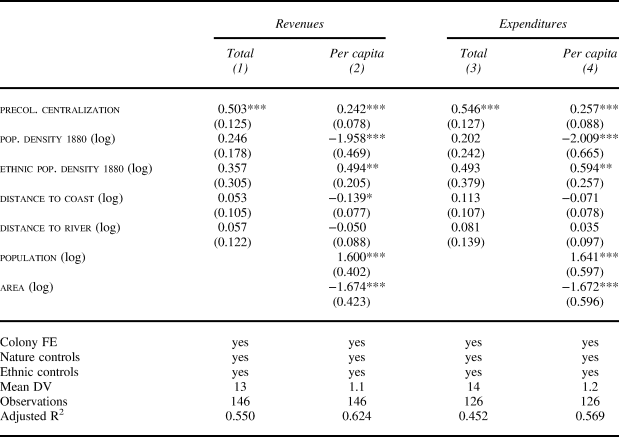
I estimate the effect of precolonial centralization on the revenues and expenditures of native treasuries under British rule in a cross-sectional manner. Because the previous analysis suggests that large districts are a consequence of precolonial centralization, the following considers the absolute and per capita size of native treasuries separately. The first set of regressions includes the full set of controls and takes absolute budget values as outcomes. The second set uses per capita budget values as outcomes and additionally controls for districts’ logged population and size.
In line with the expectation of greater powers devolved to indirectly ruled precolonial states, they are associated with much larger native treasuries, in absolute and per capita terms. An increase in the precolonial level of political hierarchy by one level—moving from an acephalous society to petty chiefdoms, or from a large chiefdom to a state—is associated with an increase of total budgets by between 65 and 73 percent and of per capita revenues and expenditures by around 28 percent (Table 6).Footnote 119 The respective coefficients are precisely estimated and consistent across the revenue and expenditure sides of local budgets.Footnote 120 The results show that native authorities in British colonies presided over larger, more powerful, and more effective local governments where they could rule indirectly through pre-existing, centralized institutions.
Native treasuries under British rule: Per capita revenues and expenditures (logged 2016 £)

Notes: OLS models. Standard errors are clustered on the province level. The sample includes the colonies of the Gold Coast (Ghana), Nigeria, Nyasaland (Malawi), and Uganda. Nature controls consist of median altitude and slope, mean annual temperature, precipitation and evapotranspiration, the ratio of the two, agricultural suitability, and soils' suitability for cash crop production. Ethnic controls include the reliance on agriculture and pastoralism, as well as the intensity of agricultural activities. *p <.10; **p <.05; ***p <.01.
I conduct a series of robustness checks, fully reported in Appendix A4.1. Following the previous analysis, I test whether the disease environment, the unequal weight of colonies, or outliers bias the results. Furthermore, I report alternative specifications of the model that do more justice to the panel character of the original budget data, moving from the cross-sectional analysis to a district-weighted panel and hierarchical models. The estimated association between revenues per capita and precolonial centralization remains stable in size and statistical significance. I also re-estimate the main model using the alternative measures of precolonial centralizationFootnote 121 and a dummy for districts that feature a capital of a precolonial polity in 1885. Districts with a capital in 1885 exhibit larger budgets, but not on a per capita basis. Although I speculate, this might be indicative of indirect rule's differential effectiveness in rural and urban(izing) areas that developed around the old centers of society. I also disaggregate the analysis into the main revenue and expenditure lines of the budgets. The findings are prevalent across almost all budget items. Finally, a colony-level jackknife analysis reveals that the results are mainly driven by observations of Nigerian local budgets, which numerically dominate the sample (see Table 4).
To explore whether similar or opposite dynamics marked district finances in French colonies, I make use of Huillery's data on tax collection, public investments, and service provision in 109 French West African cercles.Footnote 122 The results in Appendix A4.3 suggest that precolonial centralization had no significant effect on tax collections in French West Africa, but a negative effect on investments and spending on teachers and doctors. In per capita terms, only the number of doctors is significantly lower in centralized districts than elsewhere; all other indicators yield statistically insignificant results. Although in itself not fully conclusive, these insignificant but negative associations provide a foil to compare the results from the British colonies against. This comparison increases the confidence that the positive association between precolonial institutions and native treasuries’ resources in British colonies are indeed due to indirect rule over precolonially centralized polities.
The power of chiefs
The analysis of British native treasuries consistently shows that native administrations had more financial resources at their disposal if they were located in areas with high degrees of precolonial centralization. However, chiefs in centralized and decentralized areas might have enjoyed the same status, with the former being able to more effectively use their powers. An analysis of the highest class of chiefs in Nigerian districts shows that this doubt is unfounded (Table A28). Precolonial centralization correlates strongly with the class of chiefs. Districts in the territory of precolonial kingdoms featured many more “first class” chiefs than acephalous areas, which were most often headed by “third class” chiefs.
This pattern of greater powers remaining in the hands of chiefs who could build on precolonial institutions in Nigeria completes the picture of the second analytical part of this study. Drawing on data on districts’ sizes, British administrators, native treasuries, and the power of local chiefs, the analyses provide consistent evidence that the British devolved more power to indigenous elites where centralized precolonial institutions offered readily usable structures for indirect rule. This dynamic is not apparent in data from the French colonies where, as we have seen, direct rule came with the frequent demise and downfall of precolonial polities.
Conclusion
Following up on the decades-old debate on indirect rule, in this article I have brought forward systematic empirical evidence on variation in the application of indirect rule between the French and the British empire and within British and French colonies in Africa. I argue that the French have ruled more directly and against rather than through precolonial institutions. In comparison, the British ideal of indirect rule and local self-government could be most effectively realized in areas that featured centralized precolonial institutions. Elsewhere, in particular in acephalous societies, the British established more direct rule to bridge the gap between the colonizers and the population.
The systematic evidence presented here supports both arguments. First, French rule was hostile toward precolonial polities to a degree that about 70 percent of all colonized polities ceased to exist before independence. In British colonies, this figure amounts to about 30 percent. Second, where strong precolonial institutions prevailed and the British ruled, districts were 35 to 54 percent larger than in areas settled by acephalous societies. They were by the same amount smaller where the French ruled. Within British colonies, equivalent differences are apparent in the size of native administrations’ budgets, both in absolute and per capita terms. I interpret larger districts and budgets of local native administrations as proxies for local indirect rule. These patterns thus strongly support the argument that indirect rule was implemented where pre-existing institutions could be co-opted by the colonial state.
These results have consequences for research on the establishment of political hierarchies in comparative politics and international relations. For one, I find that indirect rule through cooptation crucially depends on the political centralization and capabilities of the polity to be subordinated. In the international realm, it may therefore come as no surprise that the United States could outsource, for example, the “war on terror” to some states, but saw the need for relatively and increasing direct involvement in post-2001 Afghanistan where the central government was too weak to act as a reliable proxy.Footnote 123 For another, I identify differences in the indirectness of rule that can only be explained by the characteristics of the colonizing empires. This raises the expectation that different actors follow diverging strategies of dominance over subordinates, dictated by their internal power structure, ideological preferences, or limitations in their powers to coerce. This may be relevant to understand rather direct rule over the Eastern Bloc implemented by the ideologically more transformative and geographically closer USSR compared to the relation of the United States to Western Europe.Footnote 124
My findings also bear important implications for understanding political development in Africa. Contrary to a deterministic view that “there is often nothing new out of Africa,”Footnote 125 the evidence shows that local governance institutions were shaped by colonialism, but not in a uniform manner. The diversity of colonial experiencesFootnote 126 interacted with the local precolonial past in shaping colonial and postcolonial socio-political development. Arguments that neglect this heterogeneity by positing direct links between the (pre-)colonial past and the present might thus, in some cases, overly compress history.Footnote 127
In particular, variation in indirect rule between and within colonial empires likely affects states’ treatment of traditional authorities until today. What effects does colonial indirect rule have, for example, on postcolonial local governance,Footnote 128 ethnic politics and conflict,Footnote 129 traditional institutions,Footnote 130 and land rights?Footnote 131 Since indirect rule still belongs to the repertoires of states today and chiefs act as brokersFootnote 132 and auxiliariesFootnote 133 of politicians and the state, better evidence on its short- and long-term effects on local and national politics is of considerable value.
Finally, in this article I show that European imperialism came with a variety of local governance arrangements, posing questions on the effects they had on the local population. What was the impact of direct and indirect rule on the lives and livelihoods of the millions colonized and ruled by either district officers, traditional rulers, or warrant chiefs? How did the style of local rule affect the level of violence, destruction, and extraction committed by the European empires and their local intermediaries? The present characterization and measurement of indirect colonial rule may offer a useful starting point for answering such questions.
Data Availability
Replication files for this article may be found at <https://doi.org/10.7910/DVN/5DX7DP>.
Supplementary Material
Supplementary material for this article is available at <https://doi.org/10.1017/S0020818320000211>.
Acknowledgments
I thank the editor Erik Voeten, two anonymous reviewers, Robert Bates, Lars-Erik Cederman, Lauren Honig, Simon Hug, Philipp Hunziker, Horacio Larreguy, Emmy Lindstam, Yannick Pengl, Thomas Sattler, as well as participants in seminars at Harvard University and ETH Zurich, the APSA Annual Meeting 2018, and the SPSA Conference 2018 for helpful discussions, comments, and suggestions.
Funding
This research was supported by the Swiss National Science Foundation under grant P0EZP1_165233.